Language Learning in the 21st Century: Part III – Chinese As the Language of the Future

By Michael Hurwitz

[Note: This series is being brought to you by ETCJ associate editor Lynn Zimmerman. See Part I: “Technology Is a Game Changer” and Part II: “Technology Makes English the Global Language.” -Editor]

It’s an oft-discussed topic in the media that Chinese, specifically the Mandarin Chinese form that has become the official language of Mainland China, is the “language of the future.” This might sound a bit odd because Chinese is in fact one of the oldest languages in the world, but it’s pretty irrefutable that it’s also one of the fastest-rising languages in terms of global prominence. Learning to speak, read and write Chinese is becoming increasingly popular around the world, but as such an old and unusual language, Chinese presents a lot of problems for learners. Technology, however, is beginning to alleviate this on many fronts.

Chinese is a unique language and can be very difficult for Westerners who are native Romance or Germanic language speakers. Even Japanese speakers, whose native language has a lot in common with Mandarin (including some characters), can struggle mightily with learning it. That’s part of why it helps to approach Mandarin more methodically and tactically than one might a language that’s closer to their native tongue. For instance, while exposure and listening practice are still very important, it’s much more difficult to simply “pick up” Chinese than it would be to pick up Spanish for, say, a native English or French speaker. Much of this has to do with Mandarin’s tonal nature, with different pronunciations of the same syllable taking on (often wildly) different meanings. Without careful instruction and practice in differentiating the five tones, it’s tough to get going in the learning process. This hurdle is especially problematic for adult learners not only because they’ve spent decades in non-tonal or semi-tonal language environments but because they often don’t have the big blocks of time necessary to devote to language learning.

Continue reading

The Short Shelf Life of Digital Textbooks

By Samantha Peters

Digital textbooks are all the rage these days as students and school districts clamor to get the iPad, download and fill it with $15 textbooks, and rid themselves of the heavy traditional versions once and for all. But digital textbooks are not the present – or even the future – of education. Here’s why:

1. School districts still save money by using textbooks.

Yes, digital textbooks are far cheaper than the physical variety. But various other costs – chief among them the price of an iPad and the need to periodically repurchase digital versions – drive the digital price far higher. One study found that an average school would spend $215 per student per year when following a digital textbook strategy. This compares with a far lower cost of $90 per student when only traditional textbooks are used. Although some schools with sufficient resources will surely still jump at the chance to make backpacks lighter and lessons more interactive, the significant costs associated with a digital program will prevent most districts from following this course.

Continue reading

iFacilitate 2012 Online Workshop: First Two Weeks

Jim ShimabukuroBy Jim Shimabukuro
Editor

(Note: This is the first of two reports on the iFacilitate 2012 online workshop. I participated as a student and opted for the certificate option to make sure that I stayed the course. I created a temporary blog for the coursework, and the excerpts below link to posts in that blog. Click here to see the second report. -js)

In early February, when I found an invitation from Greg Walker, Leeward Community College (University of Hawaii System) Distance Education Coordinator, in my emailbox, I decided to go for it. Some of my ETCJ colleagues have written about their MOOCing experiences, and I wanted to see, firsthand, what it was like. In the following weeks, I’ll be sharing some observations and comments that I’m posting in my workshop blog.

The invitation was for a five-week online faculty workshop, iFacilitate:

Aloha mai e. Are you an adventurous “life long learner” who is interested in experiencing the future of online learning? iFacilitate is …. FREE and open. It does not consist of a body of content you are supposed to remember. Rather, the learning in the course results from the activities you undertake, and will be different for each person. In addition, this course is …. distributed across the web….Your active participation in this workshop will help you to acquire the skills needed to function in this type of course. iFacilitate is a 5 week open workshop [beginning 2.27.12] that introduces a variety of facilitation skills to help participants engage learners across a range of conversational spaces, including online discussion forums, web conferencing rooms, and wikis and blogs. This workshop explores building online learning communities and communities of practice …. Online learning communities develop through interaction among participants. Participation is open to everyone …. Your level of participation is up to you. [One of the options is a letter of completion.]

My First ‘Week 1 Online Learning Communities’ Post

Feb. 27 – I haven’t done the readings yet, but here are some preliminary thoughts and concerns. I’ve found that both a challenge and an advantage is the openness of online learning communities. In other words, as a teacher, I can’t and shouldn’t want to control the networks that students naturally create with classmates — individually and in small groups — as well as with me and course spaces I’ve created. In the students’ personal  [click here to read the rest of the post]

Continue reading

On SITE 2012 in Austin: So What Is Digital Citizenship?

Report from SITE2012 AACE in Austin, Texas.

Social Justice and Digital Equity SIG has, with Mike Searson, created a project in Digital Citizenship that is funded by Facebook. We will hold our first meeting tomorrow to iron out details. We are at the SITE.org Conference in Austin, Texas.

Digital Citizenship is a concept which helps teachers, technology leaders and parents understand what students/children/technology users should know to use technology appropriately. Digital Citizenship is more than just a teaching tool; it is a way to prepare students/technology users for a society full of technology. Too often we are seeing students as well as adults misusing and abusing technology but aren’t not sure what we can do. The issue is more than what the users do not know but what is considered appropriate technology usage.

You have probably heard about the parent who shot his child’s computer. There was an interview with the student and parent on NBC to explore the incident.

Continue reading

Twitter for Professional Use – Part 3: Curating the Chaos

By Melissa A. Venable

[Note: ETCJ’s Twitter editor, Jessica Knott, has been working with Melissa to develop this series. See Part 1: Getting Started, Part 2: Channeling the Streams, and Part 4: Participating in a Live Event. -Editor]

In part one of this series we covered many of the fundamental tasks of Twitter, and in part two we addresed basic techniques and workflow management. As you gain more experience with Twitter and grow more confortable using it as a platform for sharing and conversation, you may find you need better organization techniques and more advanced tools. Dashboard applications present linear, chronological streams. If you prefer a more reader-friendly format in terms of information browsing, you should consider other options.

Reader-Friendly Formats

Paper.li, Zite, Twylah, Summify, and The Tweeted Times are all applications with easy to read interfaces featuring the most popular items of the day, as shared by members of your social network. These tools aggregate links in one place, display images, and categorize the information for easy scanning.

Establishing an account includes opening a link to your Twitter feed (or other social media account, as applicable) and configuring the customization options in terms of categories, keywords, screen layout, color, etc. The result is a custom user interface crafted to your specifications. You’ll find headlines, article snippets or previews, links, and navigation menus that cycle through periodic updates (e.g., every 24 hours).

Continue reading

A Radical Rethinking of What Learning Can Be

Frank B. WithrowBy Frank B. Withrow

Our technology has led the way to thinking of new and efficient ways to distribute videos and computer learning experiences. The entertainment fields with programs such as NetFlix have set the stage for a new format for marketing learning resources. The streaming of video or transmedia distribution can make thousands of lessons available to learners when needed. For an inexpensive monthly service fee, we can make vast libraries of lessons universally available in the home, the library, the classroom and the workplace.

While we are in an economic slow down, we are at the same time faced with the most productively efficient period of American industry. With a high rate of unemployment we are faced with increased individual productivity based upon technical applications of digital technologies. The retooling of the auto industry is an example of this increased efficiency. We are manufacturing better and more efficient automobiles with fewer people and more computer driven machines than ever before.This is true not only in the auto industry but in many manufacturing industries. As new and more complicated machines come on line, we need fewer but smarter workers.

Continue reading

The Huge Void in Quality Multiple Media Programs for Upper Grade Levels

Frank B. WithrowBy Frank B. Withrow

[Note: Dr. Withrow was the Director of Educational Programs for the NASA Classroom of the Future from 1996 to 1998. He served in the U.S. Department of Education from 1966 to 1992 as the Senior Learning Technologist. In the USDE, he was the program manager for the development of Sesame Street and also supported some work on Mister Roger’s Neighborhood. Click here for a brief bio. -Editor]

From the late 1960s until the Reagan Administration, the U.S. Department of Education invested $150 million in children’s television series. Half of this investment was for general television, such as Sesame Street, and half for ESSA television. ESSA TV was devoted to emphasizing Hispanic, Afro-American Asian American, Franco American and Indian American heritages. These efforts funded fifty-four series from Sesame Street to The Voyages of the Mimi. They were not limited to PBS carriage but most were aired on PBS. No commercials were possible when they were broadcast. Sesame Street has become a worldwide early childhood success and is coproduced in many countries and in many languages.

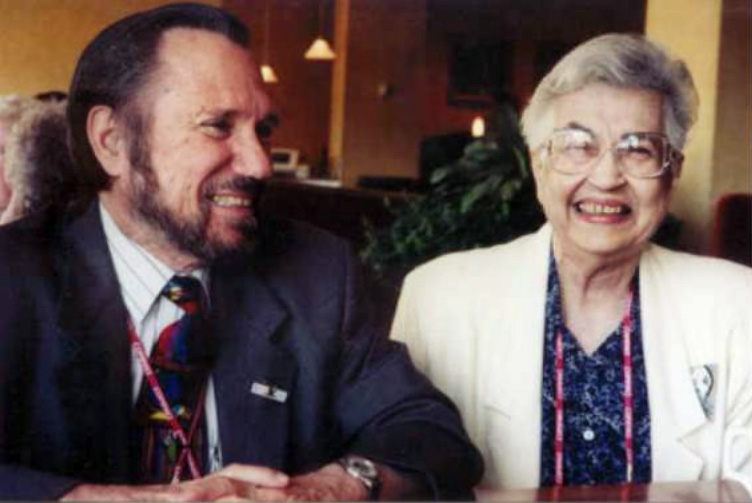
Frank and his wife, the late Margaret Schram Withrow

There was a concerted campaign against ESSA TV by talk radio hosts claiming that Social Security was in danger because of these minority-based programs. Sixty Minutes ran a segment on “Hollywood on the Potomac,” which featured World War II training films but was used to kill USDE television programs. Since most of the productions were multi-year contracts rather than grants, we were able to finish the work that had been started, but Congress at the urging of the Reagan Administration killed the programs. The third season of The Voyage of the Mimi, which was to be a trip down the Mississippi, was canceled, but we were allowed to finish the second season.

Continue reading