





By Jim Shimabukuro (assisted by Claude)
Editor
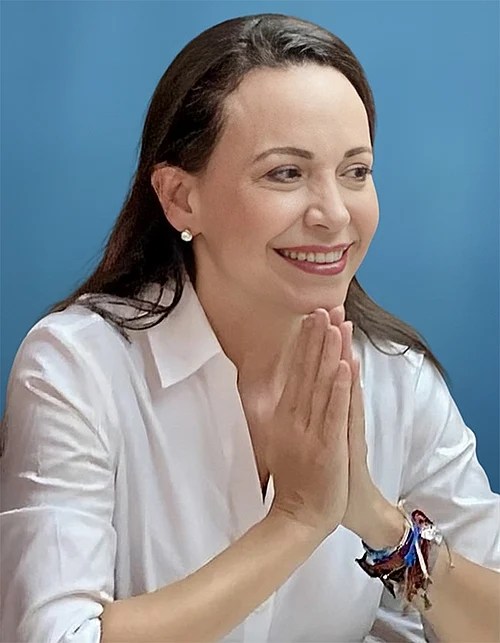
When the Norwegian Nobel Committee announced María Corina Machado as the 2025 Nobel Peace Prize laureate, they described her as someone who “keeps the flame of democracy burning amidst a growing darkness.” It’s a poetic phrase, but for Venezuelans who have lived through decades of authoritarian tightening, economic collapse, and systematic suppression of dissent, it’s also painfully literal. In a country where speaking truth to power can cost you everything—your livelihood, your freedom, even your life—Machado has refused to be silenced. At 58 years old, this industrial engineer turned democracy activist has become the most prominent voice of resistance in Venezuela, a woman whose courage has inspired millions even as she’s been forced into hiding to preserve her safety and freedom.

The Nobel Committee’s recognition of Machado matters profoundly, not just for Venezuela but for the global struggle to preserve democratic values in an era when authoritarianism is resurgent worldwide. Her story is one of transformation: from privileged background to street-level activism, from engineer to electoral champion, from legislator to hunted dissident. It’s a story that reveals both the extraordinary character of one woman and the desperate yearning of an entire nation for the most basic of freedoms—the right to choose their own leaders, speak their own minds, and determine their own future.
From Steel and Privilege to Streets and Service
María Corina Machado was born in Caracas on October 7, 1967, the eldest of four daughters in a family of considerable privilege. Her father, Henrique Machado Zuloaga, was a prominent steel businessman, and she grew up with advantages that most Venezuelans could only dream of. Yet privilege, for Machado, never translated into complacency. She pursued industrial engineering at Universidad Católica Andrés Bello, one of Venezuela’s premier institutions, equipping herself with the analytical and problem-solving skills that would later serve her political work. After studying engineering and finance, she had a short career in business—a path that seemed destined to lead to corporate success and comfortable obscurity.
But 1992 marked a turning point. That year, Machado established the Atenea Foundation, which works to benefit street children in Caracas. The choice was revealing. Here was a young woman from one of Caracas’s most affluent families choosing to dedicate herself to the city’s most vulnerable, most forgotten children. The foundation’s work brought her face-to-face with the harsh realities that most of her social class could ignore: the poverty, the lack of opportunity, the systemic failures that left children sleeping rough in the capital’s streets. It was hands-on, unglamorous work that offered no obvious career advancement. It was also, in retrospect, the beginning of a moral awakening.
Through Atenea, Machado learned something that would define her political life: that the problems facing Venezuela weren’t merely economic or technical—they were fundamentally about power, about who got to make decisions, and about whether ordinary people had any say in the systems that governed their lives. She saw that street children weren’t just unfortunate victims of circumstance; they were the predictable outcome of a political system that prioritized the interests of the powerful over the needs of the vulnerable.
The Birth of a Democrat: Súmate and the Fight for Fair Elections
The year 2002 proved fateful for both Venezuela and Machado. She founded Súmate, a volunteer group that promotes political rights and monitors elections. The organization’s very name—which means “Join Up” in Spanish—was a call to action, an invitation for ordinary Venezuelans to take ownership of their democracy. Súmate conducted training and election monitoring, teaching citizens how to observe voting procedures, document irregularities, and demand accountability from electoral authorities.
In Venezuela’s increasingly authoritarian climate under Hugo Chávez and later Nicolás Maduro, Súmate’s work was nothing short of revolutionary. The organization operated on a simple but powerful premise: that free and fair elections are the bedrock of democracy, and that citizens have both the right and the responsibility to ensure their votes are counted honestly. Machado has described her life’s work as promoting “ballots over” violence, a commitment to peaceful democratic change even when the regime made violence tempting.
Súmate trained thousands of election observers, created networks of grassroots activists, and provided Venezuelans with the tools to document electoral fraud. The regime’s response was predictable: harassment, intimidation, and legal persecution. Machado and other Súmate leaders were charged with conspiracy and treason for accepting funding from international democracy organizations. The charges were transparently political, designed to criminalize the very act of promoting free elections. But they also had an unintended effect: they elevated Machado’s profile and demonstrated to Venezuelans that their government feared nothing more than honest elections.
The People’s Champion: A Record-Breaking Electoral Victory
In 2010, Machado was elected to the National Assembly, winning a record number of votes. It was a stunning validation of her work and her message. She had been elected with the highest number of votes among all candidates, a testament to her grassroots organizing and the hunger among Venezuelans for authentic representation. Here was someone who had proven her commitment to democracy not just through words but through years of work on the ground, someone who had earned trust through action.
Her tenure was marked by her vocal opposition to governmental abuses and her advocacy for human rights. In the Assembly, Machado refused to play the role of polite opposition. She used her platform to denounce corruption, challenge illegal actions by the executive branch, and give voice to Venezuelans whose concerns were systematically ignored. She was fearless, confrontational when necessary, unwilling to accept the slow normalization of authoritarianism that many of her colleagues had resigned themselves to.
Her effectiveness made her dangerous. The regime expelled her from office in 2014—a nakedly illegal move that nevertheless succeeded in silencing her official voice. The expulsion was revealing: the regime was willing to violate its own rules to remove someone whose words had power. For Machado, it was confirmation that she was doing something right. Being expelled from office by authoritarians became, perversely, a badge of honor.
Building Bridges: The Unity of Resistance
Exile from office didn’t mean exile from politics. Machado leads the Vente Venezuela opposition party and in 2017 helped found the Soy Venezuela alliance, which unites pro-democracy forces in the country across political dividing lines. The Soy Venezuela platform was particularly significant because it brought together opposition figures and ordinary citizens from across the political spectrum—from center-left to center-right, from urban professionals to rural workers. She co-founded it along with Antonio Ledezma and Diego Arria, and accompanied by an extensive National Council, creating a genuinely broad-based movement.
This ability to build coalitions—to unite people who might disagree on economic policy or social issues but share a commitment to democracy—has been one of Machado’s greatest strengths. In a region where opposition movements often splinter into factional infighting, where personality conflicts and ideological differences regularly undermine unity, Machado has repeatedly demonstrated the discipline and vision to keep diverse groups focused on their common goal: restoring democracy to Venezuela.
The work was exhausting and often discouraging. Every step forward seemed to be met with two steps back. The regime controlled the electoral machinery, the courts, the security forces, the oil revenues. What did the opposition have? Only the will of the people and the moral clarity of their cause. For many opposition figures, it was tempting to give up, to flee to exile, to accept that Maduro’s grip was unbreakable. Machado refused.
The Presidential Campaign That Wasn’t: 2024’s Defining Moment
In 2023, Machado announced her candidacy for president in the 2024 presidential election. The announcement electrified the opposition. Here, finally, was a candidate with unimpeachable democratic credentials, someone who had spent decades building grassroots movements and fighting for fair elections. Her candidacy represented not just a political challenge to Maduro but a moral one: a reminder that Venezuela had once been a democracy and could be again.
The regime’s response was to ban her from running. When she was blocked from running, she supported the opposition’s alternative candidate, Edmundo González Urrutia. It was a moment that revealed Machado’s character. She could have protested, refused to recognize the alternative candidate, fractured the opposition. Instead, she put the cause above her ego. She threw her full support behind González Urrutia and worked tirelessly to mobilize voters.
The opposition mobilized widely and collected systematic documentation that it was the true winner of the election. They created parallel vote tabulation systems, deployed thousands of observers, and meticulously documented the voting and counting process. The evidence of their victory was overwhelming—detailed, precinct-by-precinct data showing that González Urrutia had won decisively. It was democracy activism at its finest: peaceful, methodical, irrefutable.
The regime declared victory and tightened its grip on power. International observers, human rights organizations, and democratic governments around the world recognized the election as fraudulent. But fraud backed by armed force is difficult to overturn without violence. The opposition faced an impossible choice: accept the stolen election or take to the streets, knowing that protests would be met with brutality. Machado chose a third path: persistent, non-violent resistance. She continued to speak out, to organize, to document abuses, to keep alive the evidence of the regime’s illegitimacy.
It was after this election that she said she had gone into hiding because she was worried about her safety and freedom. The courage required to continue fighting while living as a hunted person in your own country cannot be overstated. Machado could have fled to exile, joined the millions of Venezuelans who have left the country. She chose to stay, to continue her work even in hiding, to remain present in the struggle even when presence meant danger.
Why It Matters: Venezuela, Democracy, and the World
The Nobel Committee’s decision to honor Machado comes at a critical moment. Democracy is in retreat internationally, and democracy—understood as the right to freely express one’s opinion, to cast one’s vote and to be represented in elective government—is the foundation of peace both within countries and between countries. Venezuela’s descent from one of Latin America’s most stable democracies to authoritarian dictatorship is not an isolated story. It’s a warning about how democracies die: gradually, through the erosion of institutions, the normalization of corruption, the delegitimization of opposition, the manipulation of elections.
For Venezuelans, Machado’s Nobel Prize is validation that the world has not forgotten them. It’s recognition that their suffering matters, that their fight is just, that their aspirations for freedom are legitimate. In a country where the regime controls virtually all media, where speaking against the government can result in imprisonment, where economic collapse has driven more than seven million people to flee, the Nobel Prize is a powerful counter-narrative. It says: the world sees you, believes you, stands with you.
Machado’s recognition also matters because it highlights the central role of women in democracy movements worldwide. From Belarus to Myanmar, from Hong Kong to Venezuela, women have been at the forefront of resistance to authoritarianism. They have organized, mobilized, and maintained moral clarity when male-dominated political establishments have compromised or collapsed. Machado’s Nobel Prize acknowledges this reality and celebrates it.
The Flame That Refuses to Die
What makes María Corina Machado extraordinary is not that she’s done superhuman things but that she’s done profoundly human things in circumstances designed to break the human spirit. She has chosen to stay when leaving would be safer. She has chosen to organize when silence would be easier. She has chosen to hope when despair would be justified.
Her work with street children taught her empathy. Her founding of Súmate taught her strategy. Her electoral triumphs taught her that democracy is what people want when given a genuine choice. Her expulsion from office taught her that authoritarians fear truth-tellers. Her banned presidential candidacy taught her that the regime’s power rests on fragile foundations. And her time in hiding has taught her that courage is not the absence of fear but action despite it.
The Nobel Peace Prize recognizes all of this: the decades of work, the personal sacrifice, the unwavering commitment to non-violent democratic change. She is receiving the award for her tireless work promoting democratic rights for the people of Venezuela and for her struggle to achieve a just and peaceful transition from dictatorship to democracy. But more than that, it recognizes something ineffable but essential: the power of one person to keep hope alive.
Venezuela’s road back to democracy will be long and difficult. The regime remains entrenched, the economy remains shattered, millions of citizens remain in exile. But because of María Corina Machado, Venezuelans know that democracy is worth fighting for. They know that free elections are possible. They know that authoritarian power, no matter how overwhelming it appears, cannot extinguish the human desire for freedom.
The flame still burns. And as long as it does, there is hope.
[End]
Filed under: Uncategorized |




















































































































































































































































































































































































Leave a Reply