





By Jim Shimabukuro (assisted by Claude)
Editor
[Related: The Two-Minute Cliffhanger | AI-Generated Micro Dramas]
The emergence of AI-generated micro dramas as a commercially and culturally dominant entertainment form is one of the most consequential developments in short-form media history. As documented in a May 2026 article in ETC Journal, these are serialized, vertically filmed series purpose-built for mobile consumption, with episodes typically running one to three minutes and spanning sixty to eighty installments per series. They lean into romance, fantasy, and high-concept hooks, and what distinguishes the AI variant is that large language models and multimodal generative systems replace or dramatically reduce the human roles of scriptwriter, actor, cinematographer, and editor — enabling entire series to be produced end-to-end by algorithm (1).

The question this report addresses is whether the same wave of democratization that has transformed commercial micro drama production in China and globally will extend to students — in grade school, high school, and college — enabling them to independently develop, produce, and distribute viable and potentially competitive dramatic content from their home computers. The evidence strongly suggests the answer is yes, and that the trajectory from 2026 to 2030 makes this not merely possible but increasingly probable and educationally significant.
The Current State: AI Micro Dramas Have Already Crossed Into the Mainstream
Any assessment of the student opportunity must begin with the astonishing scale of what AI micro dramas have already achieved industrially. By early 2026, more than 10,000 AI-produced titles were being released every month. On Douyin alone, nearly 50,000 new AI micro dramas were uploaded in March 2026, and by January of the same year a new AI-generated title was going live every ninety seconds. The global micro drama market reached an estimated $11 billion in 2025 and is projected to hit $14 billion in 2026, with revenue outside China from overseas short dramas hitting $1.5 billion in the first eight months of 2025 — up nearly 195 percent year-on-year (1). Global projections suggest the vertical short drama sector could hit $100 billion by 2029 (11).
These figures are not merely commercial curiosities. They reflect a fundamental shift in who can make and distribute dramatic content. As the ETC Journal article explains, the standard production pipeline now follows a “script establishment → AI parsing → persona generation → card-draw video generation → post-production refinement” model, and some studios report that three-person teams can produce five series per month, with per-minute costs collapsing from thousands of yuan to just a few dozen yuan (1). Cultural researcher Zhang Peng of Nanjing Normal University notes that AI can reduce per-episode production costs from tens of thousands of yuan to just a few hundred, while shrinking production cycles from weeks to hours, adding that in some cases “single creators can now produce entire series independently” (9). This is the foundational economic reality that makes student participation not just conceivable but structurally enabled.
The Student Pathway Is Already Open in 2026
A companion ETC Journal article from February 2026 addresses the question of student creative capacity directly and arrives at an affirmative conclusion: “In 2026, a high school student working alone on a laptop with freely available AI tools can plausibly produce an AI-driven short film that is competitive at the finalist level of national or international AI film competitions” (5). The institutional evidence cited is compelling. Runway’s AI Film Festival, established in 2022, receives thousands of submissions and screens finalists at venues such as Lincoln Center in New York. Its rules explicitly require that films “include AI-powered tooling in the creation process” but impose no studio backing requirement, and the organizers emphasize that “millions of individuals are creating billions of videos” with these tools. The “Shortest AI Film Competition” organized by Forward Festival and LTX Studio invites anyone, from anywhere, to produce up to sixty-second AI films with the promotional materials explicitly stating that “no studio [is] needed, just a strong idea and a laptop.” MIT’s AI Film Hack runs a “Next Generation” track that explicitly calls for AI shorts from creators eighteen and under who have not yet enrolled in college, normalizing the expectation that high-school-aged filmmakers can produce meaningful AI-enhanced work (5).
Concrete examples of near-solo productions bear this out. A VFX student at Bournemouth University named Josh Williams described starting “with a dream and a laptop” before using Kling AI to produce “Ghost Lap,” an F1-inspired short that won the Jury Prize in the Kling NextGen Creative Contest in October 2025 — a film that would have been unaffordable with traditional production methods. A separate project called “Lovely,” a two-minute AI short made by two people using nine AI tools over three days with a total budget of about $450, demonstrated that small, resource-constrained teams can deliver coherent, character-focused stories using off-the-shelf generative tools alone (5).
The broader AI video generation landscape in 2026 also supports the student pathway. Tools such as OpenAI’s Sora 2, Google’s Veo 3, Runway’s Gen-4, Pika, Kling AI, and Luma Dream Machine have matured into what one technology analyst describes as “the ultimate AI Co-Director,” enabling directors to generate photorealistic sequences, complex background plates, and native audio-synced content without expensive on-location shoots (2). Runway’s Gen-4 offers “perfect character consistency” capabilities from a single reference image — addressing one of the core challenges in narrative AI filmmaking — while Sora 2 provides native audio synchronization for synchronized dialogue and sound effects in a single pass. LTX Studio integrates scripting, storyboarding, animation, directing, and editing in one cloud environment accessible from any browser (5). According to one 2026 industry analysis, “over one million channels were already using YouTube’s AI creation tools daily by the end of 2025,” and YouTube CEO Neal Mohan framed the platform’s direction by saying that when creators “hold the keys to their own production and distribution, the only limit is their imagination” (4).
Independent of formal competitions, the distribution pathway for student-made micro dramas is also effectively open. TikTok, YouTube Shorts, Instagram Reels, and dedicated micro drama platforms like ReelShort and DramaBox are all free to upload to, with algorithmic discovery mechanisms that can surface compelling content regardless of its origin. The creator economy, estimated at approximately $191 billion in 2026 and potentially reaching $528 billion by 2030, does not ask for credentials before rewarding compelling content (4).
What Democratization Means Across Grade Levels
The democratization of micro drama creation will not arrive uniformly across age groups, and thinking about it in terms of grade-school, high-school, and college students reveals distinct trajectories for each level.
For college students, the entry point is already available. Students in film, communications, media arts, creative writing, and even STEM disciplines with storytelling interests can today assemble a complete micro drama pipeline using freely available or low-cost tools: a large language model for scripting, a text-to-video tool for visual generation, a voice cloning or synthesis tool for dialogue, and a standard non-linear editor for assembly. College film programs are beginning to integrate these tools explicitly (5), and entrepreneurially minded students are already building small-scale production businesses. The micro drama format is particularly well-suited to the college context because its short episode length (one to three minutes) is compatible with academic schedules, its serialized structure rewards iterative learning, and its genre conventions — romance, fantasy, revenge arcs — align with the kind of emotionally driven storytelling that student writers naturally attempt.
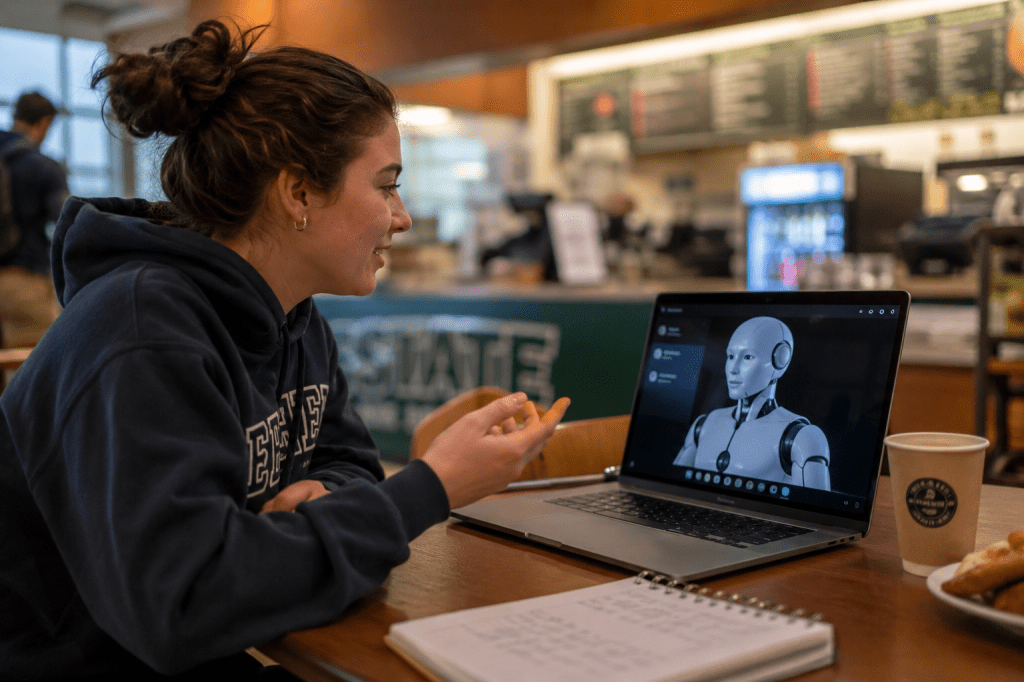
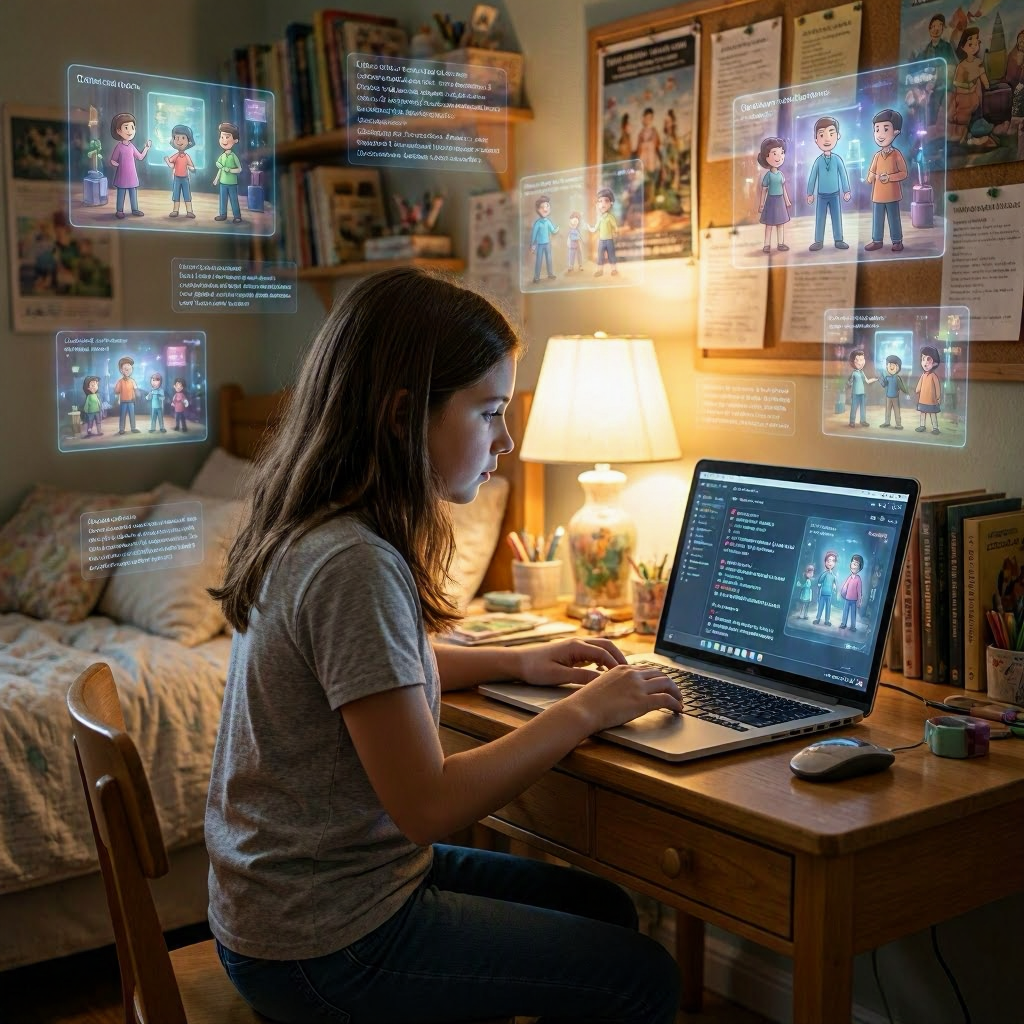
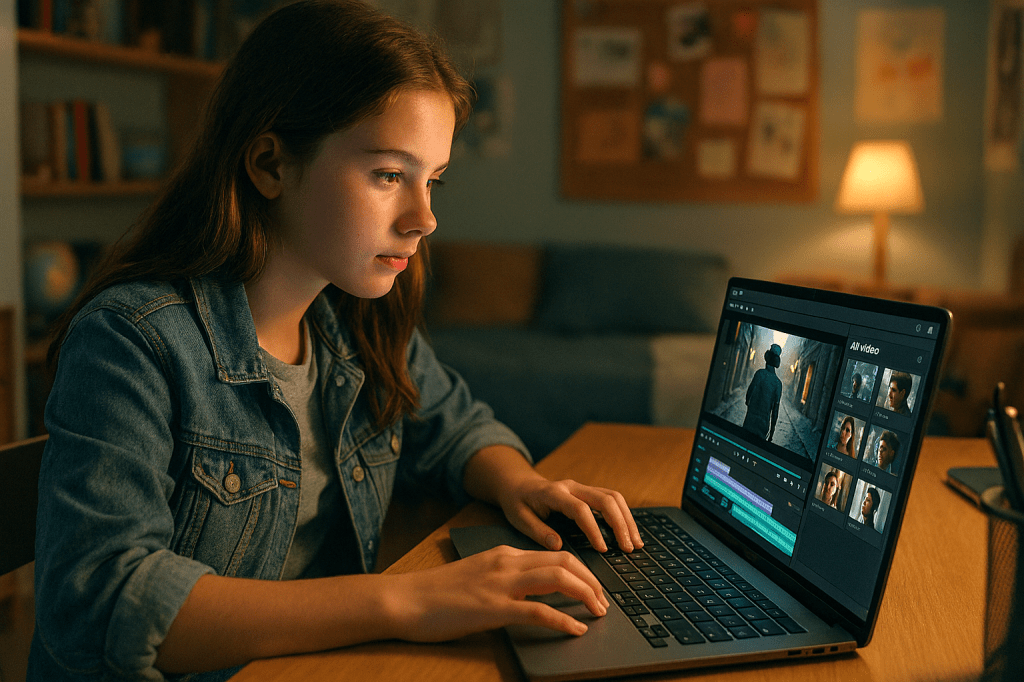
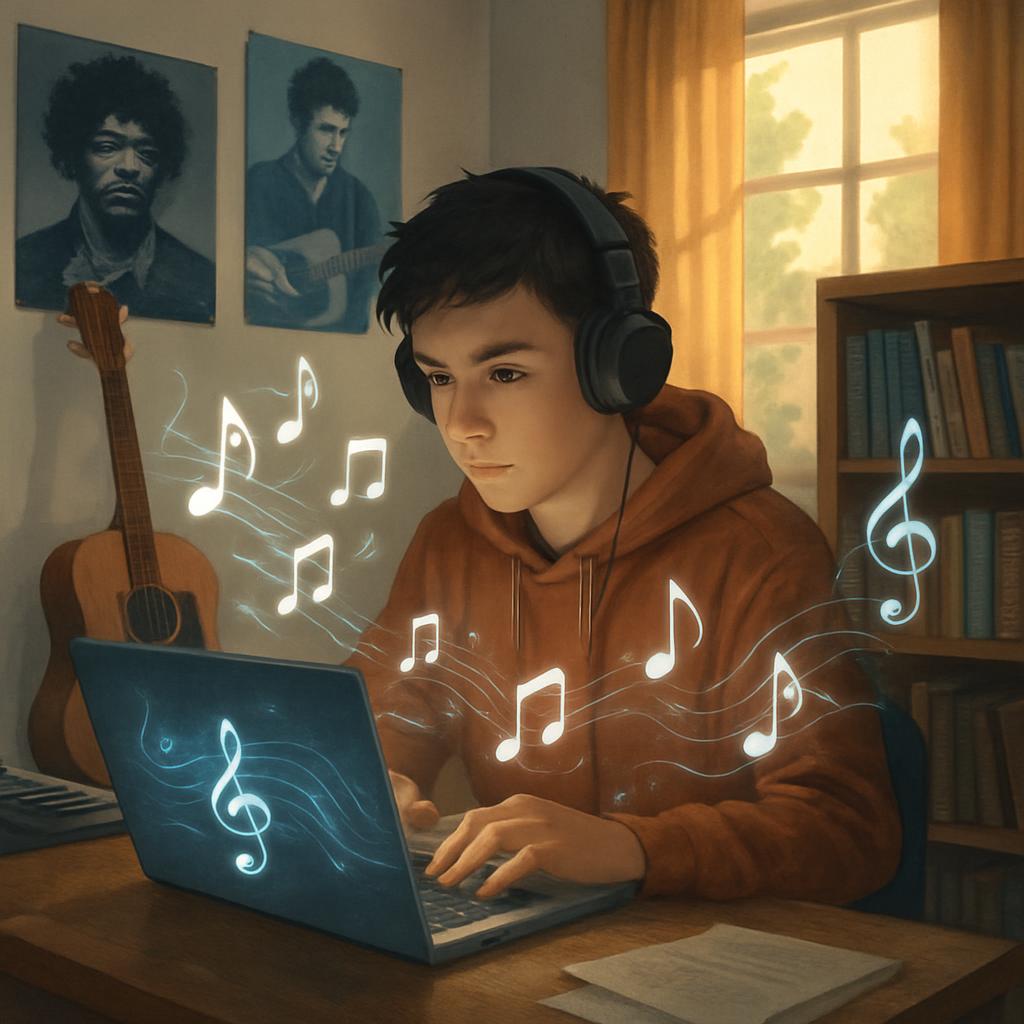
For high school students, the landscape is nearly as favorable, with the primary constraints being subscription costs (which free tiers increasingly address), parental or institutional oversight, and the time needed to develop the story sensibility that separates compelling micro dramas from algorithmically generated noise. The MIT AI Film Hack’s teen-specific track and the Shortest AI Film Competition’s open eligibility demonstrate that the institutional gateway is already unlocked. A plausible workflow for a high school student involves writing a short script in a text editor, generating key sequences with a text-to-video model, assembling episodes in a free or low-cost editing tool, and uploading directly to TikTok or YouTube — a pipeline that requires no physical equipment beyond a laptop and internet connection (5).
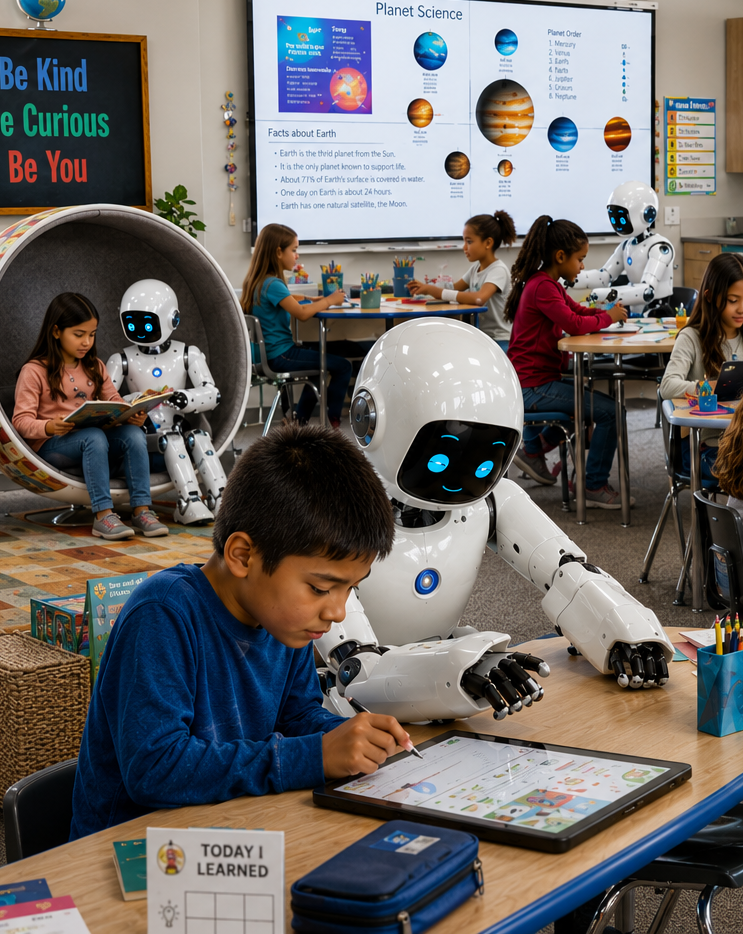
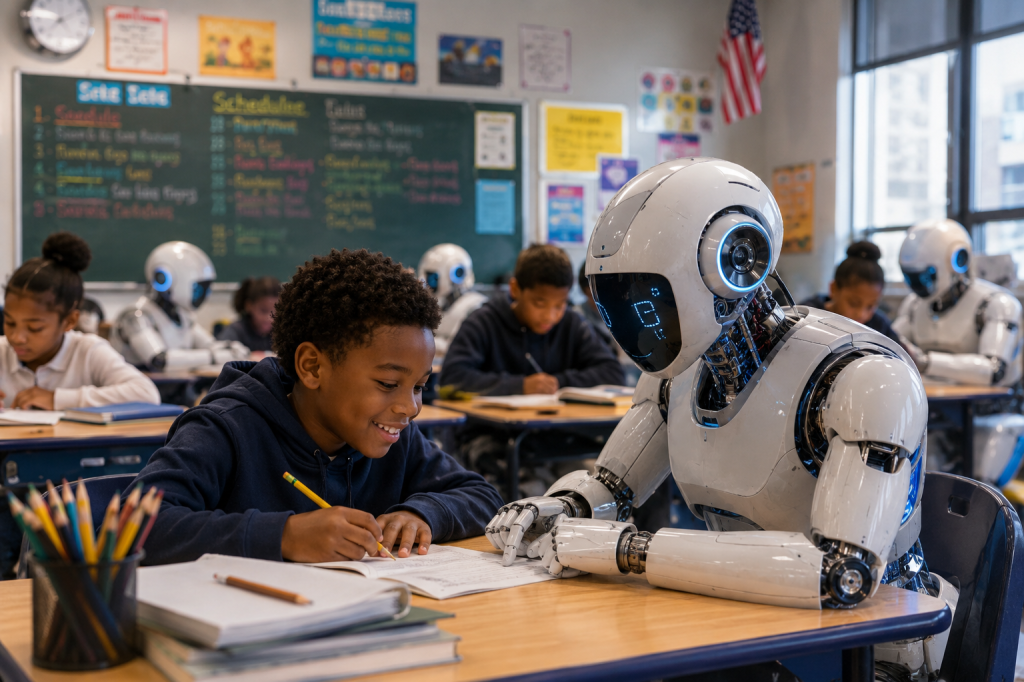
For grade school children, the near-term pathway is more scaffolded. The tools themselves are in principle accessible — several text-to-image and short video generators have intuitive interfaces — but the storytelling frameworks, platform literacy, and content safety considerations appropriate to younger children require educator guidance. The evidence that this scaffolding is being built comes from the broader AI-in-education ecosystem, where platforms like Adobe’s generative AI tools are developing education-oriented tiers and where primary schools in several countries are beginning to incorporate AI-assisted media production into curricula (6). The grade school pathway in 2026 is less about solo creation and more about supervised studio experiences that plant the creative and technical seeds for later independent work.
A 2026–2030 Trajectory
The convergence of rapidly improving tools, collapsing production costs, open distribution platforms, and growing institutional support creates a clear trajectory across the next four years.
2026 — The Proof-of-Concept Year. The infrastructure for student micro drama creation is already in place, but it remains largely uncoordinated and informal. Individual students at the college and high school levels are producing AI-assisted short films and micro series without institutional frameworks to support or recognize them. Competitions like Runway’s AI Film Festival and the MIT AI Film Hack are the primary validation channels. The tools are capable but require meaningful prompt-engineering skill and iterative refinement to produce quality output. Production costs for a short micro drama series are in the range of $0 to $50 using free tiers and open-source alternatives. The major platforms — TikTok, YouTube, Instagram — are beginning to see AI-assisted content from young creators but have not yet established dedicated channels or competitions for student work in this format specifically. The global micro drama market is at approximately $11 billion and growing (10).
2027 — The Curriculum Integration Year. By 2027, leading college media programs and forward-thinking high schools are expected to have formalized AI micro drama production as a curriculum component, drawing on the “AI-first university” model that ETC Journal documented beginning in early 2026. ETC Journal’s projections suggest China’s AI micro drama market alone could break through 400 billion yuan by 2027, and the overseas AI drama market is expected to leap from roughly $1 billion in 2025 to $6.5 billion by 2026 (1) — numbers that accelerate platform investment in creator tools. Text-to-video tools are expected to achieve longer-duration generation (two to three minutes of coherent output), stronger temporal coherence across multi-scene narratives, and better audio integration (3), all of which lower the skill threshold for student creators. A Tsinghua University research team has projected that this period will be defined by the shift from project-based production to software-driven, pipeline-based, and platform-centric creation (1), a shift that naturally accommodates student participation. At the high school level, national and international competitions specifically for AI micro dramas made by students under eighteen are a plausible development, modeled on the existing AI film festival circuit. Platform-level tools — YouTube’s expanding suite of AI creation features, TikTok’s internal creation tools — are expected to further reduce the friction between idea and published episode (4).
2028 — The Emergence of Student Creators as a Recognized Category. By 2028 it is reasonable to expect that the first wave of students who began experimenting with AI micro drama tools in 2026 will have refined their craft to the point of producing content competitive with professional micro drama studios, at least in genre categories where AI excels — fantasy, supernatural romance, sci-fi action. The evidence for this projection comes from the pace of tool development: models capable of two to three minute coherent generations, better character stability, and synchronized audio are anticipated within two years of 2026 (3). As ETC Journal’s companion article observes, there is no technical barrier preventing a capable student from doing what is already being done by solo professional creators (5). The broader creator economy expected to reach $528 billion by 2030 (4) creates financial incentives for platforms to surface and reward student talent earlier rather than later. Dedicated student tracks on major AI film platforms, partnerships between micro drama distributors and school systems, and the first documented cases of student-made micro dramas achieving measurable viewership on commercial platforms are all plausible milestones for this phase. The micro dramas production market is projected to reach approximately $8.7 billion by 2028 (12), and the competition for viewer attention within that market will encourage platform algorithms to surface fresh creative voices regardless of age.
2029 — Competitive Parity in Specific Genres. Analysts project the vertical short drama sector could reach $100 billion by 2029 (11), a scale that implies an enormous proliferation of titles and, paradoxically, a rising premium on distinctive creative voice. This is the year in which the combination of mature tools, accumulated student skill, open distribution, and established educational frameworks converges to produce the first instances of student-made micro dramas that are not merely technically adequate but culturally significant — content that attracts substantial audiences, generates revenue through platform sharing programs, and earns recognition at mainstream film and media competitions rather than only AI-specific ones. The mini-series market has been projected to surpass RMB 1 trillion (roughly $137 billion) by 2027, and the democratization thesis — that low-barrier creativity empowers creators outside major studios to reach millions, the “creative equivalent of the influencer economy” (12) — will by this point have had time to mature into concrete institutional and market reality for student creators. Tools will have advanced to the point where grade school students working in supervised settings can produce coherent short-form narratives with minimal technical friction.
2030 — Full Integration and New Questions. By 2030, the question will no longer be whether students can make competitive micro dramas with AI, but what kind of storytelling is worth making. As one industry analyst has framed the central tension: “in a world where anyone can generate a story, what makes one worth watching?” (9). ETC Journal’s primary article makes a similar point in noting that the risk of AI micro drama proliferation is that algorithmically optimized, formulaic content could crowd out riskier, human-led storytelling (1). For students, this means that technical skill with AI tools will be table stakes by 2030 — a baseline competency rather than a differentiator. The differentiating factor will be the qualities that AI still struggles to replicate: as VML’s industry analysis notes, live-action and human-directed work still outperforms AI in emotionally complex storytelling (9), and producer Chen Caiying has stated that “AI-generated dramas are best suited for high-effects genres, but live-action remains stronger for emotional storytelling” (9). The students who will be most competitive in 2030 are likely to be those who, starting in 2026 and 2027, used AI tools not merely to automate production but to develop their narrative sensibility, understand their audiences, and build the kind of distinctive creative voice that no algorithm can substitute.
Challenges and Caveats
The democratization trajectory is real but not without obstacles. Subscription costs for top-tier AI video models remain non-trivial — comprehensive access to leading 2026 tools can exceed $200 per month (2) — though free tiers and open-source alternatives continue to improve. Content safety review, intellectual property questions, and the ethical use of AI-generated likenesses are live regulatory concerns (1), and platforms may impose age restrictions or content guidelines that differentially affect younger creators. The ETC Journal article also notes that tighter content review rules in China and audience fatigue with low-quality output are already pushing the industry toward higher production values (1), a dynamic that will raise the quality bar for student content over time. And the digital divide remains a structural reality: students without reliable broadband access or modern hardware face barriers that institutional programs and public libraries must help address.
None of these challenges, however, fundamentally alters the trajectory. The tools are improving faster than the barriers are rising. The distribution infrastructure is free and open. The educational frameworks to support student participation are being built. And the market is large enough that platforms have strong financial incentives to surface and reward creative talent at every age level.
Conclusion
The evidence drawn from the ETC Journal article, the broader AI video generation literature, industry market projections, and the documented record of solo and small-team AI film production collectively support a clear and well-grounded conclusion: AI is in the process of democratizing the development, production, and distribution of micro dramas to a degree that will, within the 2026–2030 window, enable students from high school through college to independently create viable and potentially competitive dramatic content from their home computers. Grade school students, with appropriate scaffolding, are on a slightly longer trajectory to the same destination. The pathway is not hypothetical — it is already open. What remains is the educational will to walk it.
References
- “AI-Generated Micro Dramas: Reshaping the Industry.” Educational Technology and Change Journal, May 15, 2026. https://etcjournal.com/2026/05/15/ai-generated-micro-dramas-reshaping-the-industry/
- Balla, Erika. “How AI Video Generators Are Revolutionizing the Film Industry (2026).” The AI Journal, March 14, 2026. https://aijourn.com/how-ai-video-generators-are-revolutionizing-the-film-industry-2026/
- “The State of AI Video Generation in 2026: What Works & What Doesn’t.” is4.ai, March 22, 2026. https://is4.ai/blog/our-blog-1/ai-video-generation-2026-what-works-what-doesnt-340
- “AI Video Generation Is Democratizing Entertainment.” The Slide Factory, August 8, 2025. https://www.theslidefactory.com/post/the-equalizer-how-ai-video-is-about-to-democratize-entertainment
- “Could a Teenager With a Laptop and AI Create a Prize-Winning Film?” Educational Technology and Change Journal, February 11, 2026. https://etcjournal.com/2026/02/11/could-a-teenager-with-a-laptop-and-ai-create-a-prize-winning-film/
- “Best AI Video Tools for Education in 2026.” freevideogenerator.io, April 2026. https://freevideogenerator.io/blog/best-ai-video-tools-education-2026
- “AI Micro-Dramas.” VML, April 2026. https://www.vml.com/insight/ai-micro-dramas
- “AI Micro Drama Revolution in Entertainment and Global Localization.” WordsPrime, December 16, 2025. https://wordsprime.com/ai-micro-drama-revolution-in-entertainment-and-global-localization/
- “One AI Short Drama Every 90 Seconds.” AI in Asia, April 2, 2026. https://aiinasia.com/life/china-ai-short-drama-explosion-2026
- “Micro-Dramas Production Market Strategies for the Next Decade: 2025–2033.” Market Report Analytics, January 27, 2026. https://www.marketreportanalytics.com/reports/micro-dramas-production-72923
- “The Future of Movies: How AI and Micro-Dramas Are Redefining Entertainment.” Clixie.ai, November 5, 2025. https://www.clixie.ai/blog/future-of-movies-and-series-ai-micro-dramas-entertainment
- “Trends 2025: ‘Microdramas, Mega Impact’ — How China’s TV Industry Reinvented Itself for the Attention Economy.” Daily Entertainment World, November 2, 2025. https://www.dailyentertainmentworld.com/post/trends-2025-microdramas-mega-impact-how-china-s-tv-industry-reinvented-itself-for-the-attentio
###
Filed under: Uncategorized |









































































































































































































































































































































































Leave a Reply