





By Jim Shimabukuro (assisted by Claude)
Editor
[Related: What to Call a Technophile Who Is Also a Retro-Tech Enthusiast: ‘techno-primalist’?]
Summary: Techno‑primalism argues that the future won’t reject the past — it will fuse cutting‑edge tools with ancestral habits to stabilize human identity in an AI world. –Copilot

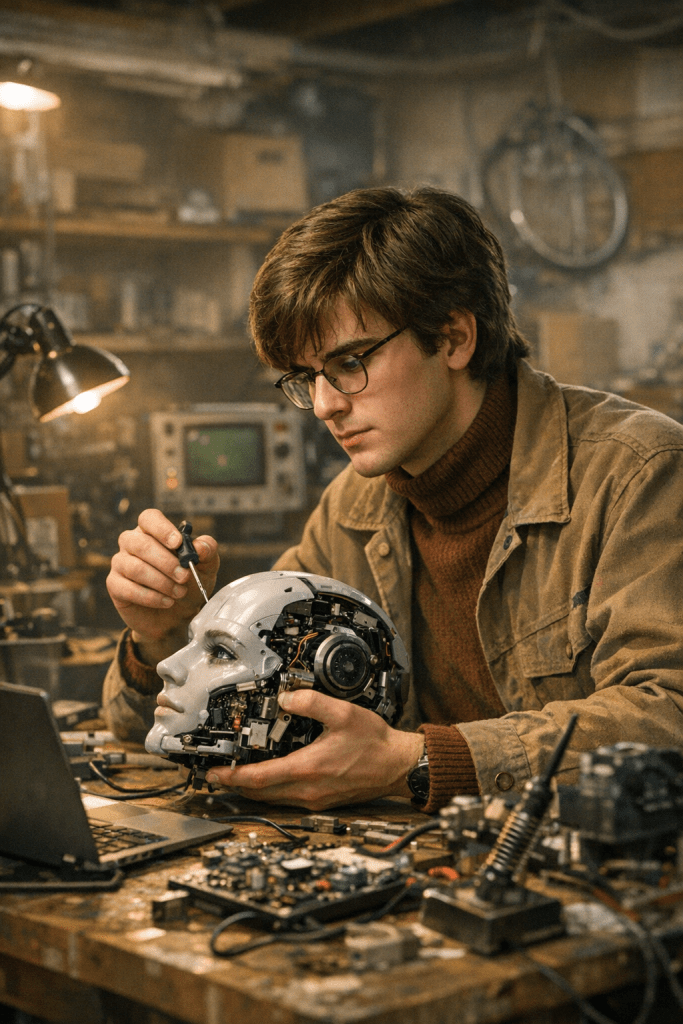
The article, “What to Call a Technophile Who Is Also a Retro-Tech Enthusiast: ‘techno-primalist’?” (ETC Journal, 22 May 2026) proposes a richly evocative label—techno-primalist—for those who adopt the newest computing and AI tools while simultaneously rediscovering manual typewriters, sourdough baking, basket weaving, organic gardening, analog audio restoration, and wilderness hiking (1). The term deserves serious consideration, but it also invites comparison with several existing coinages and frameworks. Understanding where “techno-primalist” sits in a broader intellectual map helps clarify both what is genuinely new about the phenomenon and what older theories already illuminate.
The most proximate scholarly predecessor is technobiophilia, a concept developed by British author and academic Sue Thomas in her 2013 book Technobiophilia: Nature and Cyberspace. Thomas defined the term as “the innate tendency to focus on life and lifelike processes as they appear in technology,” drawing directly on biologist E. O. Wilson’s earlier notion of biophilia—our evolved attraction to living systems (2). For Thomas, the proliferation of nature metaphors in digital culture (clouds, streams, viruses, bugs, the Apple logo) is not accidental but rooted in a deep biological need. Technobiophilia captures how nature bleeds into technology; the techno-primalist extends the idea in the opposite direction—the technologist who physically returns to handcraft, soil, and analog materiality.
Other candidate terms have circulated in journalism and trend-research circles. “Analog enthusiast,” “makerspac devotee,” “digital minimalist,” and “reto-futurist” each capture a fragment of the portrait but none its full duality. The techno-primalist is not anti-digital; the same person who writes code by day may restore a vintage Underwood typewriter by night—not as an act of nostalgia but as an act of cognitive rebalancing. “Techno-primalist” captures this duality more economically than any alternative. An allied phrase—analog-digital hybrid lifestyle—appears in market-research and cultural commentary but lacks the philosophical weight of “techno-primalist” (3).
The Analog Revival: Evidence of the Phenomenon
The phenomenon in the ETC article is empirically well-documented. A 2024 report from Pew Research Center found that 62 percent of American adults feel “overwhelmed” by digital life and actively crave periods of disconnection (4). This cognitive fatigue is not merely anecdotal. As the Global Wellness Summit observed in its 2025 trend analysis, a growing cohort of consumers now seeks what it labeled analog wellness—deliberately archaic hobbies including blacksmithing, vinyl “deep listening,” and handwritten correspondence—as a structured antidote to screen saturation (5). The Summit noted that the movement goes well beyond nostalgia; it represents a systematic effort to restore the tactile, the slow, and the social dimensions of life that digital acceleration erodes.
Sales data corroborate the cultural analysis. Vinyl record sales rose sharply in recent years, instant camera purchases climbed, independent bookstores multiplied, and—most emblematically for the techno-primalist profile—typewriter sales surged despite, or arguably because of, the proliferation of AI writing tools. In October 2024, PBS News Weekend aired a dedicated report on the typewriter renaissance, noting that many buyers are software engineers and designers who spend their professional hours inside machine-learning pipelines (6). The pattern is consistent: the deeper the immersion in digital work, the stronger the reported pull toward analog craft.
Pinterest’s 2025 Summer Trend Report, sourced from internal data collected between January and March 2025, documented a parallel surge among Gen Z users. Searches for “digital detox vision board” increased by 273 percent, and interest in “cottagecore,” urban gardening, and farm-to-table cooking rose sharply. The report found that 46 percent of surveyed Gen Z respondents were actively limiting screen time—not rejecting technology, but seeking a deliberate counterweight to it (7). This is a generational inflection point: the cohort that grew up most thoroughly immersed in digital life is also among the most enthusiastic about analog craft and slow living.
The Title Media cultural analysis published in June 2025 described the trend as a “rebalancing” rather than a retreat, observing that physical devices and handmade objects offer design qualities, tactile feedback, and embodied meaning that digital tools cannot replicate (8). Independent bookstores thrived, zine culture flourished, and the craftsmanship aesthetic spread from artisan markets into major brand identities—a signal that the techno-primalist sensibility had moved from subculture to mainstream consumer aspiration.
The Neuroscience of Dual Drives
The techno-primalist is not a cultural accident; the dual drives that define the type—curiosity toward the new and attachment to the embodied—are both deeply rooted in human neurobiology. Understanding their separate neural substrates helps explain why they so often appear together rather than in opposition.
Novelty-seeking behavior is mediated primarily by dopaminergic circuits in the mesolimbic and mesocortical systems. A 2024 computational-neuroscience study published in PLOS Computational Biology, drawing on basal-ganglia modeling and behavioral data, demonstrated that transient dopamine signals encoding novelty drive exploration by creating an internal representation of uncertainty that motivates approach behavior (9). The implication is that curiosity—the engine of both scientific discovery and technology adoption—is not merely a personality trait but a neurochemical imperative. When we encounter an AI tool, an unsolved physics problem, or an anomaly at the edge of a scientific paradigm, dopamine circuits fire in ways structurally identical to those activated by food, money, or social reward (10).
The complementary drive—attachment to the natural, physical, and embodied—is grounded in what E. O. Wilson called biophilia: the innate human tendency to seek connections with other living systems and with the natural world (11). A 2025 open-access study published in Scientific Reports confirmed that biophilic interventions—exposure to natural environments or even nature-evocative stimuli—significantly reduce physiological stress markers and improve sustained attention, even during cognitively demanding tasks (12). The study situates these findings within the framework of Attention Restoration Theory, which holds that natural settings replenish directed-attention resources depleted by intensive cognitive work. For the techno-primalist, tending a garden or pressing typewriter keys is not merely pleasurable; it is neurologically restorative in ways that another screen-based activity cannot replicate.
These two systems—novelty-seeking dopamine circuits and biophilic restoration circuits—are not in competition. They are complementary regulators. Research on curiosity published in Trends in Cognitive Sciences in early 2024 found that curiosity is optimally sustained when the brain alternates between states of high exploration and states of consolidation and rest (13). The techno-primalist, cycling between AI experimentation and hand-tool craft, is enacting precisely this neurologically optimal alternation—not despite their dual passions but because of them.
Exploring the Unknown: Paradigm Frontiers and Primal Ground
The “What to Call a Technophile Who Is Also a Retro-Tech Enthusiast” article raises a second and deeper question: what drives humans to explore the anomalies and unknowns that lie just beyond the current horizon of science—and does that same drive return us to the primal ground of our biological being?
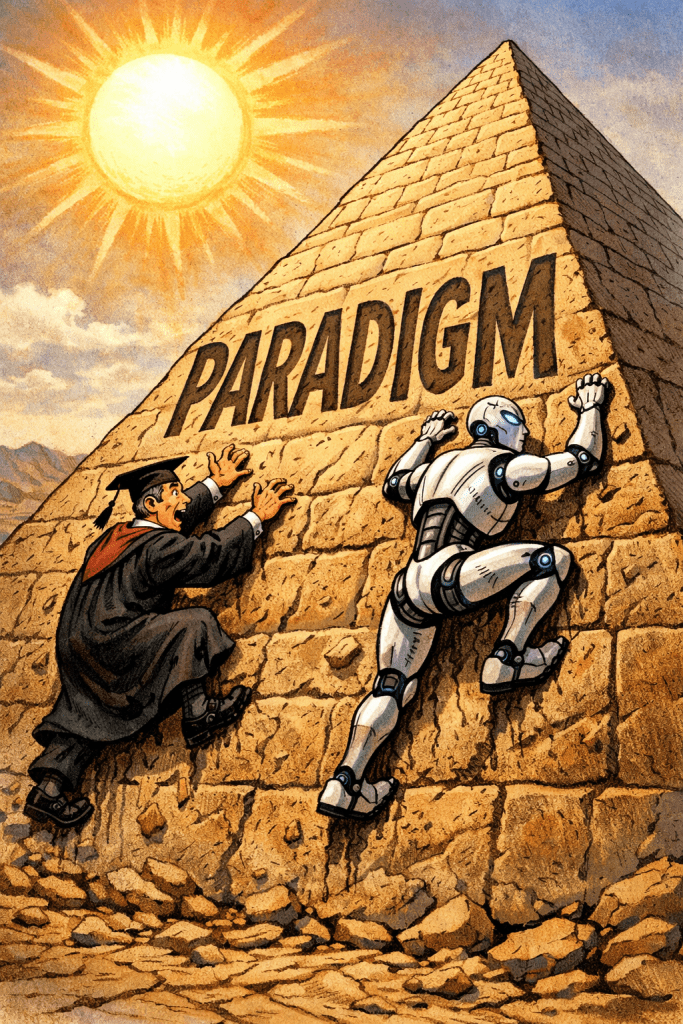
Thomas Kuhn’s foundational 1962 work The Structure of Scientific Revolutions remains the most influential framework for understanding how science advances not through smooth accumulation but through periodic, disruptive upheavals. Kuhn argued that scientific disciplines operate within shared frameworks of assumptions and methods—paradigms—until anomalies accumulate that the paradigm cannot absorb. When the anomalies become severe enough, a crisis ensues that opens space for new frameworks to emerge in what Kuhn called a scientific revolution (14). A 2025 paper in the International Journal of Innovative Science and Research Technology applied Kuhn’s framework to contemporary developments including artificial intelligence and CRISPR gene editing, confirming that the model remains productive for understanding how transformative innovations disrupt established fields (15).
The Kuhnian frame illuminates the techno-primalist’s curiosity about frontier science. Those who feel drawn to the boundaries of AI capabilities, the mysteries of dark matter, the anomalies in consciousness research, or the edge cases of quantum mechanics are responding to the same primal impulse that drove early hominids to cross unknown terrain. The anomaly—the thing that does not fit—is a cognitive attractor. It activates the dopaminergic novelty circuits described above and simultaneously triggers the pattern-seeking behaviors that allowed our ancestors to build mental models of unpredictable environments. Frontier science, from this perspective, is ancient curiosity wearing a new costume.
Yet the very abstraction of frontier science—its remove from the sensory, physical world—may be precisely what amplifies the techno-primalist’s return to embodied practice. When one spends hours probing the mathematical structure of a neural network or the theoretical implications of quantum entanglement, the hands and body are largely idle. The craving for tactile engagement that follows is not regression but homeostasis. It is the organism restoring a balance that pure abstraction disrupts.
Theoretical Frames: Yin-Yang, Dialectics, and the Extended Mind
Yin-Yang and Dialectical Complementarity: Yin-yang comes close to capturing the tension of opposing drives—closer than almost any Western framework, though several Western theories also illuminate the dynamic. Classical Chinese philosophy, formalized in the I Ching and the Taoist tradition, describes yin and yang not as antagonists but as mutually generating forces, each containing the seed of the other and each reaching its fullest expression only in relation to its complement. A 2024 open-access paper in the journal Fragmentos de Filosofía examined how yin-yang dialectical thinking differs from Western dialectics—specifically, it does not require the synthesis or resolution of opposites but holds them in creative, dynamic tension (16). Applied to the techno-primalist, this framework suggests that the embrace of AI and the love of hand-tool craft are not contradictions to be resolved but polarities to be sustained. Neither extreme is desirable; the vitality lies in the movement between them.
Western relational dialectics theory, rooted in Mikhail Bakhtin’s work and formalized by scholars including Leslie Baxter, describes a similar structure—relationships and identities as constituted by the ongoing tension between opposing tendencies rather than by their resolution. Relational dialectics theory is explicitly “rooted in the dynamism of the yin and yang” (17). Applied beyond interpersonal relationships to the individual identity of the techno-primalist, it suggests that the dual orientation is not a phase to be grown out of but a stable, generative mode of being.
The Extended Mind: A second relevant framework is the extended mind thesis, originally proposed by philosophers Andy Clark and David Chalmers and subsequently elaborated in cognitive science. The thesis holds that cognitive processes are not confined to the brain but extend into the tools and environments that agents use. If the external tools we habitually engage with become genuine components of our cognitive systems, then both an AI assistant and a hand loom are equally legitimate cognitive extensions. The techno-primalist does not choose between mind-extending tools; they maintain a richer, more diverse cognitive ecology by using tools drawn from multiple technological eras. This is not incoherence but cognitive breadth.
Complexity Theory and Cultural Homeostasis: A third frame draws on complexity theory and the concept of dynamic equilibrium in self-organizing systems. When a system undergoes rapid perturbation—as human culture does during periods of accelerating technological change—it tends to self-organize toward new forms of balance. The analog revival can be understood as a homeostatic response to digital saturation: a cultural negative-feedback mechanism that restores sensory diversity, embodied engagement, and temporal variety when digital saturation threatens to overwhelm them. The Global Wellness Summit’s “Analog Wellness” trend analysis for 2025, for example, framed the movement explicitly as the culture’s self-correcting response to what it called the online world’s “brain and culture rotting” overreach (5).
Historical Parallels: Innovation Always Invites Its Counterpart
The techno-primalist phenomenon, while taking a distinctly contemporary form, follows a recurrent historical pattern. Periods of rapid technological acceleration have repeatedly been accompanied by cultural movements that valorize craft, nature, and embodied slowness.
The nineteenth-century Industrial Revolution produced, as its cultural counterpart, the Arts and Crafts movement led by William Morris and John Ruskin, which celebrated hand production, natural materials, and pre-industrial design as antidotes to factory uniformity. The rise of mass media and consumer culture in the mid-twentieth century was met by the back-to-the-land movement and the counterculture’s embrace of handcraft, vinyl records, and communal organic farming. In each case, the analog revival was not a rejection of technological progress but a parallel movement that restored dimensions of human experience that rapid change had put at risk (4).
The current digital-AI era appears to be generating a structurally analogous response. The Truffle Culture cultural analysis of 2025 described the pattern directly: the analog resurgence “echoes those earlier moments—but the backdrop is distinctly modern,” with AI and algorithmic saturation playing the role that industrial machinery and broadcast media played in earlier eras (18). The implication is that the techno-primalist is not an anomaly but the latest iteration of a recurring human type—the person who integrates the cutting edge with the ancestral, the synthetic with the organic, the algorithmic with the handmade.
Is the Balance Natural? The Evidence Suggests Yes
Is the yearning for technological innovation naturally balanced by a growing love for the older, physical, DIY craving that seems to accompany progress? The evidence reviewed here supports an affirmative answer, for reasons that are simultaneously neurological, evolutionary, cultural, and philosophical.
Neurologically, the brain’s novelty-seeking dopamine systems and its biophilic restoration systems operate in complementary registers. Heavy engagement of one system creates conditions that favor activation of the other. The software engineer who craves gardening after a day of machine-learning work is not behaving irrationally; their nervous system is regulating itself toward optimal function.
Evolutionarily, humans are creatures shaped by hundreds of thousands of years of multi-modal engagement with the world—making, moving, tending, building, exploring. The extraordinary narrowness of screen-based cognition is evolutionarily novel and sits in tension with the full bandwidth of capabilities our nervous systems were shaped to express. Analog craft and outdoor activity reactivate that full bandwidth. As E. O. Wilson argued, the attenuation of biophilic behavior under conditions of technological immersion is not merely a cultural loss but a potential threat to the quality of human mental life and to our sense of connection with the natural world that sustains us (11).
Culturally and historically, every major acceleration of technological change has generated a compensatory analog revival. The techno-primalist is the embodied expression of this recurring human equilibrium—not a contradictory figure but a coherently balanced one.
Philosophically, the yin-yang framework and its Western analogs suggest that the balance is not merely desirable but structurally necessary. A purely digital life, like a purely analog one, is impoverished. The vitality lies in the creative tension between them—the techno-primalist, simultaneously explorer of the new and custodian of the old.
Conclusion
The term techno-primalist captures something real and important: a cultural identity shaped by the simultaneous embrace of cutting-edge technology and ancestral, embodied practice. It is grounded in neurological reality (the complementarity of novelty-seeking and biophilic restoration), evolutionary history (the full-bandwidth capabilities our nervous systems were shaped to express), cultural pattern (the recurring analog revival that has accompanied every major technological acceleration), and philosophical tradition (yin-yang’s insight that vitality lies in dynamic tension rather than in the resolution of opposites).
The broader phenomenon—humanity’s compulsive exploration of the unknown while rediscovering its primal biological ground—is equally well-grounded. Kuhnian paradigm theory explains the magnetic pull of scientific anomalies at the frontier. Dopamine neuroscience explains why we cannot resist approaching them. Biophilia and attention restoration theory explain why the approach must be balanced by embodied return. Yin-yang and relational dialectics explain why the tension between the two is not a problem to be solved but a dynamic to be inhabited.
The techno-primalist, in short, is not a contradictory figure. They are a fully human one—living in two directions at once, and finding in that dual orientation not confusion but wholeness.
References
1. Shimabukuro, J. (2026). What to Call a Technophile Who Is Also a Retro-Tech Enthusiast: ‘techno-primalist’? Educational Technology & Change Journal. https://etcjournal.com/2026/05/22/what-to-call-a-technophile-who-is-also-a-retro-tech-enthusiast-techno-primalist/
2. Thomas, S. (2013). Technobiophilia: Nature and Cyberspace. Bloomsbury. See also: Thomas, S. “What is Technobiophilia?” https://suethomasnet.wordpress.com/technobiophilia/
3. The Ricciardi Group. (n.d.). Let’s Get Physical: What the Analog Revival Means for B2B Marketing. https://www.thericciardigroup.com/insights/lets-get-physical-what-the-analog-revival-means-for-b2b-marketing
4. Truffle Culture. (2025, April 28). The Resurgence of Analog in a Digital World. https://www.truffleculture.com/the-resurgence-of-analog-in-a-digital-world/
5. Global Wellness Summit. (2025). Trend: Not Just Digital Detox, But Analog Travel. https://www.globalwellnesssummit.com/blog/trend-not-just-digital-detox-but-analog-travel/
6. PBS NewsHour. (2024, October 5). Why typewriters are having a renaissance in the digital age. https://www.pbs.org/newshour/show/why-typewriters-are-having-a-renaissance-in-the-digital-age
7. Fast Company. (2025, June 11). Gen Z is embracing a digital detox and the ‘Martha Stewart summer.’ https://www.fastcompany.com/91350185/gen-z-is-embracing-a-digital-detox-and-the-martha-stewart-summer
8. Title Media. (2025, June 16). Analogue renaissance: why old school is cool. https://titlemedia.co.uk/analogue-renaissance-why-old-school-is-cool/
9. Wang, Y., Lak, A., Manohar, S. G., et al. (2024). Dopamine encoding of novelty facilitates efficient uncertainty-driven exploration. PLOS Computational Biology. https://www.ncbi.nlm.nih.gov/pmc/articles/PMC11051659/
10. ScienceInsights. (2026, March 17). Why Do We Seek Knowledge? The Science of Curiosity. https://scienceinsights.org/why-do-we-seek-knowledge-the-science-of-curiosity/
11. Wilson, E. O. (1984). Biophilia. Harvard University Press. See summary: Britannica. Biophilia hypothesis. https://www.britannica.com/science/biophilia-hypothesis
12. Scientific Reports. (2025, November 12). Biophilic interventions in real and virtual environments reduce stress during cognitively demanding tasks. https://www.nature.com/articles/s41598-025-23224-3
13. Trends in Cognitive Sciences. (2024, February 26). Curiosity and the dynamics of optimal exploration. https://www.cell.com/trends/cognitive-sciences/fulltext/S1364-6613(24)00028-7
14. Simply Psychology. (2023). Thomas Kuhn: Paradigm Shift. https://www.simplypsychology.org/kuhn-paradigm.html
15. International Journal of Innovative Science and Research Technology. (2025, January). The role of paradigm shifts in scientific innovation: analysis of Kuhn’s concept of scientific revolutions with modern case studies. https://www.ijisrt.com/the-role-of-paradigm-shifts-in-scientific-innovation-analysis-of-kuhns-concept-of-scientific-revolutions-with-modern-case-studies
16. Fragmentos de Filosofía. (2024). Yin-Yang Theory in Chinese Philosophy and its Contribution to the Implementation of Gender Equality in Vietnam. Vol. 20: 20–31. https://revistascientificas.us.es/index.php/fragmentos_filosofia/article/download/25639/23153/128504
17. Wikipedia. Relational dialectics. https://en.wikipedia.org/wiki/Relational_dialectics
18. Truffle Culture. (2025, April 28). The Resurgence of Analog in a Digital World. https://www.truffleculture.com/the-resurgence-of-analog-in-a-digital-world/
###
Filed under: Uncategorized |

































































































































































































































































































































Leave a Reply