





By Jim Shimabukuro (assisted by Claude)
Editor
Summary: China’s humanoid surge signals a geopolitical shift where robotics becomes the new measure of national capability, competitiveness, and influence. –Copilot

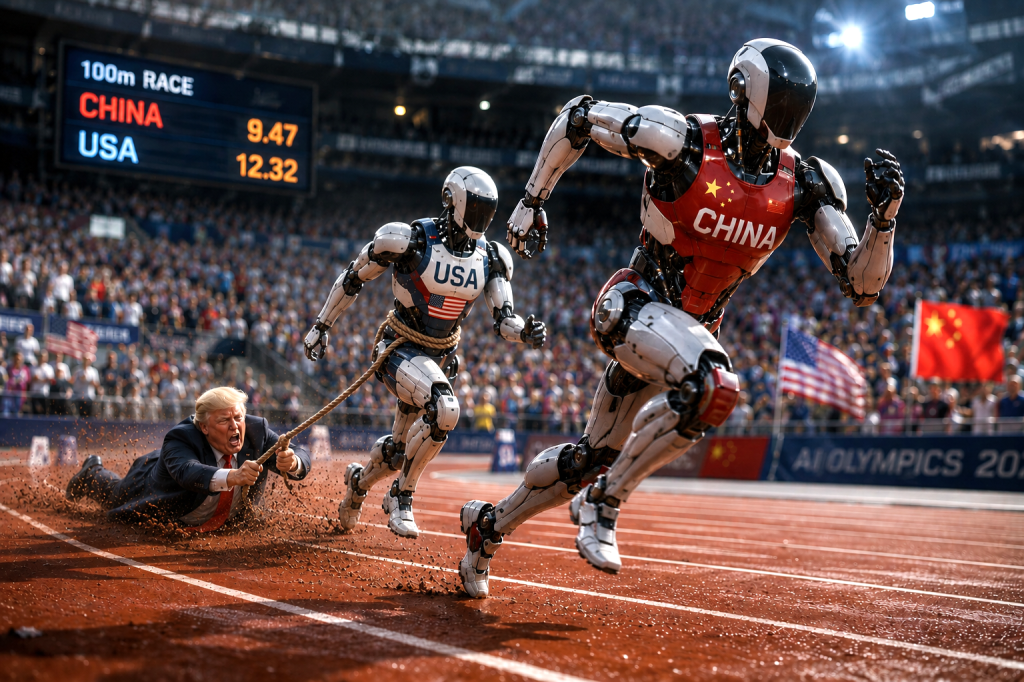
Since early 2026, Western media outlets including ABC News have brought growing public attention to a concern that strategic analysts have tracked for several years: China’s rapid and massive proliferation of humanoid robots—what Beijing and others call ’embodied AI’—may eventually pose a national security risk to Western nations (1). The worry is not hypothetical. As of May 2026, China commands nearly 80 percent of the global humanoid robot market, has deployed autonomous humanoid units in public traffic management, and has established a national standardization committee that explicitly links civilian robotics development to People’s Liberation Army (PLA) priorities (2,5). The United States, by contrast, remains strong in AI software and high-end robotics research but trails badly in volume manufacturing, cost competitiveness, and real-world deployment.
This report examines the structural causes of the gap between the two nations as it stands in May 2026, surveys the responses emerging from both the public and private sectors of the United States, assesses the geopolitical implications over the next five years if current trajectories continue, and concludes with a set of recommended policy and industrial actions that could meaningfully narrow the divide.
Reasons for the Widening Gap
Industrial Policy and State Coordination
The roots of China’s dominance extend back more than a decade. The ‘Made in China 2025’ initiative, launched in 2015, identified robotics as one of ten priority sectors deserving sustained state investment, subsidized land, and preferential tax treatment. The current 15th Five-Year Plan (2026–2030) elevates embodied intelligence—alongside quantum technology, brain-computer interfaces, and 6G—to a distinct strategic industrial priority, the first time it has appeared as its own category in such a high-level policy document (9). Since late 2024, Beijing, Shenzhen, and other Chinese cities have assembled investment funds worth over $26 billion specifically targeting humanoid robotics (11). Local governments sweeten these incentives further by offering free land, subsidized office rent, and buyer rebates equivalent to approximately ten percent of each robot’s sale price.
In March 2026, China released its first comprehensive national standard system for humanoid robots and embodied intelligence, a six-part framework covering foundational technologies, brain-like computing, limbs and components, complete systems, applications, and safety and ethics. The framework was drafted by over 120 institutions (2). Critically, the 65-member National Humanoid Robot Standardization Technical Committee embeds defense interests directly into commercial development: its membership includes representatives from PLA-linked universities, executives from U.S.-restricted companies such as SenseTime and Huawei, and Fan Chang from the 43rd Research Institute of the China Electronics Technology Group (CETC)—a defense conglomerate that underpins PLA electronic warfare. According to the Jamestown Foundation, the committee’s mandate explicitly requires mandatory domestic cryptography, industrial cybersecurity standards, and ecosystem alignment that could severely limit interoperability with foreign platforms and may facilitate state supervisory access (5). This is military-civil fusion by design, not coincidence.
Scale, Cost, and Supply Chain Advantages
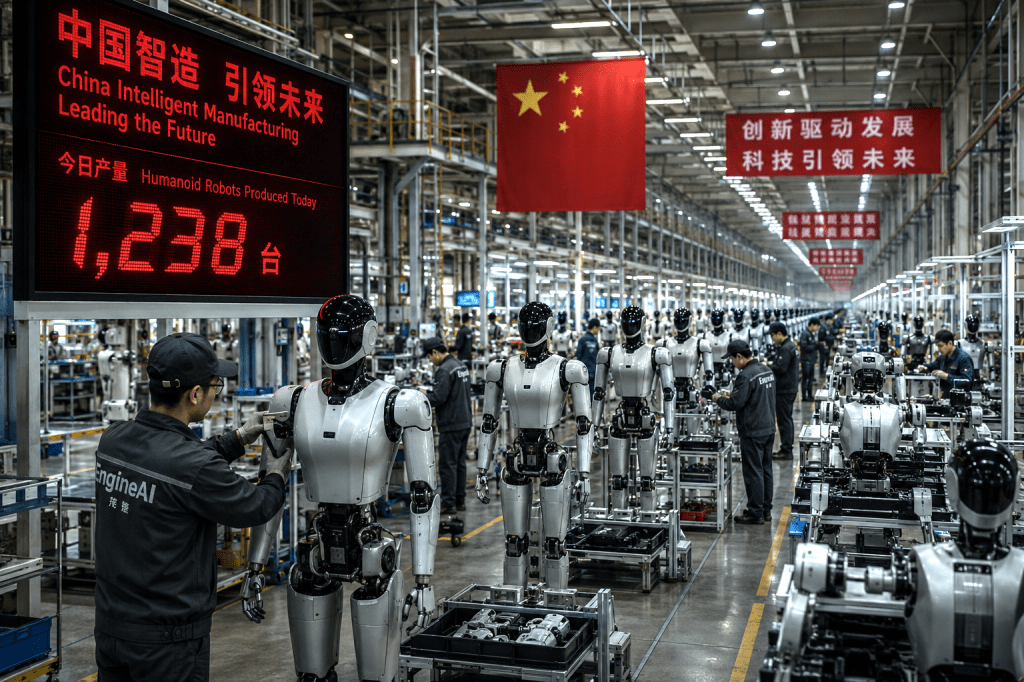
China now has over 140 humanoid robot manufacturers, with more than 330 distinct models launched in the past year alone. Shanghai-based AgiBot delivered 5,168 units in 2025, capturing a 39 percent global market share; Unitree Robotics captured 32 percent; and Chinese firms collectively controlled nearly four-fifths of the global market (2). TrendForce projects that China’s domestic output will surge by 94 percent in 2026, with Unitree and AgiBot together accounting for almost 80 percent of shipments (6). Deutsche Bank’s 2026 forecast expects China to ship more than 35,000 units, nearly three times the combined shipments of all U.S. original equipment manufacturers (7).
Cost is perhaps the most durable advantage. Chinese manufacturers have achieved per-unit costs roughly one-third to one-half of Western equivalents: Unitree and AgiBot offer low-end humanoids for about $10,000, whereas U.S. and European OEMs target the $20,000–$30,000 range (7). Chinese firms reduced total bill-of-materials costs by approximately 40 percent year-over-year, a rate far exceeding industry predictions. Morgan Stanley economists note that China is replicating its electric vehicle playbook, using an integrated supply chain and massive domestic testing grounds to drive down costs, and projects that this strategy will help lift China’s share of global manufacturing from 15 percent today to 16.5 percent by 2030 (8). A factory in Foshan, Guangdong now assembles a humanoid robot every 30 minutes—a pace that Tesla, Figure AI, and Boston Dynamics have not yet matched collectively (12).
Underlying this cost leadership is China’s control of the relevant supply chain. The country dominates rare earth mineral extraction and processing, and it has built up decades of component manufacturing expertise from its electric vehicle and drone industries. In 2024, China installed 295,000 new industrial robots—more than every other country in the world combined—creating the factory experience and data infrastructure that humanoid developers depend on (25). U.S. companies, by contrast, must source many components from the very supply chains they hope to displace.
Rapid Real-World Deployment and Data Accumulation
A virtuous cycle of deployment and data collection has further widened the gap. The April 2026 Beijing E-Town half-marathon featured over 100 humanoid robots competing on a complex urban course. The autonomous winner—’Lightning,’ developed by the Honor/Monkey King team—finished in 50 minutes and 26 seconds, beating the human world record by nearly seven minutes, and nearly 40 percent of competitors ran in full autonomous navigation mode (9). In May 2026, the city of Hangzhou deployed the world’s first public-facing humanoid robot traffic management brigade, placing 15 AI-equipped units alongside human officers at key intersections (3). A new ’embodied intelligence super factory’ in Beijing’s E-Town has begun commercial deliveries (11). These deployments generate the real-world locomotion and interaction data that iteratively improves AI models—data that U.S. firms, constrained by smaller fleets and fewer deployment contexts, are not yet collecting at comparable scale.
Chinese humanoid startups are already shipping robots to factories, malls, and public spaces while their U.S. rivals remain largely focused on development. As analyst Rui Ma of Tech Buzz China has observed, Chinese companies are being valued as industrial hardware plays, not as wide-ranging AI platforms—which means their valuations appear modest, but they are shipping product and accumulating operational intelligence at a pace that could prove decisive (5,23).
U.S. Structural Weaknesses
The U.S. side of the equation suffers from structural deficits that cannot be addressed overnight. American robotics companies are highly innovative but fragmented, heavily venture-capital dependent, and focused on premium market segments. Roughly 90 percent of U.S. humanoid robot activity remains in development rather than commercial deployment (5). The federal government has been slow to treat robotics as a strategic industrial sector requiring coordinated support, and there is no domestic equivalent of China’s centrally coordinated purchasing programs, subsidized testing grounds, or vertically integrated component ecosystem. Meanwhile, the Trump administration’s tariff escalation and restrictions on Chinese students and researchers, while motivated by security concerns, have in some instances impeded the cross-border talent flows that historically nourished U.S. technology leadership. Export controls on advanced semiconductors have slowed Chinese progress in some areas, but Chinese firms are increasingly working around these constraints through domestic chip design and by drawing on their embedded supply chain advantages (20).
How U.S. Leaders Are Responding
Congressional Action
The legislative branch has moved on multiple fronts. In November 2025, Senators Cassidy and colleagues introduced the Humanoid ROBOT Act (S.3275), which would bar federal executive agencies from procuring or using humanoid robots designed, tested, developed, or manufactured by covered entities linked to foreign adversaries including China, with the Secretary of Defense retaining a waiver for national security and research purposes (16). In March 2026, a bipartisan group of senators introduced the ‘American Security Robotics Act,’ which similarly targets federal procurement of Chinese-made robotic systems (13). Congress had earlier, in December 2025, encouraged the Department of Defense to designate Unitree Robotics as a ‘Chinese military company’ while banning Chinese drone components from entering the United States (7).
Beyond restriction, lawmakers have moved toward building domestic capacity. In February 2026, members including Representatives Obernolte and McLellan introduced bills to establish a National Commission on Robotics and to make targeted investments to ‘reduce reliance on foreign suppliers, scale domestic manufacturing, and create high-quality jobs in communities across the country’ (21). At a House Homeland Security Committee cybersecurity subcommittee hearing in March 2026, legislators heard testimony from executives of Scale AI and Boston Dynamics calling for a whole-of-government approach, expanded export controls covering AI inference chips, and potential bans on federal procurement of certain Chinese AI and robotics systems (3,4). Representative Zoe Lofgren encapsulated the bipartisan consensus: ‘We can and still must lead in the field of robotics, but to achieve that goal, we need a concerted national effort to support innovation across the full robotics system’ (10).
In the chip domain, the House Committee on Foreign Affairs pushed the AI OVERWATCH Act through committee in January 2026, which would grant Congress veto power over AI chip export licenses. Representative Moolenaar, Chair of the House Select Committee on China, has written repeatedly to Commerce Secretary Howard Lutnick opposing the export of advanced chips to China (20). The overall legislative posture, then, combines procurement bans, export control tightening, domestic investment, and institutional coordination—though critics note that the pieces have not yet cohered into a single national robotics strategy.
Executive Branch Initiatives
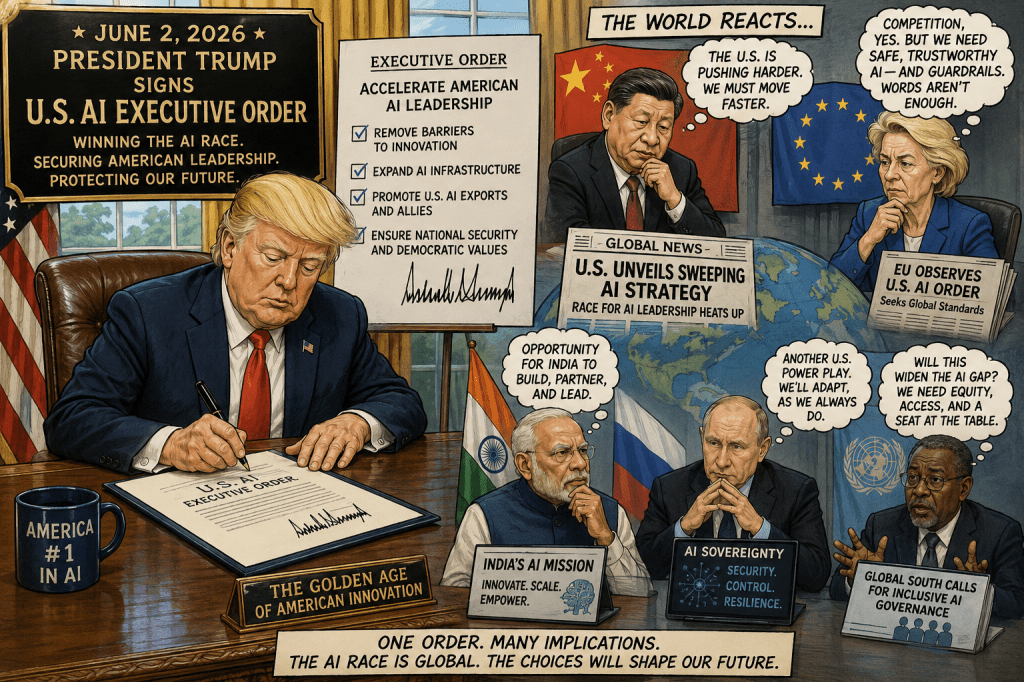
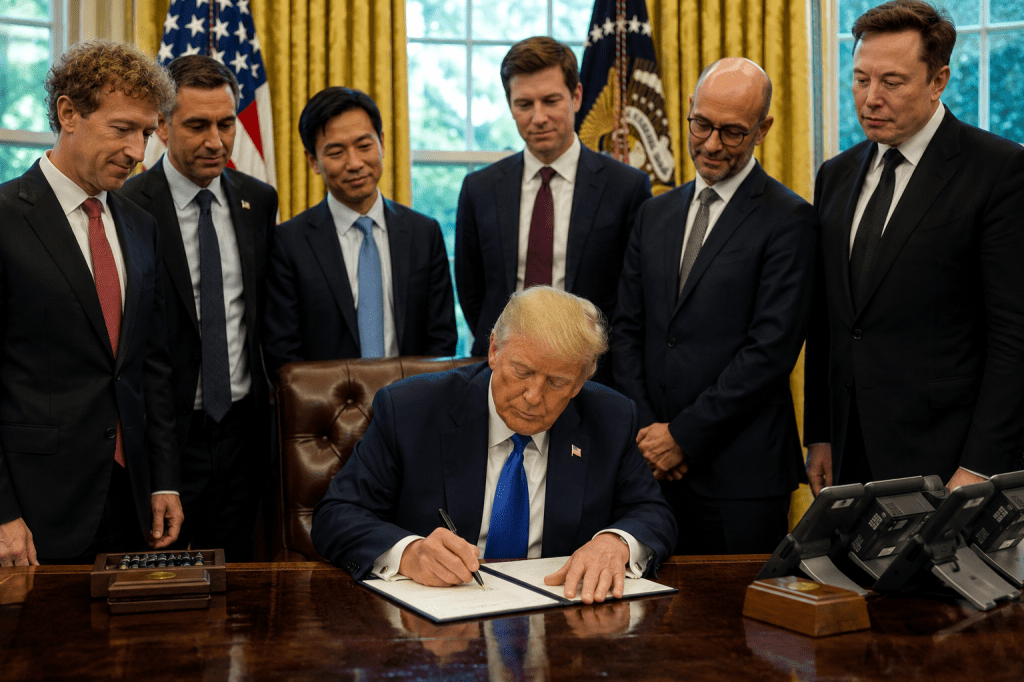
The Trump administration has moved to extend its AI executive order framework into robotics. According to reporting by Politico and others, the White House has been actively drafting a stand-alone executive order on robotics policy for potential release in 2026, building on the ‘Genesis Mission’ order for scientific AI and aimed at removing regulatory friction from U.S. robotics development and deployment in manufacturing, logistics, and defense (17,18). Robotics has been characterized within the Genesis Mission framework as ‘the only [priority sector] that physically integrates the other five’—meaning chips, energy, magnets, copper, and lithium—making a dedicated robotics order a logical capstone to existing AI policy (17).
The Foundation for Defense of Democracies has recommended that the Trump administration pursue several additional executive measures: adding Chinese internet-connected robots to the Federal Communications Commission’s Covered List to prevent their sale in the U.S. market; directing the Commerce Department toward more targeted export controls on advanced sensors used in humanoid locomotion; and coordinating these measures with Japan, Germany, and South Korea, all of which are key nodes in global robotic supply chains (7). The Pentagon has separately made agreements with companies to integrate AI into classified networks, a step that may accelerate the military applications of domestic robotics (26).
Private Sector Response
American industry has not stood still. In his Q4 2025 earnings call, Tesla CEO Elon Musk announced that the Fremont factory will wind down production of the Model S and Model X vehicles to convert floor space for an Optimus production line targeting one million units per year, backed by capital expenditure exceeding $20 billion for 2026. Tesla’s Optimus Gen 3 is targeting production start in summer 2026 at Fremont. Musk acknowledged that ‘China is an ass-kicker, next level’ and conceded that, to his knowledge, there are no significant humanoid competitors ‘outside of China’ (14). Boston Dynamics’ electric Atlas has begun commercial deployments, with its entire 2026 production allocation committed to Hyundai and Google DeepMind (13). Figure AI, which commands a private valuation of at least $39 billion, has had its Figure 02 robots contribute to the production of over 30,000 vehicles at BMW’s Spartanburg plant, with the pilot now expanding to Leipzig, Germany (15).
The industry has also begun to organize politically. Members of Congress met with executives organized by the Association for Unmanned Vehicle Systems International (AUVSI) to launch the Partnership for Robotics Competitiveness (PfRC), which aims to create policies and investment targets to reduce dependence on foreign suppliers and build domestic manufacturing at scale. Jeff Cardenas, CEO of Apptronik, stated: ‘If we want to stay competitive on the global stage, we need a coordinated national robotics strategy that aligns innovation, workforce development, and federal policy.’ Wendy Tan White, CEO of Intrinsic, added: ‘The strategic importance of physical AI for the coming decades cannot be overstated’ (21). The IDTechEx market analysis published in May 2026 provided an important commercial catalyst, finding that under high-utilization industrial conditions, a humanoid robot’s payback period can already fall to approximately six months—a finding that may accelerate U.S. enterprise adoption and investment (2).
Geopolitical Implications for 2026–2031
Manufacturing Competitiveness and Economic Power
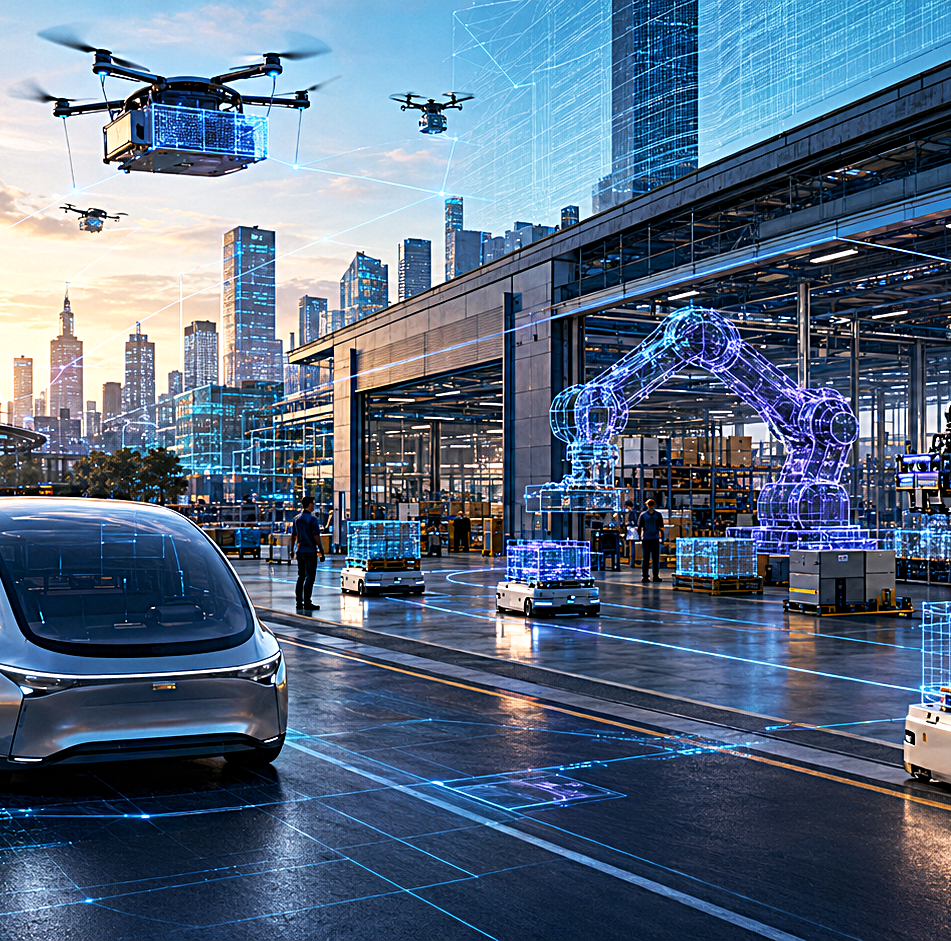
The most immediate geopolitical consequence of continued Chinese dominance is a structural shift in global manufacturing competitiveness. China already installed more industrial robots in 2024 than every other country combined, and the CSIS ChinaPower Project identifies four key implications: boosts to China’s domestic manufacturing competitiveness; growing overseas reliance on Chinese robots; risk of lost development opportunities in developing economies that adopt Chinese robotic infrastructure; and direct challenges to U.S. manufacturing revitalization (25). Morgan Stanley projects that China’s robotics-driven manufacturing advantage could lift its share of global manufacturing to 16.5 percent by 2030 (8). If Chinese humanoid robots penetrate factories across Southeast Asia, Africa, and Latin America, those regions will develop dependencies on Chinese hardware, software, and maintenance ecosystems—dependencies that could constrain their foreign policy autonomy in much the same way that Huawei telecommunications infrastructure did in the previous decade.
The EV precedent is instructive and cautionary. China used state subsidies, integrated supply chains, and a massive domestic market to drive down costs and capture global share from established Western incumbents. As Rest of World reported in February 2026, ‘Chinese companies control 90 percent of the humanoid robot market, dominating the technology that will reshape manufacturing and labor. The West is barely competing’ (23). If this trajectory continues through 2031, Western manufacturers could find themselves unable to compete in the very automation technologies they need to offset their own labor cost disadvantages.
Military and Dual-Use Dimensions
China’s military-civil fusion strategy means that commercial humanoid robotics advances directly accrue to PLA capabilities. During China’s September 2025 military parade, the PLA unveiled a series of unmanned platforms including a robotic ‘wolf’ designed for long-range reconnaissance (7). The Jamestown Foundation has documented how the National Humanoid Robot Standardization Technical Committee—which sets the technical standards for all Chinese humanoid development—embeds defense priorities, PLA-affiliated institutions, and U.S.-restricted companies at its core (5). Over the next five years, the data and manufacturing expertise accumulated in commercial humanoid production will inevitably feed into autonomous military platforms. As the Diplomat has observed, embodied intelligence and robotics are being folded into a longer-term blueprint for AI integration across manufacturing and strategic sectors under the 15th Five-Year Plan, with Premier Li Qiang explicitly elevating the sector in the 2026 Government Work Report (9).
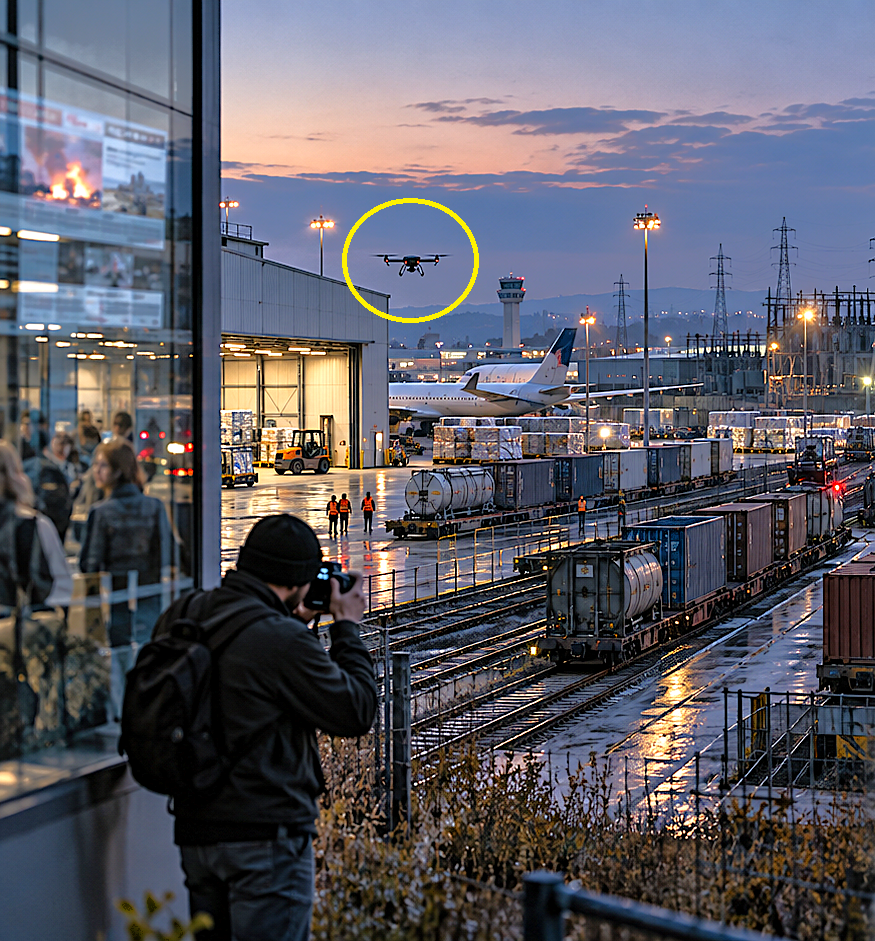
The cybersecurity dimension is no longer abstract. At the GEEKCon 2025 event in Shanghai, researchers from DARKNAVY demonstrated how a single verbal command could be used to seize control of a commercially available humanoid robot and transform it into a ‘Trojan horse’ capable of infecting and commandeering other internet-connected robots, exploiting a flaw in the robot’s built-in large-language-model agent (4). As security researchers Xu Wenyuan and colleagues have noted, embodied AI systems create an ‘expanded threat surface’ where cyber vulnerabilities can propagate into real-world physical actions, potentially endangering critical infrastructure and public safety (12). If Chinese-made robots penetrate U.S. logistics, manufacturing, or public infrastructure over the next five years, the remote-access vulnerabilities already demonstrated in controlled conditions could become operational threats.
Alliance and Diplomatic Implications
China’s robotics expansion is not limited to its domestic market. As reported by Gasgoo in February 2026, Chinese humanoid robot makers are systematically building overseas footprints—AgiBot has partnered with Minth in Germany and opened an experience center in Malaysia; Magic Atom has set up an R&D team in the U.S.; and DeepRobotics is building a local support network in North America (24). For some Chinese firms, overseas operations already contribute over 50 percent of revenue. This global expansion will create competing loyalties within U.S. alliances as countries weigh the economic benefits of cost-competitive Chinese automation against the security concerns raised by Washington. Japan, Germany, and South Korea—key U.S. allies and themselves major robotics powers—face particularly difficult choices as Chinese firms undercut their domestic champions on price.
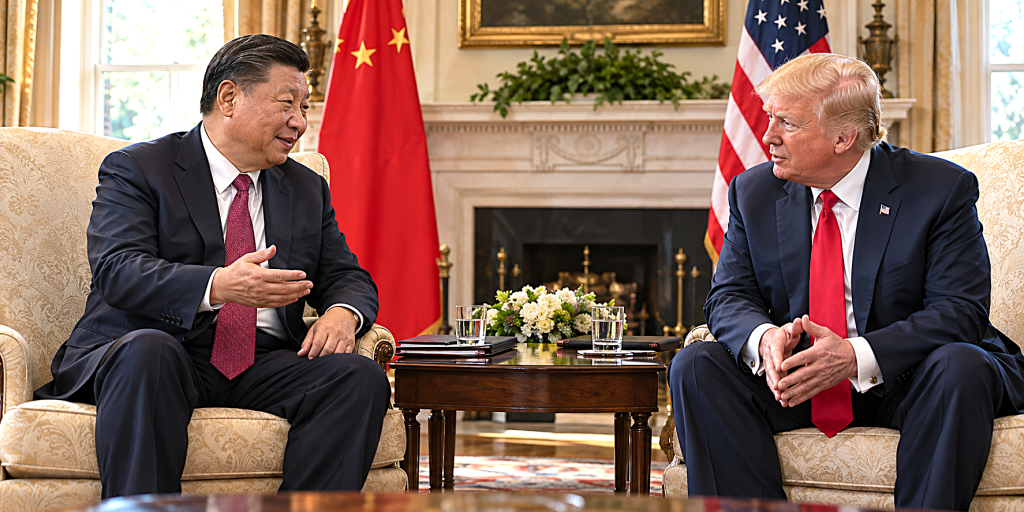
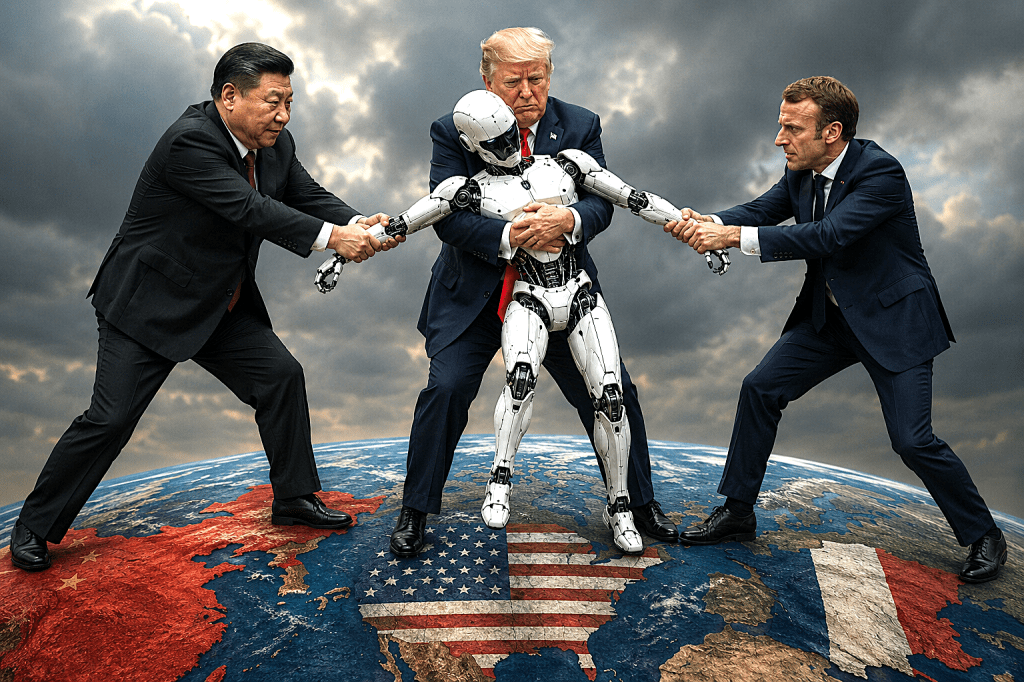
The broader geopolitical framework is one of increasing technological bipolarity. If the gap continues to widen, the world risks fragmenting into two robotics ecosystems—one centered on Chinese standards, Chinese hardware, and Chinese data collection, and one struggling to maintain an alternative. The result, as analysts at Xpert.Digital have characterized it, would be ‘a multipolar world order in automation technology,’ in which the era of unchallenged Western dominance has conclusively ended (22). The United States would find its leverage over both adversaries and allies substantially reduced if the physical infrastructure of global manufacturing runs on Chinese platforms.
Recommended U.S. Course of Action
Forge a National Robotics Strategy
The single most important step is what has so far been absent: a coherent, whole-of-government national robotics strategy that treats humanoid and industrial robotics as a strategic sector requiring coordinated support comparable to semiconductors, nuclear energy, or aerospace. The anticipated executive order on robotics, if and when issued, should be grounded in this broader framework rather than standing as an isolated deregulatory measure. Concretely, this means designating robotics as a national security priority under the Defense Production Act, creating a White House robotics coordinator position with interagency authority, and establishing dedicated funding streams—comparable to the CHIPS and Science Act—for domestic humanoid and industrial robot manufacturing. Rep. Lofgren’s call for ‘a concerted national effort to support innovation across the full robotics system’ should be translated into statute (10).
Build and Diversify the Supply Chain
China’s dominance of rare earth minerals and component manufacturing constitutes a structural vulnerability for U.S. robotics development that no amount of software innovation can fully compensate for (10). The U.S. government should accelerate domestic and allied-country production of the actuators, sensors, torque feedback systems, and specialized materials that humanoid robots require, leveraging the same allied coordination recommended for semiconductors. Japan, South Korea, Germany, and Australia are natural partners in this effort. The Foundation for Defense of Democracies has specifically recommended coordinating export controls on advanced sensors with these allies—an approach that would simultaneously slow Chinese capability development and build allied industrial capacity (7).
Accelerate Domestic Deployment and Data Generation
China’s deployment advantage compounds over time because real-world operation generates the training data that makes the next generation of robots more capable. The U.S. government should actively create deployment opportunities for domestic humanoid robots in federal contexts—defense logistics, shipbuilding, and infrastructure construction—that generate large-scale operational data. Federal procurement preferences for domestically made robots, building on the Humanoid ROBOT Act, should be designed not just to exclude Chinese competitors but to guarantee a market that underwrites the scaling of U.S. manufacturers. Amazon, which has already deployed over 750,000 robots in its logistics network, and automotive manufacturers partnering with Figure AI and Boston Dynamics, demonstrate that the private sector can scale quickly when a market signal is clear (19).
Tighten Targeted Security Measures Without Overreaching
The demonstrated cybersecurity vulnerability of Chinese humanoid platforms—particularly the voice-command exploit that can turn one compromised unit into a vector for commandeering an entire connected fleet (4)—justifies adding internet-connected Chinese robots to the FCC Covered List and establishing rigorous security certification requirements for any robot that will operate in critical infrastructure or sensitive government environments. The DoD designation of Unitree as a Chinese military company should be followed by similar reviews of other leading Chinese manufacturers. Export controls on advanced AI inference chips and high-precision sensors should be calibrated to deny Chinese manufacturers the components most critical to fine motor control and autonomous navigation, the capabilities currently separating demonstrations from sustained industrial deployment. However, as the ETC Journal analysis has cautioned, ‘the challenge lies in distinguishing between legitimate national security concerns and over-broad protectionism’ that stifles beneficial competition and innovation (1).
Invest in Talent and Education
Technical leadership in robotics depends on a pipeline of engineers, AI researchers, and manufacturing specialists that the United States has not yet committed to producing at the required scale. Federal investment in robotics-focused engineering programs, apprenticeship schemes for robotic manufacturing technicians, and streamlined immigration pathways for international robotics talent would address the human capital dimension of the gap. Jensen Huang’s April 2026 remarks on U.S. leadership in AI, delivered at an event whose transcript was preserved by the ETC Journal, underscored that sustaining technological leadership requires not only capital investment but the intellectual infrastructure to generate and apply breakthroughs (ETCJournal, May 2026).
Conclusion
The gap between China and the United States in humanoid robotics is real, measurable, and widening in May 2026. It reflects the cumulative advantage of a decade of coordinated Chinese industrial policy, cost-reduction discipline, supply chain integration, and real-world deployment at scale—a playbook the People’s Republic has now executed successfully in multiple strategic sectors. The national security concerns are not speculative: documented cybersecurity vulnerabilities, explicit dual-use design in China’s standardization framework, and the PLA’s growing robotic capabilities all point to genuine risks (4,5). American leaders in government and industry have begun to respond, but the response so far is fragmented, reactive, and insufficiently scaled to the challenge.
The next five years will likely determine whether humanoid robotics follows the pattern of semiconductors—where a belated but serious U.S. response through the CHIPS Act began to reverse structural dependencies—or the pattern of solar panels, where Western markets ceded manufacturing to China permanently. The window for effective action remains open, but it is narrowing. What is already clear is that humanoid robotics has emerged as a frontline technology in the broader U.S.-China strategic competition, with long-term implications for global manufacturing, labor markets, and the fundamental security of the digital-physical infrastructure that underpins modern society (1,13). The United States has the technological talent, the capital markets, and the allied partnerships required to mount a credible response—what it has lacked, and must now urgently develop, is the strategic will to treat this as the defining industrial and security challenge of the decade.
References
1. “China’s Humanoid Robotics Trajectory and the Emerging National Security Debate.” Educational Technology and Change Journal, May 21, 2026. https://etcjournal.com/2026/05/21/chinas-humanoid-robotics-trajectory-and-the-emerging-national-security-debate/
2. “China’s Humanoid Robot Boom Gains Speed.” China Economic Net, March 7, 2026. http://en.ce.cn/Insight/202603/t20260307_2811144.shtml
3. “China Despliega Robots Humanoides para Controlar el Tráfico.” La Nación, May 19, 2026. https://www.lanacion.com.ar/tecnologia/china-despliega-robots-humanoides-para-controlar-el-trafico-nid19052026/
4. “Chinese Researchers Show How a Word Could Let Spies Take Control of a Robot Army.” South China Morning Post, 2025/2026. https://www.scmp.com/news/china/science/article/3337300/chinese-researchers-show-how-one-word-could-allow-spies-take-control-robot-army
5. “New Military-Civil Fusion Body for PRC Robotics Ecosystem.” Jamestown Foundation, 2026. https://jamestown.org/new-military-civil-fusion-body-for-prc-robotics-ecosystem/
6. “China Humanoid Robot Production 2026: 94% YoY Increase.” TechNews (Taiwan), April 9, 2026. https://technews.tw/2026/04/09/china-humanoid-robot-production-2026/
7. Burnham, Jack. “As Chinese Robotics Industry Surges, Senate Considers Limited Federal Procurement Ban.” Foundation for Defense of Democracies, March 27, 2026. https://www.fdd.org/analysis/2026/03/27/as-chinese-robotics-industry-surges-senate-considers-limited-federal-procurement-ban/
8. “Humanoid Robots to Drive Next Leg of China’s Export Dominance — Morgan Stanley.” The Edge Malaysia, 2026. https://dev.theedgemalaysia.com/node/802736
9. “How China’s AI-Powered Robots Could Reshape the Global Order.” The Diplomat, March 13, 2026. https://thediplomat.com/2026/03/how-chinas-ai-powered-robots-could-reshape-the-global-order/
10. Graham, Edward. “US Needs to Flesh Out Strategy to Counter China’s Robotics Advances, Lawmakers Say.” Nextgov/FCW, April 22, 2026. https://www.nextgov.com/emerging-tech/2026/04/us-needs-flesh-out-strategy-counter-chinas-robotics-advances-lawmakers-say/413029/
11. “China’s Embodied AI Robots Take on High-Risk Industrial Frontiers.” China.org.cn, May 4, 2026. https://www.china.org.cn/china/2026-05/04/content_118701163.htm
12. Xu Wenyuan et al. “具身智能系统安全风险及应对建议” [Embodied AI System Security Risks and Response Recommendations]. SecRSS, 2026. https://www.secrss.com/articles/89228
13. “US Sounds Alarm Over China’s Humanoid Robots Amid Security Concerns.” South China Morning Post, March 18, 2026. https://www.scmp.com/news/us/politics/article/3346942/us-sounds-alarm-over-chinas-humanoid-robots-amid-security-concerns
14. “‘China Is Next Level’: Elon Musk’s Bold Dismissal of Boston Dynamics, Figure, and the U.S. Robotics Scene.” Humanoids Daily, January 29, 2026. https://www.humanoidsdaily.com/news/china-is-next-level-elon-musk-s-bold-dismissal-of-boston-dynamics-figure-and-the-u-s-robotics-scene
15. “Humanoid Robots News.” Humanoid.press, 2026. https://humanoid.press/
16. U.S. Senate. Humanoid ROBOT Act of 2025, S.3275, 119th Congress. November 20, 2025. https://www.congress.gov/bill/119th-congress/senate-bill/3275/text
17. “Washington Brings Its Silicon Valley-Building Playbook to Robotics.” Yahoo Finance / Robotics Report, January 28, 2026. https://finance.yahoo.com/news/robotics-become-america-most-important-135500537.html
18. “Trump Administration Weighs New Executive Order on Robotics for 2026.” Roic News, December 3, 2025. https://www.roic.ai/news/trump-administration-weighs-new-executive-order-on-robotics-for-2026-12-03-2025
19. “Is 2026 the Year Robots Go Mainstream?” Banyan Hill Publishing, December 10, 2025. https://banyanhill.com/is-2026-the-year-robots-go-mainstream/
20. “US Chip Export Controls Have Cooled Down.” East Asia Forum, March 11, 2026. https://eastasiaforum.org/2026/03/11/us-chip-export-controls-have-cooled-down/
21. “Bills Introduced to Strengthen U.S. Robotics Competitiveness, Humanoid Security.” The Robot Report, February 6, 2026. https://www.therobotreport.com/bills-introduced-strengthen-u-s-robotics-competitiveness-humanoid-security/
22. “China’s Robotics Offensive: The End of Western Dominance? 80% Quality for 20% Price.” Xpert.Digital, October 14, 2025. https://xpert.digital/en/china-s-robotics-offensive
23. “China Is Running the EV Playbook on Humanoid Robots.” Rest of World, February 25, 2026. https://restofworld.org/2026/china-humanoid-robots-unitree-agibot-tesla-optimus/
24. “Humanoid Robots Enter a ‘New Battlefield.'” Gasgoo, February 27, 2026. https://autonews.gasgoo.com/articles/news/humanoid-robots-enter-a-new-battlefield-2026957094341603329
25. Grant-Chapman, Hugh, et al. “Is China Leading the Robotics Revolution?” ChinaPower Project, CSIS, February 12, 2026. https://chinapower.csis.org/china-industrial-robots/
26. “Pentagon Makes Agreements with 8 Companies to Add AI to Classified Networks.” Nextgov/FCW, May 2026. https://www.nextgov.com/artificial-intelligence/2026/05/pentagon-makes-agreements-7-companies-add-ai-classified-networks/413264/
###
Filed under: Uncategorized |












































































































































































































































































































































































































































































Leave a Reply