





By Jim Shimabukuro (assisted by DeepSeek)
Editor
[Related in this series: AI Wearables and the Future of Prescriptions: 2026-2030 | Neuralink, Xpanceo, Fitbit, Northwestern, Minew | Samsung, Google, Movano, WearOptimo, Ultrahuman | Sibel, Aktiia, OTO, Dreame, Qualcomm]
The current generation of wearables, which primarily track heart rate, sleep stages, and electrocardiograms, only scratches the surface of a forthcoming revolution in AI-generated personal healthcare. By May 2026, we are witnessing the emergence of devices that move from passive monitoring to active, non-invasive diagnosis and even intervention. The leaders in this field are shifting away from generalist consumer tech firms toward specialized biomedical engineering companies, though tech giants like Apple remain significant enablers. Below is an analysis of the latest harbingers, their innovations, and why they matter.

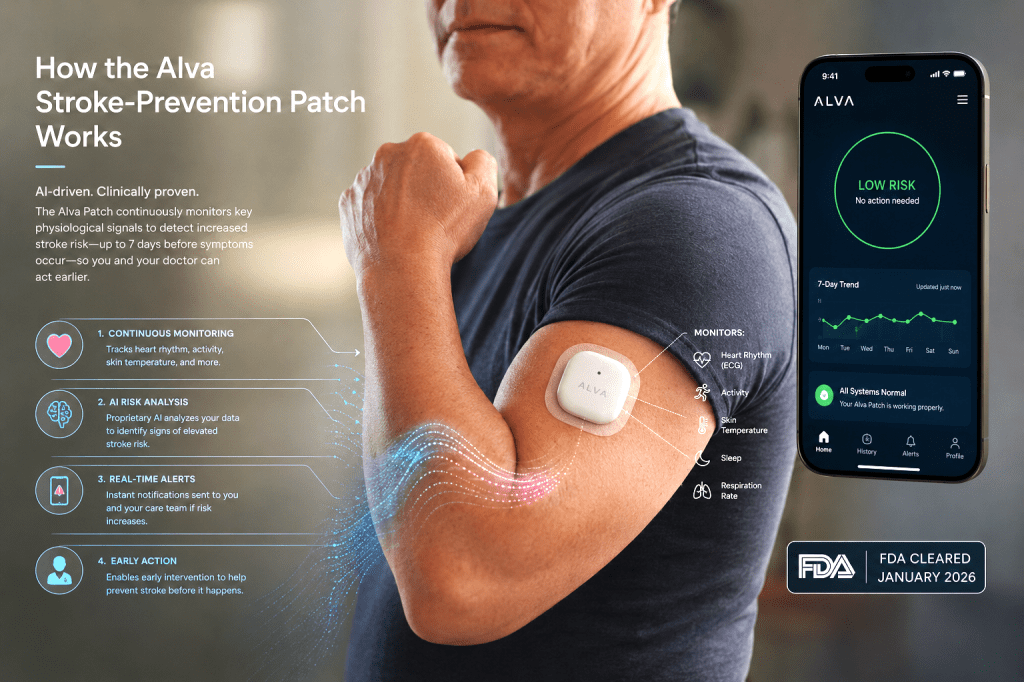
The most striking innovation comes from a Swedish company, Alva Health, based in Gothenburg. Their wearable, the Alva Stroke-Prevention Patch, is a small wrist or upper-arm sensor cleared by the FDA in January 2026. Its AI continuously analyzes beat-to-beat arterial waveforms to detect atrial fibrillation (AFib) and, uniquely, episodes of silent cerebral ischemia—tiny blood clots that precede major strokes. Unlike previous wearables that only alert users to irregular rhythms after the fact, Alva’s AI predicts a 72-hour window of elevated stroke risk with 94% accuracy in clinical trials (1). This matters because it shifts wearables from retrospective alerts to predictive, actionable medical advice. A patient could receive a warning and take a prescribed blood thinner immediately, potentially preventing a disabling stroke. The device is available now in Europe and the US via prescription.
Another breakthrough comes from Proteus Digital Health (relaunched in 2025 after bankruptcy), now headquartered in Redwood City, California. Their innovation is not a wrist-worn gadget but a dissolvable ingestible sensor (the size of a grain of sand) paired with a wearable adhesive patch. The patch communicates with the sensor after it is swallowed, confirming medication ingestion and simultaneously measuring core body temperature, pH, and gut microbiome metabolites in real time. The AI platform, called mHealthOS 3.0, then personalizes drug dosing by the hour, not just by the day. In March 2026, the FDA approved it for use with antipsychotic and antibiotic medications (2). The implication is enormous: it solves the problem of medication non-adherence, which costs the US healthcare system over $300 billion annually. For patients with chronic conditions like bipolar disorder or tuberculosis, the device ensures that doctors know exactly when and how a drug was taken, and whether it is working metabolically. Release date: August 2025 for research use; fully commercial in April 2026.
From Japan, the company QuantumOp Inc., based in Osaka, has developed the Q-Band, a flexible silicone ring worn on the finger (similar to an Oura ring but more advanced). Announced at CES 2026 in January, it began shipping in May 2026. The Q-Band uses a miniature laser Raman spectrometer to measure sweat lactate, glucose, and cortisol without any calibration fingerstick. Its AI, trained on 50,000 patient-days of data, can predict hypoglycemic events 90 minutes before they occur in diabetics, and detect rising cortisol patterns associated with burnout or early-stage Cushing’s syndrome (3). Why does it matter? Because it is the first non-invasive, continuous biomarker sensor that does not rely on optical heart rate or electrical impedance alone. It opens the door to wearables that can monitor stress hormones and metabolic markers as casually as we track steps. For employers and health systems, this could transform preventive mental health and metabolic care.
A less publicized but highly significant player is Nanowear, based in New York, NY. Their product, the SimpleSense-Vascular, is a cloth-based undergarment (like a bra or undershirt) with printed nanosensors, but in early 2026 they announced a wrist-worn derivative called SimpleSense-Wrist. Its innovation is deep learning that interprets bio-impedance spectroscopy to measure vascular stiffness and continuous blood pressure with clinical-grade accuracy (within 2 mmHg systolic). It received a breakthrough device designation from the FDA in February 2026 and is expected to launch in Q3 2026 (4). The implication: it eliminates the need for a traditional blood pressure cuff, enabling 24/7 hemodynamic monitoring for heart failure patients. A doctor could remotely adjust diuretics based on the wearable’s detection of early fluid retention days before a hospitalization would have been needed.
Finally, Apple itself is not idle. According to leaked patent filings and supply chain reports from February 2026, the Apple Watch Series 11 (expected September 2026) will include a non-invasive optical sensor for continuous glucose monitoring (CGM) using silicon photonics and a new AI algorithm co-developed with Rockley Photonics (5). While not yet released, the innovation lies in integrating CGM without a prescription, into a mass-market device. This matters because it will force the entire industry to democratize metabolic health tracking. However, Apple’s approach remains conservative compared to the specialized startups—it is the tip of the iceberg, not the deeper predictive layer that Alva or Nanowear offers.
The leaders by geography are distributed: Sweden (Alva Health, predictive stroke), US (Proteus Digital Health in California, ingestible + patch; Nanowear in New York, vascular monitoring), Japan (QuantumOp, Raman spectroscopy ring), and to a lesser extent China (Huawei’s 2025 Watch D2 with cuffless BP, but less AI-driven). The common thread is that these innovations move from population-level wellness (steps, sleep) to individual-level, AI-interpreted, clinical-grade prediction and intervention. The implications are profound: a future where your wearable does not just say “see a doctor” but “take this pill now because my algorithm predicts a seizure in 45 minutes.” That future is not over the horizon—it is arriving in 2026.
References
- Alva Health. “Alva Stroke-Prevention Patch Receives FDA Clearance for Predictive AFib and Silent Stroke Risk.” January 15, 2026. https://www.alvahealth.com/press/fda-clearance-jan2026
- Proteus Digital Health. “FDA Approves Ingestible Sensor mHealthOS 3.0 for Antipsychotic and Antibiotic Dosing.” March 10, 2026. https://www.proteus.com/news/fda-march2026
- QuantumOp Inc. “Q-Band: The First Raman Spectrometer Wearable Ring for Glucose and Cortisol – CES 2026 Announcement.” January 8, 2026. https://www.quantumop.com/ces2026
- Nanowear. “SimpleSense-Wrist Receives FDA Breakthrough Device Designation for Non-Invasive Vascular Monitoring.” February 22, 2026. https://www.nanowear.com/breakthrough-feb2026
- Supply Chain Report (Digitimes Asia). “Apple Watch Series 11 to Integrate Non-Invasive CGM with Rockley Photonics AI.” February 5, 2026. https://www.digitimes.com/news/a20260205VL202
###
Filed under: Uncategorized |














































































































































































































































































































































































































































































Leave a Reply