





By Jim Shimabukuro (assisted by Claude)
Editor
[Related: Evolution of Connectivism to the Age of AI: Downes and Siemens | cMOOC: Increasing Connectivist Overlap Into AI-Enhanced Education | A May 2026 Update on Downes and Siemens’ cMOOC]
Summary: Connectivism’s founders anticipated an era where learning is networked — and AI now makes those networks intelligent, adaptive, and globally scalable. –Copilot
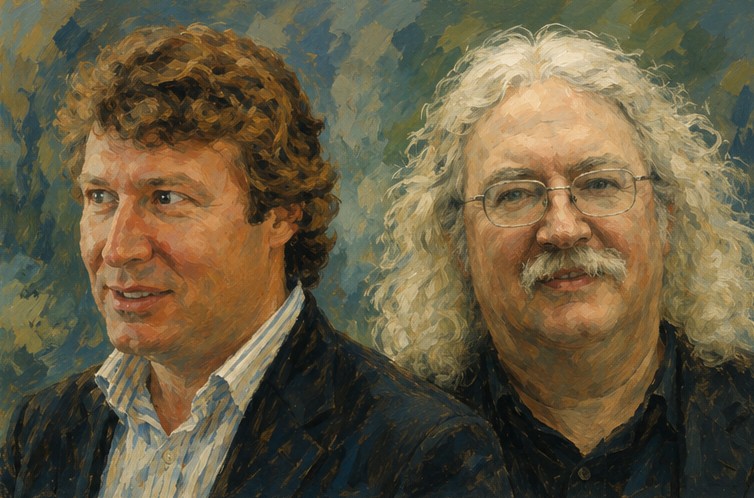
In 2008, George Siemens and Stephen Downes designed and taught the first connectivist MOOC — a course titled “Connectivism and Connective Knowledge” (CCK08) offered through the University of Manitoba — enrolling approximately 2,300 students and launching what would become a landmark in the history of open teaching (1,2). Their effort was grounded in a learning theory, connectivism, that Siemens had first articulated in a 2005 article in the International Journal of Instructional Technology and Distance Learning (3). Downes extended and deepened the theory in a series of papers and blog posts through his widely-read newsletter OLDaily, which he has published almost every weekday since the mid-1990s.
Connectivism holds that knowledge is distributed across a network of connections and that learning consists of the ability to construct and traverse those networks (2,3). The theory was conceived explicitly as an alternative to the three dominant paradigms that preceded it — behaviourism, cognitivism, and constructivism — all of which were developed before the internet reconfigured how information moves and how people encounter it (2). In Siemens’ formulation, learning may reside in non-human appliances, the capacity to know more is more critical than what is currently known, and the ability to see connections between fields and ideas is a core skill — propositions that would seem eerily prescient in the age of large language models (3,4).
The cMOOC (connectivist MOOC) that CCK08 exemplified is distinguished sharply from the institutional xMOOC model that Coursera, edX, and similar platforms popularised beginning in 2011–2012. In the cMOOC, the course is open, learner-generated, built around a diverse ecosystem of web tools, and premised on the idea that participants themselves largely create the content through networked interaction (2,5). The xMOOC, by contrast, follows a more traditional instructional structure — video lectures, fixed readings, machine-graded assessments — and has been criticised for replicating conventional pedagogy at scale without genuinely rethinking learning (5,6). Siemens himself distinguished the two, characterising xMOOCs as either instructivist or constructivist but not genuinely connectivist (5).
Evolution and Influence of the cMOOC Framework
The cMOOC model never achieved the mass enrolment numbers of institutional xMOOCs, yet its intellectual influence spread steadily and internationally. Research conducted in China and published in the Canadian Journal of Learning and Technology documented the design and delivery of six successive cMOOC offerings between 2018 and 2021, developed by the Distance Education Research Centre at Beijing Normal University under Downes’ direct involvement (4). That project employed large-scale data analytics — including social network analysis, text mining, epistemic network analysis, and behavioural sequence analysis — to study connectivist learning in practice, demonstrating how the original theoretical model could be operationalised in a large national higher-education system far removed from its Canadian origins (4).
Meanwhile, the broader MOOC landscape fractured into a taxonomy of hybrid forms. Researchers proposed the hMOOC (hybrid MOOC) and the ahMOOC (adaptive hybrid MOOC) as models that attempt to combine the social and participatory strengths of cMOOCs with the organisational clarity of xMOOCs (6). Studies on the MiriadaX platform found that a cooperation-oriented hybrid methodology — introducing elements of connectivist peer knowledge-sharing into an otherwise xMOOC structure — doubled completion rates compared with the platform average, a result that Downes himself noted on his website with evident satisfaction (7,6). The emergence of the tMOOC (transfer MOOC), sMOOC (social and seamless MOOC), bMOOC, and SPOC (small private online course) all reflect the generative pressure of the original cMOOC distinction: once researchers had a theoretical vocabulary for what was missing from xMOOCs, they began designing toward it (6).
Scholarly interest in cMOOC participation patterns has continued robustly into the mid-2020s. A 2025 study published in Interactive Learning Environments employed community detection algorithms and SIENA longitudinal network modelling to identify three distinct subcommunities — “budding,” “partially cohesive,” and “integrated” — within a cMOOC, and catalogued six social capital accumulation strategies that connectivist learners use: rational reciprocity, closed-loop reciprocity, relational bridging, influence-following, social connector engagement, and homophilic proximity (8). This level of analytical sophistication would have been impossible in 2008; the fact that it is now being applied to cMOOC environments signals that the model remains an active site of research rather than a historical curiosity.
Connectivism and the AI Explosion: Anticipation and Resonance
Perhaps the most striking feature of connectivism in retrospect is how closely its core metaphors anticipate the architecture of modern machine learning. Siemens and Downes proposed that knowledge “resides in non-human appliances,” that learning is a physical process of forming and adjusting network connections, and that the behaviour of any intelligent system emerges from the properties of its nodes and links rather than from a central representation (3,9). These are, almost verbatim, the operating assumptions of artificial neural networks. In a 2022 update to the theory published on his blog Half an Hour, Downes explicitly framed connectivism as a non-representational theory, arguing that there is no real concept of transferring, making, or building knowledge — rather, learning and knowing are descriptions of physical processes that happen in neural nets, biological or artificial, as they grow and develop based on experience (9). Critic Tony Bates, writing that same year, noted that Downes discussed how machines learn at length “without questioning whether this is the same or might be different from how humans learn” — a characterisation that, from the vantage of 2026, reads less as a criticism than as a sign that Downes was tracking developments most educators had not yet absorbed (9).
This resonance is not merely metaphorical. A November 2025 systematic review published in Innovation in Language Learning and Teaching and framed explicitly through connectivism found that AI tools — particularly large-language-model chatbots — “introduce an active AI node that routes, generates, and curates knowledge,” strengthening weak ties in human learning networks, accelerating feedback cycles, and expanding participation across contexts (10). The paper concluded that AI not only augments access but reconfigures the learning network itself, exactly the dynamic that Siemens and Downes described in 2005–2008 when they spoke of knowledge residing in non-human appliances and the importance of maintaining connections to external information sources (3,10).
Researchers studying AI integration in cMOOCs have found that generative AI can address one of the model’s longstanding practical weaknesses: the thin facilitation that preserves learner autonomy also tends to leave social and cognitive presence underdeveloped in large-scale settings. A 2025 paper in Computers and Education introduced a collaborative AI-in-the-loop workflow designed to enhance those presences in cMOOC discussion facilitation, treating the AI as an assistive actor within the connectivist network rather than as a replacement for peer interaction (11). A related preprint from 2026 tested a pedagogical conversational agent in a cMOOC context, finding that thoughtfully designed AI facilitation could strengthen both social presence and the depth of cognitive discourse without collapsing the learner autonomy that defines the cMOOC model (12).
The relationship is not without tension. Connectivism values diversity, autonomy, openness, and learner-generated connectivity — properties that large commercial AI platforms do not automatically exhibit. Downes, who has been outspoken on the risks of educational technology driven by commercial interests, has expressed concern about AI tools that centralise control and reduce learner agency, noting that a connectivist learning environment should grant the learner “autonomy within the environment” and that “personalization typically means less: fewer rules, fewer constraints” — a stance that sits uneasily with AI systems trained to deliver authoritative answers (13).
Stephen Downes Today: OLDaily, AI Ethics, and AI-Agnostic Assessment
As of May 2026, Stephen Downes remains exceptionally active. He continues to publish OLDaily almost every weekday — a practice he began in the mid-1990s — and the newsletter, which runs each entry at 100–200 words of original commentary on a resource he has read, carries a “100% human-authored” notice he added specifically to distinguish it from the AI-summarised curation tools that have proliferated in recent years (14). Downes is a Senior Researcher at Canada’s National Research Council, a position he has held for many years and from which he continues to shape policy and research agendas in online education.
In a September 2025 interview with AACE Review, Downes ranged widely across generative AI, assessment, authenticity, human consciousness, and the regulation of technology (14). The interview introduced the term he had recently coined: “AI-agnostic assessment” — the principle that educators should design genuine tasks and evaluate the quality of the outcome regardless of whether AI was used, because any task that can be “completed by passively watching or automatically summarising … probably wasn’t a learning task in the first place” (14). He called for education to abandon the model of content-delivery and proof-of-retention, replacing it with student-led advocacy campaigns, community problem-solving, scientific investigation, and design challenges that make the question of AI use beside the point (14). The same month, he appeared on the EduTrends Webcast produced by the Tecnológico de Monterrey’s Institute for the Future of Education, where he reiterated that learning is about building meaningful connections within networks of people, ideas, and technologies — while warning explicitly of the risks of over-reliance on AI in education (15).
In early 2026, he was interviewed by Geoff Cain for the Simon Says: Educate! podcast (Episode 61) on AI ethics in education, where he explored the extent to which ethics frameworks for AI reflect the values and assumptions of their creators rather than any neutral consensus (16). His OLDaily entries in April and May 2026 covered topics including bias taxonomies in scientific inquiry, the political economy of youth voice, and the epistemology of open educational practices — range that reflects his longstanding commitment to education as a philosophical enterprise rather than a technical one (17).
George Siemens Today: SNHU, Matter and Space, and Precision Learning
George Siemens has moved decisively into institutional AI leadership. He currently serves as Chief AI and Innovation Officer at Southern New Hampshire University (SNHU), one of the largest online universities in the United States, and is the co-founder and principal architect of Matter and Space — a human development platform that SNHU incubated and has since brought in-house (18,19). He simultaneously holds a professorship and directs the Centre for Change and Complexity in Learning (C3L) at the University of South Australia (Adelaide University), and is President of the Global Research Alliance for AI in Learning and Education (GRAILE) (18,20).
In a December 2025 interview with the Humanist newsletter, Siemens described the three domains around which Matter and Space organised its work: knowledge and skills (what most universities focus on), human skills (collaboration, communication, goal-pursuit), and well-being (physical, mental, and emotional wellness) (18). He argued that AI will play the largest role in the first bucket — helping learners navigate rapidly shifting skills landscapes — a more moderate role in the second, and a supporting but never dominant role in the third, where “wellness will always require deeply human anchoring” (18). He framed this in terms that echo, but also evolve, connectivism: the question for education is not merely how networks form but how they sustain human flourishing in conditions of radical uncertainty.
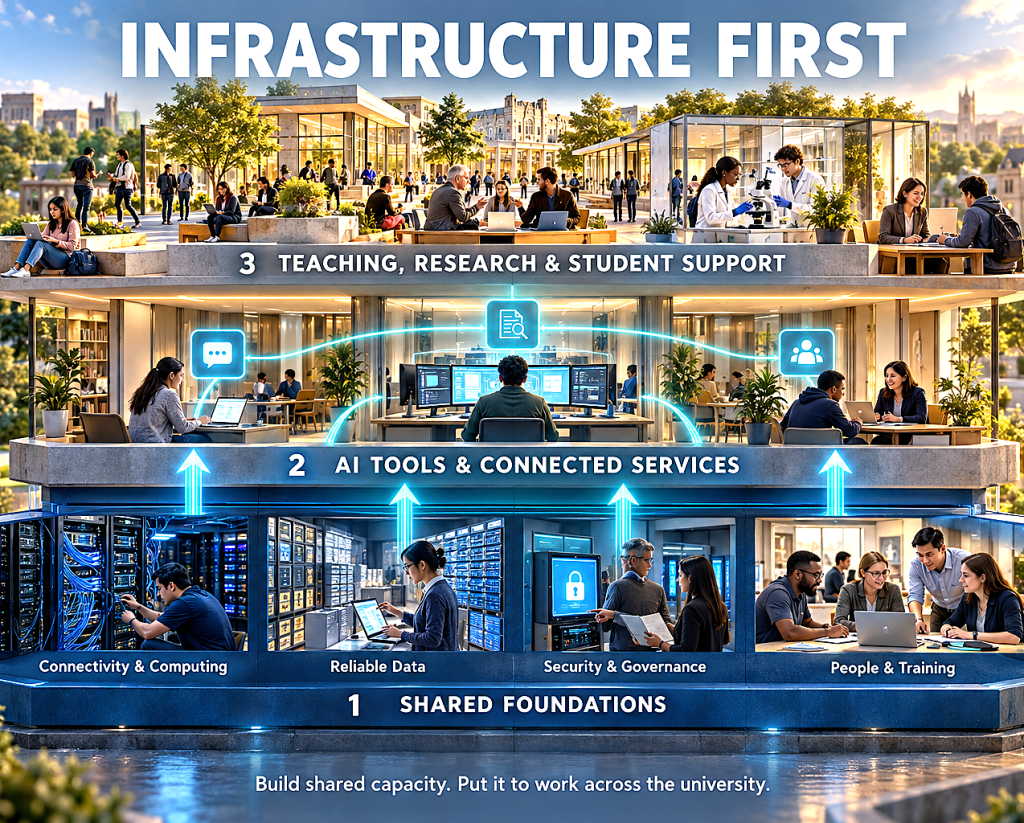
Siemens has been increasingly sharp in his criticism of higher education’s passivity before the AI industry. In the same interview, he argued that universities must stop renting tools that do not reflect their values and must begin building AI infrastructure as a public good, warning that academic leadership has been “asleep at the wheel” while “people with conclusions” sell services to institutions that have not defined what they want AI to do for them (18,19). He has called for universities to treat AI infrastructure as critical public infrastructure, comparable in importance to classrooms — and has insisted that students, especially those from historically underrepresented groups, must have an active voice in shaping those systems (18).
In a November 2025 article in EDUCAUSE Review co-authored with colleagues at SNHU, Siemens argued for moving from “personalized learning” to “precision learning” — a concept that uses AI to capture not just what students know but how they think, create, and adapt in real time, enabling performance-based assessment at scale (19,21). This framing extends the connectivist concern with learning as a dynamic, network-based process rather than a static accumulation of content, now operationalised through AI-driven analytics rather than peer-network interaction alone. He drew an explicit connection to the MOOC era: “Open educational resources scaled content. MOOCs scaled instruction. AI is our chance to scale meaningful engagement and assessment” (18).
Expert Commentary: Where Does cMOOC Stand in 2026?
Broader expert opinion on the legacy and current relevance of cMOOCs tends to acknowledge the theory’s conceptual generativity while remaining candid about its limited practical uptake in comparison with xMOOCs. A 2025 guide from Western Governors University described connectivism as “particularly relevant in today’s interconnected world” and as having anticipated how AI tools, search engines, and recommendation algorithms would become nodes in human learning networks (4,22). The eLearning Industry’s 2025 overview similarly noted that Downes’ emphasis on learning as distributed across a network of connections, with critical assessment of AI-generated knowledge as a core skill, has become more urgent rather than less as generative AI proliferates (23).
For his part, Downes has consistently resisted the framing that cMOOCs failed because they never scaled like Coursera. His position, articulated across decades of OLDaily commentary, is that the xMOOC model solved the wrong problem — delivering content at scale while leaving untouched the more fundamental question of whether content-delivery is the right model for education at all. The AI moment, in his view, makes this critique impossible to ignore: if a language model can pass every content-based assessment a university administers, then the university has been optimising for the wrong output for decades. AI-agnostic assessment is, in this framing, not a concession to AI but a vindication of the cMOOC’s original premise that authentic, networked, task-based learning was always the goal (14).
Tony Bates, one of the more penetrating critics of Downes’ theoretical formulations, has acknowledged the importance of connectivism as an attempt to build a learning theory genuinely fit for the 21st century, even while identifying what he sees as unresolved tensions in the theory’s mechanistic account of cognition (9). From the vantage of 2026, those tensions — between the human and the algorithmic, between learner autonomy and AI facilitation, between network emergence and institutional structure — are precisely the tensions that define the most contested debates in educational AI. In that sense, the cMOOC project has not been superseded; it has been absorbed into a larger argument whose stakes are higher than anyone imagined in 2008.
Conclusion
The cMOOC as a discrete course format remains a minority tradition in the MOOC landscape, consistently overshadowed by the instructivist xMOOC model in terms of enrolment and institutional adoption. Yet the theory of connectivism that it embodied has proven remarkably durable and increasingly resonant as artificial intelligence reshapes education. The claim that knowledge resides in non-human appliances, that learning is network formation, and that the capacity to traverse and evaluate connections matters more than static content acquisition now reads not as marginal provocation but as a description of the environment every student and educator inhabits.
Stephen Downes and George Siemens remain among the most visible and intellectually engaged figures in educational technology in 2026 — though their emphases have diverged. Downes continues to operate primarily as a public intellectual and critic, publishing daily commentary, coining new terms for the AI-in-education conversation, and insisting that the deepest lessons of connectivism are ethical and pedagogical rather than technical. Siemens has moved into institutional leadership and applied AI research, channelling the connectivist concern for networked, learner-centred education into platform design, precision learning systems, and advocacy for universities to build rather than merely buy their AI futures. Both trajectories can be read as extensions of the same 2008 wager: that networks — of people, ideas, and now machines — are the medium in which meaningful learning occurs, and that education will not become genuinely equitable or effective until it is designed around that fact.
References
1. Siemens, G. & Downes, S. (2008). Connectivism and Connective Knowledge (CCK08). University of Manitoba. [Historical course site; described in multiple secondary sources including https://donaldclarkplanb.blogspot.com/2015/12/downes-siemens-connectivismts-mooc-men.html%5D
2. Clark, D. (2015). Downes & Siemens — Connectivists & MOOC Men. Donald Clark Plan B. https://donaldclarkplanb.blogspot.com/2015/12/downes-siemens-connectivismts-mooc-men.html
3. Siemens, G. (2005). Connectivism: A learning theory for the digital age. International Journal of Instructional Technology and Distance Learning, 2(1), 3–10. [Archived at https://er.educause.edu/articles/2014/11/mooc-evolution-and-one-poetry-moocs-hybrid-approach%5D
4. Distance Education Research Centre MOOC Research Team / Beijing Normal University. (2022). Theoretical Development of Connectivism through Innovative Application in China. Canadian Journal of Learning and Technology, 48(4). https://files.eric.ed.gov/fulltext/EJ1374722.pdf
5. Wikipedia contributors. (2025). George Siemens. Wikipedia. https://en.wikipedia.org/wiki/George_Siemens
6. García-Peñalvo, F.J. et al. (2017). An adaptive hybrid MOOC model: Disrupting the MOOC concept in higher education. Telematics and Informatics. https://www.sciencedirect.com/science/article/abs/pii/S0736585317303453
7. Downes, S. (2025). Commentary on hybrid xMOOC/cMOOC completion rate research. OLDaily. https://www.downes.ca/post/65696
8. [Authors]. (2025). Diversified social capital accumulation strategies for cMOOC learners: a longitudinal analysis of interaction patterns. Interactive Learning Environments. https://www.tandfonline.com/doi/full/10.1080/10494820.2025.2535681
9. Bates, T. (2022). A review of Stephen Downes’ latest contribution to the theory of connectivism. TonyBates.ca. https://www.tonybates.ca/2022/02/27/a-review-of-stephen-downes-theory-of-connectivism/
10. [Authors]. (2025). Contemporary trends of AI-powered foreign language teaching: a systematic literature review from connectivism perspective. Innovation in Language Learning and Teaching. https://www.tandfonline.com/doi/full/10.1080/17501229.2025.2586144
11. Wang, C. et al. (2025). Collaborative AI-in-the-Loop pedagogical conversational agent to enhance social and cognitive presence in cMOOC. Computers & Education. https://www.sciencedirect.com/science/article/abs/pii/S0360131525002192
12. Wang, C. et al. (2026). Designing Human-GenAI Interaction for cMOOC Discussion Facilitation. arXiv preprint. https://arxiv.org/pdf/2603.29285
13. Downes, S. (2007). What Connectivism Is. Half an Hour / Downes.ca. https://www.downes.ca/post/38653
14. Panke, S. (2025). “If we want better AI, we have to become better people” – An Interview with Stephen Downes. AACE Review. https://aace.org/review/downes/
15. Institute for the Future of Education, Tecnológico de Monterrey. (2025). Learning Networks and the Age of AI with Stephen Downes. EduTrends Webcast / Observatory. https://observatory.tec.mx/edu-news/edu-media/learning-networks-and-the-age-of-ai-with-stephen-downes/
16. Cain, G. (Host). (2026). Unpacking the Ethics of AI in Education (Episode 61, with Stephen Downes). Simon Says: Educate! Referenced at: https://dawsonite.dawsoncollege.qc.ca/2026/02/unpacking-the-ethics-of-ai-in-education/
17. Downes, S. (2026). OLDaily. https://www.downes.ca/news/OLDaily.htm
18. Dulin Salisbury, A. (2025). George Siemens on Why Universities Must Stop Outsourcing AI—and Start Building It. The Humanist (Substack). https://humanistxyz.substack.com/p/george-siemens-on-why-universities
19. Gamby, T., Kil, D., Koblic, R., LeBlanc, P., Moldoveanu, M., & Siemens, G. (2025). From Personalized to Precision Learning: Unlocking the Next Transformation in Higher Education. EDUCAUSE Review. https://er.educause.edu/articles/2025/11/from-personalized-to-precision-learning-unlocking-the-next-transformation-in-higher-education
20. Adelaide University People Directory. (2025). Prof George Siemens, Professor and Director, Centre for Change and Complexity in Learning. https://people.unisa.edu.au/George.Siemens
21. ASU GSV Summit. (2025). Speaker Profile: George Siemens. https://www.asugsvsummit.com/speakers/george-siemens
22. Western Governors University. (2026). Connectivism Learning Theory: A Guide for Educators. WGU Blog. https://www.wgu.edu/blog/connectivism-learning-theory2105.html
23. eLearning Industry. (2025). Connectivism Learning Theory: Everything You Need To Know. https://elearningindustry.com/everything-you-need-to-know-about-the-connectivism-learning-theory
###
Filed under: Uncategorized |





























































































































































































































































































































































































Leave a Reply