



By Jim Shimabukuro (assisted by Claude)
Editor
Summary: Americans still converge on five bedrock liberties—speech, press, religion, assembly, and equal protection—revealing a deeper civic consensus beneath today’s partisan noise and reminding us that shared freedoms remain the country’s most durable source of unity. –Copilot

The United States turns 250 today in an argumentative mood. A national Elon University Poll released in June 2026 found that 69 percent of Americans believe the signers of the Declaration of Independence would feel more disappointment than pride in modern American democracy, and 73 percent rate the overall health of that democracy as only fair or poor. Yet the same survey found 68 percent proud to be American and 79 percent convinced that the United States plays a uniquely important role in world history (13). That combination, pride in the thing and worry about its condition, runs through nearly every measure of public opinion this anniversary year.
Ask Americans what still holds the country together, though, and the answer is remarkably consistent. In the AP-NORC America 250 Poll, conducted in April 2026 among 2,596 adults, “freedom or liberty” was the most common response when people were asked what unites Americans, just as it was when the question was asked a decade earlier (2). And beneath the noise of daily politics, a Kettering Foundation and Gallup study of more than 20,000 adults found broad common ground on the basics: 83 percent reject violence as a means of achieving political goals, 80 percent want leaders who compromise to get things done, and 84 percent say the country’s racial, religious and cultural diversity makes it stronger (4).
The five freedoms ranked below were chosen and ordered using that same public record: the share of Americans who call each one essential in recent surveys, the persistence of that support across party, age and region, and the weight each freedom carries in daily life. Reasonable people could reorder this list. Very few Americans, the data suggest, would strike anything from it.
First: Freedom of Speech
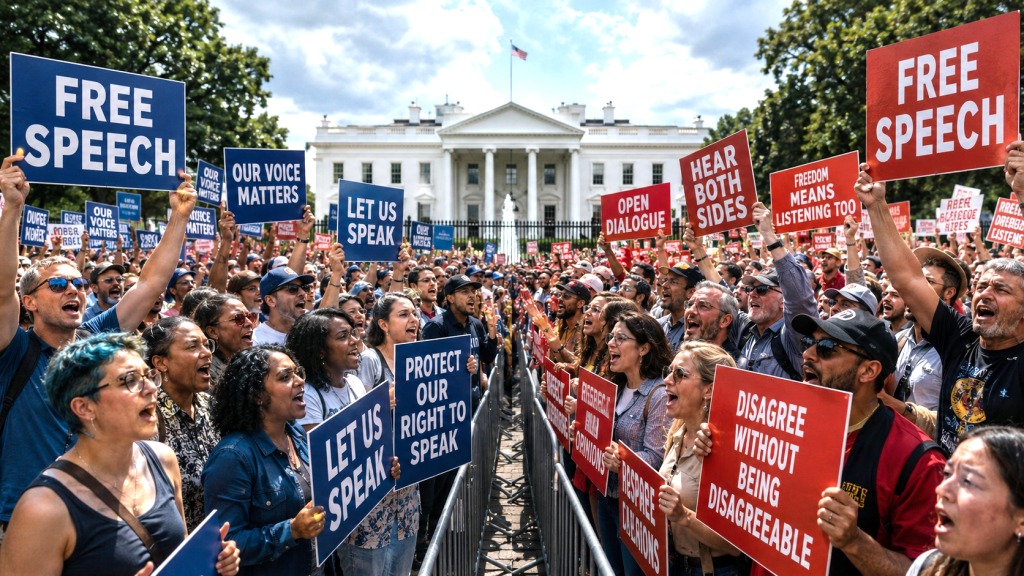
Freedom of speech is the First Amendment’s guarantee that government may not punish or silence you for what you think, say, write or publish. It covers political argument, protest, parody, art, religious expression and, above all, criticism of the people in power. It extends deliberately to speech that most people find wrong or offensive, because a right that protected only agreeable opinions would protect nothing. The guarantee restrains government at every level, from a city council to the White House. It does not shield a speaker from private disagreement, social consequences or a private employer’s displeasure, and it has recognized legal limits, including true threats, incitement to imminent violence and defamation. Its core principle is simple: the state does not get to pick winners in public debate.
No American freedom commands broader assent. In the AP-NORC America 250 Poll, 87 percent said freedom of speech is important to the country’s identity as a nation, the highest figure for any right tested (2). When Freedom Forum’s 2025 “Where America Stands” survey asked which of the five First Amendment freedoms is most essential, speech won by a landslide: 39 percent chose it, more than three times the share for any other freedom, and 64 percent said they would not change the amendment’s 45 words at all, up from 54 percent five years earlier (1). Pew Research Center found in 2025 that 62 percent of American adults consider it very important to be able to say what they want without government censorship, up six points from the year before (3).
The year before this anniversary supplied a vivid test case. In September 2025, after the chairman of the Federal Communications Commission publicly threatened regulatory consequences over remarks by late-night host Jimmy Kimmel, ABC suspended his program. The reaction crossed party lines: prominent conservatives joined civil libertarians in objecting to government pressure on a broadcaster over a monologue, and the show returned to the air within a week (10). The episode became a live civics lesson in the difference between a network’s business judgment and a government official’s threat, and the public reaction showed how deep the instinct against official censorship runs. Public opinion has also moved toward the courts’ long-standing position that even hateful speech is protected: the share of Americans who say preventing hate speech matters more than protecting free speech fell to 32 percent in 2025, the lowest since 2020, with the sharpest declines among the youngest adults (1).
Why does it come first? Because every other freedom on this list is defended with words. A citizen who cannot argue, petition, expose or object has no peaceful way to keep the vote honest, the church free, the courts fair or the press open. Free speech is how a self-governing people finds and fixes its mistakes. And agreement on the principle is not the same as security in practice: 65 percent of Americans still say something makes them afraid to speak freely, whether fear of violence, job loss or tension with family and friends, although the share who say “nothing keeps me from speaking freely” rose from 29 percent in 2024 to 35 percent in 2025 (1). Nearly half the country, 46 percent, believes free speech is currently under major threat (2). Americans agree on the freedom. They are less sure it is safe.
Second: The Right to Vote
The right to vote is the working machinery of the Declaration’s central claim, that governments derive their just powers from the consent of the governed. The original Constitution largely left the question of who could vote to the states, and the affirmative right Americans now take for granted was built over two centuries of struggle: the Fifteenth Amendment barred racial exclusion in 1870, the Nineteenth enfranchised women in 1920, the Twenty-Fourth abolished poll taxes in federal elections in 1964, the Twenty-Sixth lowered the voting age to 18 in 1971, and the Voting Rights Act of 1965 gave the promise federal teeth. The freedom is not merely the act of marking a ballot. It is the assurance that the ballot will be available, counted and capable of changing who governs.
Its standing with the public is essentially level with free speech. In the AP-NORC America 250 Poll, 86 percent of Americans said the right to vote is important to the nation’s identity, a single point behind speech and well within the poll’s margin of error (2). That figure holds across a country that agrees on little else about elections.
The agreement is over the right itself, not the rules around it, and the past year showed both halves clearly. The Voting Rights Act marked its 60th anniversary on August 6, 2025, with its remaining protections facing the most serious legal challenges in its history (11). On April 29, 2026, the Supreme Court decided Louisiana v. Callais, a 6 to 3 ruling that struck down Louisiana’s second majority-Black congressional district as a racial gerrymander and reworked the 40-year-old framework for enforcing Section 2 of the Act, making future vote-dilution claims substantially harder to win (12). Americans will argue fiercely about that decision, as they argue about voter identification, mail ballots and district maps. But notice the shape of the argument: it is about how voting should work, never about whether ordinary citizens should choose their leaders. The AP-NORC poll captured the same pattern, with the public split roughly into thirds on whether the right to vote faces a major threat, a minor threat or none at all, even as almost everyone affirmed the right’s importance (2).
The vote ranks second because it is the enforcement mechanism for everything else. Officials who ignore speech rights, religious liberty, due process or the press can be replaced only if elections are real. The franchise is also the American substitute for political violence, the reason disputes that would break other countries end here in concession speeches. A freedom that 86 percent of a famously divided people call essential to national identity, from a base of citizens who have watched contested elections, recounts and court fights up close, is not a fragile consensus. It is the load-bearing wall.
Third: Freedom of Religion
Religious freedom in America has two parts, both packed into the First Amendment’s opening words. The establishment clause forbids government from creating, funding or favoring an official church. The free exercise clause forbids government from punishing or burdening the practice of faith. Together they produce something rare in human history: a state with no religious test, where a citizen may worship in any tradition, change traditions or reject religion entirely, and where the government must stand back from all of those choices. George Washington described the aspiration in his 1790 letter to the Hebrew Congregation in Newport, promising a government that would give no sanction to bigotry and no assistance to persecution. The principle predates the Bill of Rights itself, running back through Virginia’s 1786 Statute for Religious Freedom.
Roughly eight in ten Americans say freedom of religion is important to the country’s identity, and notably, fewer Americans see it as facing a major threat than any other right the AP-NORC poll tested (2). In Freedom Forum’s 2025 survey it was the second most commonly named essential First Amendment freedom after speech (1). In a nation that now contains the world’s religious variety in a single citizenry, that level of agreement is an achievement, not an accident.
The freedom’s current controversies are mostly boundary disputes, and the Supreme Court decided a significant one in June 2025. In Mahmoud v. Taylor, a group of Muslim and Christian parents in Montgomery County, Maryland objected when their school district introduced storybooks addressing gender and sexuality in elementary classrooms and then eliminated the option to excuse children from those lessons. The Court ruled 6 to 3 that denying opt-outs unconstitutionally burdened the parents’ religious exercise, holding that policies posing a real threat of undermining the religious beliefs parents wish to instill must survive the most demanding constitutional scrutiny (6). Public opinion tracks the difficulty of the question rather than any hostility to the underlying right: 49 percent of Americans say parents should be able to opt young children out of certain books on religious grounds, a near-even split on the application, inside a broad consensus on the principle of free exercise itself (1).
Religious freedom matters because conscience is the part of a person that government can least legitimately command. History’s religious wars and state churches demonstrated the alternative. The clause protects the majority and the minority with the same words, which is why a Muslim father and a Catholic mother could stand together as plaintiffs in the same 2025 case, and why the atheist and the evangelical hold identical rights against the state. A country of 340 million believers, seekers, doubters and skeptics stays peaceful on questions that once burned cities largely because the government is required to leave the answers to its citizens.
Fourth: Due Process of Law
Due process is the Constitution’s promise, made twice, in the Fifth Amendment against the federal government and the Fourteenth against the states, that no person may be deprived of life, liberty or property without fair legal procedure. At its core it means notice of what the government intends to do to you, a genuine hearing before a neutral decision-maker, and rules applied equally rather than invented for the occasion. The text says “person,” not “citizen,” and courts have read it that way for more than a century. The idea is older than the country: it descends from Magna Carta’s 1215 pledge that no free man would be imprisoned except by the lawful judgment of his peers and the law of the land.
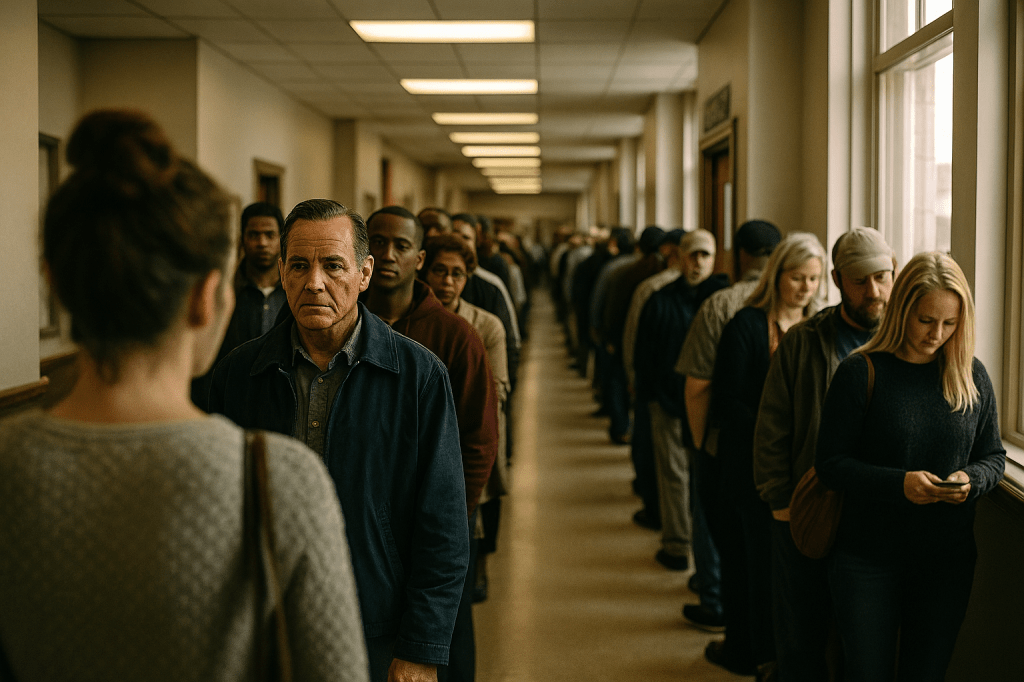
Because due process is procedural, it rarely gets celebrated on posters. Its depth of support shows when it is stressed, and 2025 stressed it. Even in the middle of the country’s bitter fight over immigration enforcement, a PRRI survey found 61 percent of Americans opposed deporting people to foreign prisons without allowing them to challenge their removal in court (8). A December 2025 poll reported by CalMatters found majorities across party lines, 84 percent of Democrats, 61 percent of independents and 54 percent of Republicans, agreeing that even a person with a criminal record deserves due process and the chance to have their case heard by a judge before deportation (15). When a principle survives contact with the most polarizing policy dispute of its moment, the agreement is real.
The year’s defining example was the case of Kilmar Abrego Garcia, a Maryland resident deported to a maximum-security prison in El Salvador in March 2025 despite a standing 2019 court order protecting him from removal to that country, and without any hearing. On April 10, 2025, the Supreme Court let stand a district court’s directive, writing that the order “properly requires the Government to ‘facilitate’ Abrego Garcia’s release from custody in El Salvador and to ensure that his case is handled as it would have been had he not been improperly sent to El Salvador” (7). Whatever one concludes about the man, and the government later brought criminal charges he continues to contest, the constitutional point drew no dissent: the state must follow its own rules even when pursuing people it insists are dangerous.
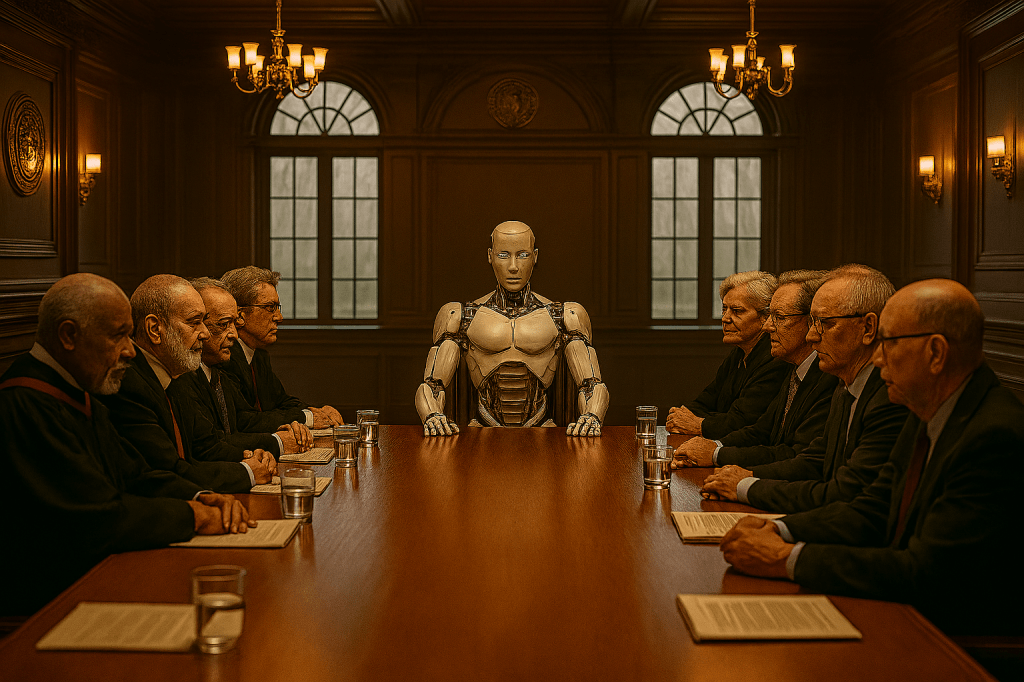
Due process matters because it is the working difference between law and raw power. Every other freedom in this essay is enforced through it; a right you cannot assert before a judge is a suggestion. Procedure protects the innocent from error and, just as important, makes punishment of the guilty legitimate, because a verdict reached fairly commands respect that a decree never will. Americans disagree about nearly every substantive policy. The demand to be heard before the government acts against you may be the closest thing the country has to a universal instinct.
Fifth: Freedom of the Press
Freedom of the press is the right to gather, report and publish information, especially about government, without official license, censorship or retaliation. The First Amendment names “the press” explicitly, the founders’ acknowledgment that self-government depends on citizens learning things officials would rather they not know. In practice the freedom belongs to everyone who publishes, from a national wire service to a local blogger, and its defining function is the watchdog role: examining power on behalf of the public that grants it.
Americans are famously unhappy with the media, and they still overwhelmingly want it free. Pew Research Center found in 2025 that 77 percent of U.S. adults say press freedom is extremely or very important to the well-being of society, and that seven in ten are at least somewhat concerned about potential restrictions on it, including 43 percent who are extremely or very concerned (9). Freedom Forum’s 2025 survey found 61 percent saying it is important for the press to act as a watchdog on government, up five points from the year before (1). The public plainly separates two judgments: distrust of particular coverage, which is widespread, and tolerance for government control of coverage, which is scarce.
The clearest recent test began with a style decision. In February 2025, the White House barred Associated Press reporters from the Oval Office and Air Force One because the AP continued to use the name “Gulf of Mexico” after an executive order renamed the body of water. In April, a federal judge ordered access restored, writing that “under the First Amendment, if the government opens its doors to some journalists — be it to the Oval Office, the East Room, or elsewhere — it cannot then shut those doors to other journalists because of their viewpoints” (5). An appeals court later allowed the White House to reimpose some restrictions while the case continued (14). However the litigation ends, the dispute itself, a news organization suing the government over two words and pressing the case for more than a year, is the freedom working as designed.
A free press matters because voters cannot supervise what they cannot see. Budgets, wars, indictments, inspections and failures become public knowledge almost entirely because someone whose job is asking questions is legally protected while asking them. The freedom ranks fifth here not because it is less essential but because Americans quarrel more over its application than over any other right on this list. Yet the quarrels prove the consensus: each party has spent recent years accusing the other of menacing the press, which means both, at least rhetorically, accept that menacing the press is the offense. A right that 77 percent of a media-weary country still calls essential to society’s well-being has earned its place among the five.
The Common Ground, and the Work
Set side by side, the surveys of 2025 and 2026 tell a consistent story. Americans argue about applications and agree about principles. Nearly nine in ten affirm free speech and the vote; eight in ten affirm religious liberty; strong majorities across party lines insist on a day in court and a press free of government control (1,2,8,9). At the same time, nearly half the country believes the most cherished of these freedoms is under major threat (2), and most Americans would rather spend this anniversary reflecting on the country’s values than simply celebrating them (13).
That instinct is sound. The journalist John Seigenthaler liked to say that these freedoms “are never safe, never secure, but always in the process of being made safe and secure” (1). The 250th anniversary is best understood not as a victory lap but as a maintenance call. The freedoms above were not given; they were claimed, extended, litigated and defended, generation by generation, and they persist only in use. Speak. Vote. Worship or decline to. Insist on the hearing. Read the reporting. That is how a 250-year-old promise gets kept for the next 250.
References
1. Freedom Forum, “Where America Stands on the First Amendment: Key Takeaways” (September 25, 2025). https://www.freedomforum.org/2025-where-america-stands-survey-takeaways/
2. AP-NORC Center for Public Affairs Research, “AP-NORC America 250 Poll” (June 2026). https://apnorc.org/projects/ap-norc-america-250-poll/
3. Pew Research Center, “Free Expression Seen as Important Globally, but Not Everyone Thinks Their Country Has Press, Speech and Internet Freedoms” (April 24, 2025). https://www.pewresearch.org/global/2025/04/24/free-expression-seen-as-important-globally-but-not-everyone-thinks-their-country-has-press-speech-and-internet-freedoms/
4. Gallup and Kettering Foundation, “Americans Show Consensus on Many Democracy-Related Matters.” https://news.gallup.com/poll/696494/americans-show-consensus-democracy-related-matters.aspx
5. NPR, “Judge orders White House to give AP access to Oval Office” (April 8, 2025). https://www.npr.org/2025/04/08/nx-s1-5342369/ap-white-house-court-ruling-oval-office-gulf-of-mexico-america
6. Supreme Court of the United States, Mahmoud v. Taylor, slip opinion (June 27, 2025). https://www.supremecourt.gov/opinions/24pdf/24-297_4f14.pdf
7. NPR, “Supreme Court says Trump officials should help return wrongly deported Maryland man” (April 10, 2025). https://www.npr.org/2025/04/10/nx-s1-5358421/supreme-court-abrego-garcia-deportation-decision
8. PRRI, “New PRRI Poll: Six in Ten Americans Oppose Exporting Undocumented Immigrants to Foreign Prisons Without Due Process” (2025). https://prri.org/spotlight/new-prri-poll-six-in-ten-americans-oppose-exporting-undocumented-immigrants-to-foreign-prisons-without-due-process/
9. Pew Research Center, “Americans remain concerned about press freedoms, but partisan views have flipped since 2024” (April 24, 2025). https://www.pewresearch.org/short-reads/2025/04/24/americans-remain-concerned-about-press-freedoms-but-partisan-views-have-flipped-since-2024/
10. Brookings Institution, “Beyond Kimmel, the FCC controversy exposes a larger struggle over free speech” (2025). https://www.brookings.edu/articles/beyond-kimmel-the-fcc-controversy-exposes-a-larger-struggle-over-free-speech/
11. NPR, “Voting Rights Act of 1965 faces new threats to survival” (August 6, 2025). https://www.npr.org/2025/08/06/nx-s1-5482864/scotus-voting-rights-act-8th-circuit-vra
12. SCOTUSblog, “How Callais broke the Voting Rights Act and weaponized the equal protection clause: part 1” (May 2026). https://www.scotusblog.com/2026/05/how-callais-broke-the-voting-rights-act-and-weaponized-the-equal-protection-clause-part-1/
13. Elon University Poll, “A proud but deeply uneasy public as America celebrates 250th” (June 2, 2026). https://www.elon.edu/u/news/2026/06/02/elon-poll-a-proud-but-deeply-uneasy-public-as-america-celebrates-250th/
14. JURIST, “US federal court upholds White House restrictions on Associated Press” (June 2025). https://www.jurist.org/news/2025/06/federal-court-upholds-white-house-restrictions-on-associated-press/
15. CalMatters, “‘We may be deporting the wrong people’: New poll shows doubts about immigration crackdown” (December 2025). https://calmatters.org/justice/2025/12/immigration-poll-criminal-record/
Filed under: Uncategorized |


































































































































































































































































































































































































Leave a Reply