






By Jim Shimabukuro (assisted by ChatGPT)
Editor
Summary: The race to crown Earth’s oldest tree is still unresolved, and the real story is how a single living organism can force scientists to rethink age, resilience, and conservation. –Perplexity
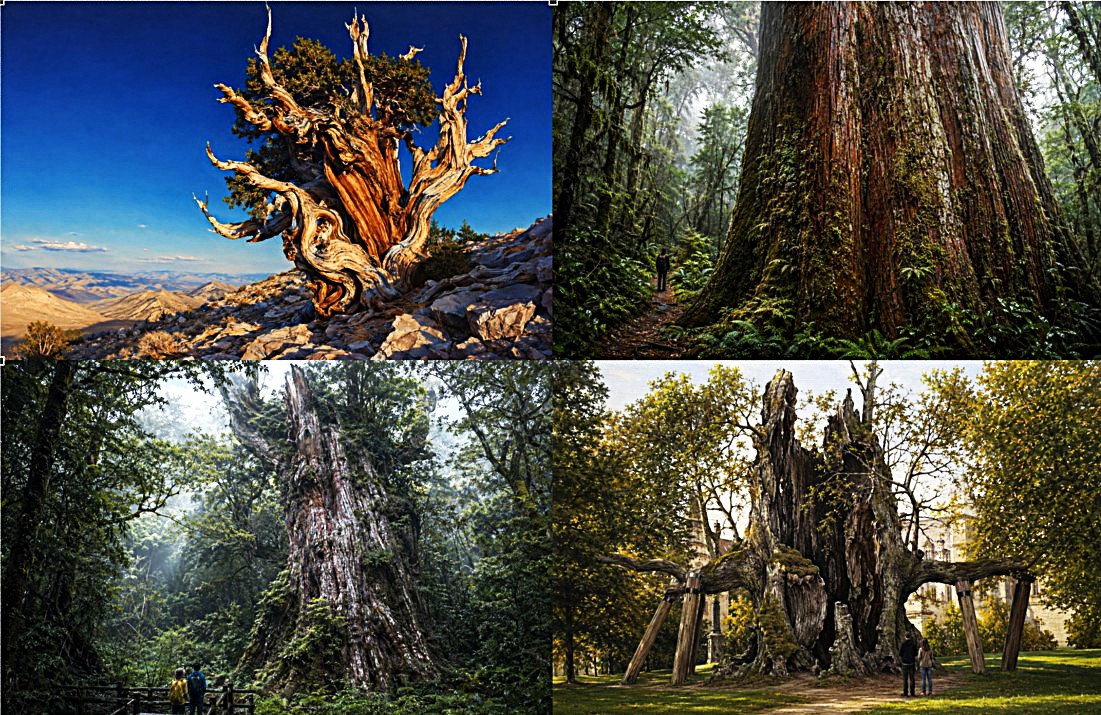
What does “oldest” mean when the subject is a tree? A person has one body and one birthday. A tree can be less cooperative. Its center may rot away while a living shell keeps growing. Its trunk may die and be replaced by a genetically identical shoot from the same roots. A famous specimen may carry a planting story that is older than the surviving wood—or a ring record that begins centuries after the seed first opened. This is why lists of the “world’s oldest trees” so often disagree without any of them being wholly dishonest.
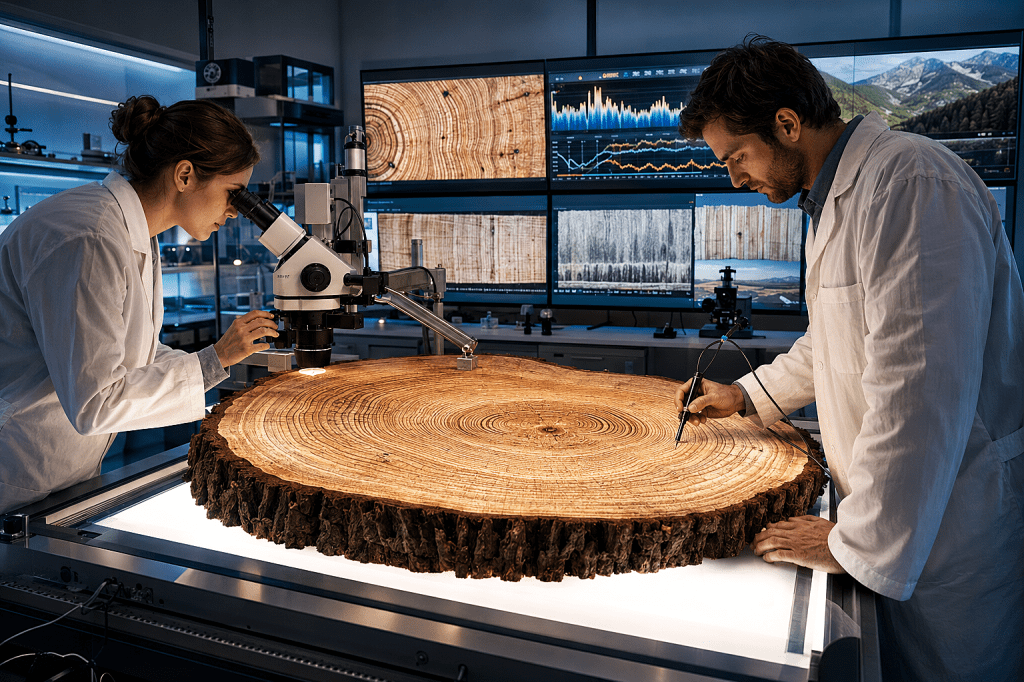
The strongest ages usually come from crossdated annual rings: researchers match wide and narrow ring patterns among trees from the same region, much as one might align fingerprints. Even then, the oldest recovered ring normally gives a minimum age, because a core may miss the exact point where the tree germinated. Other ages come from a simple ring count, radiocarbon dating, a mathematical extrapolation, or a historical record. Rocky Mountain Tree-Ring Research’s OldList keeps these categories separate for precisely that reason. It even removes celebrated record-holders when the underlying sample can no longer be independently confirmed. [2]
Rarity is the first lesson. A global study combined 197,855 tree cores from 4,854 sites with other scientifically dated records from 156 more. Among the trees in that immense survey, only 30 individuals exceeded 2,000 years—and 27 of those grew in high mountains. Cold, dryness, altitude, and distance from people can be brutal conditions for growth, yet they can also reduce fire, rot, competition, and logging. The oldest trees often survive not by growing faster, but by living where almost nothing happens quickly. [1]
The ten selections that follow therefore are not a rigid countdown. They are ten different answers to the same irresistible question. Some are well-supported biological elders. Some are plausible estimates. One is a clone whose advertised age is debated. One has a planting date carried through human history. And the last—the extraordinary Czech linden that inspired this search—is younger than the others but a master class in how an injured tree can rebuild itself.
A reader’s guide to the age claims
| Tree | Place | Published age | What supports it |
| Old Tjikko | Sweden | 9,550-year root lineage | Radiocarbon-associated clone; continuity disputed |
| Methuselah | United States | About 4,850 years | Tree-ring evidence; confirmed living individual |
| Gran Abuelo | Chile | 5,484 years proposed | 2,400-ring partial core plus statistical model |
| Sarv-e Abarkuh | Iran | About 4,000 years | Expert estimate; exact age undetermined |
| Llangernyw Yew | Wales, UK | 1,500–5,000 years | Competing estimates; hollow fragmented trunk |
| Olive of Vouves | Greece | 3,000–5,000 years claimed | Estimate; heartwood loss prevents certainty |
| Jōmon Sugi | Japan | At least 2,000; up to 7,200 claimed | Branch rings support the lower bound |
| Black River bald cypress | United States | At least 2,624 in 2018 | Crossdating plus radiocarbon confirmation |
| Jaya Sri Maha Bodhi | Sri Lanka | Planted 288 BCE | Continuous historical planting record |
| Kamenice linden | Czech Republic | About 700–800 years | Heritage-tree estimate |
Note: Age ranges are reported claims, not interchangeable measurements. “Confirmed” here means supported by reproducible tree-ring or equivalent evidence in the cited specialist sources.
1. Old Tjikko: Sweden’s 9,550-year question
FULUFJÄLLET, SWEDEN | NORWAY SPRUCE | CLONAL-LINEAGE CLAIM
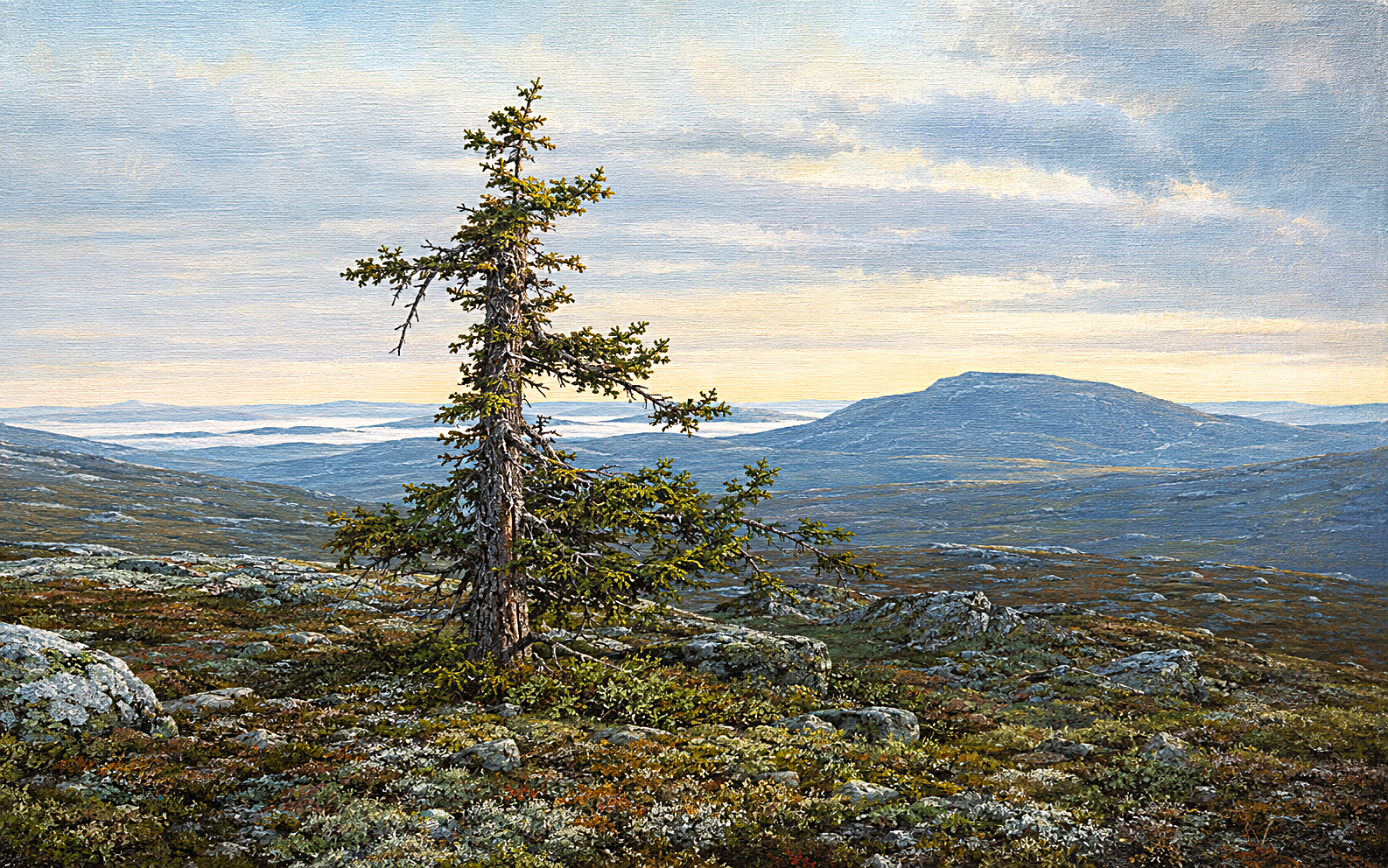
Old Tjikko may be the most useful tree with which to begin, because it exposes the hidden argument inside the word “tree.” Sweden’s national-parks authority calls it the world’s oldest known tree clone and gives its root system an age of 9,550 years. The visible spruce on Fulufjället is not a 9,550-year-old trunk. It is the latest above-ground expression of a plant that is said to have persisted through repeated renewal since the early Holocene, when the last ice sheet had only recently retreated. [3]
A Norway spruce can reproduce by layering: snow presses a low branch against the ground, the branch forms roots, and a new stem grows while older wood dies. Seen this way, Old Tjikko is less like one ancient column and more like a flame passed from wick to wick. The present trunk is comparatively young; the claimed antiquity belongs to the continuing organism beneath and around it.
Yet the headline deserves an asterisk. OldList does not accept Old Tjikko as a confirmed 9,550-year-old tree. Its editor notes that the old radiocarbon-dated wood found at the base has not been shown to be genetically continuous with the living stem. Without that bridge of evidence, ancient wood beside a living spruce is not necessarily ancient wood from the same enduring individual. [2]
That disagreement does not make Old Tjikko a fraud. It makes the spruce a fascinating boundary case. If identity resides in uninterrupted roots and genes, the clonal claim may be persuasive. If a tree must be a single, continuously surviving stem—or if genetic continuity must be demonstrated—Methuselah has the firmer title. Old Tjikko’s real gift is not a clean record. It is the question it leaves rooted in the mountain: how much may a living thing replace before it becomes something new?
Dating note: why “minimum age” matters
A core can be perfectly crossdated and still understate a tree’s true age. The drill may pass above the original root collar, miss the pith, or begin after the seedling had already lived for years. OldList therefore treats many ring-based ages as minimums: the sampled wood is at least that old, while the organism may be older. [2]
The reverse problem appears when missing rings are supplied by a model. Extrapolation may offer a sensible range, but its answer depends on assumptions about growth in centuries no instrument reached. A precise-looking estimate should never be mistaken for a complete count.
2. Methuselah: the old pine nobody can point out
WHITE MOUNTAINS, CALIFORNIA | GREAT BASIN BRISTLECONE PINE | RING-DATED INDIVIDUAL

Somewhere among the pale rock and hard light of California’s White Mountains stands a Great Basin bristlecone pine known as Methuselah. Its exact location is not advertised. Visitors may walk among trees more than 4,000 years old, but the celebrity is deliberately allowed to hide in the crowd. The U.S. Forest Service describes the grove’s living pines as the oldest trees in the world; tree-ring sources place Methuselah at roughly 4,850 years, making it the best-supported claimant among living, nonclonal individuals. [4,5]
The setting explains part of the miracle. These pines grow high above comfortable forest country in cold, dry, wind-scoured terrain. The soil is poor, the growing season short, and yearly growth can be almost miserly. That hardship keeps the wood dense and slows the organism’s entire metabolism. Sparse vegetation also means less fuel for catastrophic fire. A bristlecone can lose bark and living tissue until only a narrow ribbon connects roots to a small spray of needles, while the exposed deadwood twists into polished amber sculpture.
Its rings are more than a birthday ledger. Because annual growth responds to temperature and moisture, long bristlecone chronologies help researchers date old wood and reconstruct past climates. A tree that seems half dead may be carrying a nearly year-by-year environmental record from before the pyramids at Giza were finished.
The protected location also acknowledges a paradox of fame. Naming an ancient tree can help people value it, but publicity can deliver trampling, souvenirs, vandalism, and fire. Methuselah survives partly because the public is invited to meet its community rather than demand a selfie with one marked trunk. It is a celebrity whose best security system is anonymity.
3. Gran Abuelo: the contender in the Chilean rain
ALERCE COSTERO, CHILE | PATAGONIAN CYPRESS | MODELLED AGE
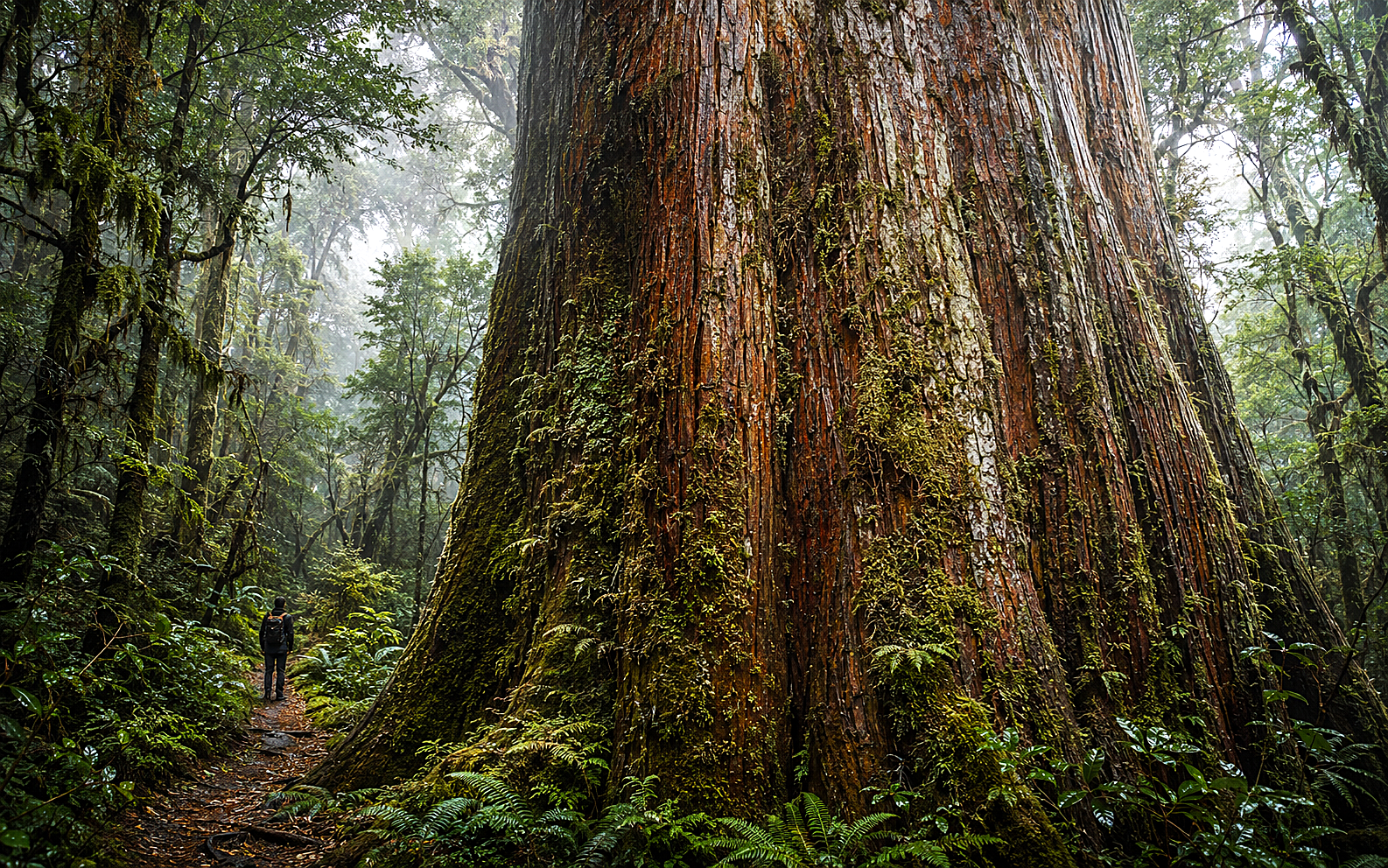
Gran Abuelo—“Great-Grandfather”—stands in a fern-dark ravine in Chile’s Alerce Costero National Park. Its species, Fitzroya cupressoides, grows with extraordinary slowness and can survive for millennia. In 2020, Jonathan Barichivich and Antonio Lara extracted a narrow core. The borer reached only partway into the immense trunk, but the sample still contained about 2,400 rings. [6]
To estimate the missing center, Barichivich used growth records from other alerces and modeled thousands of possible life histories. The result was irresistible to headline writers: a most likely age of 5,484 years and an 80 percent probability that the tree is older than 5,000. If confirmed, Gran Abuelo could surpass Methuselah as the oldest known living nonclonal tree. But the model has not replaced a complete, independently checkable ring series. Tree-ring specialists quoted by Smithsonian emphasized that every ring must be present or accounted for before an age can be treated as definitive. [6]
The uncertainty is not a failure. A complete core might require drilling farther into fragile, partly decayed wood than conservation permits. Barichivich put the ethical choice plainly: “The objective is to protect the tree, not to make headlines or break records.” The less invasive method leaves room for doubt, but it may also leave more of the tree alive. [6]
That matters because visitors have walked over Gran Abuelo’s roots and compacted the soil around them. A drying climate adds another strain. The argument over 5,484 years can distract from the fact that even the measured portion of the core makes this a biological archive of astonishing depth. Whether Great-Grandfather is first or second, the urgent question is not how to crown it. It is how to avoid becoming the generation that finally exhausts it.
4. Sarv-e Abarkuh: a green monument in Iran’s dry heart
ABARKUH, IRAN | MEDITERRANEAN CYPRESS | EXPERT ESTIMATE
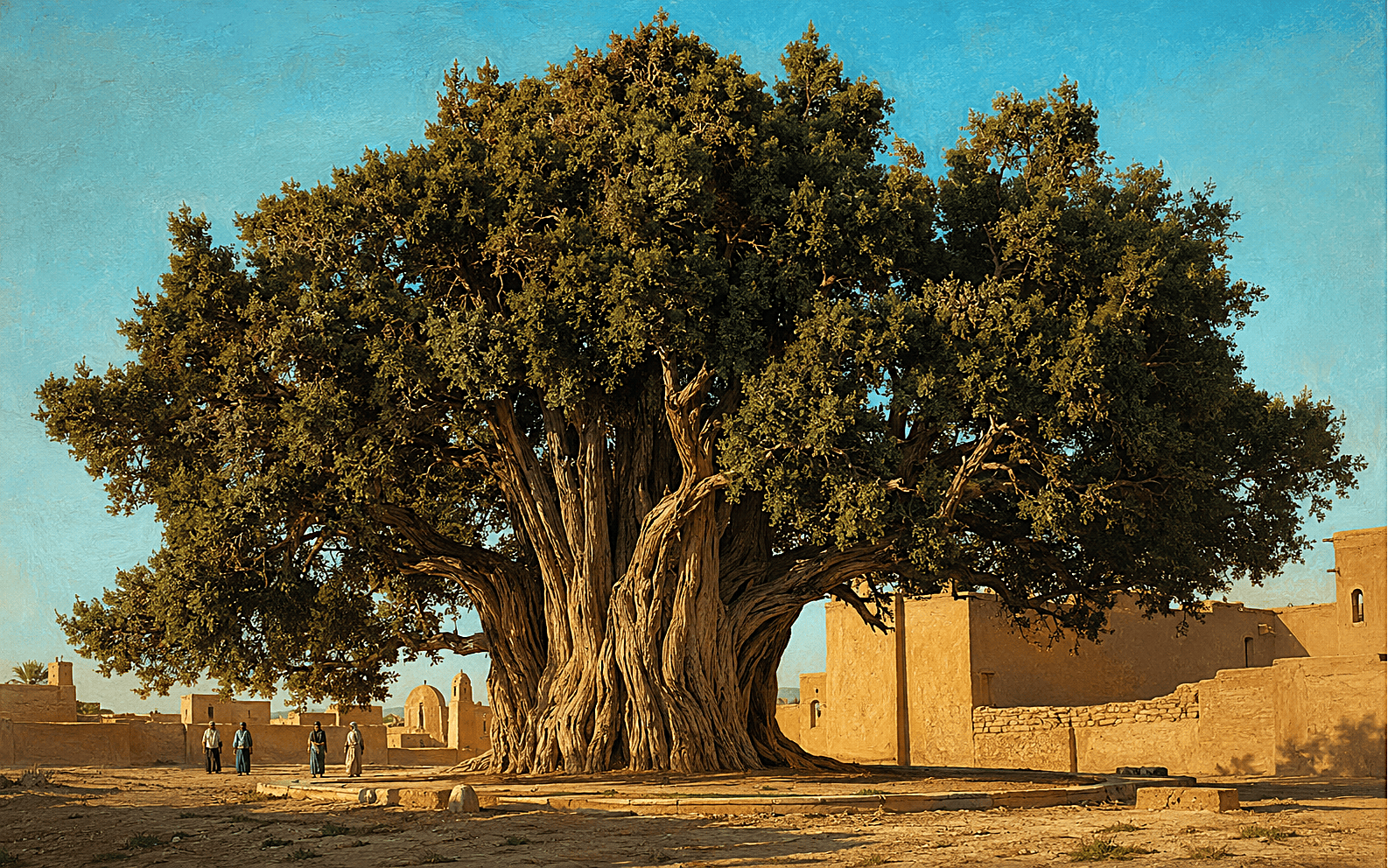
In the dry interior of Iran, the cypress of Abarkuh does not resemble a battered remnant clinging to life. It rises about 25 meters and spreads a generous evergreen crown over a trunk whose perimeter is reported at 11.5 meters. Iran’s nomination of its long-lived trees to UNESCO’s World Heritage Tentative List calls this cypress the country’s oldest and estimates it at about 4,000 years. The same source is careful to say that the exact age has been difficult to determine. [7]
The Persian cypress is built for symbolic work. Evergreen foliage suggests endurance; an upright form suggests freedom and moral strength. Cypress shapes appear throughout Persian gardens, carpets, poetry, and decorative arts. Sarv-e Abarkuh carries that cultural vocabulary into living wood.
A popular legend says Zoroaster planted the tree. The story is part of its identity, but it is not a planting certificate. Unlike annual rings that can be cross-matched or a dated historical record, legend tells us what generations believed the tree meant. Both kinds of knowledge matter, provided they are not confused.
Its presence also complicates the scientific pattern that sends so many ancient trees into remote mountains. This one lives beside a human settlement. Its survival may owe something to favorable local conditions, but also to reverence—to the long decision not to cut it. That makes Sarv-e Abarkuh an ancient natural object and an ancient human agreement. Every generation has inherited a large, useful tree and, so far, has passed it forward.
5. The Llangernyw Yew: four trunks and several possible birthdays
CONWY, WALES | COMMON YEW | WIDE, DISPUTED RANGE
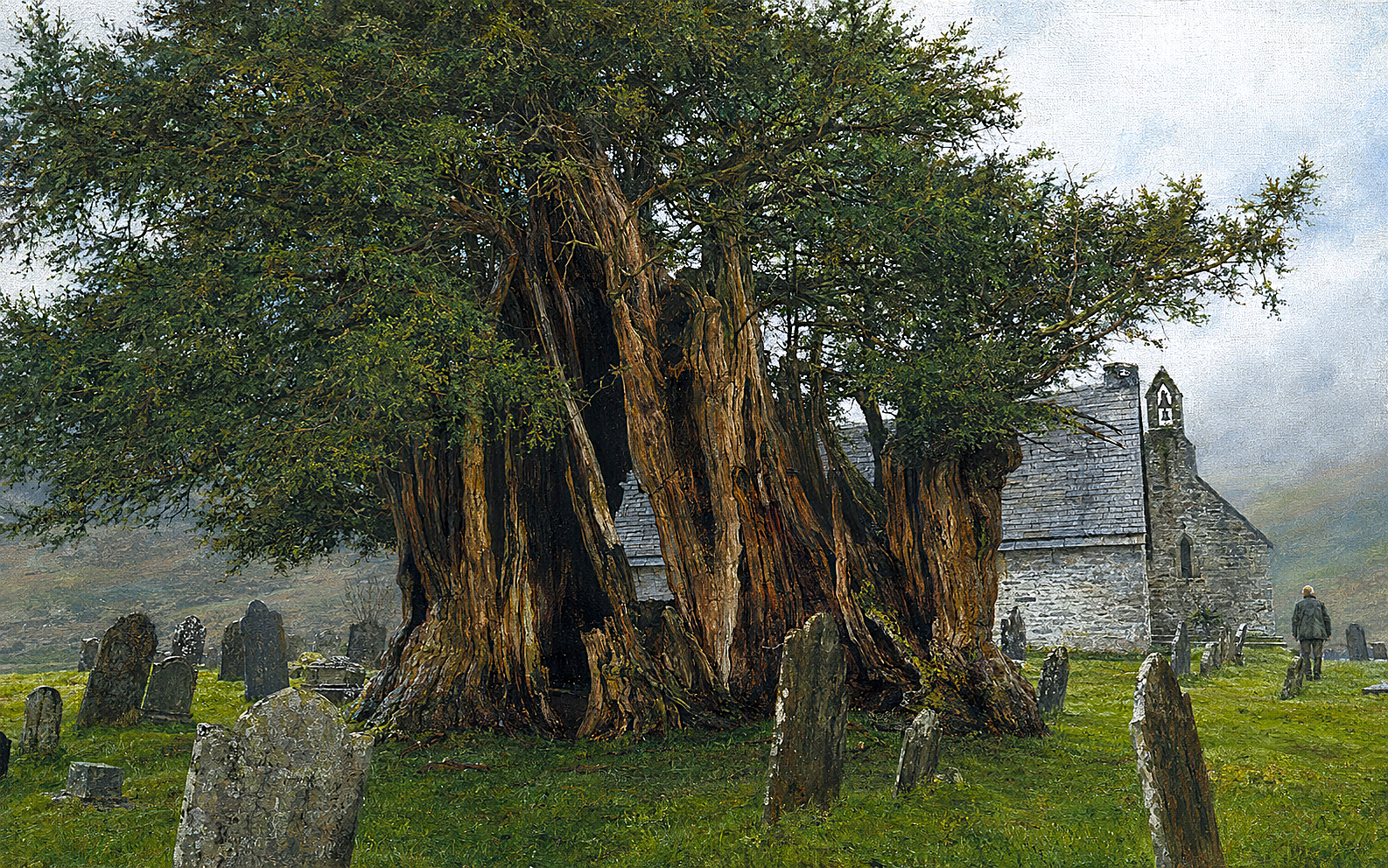
In the churchyard of St. Digain in north Wales, four massive pieces of yew stand around an open center. The heartwood that might have settled the tree’s birthday is gone. Some claims put the Llangernyw Yew between 4,000 and 5,000 years old; a more conservative interpretation makes it closer to the age of the early church, perhaps about 1,500. The Woodland Trust reports both possibilities rather than pretending the argument is finished. [8]
The yew itself seems designed to defeat tidy measurement. Fungi hollow old trunks and erase ring sequences. Meanwhile, the tree can rejuvenate: new growth forms around fractures, and aerial roots descend inside the cavity, sometimes becoming trunk-like supports. What looks like ruin may be the mechanism of survival. The tree’s girth near the base is about 10.9 meters, but the open center makes a simple circumference-to-age formula especially unreliable. [8]
Yews and churchyards have become inseparable in the British imagination. Many of the oldest yews predate the buildings beside them. Sacred sites may have been reused across religious eras; practical motives mattered too, since poisonous foliage could be kept away from grazing livestock while useful wood remained available for bows. Over centuries, the association with death and renewal deepened.
The uncertainty is part of the atmosphere. A firm 4,500 printed on a sign would feel satisfying, but the living evidence is more interesting: a tree can become hollow, split into fragments, and still cast one shade. Llangernyw’s age may never be compressed into a single trustworthy number. Its form is the better testimony.
How can a hollow tree remain alive?
Most of a tree’s transport and growth occur in comparatively young tissues near the outside of the trunk. The central heartwood can decay while an unbroken living shell continues to move water, make new wood, and support a crown. A hollow is therefore not a death certificate.
For an ancient yew or linden, the cavity can even become a workshop for renewal. Roots descend through the protected interior, new stems thicken, and the load is redistributed. The resulting organism may be harder to date and harder to recognize as one tree—but better equipped to outlast the solid trunk it once possessed.
6. The Olive Tree of Vouves: still bearing fruit after millennia
CRETE, GREECE | OLIVE | ESTIMATED AGE

The monumental olive at Ano Vouves, Crete, is proof that usefulness and antiquity need not be enemies. Its trunk has become a 12.5-meter spiral of ridges, hollows, and fused wood, yet the crown still bears olives. The local museum reports an estimated age of 3,000 to 5,000 years while acknowledging that scientists cannot be certain. [9]
Old olives are notoriously hard to date. The central wood disappears, trunks divide and rejoin, and human cultivation adds another layer of complexity. The Vouves tree began on wild olive stock and was grafted with a cultivated variety. Is its age the age of the rootstock, the trunk, the grafted crown, or the living system that joins them? Once again, the organism is older than our categories.
The tree has also crossed the line from agriculture into ceremony. Branches from Vouves supplied wreaths associated with the men’s marathon champions at the 2004 Athens and 2008 Beijing Olympic Games. The gesture reconnected a modern global spectacle with the olive wreaths of Greek antiquity. The museum’s page quotes the poet Theodosis Pieridis hearing in the tree “the buzz of the centuries that formed it.” [9]
That phrase suits the trunk. It does not look like an untouched column preserved from the Bronze Age. It looks worked upon—by drought, pruning, harvesting, grafting, wind, and the repeated attention of people. Its longevity is not isolation from human life but a long partnership with it.
7. Jōmon Sugi: the cedar at the end of a ten-hour walk
YAKUSHIMA, JAPAN | JAPANESE CEDAR | LOWER BOUND PLUS BROAD ESTIMATE

Jōmon Sugi is not easily met. Reaching the famous Japanese cedar on Yakushima generally requires a hike of about ten hours, and the final view comes from an observation deck 15 meters away. The distance is deliberate. When fame sent more visitors into the forest, roots and soil needed protection. [10]
The tree is 25.3 meters tall and 16.4 meters around. Its published age range—2,000 to 7,200 years—is so broad that it can seem almost comic. The lower figure has firmer footing: dendrochronology performed on branches indicated at least 2,000 years. The upper end is a prediction built around the size and character of a tree whose center cannot be read like a fresh-cut stump. [10]
Its name reaches toward Japan’s Jōmon period, a long prehistoric era, and the tree’s appearance makes the association easy to feel. The trunk is thick, irregular, and crowded with other life; in Yakushima’s wet climate, mosses and epiphytes turn an old cedar into a vertical habitat.
Jōmon Sugi was brought to wide public attention in 1966. The resulting concern for Yakushima’s ancient cedars helped propel forest protection and the island’s 1993 designation as a UNESCO World Heritage site. In that sense, the tree’s cultural age has a known modern turning point. Before 1966 it was a giant in a forest. Afterward it became an ambassador—and then had to be defended from the footsteps of its admirers.
8. The Black River bald cypress: 605 BCE in a living swamp
NORTH CAROLINA, UNITED STATES | BALD CYPRESS | CROSSDATED AND RADIOCARBON-CHECKED

The oldest trees are often pictured on barren mountains, but North Carolina’s Black River offers a different kind of deep time: buttressed trunks standing in dark water. In 2019, David Stahle and colleagues reported a bald cypress with an inner ring dated to 605 BCE. It was at least 2,624 years old when studied in 2018, making it the oldest known living tree in eastern North America and the oldest documented wetland tree species. [11]
This is one of the stronger ages in the article. Researchers took non-destructive cores from 110 trees, crossdated the annual rings, and used radiocarbon dating to check the oldest specimens. The forest did more than yield a record-holder. Its rings extended the region’s paleoclimate record by about 900 years and preserved evidence of severe droughts and floods long before modern instruments. [11]
The discovery also exposed how little remains. Stahle noted that bald cypress was heavily logged and that far less than one percent of the original virgin forests survived. Conservation work has protected thousands of acres along the river, but the watershed still faces pressure from timber cutting, agriculture, pollution, and a changing climate.
The most haunting line in the announcement is also the most hopeful: “We think there are older trees out there still.” [11] Unlike Methuselah, the Black River elder is not primarily a solitary celebrity. It belongs to a long corridor of old growth. Protecting the record-holder means protecting the water, floodplain, younger trees, and the conditions that make another 2,000-year life possible.
9. Jaya Sri Maha Bodhi: the tree with a documented human birthday
ANURADHAPURA, SRI LANKA | SACRED FIG | HISTORICAL PLANTING RECORD

The Jaya Sri Maha Bodhi is not the oldest tree in biological terms, but it may have the most remarkable birth record. Guinness World Records identifies the sacred fig at Anuradhapura as the oldest known tree planted by humans, giving the date as 288 BCE. UNESCO describes the ancient city as having grown around a cutting from the Buddha’s “tree of enlightenment,” brought to Sri Lanka in the third century BCE by Sanghamitta, founder of an order of Buddhist nuns. [12,13]
A planting date is different from a ring date. It rests on chronicles, religious tradition, and the continuity of custodianship. OldList therefore places this tree in its “historic record” category rather than treating the date as dendrochronology. That category is not second-rate; it answers a different question. The record tells us when people planted, recognized, and began caring for this particular living descendant. [2]
For more than two millennia, the tree has been surrounded by ritual, architecture, offerings, and protection. It is a biological organism whose survival has depended on an institution of memory. Generations of caretakers did not merely refrain from cutting it. They organized a sacred landscape around its continued life.
Many ancient trees become culturally important after scientists announce a number. Jaya Sri Maha Bodhi reverses that sequence. Reverence came first, and longevity followed. Its great age is partly the accumulated result of belief translated into daily care.
10. The Kamenice linden: the 800-year survivor that began this journey
KAMENICE NAD LIPOU, CZECH REPUBLIC | LINDEN | HERITAGE ESTIMATE

The linden in the castle park at Kamenice nad Lipou is often promoted online as 820 years old. The Museum of Decorative Arts in Prague, which manages the chateau, uses the more responsible range of 700 to 800 years. That does not place the tree among Earth’s oldest ring-dated individuals, but the video’s effect is understandable. Few trees look more visibly ancient. [14]
Its vast, damaged body has become living architecture. A dark cavity occupies the old center. Heavy limbs travel sideways and rest on supports, while fresh growth rises from wood that seems too broken to function. Lindens are gifted regenerators: they can send down adventitious roots and build new support inside and around decayed tissue. The hollow does not mean the tree is empty. It means the oldest, least necessary wood has disappeared while younger living layers continue the work.
The viral number may be too precise, but the wonder is not. An age range of 700 to 800 years still places the tree’s beginnings in medieval Europe. More important, its present form records centuries of injury, repair, and human intervention. Braces, props, and a protective covering are not signs that the tree is artificial; they are evidence of a long partnership between a community and a vulnerable organism.
This is why the Kamenice linden belongs at the end of a tour that includes far older trees. Longevity is not only the possession of an impressive number. It is a process—slow growth, partial death, renewal, shelter, restraint, and care. The linden lets us see that process with unusual clarity.
The record that matters
After ten trees, the temptation to crown one winner should have weakened. Methuselah has the cleanest claim among famous living nonclonal individuals. Gran Abuelo may be older, but its headline age is modeled. Old Tjikko may represent a 9,550-year clonal lineage, but specialists dispute whether continuity has been demonstrated. Jaya Sri Maha Bodhi owns a different record altogether: a human planting date carried through more than two millennia.
The global pattern is clearer than the podium. Extremely old trees are rare, and most of the best-documented individuals over 2,000 years live in high, cold, dry mountains with limited human disturbance. The exceptions survive because wetlands remained intact, sacred practices discouraged cutting, or communities chose to prop up a damaged trunk instead of replacing it. [1]
Each ancient tree is therefore two archives at once. Its wood stores environmental time: drought, cold, flood, fire, and recovery. Its continued existence stores human choices. We inherited these organisms not because history was gentle, but because enough people, for long enough, allowed them to remain.
References
1. Liu, Jiajia, et al. “Age and Spatial Distribution of the World’s Oldest Trees.” Conservation Biology 36 (2022), e13907. DOI: 10.1111/cobi.13907. Open source
2. Rocky Mountain Tree-Ring Research. “OLDLIST, a Database of Old Trees.” Includes definitions of crossdated, ring-counted, extrapolated, historical, and radiocarbon ages. Open source
3. Sweden’s National Parks. “Things to Do: Fulufjället National Park.” Old Tjikko and the 9,550-year root-system claim. Open source
4. U.S. Forest Service, Inyo National Forest. “Ancient Bristlecone Pine Forest.” Open source
5. Conservation International. “Methuselah: Still the World’s Oldest Tree?” Updated May 12, 2023. Open source
6. Smithsonian Magazine. “A New Candidate for Oldest Tree in the World Is Discovered in Chile.” May 31, 2022. Open source
7. UNESCO World Heritage Centre. “Long-Lived Trees of Iran.” Tentative List submission. Open source
8. Woodland Trust. “Ancient Yew Trees: The UK’s Oldest Yews.” August 27, 2025. Open source
9. ABEA. “The Monumental Olive Tree at Vouves.” Open source
10. Japan National Tourism Organization. “Jomon Sugi.” Open source
11. University of Arkansas. “Researchers Document the Oldest Known Trees in Eastern North America.” May 9, 2019; links to Environmental Research Communications, DOI 10.1088/2515-7620/ab0c4a. Open source
12. Guinness World Records. “Oldest-Known Human-Planted Tree.” Open source
13. UNESCO World Heritage Centre. “Sacred City of Anuradhapura.” Open source
14. Museum of Decorative Arts in Prague. “Kamenice nad Lipou Chateau.” Open source
__________
*Note on illustrations and reuse: All tree images in this document are newly created, near-lifelike acrylic-style editorial illustrations. They should not be presented as documentary photographs or as exact portraits of protected trees whose precise locations are withheld.
###
Filed under: Uncategorized |



















































































































































































































































































































































































































































































Leave a Reply