






By Jim Shimabukuro (assisted by Claude)
Editor
Summary: A closer look at the machines crowding the world’s cockpits — and the evidence that the shift is accelerating

On August 19, 2026, defense analyst Veronica Marcone published a careful, measured policy brief asking whether we are entering “the age of autonomous air power.” Her answer was a qualified not-yet: drones will take over surveillance, she argued, but fighters and bombers face a “low” risk of replacement, human judgment “remains irreplaceable in warfighting,” and the future belongs to hybrid squadrons of crewed and uncrewed aircraft flying together [1].
It is a defensible position, and by the end of this article we will give it its due. But spend a few weeks immersed in what actually happened in military aviation over the past twelve months — the contracts signed, the missiles fired, the flight tests logged, the casualty statistics tallied — and Marcone’s caution starts to feel like a snapshot of a train taken from inside the train. The scenery looks stationary. It is not.
Consider a single week in late June 2026. The United States Air Force ordered two jet-powered, fighter-class combat drones into full production — the first uncrewed aircraft ever bought as fighters, with fighter designations, to fly and fight alongside fighter pilots [2]. That same month, an Australian-built combat drone that had already shot down an aerial target with a radar-guided missile was flying integrated combat drills with American F-35s over the Pacific [9,10]. In Ukraine, the government reported that drones were destroying more than 80 percent of all enemy targets [11]. And a president at a G7 summit mentioned, almost in passing, that his country would build ten million drones this year and could double that if needed [14].
None of these things had ever happened before. All of them happened within weeks of each other. The question is no longer whether unmanned aircraft are encroaching on manned aviation. The question is how fast the curve is bending — and what the people who fly, fight, and plan wars are doing about it.
What follows is the strongest evidence we could assemble, from primary and credible 2026 sources, that the shift is real, that it is accelerating at a pace that at least resembles an exponential curve, and that artificial intelligence is the engine underneath it. Ten exhibits, then the harder questions: What happens to the pilots? How is war itself changing? And what does the next decade look like?
Exhibit 1: The First Fighter Drones Just Entered Mass Production
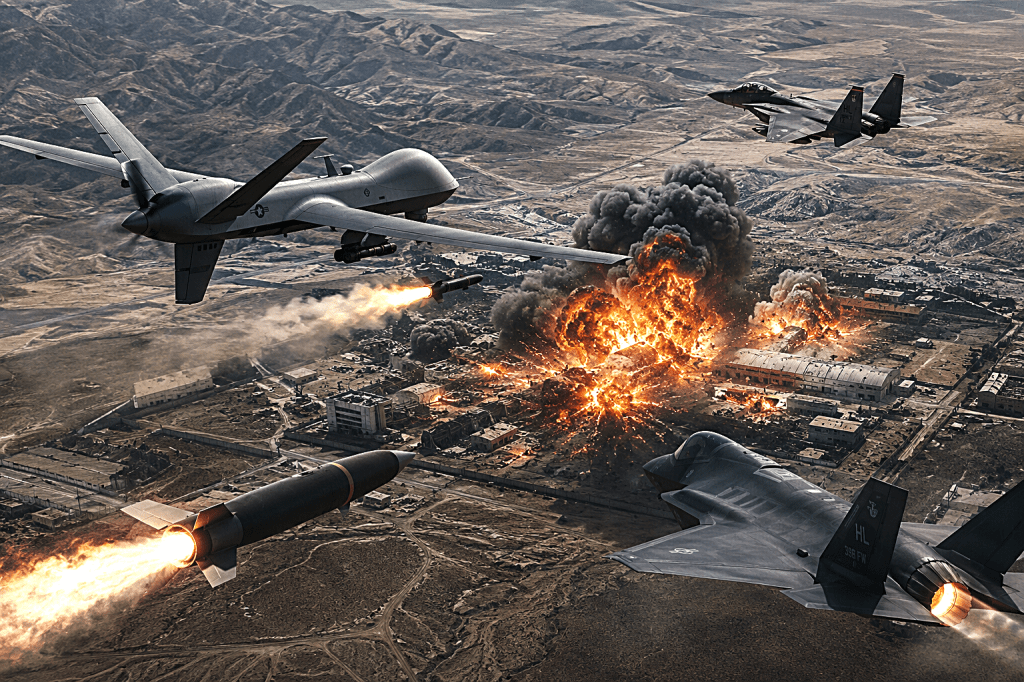
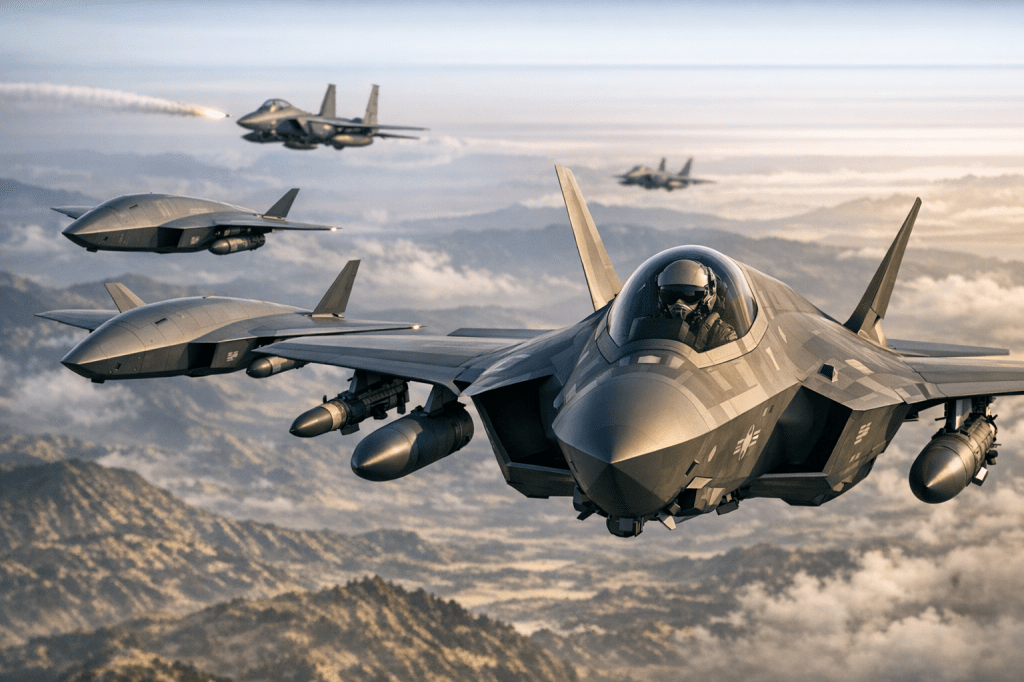
For a century, every aircraft the U.S. Air Force designated with an “F” — for fighter — carried a human being. That ended on June 17, 2026, when the Air Force awarded production contracts for both of its Collaborative Combat Aircraft prototypes: General Atomics’ FQ-42A Dark Merlin and Anduril’s FQ-44A Fury. The “Q” in those designations means uncrewed. The service plans to field more than 150 combat-capable examples by the end of the decade, on the way to a stated objective of roughly a thousand, and requested nearly a billion dollars in its 2027 budget to get the line moving [2,4].
Two details deserve attention. First, the speed: General Atomics went from contract award to a flying, production-representative jet in about thirteen months — a tempo the industry had not seen since the Second World War [3]. Second, the language. “By moving fast from competitive selection into full-scale manufacturing,” Air Force Secretary Troy Meink said, “we position ourselves to field highly credible and combat-ready semi-autonomous systems” [2]. The production decision arrived four months ahead of schedule. Militaries do not usually accelerate programs they are ambivalent about.
Exhibit 2: AI Has Learned to Fly Fighter Jets — Real Ones
The software story matters more than the airframes. In 2024, DARPA’s X-62A VISTA — a heavily modified F-16 — flew dogfights against human pilots with an AI agent at the controls, the first time machine learning had flown a real fighter in visual-range combat maneuvering. In July 2026 the follow-on arrived: an ordinary F-16, fitted with what the Air Force calls the VENOM autonomy kit, flew a sortie from Eglin Air Force Base with artificial intelligence controlling the jet for most of the flight. A safety pilot handled takeoff and sat ready to intervene; six such jets are being modified so pilots can toggle between human and machine control “with the flip of a switch” [5,6].
The stated goal has moved past dogfighting. “We now have the opportunity to create dominant autonomy for beyond-visual-range, multi-ship combat,” said Lt. Col. Patrick Highland, who manages DARPA’s Artificial Intelligence Reinforcements program [5]. Translated from program-speak: the labs are no longer teaching AI to fly one plane against one plane. They are teaching it to fight formations.

Exhibit 3: Unmanned Jets Are Now Scoring Air-to-Air Kills
Skeptics long held that air-to-air combat — the fighter pilot’s defining job — was the one mission machines could not touch. That line broke twice in a single month. On November 28, 2025, Turkey’s Bayraktar Kizilelma, a jet-powered uncrewed fighter, used its onboard AESA radar to launch a Gökdoğan missile beyond visual range and destroy a jet-powered target drone over the Black Sea — the first radar-guided, beyond-visual-range air-to-air kill by a fighter-class drone in history, flown in formation with five Turkish F-16s. “For the first time in the world, an unmanned combat aircraft fired an air-to-air missile with radar guidance,” said Gen. Ziya Cemal Kadıoğlu, the Turkish Air Force commander [7].
Two weeks later, on December 12, Australia’s MQ-28A Ghost Bat fired an AIM-120 AMRAAM — the standard medium-range missile of Western air forces — and destroyed an aerial target over the Woomera range while teamed with an E-7A radar plane. “This is a first for Air Force and one of the first times it’s been done anywhere in the world,” said Sgt. James Howitt of the Royal Australian Air Force [9]. By June 2026, the Ghost Bat was flying counter-air missions alongside F-35s, Super Hornets, and F-15EXs in Valiant Shield, a major multinational exercise near Guam — its debut as an operationally relevant coalition asset rather than an experiment [10]. Turkey, meanwhile, says the Kizilelma enters squadron service this year [8].
Exhibit 4: In Ukraine, Drones Now Do Most of the Killing
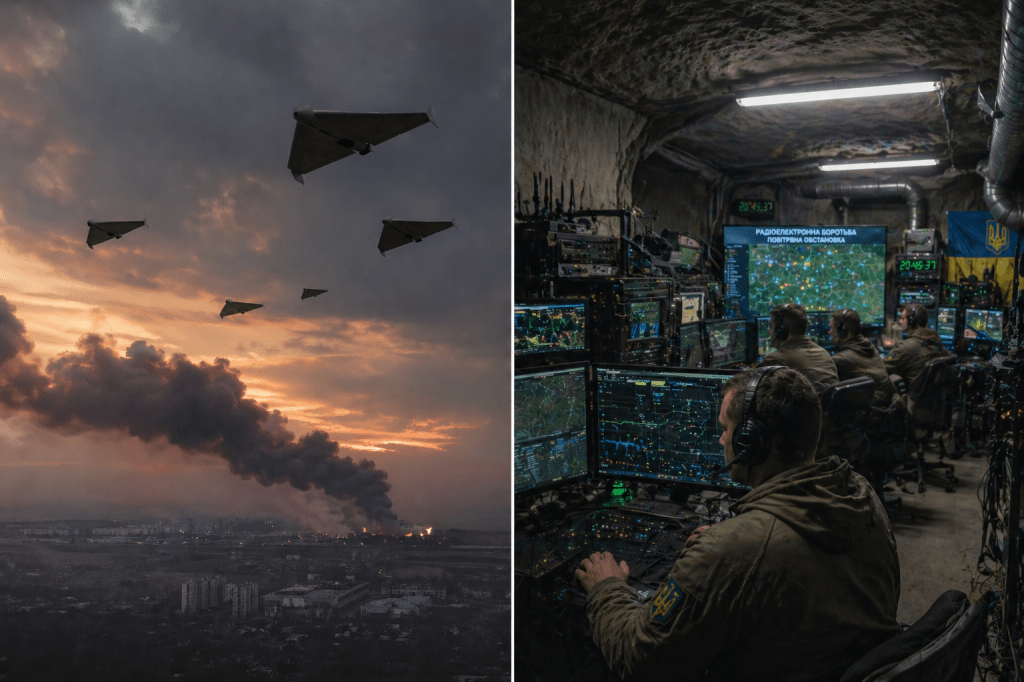
The largest war in Europe since 1945 has become, by the numbers, a drone war. In January 2026, President Volodymyr Zelensky reported that more than 80 percent of enemy targets destroyed by Ukrainian forces are now destroyed by drones, the overwhelming majority domestically produced. Ukraine’s military logged 819,737 video-confirmed drone strikes in 2025 alone — each one recorded, verified, and credited through a points system that lets units exchange confirmed hits for new equipment [11,12].
The trend line steepened from there. In April, Kyiv reported that of roughly 35,000 Russian soldiers killed or badly wounded in March, some 96 percent were casualties of drones; artillery and everything else accounted for the remainder [13]. Even allowing for wartime inflation in such claims — and independent analysts do urge caution — the direction is not in dispute. Artillery, the “king of battle” for four centuries, has been dethroned in the one place where a modern war is actually being fought.
Exhibit 5: The Pentagon Is Retooling Like It’s 1942
Washington noticed. In July 2025, Defense Secretary Pete Hegseth issued a memorandum titled “Unleashing U.S. Military Drone Dominance,” and by December the department had asked industry a question no Western military had posed in the drone age: can you build us roughly 340,000 one-way attack drones in two years? The program is blunt about its economics — early batches at $5,000 apiece, final batches at $2,300, a billion dollars in total. “Drone dominance will do two things,” Hegseth said. “Drive costs down and capabilities up” [15].
In February 2026, twenty-five vendors — most of them startups few people had heard of three years ago — were selected to compete in a live fly-off at Fort Benning called “the Gauntlet,” with $150 million in initial orders behind it and a target of hundreds of thousands of combat-ready attack drones by 2027 [16]. For scale: Ukraine built about four million drones in 2025, roughly forty times American output, and plans ten million in 2026 [14]. The Pentagon’s program is an explicit attempt to close an industrial gap with a war it is not even fighting.
Exhibit 6: Fighter Pilots Are Becoming Drone Commanders — in Flight
In November 2025, General Atomics and Lockheed Martin revealed that an F-22 Raptor pilot had, for the first time, controlled an MQ-20 Avenger combat drone from the Raptor’s cockpit using a tablet interface, running “mature mission autonomy software” during a mock combat mission over the Nevada Test and Training Range. The Air Force has designated the F-22 the threshold platform for this kind of teaming, with the F-35 next in line [17].
China is running the same play. Days before the American announcement, the People’s Liberation Army released the first operational footage of its GJ-11 stealth combat drone — a flying-wing aircraft with internal weapons bays — flying in formation with a J-20 stealth fighter and a J-16D electronic-warfare jet, complete with radio calls between the crews and the drone’s controllers [18]. Two air forces that plan against each other have independently concluded that the fighter cockpit’s future occupant is part pilot, part air-traffic controller for robots.
Exhibit 7: At Sea, a Robot Boat Shot Down a Fighter Jet
If a single event captures the inversion underway, it happened on May 2, 2025, near Novorossiysk. A Ukrainian Magura naval drone — an unmanned speedboat — raised a missile launcher and shot down a Russian Su-30 fighter, a $50 million supersonic jet, with a modified infrared missile. Ukraine’s defense intelligence agency called it the first destruction of a manned combat aircraft by a naval drone in history; the same unit had already used sea drones to down two Russian helicopters [19].
The broader campaign is just as striking. Sea drones costing a few hundred thousand dollars have sunk or damaged more than a dozen Russian warships and driven the Black Sea Fleet out of its centuries-old home in Sevastopol — achievements of a country with almost no conventional navy. Russia is now imitating its tormentor, with plans for 150 and possibly 230 uncrewed vessels in 2026, held back mainly by sanctions on electronics [20]. And in April 2026 the U.S. Navy finally flew its first production-representative MQ-25A Stingray, the carrier-based tanker drone that will, when it reaches the fleet in 2029, put uncrewed jets into the carrier air wing’s daily rhythm for the first time [21].
Exhibit 8: On Land, Soldiers Have Surrendered to Machines
In July 2025, Russian soldiers surrendered to Ukrainian ground robots — tracked vehicles carrying explosives and cameras, backed by drones overhead — in what Ukraine’s 3rd Assault Brigade described as an assault conducted “without infantry and without losses on our side” [23]. By April 2026 the practice had matured into something without precedent: Ukrainian forces captured a Russian position using only aerial drones and unmanned ground vehicles, no human attackers present. Ukrainian robotics firms had run more than 22,000 front-line ground-robot missions in the preceding three months [22,23].
Ground robots still struggle with navigation and jamming in ways aerial drones do not, and no one claims the infantryman is obsolete. But “first position captured entirely by machines” is the kind of sentence that, once written, does not get unwritten.
Exhibit 9: Every Recruit Is Now a Drone Student
Institutions reveal their beliefs in their curricula. As of this year, all four U.S. military services have pushed drone instruction into their earliest training. Air Force basic trainees drill against drone attacks on their bases; Marine infantry officers learn to employ strike drones at the Infantry Officer Course; Army recruits at Fort Benning fly quadcopter simulators before they fly the real RQ-28A, in a program the service also uses to scout talent for dedicated drone units [24]. The Army has rewritten its capstone doctrine, Field Manual 3-0, around imperatives that assume “constant observation” from above and instruct units to make first contact “with sensors, unmanned systems, or the smallest element possible” — that is, with something other than people [25].
Meanwhile, the fighter pilot’s own schoolhouse is changing from the top down. The Air Force stood up an Experimental Operations Unit at Nellis Air Force Base whose job is to work out how a human in one cockpit commands several uncrewed wingmen — new tactics, new interfaces, new trust [4]. As a January 2026 Georgetown Security Studies Review analysis put it, the pilot is becoming a “mission commander” and “network integrator,” directing formations rather than dueling in them [26].
Exhibit 10: The Money Has Already Voted
Follow the budgets. Global military drone spending, about $17 billion in 2025, is projected to more than double to roughly $36 billion by 2035, with Asia-Pacific growing fastest [28]. Turkey’s Baykar — a company that barely existed in export markets a decade ago — sold $2.2 billion worth of drones abroad in 2025, its third straight year as the world’s leading armed-drone exporter, with contracts in 37 countries; its chairman says 2026’s keyword is “production,” with “AI-supported swarm technology” next [8]. NATO has pledged $40 billion over five years for counter-drone defenses alone — a tax paid on the threat’s growth [27]. And the venture-backed newcomers — Anduril, Shield AI, and the two dozen startups in the Pentagon’s Gauntlet — now win contracts that once belonged exclusively to companies with fifty-year histories [2,16]. Capital is a forecast. This one is unambiguous.
Is the Curve Actually Exponential?
“Exponential” is an abused word, so let us be precise about what the evidence supports. Three quantities are compounding. Production: Ukraine went from roughly 300,000 drones in 2023 to four million in 2025 to a planned ten million in 2026, with its president floating twenty [14]. That is a doubling time of well under a year, sustained for three years. Cost: the Pentagon’s attack-drone program prices early units at $5,000 and late units at $2,300 — a halving inside the same contract — while a fighter-class drone like the FQ-42A is intended to cost a fraction of the crewed jet it escorts [15,2]. Battlefield share: drones’ portion of confirmed kills in Ukraine climbed from a curiosity in 2022 to a majority in 2024 to more than 80 percent of targets and, by some monthly tallies, 96 percent of enemy casualties in 2026 [11,13].
Software is the accelerant that makes these curves feed each other. Every flight logged by an autonomy stack — Shield AI’s, Anduril’s, General Atomics’ five years of AI training on the MQ-20 [3] — improves the next flight, and unlike pilot experience, the improvement copies at zero cost to every airframe in the fleet. A human fighter pilot takes a decade and several million dollars to season, and retires. An AI pilot’s education is cumulative, transferable, and immortal. That asymmetry, more than any single airframe, is why the trend resists slowing down. So: is it safe to say AI is playing a major role? It is playing the defining role. Cheap airframes existed for decades; what changed is that software became a pilot.
Is “Disruptive” the Right Word?
Yes — and in the strict, Clayton Christensen sense, not the promotional one. Disruption theory describes a cheap, initially inferior product that incumbents dismiss because it cannot match their flagship’s performance, until it improves faster than the market’s needs and hollows out the flagship’s market from below. That is precisely the pattern here. A $500 FPV drone is a laughable substitute for an F-35 — until you notice that the job to be done was “destroy that tank,” and the drone does it for one ten-thousandth of the price [1]. The incumbents’ response has followed the classic script, too: first dismissal, then partnership (the “loyal wingman”), then the quiet migration of missions — surveillance, then strike, then tanking, now air-to-air — from the expensive product to the cheap one. NATO firing $400,000 missiles at $35,000 drones over Poland, and scrambling to field $15,000 interceptor drones instead, is what a disrupted cost structure looks like in real time [27].
What Happens to the Pilots?
Here is the paradox of 2026: the machines are ascending, and the humans have never been more sought-after. The U.S. Air Force remains roughly 2,000 pilots short of requirements, a gap it has carried for a decade [29], and this spring it rolled out retention bonuses worth up to $50,000 a year — as much as $600,000 over a twelve-year commitment — to keep experienced aviators in uniform. Tellingly, the offer extends beyond traditional pilots to the people the new force runs on: remotely piloted aircraft operators and air battle managers [30]. Nothing about the drone boom has yet reduced the demand for people who understand air combat — it has changed what they are needed for.
The emerging career arc looks like this. Stick-and-rudder skill is being demoted from the pilot’s whole job to the entry fee. What the services increasingly need is the judgment layered on top: the F-22 pilot managing an MQ-20 from a tablet [17], the Nellis crews inventing the playbook for commanding drone formations [4], the VENOM test pilots whose role is to supervise an AI and decide when to trust it [6]. The Georgetown analysis frames it as evolution rather than obsolescence — pilots as mission commanders whose aircraft happens to be the node of a robotic network [26]. Training pipelines are bending accordingly: drone familiarization in basic training across all services, FPV instruction for Marine lieutenants, simulator-first drone courses for Army recruits that double as talent scouting [24]. The military is not training fewer aviators. It is training a different kind — and far more of them, since every squad now contains someone whose weapon flies.
The uncomfortable long-term question is not whether pilots lose their jobs but whether the next generation gets the old ones. A thousand collaborative combat aircraft flown from a few hundred cockpits implies a future in which the ratio of aircraft to pilots inverts — and in which most things with wings in an air force have no one aboard.
The Strategy Rewrite
Military planners are treating Ukraine the way naval officers once treated Jutland: as the dataset. The lessons they are drawing are reshaping doctrine far beyond air forces. The first lesson is mass over exquisiteness — wars of attrition are won by the side that can lose machines faster than the enemy can lose money, which is why the Pentagon wants hundreds of thousands of $2,300 drones and not merely dozens of exquisite ones [15,16]. The second is transparency — the Army’s new doctrine assumes every formation is watched constantly from above and orders units to touch the enemy first with machines [25]. The third is cost-exchange discipline — the Sidewinder-versus-Shahed arithmetic that is pushing NATO toward layered “drone wall” defenses on its eastern flank [27]. And the fourth is industrial speed as a weapon: thirteen months from contract to flying fighter drone [3], a production decision four months early [2], doctrine rewritten annually instead of generationally [25]. Air superiority itself is being redefined — from “our pilots rule the sky” to “our machines can be everywhere, and theirs cannot.”
The effects spill across every domain. At sea, Ukraine’s robot boats have done to the Black Sea Fleet what only rival battle fleets used to do, and both the U.S. Navy’s carrier wings and Russia’s shipyards are drawing the same conclusion in opposite directions — the Americans adding uncrewed jets to the flight deck, the Russians racing to build robot boats of their own [19-21]. On land, the first robot-captured position and the first surrender to machines mark the beginning of a transition that ground forces expect to be slower than aviation’s — robots still navigate badly under jamming — but pointed the same way [22,23].
The Next Five to Ten Years
Extrapolation is a hazard, but the programs of record, budget lines, and stated plans let us sketch 2031 with some discipline — and 2036 with informed imagination.
For the U.S. Air Force, the hybrid era arrives first and hits hardest. By 2030 it plans more than 150 collaborative combat aircraft in service, climbing toward a thousand; Increment 2 of the program — likely cheaper, possibly more autonomous — will be under contract; and the crewed F-47, the sixth-generation fighter Boeing is building, will be flying with drone wingmen designed in from birth [2,4]. Expect the first operational squadron where uncrewed aircraft outnumber crewed ones before 2030, and — if the autonomy stacks keep maturing at VENOM’s pace — the first combat air patrol with no human airborne at all by the early 2030s, most likely in a defensive counter-drone role where the ethical stakes of autonomy are lowest [5,6]. Pilot production will hold steady or grow, but by 2036 “fighter pilot” will describe a minority of the people controlling the fight in the air.
For the Navy, the carrier deck integrates rather than converts. The MQ-25 reaches the fleet in 2029, taking over tanking; surveillance and electronic-warfare drones follow on the same deck-handling foundations; and the surface fleet fields uncrewed vessels in numbers, because the Black Sea demonstrated what a few dozen robot boats do to a fleet that lacks them [21,20]. A carrier air wing that is one-third uncrewed by the early 2030s is the Navy’s own stated direction of travel. The submariners, notably, may be disrupted last — the undersea domain resists the cheap-swarm economics that upended the surface.
For the Army and Marine Corps, the transformation is at the squad. Both services are pushing toward formations where every platoon flies its own reconnaissance and strike drones, counter-drone defense is as basic as marksmanship, and ground robots take the first contact — the doctrine already says so; the decade will make it real [24,25]. Artillery, engineering, and logistics branches will absorb robotic systems the way they once absorbed the truck.
Globally, expect proliferation to outrun regulation. Baykar’s 37 export customers, China’s parade-ready combat drones, Russia’s robot-boat program, and Europe’s $40 billion counter-drone build-out describe a world in which advanced air power — historically the most exclusive club in warfare, gated by pilot training as much as by money — becomes available to any state that can buy software and airframes [8,18,20,27]. That is the deepest disruption of all: for eighty years, air power correlated with the wealth and institutions needed to train pilots. Autonomy breaks that correlation. Some of the consequences will be stabilizing; many will not.
The Case for the Cockpit
The honest version of this story includes the friction, and Marcone’s brief is a good guide to it [1]. Crewed fighter programs are not dying; they are thriving. The F-47 exists precisely because the Air Force concluded that a human mind, forward, in a survivable aircraft, commanding machines, beats either humans or machines alone. Analysts at the Mitchell Institute argue that no autonomy on the horizon replaces the seasoned aviator in a contested fight — “AI approaching a human pilot’s capability is still a long way off,” as one 2025 study put it — and that experience “is often the critical differentiator in peer conflict” [29]. RAND-style lifecycle analyses cited by Marcone find that drone fleets, once you count ground stations, bandwidth, and maintainers, are not as cheap as their sticker prices suggest [1].
Electronic warfare remains the great equalizer: much of Ukraine’s drone fleet is defeated by jamming rather than by weapons, which is why both sides now race toward fiber-optic tethers and jam-proof autonomy — a race that itself accelerates the AI trend it responds to [23]. Skeptics of the collaborative combat aircraft note it may occupy an awkward middle — too expensive to lose casually, too limited to fight alone [4]. And the moral architecture holds, for now: every Western program keeps a human on the loop for lethal decisions, a line drawn in policy rather than physics, meaning it holds only as long as every actor agrees to be slower than their machines allow.
So no, the fighter pilot is not being deleted. The evidence points somewhere more interesting: the pilot is being promoted — from operator of one aircraft to commander of many — while the aircraft themselves multiply, shrink in cost, and learn. Replacement is happening, but from the bottom up, mission by mission: surveillance already gone, strike mostly gone, tanking going, air-to-air now breached. The manned fighter’s remaining monopoly is judgment, and the entire thrust of military AI research is to need less of it, less often, in fewer places.
Marcone predicts hybrid squadrons by 2035 [1]. On the evidence of the past year, that may be the rare forecast in this field that errs on the side of caution: the hybrid squadrons are already forming, and the curve underneath them is still bending upward. The age of autonomous air power is not approaching. We are inside it, watching the scenery and insisting the train is still.
References
1. Veronica Marcone, “Manned vs Unmanned Military Aircraft: Are We Entering the Age of Autonomous Air Power?” NAPF Policy Brief, August 19, 2026. https://www.napforum.org/policy-briefs/manned-vs-unmanned-military-aircraft-are-we-entering-the-age-of-autonomous-air-power
2. “USAF Orders Both General Atomics’ FQ-42 and Anduril’s FQ-44 Into Production,” The War Zone (TWZ), June 17, 2026. https://www.twz.com/air/usaf-orders-both-general-atomics-fq-42-and-andurils-fq-44-into-production
3. “GA-ASI Marks Another Aviation First with YFQ-42A CCA Flight Testing,” General Atomics Aeronautical Systems, August 27, 2025. https://www.ga-asi.com/ga-asi-marks-another-aviation-first-with-yfq-42a-cca-flight-testing
4. “2026 Will Test U.S. Air Force’s Bet on Drone Wingmen,” Aerospace America (AIAA), 2026. https://aerospaceamerica.aiaa.org/2026-will-test-u-s-air-forces-bet-on-drone-wingmen/
5. “DARPA, U.S. Air Force Fly AI-Controlled F-16,” DARPA News, July 16, 2026. https://www.darpa.mil/news/2026/darpa-us-air-force-fly-ai-controlled-f-16
6. “F-16 Outfitted with AI Kit Completes Pathbreaking Sortie in ‘Monumental Milestone,'” Stars and Stripes, July 20, 2026. https://www.stripes.com/branches/air_force/2026-07-20/first-venom-autonomous-jet-flight-22317435.html
7. “Bayraktar Kızılelma Makes History: Turkey Becomes First Nation to Conduct BVR Air-to-Air Missile Kill with Autonomous UCAV,” Defence Security Asia, November 2025. https://defencesecurityasia.com/en/kizilelma-ucav-first-bvr-missile-test-gokdogan-murad-aesa-turkey-air-combat/
8. “Baykar Sets $2.2B Export Record; Kizilelma to Enter Inventory in 2026,” Türkiye Today, February 3, 2026. https://www.turkiyetoday.com/nation/baykar-sets-22b-export-record-kizilelma-to-enter-inventory-in-2026-3213966
9. “Ghost Bat Hits the Mark Mid-Air,” Australian Department of Defence, December 12, 2025. https://www.defence.gov.au/news-events/news/2025-12-12/ghost-bat-hits-mark-mid-air
10. “Australia’s MQ-28 ‘Ghost Bat’ Enters Indo-Pacific Battlespace at Valiant Shield 2026,” Defence Security Asia, June 27, 2026. https://defencesecurityasia.com/en/mq28-ghost-bat-valiant-shield-2026-indo-pacific-airpower-shift/
11. “President: Today, More Than 80% of Enemy Targets Are Destroyed by Drones,” Official Website of the President of Ukraine, January 26, 2026. https://www.president.gov.ua/en/news/prezident-na-sogodni-ponad-80-vorozhih-cilej-znishuyutsya-sa-102585
12. “Ukraine Says More Than 80% of Enemy Targets Now Destroyed by Drones,” Defense News, January 28, 2026. https://www.defensenews.com/global/europe/2026/01/28/ukraine-says-more-than-80-of-enemy-targets-now-destroyed-by-drones/
13. “Drones Caused 96% of Russia’s Losses in March – 34,000 Troops Killed or Wounded,” Euromaidan Press, April 3, 2026. https://euromaidanpress.com/2026/04/03/drones-caused-96-of-russias-losses-in-march/
14. “Ukraine Will Produce 10 Million Drones This Year and Could Double Its Production, Says Zelenskyy,” LIGA.net, June 16, 2026. https://news.liga.net/en/war/news/zelenskyy-ukraine-will-produce-10-million-drones-this-year
15. “War Department Asks Industry to Make More Than 300K Drones, Quickly, Cheaply,” U.S. Army, December 3, 2025. https://www.army.mil/article/289322/war_department_asks_industry_to_make_more_than_300k_drones_quickly_cheaply
16. “Pentagon Names 25 Vendors to Compete for $150M in Delivery Orders During First Phase of Its Drone Dominance Program, ‘the Gauntlet,'” DefenseScoop, February 3, 2026. https://defensescoop.com/2026/02/03/drone-dominance-program-hegseth-military-uas-vendors/
17. “In a First, F-22 Pilot Controls Wingman Drone from Cockpit, General Atomics Says,” Breaking Defense, November 2025. https://breakingdefense.com/2025/11/in-a-first-f-22-pilot-controls-wingman-drone-from-cockpit-general-atomics-says/
18. “China Shows GJ-11 UCAV Flying with J-20 in First Public Clip,” The Aviationist, November 11, 2025. https://theaviationist.com/2025/11/11/gj-11-ucav-flying-with-j-20-j-16/
19. “World First: Defence Intelligence of Ukraine Destroys Russian Su-30 Fighter Jet with a Sea Drone Strike,” Defence Intelligence of Ukraine (GUR), May 2025. https://gur.gov.ua/en/content/vpershe-u-sviti-voiny-hur-udarom-z-morskoho-drona-magura-znyshchyly-vorozhyi-boiovyi-litak
20. “Russia’s Fleet Is Set to Get 150 Uncrewed Vessels in 2026, and Possibly 230,” Euromaidan Press, August 26, 2026. https://euromaidanpress.com/2026/08/26/russias-fleet-is-set-to-get-150-uncrewed-vessels-in-2026-and-possibly-230-sanctions-are-holding-the-build-back/
21. “Navy Pushes MQ-25A Stingray IOC Back to 2029 While Production Aircraft Takes First Flight,” USNI News, April 27, 2026. https://news.usni.org/2026/04/27/navy-pushes-mq-25a-stingray-ioc-back-to-2029-while-production-aircraft-takes-first-flight
22. “No Infantry: For First Time, Ukraine Captured Russian Position Using Only Drones and Robots,” Euromaidan Press, April 13, 2026. https://euromaidanpress.com/2026/04/13/no-infantry-for-first-time-ukraine-captured-russian-position-using-only-drones-and-robots/
23. “Russians Will Surrender to Robots. Russian Robots Won’t.” Defense One, April 15, 2026. https://www.defenseone.com/technology/2026/04/russians-will-surrender-robots-russian-robots-wont/412889/
24. “As the Pentagon Goes Full-Tilt on Small UAS, Some Services Are Trying to Build a New Generation of Drone-Savvy Troops from the Rip,” DefenseScoop, February 24, 2026. https://defensescoop.com/2026/02/24/small-drones-army-marines-navy-air-force-basic-training-uas/
25. “Army Adapts Doctrine Force-Wide, Integrating Drone Lessons to Achieve ‘Drone Dominance,'” U.S. Army, March 30, 2026. https://www.army.mil/article/291361/army_adapts_doctrine_force_wide_integrating_drone_lessons_to_achieve_drone_dominance
26. Alexandra Grande, “The Shifting Role of Human Pilots in the Future of Air Warfare,” Georgetown Security Studies Review, January 12, 2026. https://gssr.georgetown.edu/the-forum/topics/defense/the-shifting-role-of-human-pilots-in-the-future-of-air-warfare/
27. “As Russian Drone Incursions Escalate, NATO Weighs Costs of Shooting Back,” The Kyiv Independent, 2026. https://kyivindependent.com/natos-patience-with-drone-incursions-wears-thin/
28. “Military Drones Market Size to Hit USD 35.96 Billion by 2035,” Precedence Research, 2026. https://www.precedenceresearch.com/military-drones-market
29. “Fixing the Air Force Pilot Crisis,” Air & Space Forces Magazine, April 4, 2025. https://www.airandspaceforces.com/article/fixing-the-air-force-pilot-crisis/ 30. “Air Force Offering Bonuses for Aviators to S
###
Filed under: Uncategorized |






























































































































































































































































































































































































































































































Leave a Reply