




By Jim Shimabukuro (assisted by ChatGPT)
Editor
Award winners, viral bestsellers, and disputed cases are changing fiction publishing. The most intriguing AI-era novels are not necessarily the ones written most extensively by a machine. They are the books that readers actually finish, prize juries recognize, or publishing houses believe they can sell. Their importance lies in what they reveal about authorial control, changing production costs, and the difficulty of establishing how a contemporary manuscript was made.

This is a ranked critical selection, not a verified bestseller chart. No comprehensive and independently audited list of the ten highest-grossing AI-assisted novels exists. Four categories must also be kept separate: acknowledged AI-assisted writing; experimental machine-produced literature; works identified by statistical detection; and novels whose authors deny allegations of AI use. Inclusion below is not a judgment that a disputed book was written using AI. Ranking weighs documented prominence, literary significance, reception and relevance to the future of publishing, rather than unreported royalties or unit sales.
A short history
Computers were generating experimental prose long before ChatGPT. Ross Goodwin’s 2018 1 the Road placed a language-generating system in a car, connected to sensors during a drive through the United States, and published its output as an intentionally unpolished literary artifact. In 2023, Canadian novelist and critic Stephen Marche moved the experiment into commercial genre fiction. His murder mystery Death of an Author, issued as Aidan Marchine, used ChatGPT, Sudowrite and Cohere to generate most of the text while Marche shaped its conception and editing (Goodwin, 2018; Marchine, 2023; WIRED, 2023).
The decisive second stage arrived when a recognized Japanese literary prize honored Rie Qudan’s Sympathy Tower Tokyo in 2024 and the author publicly disclosed using ChatGPT for a small portion of the book. By 2026 the business question was no longer whether a machine could produce an entire manuscript. It was whether AI-assisted fiction could obtain chart positions, book deals and repeat readers—and whether publishers could distinguish it reliably from human-written work. A 2026 working paper examined 14,419 self-published genre novels with sales data through June; the authors found that AI-detected titles were gaining commercial ground while enlarging a catalog faster than its revenue (Qudan, 2025; Chakrabarty et al., 2026).
Ten revealing selections, ranked
1. Sympathy Tower Tokyo — Rie Qudan (Japan; 2024). Evidence status: Confirmed limited AI use; major literary award. Qudan writes intellectually precise, socially observant literary fiction, here centered on an architect designing a humane high-rise prison in a near-future Tokyo. She won the Akutagawa Prize and has explained that dialogue involving a chatbot accounts for roughly 5% of the novel’s text. The source of that speech is part of the subject rather than an invisible production shortcut (Qudan, 2025; Ha, 2025). It ranks first because it offers the cleanest conjunction of established literary recognition and author-disclosed generative text. The award is genuine; it is not an award for AI as such. Its lesson is that a carefully bounded use of machine language can serve an existing artistic design.
2. Death of an Author — Stephen Marche, writing as Aidan Marchine (Canada/U.S. market; 2023). Evidence status: Confirmed extensive AI collaboration; critical attention, not documented bestseller. Marche, a novelist, journalist and critic, works here in a self-aware murder-mystery tradition. His story involves the killing of a celebrated novelist and questions of authorship. He disclosed assembling it with three AI systems and attributed about 95% of the prose to machine generation, while taking human responsibility for its architecture and revision (Marche, n.d.; WIRED, 2023). It ranks second for its influence as a publicly documented test of whether a recognizable genre story could be made primarily through prompting, selection and rewriting. Critical notice, including coverage by major U.S. reviewers, makes it more consequential than its unverified sales suggest.
3. Daggermouth — H. M. Wolfe (U.S. market; 2025). Evidence status: Commercial hit; AI use disputed and expressly denied. Wolfe’s science-fiction romance follows a would-be assassin and the son of a president inside an oppressive surveillance state. Its appeal is genre-driven: danger, political intrigue, romance and a bingeable emotional arc. The Atlantic reported months on the USA Today bestseller list and a seven-figure Simon & Schuster rights deal covering the book and sequel. Researchers classified sections of the novel as likely AI text; Wolfe categorically rejected that conclusion (Oremus, 2026). It ranks third because its financial success makes the disputed question unusually important. It is NOT a confirmed AI-assisted novel. It illustrates the stakes if major, reader-loved commercial fiction is suspected of AI participation and the technology cannot settle the argument.
4. Shy Girl — Mia Ballard (UK/U.S.; 2025). Evidence status: Commercially noticed horror novel; contested production history. Ballard’s dark psychological horror follows Gia, whose financial desperation leads her into a disturbing arrangement with a wealthy stranger. Originally self-published, it gained sufficient notice for Hachette to acquire publication rights. Ballard denied personally using AI and attributed possible machine material to an acquaintance who assisted on an earlier version (Loffhagen, 2026). It ranks fourth for a negative commercial outcome: Hachette canceled the planned U.S. release and withdrew the U.K. edition amid questions over provenance. The Guardian cited about 1,800 U.K. print sales, a useful reminder that publicity and acquisition are not the same as blockbuster sales. The case exposes a new editorial risk.
5. Land of Memories — Shen Yang (China; 2023). Evidence status: Confirmed AI-created short novel; competition recognition. Shen, a Tsinghua University journalism professor, directed a science-fiction account involving memory loss, robots and the metaverse. Reports describe 66 prompts, an initial AI output of roughly 43,000 Chinese characters and a condensed work of about 6,000 characters. The story earned a second-tier award in a Chinese science-fiction competition (Chik, 2023). It ranks fifth because it documents a rapid production method and external assessment outside the English-speaking market. Its brevity and mixed assessments of emotional depth limit claims about novelistic mastery; its importance is reproducibility.
6. 1 the Road — Ross Goodwin (U.S./France; 2018). Evidence status: Confirmed machine-generation experiment; literary precedent. Goodwin is an artist and creative technologist rather than a conventional commercial novelist. A sensor-equipped road trip produced associative, sometimes jagged prose, subsequently issued by French publisher Jean Boîte Éditions. Its approach evokes the American road novel more than plotted suspense (Goodwin, 2018). It ranks sixth as an indispensable ancestor of today’s AI fiction, even though it is neither an award-winning popular novel nor evidence that present-day AI fiction sells. The uncorrected text exposes the distance between generating sentences and sustaining a satisfying narrative.
7. Ojīchan wa kokka hangyakusha [Grandpa Is a Traitor to the State] — Koto no Tenmatsu (Japan; 2025). Evidence status: AI-assisted fiction competition winner; limited public sales data. Published in the context of Japan’s AI Novelist literary competition, this Japanese-language work took its top award. The contest explicitly supports collaboration between writers and its AI novelist system. Publicly accessible results identify the author by the pen name Koto no Tenmatsu, but offer little reliable biographical or stylistic information (AI Novelist Literary Prize, 2025). It ranks seventh because it shows AI-native literary institutions beginning to cultivate and judge fiction, not merely tolerate it. Without an accessible manuscript, independent review or circulation figures, a confident account of its prose style or commercial reach would be speculation.
8. Mr. Sterling: My Boss. A Contract. And a Heart at Stake — Violeta Dark (Spain; 2025–26 market). Evidence status: Popular self-published romance; AI use inferred by detector, not established. Dark writes under a pseudonym in a familiar romance formula: employer, contract and high-stakes attraction. In an October 2026 investigation of Spanish bestsellers, EL PAÍS reported that the detector Pangram attributed all the text it tested to AI. The outlet sought comment but reported receiving none (Llaneras & Pérez Colomé, 2026). It ranks eighth for showing how commercially visible formula fiction may be affected in a major non-English market. The detection score is not proof, and neither revenue nor author background is independently established.
9. My Boss Is the Antichrist (Sexy Version) — Estrella Correa (Spain; 2025–26 market). Evidence status: Self-published genre romance; AI use inferred by detector. Correa’s marketed subject mixes supernatural danger and workplace/romantic fantasy. EL PAÍS included the novel among its high-ranking self-published titles and reported a Pangram result attributing about 86% of tested text to AI. Public documentation is inadequate for a verified author biography or a close stylistic assessment (Llaneras & Pérez Colomé, 2026). It ranks ninth for the conspicuous marriage of trope-led packaging and low-cost content production. Its relevance lies in discovery systems rewarding a recognizable niche; its exact sales and writing method remain unverified.
10. The Map Killer — Pablo Poveda (Spain; 2025–26 market). Evidence status: Commercially visible thriller; AI use inferred by detector. Poveda’s entry into this selection is a thriller rather than a romance. EL PAÍS reported that Pangram attributed 75% of the book’s sampled text to AI and counted it among widely available self-published titles. The investigation did not establish his production workflow or provide a standalone audited sales total (Llaneras & Pérez Colomé, 2026). It ranks tenth because it demonstrates that possible AI-assisted mass-market fiction is not restricted to romance. Crime and thriller formulas offer equally recognizable hooks, serial possibilities and exportability. It is a case study in market exposure, not verified machine authorship.
What is driving the market?
The strongest explanation is an interaction between low production cost and discovery platforms. Books no longer have to survive a traditional editorial acquisition process to reach readers: ebooks can be uploaded, given a genre-specific cover and description, promoted by short video and offered through subscription libraries. AI makes drafting and revision faster; it does not supply attention, credibility or reader loyalty automatically. The Atlantic’s account of Daggermouth and the 2026 academic sales study show both sides: a rare commercial success, and a much larger accumulation of modest sellers (Oremus, 2026; Chakrabarty et al., 2026).
The study’s striking measure was not a universal leap in quality. The number of books with recorded quarterly sales grew 19.2-fold during its observation window, whereas quarterly revenue grew 8.9-fold. Authors selling traditionally composed books faced more competing titles in the same search results. The authors of the research also found a stronger relationship between distinctive overlaps with existing books and revenue among some heavily AI-flagged bestsellers. That raises concerns about imitation, although it does not determine infringement in an individual book (Chakrabarty et al., 2026).
Readership is not one homogeneous “AI fiction demographic.” There is little credible demographic research identifying people who knowingly seek out AI-authored novels. Available evidence instead concerns the markets in which suspected AI fiction circulates: romance, fantasy, serial thrillers and digital self-publishing. Pew’s April 2026 release found that 41% of U.S. adults ages 18–29 had read an ebook in the previous year, compared with 23% of adults 65 and older; women were somewhat more likely than men to report reading a book in any format. These data describe book readers, NOT purchasers of AI-generated books (Pew Research Center, 2026).
Is the writing getting better?
There is no solid basis for claiming that the median AI-generated novel has improved enough to win critics or displace leading human novelists. The 2026 study showed rising visibility despite a lower relative share of revenue, consistent with production volume doing much of the work. Yet a more interesting possibility emerges in strongly guided projects: models can assist with routine drafting, restructuring, continuity checks, translations or alternative phrasings while human authors control characterization and pacing. Qudan demonstrates narrow, disclosed use; Marche demonstrates extensive, curated use. Neither proves that entirely automated novels can consistently sustain compelling plots across hundreds of pages.
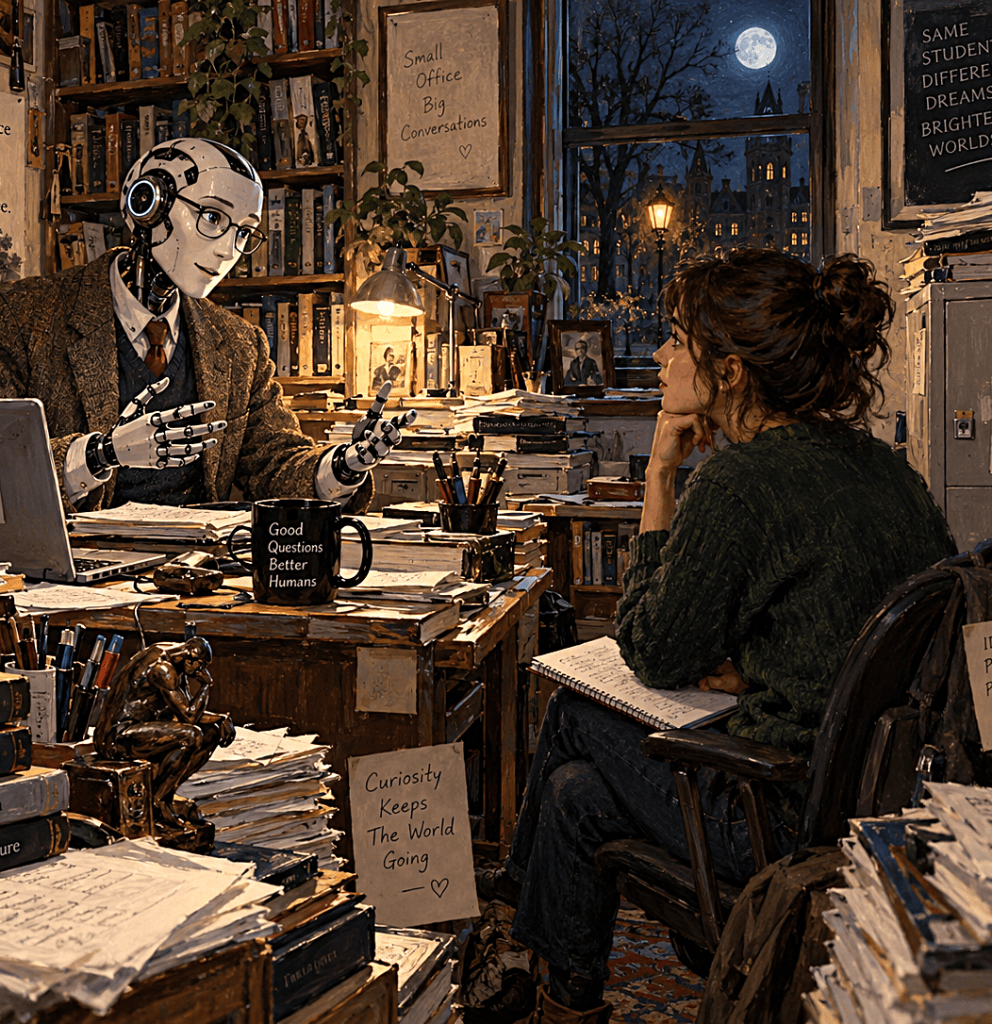
The frontier is therefore editorial craft and provenance, not simply model fluency. Editors who can identify repetition, factual inconsistencies, wooden exposition and derivative scenes remain valuable; so do writers with lived experience, command of language and distinctive imaginative choices. In May 2026, the Authors Guild clarified that its Human Authored mark generally applies where the text was human-written apart from minimal AI-generated or modified material. Different kinds of AI assistance now carry different reputational and contractual consequences (Authors Guild, 2026).
Publishing and entertainment, 2027–2029
For ebook retailers and subscription services, a likely next step is a greater need for authenticity disclosure, provenance records, spam prevention and recommendation systems that reward completed reading rather than uploads alone. For conventional publishers, the Hachette withdrawal and the controversy surrounding other acquisitions make manuscript warranties, editing histories and defensible due diligence more pressing. But aggressive AI detection can harm innocent writers. Statistical tools measure patterns; they do not directly witness an author’s writing process (Loffhagen, 2026; Oremus, 2026).
Hardcopy economics are different. Printing, warehousing, distribution and returns impose costs that generative text cannot remove. AI may accelerate selection of low-risk genre titles or translations, but print space and physical distribution favor demonstrated demand. In film, television, comics, audio and games, a popular premise can become an adaptable property regardless of its drafting method; rights owners will nevertheless need clear chains of title, character rights and contractual assurances before investing heavily. The greatest pressure may fall on discoverability and licensing rather than on the physical printing press.
By 2029, a plausible market is divided less by AI versus human books than by disclosed, edited, sustainable creative production versus anonymous high-volume output. Some hybrid novels should earn loyal readers. Many generated titles will probably remain interchangeable. The decisive measure will be whether readers return for another book by the same creator—and whether creators can earn a living when supply is almost unlimited. This is a forecast, not an observed 2026 outcome.
References
AI Novelist Literary Prize. (2025). AIのべりすと文学賞 [AI Novelist literary prize: Award results]. https://demeken.net/ai-novelist/index.html
Authors Guild. (2026, May 4). Clarifications regarding the Human Authored certification terms. https://authorsguild.org/news/clarifications-regarding-the-human-authored-certification-terms/
Chakrabarty, T., Liu, X., Ginsburg, J. C., & Dhillon, P. (2026, July 22). Generative AI floods and dilutes the market for books [Preprint]. arXiv. https://arxiv.org/abs/2607.20349
Chik, H. (2023, December 20). A Chinese professor used AI to write a science fiction novel. Then it was a winner in a national competition. South China Morning Post. https://www.scmp.com/news/china/science/article/3245725/chinese-professor-used-ai-write-science-fiction-novel-then-it-won-national-award
Goodwin, R. (2018). 1 the Road. Jean Boîte Éditions. https://en.wikipedia.org/wiki/1_the_Road
Ha, T.-H. (2025, May 24). AI fiction is already here. Are humans ready? The Japan Times. https://www.japantimes.co.jp/culture/2025/05/24/books/rie-qudan-chatgpt/
Llaneras, K., & Pérez Colomé, J. (2026, October 13). How much AI is in Spain’s bestselling books? EL PAÍS. https://english.elpais.com/technology/2026-10-13/how-much-ai-is-in-spains-bestselling-books.html
Loffhagen, E. (2026, March 20). Hachette pulls horror novel Shy Girl after suspected AI use. The Guardian. https://www.theguardian.com/books/2026/mar/20/hachette-horror-novel-shy-girl-suspected-ai-use-mia-ballard
Marche, S. (n.d.). The books. https://www.stephenmarche.com/the-books
Marchine, A. (2023). Death of an Author. Pushkin Industries. https://www.pushkin.fm/audiobooks/death-of-an-author
Oremus, W. (2026, July 27). Is this what comes after AI slop? The Atlantic. https://www.theatlantic.com/technology/2026/07/daggermouth-novel-bestseller-ai/688067/
Pew Research Center. (2026, April 8). Book reading habits in the U.S. vary by education, age and other factors. https://www.pewresearch.org/chart/book-reading-habits-in-the-u-s-vary-by-education-age-and-other-factors/
Qudan, R. (2025, August 18). Author Rie Qudan: Why I used ChatGPT to write my prize-winning novel. The Guardian. https://www.theguardian.com/books/2025/aug/18/author-rie-qudan-why-i-used-chatgpt-to-write-my-prize-winning-novel
WIRED. (2023, May 9). AI wrote 95 percent of this murder mystery. https://www.wired.com/story/death-of-an-author-ai-book-excerpt/
###
Filed under: Uncategorized |
















































































































































































































































































Leave a Reply