





By Jim Shimabukuro (assisted by ChatGPT)
Editor
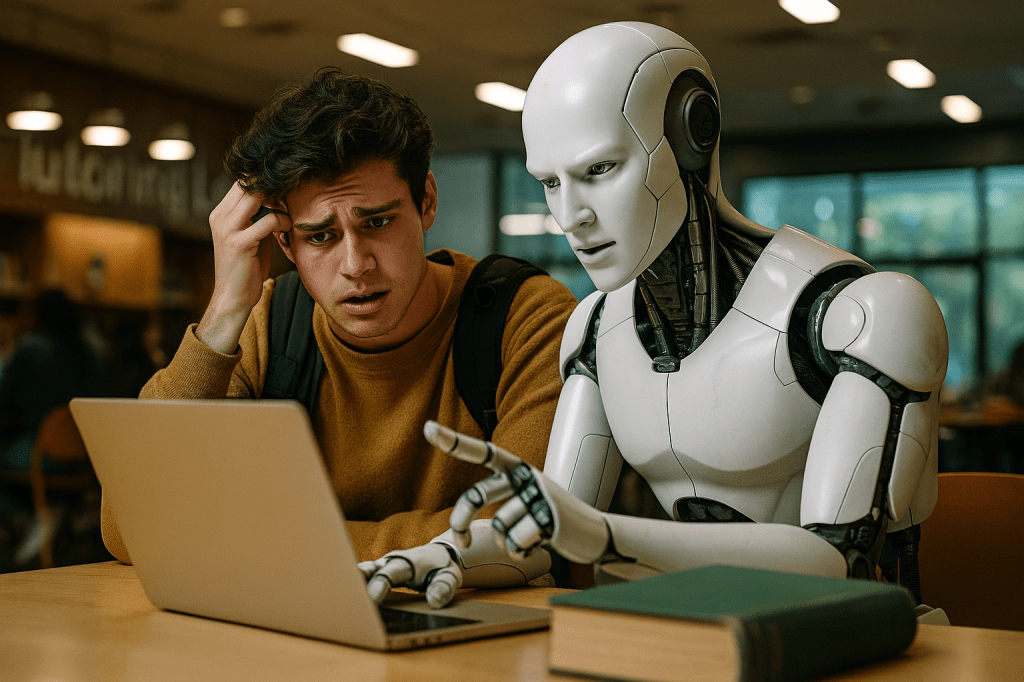
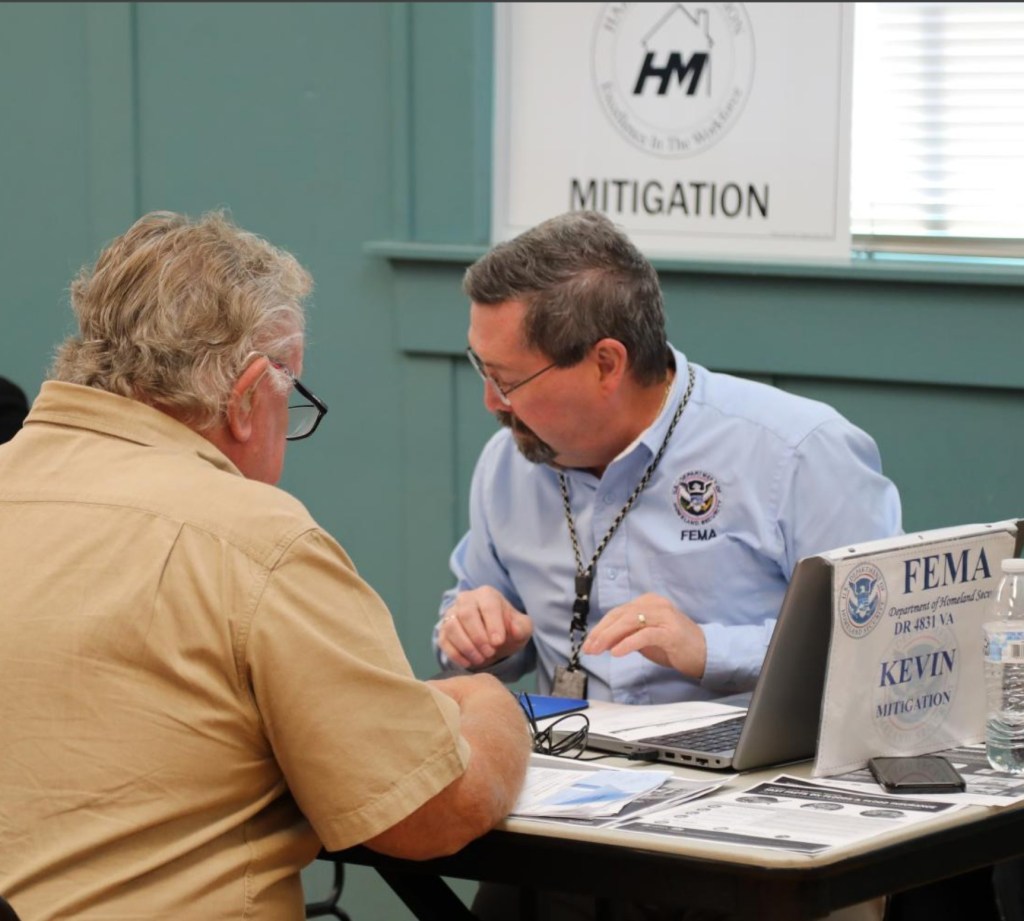
Kevin Bushweller’s question is the right one: What should teacher education look like in the age of AI? (Education Week, 2026). Most current answers begin with the college of education. They propose AI-literacy requirements, simulated students, lesson-design studios, revised assessment, and stronger training in ethics, bias, privacy, and professional judgment. These changes can improve teacher preparation. But they leave a larger issue unresolved.

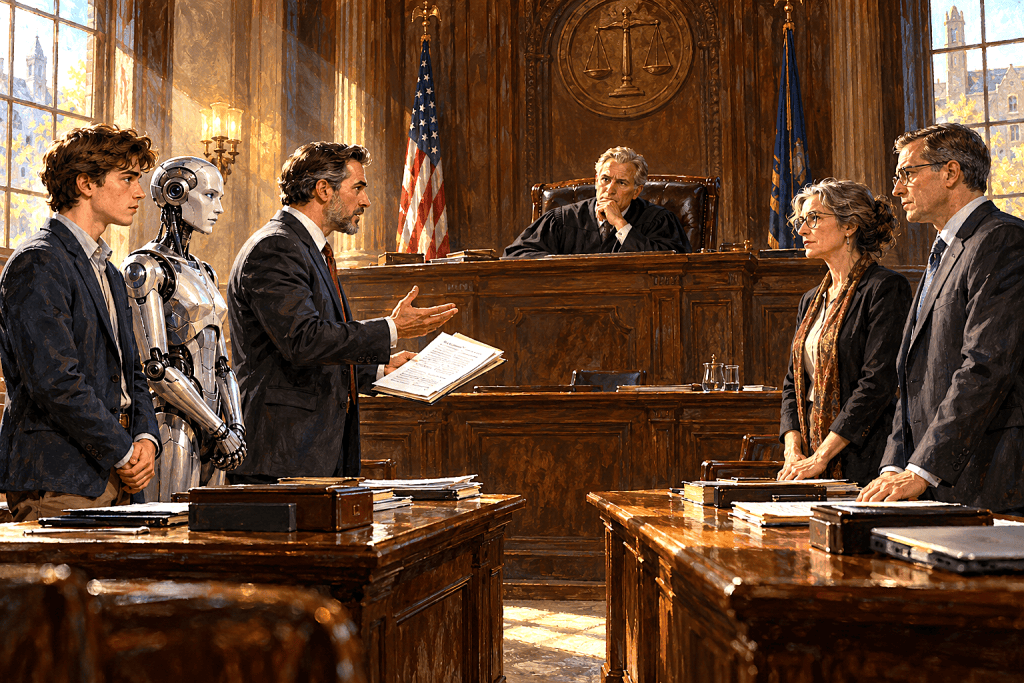
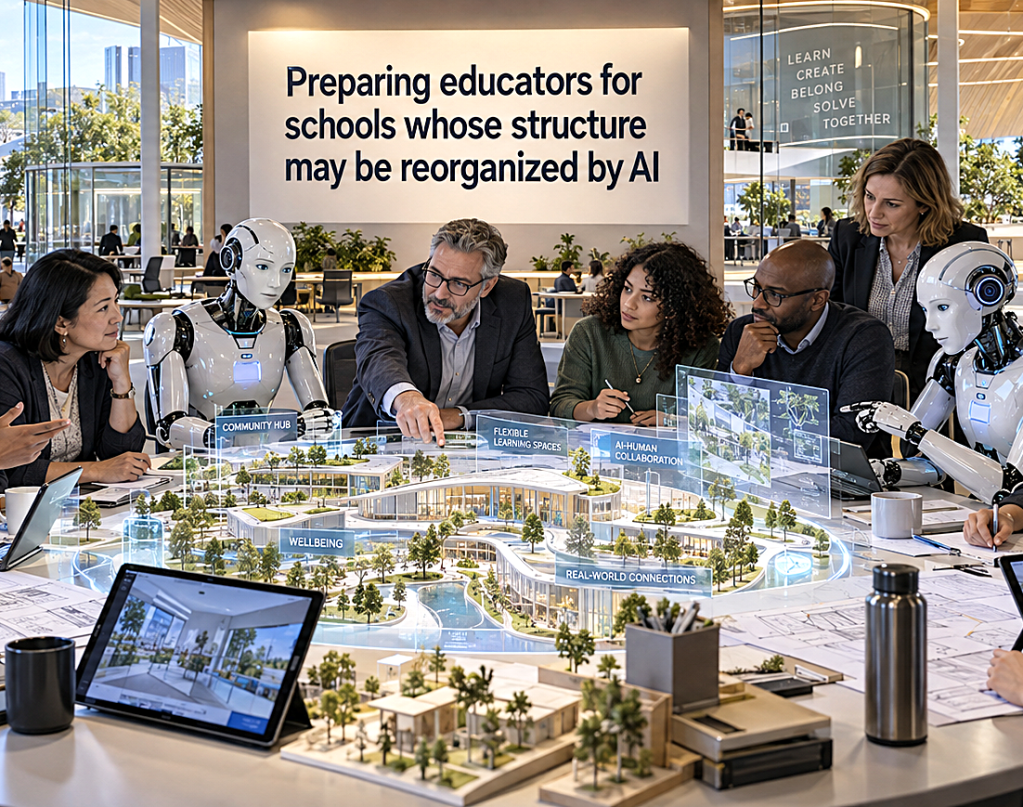
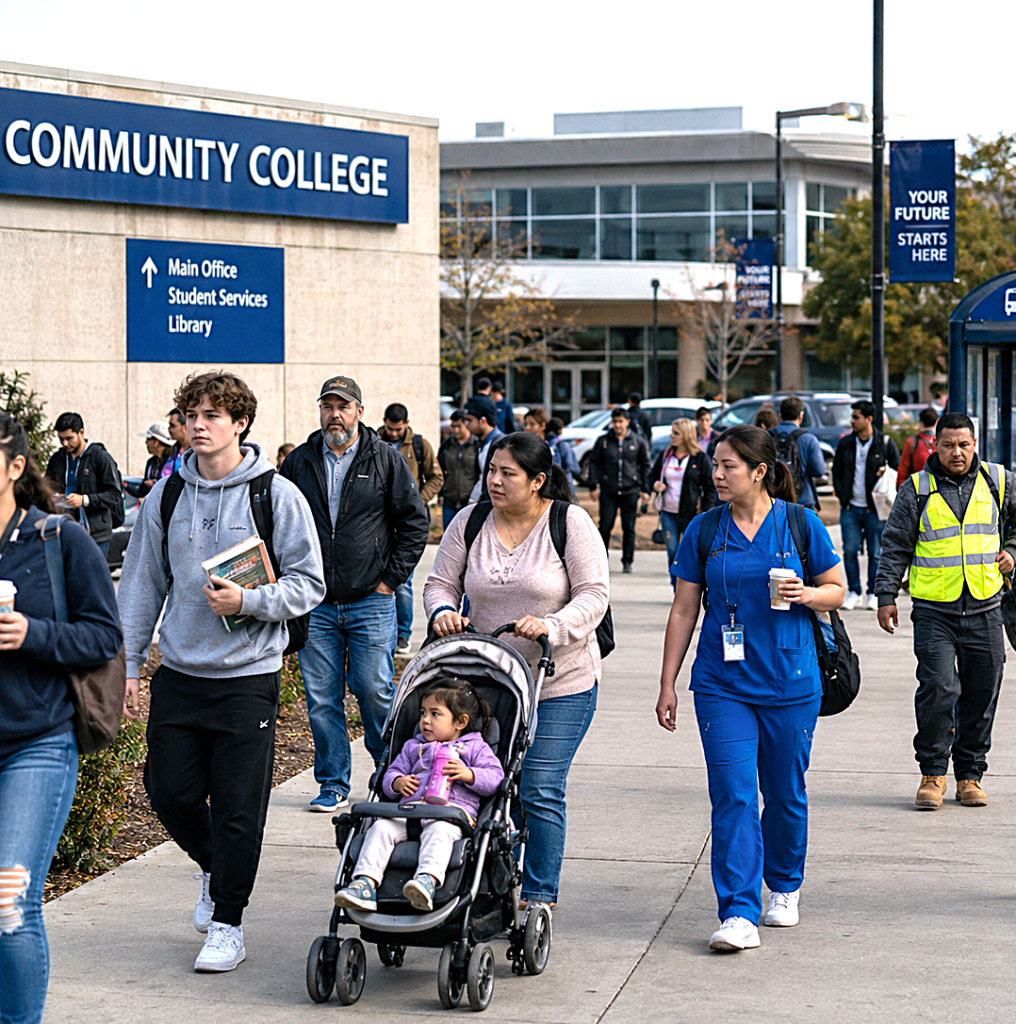
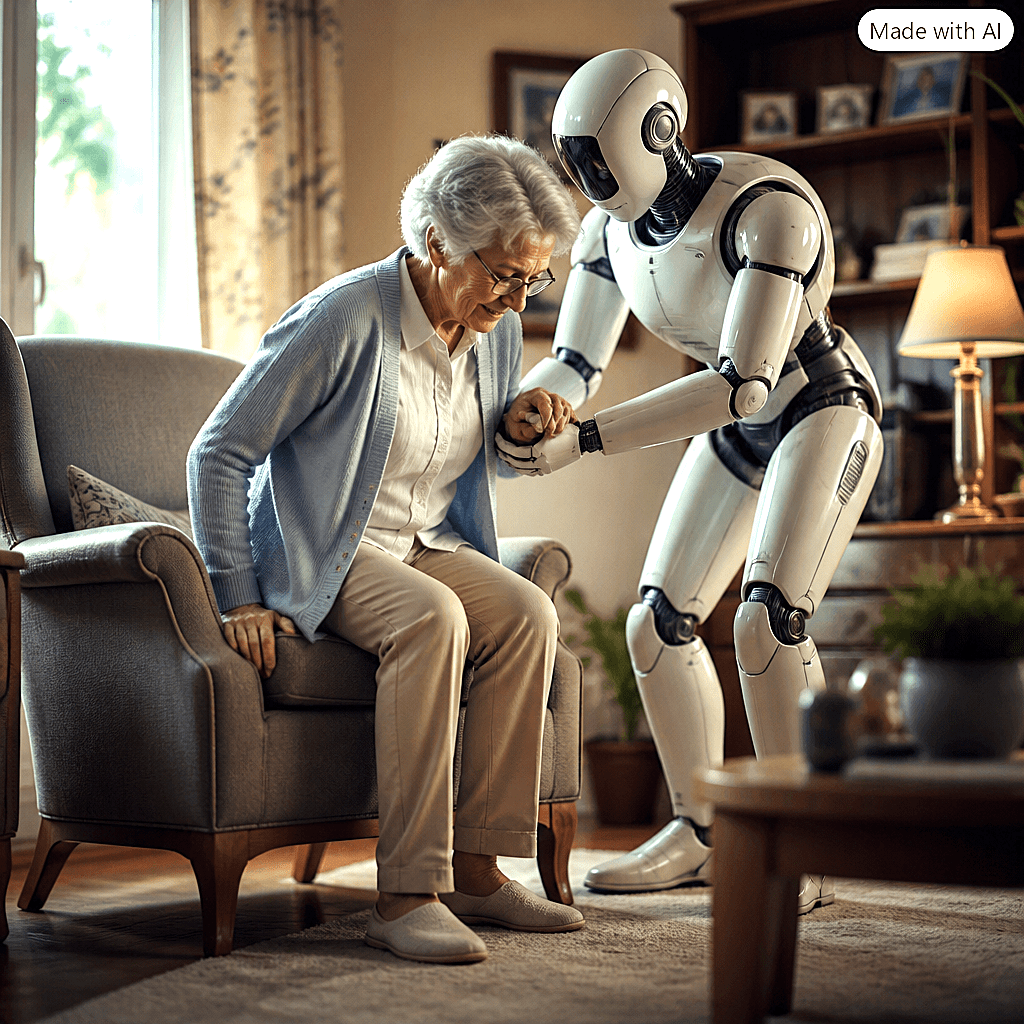
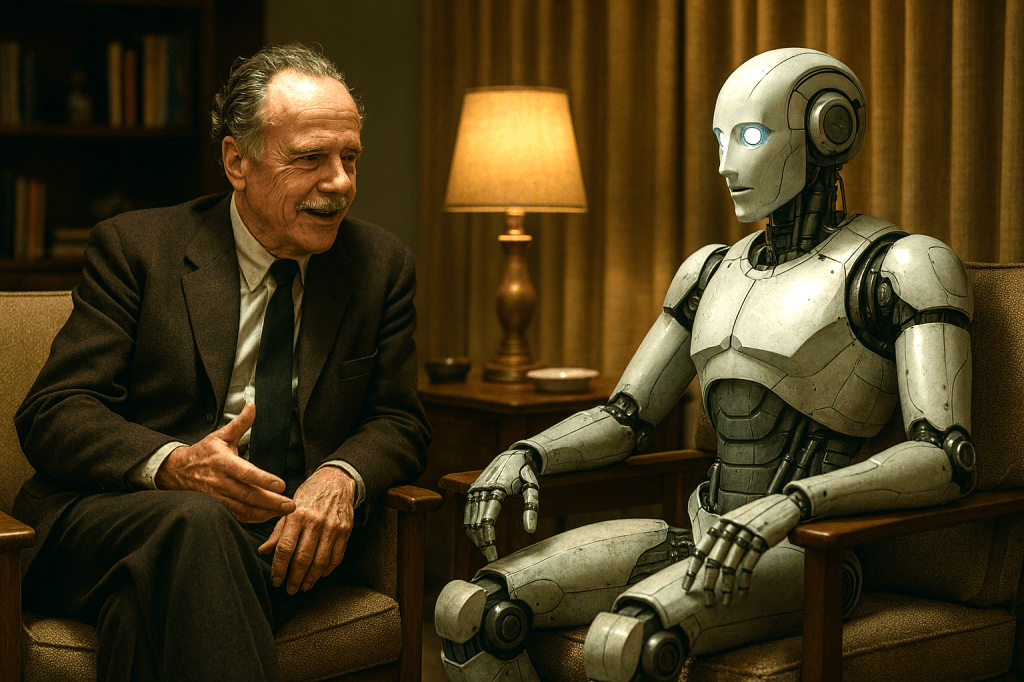
Teacher education prepares people for schools. If artificial intelligence changes the structure of those schools—their schedules, staffing, curriculum, assessment, geography, and division of labor—then adding AI to a conventional teacher-preparation program will not be enough. Programs must prepare educators for several kinds of institutions at once: familiar classrooms using new tools, schools that reorganize teaching around AI, and learning systems designed from the beginning around capabilities that did not exist a few years ago.
The distinction matters because candidates entering teacher education in 2026 may still be working in 2060. Training them only for today’s classroom would prepare them for the opening years of their careers while leaving the remaining decades to improvisation. The stronger question is therefore concrete and forward-looking: What kinds of educators will schools need if AI changes how, when, and where children learn?
The Limits of AI Added Schools
The American Association of Colleges for Teacher Education took an important step in August 2026 when it released a national framework for AI in educator preparation. The framework covers four areas: ethical and policy guardrails, clinical practice and implementation, cognitive architecture and advocacy, and professional expertise and human judgment. It calls on future educators to evaluate AI-generated information, recognize bias and limitations, protect privacy, promote equitable access, and make responsible instructional decisions. AACTE President and CEO Cheryl Holcomb-McCoy summarized the governing principle: technology should “serve, not supplant” educators’ expertise, ethics, and judgment (American Association of Colleges for Teacher Education [AACTE], 2026).
That framework addresses immediate needs. Every preparation program now has to decide what candidates should know about generative AI, what they may do with student data, how they should inspect machine output, and how faculty can determine whether a submitted lesson plan reflects the candidate’s own reasoning. AACTE gives programs a credible national starting point.
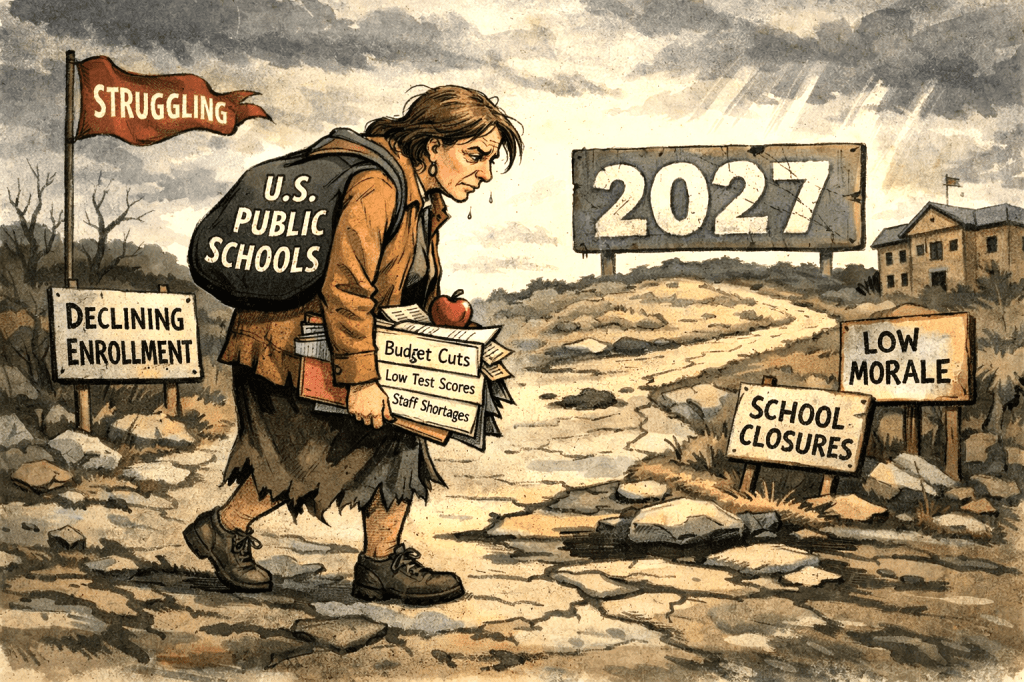
The framework still assumes a recognizable professional setting. Teachers remain the main instructors. Students attend schools organized into classes, grades, subjects, and schedules. AI assists planning, differentiation, feedback, and administration inside that inherited structure. The free Education Week webinar scheduled for October 14, 2026, reflects the same orientation. Its questions concern ethical classroom use, age limits, teacher workload, and challenges prospective teachers will face when using AI in their future classrooms (Education Week, 2026).
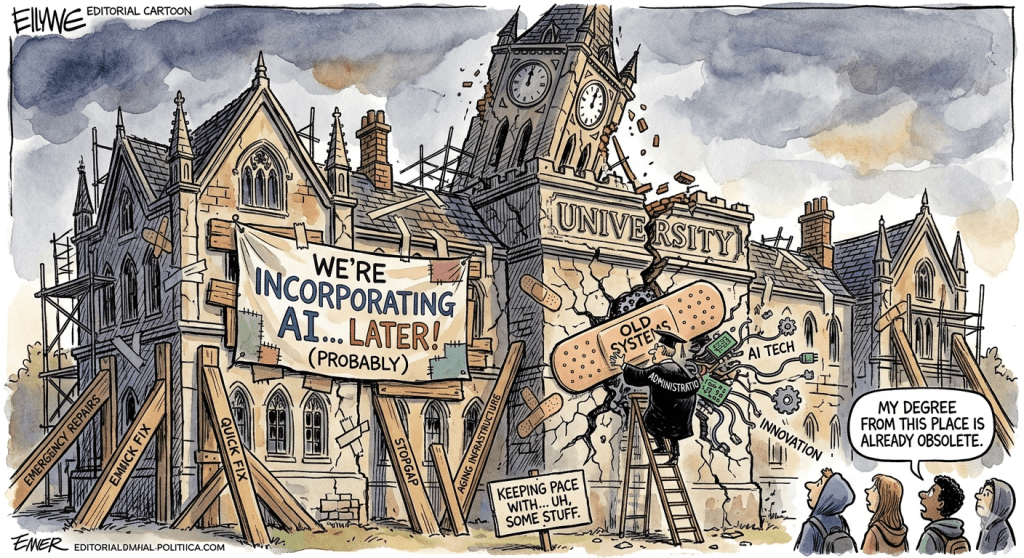
These questions deserve answers. They describe an AI-added school: the institution keeps its basic form and incorporates new technology. Many schools will remain in this category for years, and some may stay there by choice. Teacher education must serve them. It must also recognize that this model is only one part of the emerging field.
Whole School Redesign
The Center on Reinventing Public Education made the structural problem explicit in July 2026. Its research agenda identified gaps in educational vision, institutional coherence, evidence, leadership, and policy. The report then stated the problem in one sentence: “AI is being layered onto existing systems rather than used to redesign them” (Lake & Haderlein, 2026).
CRPE’s proposed research program includes Whole School Redesign: the study of how AI might support “fundamentally different models of learning, teaching, and schooling, not just faster versions of the same ones” (Lake & Haderlein, 2026). This agenda moves the discussion beyond better tools. It asks whether the 50-minute period, age-graded class, subject timetable, individual classroom teacher, standardized pace, and school building should continue to define the system.
CRPE’s April 2026 Think Forward collection supplied several possible directions. Scott Bess described competency-based high schools in which students advance through demonstrated mastery and AI helps coordinate internships and other real-world learning. Other contributors emphasized performance assessment, student purpose, collaboration, judgment, and human relationships. CRPE called Bess’s proposal “mastery, not minutes,” a compact description of what changes when time stops serving as the main measure of progress (Center on Reinventing Public Education [CRPE], 2026a).
The August 2026 follow-up examined four public-school systems already moving beyond routine adoption. Agua Fria uses custom AI tools to connect academic standards with individual career pathways. Anaheim tracks abilities such as collaboration and critical thinking. ASU Prep builds tutoring and planning tools internally. Elma links instruction to changing needs among local employers. CRPE classifies these districts as System Changers because they adapt and build tools, develop internal technical capacity, and use AI to advance broader reforms. The districts increasingly behave like research-and-development organizations. CRPE also reports that they have little evidence so far that AI has improved student outcomes (Berardino & Guin, 2026).
That evidence gap should shape teacher education. Candidates need experience in schools that are testing new structures, and they need the research skills to determine whether those structures help students. Enthusiasm cannot substitute for evidence. Waiting for a settled model is equally unrealistic when schools are already changing.
Operating Experiments
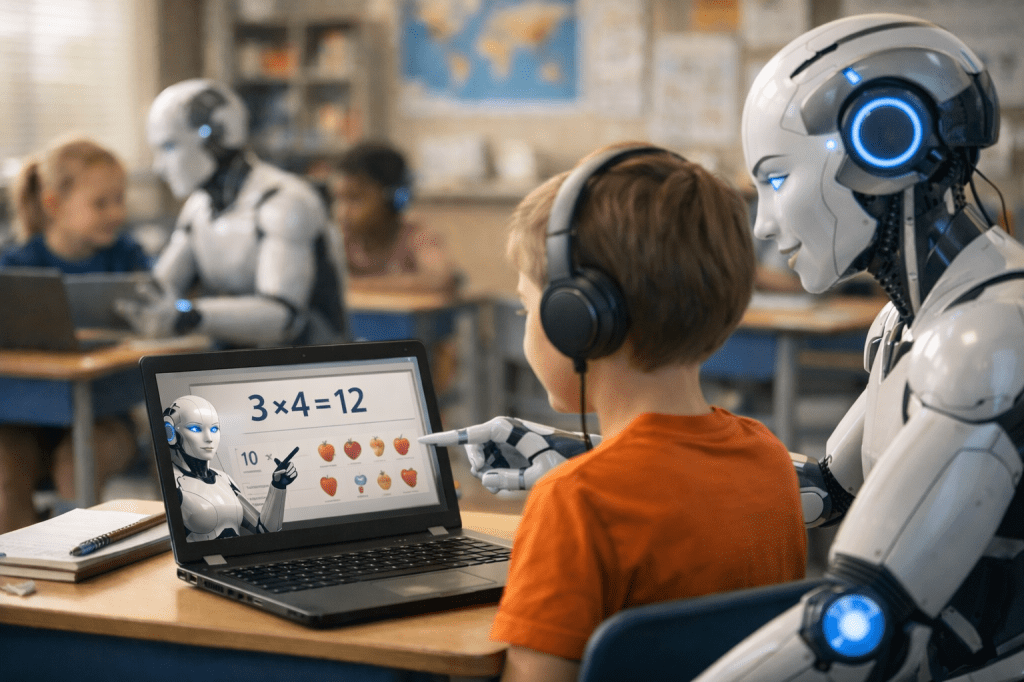
Alpha School offers the clearest K–12 example of a different instructional premise. Its website says students complete core academic work in about two hours each morning through adaptive software and an AI tutor. Students progress at an individual pace through mastery rather than moving together through the same lesson. Adults in the room support motivation, independence, and growth. The afternoon is reserved for workshops and practical skills (Alpha School, n.d.).
This arrangement reallocates the school day. Academic explanation and practice occupy a smaller block. Adults spend less time delivering common lectures and more time coaching students. The campus supports projects, communication, collaboration, and other activities that are difficult to reduce to a sequence of online exercises. Whether Alpha consistently delivers the academic gains it advertises remains a separate question. Its organizational design is still significant because it separates functions that conventional schools usually bundle into one teacher’s job.
Founders School pushes that separation further. Its site says students complete AI-accelerated, mastery-based academics by 11 a.m. and spend the rest of the day building businesses. Students receive feedback from working entrepreneurs and develop skills in selling, product development, financial thinking, AI systems, and communication. The school says its first class begins in fall 2026. Its schedule gives three hours to academics and more than five hours to venture building (Founders School, 2026).
The model is highly specialized and commercially oriented. It would be a poor blueprint for many children and communities. It nevertheless exposes a useful design choice: once individualized software handles a portion of academic practice, a school can devote much more time to sustained work with mentors, teams, customers, and public audiences. Teacher education rarely prepares candidates to supervise such an environment.
Evidence Still Matters
Novelty does not establish effectiveness. Alpha’s claims have attracted serious scrutiny from state officials, researchers, and journalists. A September 2026 investigation by The Texas Tribune and ProPublica reviewed Alpha’s attempts to secure public charter approval and examined performance claims tied to two more diverse Texas campuses. State officials questioned whether a model developed largely among affluent private-school students would serve children who enter behind grade level, receive special-education services, or are learning English (Churchill, 2026).
The investigation found that one public claim about dramatic improvement at Texas Preparatory School did not match state test data. The share of students reaching the lowest passing category moved from 19 percent to 21 percent, while the share performing at grade level fell from 10 percent to zero during the partnership. Toni Templeton of the University of Houston Education Research Center said, “I don’t see the extreme growth.” Jennifer Steele of American University concluded that there was no evidence the model worked as a scalable approach for public schools (Churchill, 2026). Alpha disputed critical reporting about its schools.
These findings do not settle every question about personalized AI instruction. They establish the standard that new models must meet. A redesigned school should publish comparable outcome data, explain which students it serves, show how it supports disabilities and language learning, and permit independent evaluation. Teacher-preparation programs should teach candidates to ask for that evidence. Future educators will need to distinguish an interesting architecture from a demonstrated improvement.
Schools Beyond Fixed Place and Pace
Other programs weaken the traditional assumptions of place, timetable, curriculum, and age cohort. Alpha World School describes a high-school year that moves as a cohort through Kenya, Ecuador, and the United States. Students keep up with daily academic work while helping launch a learning system, install solar power and internet access, study local languages, conduct research, and complete community projects. Community leaders, guides, and mentors take part in evaluating their work (Alpha World School, n.d.).
Its claims deserve the same scrutiny as Alpha’s domestic model, especially where the program describes work in communities facing poverty. Even so, the design illustrates a school that functions as a moving project network. The campus becomes one site among several. Academic study, fieldwork, community participation, remote expertise, and digital instruction operate together.
School of Humanity offers a less technologically aggressive example. This internationally accredited online high school organizes learning around real-world projects, personalized pathways, interdisciplinary study, and a mastery transcript. Its site summarizes the approach plainly: “Instead of exams, we learn through real-world projects” (School of Humanity, n.d.). Synthesis, which grew from an experimental school created for the children of SpaceX employees, organizes children into global teams that work through simulations and difficult problems. Its curriculum states, “Experience, not instruction, drives learning” (Synthesis, n.d.).
Neither organization depends entirely on generative AI. Their importance comes from structures that already fit an AI-rich environment: flexible pace, distributed participation, team problem-solving, project work, and evidence of competence. AI can enter these settings without being forced into a six-period day. These programs also remind us that many useful changes began before the current AI boom.
Higher Education Begins to Rebuild Itself
Higher education is beginning to examine its own institutional form. The Universitat Oberta de Catalunya, one of the early online universities, launched its uoc.Ωmega initiative in June 2026. UOC describes AI as “a contextual shift in how we learn, produce knowledge and build trust.” The university is reviewing teaching roles, student support, organization, inclusion, personalization, and the production of knowledge. Nearly 400 participants are contributing to ideation expeditions, and the first proposals are scheduled for testing during the 2026–2027 academic year (Universitat Oberta de Catalunya [UOC], 2026).
UOC’s value as an example lies in its scale and maturity. This is an accredited institution reconsidering its operating model rather than a new school built around a founder’s claim. Rector Àngels Fitó says AI reaches “the heart of the university model.” The initiative asks what students need from a university when explanation, practice, feedback, and routine support can be supplied continuously by AI systems (UOC, 2026).
Teacher education should ask the same question about its own work. A professor of education now explains concepts, demonstrates methods, evaluates plans, supervises fieldwork, provides feedback, coaches reflection, and certifies readiness. AI can already perform limited parts of several of those functions. Programs should decide which tasks can be distributed, which require direct human responsibility, and how candidates will learn to make the same decisions in schools.
Preparing Educators for Changing Schools
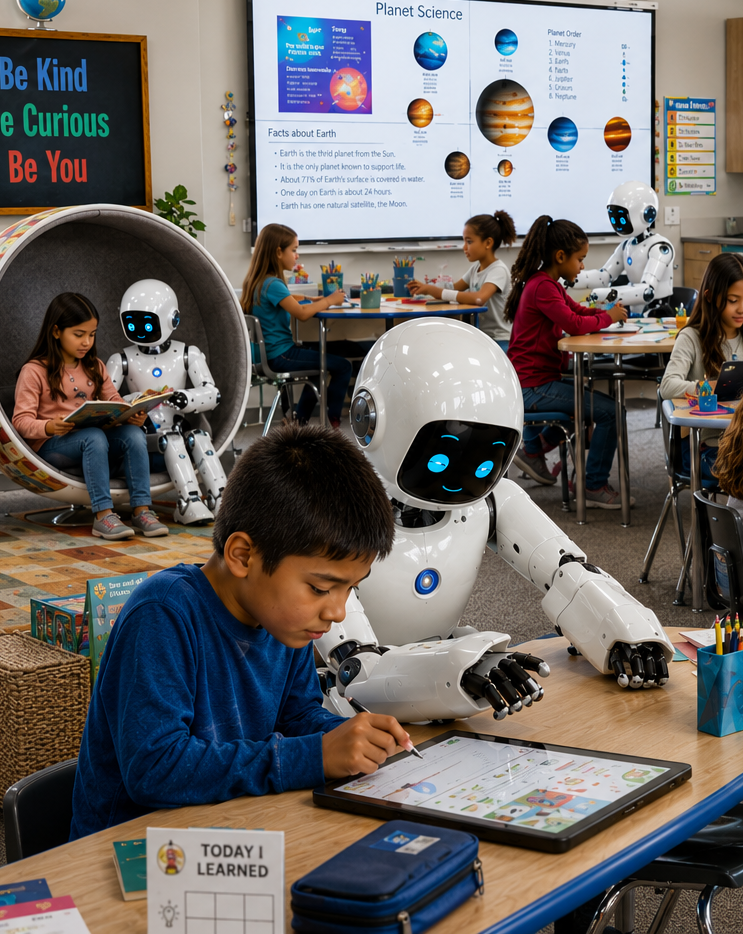
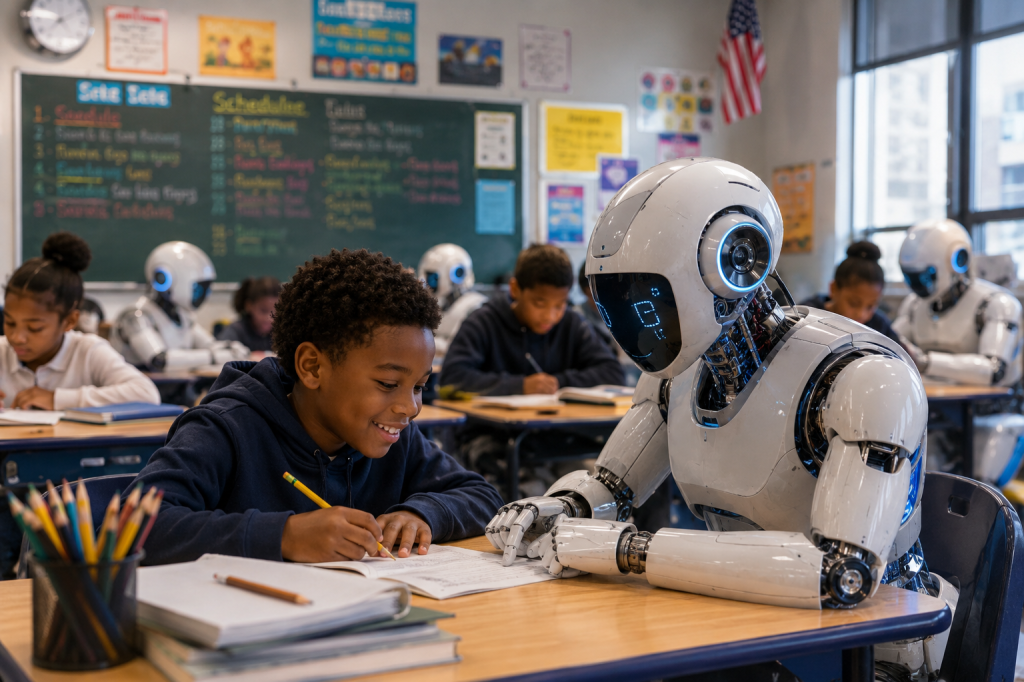
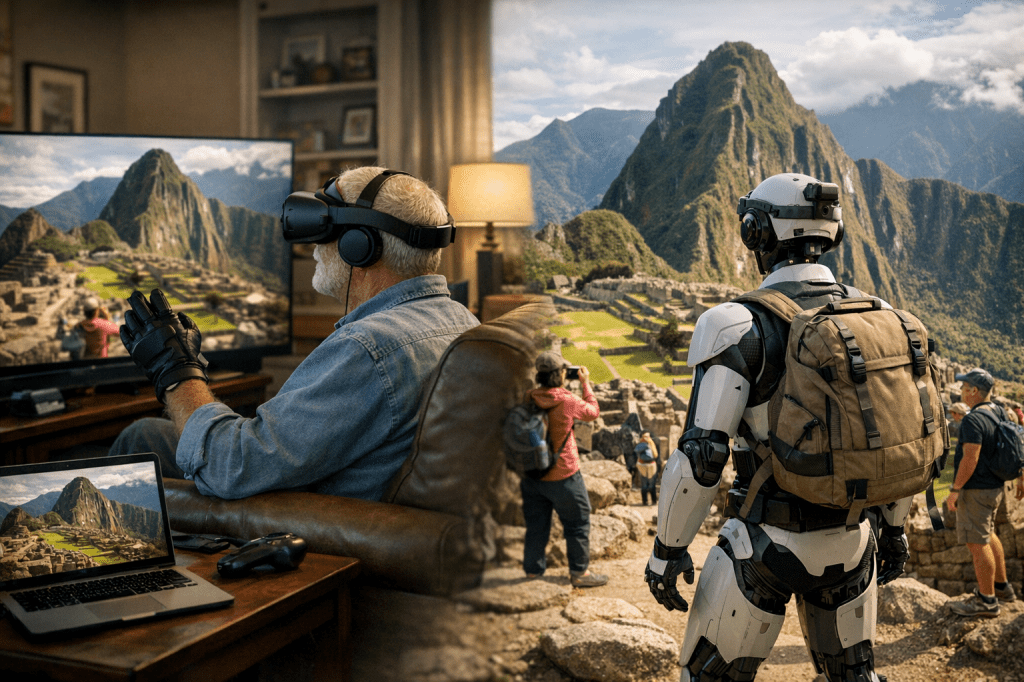
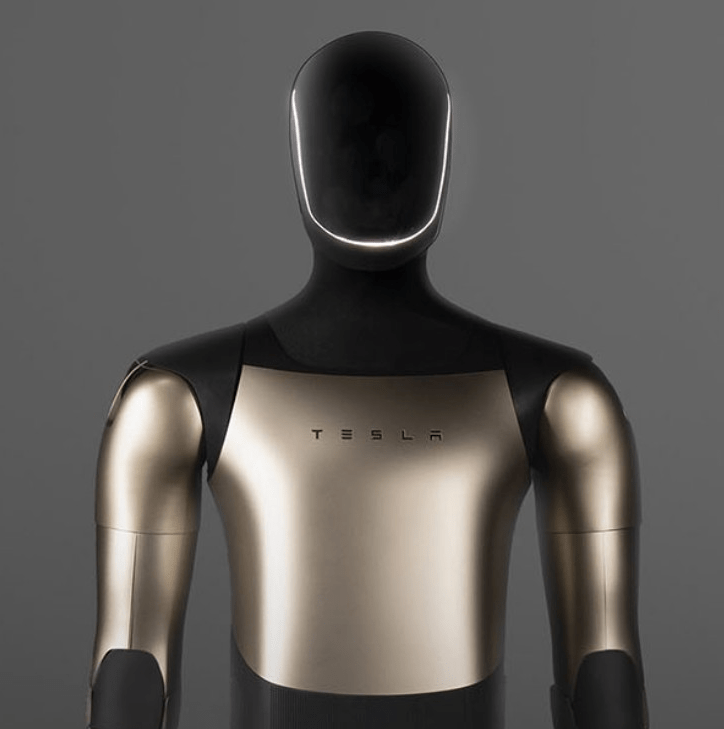
The emerging models can be understood in three categories. AI-added schools preserve conventional classes, schedules, staffing, and curriculum while using AI for planning, tutoring, feedback, and administration. AI-reorganized schools change the use of time, divide instructional functions among people and machines, adopt mastery progression, and connect learning more closely with projects and outside partners. AI-native learning systems begin with current AI capabilities and reconsider the institution itself, including where learning occurs, who performs each function, how students demonstrate competence, and whether the permanent campus remains the main unit of organization.
Most educators will work in mixtures of these categories. A public school may retain grade levels while introducing flexible mastery blocks. A district may keep neighborhood campuses while using remote tutors and community internships. An online program may hold periodic residential sessions. A conventional high school may create one AI-supported pathway that operates more like a studio or apprenticeship. Teacher education therefore needs breadth without pretending that one model has already won.
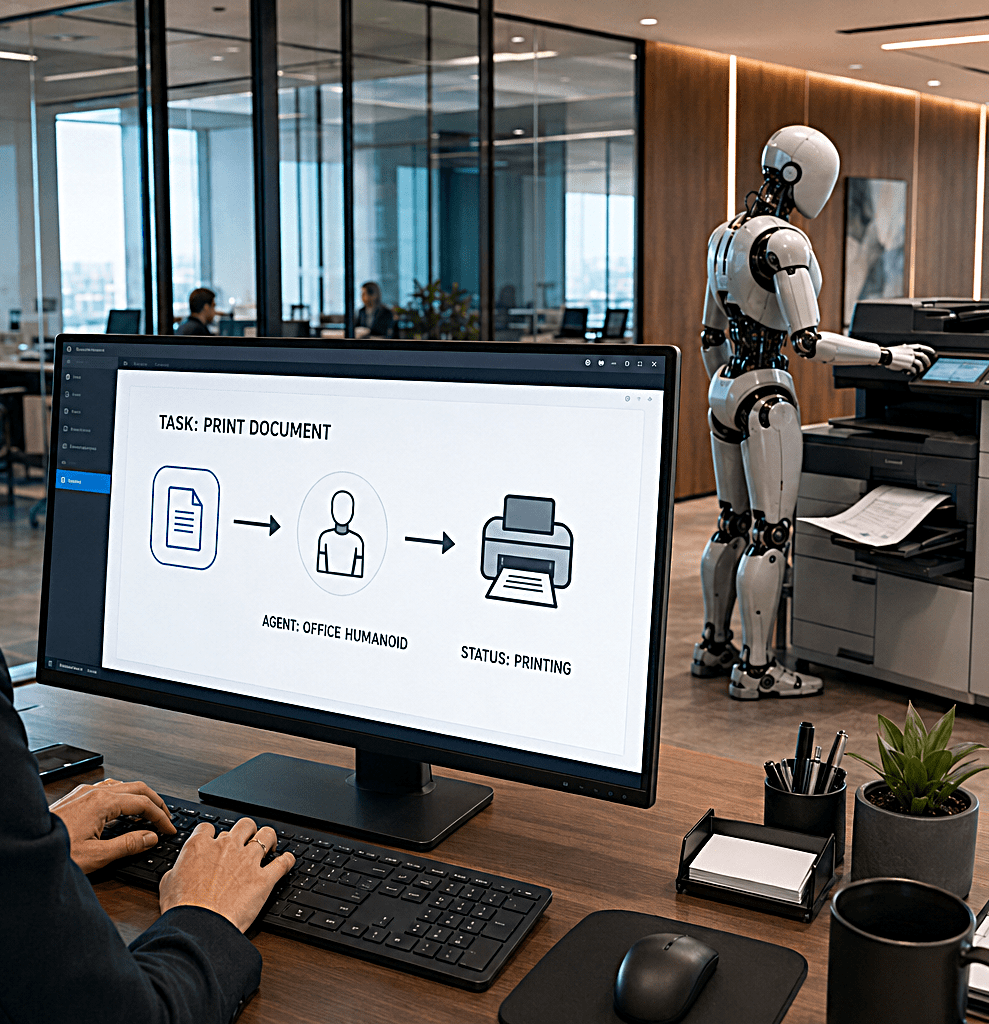
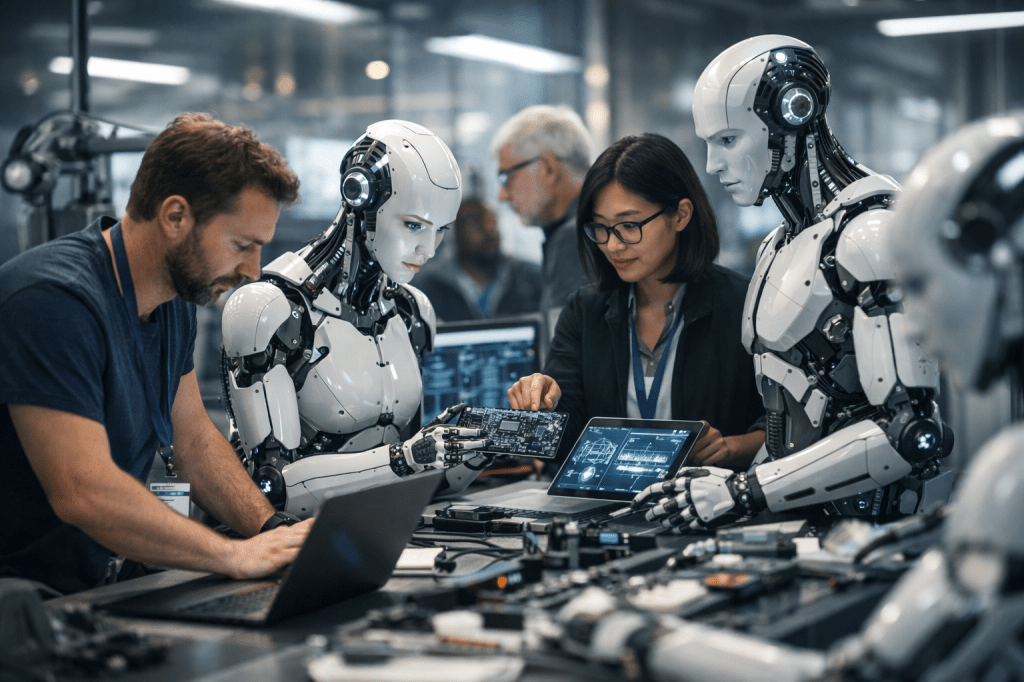
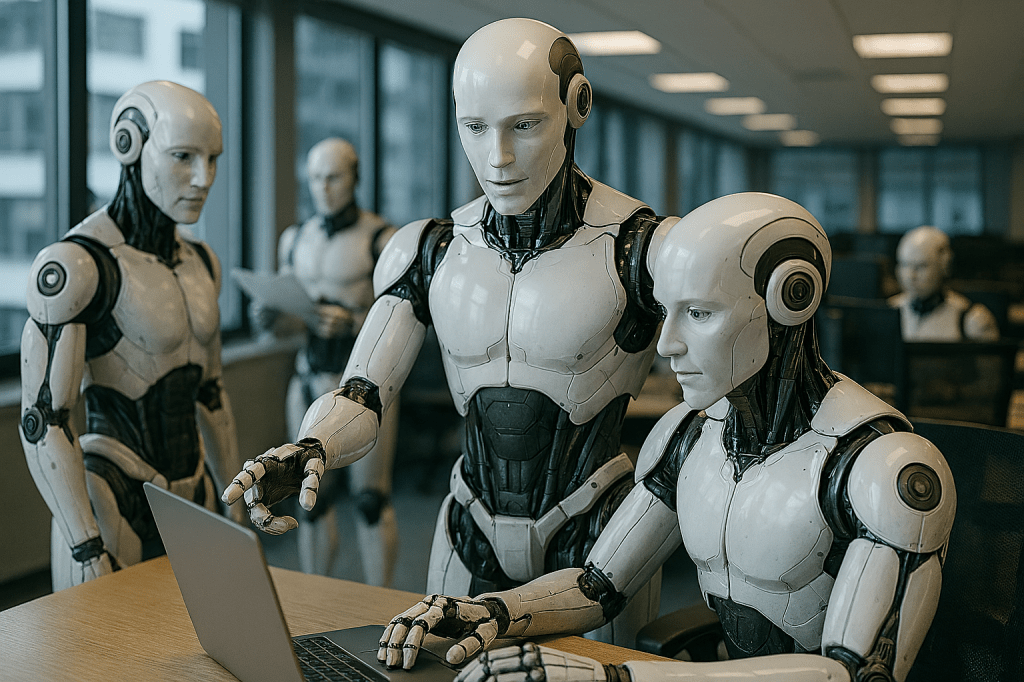
The work of educators will also divide into more specialized roles. One person may design learning pathways for many students. Another may coach a small group through unrelated long-term projects. An assessment specialist may verify mastery when AI has helped produce the work. A community coordinator may connect students with laboratories, businesses, artists, and public agencies. A subject expert may intervene when a tutoring system cannot diagnose a misconception. A guide may concentrate on motivation, judgment, relationships, and well-being. Some schools will combine these responsibilities in teams instead of assigning every function to one classroom teacher.
Students assume greater responsibility in these settings. They set goals, select pathways within defined requirements, initiate projects, consult human and machine specialists, work for real audiences, and assemble evidence of competence. Educators remain responsible for structure, safety, standards, and equitable access. Their authority rests less on controlling the flow of information and more on creating conditions in which students can use abundant information well.
A Teacher Education Program Built for Change
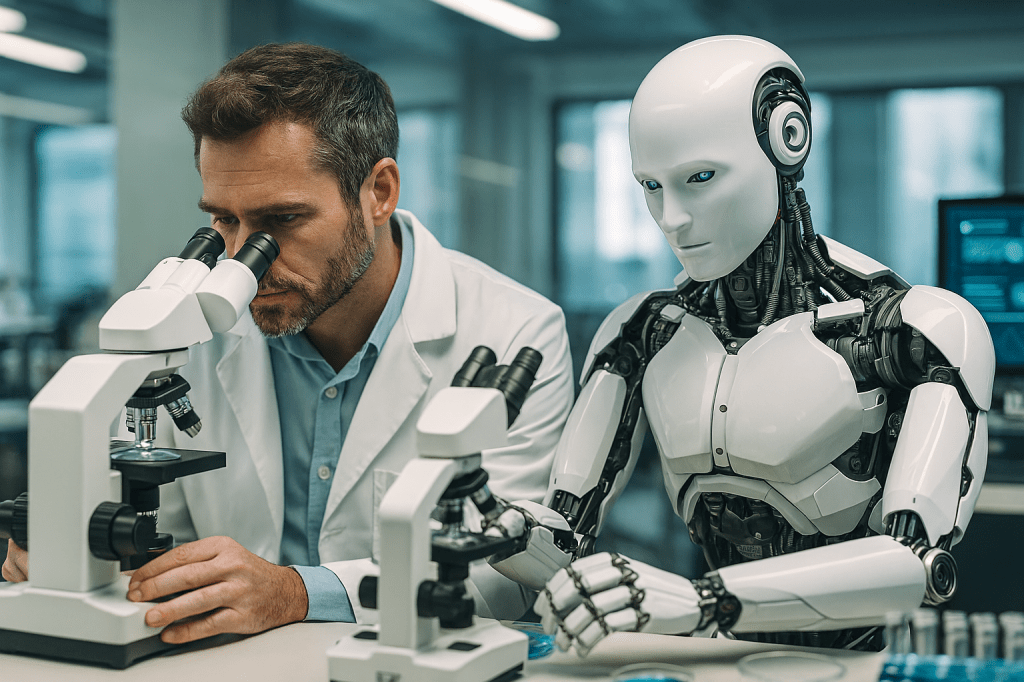
A preparation program designed for this field would keep many elements already emerging in 2026: simulation, supervised practice, AI literacy, design studios, evidence-based assessment, residencies, and strong human coaching. It would organize them around institutional change rather than classroom adoption alone.
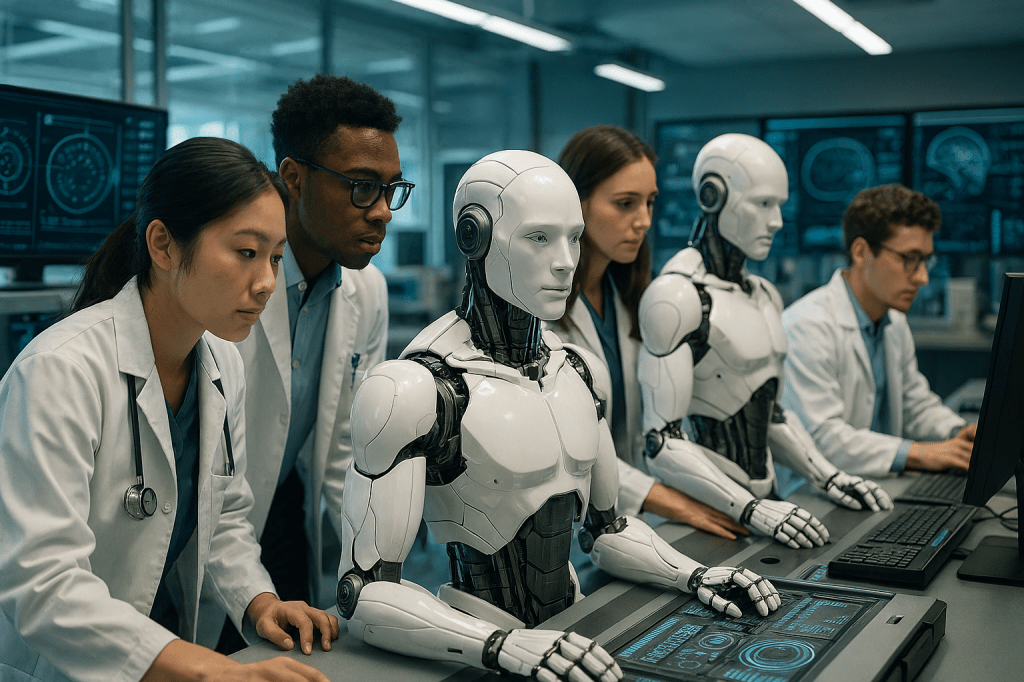
Candidates would rotate through contrasting settings. One placement might be a conventional classroom using AI carefully. Another might use mastery progression, interdisciplinary projects, team teaching, or extensive online tutoring. A third might take place in a community organization, workplace, museum, laboratory, or distributed online program. These placements would help candidates see how the educator’s role changes with the setting.
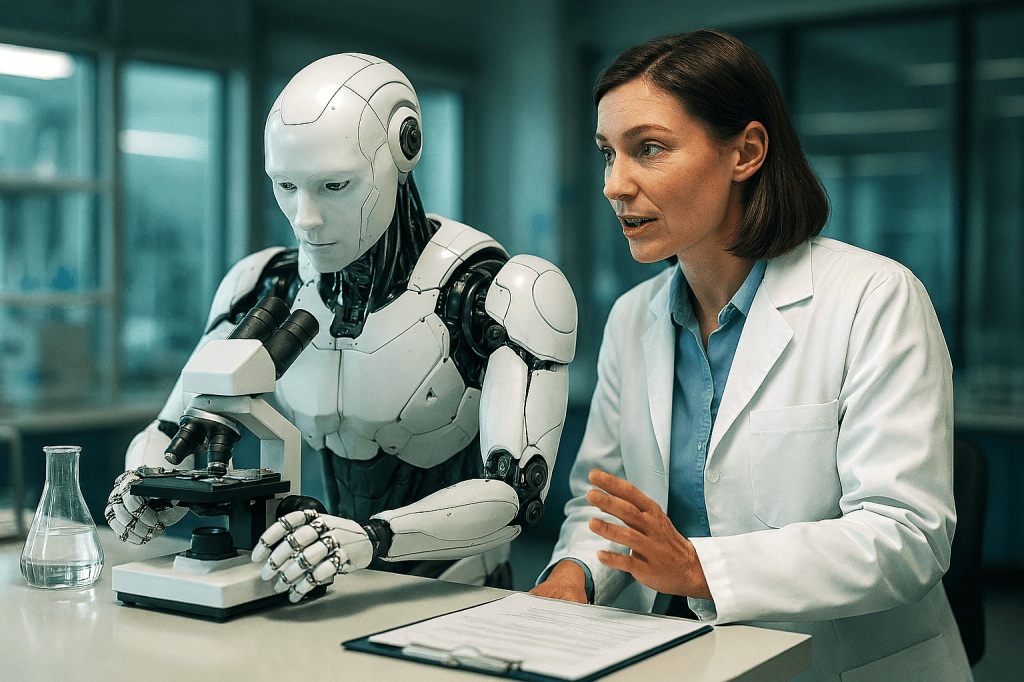
The curriculum would include the design and supervision of AI-supported learning systems. Candidates would learn to select models, inspect output, protect student data, monitor individual progress, identify disengagement, and intervene when automated instruction fails. They would test claims made by vendors and schools against independent evidence. They would practice explaining system decisions to families and students in ordinary language.
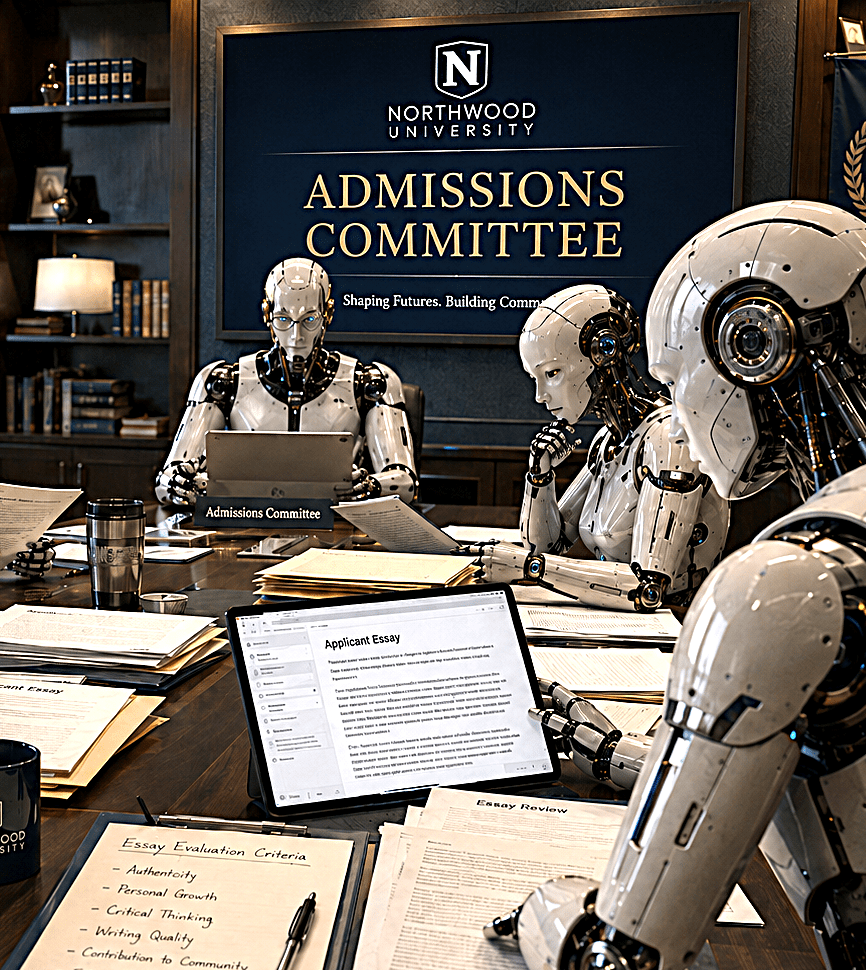
Assessment would focus on professional reasoning and performance. Candidates would teach, coach, design, analyze, revise, and defend their decisions. Programs would examine recorded interactions, responses to unexpected student needs, evaluation of machine output, project supervision, and growth across repeated attempts. A polished lesson plan would count as one artifact among many because generative AI can now produce polished plans with little evidence of the author’s judgment.
Faculty roles would change as well. Some faculty members would remain subject and pedagogy specialists. Others would direct simulations, maintain partnerships with schools and community sites, evaluate AI systems, supervise design studios, or lead applied research on new models. The college of education would operate as a continuing research partner for schools instead of sending candidates into the field only near the end of a program.
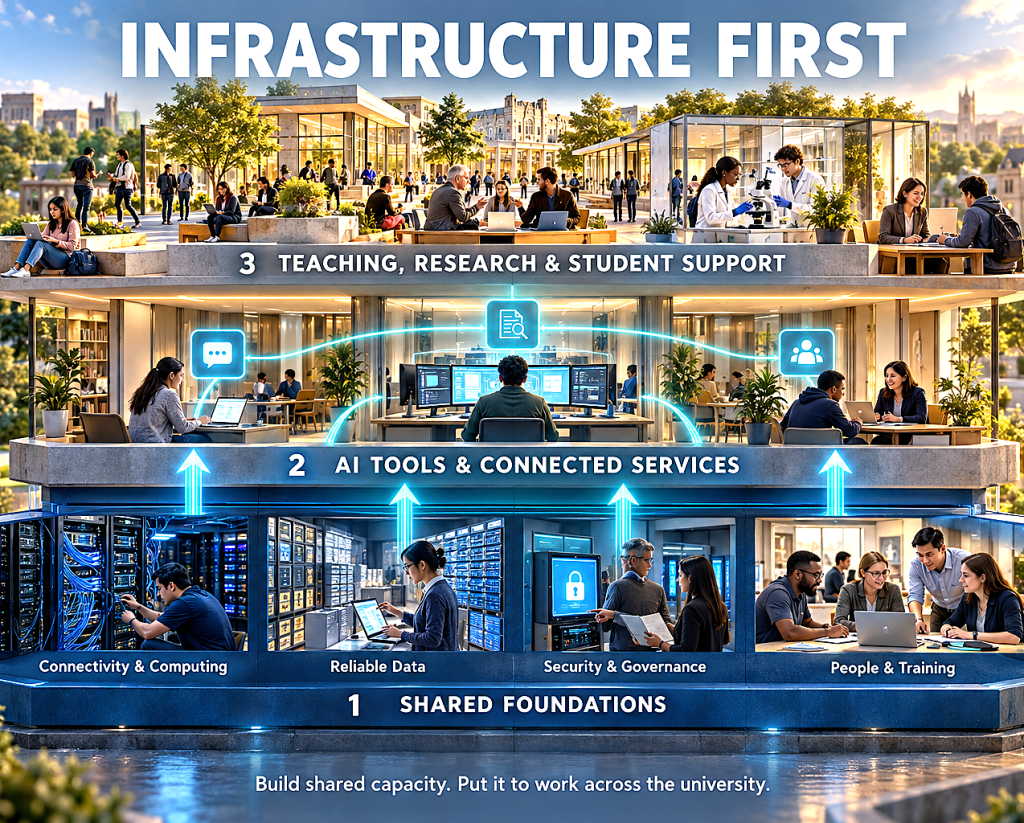
Physical space would support this work. Flexible studios, simulation rooms, observation and debriefing areas, project workshops, remote-coaching facilities, and community-partnership hubs would replace some lecture-room capacity. The facility would connect continuously with schools and other learning sites. Its design would allow rooms, equipment, and programs to change as the technology changes.
The School Still Taking Shape
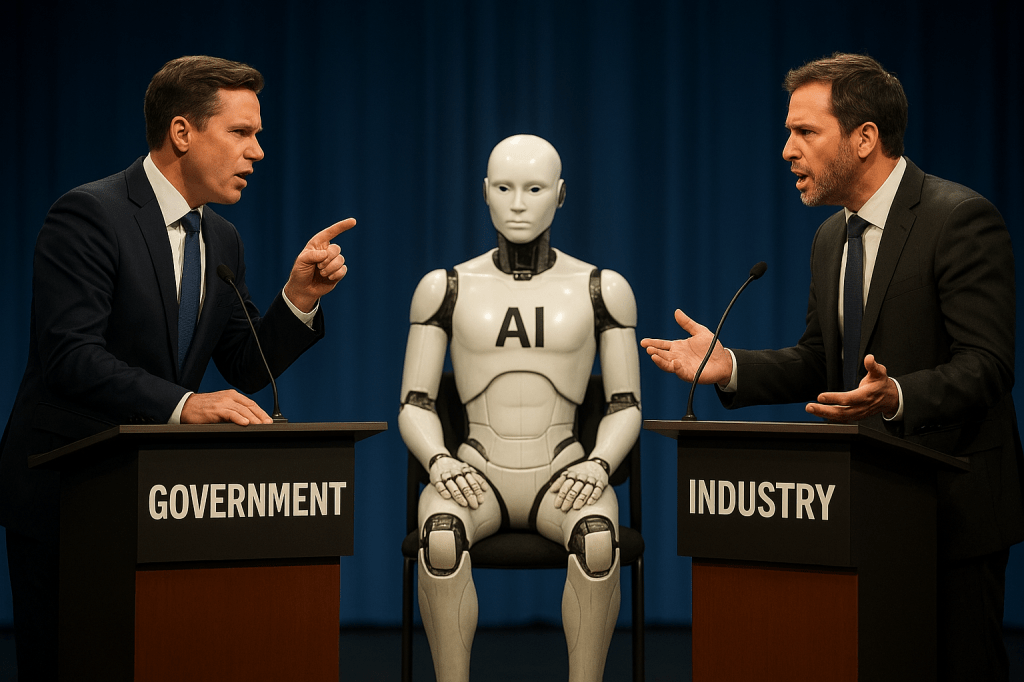
The most credible conclusion in September 2026 is that teacher education must prepare candidates for institutional variety and continued change. AACTE is right to establish ethical safeguards and protect professional judgment. CRPE is right to warn that placing AI inside an old structure can preserve the weaknesses of that structure. Alpha, Founders School, Alpha World School, School of Humanity, and Synthesis are useful because they test different arrangements of time, place, adult work, and student responsibility. Their claims and results require independent examination. UOC shows how a mature institution can reconsider its model without assuming that adoption alone equals progress.
Teacher education should join this work directly. Its graduates will teach in conventional classrooms, redesigned schools, hybrid networks, community projects, and institutions that have not yet been invented. Their preparation should give them the judgment to work across those settings and the capacity to help shape them.
Bushweller’s question therefore reaches beyond a new course in AI literacy or a new laboratory on campus. Teacher education should prepare educators for schools whose architecture is becoming active, flexible, and open to revision. The programs that accept that responsibility will do more than help teachers use AI. They will help educators decide what school should become.
References
American Association of Colleges for Teacher Education. (2026, August 20). AACTE releases national framework on artificial intelligence in educator preparation. https://aacte.org/2026/08/aacte-releases-national-framework-on-artificial-intelligence-in-educator-preparation/
Alpha School. (n.d.). Overview. Retrieved September 21, 2026, from https://alpha.school/overview/
Alpha World School. (n.d.). Learn by building across three continents. Retrieved September 21, 2026, from https://world.alpha.school/
Berardino, M., & Guin, S. (2026, August). Charting new paths: What AI-enabled transformation looks like in four early adopter districts. Center on Reinventing Public Education. https://crpe.org/ai-transformation-four-early-adopter-districts/
Center on Reinventing Public Education. (2026a, April). Reimagining learning for the age of AI: Visions from CRPE’s Think Forward fellows. https://crpe.org/reimagining-learning-for-the-age-of-ai/
Churchill, L. (2026, September 2). Texas rejected an AI-driven school’s bid to open a charter. Then the state approved it for the voucher program. The Texas Tribune and ProPublica. https://www.texastribune.org/2026/09/02/alpha-school-texas-vouchers-ai/
Education Week. (2026). What teacher education should look like in the age of AI [Webinar]. Retrieved September 21, 2026, from https://www.edweek.org/events/webinar/what-teacher-education-should-look-like-in-the-age-of-ai
Founders School. (2026). Founders School. https://www.founders.school/
Lake, R., & Haderlein, S. (2026, July). A strategic research agenda for AI-driven transformation in public education. Center on Reinventing Public Education. https://crpe.org/a-strategic-research-agenda-for-ai-driven-transformation-in-public-education/
School of Humanity. (n.d.). Alternative online high school for future-ready learning. Retrieved September 21, 2026, from https://sofhumanity.com/programs/high-school/
Synthesis. (n.d.). Curriculum. Retrieved September 21, 2026, from https://www.synthesis.com/curriculum
Universitat Oberta de Catalunya. (2026, June 2). UOC launches uoc.Ωmega mission to rethink its educational model in the age of AI. https://www.uoc.edu/en/news/2026/ai-native-university-uoc-omega-mission-uoc
###
Filed under: Uncategorized |










































































































































































































































































































































































Leave a Reply