




By Jim Shimabukuro (assisted by Claude)
Editor
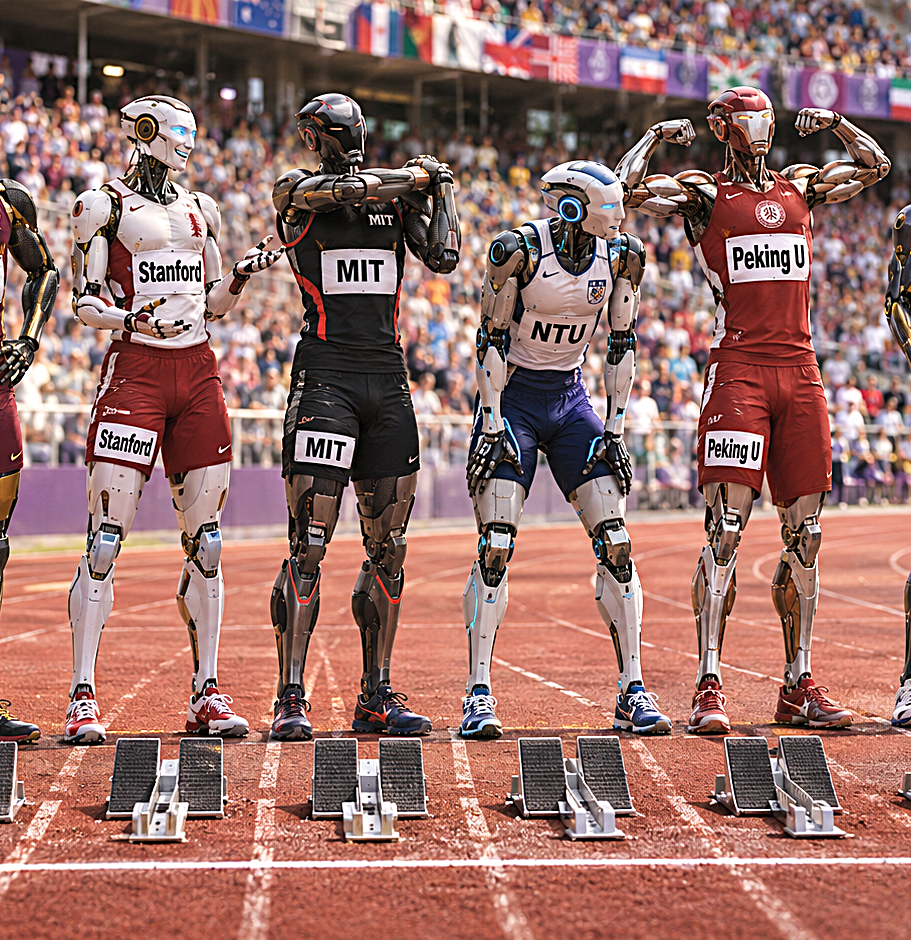
We relied on four criteria to identify and rank the world’s five strongest AI universities: (1) reputation among academics and employers; (2) citation-based research performance; (3) papers accepted at the most selective conferences; and (4) contribution to notable AI systems and to the research workforce. A university qualifies as a leader if it performs near the top on at least three of the four. Five universities meet that test most clearly in the second half of 2026: Tsinghua, Carnegie Mellon, Stanford, MIT, and NTU. Peking University, NUS and the University of California, Berkeley, are close behind, and a reasonable reader could give the fifth place to any of them.

In March 2026, QS ranked MIT first in the world for data science and artificial intelligence, followed by Stanford, the National University of Singapore (NUS), Nanyang Technological University (NTU) and Carnegie Mellon (QS, 2026). Three months later, U.S. News & World Report published its own global table for artificial intelligence. Tsinghua University was first, NTU second, Zhejiang University third, Peking University fourth and NUS fifth. Carnegie Mellon, the highest-placed North American university, was 39th. Stanford was 44th and MIT 45th (Ngo, 2026b; Xuanxiao, 2026). Asian universities held 18 of the top 20 places (Ngo, 2026b).
The two tables disagree because they count different things. One analysis of the QS indicator scores found that about 70 percent of a university’s total comes from surveys of academics and employers and about 30 percent from citation measures (Wong, 2026a). U.S. News relies on publication and citation data, and its 2026–27 edition counts papers published from 2020 through 2024 (Wong, 2026b). ShanghaiRanking’s 2026 subject ranking, which is also built on research performance, places NTU first in AI (Nanyang Technological University, n.d.). CSRankings counts faculty papers at selective computer science conferences and uses no surveys. Two reports on its 2026 results put Tsinghua and Peking in the top two AI positions. The same reports place Carnegie Mellon third in one case and 14th in the other, because CSRankings lets users choose which years and subfields to count (Ngo, 2026a; Xinzhiyuan, 2026).
Choosing the five
Table listing the five selections in rank order, their rankings in two other publications, and other evidence
| University | QS 2026 | U.S. News 2026–27 | Other evidence |
| Tsinghua University | 10 | 1 | 26 notable models, 2014–2025; 4.73% of NeurIPS 2025 papers |
| Carnegie Mellon University | 5 | 39 | 25 notable models; No. 1 U.S. graduate AI program; 2.55% of NeurIPS 2025 papers |
| Stanford University | 2 | 44 | 26 notable models; seven of the 100 most-cited AI papers of 2024; 2.58% of NeurIPS 2025 papers |
| MIT | 1 | 45 | 2.45% of NeurIPS 2025 papers; fifth-largest employer of NeurIPS 2025 authors |
| Nanyang Technological University | 4 | 2 | No. 1 in ShanghaiRanking’s 2026 AI subject table |
Sources: QS (2026); Xuanxiao (2026); Stanford HAI (2026); Xinzhiyuan (2025); Carnegie Mellon University (2026a); Park (2026); Nanyang Technological University (n.d.).
Tsinghua is the only one of the five that is strong on all four measures. It is first in the U.S. News table and 10th in QS, where it earns the maximum score on the H-index indicator (Wong, 2026a). An analysis of NeurIPS 2025, a leading machine-learning conference, attributed 4.73 percent of accepted papers to Tsinghua, second only to Google’s 4.84 percent. Stanford accounted for 2.58 percent, Carnegie Mellon for 2.55 percent and MIT for 2.45 percent (Xinzhiyuan, 2025). Stanford’s AI Index, which tracks influential AI systems, counts 26 notable models from Tsinghua over the past decade, 26 from Stanford and 25 from Carnegie Mellon, the three highest totals among academic institutions (Stanford HAI, 2026).
Carnegie Mellon holds the No. 1 position among U.S. graduate programs in artificial intelligence in the 2026 U.S. News graduate rankings (Carnegie Mellon University, 2026a). MIT receives the maximum score on both QS reputation surveys (Wong, 2026a). A Carnegie Endowment study of 10,280 NeurIPS 2025 authors found that MIT and Stanford were the fifth- and sixth-largest employers of those researchers, behind Peking, Tsinghua, KAIST and Shanghai Jiao Tong (Ma & Yang, 2026; Park, 2026). NTU’s case rests on reputation and research metrics: fourth in QS, second in U.S. News and first in ShanghaiRanking. The Carnegie study also shows NTU rising from 29th to 16th as an employer of NeurIPS authors between 2022 and 2025 (Ma & Yang, 2026). The AI Index does not name NTU among the three most prolific academic producers of notable models, and that is the weakest part of its record.
The five have several things in common. All are research universities with large engineering schools. All recruit faculty and students internationally. All draw on both public and corporate money. Three shared traits matter more than the rest, because each one explains a measurable result: a research faculty organized in a college of its own, working ties to industry, and degree programs designed around AI.
A research faculty with a college of its own
Each of the five has given AI an organizational home with its own leadership. Carnegie Mellon was among the first universities to establish a stand-alone school of computer science, and the university says it created the first academic units devoted to robotics and to machine learning. On September 30, 2026, Citadel founder Ken Griffin gave that school $500 million as part of a $3 billion commitment to the university. The school now carries his name, and the gift pays for GPUs, servers, storage and networking for its researchers. “We have never been a place that waits for the future to arrive,” said Martial Hebert, the school’s dean (Carnegie Mellon University, 2026b).
Stanford’s AI laboratory dates to 1963, when John McCarthy founded it (Stanford University, n.d.). In May 2026 the university merged its Institute for Human-Centered AI (HAI), founded in 2019, with Stanford Data Science. The combined institute keeps the HAI name. It brings together a network of more than 400 scholars, $60 million in cumulative grant funding, an industry affiliates program and the Marlowe computing cluster. President Jonathan Levin called it “the front door for AI at Stanford” (Stanford Report, 2026). MIT’s Schwarzman College of Computing added seven faculty members in 2026, some in core computing and some in positions shared with other departments (MIT News, 2026).
Tsinghua established its College of AI in April 2024 under Andrew Chi-Chih Yao, a Turing Award laureate. Yao has told students that the aim is a college on par with those at MIT and Stanford, and that the college started by appointing AI researchers already at Tsinghua as adjunct professors (Tsinghua University College of AI, n.d.). NTU opened its College of Computing and Data Science in 2024 as the university’s sixth college. It combined the School of Computer Science and Engineering with related disciplines under Luke Ong, who also holds the new post of vice president for AI and the digital economy (Nanyang Technological University, 2024).
These faculties produce the papers that the research-based rankings count. The NeurIPS shares cited above are one measure. Another comes from the AI Index: Stanford and Google each had seven papers among the 100 most-cited AI papers of 2024, more than any other institution (Stanford HAI, 2026).
Working ties to industry
Companies now build almost all of the largest AI systems. The AI Index reports that more than 90 percent of the notable models released in 2025 came from industry (Stanford HAI, 2026). The universities that remain central to the field share money, computing power and people with those companies.
MIT and IBM have run a joint AI laboratory on the MIT campus since 2017. In April 2026 they relaunched it as the MIT-IBM Computing Research Lab and added quantum computing to its scope (MIT Schwarzman College of Computing, 2026). Carnegie Mellon signed a five-year, $10 million agreement with the bank BNY in September 2025 to support AI research. BNY is the largest employer of graduates of the university’s Master of Science in Artificial Intelligence and Innovation program (Carnegie Mellon University, 2025a). A month later Carnegie Mellon and Amazon opened an AI innovation hub whose first projects are in AI and robotics (Carnegie Mellon University, 2025b). In April 2026 Fujitsu and Carnegie Mellon announced a research center for physical AI inside the university’s 150,000-square-foot Robotics Innovation Center (Government Technology, 2026).
Stanford’s ties run through Silicon Valley, and they bring dependence along with advantage. Utsav Gupta, a Stanford master’s student, wrote in the Stanford Daily in February 2026 that the university’s GPU clusters are “small compared to hyperscalers” and that Stanford relies on industry resources. He also credited the university with a founder ecosystem that has produced companies from Google to the current group of AI startups (Gupta, 2026).
Tsinghua’s ties are visible in the companies its people start. Zhipu AI listed on the Hong Kong stock exchange on January 8, 2026, and became the first developer of large language models to go public (Lv, 2026). The company draws on researchers and doctoral students from Tsinghua (Ngo, 2026c). Yang Zhilin finished his undergraduate degree at Tsinghua in 2015, earned a doctorate in computer science at Carnegie Mellon, and returned to China in 2023 to found Moonshot AI, which has raised more than $1 billion (Sheehan & Zhuang, 2025). His career runs through two of the five universities.
NTU signed a memorandum of understanding with Google on October 30, 2026. It covers AI tools for the whole campus, work with AI Singapore on Southeast Asian language models, scientific research and AI safety (Nanyang Technological University, 2026). The Singapore government is spending S$1 billion from 2025 to 2030 on public AI research, and part of that money pays for training research talent and for an AI visiting professorship program (L. Y. Lee, 2026).
Degree programs designed around AI
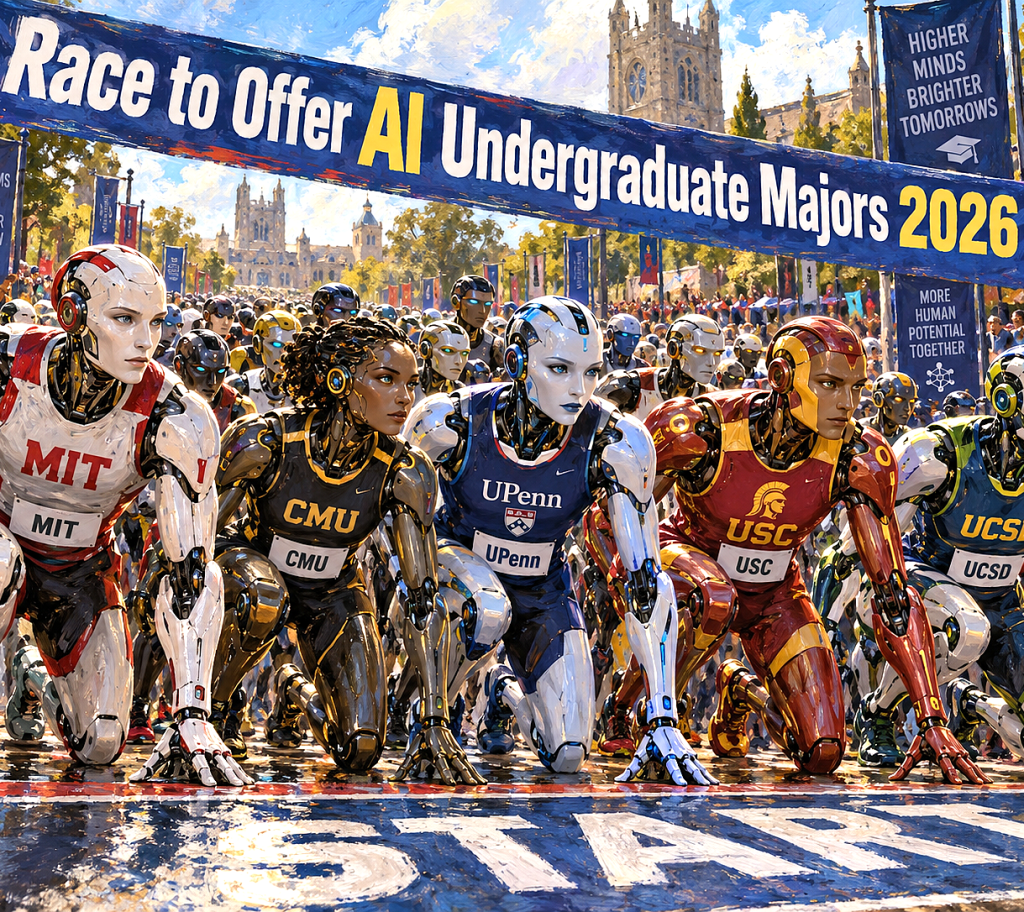
The third trait is the one students see. Carnegie Mellon says it offered the first undergraduate degree in artificial intelligence, and U.S. News ranks its graduate AI program first in the United States (Carnegie Mellon University, 2026a, 2026b). MIT launched its Artificial Intelligence and Decision Making major in fall 2022. By October 2026 it had 354 students and was the second most popular major on campus. Antonio Torralba, the faculty head of the program, said the goal is to “teach them the foundations needed to build the future of AI” (S. Lee, 2026).
Tsinghua added about 150 undergraduate places in 2025 and created a new general-education college to train students who combine AI with other fields. It also introduced 38 AI-related general education courses (China Daily, 2025). NTU plans to embed AI in 40 percent of its undergraduate courses by 2030, and since August 2026 its undergraduates have had full access to Google’s premium AI tools (Nanyang Technological University, 2026). Stanford organizes AI education across departments through HAI, which the university describes as a hub for research, education and policy (Stanford Report, 2026).
The talent data show how these programs depend on one another. China educated 57 percent of the NeurIPS 2025 authors in the Carnegie study as undergraduates, and the United States educated 13 percent. The United States still retains 89 percent of the researchers who work there, and for every American-origin researcher working in China, 30 Chinese-origin researchers work in the United States (Ma & Yang, 2026). An earlier Carnegie analysis found that 56 percent of the NeurIPS 2019 researchers with Chinese undergraduate degrees were studying or working at U.S. institutions (Sheehan & Zhuang, 2025). Tsinghua supplies many of the undergraduates. American universities, including the three on this list, train many of them as doctoral students.
Limits of the comparison
Rankings describe the recent past. The U.S. News table reflects papers published through 2024 (Wong, 2026b), and reputation surveys favor older and better-known universities (Wong, 2026a). The fifth place on this list is contested, and the order among the five depends on which measure a reader weights most.
Conditions are also changing. In the Carnegie study, China employed 41 percent of the NeurIPS 2025 authors and the United States 34 percent, a reversal of the 2022 result, and the authors point to tighter U.S. visa rules for Chinese graduate students in science and engineering as one cause (Ma & Yang, 2026). Carnegie Mellon was the fifth-largest employer of NeurIPS authors in 2022 and was outside the top ten in 2025 (Park, 2026). The three traits are easier to verify than a rank order. In late 2026, each of the five leaders has a dedicated AI college, corporate partners that supply funding and computing power, and degree programs that are growing.
References
Carnegie Mellon University. (2025a, September). BNY and Carnegie Mellon University join forces to advance AI education and research. https://www.cmu.edu/news/stories/archives/2025/september/bny-and-carnegie-mellon-university-join-forces-to-advance-ai-education-and-research
Carnegie Mellon University. (2025b, October). Amazon and Carnegie Mellon University launch strategic AI innovation hub. https://www.cmu.edu/news/stories/archives/2025/october/amazon-and-carnegie-mellon-university-launch-strategic-ai-innovation-hub
Carnegie Mellon University. (2026a, April 8). CMU ranks No. 1 in 2026 U.S. News graduate rankings. https://www.cmu.edu/news/stories/archives/2026/april/cmu-ranks-no-1-in-2026-us-news-graduate-rankings
Carnegie Mellon University. (2026b, September 30). $500M gift will fuel next era of computer science at Carnegie Mellon. https://www.cmu.edu/news/stories/archives/2026/september/500m-gift-will-fuel-next-era-of-computer-science-at-carnegie-mellon
China Daily. (2025, March 3). Tsinghua expands admissions to nurture AI professionals. https://www.chinadailyhk.com/hk/article/605962
Government Technology. (2026, April 24). Carnegie Mellon launches physical AI research institute. https://www.govtech.com/education/higher-ed/carnegie-mellon-launches-physical-ai-research-institute
Gupta, U. (2026, February 5). Stanford’s big AI bet: What if it busts? [Opinion]. The Stanford Daily. https://stanforddaily.com/2026/02/05/stanfords-big-ai-bet-what-if-it-busts/
Lee, L. Y. (2026, January 24). Singapore to invest $1 billion over 5 years to boost AI public research. The Straits Times (republished by JTC). https://www.jtc.gov.sg/about-jtc/news-and-stories/feature-stories/singapore-to-invest-$1-billion-over-5-years-to-boost-ai-public-research
Lee, S. (2026, October 23). In higher education, the race is on to offer AI as an undergraduate major. WBUR. https://www.wbur.org/news/2026/10/23/ai-college-major-massachusetts
Lv, Q. (2026, January 8). Zhipu AI soars in Hong Kong stock market debut as Chinese startup becomes world’s first LLM firm to go public. Yicai Global. https://www2.yicaiglobal.com/news/zhipu-ai-soars-in-hong-kong-stock-market-debut-as-chinese-startup-becomes-worlds-first-llm-firm-to-go-public
Ma, D., & Yang, B. (2026, September 23). Who’s ahead in the global AI talent race? Carnegie Endowment for International Peace. https://carnegieendowment.org/features/whos-ahead-in-the-global-ai-talent-race
MIT News. (2026, November 10). MIT Schwarzman College of Computing welcomes seven new faculty for 2026. https://news.mit.edu/2026/mit-schwarzman-college-computing-welcomes-new-faculty-1110
MIT Schwarzman College of Computing. (2026, April 29). The MIT-IBM Computing Research Lab launches to shape the future of AI and quantum computing. https://capd.mit.edu/blog/2026/04/29/the-mit-ibm-computing-research-lab-launches-to-shape-the-future-of-ai-and-quantum-computing/
Nanyang Technological University. (2024, February). NTU Singapore launches new College of Computing and Data Science to propel AI ambitions [News release]. EurekAlert. https://www.eurekalert.org/news-releases/1034873
Nanyang Technological University. (2026, October 30). NTU and Google deepen AI partnership. https://www.ntu.edu.sg/news/detail/ntu-and-google-deepen-ai-partnership
Nanyang Technological University. (n.d.). Rankings. Retrieved November 13, 2026. https://www.ntu.edu.sg/admissions/undergraduate/rankings
Ngo, P. (2026a, January 29). China’s Tsinghua University named world’s best for AI. VnExpress International. https://e.vnexpress.net/news/tech/tech-news/china-s-tsinghua-university-named-world-s-best-for-ai-5011098.html
Ngo, P. (2026b, July 11). The best universities for AI across six continents. VnExpress International. https://e.vnexpress.net/news/tech/tech-news/the-best-universities-for-ai-across-six-continents-5095941.html
Ngo, P. (2026c, September 29). China overtakes US as top workplace for elite AI researchers. VnExpress International. https://e.vnexpress.net/news/tech/tech-news/china-overtakes-us-as-top-workplace-for-elite-ai-researchers-5125805.html
Park, S. (2026, September 26). Top AI talent now chooses China over the United States. The Asia Business Daily. https://view.asiae.co.kr/en/article/2026092616524384107
QS Quacquarelli Symonds. (2026). QS World University Rankings by Subject 2026: Data science and artificial intelligence. https://www.topuniversities.com/university-subject-rankings/data-science-artificial-intelligence
Sheehan, M., & Zhuang, S. (2025, December 3). Have top Chinese AI researchers stayed in the United States? Carnegie Endowment for International Peace. https://carnegieendowment.org/emissary/2025/12/china-ai-researchers-us-talent-pool
Stanford Institute for Human-Centered Artificial Intelligence. (2026). The AI Index 2026 annual report: Chapter 1, Research and development. Stanford University. https://hai.stanford.edu/assets/files/ai_index_report_2026_chapter_1_research_development.pdf
Stanford Report. (2026, May). Stanford merges AI and data science efforts under single institute. Stanford University. https://news.stanford.edu/stories/2026/05/stanford-merges-hai-data-science
Stanford University. (n.d.). Artificial intelligence. Retrieved November 13, 2026. https://www.stanford.edu/artificial-intelligence
Tsinghua University College of AI. (n.d.). Message from dean. Retrieved November 13, 2026. https://collegeai.tsinghua.edu.cn/en/About_Us/Message_From_Dean.htm
Wong, Z. (2026a, March 27). QS Data Science and AI Ranking 2026: 201 universities, Stanford 2nd. Xuanxiao. https://xuanxiao.org/en/articles/qs-data-science-ai-subject-ranking-2026-commentary
Wong, Z. (2026b, June 17). U.S. News Best Global Universities 2026-2027: Tsinghua rises to 6th. Xuanxiao. https://xuanxiao.org/en/articles/usnews-best-global-universities-2027-commentary
Xinzhiyuan. (2025, December 10). Tsinghua University is closing in on Google, ranking second in the number of papers at the AI conference NeurIPS. 36Kr. https://eu.36kr.com/en/p/3588990662394113
Xinzhiyuan. (2026, January 12). Chinese universities dominate the 2026 CSRankings. 36Kr. https://eu.36kr.com/en/p/3636083256247296
Xuanxiao. (2026). Artificial intelligence 2027 [Table reproducing the U.S. News Best Global Universities 2026–2027 subject ranking]. https://xuanxiao.org/en/rankings/usnews/subject/artificial-intelligence?page=1
###
Filed under: Uncategorized |
















































































































































































































































































































































Leave a Reply