





By Jim Shimabukuro (assisted by Claude)
Editor
Summary: As AI accelerates work, the true bottleneck becomes leadership itself—forcing managers to evolve from task administrators into architects of human‑machine collaboration. –Copilot

The BCG and MIT Sloan Management Review’s ninth annual global research study, released in November 2025, surveyed 2,102 executives across 21 industries and 116 countries and found that 35 percent of organizations have already begun using agentic AI — with another 44 percent planning to follow soon (1). Yet the same study identified a widening gap between AI’s pace of adoption and leaders’ readiness to manage it. The World Economic Forum’s 2026 report, Organizational Transformation in the Age of AI, reinforced this finding: only about 15 percent of organizations are fundamentally redesigning work around AI; most are simply automating what existed before (2). And SHRM’s 2026 research underscored a third dimension — that the biggest barrier to AI value capture is not employee reluctance but leadership readiness (3).
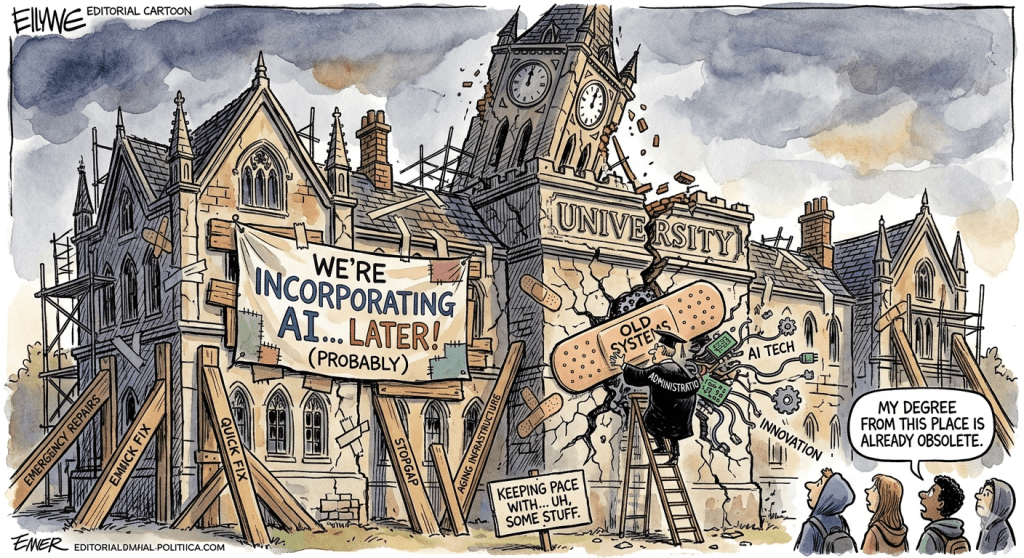
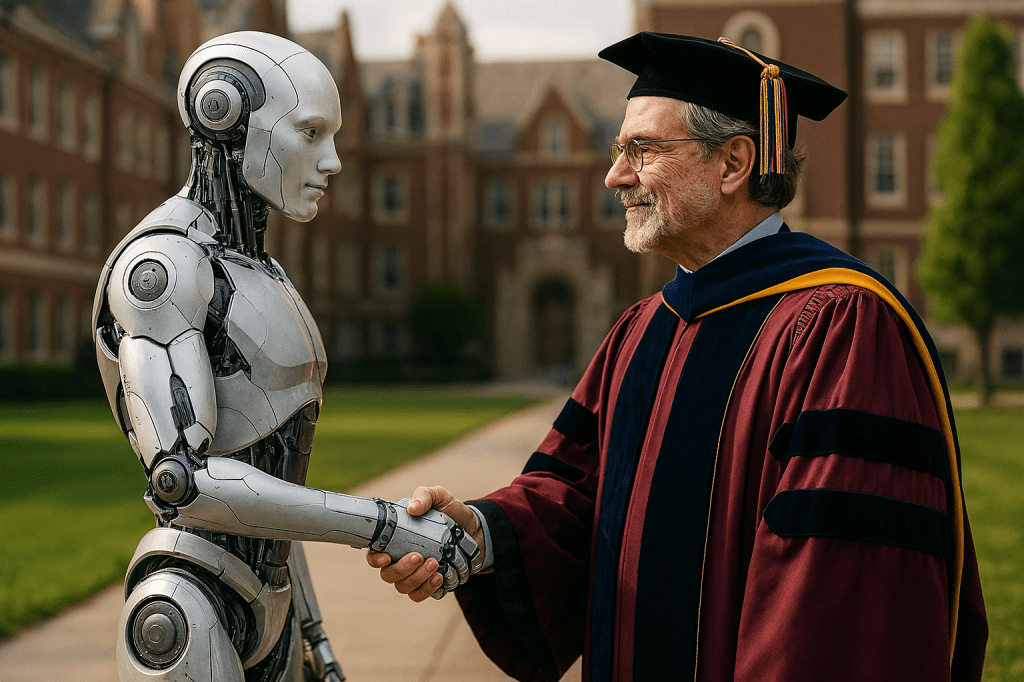
These findings converge on a single, inconvenient truth: the limiting factor in most AI-era workplaces is not the technology. It is the administrator who leads the teams that use it. The companion worker article in this series (Ten Traits of the AI-Productive Worker) examined the dispositions that help individual contributors thrive when AI enters the room. This piece turns to the other side of that dynamic — the manager or administrator whose decisions shape whether a team’s AI potential is realized or squandered. Drawing on research from BCG, MIT Sloan, the World Economic Forum, SHRM, Deloitte, McKinsey, and peer-reviewed journals, the following ten traits profile the administrator who doesn’t just survive the AI era, but defines what thriving looks like for everyone around them.
1. AI Literacy That Goes Beyond Tool Use
The effective AI-era administrator is not defined by which tools they use but by how well they understand the principles behind those tools — how models are trained, where they hallucinate, what kinds of tasks they accelerate, and what kinds they make worse. This is not a call for technical expertise; it is a call for informed intuition. BCG and MIT Sloan found that leaders who understand AI capabilities — not just AI outputs — make substantially better governance decisions than those who evaluate AI solely by its results (1). The administrator who knows why an AI system fails, not just that it fails, is the one who can set appropriate expectations, protect their team from misplaced trust, and advocate intelligently for the resources the team actually needs.
2. Willingness to Redesign Work, Not Just Automate It
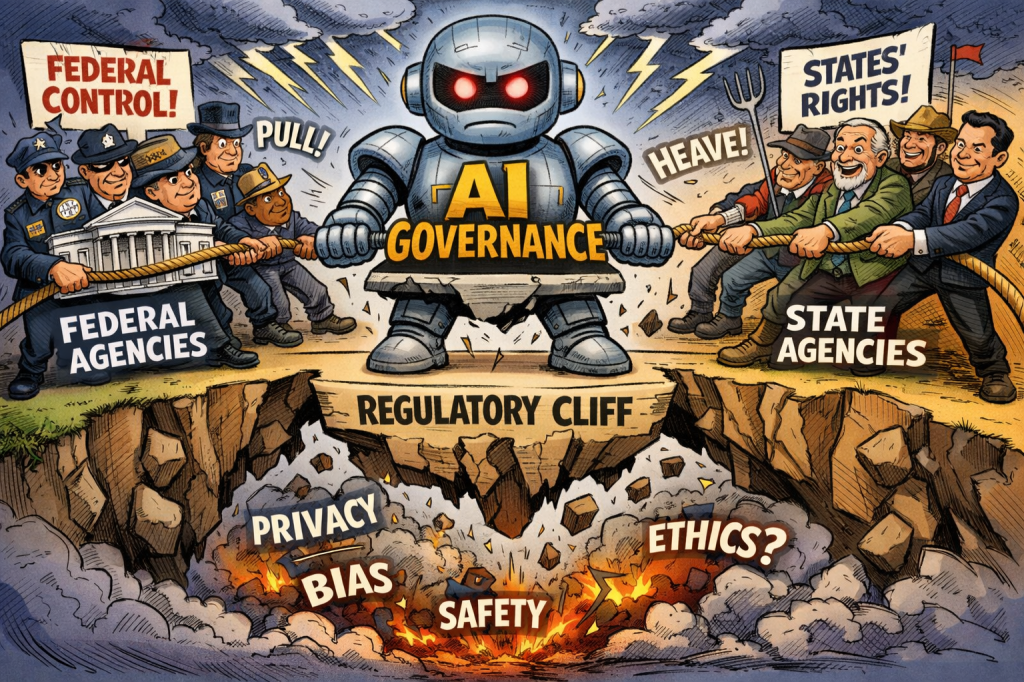
There is a sharp distinction between deploying AI tools into existing workflows and fundamentally rethinking what the workflow should be. Most organizations do the former; a minority do the latter. The WEF’s 2026 organizational transformation report found that only 15 percent of organizations are making genuine progress redesigning how humans and AI work together — the rest are essentially adding AI onto processes built for a purely human workforce (2). The administrator who grasps this distinction pushes beyond “how do we use AI to do what we already do faster?” toward the harder question: “given what AI can now handle, what should humans in this organization actually be doing?” That reframing — from automation to redesign — is where most of the long-term value lives.
3. Comfort with Redistributed Decision Rights
AI changes who decides what. It can now make reliable, real-time decisions in domains that once required seasoned human judgment — and it can surface patterns that make once-opaque situations newly legible. The effective AI-era administrator can do two things simultaneously: let go of decisions that AI can now make better or faster, and claim firm authority for decisions that require human judgment, ethical reasoning, or accountability. BCG and MIT Sloan’s agentic enterprise research found that 58 percent of leading organizations anticipate changes to governance and decision-making rights as AI matures — but those changes are not yet being managed deliberately in most places (1). The administrator who maps this terrain proactively, rather than waiting for AI to make decisions by default, keeps the organization’s accountability structure intact while gaining the speed and scale AI enables.
4. Psychological Safety as a Management Practice
Research on AI adoption consistently identifies fear — of error, of job displacement, of looking incompetent alongside AI — as one of the primary barriers to team-level AI effectiveness. A 2026 paper published on arXiv identified psychological safety as the key variable in AI transformation: teams whose members believe they can experiment, fail, and ask questions without punitive consequences adopt AI more effectively, surface problems earlier, and generate more innovation (4). This is, fundamentally, a management outcome. The administrator creates or destroys psychological safety through daily choices — how they respond to mistakes, whether they model their own uncertainty, how they frame AI tools as aids rather than auditors. The team’s AI potential is bounded by the safety the manager makes room for.
5. An Active Stake in Workforce Development
AI is compressing the shelf life of skills faster than most organizations can track. The WEF’s Future of Jobs Report 2025 estimated that more than half the global workforce will need meaningful reskilling within four years (5). SHRM’s 2026 research found that leadership and manager development has been the top CHRO priority for two consecutive years, and that 48 percent of employees rank training as the most important factor in AI adoption (3). The administrator who treats workforce development as an HR function — something that happens to their team rather than something they actively drive — will find their team’s capabilities drifting behind the curve of what the organization actually needs. The effective AI-era administrator owns reskilling as a leadership responsibility, not a training department deliverable.
6. Calibrated Trust in AI Outputs
Uncritical trust in AI outputs and reflexive skepticism toward them produce mirror-image failures. The administrator who accepts AI-generated analysis without scrutiny exposes the organization to compounding errors — decisions built on confidently stated falsehoods. The one who distrusts AI by default fails to capture the genuine intelligence AI can provide and signals to their team that skepticism, not judgment, is the appropriate response. McKinsey’s 2026 State of AI Trust report found that calibrated trust — knowing when to verify, when to defer, and when to override — is one of the clearest differentiators between high-performing and low-performing AI-adopting organizations (6). This is, at its core, an epistemic disposition: the willingness to ask how much confidence an output warrants, not just what the output says.
7. Distinctly Human Presence in an AI-Dense Environment
As AI handles more of the ambient communication work — drafting, summarizing, scheduling, reporting — the manager’s distinctly human communications carry a different weight. The candid conversation about a struggling employee’s trajectory, the acknowledgment that a strategic direction was wrong, the moral stance that a proposed efficiency gain crosses a line — these carry more significance precisely because they are not the kind of thing AI produces. EY’s 2026 research on redesigning work around human skills found that creativity, empathy, and judgment are increasingly the differentiators in human-AI hybrid workforces (7). The administrator who understands this doesn’t compete with AI on AI’s terrain; they invest in the quality of their human presence — the conversations, relationships, and judgments that AI cannot replicate and that teams cannot do without.
8. Strategic Patience Alongside Operational Speed
AI creates genuine pressure toward speed: faster cycle times, faster decisions, faster delivery. The administrator who responds only to that pressure can optimize the team’s short-term throughput while undermining its long-term architecture. The WEF’s organizational transformation research drew a consistent distinction between organizations that deployed AI opportunistically — capturing near-term gains in existing workflows — and those that used AI’s arrival as a forcing function for longer-arc redesign (2). Both moves are necessary; the error is letting one crowd out the other. The effective AI-era administrator holds operational speed and strategic patience simultaneously — exploiting the near-term gains AI enables while protecting the time and resources needed to redesign for what comes next.
9. Ethical Accountability as a Standing Leadership Responsibility
The journal Administrative Sciences published a 2026 systematic review on AI-driven leadership that found ethical governance is one of the domains where leaders most consistently underperform their stated commitments (8). The pattern is familiar: AI ethics gets positioned as a compliance function — a checklist item or a legal review — rather than an ongoing leadership practice. The effective AI-era administrator treats it differently. They ask habitually: who is affected by this AI-assisted decision, what could go wrong, and how will errors be caught and corrected before they compound? This is not a one-time risk assessment; it is a standing disposition that shapes how they evaluate tools, set expectations for their team, and communicate about AI-generated outputs to stakeholders. The administrator who builds ethical review into the rhythm of decision-making — rather than bolting it on at the end — is the one whose team’s AI use can be defended when, not if, something goes wrong.
10. Curiosity About What AI Reveals
AI analytics can surface patterns that were simply invisible at human scale — correlations in team performance, anomalies in workflow, trends in behavior that no individual had the bandwidth to notice. The administrator’s response to these revelations is not predetermined. Some find them threatening — the feeling of being observed, evaluated, compared. Others find them illuminating: new intelligence that enables more precise and more equitable leadership. Research across organizations using AI-assisted management analytics consistently finds that the distinguishing variable is not the quality of the tool but the leader’s orientation toward its findings (6). The administrator who approaches AI’s revelations with curiosity — treating unexpected patterns as intelligence rather than indictment — gains an informational advantage that compounds over time. The one who greets them with defensiveness forfeits it.
References
1. BCG and MIT Sloan Management Review. The Emerging Agentic Enterprise: How Leaders Must Navigate a New Age of AI. November 2025.
2. World Economic Forum. Organizational Transformation in the Age of AI. 2026.
3. SHRM. Navigating AI in the Workplace: 2026.
4. arXiv. Safety First: Psychological Safety as the Key to AI Transformation. 2026.
5. World Economic Forum. Future of Jobs Report 2025. January 2025.
6. McKinsey & Company. State of AI Trust in 2026: Shifting to the Agentic Era. 2026.
7. EY. Redesigning Work Around Human Skills in the Age of AI.
8. MDPI Administrative Sciences. AI-Driven Leadership: Decision-Making, Competencies, and Ethical Challenges — A Systematic Review. 2026.
###
Filed under: Uncategorized |





























































































































































































































































































































































































































Leave a Reply