


By Jim Shimabukuro (assisted by Claude)
Editor
Summary: AI mastery becomes the new freshman superpower — because clear thinking with machines now defines who thrives in college and career and who falls behind. –Copilot

If you are starting college this fall, you are arriving at a strange moment. Artificial intelligence reached more than half the world’s population faster than the personal computer or the internet did [16]. Roughly one in five American workers now uses AI on the job, and among workers with a college degree the figure has climbed to 28 percent and keeps rising [17]. By the time you graduate in 2030, the question employers ask will not be whether you can use AI. It will be whether you can think clearly with it, check it when it is wrong, and do the things it cannot.
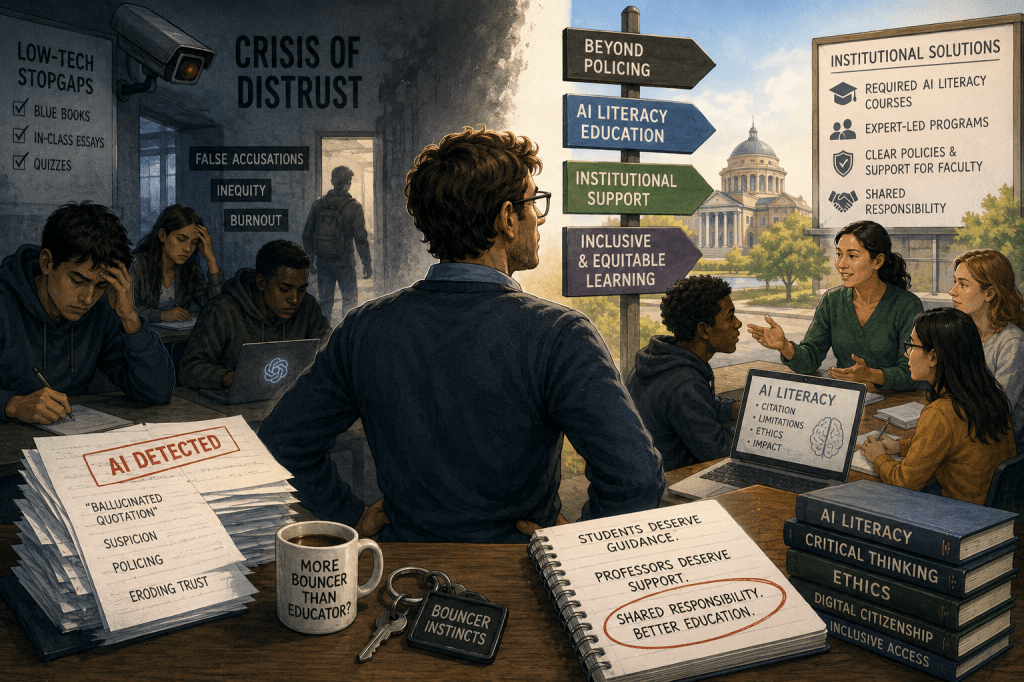
The trouble is that the advice aimed at students is deafening and contradictory. One camp says AI will write your papers and your career is doomed; another says learning to prompt a chatbot is the only skill that matters. Both are wrong, and both are a distraction from the real work, which is knowing what to learn and where to learn it.
This guide takes a different approach. Instead of pointing you at yet another list of lists, it identifies the lessons you actually need to master over the next four years, then pairs each lesson with the best freely available reading from the past two years, along with a few older pieces that have earned their place. There are ten core readings, marked as they appear, plus a handful of additions keyed to your likely field of study. Everything cited here is real, current, and free to read. Numbers in brackets point to the reference list at the end.
Lesson One: Know What the Machine Actually Is
Every bad decision people make about AI, from blind trust to blind panic, starts with a fuzzy mental picture of what these systems are. So begin with the picture. A large language model is not a database of facts and not a mind. It is a prediction engine, trained on enormous amounts of text, that generates the most plausible next word again and again. That simple mechanism turns out to produce astonishing results, and understanding it explains both the brilliance and the failures.
The best plain-language explanation ever written for a general reader remains a 2023 essay by journalist Timothy B. Lee and cognitive scientist Sean Trott, ‘Large Language Models, Explained with a Minimum of Math and Jargon’ [1]. It walks through word vectors and the transformer, the building block behind every chatbot you will use, without asking you to know any programming. It is a few years old now, which in this field counts as history, but the fundamentals it teaches have not changed. This is core reading number one.
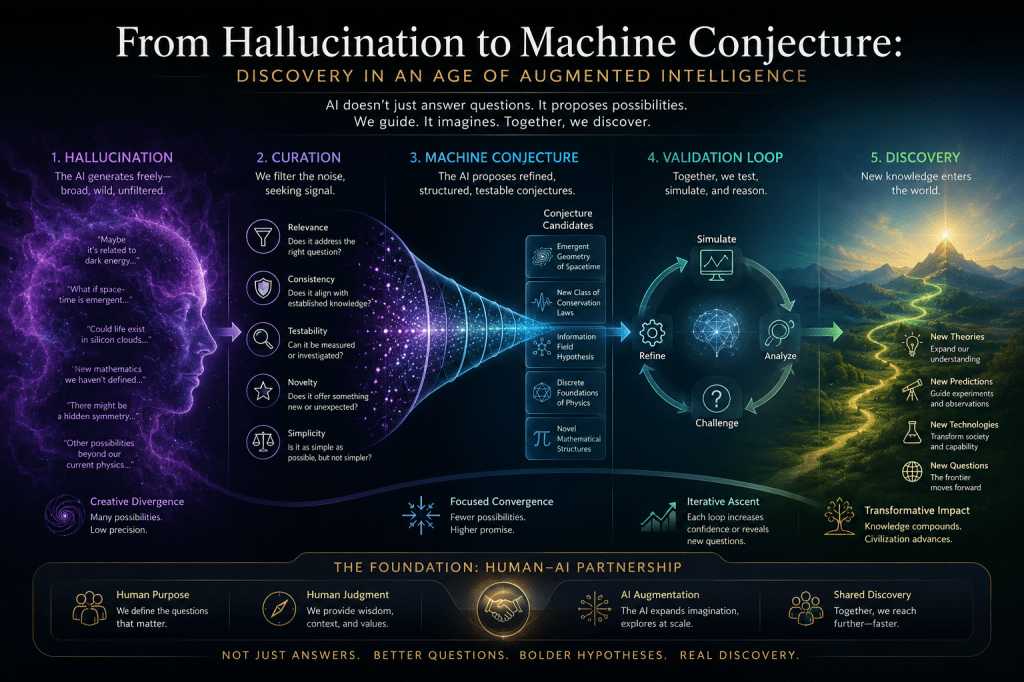
Then read the paper that explains the machine’s most famous flaw. In September 2025, researchers at OpenAI and Georgia Tech published ‘Why Language Models Hallucinate,’ which argues that chatbots make things up for a mundane reason: the way they are trained and tested rewards confident guessing over admitting uncertainty [2]. A model that says ‘I don’t know’ scores worse on the industry’s own benchmarks than one that bluffs. Once you grasp that, you stop treating AI errors as rare glitches and start treating verification as a permanent part of the job. That habit alone will put you ahead of most adults. Core reading number two.
Lesson Two: Don’t Let the Tool Do Your Becoming
Here is the uncomfortable truth at the center of your college years: the four years you are about to spend are supposed to change your brain, and AI makes it very easy to skip the changing. Struggling with a hard paragraph, holding an argument in your head, doing the derivation yourself; that friction is not an obstacle to learning. It is the learning.
The most talked-about study of 2025 made this vivid. Researchers at the MIT Media Lab wired 54 students with EEG caps and had them write essays over several months, some with ChatGPT, some with a search engine, some with nothing but their own heads [3]. The students who leaned on the chatbot showed weaker connectivity across brain regions, reported the least sense of ownership of their work, and often could not quote from essays they had turned in minutes earlier. The authors called the effect ‘cognitive debt,’ and it lingered even after the AI was taken away. The study is small and was released as a preprint, so treat it as an early warning rather than a settled verdict. But it is a warning worth reading in full, and it is core reading number three.
A larger study of working adults points the same direction. Microsoft and Carnegie Mellon researchers surveyed 319 knowledge workers about how they use generative AI on real tasks and found a consistent pattern: the more confidence people placed in the AI, the less critical thinking they did, while people with confidence in their own skills thought harder and checked more [4]. The researchers also noticed the work itself shifting, away from doing tasks and toward verifying and stewarding what the AI produces. That is core reading number four, and it doubles as a preview of your first job.
How are students actually behaving? Anthropic analyzed a million anonymized student conversations with its Claude models and found usage split roughly evenly between collaborative back-and-forth and simply asking for answers or finished output [5]. Nearly half of student use, in other words, tilts toward delegation rather than learning. The report is short, candid about misuse, and useful as a mirror: which half will you be in? Keep it on your list as a field-specific reading if you are in a technical major, for reasons that will become clear below.
The practical rule that falls out of all this research is simple. Use AI at the edge of your understanding, never in place of it. Ask it to quiz you, challenge your draft, explain a step you missed. Do not ask it to be you. A blank page you filled badly teaches you more than a polished page you did not fill at all.
Lesson Three: Learn the Craft, and Stay Honest
None of the above means avoiding AI. Fluency is now part of being an educated person, and fluency comes from deliberate practice, not from occasional panic-prompting the night before a deadline.
Start with the resource built precisely for you. Elon University’s Imagining the Digital Future Center and the American Association of Colleges and Universities publish a free Student Guide to Artificial Intelligence series, downloaded by students at some 4,000 institutions in 170 countries. The 2025 edition is the practical one: how to build AI skills, how to navigate academic integrity, how to think about ethics and your career, written for students rather than administrators [6]. Core reading number five. The 2026 edition, ‘Human Wisdom for the Age of AI,’ produced with The Princeton Review, flips the question and asks which human capabilities you should deliberately cultivate because AI cannot supply them, framing the answer through thinkers from Aristotle onward [7]. Core reading number six. Read them in that order, a semester apart, and take the self-assessment that comes with the second.
For day-to-day technique, the most trusted voice in this space is Ethan Mollick, a Wharton professor who has spent three years testing these tools in his own classroom. His guide ‘Using AI Right Now’ is the rare how-to that stays useful: pick one frontier model and go deep, treat the first response as an opening bid, argue with it, give it context, and always keep your own judgment in the loop [8]. Core reading number seven.
One piece of craft is non-negotiable: honesty. Every campus, and often every course, now has its own AI policy, and they differ wildly. One professor’s required tool is another’s honor-code violation. Read the syllabus, ask when unsure, and disclose what you used. The 2025 Student Guide has a full chapter on integrity [6], and the safest rule of thumb is that if you would be embarrassed to explain how you used AI on an assignment, you should not be using it that way.
Lesson Four: Build Judgment — Ethics, Hype, and Ownership
As the tools get better, the scarce skill stops being operation and becomes judgment: knowing when to trust, when to check, and when to refuse. Mollick captured the coming version of this problem in a September 2025 essay, ‘On Working with Wizards.’ The newest AI systems increasingly deliver impressive finished work while hiding the process, turning users from collaborators into an audience for a magic trick [9]. His question is the one your professors are quietly worried about: how do you verify work in a field you have not mastered, when the AI is the very thing keeping you from mastering it? The essay is core reading number eight, and the honest answer to its question is the whole case for taking your coursework seriously.
For a structured view of what full AI competence looks like, UNESCO’s AI Competency Framework for Students lays out twelve competencies across four dimensions, from a human-centered mindset and ethics through techniques and system design, at three levels of depth [10]. It was written for educators worldwide, but it works remarkably well as a personal checklist to revisit once a year: where am I still just a user, and where am I becoming a judge? Core reading number nine.
Two shorter pieces round out your defenses. Princeton computer scientists Arvind Narayanan and Sayash Kapoor wrote AI Snake Oil to teach exactly one skill: telling what AI can do from what its salespeople claim it can do. The book excerpt in the Stanford Social Innovation Review is free and gives you the core of the argument [11]; their ongoing newsletter continues the work. And the U.S. Copyright Office’s 2025 report on generative AI training is the clearest official account of the era’s biggest unresolved fight: these systems were trained on billions of works by writers, artists, and programmers who never agreed to it, and the law is still deciding what that means [12]. If you will create anything during your career, and you will, the ownership questions in that report are your questions.
Lesson Five: Read the Job Market Like an Economist, Not a Headline
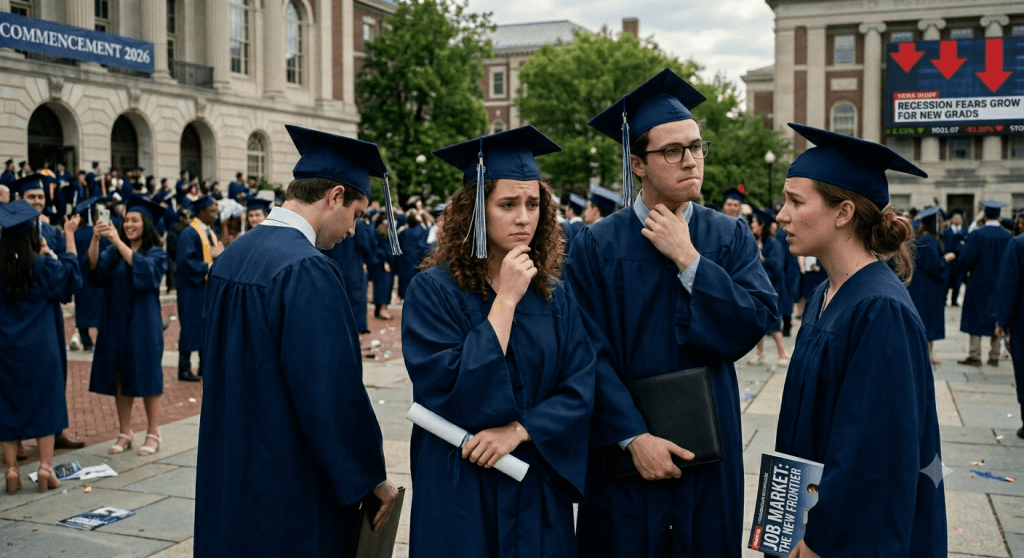
Now the part you have heard the scary versions of. Yes, AI is changing entry-level work, and pretending otherwise would be a disservice. But the real data tells a more useful story than the headlines do.
The landmark study is ‘Canaries in the Coal Mine?’ by Stanford economist Erik Brynjolfsson and colleagues, who used payroll records covering millions of American workers to measure what actually happened after generative AI arrived [13]. Their finding: workers aged 22 to 25 in the occupations most exposed to AI, such as software development and customer service, saw employment fall about 13 percent relative to older workers in the same jobs. But the decline concentrated in roles where AI automates the work outright. Where AI augments human work instead, employment held up. That distinction, automation versus augmentation, is the single most useful lens you can carry into your major and career choices. Core reading number ten.
Around that study, three free reports fill in the picture. The World Economic Forum’s 2026 report on AI and entry-level work examines how the bottom rung of the career ladder is being rebuilt, against its longer-running projection that technology will create about 170 million roles globally by 2030 while displacing about 92 million [14]. PwC’s 2026 Global AI Jobs Barometer, built from over a billion job postings, finds a two-track market emerging: jobs that AI makes more expert are growing twice as fast, with much faster wage growth, and the new tasks added to AI-exposed jobs lean heavily on empathy, judgment, and creativity [15]. Most striking for you: junior roles in AI-exposed fields are now seven times more likely to demand traditionally senior skills like leadership and strategic thinking, and those ‘seniorized’ entry-level jobs are the ones growing. The ladder’s bottom rung has not vanished; it has moved up, and college is where you reach it.
Finally, make one thing an annual habit: Stanford’s AI Index, a free, exhaustively sourced report on where the technology, the money, and the jobs actually stand each spring [16]. Read the summary every year the way an investor reads a market report, and check it against ground-level survey data such as Pew’s tracking of real workplace AI use [17], which is consistently less dramatic than the marketing. The gap between those two documents is where clear thinking lives.
Your Major, Your Map
The core readings above apply to everyone. But AI is not arriving evenly, and a sensible reading plan bends toward your field. Most majors sort into four broad clusters.
1. The Builders: Computer Science, Engineering, Math, and the Natural Sciences
You will use AI earliest and most. Computer science students already account for a wildly outsized share of student AI use, nearly 37 percent of conversations in Anthropic’s data against about 5 percent of degrees [5], and AI now writes a large share of routine code. That makes fundamentals more important for you, not less, because you are heading straight into Mollick’s wizard problem: you cannot debug, verify, or improve what you never learned to build [9]. Take the theory courses seriously, read the technical chapters of the AI Index each year [16], and treat AI as a tireless pair programmer whose work you always review.
2. The Deciders: Business, Economics, and Management
Your field’s routine layer, the first-pass analysis, the standard memo, the basic model, is precisely what AI absorbs fastest. What survives and gets more valuable is what PwC’s data shows employers now demanding even in junior roles: judgment, leadership, stakeholder skill, and the ability to direct AI rather than merely operate it [15]. Read the PwC Barometer and the WEF entry-level report [14] not as forecasts but as job descriptions, and use your electives to get comfortable with data and with making decisions under uncertainty.
3. The Healers: Nursing, Pre-Med, and the Health Sciences
In your fields, AI literacy is becoming a clinical competency, and the stakes of uncritical trust are measured in patients rather than grade points. A 2025 systematic review of AI in nursing education found the technology reshaping curricula across the profession while students and faculty scramble to build the judgment to use it safely [18]. Read it to see where your training is headed, learn your future profession’s rules on privacy and data early, and hold AI output in medicine to the standard you would hold a confident stranger’s advice: interesting until verified.
4. The Interpreters: Humanities, Arts, Social Sciences, and Communication
You have been told your fields are most threatened. The evidence reads differently: close reading, careful writing, ethical reasoning, and cultural interpretation are exactly the capacities the labor-market data now files under fast-growing ‘human skills’ [15]. Your added readings are the working papers of the MLA-CCCC task force on writing and AI, the discipline’s own thinking about what writing is for when machines can produce prose [19]; the Copyright Office report, because ownership of creative work is your fight [12]; and the AI Snake Oil excerpt, because the world badly needs interpreters who can puncture hype in public [11].
The Core Ten, In Order
For the student who wants the plan on one page, here is the sequence. Read the first four in your first semester; they are short.
1. Lee and Trott, ‘Large Language Models, Explained with a Minimum of Math and Jargon’ — how the machine works [1].
2. OpenAI, ‘Why Language Models Hallucinate’ — why it makes things up [2].
3. MIT Media Lab, ‘Your Brain on ChatGPT’ — what outsourcing your thinking costs [3].
4. Lee, Sarkar and colleagues, ‘The Impact of Generative AI on Critical Thinking’ — the confidence trap [4].
5. Elon/AAC&U, 2025 Student Guide to Artificial Intelligence — the practical handbook [6].
6. Elon/AAC&U/Princeton Review, ‘Human Wisdom for the Age of AI’ — the capabilities to cultivate [7].
7. Mollick, ‘Using AI Right Now: A Quick Guide’ — daily technique [8].
8. Mollick, ‘On Working with Wizards’ — the verification problem [9].
9. UNESCO, AI Competency Framework for Students — the yearly self-checklist [10].
10. Brynjolfsson, Chandar and Chen, ‘Canaries in the Coal Mine?’ — the job market as it is [13].
Then add your field’s readings from the section above, and renew the whole subscription each spring with the new AI Index [16].
A Last Word
Notice what this list is not. It is not a course in prompting tricks, which age in months, and it is not a survival manual for a robot apocalypse, which is not scheduled. It is a reading plan for becoming the kind of graduate the data says will thrive: someone who understands the machine, guards their own thinking, works skillfully and honestly with the tools, judges them without flinching, and reads the economy with clear eyes.
The deepest finding running through all nineteen sources below is oddly reassuring. The more capable AI becomes, the more the premium shifts to the abilities college was always supposed to build: judgment, curiosity, integrity, and the stamina to think hard about difficult things. The students who lose in this economy will be the ones who let the machine do their becoming. The ones who win will graduate having used it to become more themselves, not less. That choice is made one assignment at a time, starting this fall.
References
[1] Timothy B. Lee and Sean Trott, ‘Large Language Models, Explained with a Minimum of Math and Jargon,’ Understanding AI, July 2023. https://www.understandingai.org/p/large-language-models-explained-with
[2] Adam Tauman Kalai, Ofir Nachum, Santosh Vempala, and Edwin Zhang, ‘Why Language Models Hallucinate,’ OpenAI, September 2025. https://openai.com/index/why-language-models-hallucinate/
[3] Nataliya Kosmyna et al., ‘Your Brain on ChatGPT: Accumulation of Cognitive Debt When Using an AI Assistant for Essay Writing Task,’ MIT Media Lab, June 2025 (preprint, arXiv:2506.08872). https://www.media.mit.edu/publications/your-brain-on-chatgpt/
[4] Hao-Ping (Hank) Lee, Advait Sarkar, et al., ‘The Impact of Generative AI on Critical Thinking: Self-Reported Reductions in Cognitive Effort and Confidence Effects From a Survey of Knowledge Workers,’ CHI Conference on Human Factors in Computing Systems, April 2025. https://www.microsoft.com/en-us/research/publication/the-impact-of-generative-ai-on-critical-thinking-self-reported-reductions-in-cognitive-effort-and-confidence-effects-from-a-survey-of-knowledge-workers/
[5] Anthropic, ‘Anthropic Education Report: How University Students Use Claude,’ April 2025. https://www.anthropic.com/news/anthropic-education-report-how-university-students-use-claude
[6] Elon University Imagining the Digital Future Center and the American Association of Colleges and Universities, ‘2025 Student Guide to Artificial Intelligence,’ May 2025. https://studentguidetoai.org/
[7] Elon University, AAC&U, and The Princeton Review, ‘Human Wisdom for the Age of AI: A Field Guide to Cultivating Essential Skills’ (2026 Student Guide to Artificial Intelligence), May 2026. https://studentguidetoai.org/
[8] Ethan Mollick, ‘Using AI Right Now: A Quick Guide,’ One Useful Thing, June 2025. https://www.oneusefulthing.org/p/using-ai-right-now-a-quick-guide
[9] Ethan Mollick, ‘On Working with Wizards,’ One Useful Thing, September 2025. https://www.oneusefulthing.org/p/on-working-with-wizards
[10] UNESCO, ‘AI Competency Framework for Students,’ 2024. https://unesdoc.unesco.org/ark:/48223/pf0000391105
[11] Arvind Narayanan and Sayash Kapoor, ‘AI Snake Oil’ (book excerpt), Stanford Social Innovation Review, 2024. https://ssir.org/books/excerpts/entry/ai-snake-oil
[12] U.S. Copyright Office, ‘Copyright and Artificial Intelligence, Part 3: Generative AI Training’ (pre-publication version), May 2025. https://www.copyright.gov/ai/
[13] Erik Brynjolfsson, Bharat Chandar, and Ruyu Chen, ‘Canaries in the Coal Mine? Six Facts About the Recent Employment Effects of Artificial Intelligence,’ Stanford Digital Economy Lab, 2025. https://digitaleconomy.stanford.edu/publication/canaries-in-the-coal-mine-six-facts-about-the-recent-employment-effects-of-artificial-intelligence/
[14] World Economic Forum, ‘Artificial Intelligence and the Future of Entry-Level Work,’ 2026. https://reports.weforum.org/docs/WEF_Artificial_Intelligence_and_the_Future_of_Entry_Level_Work_2026.pdf
[15] PwC, ‘2026 Global AI Jobs Barometer: Two Futures for Jobs in an AI Era,’ June 2026. https://www.pwc.com/gx/en/services/ai/ai-jobs-barometer.html
[16] Stanford Institute for Human-Centered Artificial Intelligence, ‘The 2026 AI Index Report,’ April 2026. https://hai.stanford.edu/ai-index/2026-ai-index-report
[17] Pew Research Center, ‘About 1 in 5 U.S. Workers Now Use AI in Their Job, Up Since Last Year,’ October 2025. https://www.pewresearch.org/short-reads/2025/10/06/about-1-in-5-us-workers-now-use-ai-in-their-job-up-since-last-year/
[18] ‘AI Literacy and Competency in Nursing Education: Preparing Students and Faculty Members for an AI-Enabled Future — A Systematic Review and Meta-Analysis,’ 2025, PubMed Central. https://www.ncbi.nlm.nih.gov/pmc/articles/PMC12689331/
[19] MLA-CCCC Joint Task Force on Writing and AI, working papers and resources. https://aiandwriting.hcommons.org/
Filed under: Uncategorized |

































































































































































































































































































































































































Leave a Reply