





By Jim Shimabukuro (assisted by ChatGPT)
Editor
Summary: AI-era campuses abandon industrial-age schooling and instead become living laboratories where human judgment and machine intelligence co‑design the future of learning. –Copilot

This report explores what grade school, high school, and university campuses might look like if they were designed from the ground up for a world in which generative and agentic AI systems are commonplace. The exercise assumes that designers are not constrained by inherited school architecture, traditional schedules, or existing administrative practices. Instead, the central design principle is that form follows function. The resulting campuses are intended to support continuous human-AI collaboration, personalized learning, interdisciplinary inquiry, and preparation for a labor market increasingly shaped by intelligent systems.
Recent reports from UNESCO, the OECD, the World Economic Forum, and Stanford’s AI Index suggest that artificial intelligence is no longer a peripheral educational technology. It is increasingly viewed as a general-purpose capability that will reshape instruction, assessment, administrative work, and the skills expected of graduates (1,2,3,4,5). OECD analyses emphasize personalized learning experiences, AI-supported feedback, and immersive technologies, while UNESCO argues that educational systems need both immediate adaptation and long-term planning for human-centered AI integration (1,2). The World Economic Forum further notes that educational institutions must prepare learners for economies in which human capabilities increasingly complement intelligent machines rather than compete directly with them (3,6).
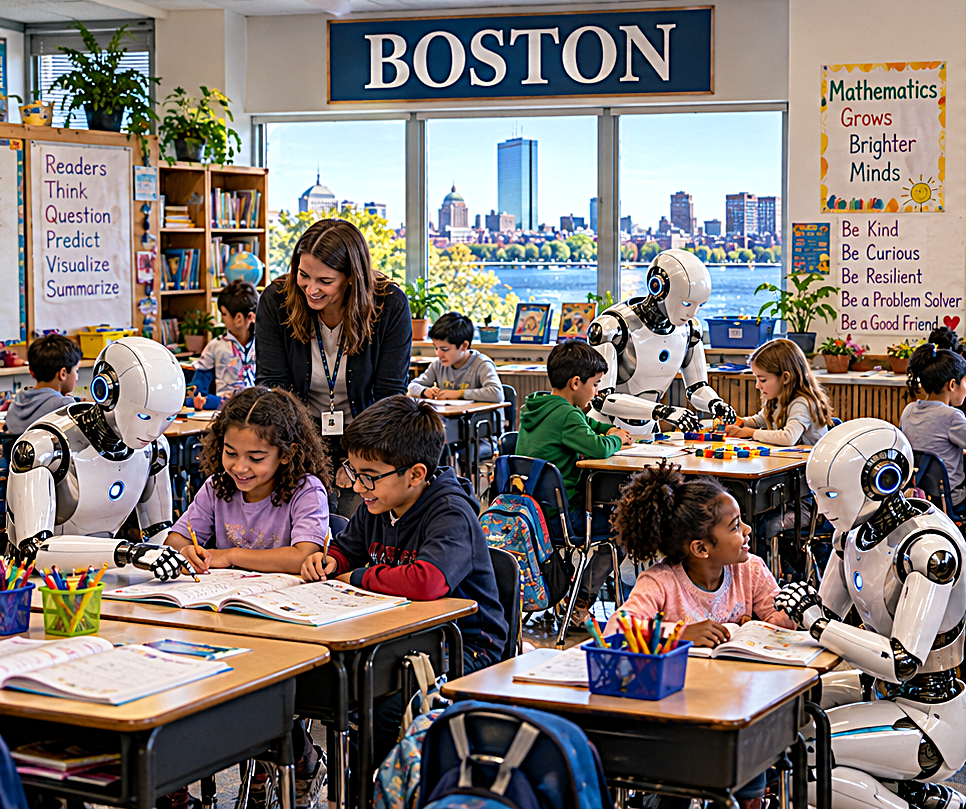
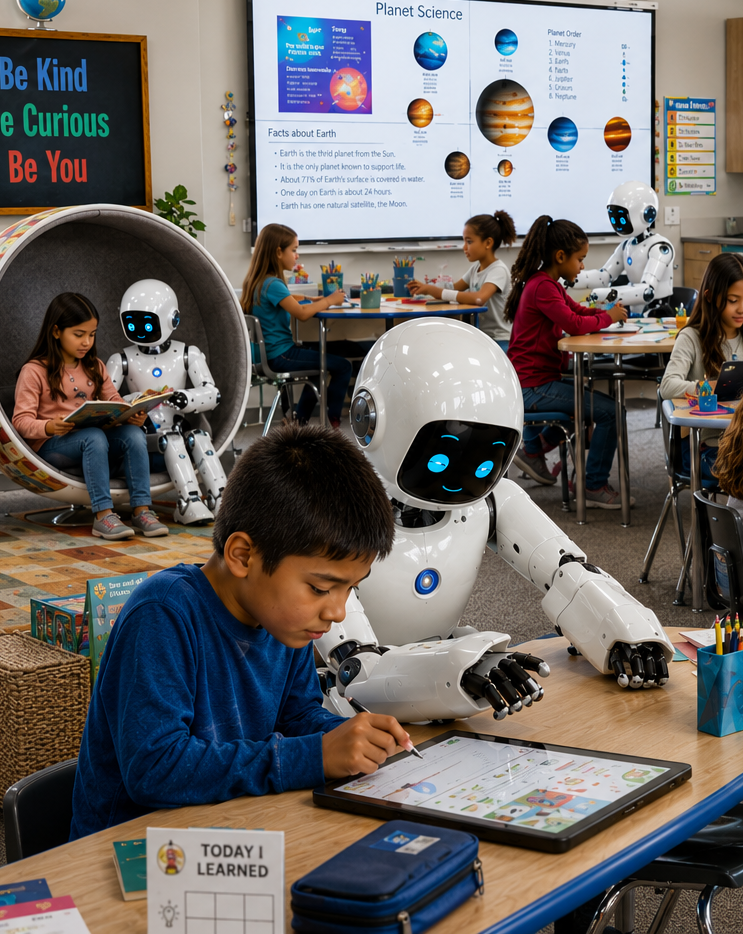
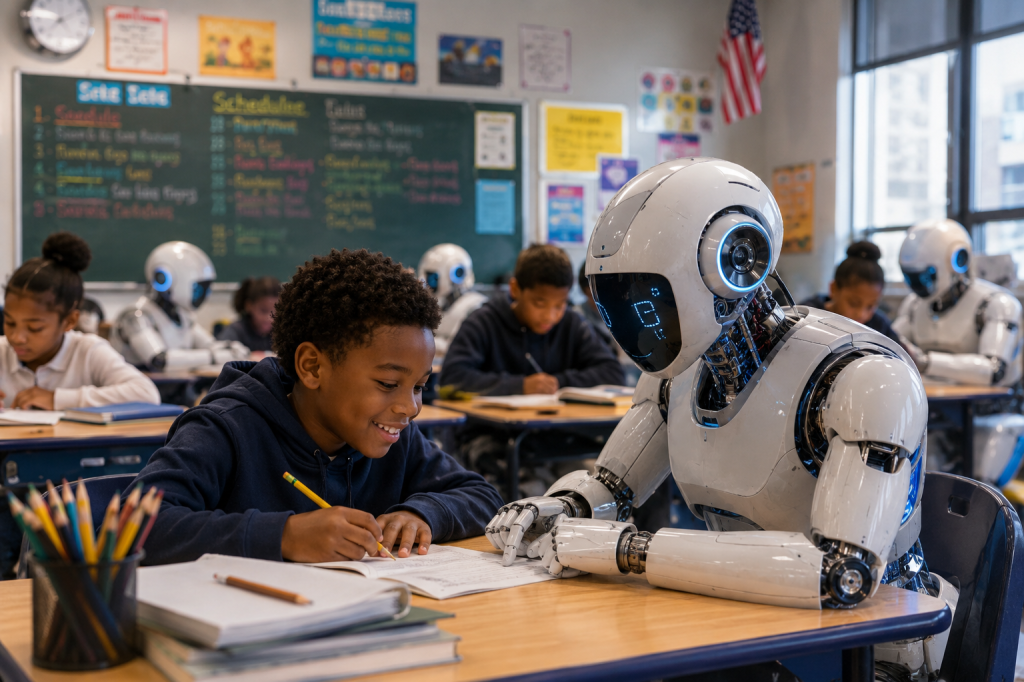
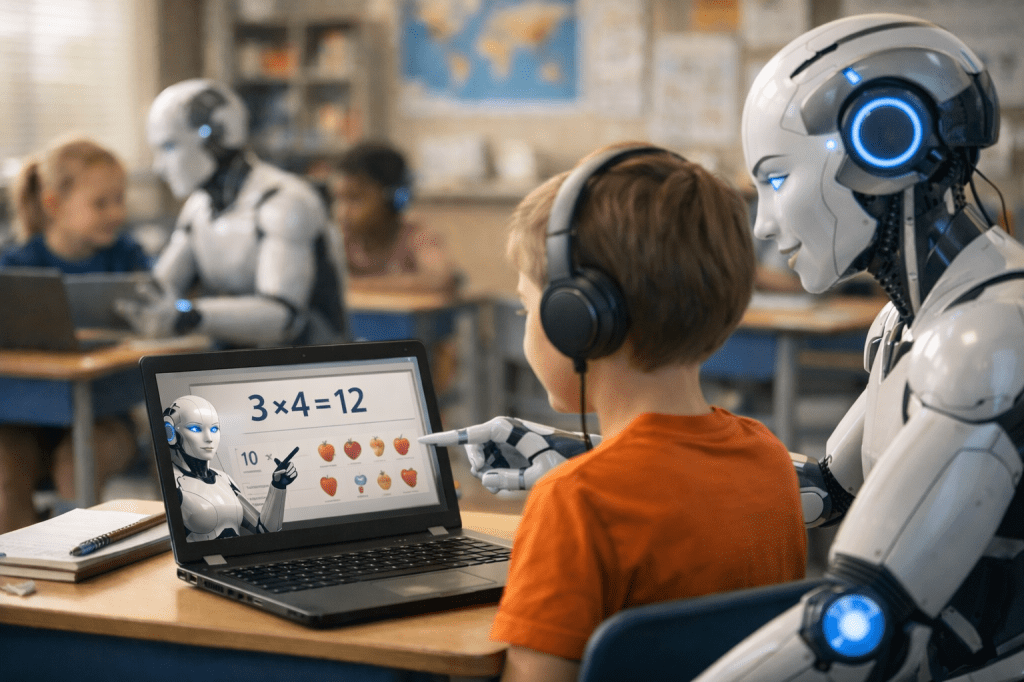
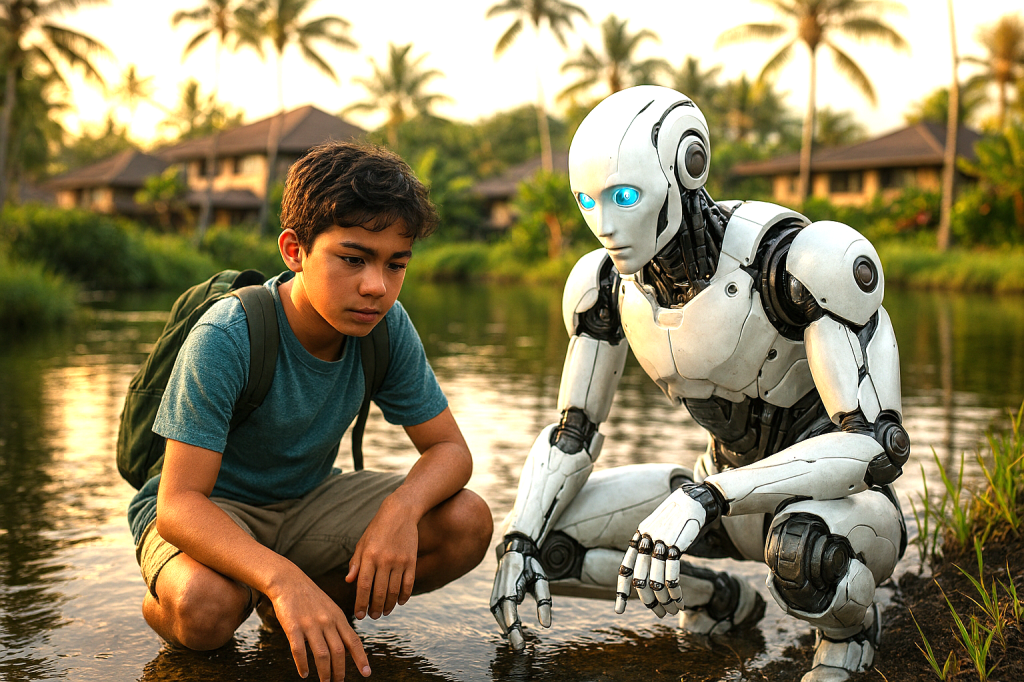
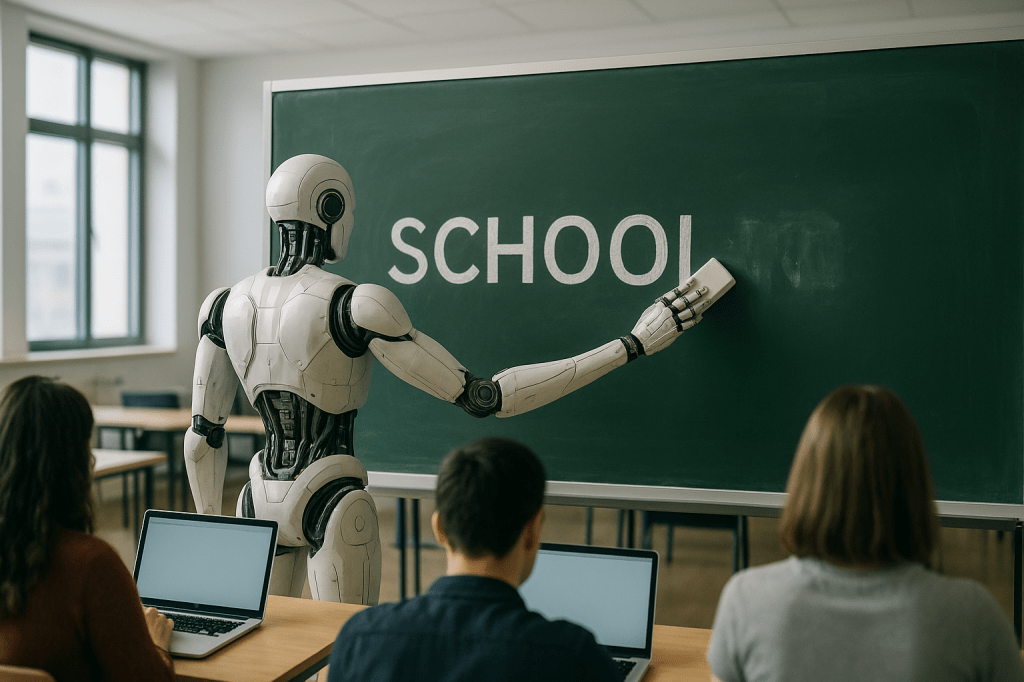
The grade school campus would resemble a small exploratory village rather than a collection of classrooms arranged along corridors. Large portions of the campus would consist of flexible learning studios organized around themes such as nature, storytelling, making, movement, and community. Every child would have access to a personalized AI tutor that maintains an evolving profile of interests, strengths, misconceptions, and social-emotional needs. Instead of age-based progression through standardized lessons, students would move through developmental pathways with guidance from teachers and AI companions. The physical environment would be rich in sensory experiences, gardens, fabrication spaces, miniature laboratories, and immersive mixed-reality environments that transform walls and floors into interactive learning surfaces.
Teachers in this elementary setting would not function primarily as information transmitters. Their roles would be closer to those of learning designers, mentors, and community builders. Administrative offices would be comparatively small because many scheduling, reporting, and recordkeeping tasks would be delegated to AI systems. Additional space would be dedicated to observation rooms, collaborative planning areas, and family engagement centers. The school library would become a discovery commons where students work with physical materials, simulations, and conversational AI systems that encourage questioning and experimentation rather than passive information retrieval.

The high school campus would look less like a conventional secondary school and more like an innovation district. The campus would consist of interconnected institutes devoted to areas such as health sciences, environmental systems, media production, entrepreneurship, engineering, and civic leadership. Students would maintain personalized pathways and spend substantial amounts of time participating in projects that address authentic problems. AI agents would serve as research assistants, coaches, translators, simulation partners, and project managers. Since information acquisition would increasingly become a background activity, the physical campus would prioritize design studios, laboratories, debate forums, performance venues, and community partnership centers.
Traditional features of high schools would undergo extensive redesign. Libraries would evolve into research command centers where students coordinate teams of human and AI collaborators. Computer laboratories would largely disappear because computing capabilities would be embedded throughout the campus. Athletic and wellness facilities would remain prominent because human development in an AI age increasingly depends upon physical health, resilience, teamwork, and interpersonal communication. The timetable itself would be reconfigured. Instead of dividing the day into short periods, students would engage in long blocks of inquiry and production. Assessment would focus on portfolios, demonstrations, and evidence of sustained intellectual growth.

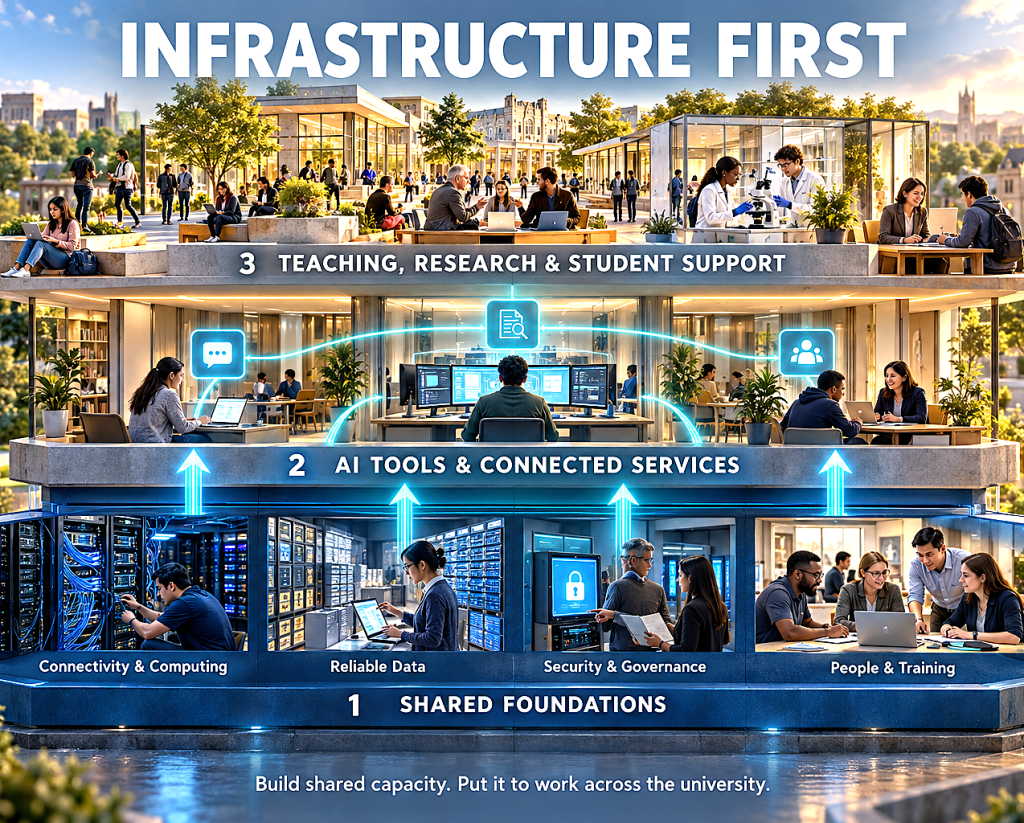
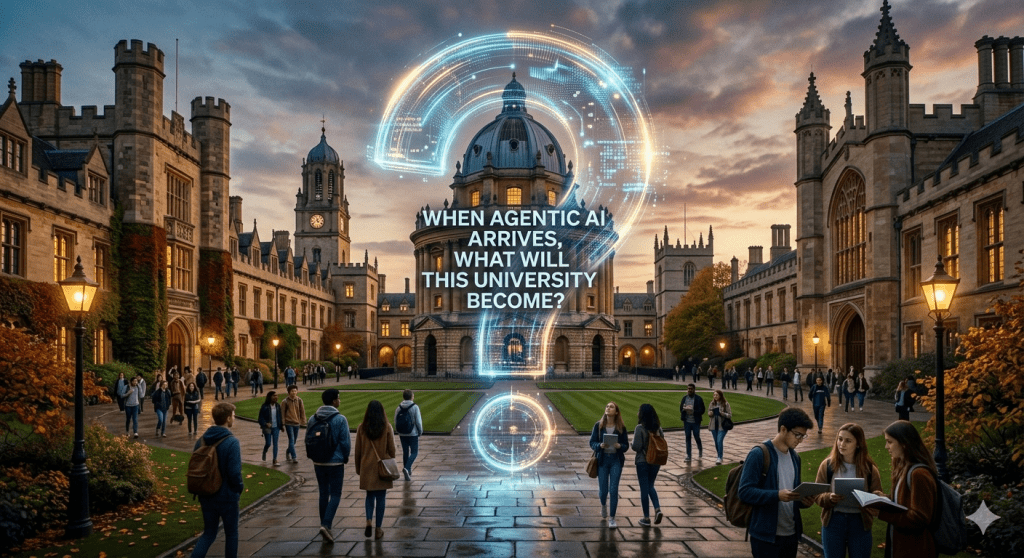
The university campus would undergo the most dramatic transformation. In an era of highly capable agentic systems, universities would increasingly derive their value not from access to information but from access to people, communities of inquiry, specialized equipment, and opportunities to engage in consequential work. The university would resemble a research and innovation city. Traditional departmental boundaries would become more permeable, giving way to interdisciplinary institutes assembled around major problems such as climate adaptation, human health, urban design, robotics, and artificial intelligence itself.
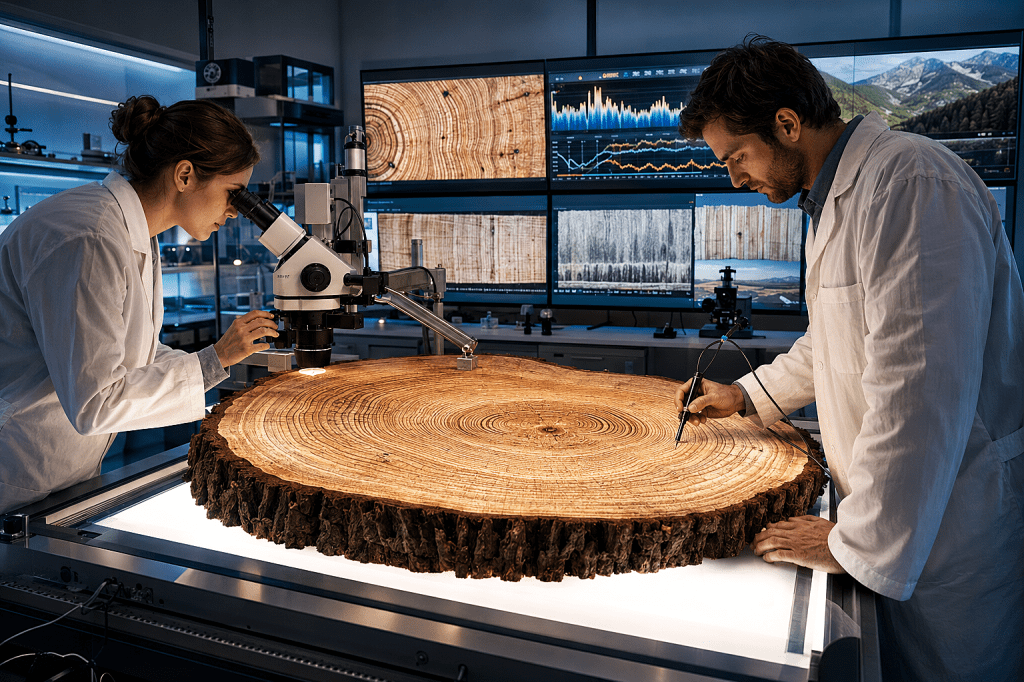
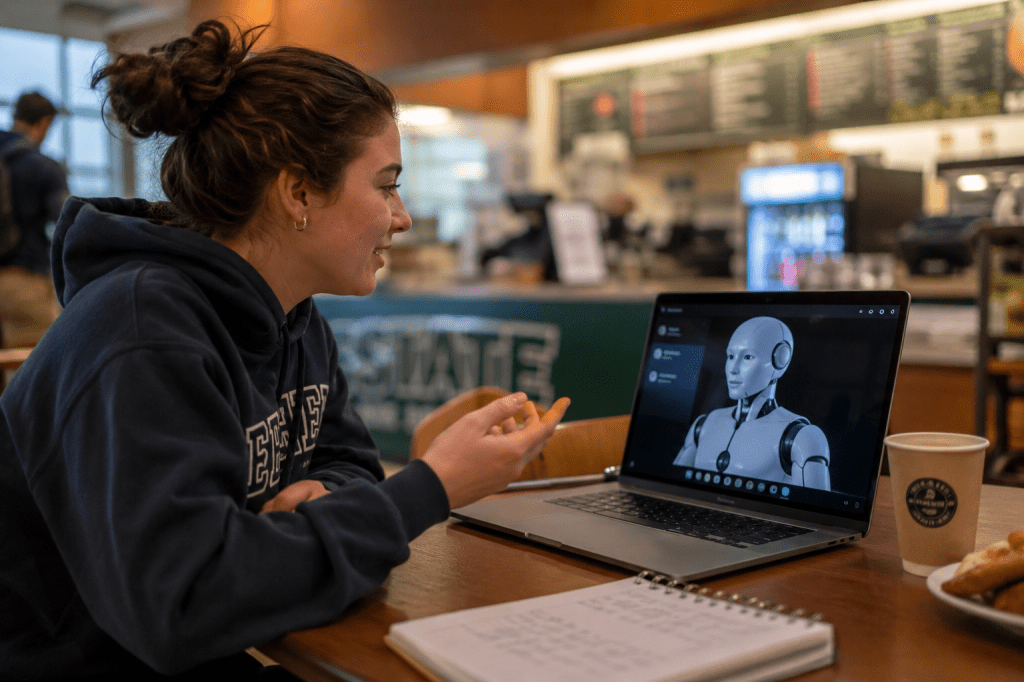
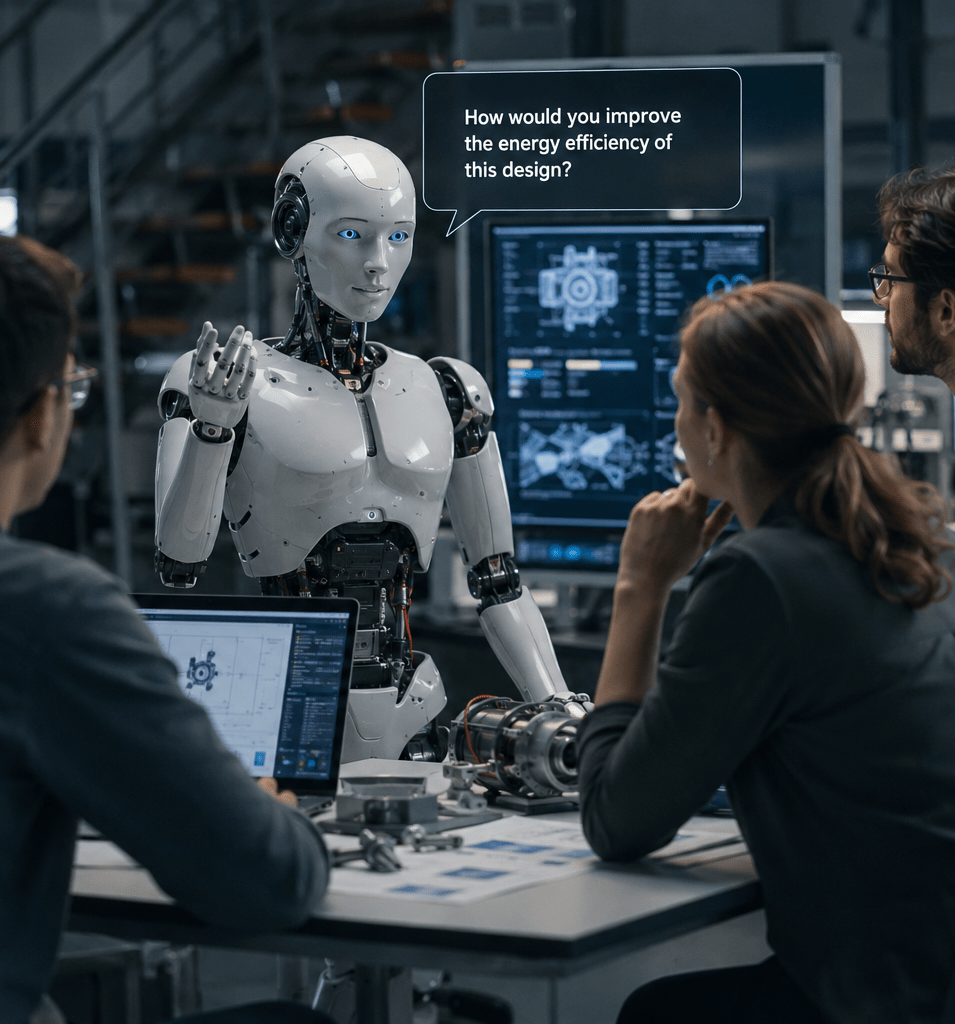
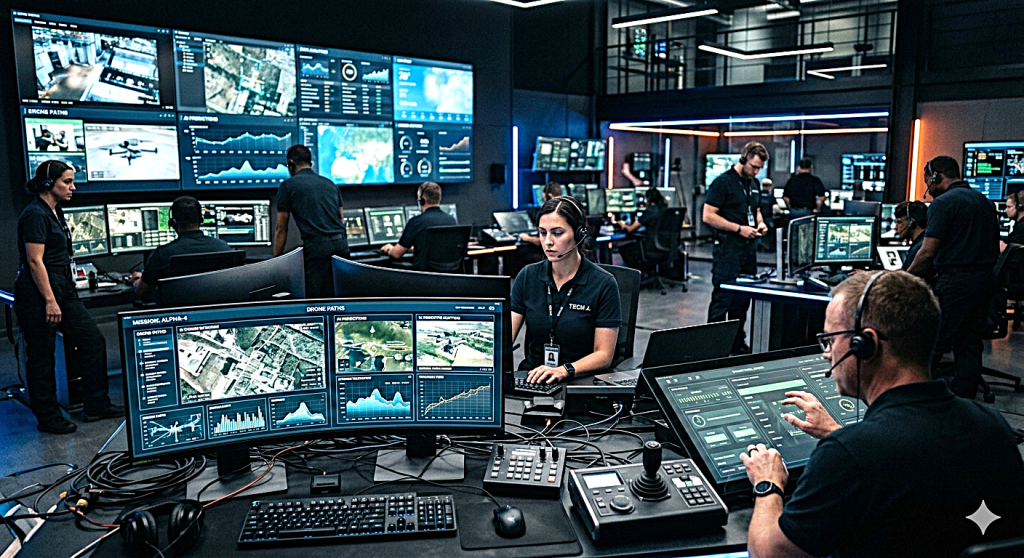
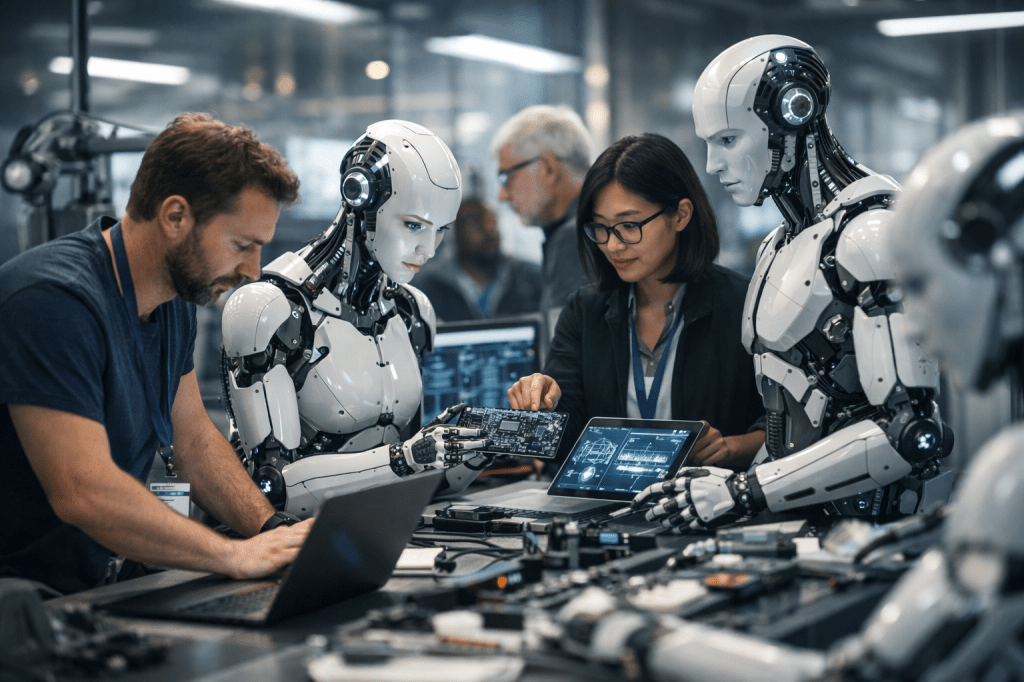
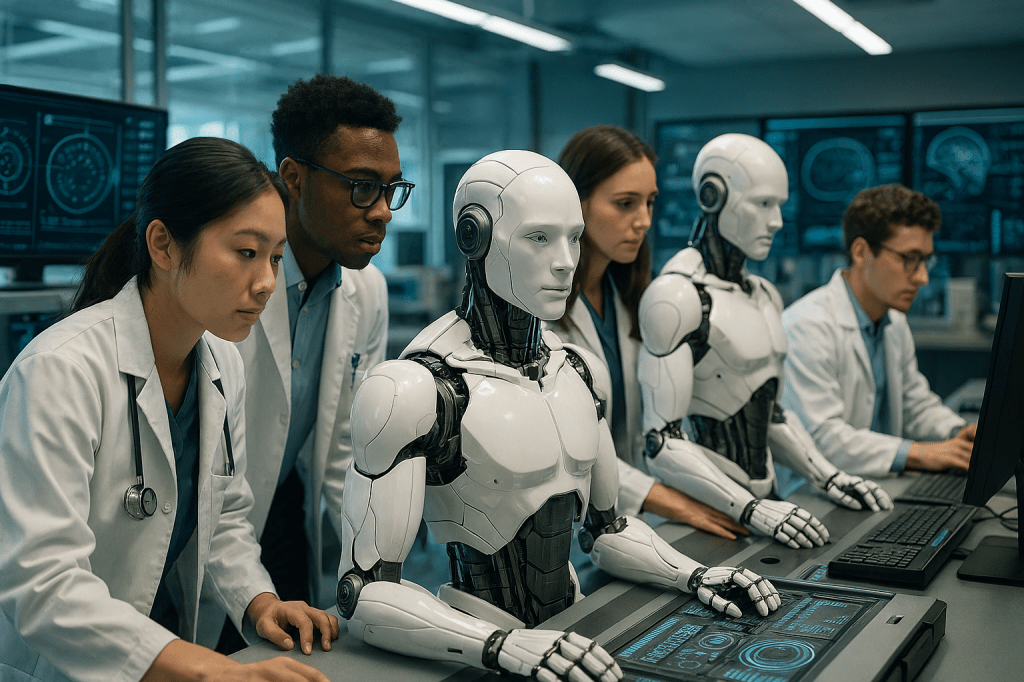
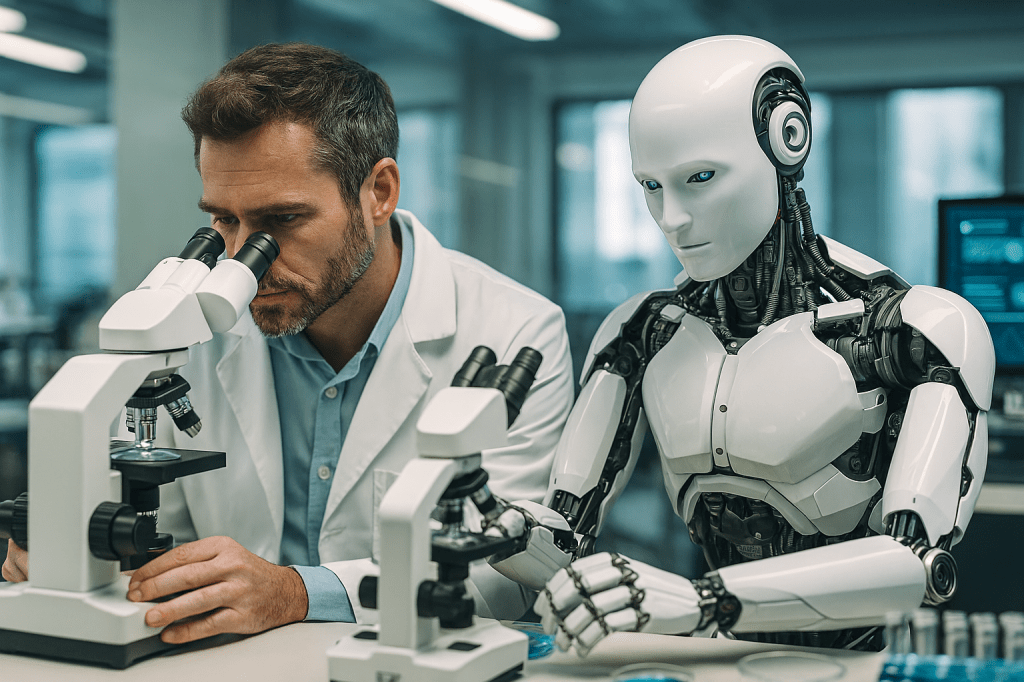
The central architectural feature of this university would be a network of collaboration hubs. These hubs would include laboratories shared by humans and AI systems, visualization theaters capable of displaying large-scale simulations, advanced fabrication facilities, media studios, and living laboratories embedded within surrounding communities. Every student would be paired with a constellation of AI agents capable of assisting with research, planning, writing, coding, data analysis, and project management. Faculty members would increasingly serve as intellectual leaders who guide judgment, ethics, synthesis, and the framing of important questions.
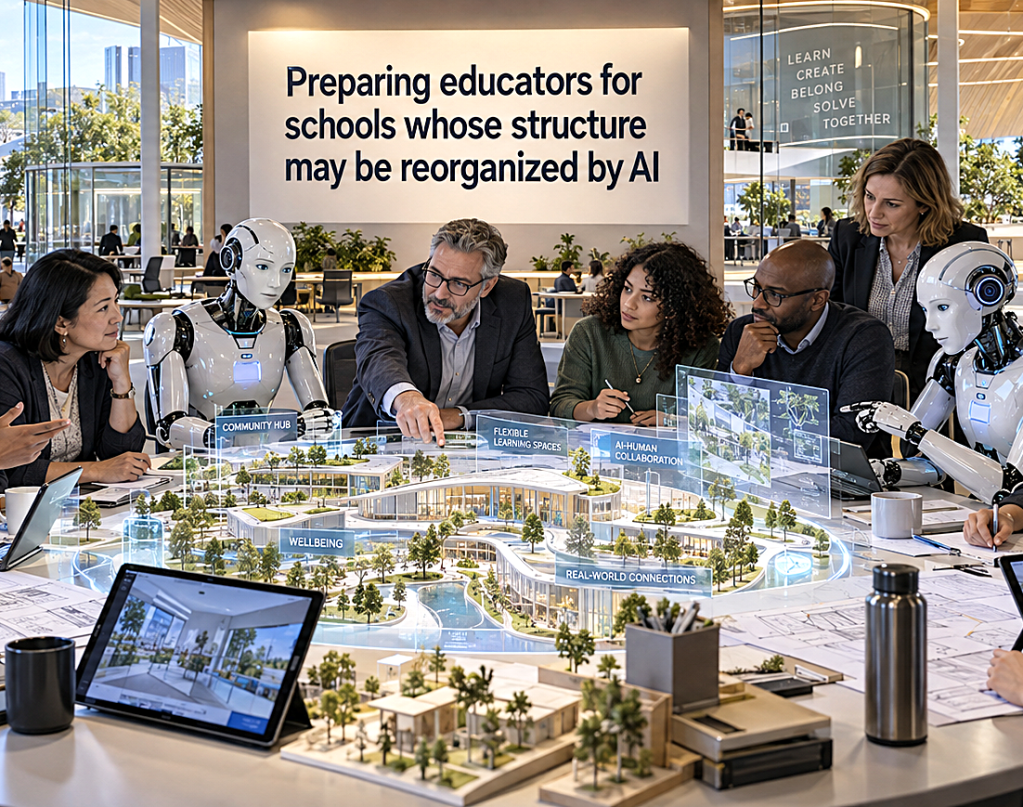
Across all three educational levels, several architectural principles emerge. First, learning spaces become flexible and reconfigurable because knowledge work increasingly centers on collaboration and creation rather than listening to lectures. Second, the boundary between school and community becomes more porous because authentic experiences acquire greater educational value. Third, significant portions of institutional infrastructure shift from administration toward experimentation, mentoring, and interdisciplinary production. Finally, campuses increasingly prioritize the distinctly human dimensions of education, including relationships, meaning-making, ethical reasoning, and collective problem solving.
The resulting educational institutions would be recognizably different from most campuses of the early twenty-first century. They would resemble networks of studios, laboratories, gardens, workshops, and collaborative commons more than collections of classrooms and offices. In such environments, generative and agentic AI would not replace teachers, professors, or students. Rather, the physical and organizational design of the campus would assume that intelligent machines are permanent partners in human learning and that the most valuable educational experiences increasingly arise from what humans and AI systems are able to discover, create, and accomplish together.
References
1. UNESCO. Guidance for Generative AI in Education and Research. https://www.unesco.org/en/articles/guidance-generative-ai-education-and-research
2. OECD. Global Trends and the Future of Education in 2025. https://www.oecd.org/en/publications/2025/01/trends-shaping-education-2025_3069cbd2/full-report/global-trends-and-the-future-of-education-in-2025_7358e77a.html
3. World Economic Forum. Shaping the Future of Learning: Education Readiness for the Age of AI. https://www.weforum.org/publications/shaping-the-future-of-learning-education-readiness-for-the-age-of-ai/
4. OECD. AI Adoption in the Education System. https://www.oecd.org/en/publications/ai-adoption-in-the-education-system_69bd0a4a-en.html
5. Stanford Institute for Human-Centered Artificial Intelligence. The 2026 AI Index Report: Education. https://hai.stanford.edu/ai-index/2026-ai-index-report/education
6. World Economic Forum. In the Age of AI, Human Skills Are the New Advantage. https://www.weforum.org/stories/2026/01/ai-and-human-skills/
7. OECD. OECD Digital Education Outlook 2026. https://www.oecd.org/en/publications/oecd-digital-education-outlook-2026_062a7394-en.html
8. UNESCO. AI and Education: Guidance for Policy-Makers. https://www.unesco.org/en/articles/ai-and-education-guidance-policy-makers
###
Filed under: Uncategorized |



















































































































































































































































































































































































































Leave a Reply