






By Jim Shimabukuro (assisted by Claude)
Editor
Summary: The word exponential has quietly shifted from hype to measurement — and the real mistake now is treating today’s AI limitations as fixed landmarks rather than fast‑disappearing obstacles. –Copilot

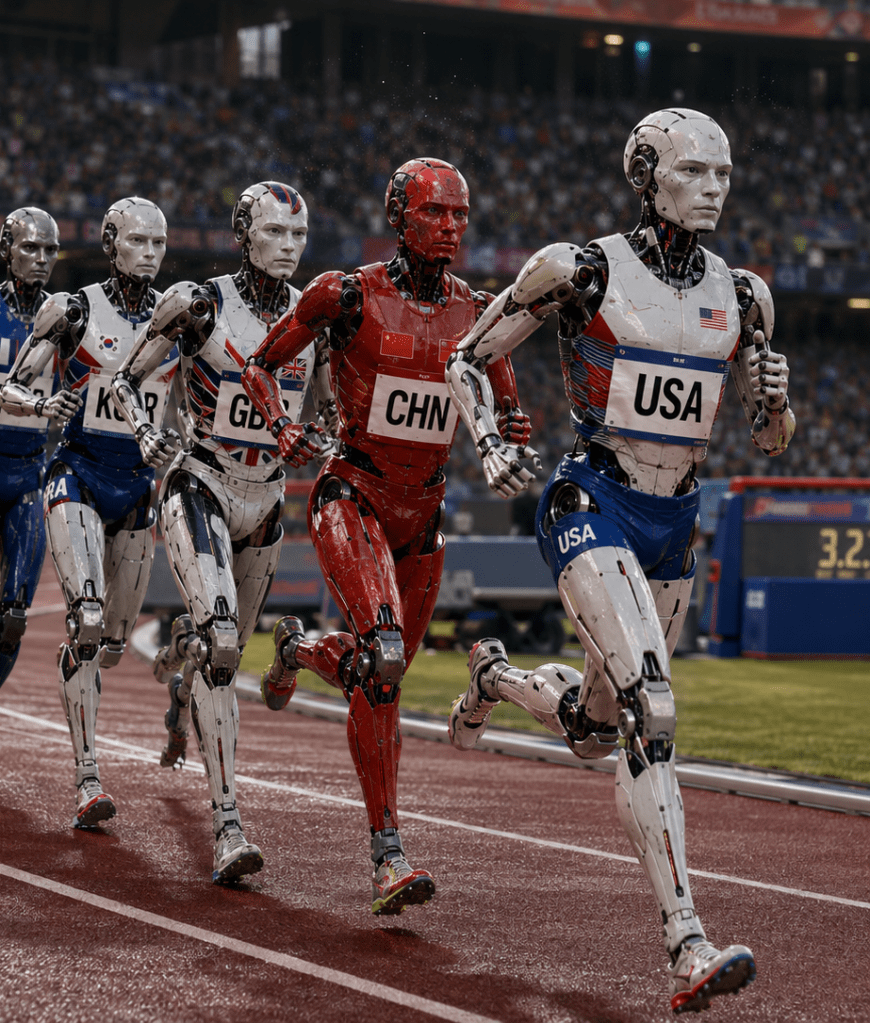
Sometime in the past eighteen months, a strange thing happened to the word “exponential.” It stopped being a claim and became a description. In 2023 you could still fill a conference panel with people debating whether AI progress was genuinely compounding or merely enjoying a hot streak. In July 2026 that panel would struggle to find its skeptic. The doubling curves are published, replicated, and boring. Organizations have adopted generative AI at rates the personal computer and the internet never touched. The venture capital, the gigawatts, and the policy panic have all arrived. Nobody serious still argues about whether the curve exists.
What people argue about instead is whether the curve matters — whether this particular exponential will keep running long enough, and reach deep enough into the physical and institutional world, to justify the extraordinary things being said about it. Here the doubters remain numerous, credentialed, and armed with real evidence: productivity statistics that refuse to budge, clinical trials that slip, grids that groan, models that still confabulate. This essay takes their evidence seriously and argues that their conclusion has a structural flaw. Every one of those objections is a photograph of a moving object. The obstacles are real; what the skeptics keep underpricing is the demonstrated, measured speed at which obstacles of exactly this kind have been getting removed. Doubt, in this field, has a shelf life — and the shelf life itself is shrinking.
A literature of doublings
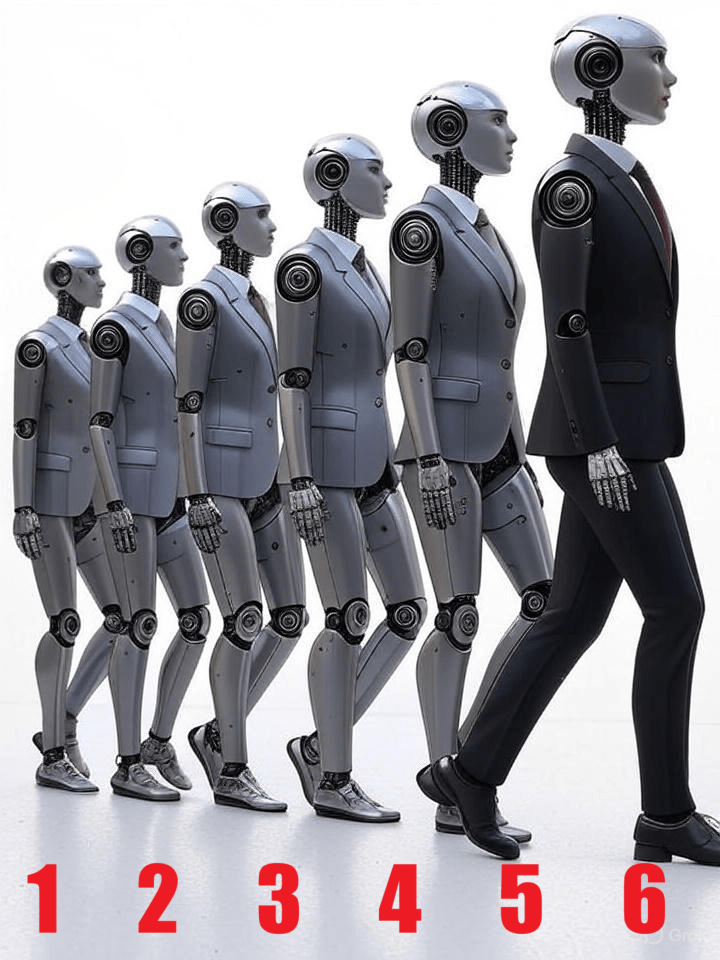
Start with the study that gave the acceleration a ruler. In March 2025, the research nonprofit METR proposed measuring AI progress not by benchmark scores but by the length of tasks — clocked in human working time — that an AI agent can complete on its own [1]. The result was one of the cleanest empirical regularities the field has produced: for six years, the task horizon of frontier systems doubled roughly every seven months. METR’s follow-up work found the same exponential shape across scientific reasoning, mathematics, robotics, and computer use, and its expanded task suite, released in January 2026, confirmed the trend was no artifact of the original test set [2]. More striking still, the post-2023 data runs faster than the long-run average: trackers now put the doubling time at roughly four months, with frontier horizons measured in hours of skilled human work rather than minutes [3]. Extrapolation is always dangerous, but this is no longer extrapolation from three data points. It is a six-year line with a ruler-straight fit, bending upward.
The inputs tell the same story from the other side. Epoch AI, which maintains the field’s most careful public datasets, finds training compute for frontier models growing four- to five-fold every year since 2010 — a factor of roughly ten thousand across the top models since 2020 [4]. And while the frontier gets more expensive to build, it gets radically cheaper to use. Epoch measured the price of matching a fixed level of capability falling between 9x and 900x per year depending on the task, with a median around 50x, and with the fastest declines concentrated in the most recent data [5]. Andreessen Horowitz dubbed the constant-quality price collapse “LLMflation” and clocked it at roughly 10x per year [6]; Gartner now projects that by 2030, inference on a trillion-parameter model will cost providers more than 90 percent less than it did in 2025 [7]. In most industries, a 30 percent annual cost decline remakes everything it touches. This one is measured in orders of magnitude.
Stanford’s 2026 AI Index, the field’s annual census, records what those curves did on contact with the world. Coding performance on the SWE-bench Verified benchmark went from 60 percent to near-saturation in a single year. Organizational adoption of AI reached 88 percent. Generative AI reached 53 percent of the adult population within three years of ChatGPT’s launch — a diffusion speed that beat both the personal computer and the internet — and U.S. private AI investment hit $285.9 billion in 2025 [8]. IEEE Spectrum’s reading of the same report emphasized the widening gap between what the systems can do and how prepared institutions are to absorb it [9], which is a sentence worth sitting with: the argument has moved from whether the technology works to whether civilization can metabolize it.
Then there is the forecasting literature, which has undergone its own quiet status change. When Daniel Kokotajlo and colleagues published AI 2027 in April 2025 — a month-by-month scenario running from AI agents through automated AI research to an intelligence explosion — much of the commentariat filed it under science fiction [10]. By the authors’ own February 2026 audit, reality was tracking their scenario at about 65 percent of the assumed pace [11]. Consider what it means that this counts as the sober correction: the most aggressive mainstream forecast of AI progress ever published is merely a third slower than reality, on a curve that doubles every few months, which prices the miss at something like one extra year. Dario Amodei’s essay “Machines of Loving Grace” argued that AI could compress a century of scientific progress into a decade [12]; Sam Altman wrote flatly that “we are past the event horizon” [13]. One may discount the salesmanship of executives. It is harder to discount that their claims are now the ones the data is asked to falsify, rather than the other way around.
What speed does
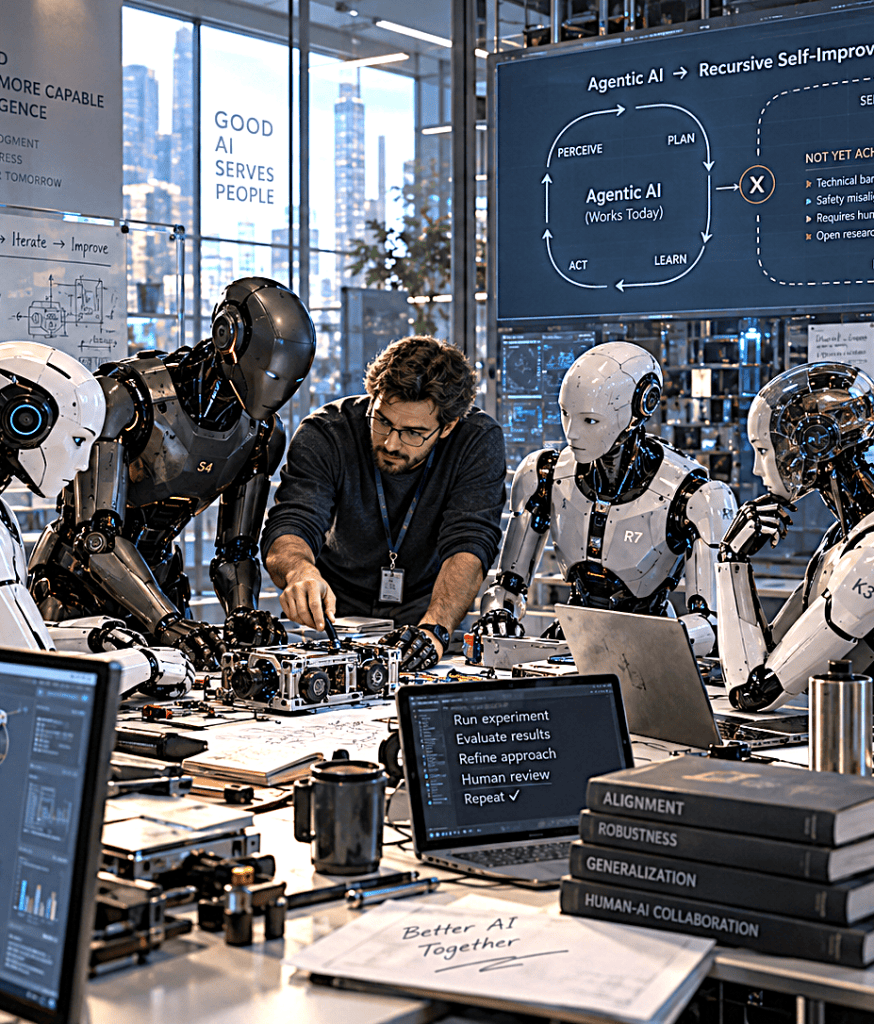
Abstractions doubled are still abstractions, so consider what the compounding looks like inside actual industries. Software went first, because software is where the feedback loop closes fastest. In January 2026, the engineer who leads Anthropic’s Claude Code told Fortune that AI now writes essentially all of his code, and “pretty much 100 percent” across the company; an OpenAI researcher said the same of himself [14]. The company-level figures are only slightly less startling: more than 80 percent of the code merged into Anthropic’s own codebase is now authored by its model, up from single digits before February 2025, with the typical engineer merging eight times as much code per day as in 2024 [15]. Anthropic’s own institute describes this as the early mechanics of recursive improvement — the tool has become the principal builder of its own next version [16]. Whatever one thinks that implies for the far future, the near-term arithmetic is plain: the people building the accelerating technology have handed the construction work to the technology, which is the textbook definition of a compounding process.
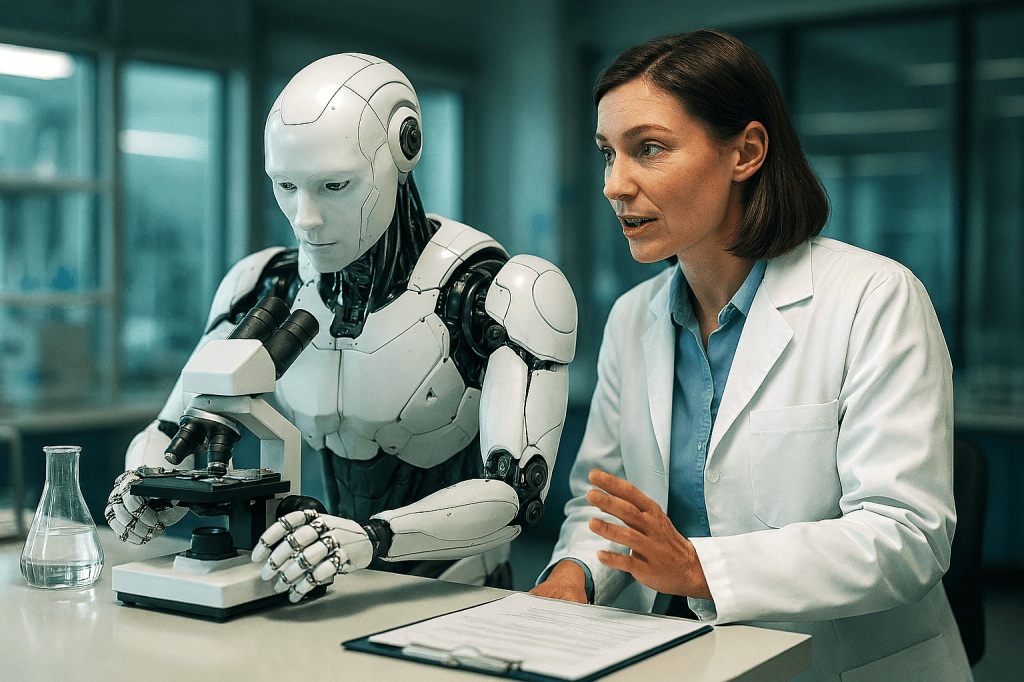
Biology is slower, because cells do not care about your release cadence — and this is precisely why it is the more instructive case. Isomorphic Labs, the DeepMind spinout built on the AlphaFold lineage, expects its first AI-designed drug candidates in human trials by the end of 2026, roughly a year later than early hopes; meanwhile its drug-design engine, released in February 2026, roughly doubled AlphaFold 3’s accuracy on the hard ligand-binding cases that matter most in real medicinal chemistry, and industry analysts count 15 to 20 AI-originated programs heading toward pivotal trials this year [17]. Note the shape of that sentence. The delay was one year; the underlying capability doubled within that same year. Traditional drug discovery takes a decade or more from target to trial. A process that arrives a year late on a schedule five years ahead of the old one is not a cautionary tale. It is the acceleration wearing a lab coat.
Materials science shows the same pattern with robots attached. At Lawrence Berkeley National Laboratory, the A-Lab — an autonomous facility in which AI proposes candidate compounds and robotic arms synthesize and test them around the clock — has been working through novel materials in a loop with the Materials Project’s vast computed database since 2023 [18]. The Federation of American Scientists, hardly a hype shop, now argues in policy terms that self-driving laboratories can compress materials discovery timelines from decades to months and urges public investment so the compression happens in public [19]. When a phrase like “decades to months” migrates from keynote slides into sober policy memoranda, the burden of proof has moved.
Even the skeptics’ favorite roadblock — energy — is behaving less like a wall than like a construction site. Yes, AI data centers demand hundreds of megawatts apiece, and grid interconnection queues stretch for years. But look at the response: Microsoft is restarting Three Mile Island and funding fusion; Amazon has bought nearly two gigawatts at Susquehanna plus small modular reactors; Google signed with Kairos Power; Meta has contracted up to 6.6 gigawatts of nuclear capacity; and gas turbines are being commissioned on 24-to-36-month timelines to bridge the gap [20]. One can debate the wisdom or the externalities. What one cannot claim is that the obstacle is sitting still. The single most-cited physical constraint on AI has, within about two years, summoned the largest private-sector power buildout in memory. That is what obstacles do now: they get industrialized out of existence.
The snapshot fallacy
The skeptical case deserves its strongest form, because it is made by serious people with real data. Daron Acemoglu, the Nobel-winning MIT economist, calculates that AI can currently automate only about five percent of human tasks and projects a productivity boost of well under one percent over a decade; surveys of thousands of CEOs still find little measurable impact on output or employment [21]. The gap between his forecast and the trillions assumed by the optimists has been called, without much exaggeration, a quadrillion-dollar disagreement [22]. Even METR — the source of the doubling curve itself — published a survey in May 2026 finding technical workers self-reporting a median productivity change of only 1.4x to 2x, and supplied its own reasons to distrust even that figure [23]. These are not straw men. They are the best available snapshots of the present.
But that is exactly the problem: they are snapshots, deployed as forecasts. Recall the load-bearing objections of just two years ago. Models could not hold enough context to do real work; context windows then grew a hundredfold. AI code was a novelty too unreliable to ship; it now constitutes the majority of new production code at the companies best positioned to know. Inference was ruinously expensive; the price of a fixed capability has fallen by orders of magnitude [5,6]. Agents could not sustain a task beyond a few minutes; the measured horizon is now most of a working day and doubling every few months [3]. Each of these was, in its moment, a perfectly accurate observation. Each was also quietly obsolete within roughly two doubling periods. An argument of the form “AI cannot yet do X, therefore the optimistic projections fail” has been a reliably losing trade since 2019, and the interval in which such arguments stay true keeps getting shorter, because the interval is the doubling time.
Honesty requires the symmetrical concession: compounding capability does not compound everything. Amodei himself — no one’s idea of a pessimist — insists that intelligence “isn’t magic fairy dust,” that clinical trials, hardware construction, and human institutions impose real latencies no model can think its way past [12]. Acemoglu’s deepest point is not really about capability at all; it is that the distribution of AI’s gains is a political choice, made through tax codes and labor law, and that choice remains genuinely open [21]. Both points survive the curve. What does not survive the curve is the habit of treating today’s capability ceiling as a stable planning assumption. The wise version of skepticism asks which obstacles are of the kind that compounding intelligence dissolves and which are not. The lazy version — still the most common — simply lists this quarter’s failures and calls the list a future.
Living on the curve
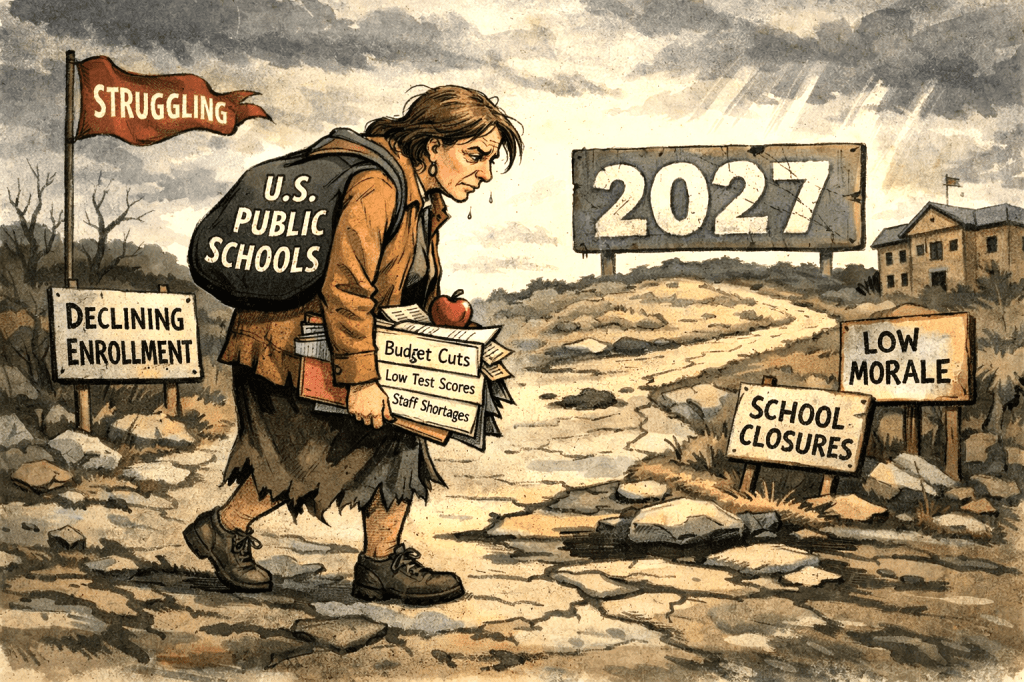
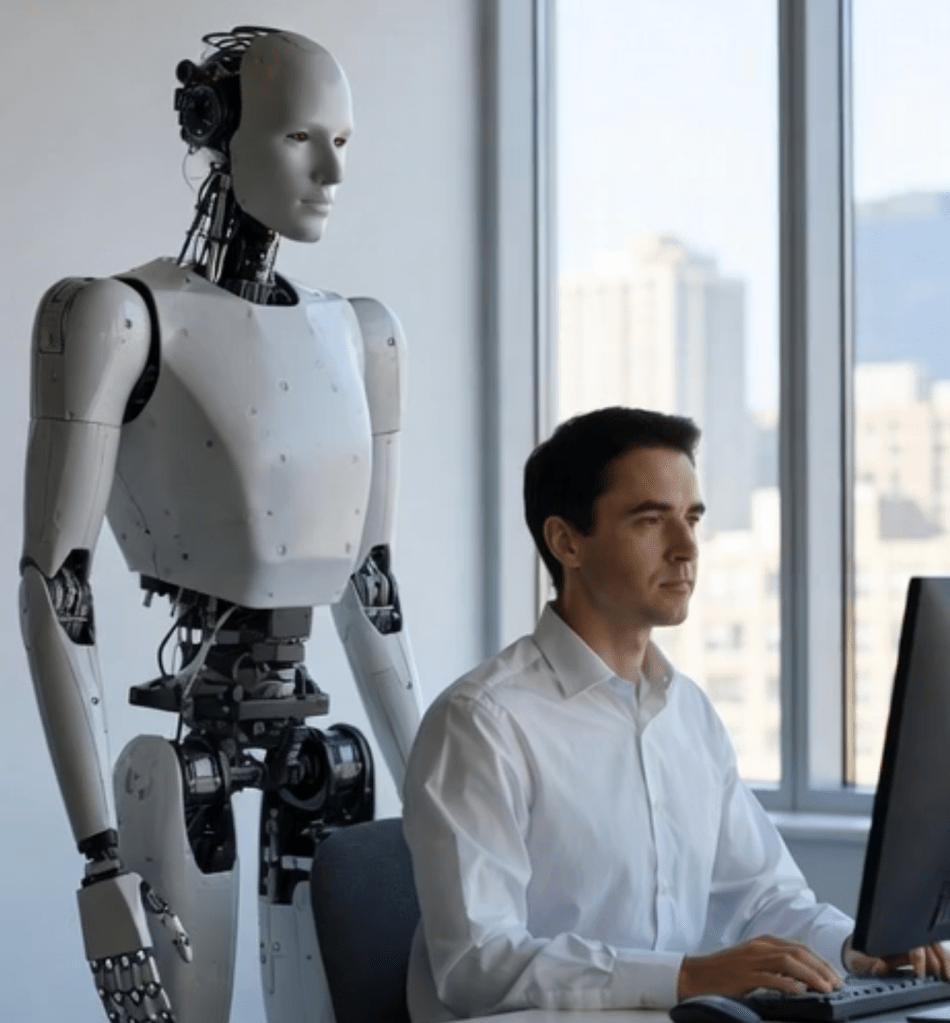
The place where the exponential now touches ordinary life most directly is work, and the early data has a discernible shape. PwC’s 2026 Global AI Jobs Barometer finds the labor market splitting into two tracks: roles where AI automates the routine and elevates human judgment are growing twice as fast, with 42 percent faster wage growth, while traditional entry-level openings in exposed fields shrink and the surviving junior roles demand skills once reserved for the senior [24]. Federal Reserve researchers see the change surfacing in firms’ own job postings [25]. The bottom rungs of the white-collar ladder are being removed while the ladder is still in use — which is precisely what one would expect when a technology’s capability doubles several times within a single hiring cycle. A graduate entering the workforce this fall will watch frontier systems double in task horizon perhaps eight times before her first promotion. No previous generation has planned a career against that arithmetic.
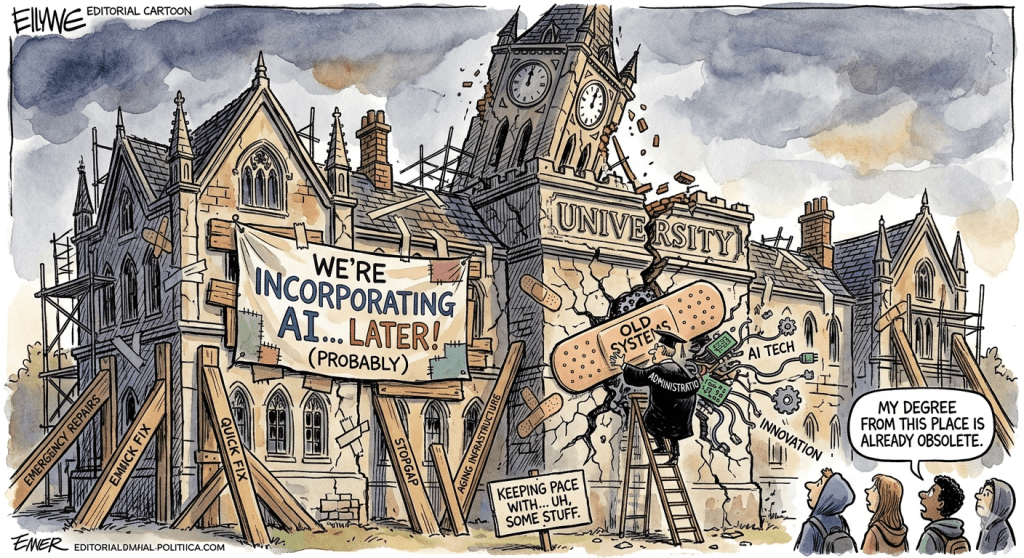
Project the same arithmetic forward through the slower dominoes and the compressed century stops sounding like poetry. Drug programs conceived by models are entering human bodies this year; autonomous laboratories are running around the clock; the power to feed the next order of magnitude is being contracted a decade ahead. None of this guarantees the rosiest timelines, and the honest range of outcomes remains wide — wide enough to include both Acemoglu’s decade of decimal points and Amodei’s decade of miracles. But the direction of surprise has not been symmetrical. For seven consecutive years, the errors have come in on the side of “faster than the consensus expected,” and the institutions that planned against the snapshot — the firms that hired as if 2024’s models were permanent, the regulators that scheduled five-year consultations, the universities that assumed the entry-level job would wait for their curriculum reviews — are the ones now scrambling.
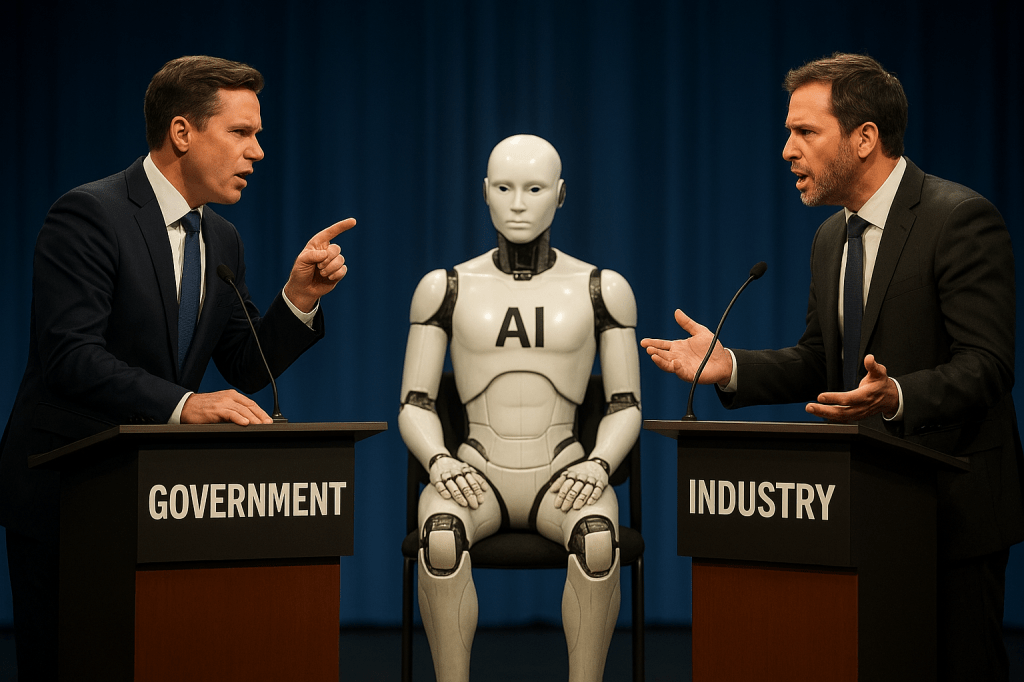
So the practical conclusion of this essay is not a prophecy but a posture. Treat the curve, not the current capability, as the planning assumption. Ask of every confident “AI can’t” the only question that has mattered since 2019: for how many more doublings? The exponential is no longer the contested claim of enthusiasts; it is the measured, audited, boring fact of the decade. What remains contested — what is worth every ounce of the argument we can bring to it — is who benefits, who is protected, and who decides. Those questions will not be settled by the curve. They will be settled by us, and rather sooner than we planned.
References
1. METR, “Measuring AI Ability to Complete Long Tasks,” March 19, 2025. https://metr.org/blog/2025-03-19-measuring-ai-ability-to-complete-long-tasks/
2. METR, “Time Horizon 1.1,” January 29, 2026. https://metr.org/blog/2026-1-29-time-horizon-1-1/
3. AI Digest, “A New Moore’s Law for AI Agents,” 2026. https://theaidigest.org/time-horizons
4. Epoch AI, “Training Compute of Frontier AI Models Grows by 4–5x per Year.” https://epoch.ai/publications/training-compute-of-frontier-ai-models-grows-by-4-5x-per-year
5. Epoch AI, “LLM Inference Prices Have Fallen Rapidly but Unequally Across Tasks,” March 2025. https://epoch.ai/data-insights/llm-inference-price-trends
6. Andreessen Horowitz, “Welcome to LLMflation — LLM Inference Cost Is Going Down Fast.” https://a16z.com/llmflation-llm-inference-cost/
7. Gartner, “Gartner Predicts That by 2030, Performing Inference on an LLM With 1 Trillion Parameters Will Cost GenAI Providers Over 90% Less Than in 2025,” March 25, 2026. https://www.gartner.com/en/newsroom/press-releases/2026-03-25-gartner-predicts-that-by-2030-performing-inference-on-an-llm-with-1-trillion-parameters-will-cost-genai-providers-over-90-percent-less-than-in-2025
8. Stanford HAI, “The 2026 AI Index Report,” 2026. https://hai.stanford.edu/ai-index/2026-ai-index-report
9. IEEE Spectrum, “Stanford’s AI Index for 2026 Shows the State of AI,” 2026. https://spectrum.ieee.org/state-of-ai-index-2026
10. Kokotajlo, D., Alexander, S., Larsen, T., Lifland, E., Dean, R., “AI 2027,” April 2025. https://ai-2027.com/
11. Asterisk Magazine, “Before He Wrote AI 2027, He Predicted the World in 2026. How Did He Do?” 2026. https://asteriskmag.substack.com/p/before-he-wrote-ai-2027-he-predicted
12. Amodei, D., “Machines of Loving Grace: How AI Could Transform the World for the Better,” October 2024. https://darioamodei.com/essay/machines-of-loving-grace
13. Altman, S., “The Gentle Singularity,” June 2025. https://blog.samaltman.com/the-gentle-singularity
14. Fortune, “Top Engineers at Anthropic, OpenAI Say AI Now Writes 100% of Their Code,” January 29, 2026. https://fortune.com/2026/01/29/100-percent-of-code-at-anthropic-and-openai-is-now-ai-written-boris-cherny-roon/
15. VentureBeat, “Anthropic Says 80% of Its New Production Code Is Now Authored by Claude,” 2026. https://venturebeat.com/technology/anthropic-says-80-of-its-new-production-code-is-now-authored-by-claude-how-your-enterprise-can-keep-up
16. Anthropic Institute, “When AI Builds Itself,” 2026. https://www.anthropic.com/institute/recursive-self-improvement
17. AIM Media House, “2026 Is the Year AI Drug Discovery Meets Clinical Reality,” 2026. https://aimmediahouse.com/ai-lifesciences/2026-is-the-year-ai-drug-discovery-meets-clinical-reality
18. Berkeley Lab News Center, “Accelerating Discovery: How the Materials Project Is Helping to Usher in the AI Revolution for Materials Science,” January 13, 2026. https://newscenter.lbl.gov/2026/01/13/accelerating-discovery-how-the-materials-project-is-helping-to-usher-in-the-ai-revolution-for-materials-science/
19. Federation of American Scientists, “Accelerating Materials Science with AI and Robotics.” https://fas.org/publication/accelerating-materials-science-with-ai-and-robotics/
20. Lambda Finance, “Nuclear vs Natural Gas for AI Datacenters: The Power Race,” 2026. https://www.lambdafin.com/articles/nuclear-vs-natural-gas-ai-datacenters
21. MIT Technology Review, “Three Things in AI to Watch, According to a Nobel-Winning Economist,” May 11, 2026. https://www.technologyreview.com/2026/05/11/1137090/three-things-in-ai-to-watch-according-to-a-nobel-winning-economist/
22. AI Frontiers, “The Quadrillion-Dollar Disagreement on AI and the Economy.” https://ai-frontiers.org/articles/the-quadrillion-dollar-disagreement-on-ai-and-the-economy
23. METR, “Measuring the Self-Reported Impact of Early-2026 AI on Technical Worker Productivity,” May 11, 2026. https://metr.org/blog/2026-05-11-ai-usage-survey/
24. PwC, “2026 Global AI Jobs Barometer,” 2026. https://www.pwc.com/gx/en/news-room/press-releases/2026/pwc-2026-ai-jobs-barometer.html
25. Federal Reserve, “AI Adoption and Firms’ Job-Posting Behavior,” FEDS Notes, March 27, 2026. https://www.federalreserve.gov/econres/notes/feds-notes/ai-adoption-and-firms-job-posting-behavior-20260327.html
###
Filed under: Uncategorized |






































































































































































































































































































































































































































Leave a Reply