






By Jim Shimabukuro (assisted by Claude)
Editor
Summary: AI‑driven pseudoarchaeology shows how machine‑generated myths can outpace human fact‑checking — threatening public literacy in the age of synthetic truth. –Copilot

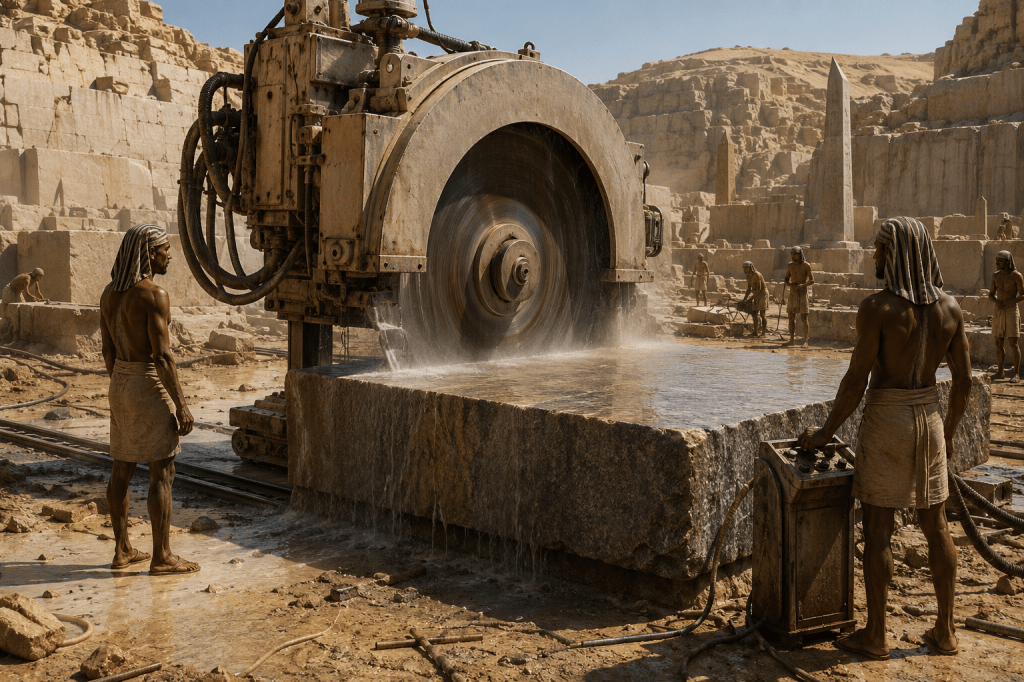
YouTube has been flooded by generative AI clickbait videos such as “AI Just Revealed the Method Egyptians Used to Cut Granite — And It Doesn’t Make Sense” (1). Its central argument is that an artificial intelligence called Grok analyzed photogrammetric scan data from the granite quarries at Aswan, Egypt, and identified ancient cutting marks so geometrically precise that they could only have been produced by industrial rotary cutting equipment — technology that did not exist until the twentieth century. The implication is that a sophisticated pre-dynastic civilization, or some form of advanced lost technology, shaped Egypt’s hardest stone thousands of years before modern machinery was invented.
Before proceeding to the claims themselves, a crucial piece of context must be stated plainly: the channel’s own comment section contains a disclosure reading, “Made with AI — Sounds or visuals were altered or fully generated” (1). This disclaimer, placed by the channel itself, signals that the video’s narration, visuals, and voiced statements were generated by artificial intelligence rather than derived from original research or actual investigators.
The video makes several interrelated scientific assertions. It contends that Grok AI analyzed 847 individual cuts at Aswan and found a variance of only 4.3 percent — far below the 12 to 22 percent variance supposedly produced by skilled human craftsmen. Tool entry angles across the quarry reportedly varied by less than 2 degrees. The closest modern match, identified at 94 percent confidence, was said to be industrial-grade rotary cutting using diamond composite abrasive tips.
The video further attributes microscopic analysis to a researcher named “Dr. Tomasz Kowalski,” who allegedly found sheared rather than fractured crystal structures, spiral rotation traces consistent with powered rotary tools, localized thermal signatures indicative of a spinning contact surface, and corundum particles embedded in the cut faces. It claims that marks appear in confined shafts where no human wielding a percussion tool could have worked. It also asserts a “temporal inversion” in which the oldest cuts are the most precise and the most recent cuts are the crudest — statistically significant, it says, at the 99th percentile. And it attributes to archaeologist Dr. Sarah Parcak the view that these findings “do not have an exit” (1).
The video is fake in substance, structure, and attribution. It combines a real archaeological site — the Aswan granite quarries — with entirely fabricated data, invented researchers, misrepresented real scientists, and a fundamental mischaracterization of what Grok is and does.
The first and most fundamental problem with the video’s claims is that no published study, peer-reviewed paper, conference proceeding, preprint, or institutional report documents a Grok AI analysis of 847 photogrammetric cuts at Aswan returning 94 percent confidence classifications on tool type (1). Grok, developed by xAI, is a conversational large language model chatbot. It does not autonomously conduct photogrammetric scans, operate a tool signature database, or generate probability scores on ancient quarrying methods. Comprehensive searches across scientific literature databases and archaeological journals return no credible record of any such analysis. The specific numerical claims — 4.3 percent variance, 2-degree entry angle consistency, 94 percent confidence, 99th-percentile temporal inversion — appear in no verifiable source (5).
A February 2026 article addressing nearly identical Grok-based claims about Egyptian granite concluded that while “modern tools, including AI systems such as Grok, can help analyze data in new ways, they do not overturn the fundamental evidence that has been carefully assembled by historians, engineers, and archaeologists.” The article makes explicit that “What AI cannot do is conjure new physical evidence where none exists” and that precision in ancient stonework “may reflect skilled craftsmanship, careful measurement, and significant labor investment” rather than lost technology (5).
The video attributes key findings to “Dr. Tomasz Kowalski, a Polish material scientist who runs surface analysis on cut stone for archaeological projects across the Mediterranean.” Searches of academic databases, university faculty directories, and publication archives return no archaeologically active material scientist by this name and description. The character and quotations attributed to him appear to be invented.
Similarly, “Dr. Mustafa El-Saied, the Cairo-based Egyptologist who has spent the last 15 years cataloging tool marks across the Aswan complex” cannot be confirmed through any accessible institutional, academic, or professional record.
Dr. Sarah Parcak is a real and accomplished archaeologist — a professor of anthropology at the University of Alabama at Birmingham and a recognized pioneer in satellite-based archaeological remote sensing (1). However, she has made no public statements attributable to this Grok analysis. No institutional communication, peer-reviewed paper, press release, or verified media interview places her anywhere near this claimed research. The quotes attributed to her in the video, including that the findings “do not have an exit,” appear to be fabricated.
The video repeatedly describes granite as “rated seven on the Mohs hardness scale, harder than steel.” This is misleading. The Mohs scale measures scratch resistance, not compressive or tensile strength. Steel ranges broadly across the Mohs scale depending on alloy and heat treatment; hardened steel can reach 7 to 8, matching or exceeding granite. More importantly, dolerite — the rock from which ancient Egyptian pounders were made — is harder and tougher than granite by the very criteria relevant to quarrying, which is precisely why ancient Egyptians selected it for this purpose (4).
The video presents the presence of corundum (crystalline aluminum oxide, rated 9 on the Mohs scale) in cut granite surfaces as evidence of technology “3,000 years before industrial chemistry existed.” This claim contradicts published findings from two separate institutions. Scanning electron microscopy analysis published by the Metropolitan Museum of Art identified a corundum-rich abrasive powder preserved inside an ancient Egyptian drill hole at the Great Temple of Aten at Amarna, dating to the New Kingdom (ca. 1353–1336 B.C.). A corundum deposit suitable for abrasive production is documented at Hafafit in Egypt’s Eastern Desert, within the geographical range of ancient trade and exploitation (3). Earlier experimental work confirmed that corundum and emery (a naturally occurring corundum-bearing mineral mixture) produce the spiral concentric lines found in ancient Egyptian granite drill cores — the very microscopic signature the video calls impossible (2).
The 1983 experimental study by Gorelick and Gwinnett at Penn Museum subjected granite to drilling using a copper tubular drill with various abrasives under scanning electron microscopy (2). They found that emery and corundum used wet — in water, olive oil, or a viscous lubricant — produce consistent concentric spiral lines on granite drill walls. These lines arise from the rotation of the drill guided by an abrasive slurry, not from any powered industrial mechanism. The spiral pattern reflects a fixed rotational direction, which is exactly what a bow drill or crank drill produces. The thermal signatures the video treats as anomalous are equally consistent with a rotating copper or bronze drill creating localized friction at its contact edge (2).
No peer-reviewed study has demonstrated that the marks in Aswan’s narrow shafts are geometrically incompatible with all non-powered tools. The video presents this as a physics-based certainty derived from Grok’s “definitive spatial impossibility classification,” but no such classification appears in any verifiable source (5). Rotary abrasive methods using copper or bronze drill cores require far less linear swing clearance than dolerite percussion and are consistent with confined working spaces.
No published study has conducted a systematic correlation of cut geometry against surface age at Aswan and returned a 91 percent confidence finding of decreasing precision over time, nor a 99th-percentile inversion result. This claim appears entirely fabricated (5). The archaeological consensus is that Egyptian quarrying and stoneworking techniques improved over dynastic time, not regressed.
The Aswan unfinished obelisk, which the video describes as abandoned for inexplicable reasons, has been understood since Reginald Engelbach’s 1922 study as a monument abandoned because a structural crack rendered it unsuitable for transport and erection. The crack-abandonment explanation remains the standard scholarly account (1). The video’s suggestion that cutting marks continue past the crack and that some other cause ended the project is presented without evidence.
Decades of experimental archaeology and laboratory analysis have established a coherent, empirically tested account of how ancient Egyptians worked granite. The method involves dolerite pounders for bulk removal, copper and later bronze tubular drills guided by abrasive slurries (emery, corundum, or quartz), and highly skilled craftsmen with extensive site-specific experience.
A 2025 peer-reviewed paper in the journal Lithic Technology, “Quarrying Granite with Dolerite Pounders in Ancient Egypt: Some Quantitative Assessment,” applied fracture mechanics to quantitatively confirm the efficiency and suitability of dolerite pounders for granite extraction (4). The study analyzed the fundamental mechanical properties of both granite and dolerite and found that dolerite is harder and tougher than granite in precisely the ways needed to fracture it progressively and controllably without destroying the pounder. This resolves what the video frames as an insurmountable physical puzzle: the tool works, and works well.
For drilling and finer surface work, the 1983 Penn Museum experimental study by Gorelick and Gwinnett examined an Old Kingdom granite sarcophagus lid using scanning electron microscopy and a systematic series of replication experiments (2). Their principal finding was that emery and corundum used with a copper tubular drill in wet or lubricated conditions produce concentric spiral lines on granite walls that are indistinguishable from those found in ancient Egyptian drill holes. Loose dry quartz sand did not produce these lines; the harder abrasives (Mohs 9) in a wet medium did. This is directly consistent with the Met Museum’s 2015 identification of corundum abrasive in an intact ancient Egyptian drill hole at Amarna (3), which confirmed that Egyptians had access to, and used, corundum. The copper drill served as a carrier; the abrasive grain did the cutting. The result is smooth, directional, rotationally consistent surface marks — precisely what the Noxium video misattributes to industrial diamond-tipped rotary machinery (2,3).
The Noxium video is part of a documented and growing pattern of AI-generated pseudoarchaeological content on social media platforms. Lara Fabian, a professor of Iranian archaeology at UCLA and member of the Cotsen Institute of Archaeology, developed a university seminar in 2026 titled “Archaeology: The Ancient Near East Goes Viral” specifically in response to what she describes as “the growing spread of misinformation and conspiracy theories — largely fueled by social media videos — about the ancient world,” adding that “thanks to the rise of hyper-realistic AI-generated content, this trend stands to worsen in the years ahead” (6).
A March 2025 case documented by Decrypt followed the same template. A group calling itself the Khafre Project claimed to have found vast underground structures beneath the Pyramid of Khafre. Egyptologist Salima Ikram of the American University in Cairo said the claims sounded “very improbable” and that there was “no data to evaluate” and “no peer-reviewed paper.” Fact-checking site Snopes determined the most widely shared supporting image had a 99.9 percent probability of being AI-generated (7). Flora Anthony, an Egyptologist who investigated the claims, stated plainly: “It’s not science. It’s not history.” The Noxium video follows this template closely: it combines a real site and a real researcher’s name with invented statistics, invented colleagues, and an AI-generated production that discloses its own fabricated nature in the comment section (1,7).
The claim advanced by the Noxium video — that ancient Egyptians could not have cut granite with the methods identified by archaeologists, and that Grok AI has identified the use of industrial rotary cutting equipment in a pre-dynastic operation — is fake in all its specific evidentiary dimensions. No such Grok analysis exists in any verifiable form. The researchers and quotes cited in the video cannot be confirmed and appear to be fabricated. The numerical statistics presented have no published basis. The scientific premises — that corundum particles are anomalous, that spiral drill marks require powered equipment, that dolerite pounders were physically incapable — are directly contradicted by peer-reviewed experimental archaeology and laboratory analysis spanning forty years (2-5). The video self-identifies, in its own comment section, as AI-generated content, and should be treated accordingly (1).
References
1. Noxium. “AI Just Revealed the Method Egyptians Used to Cut Granite — And It Doesn’t Make Sense.” YouTube, uploaded May 8, 2026. [Transcript provided as source document; channel comment disclaimer: “Made with AI — Sounds or visuals were altered or fully generated.”]
2. Gorelick, L. and Gwinnett, A.J. “Ancient Egyptian Stone-Drilling.” Expedition Magazine 25, no. 3 (1983). https://www.penn.museum/sites/expedition/ancient-egyptian-stone-drilling/
3. Serotta, A. and Carò, F. “Hidden Secrets of Ancient Egyptian Technology.” The Metropolitan Museum of Art, May 22, 2015. https://www.metmuseum.org/perspectives/ancient-egyptian-technology
4. “Quarrying Granite with Dolerite Pounders in Ancient Egypt: Some Quantitative Assessment.” Lithic Technology (2025). https://www.tandfonline.com/doi/full/10.1080/01977261.2025.2577022
5. “AI BOMBSHELL STUNS ARCHAEOLOGY: NEW GROK ANALYSIS CLAIMS TO REVEAL HOW ANCIENT EGYPTIANS REALLY CUT GRANITE.” XONE US, February 26, 2026. https://us.xone.news/ai-bombshell-stuns-archaeology-new-grok-analysis-claims-to-reveal-how-ancient-egyptians-really-cut-granite/
6. Fabian, L. (quoted in Brenner, S.) “How misinformation about archaeology spreads online.” UCLA Newsroom, June 4, 2026. https://newsroom.ucla.edu/stories/ucla-course-explores-how-misinformation-archaeology-spreads-online
7. Nelson, J. “Ancient Mystery or Modern Hoax? Experts Debunk Giza Pyramid Claims.” Decrypt, March 25, 2025. https://decrypt.co/311432/ancient-mystery-modern-hoax-experts-debunk-giza-pyramid-claims
Filed under: Uncategorized |
























































































































































































































































































































































































































































































Leave a Reply