





By Jim Shimabukuro (assisted by Claude)
Editor
[Related: Does AI Require a Paradigm Shift in the Writing Process?]
Summary: AI is forcing writing instruction to shift from product to process — turning composition into a dynamic dialogue between human intention and machine insight. –Copilot

Writing instruction in schools and colleges has long been guided by what researchers call the writing process—the recursive psychological steps competent writers take as they plan, draft, revise, and edit a text. Since the early 1970s, process-oriented pedagogy has placed peer and instructor feedback at the center of composition classrooms, treating writing not as a solitary product to be delivered and graded but as an evolving, socially constructed activity. For decades, however, a fundamental constraint limited the reach of that vision: before the internet, peer response groups were small, face-to-face, and essentially invisible to researchers and program administrators. No systematic record of how students gave feedback—or how writers used it—was ever made.
The rise of web-based learning management systems (LMSs) in the 1990s and 2000s changed the documentary landscape. Suddenly, every draft submission, every peer comment, every revision cycle existed as retrievable data. In principle, writing teachers and program directors could track the entire composing process across a class or an institution. In practice, however, the data remained largely inert. Instructors lacked programs capable of quickly and meaningfully processing the oceans of text generated within LMSs, let alone connecting that data across platforms or translating it into timely, actionable guidance for classroom or individual interventions. The data existed; the tools to make it pedagogically useful did not.
The emergence of generative AI—large language models capable of producing, analyzing, and responding to natural language at scale—alongside agentic AI systems capable of orchestrating multi-step tasks, promises to close that gap dramatically. For the first time, the full arc of a writing process is not only recordable but analyzable and respondable in near real time. AI can parse a draft, compare it to an earlier version, generate formative feedback calibrated to a rubric, and flag patterns across an entire class—tasks that once consumed entire semesters of human labor. Whether this technological promise translates into genuine pedagogical gain is the central question this essay explores.
The answer, as the most recent scholarship suggests, is a cautious but compelling yes—provided that AI is designed and deployed in ways that keep the writer, not the machine, at the center of the composing process. What follows is a review of key scholars whose published work illuminates this question. The essay opens with the historical foundations of writing-process pedagogy, then moves to a series of focused essays on researchers who have published on the intersection of AI and writing instruction, primarily between 2025 and 2026. A concluding discussion draws out the implications for writing instruction at every level of schooling.
Historical Foundations: The Writing-Process Movement
Janet Emig (1928–2026) was a professor of English education at Rutgers University, New Jersey, and one of the founding figures of empirical writing research in the United States. Her 1971 monograph, The Composing Processes of Twelfth Graders, published by the National Council of Teachers of English, constitutes the founding document of modern process-based composition research (1). Drawing on think-aloud case studies of eight high school seniors, Emig was the first writing researcher to study not the essay students produced but the mental and behavioral activities they engaged in while producing it. She showed that student writers moved recursively through planning, drafting, and revising—rarely in a straight line—and that the process differed substantially from what teachers at the time believed or taught. Emig’s work established that composition is a learnable cognitive process susceptible to systematic study and pedagogical intervention, not merely a talent distributed unequally at birth. Her significance lies in having given writing instruction its empirical and intellectual foundation, a foundation on which more than five decades of scholarship have been built.
Donald Murray (1924–2006) was a Pulitzer Prize-winning journalist and professor of English at the University of New Hampshire. In a luncheon address delivered to the New England Association of Teachers of English in October 1972—later reprinted widely and considered one of the most influential manifestos in the history of composition—Murray argued that most writing teachers had been trained to analyze the products of writing rather than to teach the process of writing itself (2). “Most of us,” he wrote, “trained as English teachers by studying a product: writing. Our critical skills are honed by examining literature, which is finished writing… and then, fully trained in the autopsy, we go out and are assigned to teach writing.” Murray called instead for classrooms that gave students control over their own texts, that respected the messiness of drafting, and that measured success not by the polished surface of a final essay but by how much a student had grown through revision. He articulated, in practical terms, what Emig had demonstrated empirically: that writing is a process, not a product, and that teaching it requires attending to that process directly. Murray’s work helped shift the field from a literature-centered curriculum toward a writer-centered pedagogy, laying the ground for the peer-feedback workshops, portfolio systems, and multidraft assignments that became standard in composition courses across the United States by the 1980s and 1990s.
Together, Emig and Murray established the conceptual architecture that every subsequent generation of writing researchers has either elaborated or contested. The LMS revolution of the late 1990s was, in one sense, their vindication: it made the previously invisible process suddenly visible as data. What was still missing, until the current decade, was the computational power to act on that data at scale. That is precisely the gap that generative and agentic AI now promises to fill.
Key Scholars on AI and Writing-Process Instruction
Eman Elturki
Eman Elturki is a Senior Lecturer in the Department of English at the University of Illinois at Chicago (UIC), where she specializes in curriculum planning and evaluation in English language teaching, multilingual writing development, corpus-based pedagogies, and pathway programs in higher education. Her research has consistently addressed how writing instruction can be made more responsive to diverse learner populations, including non-native speakers of English navigating the academic writing demands of American universities. Elturki’s article “AI-Aware Process Writing Pedagogy: Rethinking the Process-Based Approach” appeared in TESOL Journal in 2026 (3). It was announced by the journal’s social media accounts as a direct intervention in the urgent debate over how writing instruction should respond to the generative AI revolution.
Elturki’s central argument is that generative AI does not destroy process-based pedagogy—it requires its reinvention. Traditional process pedagogy assumed that drafting was inherently messy and that its messiness was pedagogically productive: students discovered ideas by wrestling with language. Generative AI disrupts this assumption because it can produce fluent, organized prose from a brief prompt, effectively short-circuiting the struggle that Murray and Emig considered essential. Elturki argues that what is needed is not the abandonment of the process framework but what she calls “Process Pedagogy 2.0”: an AI-aware model that recenters human decision-making, rhetorical reasoning, and ethical engagement within what she describes as hybrid human-AI writing ecologies (3). In this reconceived framework, the key pedagogical moves are transparency—students disclose how and where they used AI—visible thinking—students articulate the reasoning behind their choices at every stage—and dialogic engagement—students use AI tools not to bypass deliberation but to deepen it. Elturki grounds these principles in existing process theory while extending them to account for the new reality that a student’s “drafting” stage may now include prompting a language model and critically evaluating its output.
Elturki’s contribution is significant because it is simultaneously the most direct bridge between the Murray-Emig tradition and the AI present, and one of the first peer-reviewed proposals to reframe process pedagogy for a post-ChatGPT classroom. By arguing for transparency and rhetorical agency rather than prohibition or unrestricted use, she offers writing teachers a principled middle path. Her framework also anticipates a problem that purely technological solutions to AI in education tend to ignore: if students do not develop the metacognitive habits that process pedagogy was designed to cultivate—self-monitoring, critical revision, awareness of audience—no amount of AI tooling will make them better writers. Process Pedagogy 2.0 insists that the goal remains the development of the writer, not the production of a text.
Xinran Zhu, Cong Wang, and Duane Searsmith
Xinran Zhu, Cong Wang, and Duane Searsmith are researchers affiliated with the University of Illinois Urbana-Champaign (UIUC). Their work sits at the intersection of educational technology, academic writing pedagogy, and human-AI interaction, an increasingly crowded field in which UIUC has emerged as a prominent institutional voice. Their paper “Writing With Machines and Peers: Designing for Critical Engagement with Generative AI” was submitted to arXiv in November 2025 (4). It reports on a study conducted during the Spring 2025 semester and represents one of the first classroom-based empirical investigations of a fully integrated AI-plus-peer-feedback writing pedagogy at the graduate level.
The study followed graduate students through an eight-week literature review project in which they received feedback from two sources simultaneously: a custom-built AI reviewer and human peers. The research examined two questions: how students interacted with and incorporated each type of feedback, and how they reflected on their evolving relationships with both human and AI reviewers. The data included student writing artifacts, AI and peer feedback logs, AI chat transcripts, and written reflections (4). The findings revealed a productive division of labor: students relied on the AI reviewer for rubric alignment and surface-level editing—checking whether a paragraph met stated criteria, improving sentence clarity—while they turned to peers for conceptual development and disciplinary relevance. Crucially, student reflections showed that their relationship with the AI reviewer matured over the eight weeks: initial wariness gave way to increasing strategic confidence and, importantly, a sharpened critical awareness of what AI feedback could and could not do. The pedagogical design—multiple drafts, structured reflection, alternating between AI and peer response—supported not only writing improvement but AI literacy and disciplinary understanding.
Zhu and colleagues provide what writing educators most need: empirical evidence that AI feedback and peer feedback can coexist productively in a single course without either replacing the other or overwhelming students. The peer-feedback tradition that Murray championed and that LMSs preserved-but-could-not-analyze is shown here to retain its irreplaceable function at the level of meaning and disciplinary thinking, even when AI handles much of the surface correction. The study also demonstrates scalability: the custom AI reviewer could, in principle, be deployed across a large program, giving every student timely formative feedback on every draft without placing that burden entirely on faculty or peers. For institutions struggling with large class sizes and shrinking writing faculty, this model is directly actionable.
Aránzazu Sanz-Tejeda and Colleagues
Aránzazu Sanz-Tejeda is a researcher in the Departamento de Filología Hispánica y Clásica at the Universidad de Castilla-La Mancha in Ciudad Real, Spain. She collaborated on this systematic review with Juana Celia Domínguez-Oller (Universidad de Almería), Josep María Baldaquí-Escandell (Universitat d’Alacant), Raquel Gómez-Díaz (Universidad de Salamanca), and Araceli García-Rodríguez (Universidad de Salamanca). The team is funded by Spain’s Ministry of Science, Innovation and University under a project titled “Educational transformation: Exploring the impact of Artificial Intelligence on the reading and writing skills of university students.” Their systematic review, “The Impact of Generative AI on Academic Reading and Writing: A Synthesis of Recent Evidence (2023–2025),” was published in Frontiers in Education on January 6, 2026 (5). It covers the most intensive period of generative AI adoption in higher education and constitutes, to date, the most comprehensive empirical synthesis of peer-reviewed scholarship on AI and academic writing at the university level.
Applying the PRISMA (Preferred Reporting Items for Systematic Reviews and Meta-Analyses) protocol and the SALSA Framework (Search, Appraisal, Synthesis, Analysis), the authors searched the Scopus and Web of Science databases and ultimately analyzed 136 peer-reviewed, open-access articles published between January 1, 2023, and March 7, 2025 (5). The results document a global wave of research—concentrated in Asia, Europe, and North America—spanning quantitative surveys, quasi-experimental designs, and qualitative case studies. On the positive side, the review found consistent evidence that AI tools, particularly ChatGPT, produce significant improvements in student text quality as measured by coherence, discursive organization, lexical richness, and argumentation.
AI was also found to play a valuable role in formative feedback, idea generation, paraphrasing, and fostering student autonomy in self-editing. On the negative side, the synthesis identified recurring concerns: student overreliance on AI, diminished metacognitive engagement, difficulty distinguishing AI-generated text from human authorship (with studies showing that even experienced evaluators correctly identified AI-written text only about 20–25% of the time), and profound ethical questions surrounding plagiarism, authorship, and the homogenization of student voice. The review closes by calling for a wholesale rethinking of pedagogical assessment and institutional practices, as well as the cultivation of AI literacy as a core academic competency for both students and instructors.
Sanz-Tejeda and her colleagues provide the field’s most rigorous empirical foundation for discussions that often proceed on the basis of speculation or anecdote. Their finding that text quality improves under AI-assisted conditions is significant for writing teachers who worry that AI only produces generic mediocrity; their simultaneous finding that metacognitive depth is at risk is equally significant for those who assume AI assistance is purely beneficial. The synthesis confirms that the writing-process tradition’s core concern—developing the writer, not just the text—is precisely the dimension most threatened by naive AI integration. It thereby makes the case, indirectly but powerfully, that process-pedagogical principles must guide AI implementation rather than being abandoned in its wake.
Momin N. Siddiqui, Adam J. Coscia, Nikki Nasseri, Roy Pea, and Hari Subramonyam
Momin N. Siddiqui and Adam J. Coscia are computing researchers at the Georgia Institute of Technology in Atlanta; Nikki Nasseri is affiliated with the University of California, Berkeley; Roy Pea and Hari Subramonyam are at Stanford University’s Graduate School of Education, where Subramonyam holds a joint appointment in Computer Science. The team was funded by the National Science Foundation AI Research Institutes program and the Institute of Education Sciences, U.S. Department of Education—a cross-disciplinary funding alliance that reflects the project’s dual ambition to advance both educational and computing research. Their paper “DraftMarks: Enhancing Transparency in Human-AI Co-Writing Through Interactive Skeuomorphic Process Traces” was presented at the Association for Computing Machinery’s 2026 Conference on Human Factors in Computing Systems (CHI 2026) in Barcelona, Spain, in April 2026 (6). It was simultaneously announced by Georgia Tech’s research office as a significant practical contribution to the problem of AI transparency in educational writing.
DraftMarks is an open-source tool that addresses what the research team identified as the fundamental inadequacy of current AI detection approaches: they tell educators how much of a finished document may be AI-generated, but they reveal nothing about the writer’s process or learning (6). DraftMarks takes a different approach. It tracks the full draft history of a document as it is being written and overlays the final text with visual, skeuomorphic markers—physical metaphors that writing educators already recognize—to show different kinds of AI involvement. Eraser crumbs mark heavily revised passages. Smudges signal places where AI altered the argumentative thrust of a passage.
Masking tape highlights text that was initially AI-generated. Glue residue indicates AI-generated text that the writer later deleted. Ghost text marks moments when the writer prompted AI but chose not to use the output. Different typefaces distinguish human-written from AI-generated sentences. Taken together, the marks do not merely flag AI presence: they tell a story about the writer’s agency, judgment, and process. In an initial study with 21 educators and a follow-up with 70 participants including students, teachers, journalists, and general readers, the team found that instructors were most interested in seeing how ideas developed and where students exercised judgment, while general readers used the marks to assess authorial authenticity and trustworthiness. As Siddiqui observed: “By making the invisible parts of the process tangible, it forces writers to confront whether they are truly engaging with AI or just passively accepting it.”
DraftMarks directly addresses the problem identified at the outset of this essay: the oceans of writing-process data generated in digital environments that failed to translate into instructional insight. The tool shifts the conversation from policing AI use to making it pedagogically legible. For writing teachers working within the process tradition, DraftMarks is a practical realization of what Emig only dreamed of in 1971—a way to observe the composing process as it happens and to use that observation for assessment and teaching. For students, it creates a reflective mirror: seeing one’s own AI choices laid bare in visual form is a powerful prompt to ask whether each choice served the writer’s intellectual development or merely substituted for it. At a policy level, DraftMarks demonstrates that transparency, not prohibition, is the productive frame for AI governance in writing classrooms.
Yijun Liu, John Gallagher, Sarah Sterman, and Tal August
Yijun Liu, John Gallagher, Sarah Sterman, and Tal August are all affiliated with the University of Illinois Urbana-Champaign (UIUC), where they work across the domains of Human-Computer Interaction (HCI), Writing Studies, and Natural Language Processing. Gallagher’s background in writing center pedagogy and rhetoric brings a rare humanistic dimension to what is otherwise a predominantly technical research team, and that interdisciplinary breadth is central to the project’s contribution. Their paper “From Crafting Text to Crafting Thought: Grounding AI Writing Support to Writing Center Pedagogy” was published at CHI 2026 in Barcelona in April 2026, appearing simultaneously in the ACM Digital Library (7). An earlier version appeared at the Fourth Workshop on Intelligent and Interactive Writing Assistants (In2Writing 2025), signaling the project’s trajectory from workshop prototype to full conference paper over a productive year of development and review.
The paper begins with a historical parallel that is both accurate and illuminating: in the 1940s, university writing centers functioned as “fix-up shops” that cleaned students’ papers before submission, much as today’s AI writing tools function as text-generation and replacement engines. Following the emergence of the process movement in the 1970s and 1980s, writing centers transformed: they became writer-centered rather than curriculum-centered, process-oriented rather than product-oriented, and collaborative rather than didactic. Liu and colleagues argue that AI writing tools must undergo an analogous transformation, and they have designed a prototype, Writor, to demonstrate what that transformation looks like in practice (7).
Guided by design guidelines derived from interviews with ten writing tutors, Writor helps writers revise text by setting goals, receiving balanced feedback organized around both praise and constructive critique, and engaging in conversations with the system—without the system generating replacement text. The absence of direct text generation is the key design choice: Writor refuses to do the writing for the student. It can tell a student that a paragraph lacks a clear topic sentence, ask what the paragraph is trying to accomplish, suggest what a reader might be confused about—but it will not write the paragraph. In an expert review conducted with 30 writing instructors, tutors, and AI researchers, Writor was rated as preferred over generic AI tools and as a promising complement to human feedback, particularly in pre-session preparation, modeling peer-review practices, and self-directed learning.
The Liu team’s contribution matters because it shows that the core principles of writing center pedagogy—which are, in turn, the core principles of the process movement—can be embedded in the design of an AI system rather than sacrificed to the logic of automation. The system is explicitly non-directive: it does not perform writing tasks for the user. This design philosophy addresses head-on the concern identified by Sanz-Tejeda et al. that AI tools, when they generate text directly, may diminish the metacognitive engagement that writing instruction is meant to cultivate (5,7). It also provides a concrete answer to writing center professionals who worry that AI will make their work obsolete: properly designed AI writing support does not replace the writing center; it extends its pedagogical principles to students who cannot visit in person or who need support between sessions.
Chaoran Wang and Zhongfeng Tian
Chaoran Wang is an Assistant Professor of Writing and Multilingual Writing Specialist at Colby College in Waterville, Maine, where her research examines multilingual literacy and the role of technology through the intersecting perspectives of applied linguistics, writing studies, and educational technologies. Zhongfeng Tian is an Assistant Professor of Bilingual Education at Rutgers University-Newark, whose research, grounded in translanguaging theory, focuses on collaborating with pre- and in-service teachers to foster equitable, inclusive, and socially just learning environments for bilingual and multilingual students. Together, they bring a distinctly multilingual and equity-centered perspective to the AI-and-writing debate, a dimension frequently missing from work produced by technologists or monolingual composition specialists. Wang and Tian co-edited the volume Rethinking Writing Education in the Age of Generative AI, published by Routledge in 2025 (8). It is, to date, the most comprehensive book-length scholarly treatment of the topic, gathering leading researchers and practitioners across the spectrum of writing instruction contexts.
The volume assembles contributions from scholars working across a range of contexts that the AI-and-writing debate has only partially addressed: second-language and multilingual writing, first-year writing programs, writing centers, and writing program administration. Drawing on interdisciplinary perspectives from writing studies, applied linguistics, and education, the collection addresses what Wang and Tian frame as the three cardinal tensions of AI-assisted writing instruction: innovation versus ethics, efficiency versus equity, and automation versus agency (8). A recurring theme across the contributed chapters is that generative AI does not affect all writers equally. Students writing in their second or third language face a different set of AI-assisted opportunities and risks than native speakers; students at under-resourced institutions may lack access to premium AI tools whose free-tier limitations produce inferior feedback; and students from communities historically marginalized by dominant academic discourse may find that AI trained on that discourse reinforces rather than disrupts their exclusion. Wang and Tian insist that any pedagogically responsible integration of AI into writing instruction must begin with these equity questions, not treat them as an afterthought.
The significance of Wang and Tian’s edited volume lies partly in its scope and partly in its insistence on a lens—equity and multilingualism—that tends to be absent when engineers and cognitive scientists lead the AI-in-education conversation. Their work is a reminder that writing instruction has always been a site of negotiation between dominant cultural norms and the diverse linguistic and cultural resources that students bring to the classroom. Generative AI, which is trained overwhelmingly on text produced in dominant varieties of English, can reinforce that asymmetry or, if deployed thoughtfully, help to mitigate it. Wang and Tian ensure that this dimension of the debate cannot be ignored by the field.
The Association for Writing Across the Curriculum
The Association for Writing Across the Curriculum (AWAC) is the primary professional organization in the United States dedicated to Writing Across the Curriculum (WAC) and Writing in the Disciplines (WID) programs. Its membership includes writing program administrators, writing-across-the-curriculum directors, and faculty from across the academy who use writing as a tool for learning in every discipline from nursing to engineering to philosophy. The AWAC Executive Board unanimously endorsed its “Statement on AI and Writing Across the Curriculum” on September 8, 2025 (9). The document was released in a rapidly evolving policy environment—many institutions were simultaneously drafting their own AI-use policies—and was explicitly framed as a living document that would continue to evolve in response to community feedback and changing circumstances.
The AWAC statement affirms that writing remains, in the age of generative AI, a fundamentally human-centered activity grounded in rhetorical judgment, critical thinking, and the kind of reflection that constitutes learning (9). Rather than issuing a blanket prohibition or a blanket endorsement of AI use, the statement articulates three sets of guiding principles addressed to three audiences. For educators, it provides guidance on how to integrate AI ethically and effectively across disciplines, with explicit attention to course level, disciplinary context, and student experience. For students, it emphasizes the development of rhetorical agency with AI—understanding what AI tools can and cannot do, and making principled choices about when and how to use them. For institutions and policymakers, it calls for transparency and accountability, including prompting students to disclose and reflect on their AI use as part of the writing process itself. The statement keeps learning, creativity, and rhetorical agency explicitly at the center: “Writing is a deeply human act—a process of discovery, intellectual labor, and participation in academic and civic life,” and AI engagement in writing instruction is characterized as a context-sensitive practice, “not one-size-fits-all.”
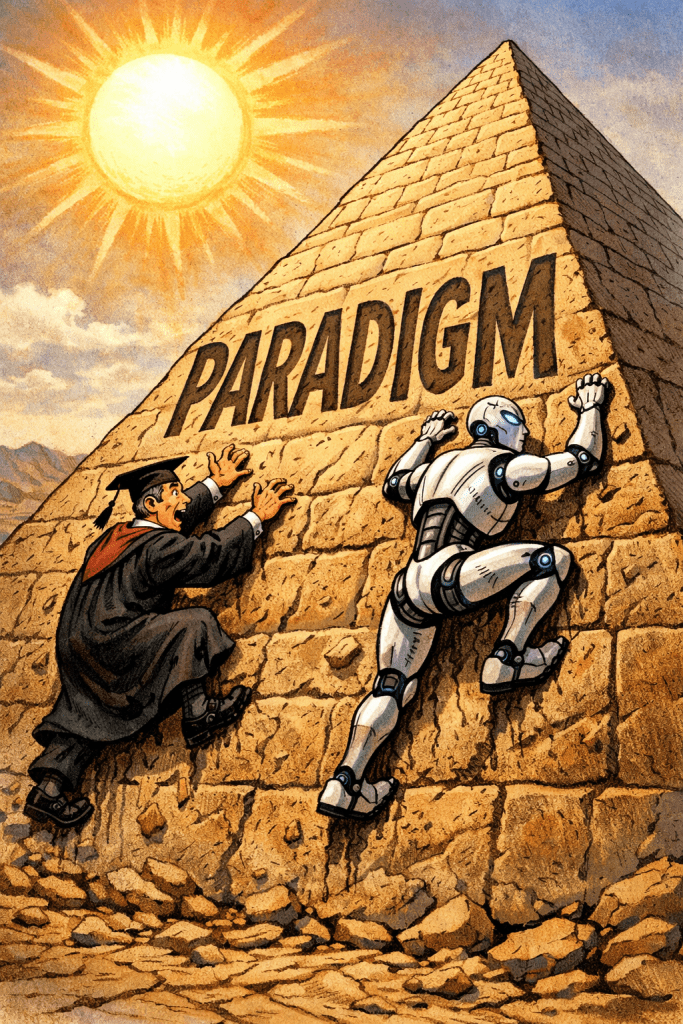
The AWAC statement matters because it represents the institutional consensus of the professional community most directly responsible for writing instruction across the entire curriculum of American higher education. When a professional organization of this standing issues a statement framing AI integration as a matter of pedagogical principle rather than technology adoption or rule enforcement, it signals a paradigm shift: the process tradition does not end with AI; it must be rethought and extended to encompass it. The statement also provides practical cover for the many individual instructors and program administrators who feel pressure to adopt simplistic policies—either “ban AI” or “allow everything”—without a principled framework for navigating the complexity in between.
Implications for Writing Instruction in Schools and Colleges
Taken together, the scholars reviewed above converge on a coherent, if still-emerging, set of implications for writing instruction at every level. The most fundamental is that the writing-process tradition is not obsolete in the age of generative AI—it is, if anything, more necessary than it has ever been. The process framework insists on attending to how writers develop through sustained engagement with drafting, feedback, and revision; generative AI, precisely because it can short-circuit that development by producing fluent text on demand, makes the pedagogical cultivation of that process more rather than less urgent (2,3,8).
The second implication is that AI feedback and human feedback are complementary, not competitive. The evidence from Zhu and colleagues demonstrates that each feedback source does different work: AI is most valuable for timely, consistent, rubric-aligned surface-level response; human peers and instructors are most valuable for the kind of conceptual, disciplinary, and relational feedback that builds a writer’s understanding of an audience and a field (4). Writing programs that deploy AI to handle surface-level feedback at scale are not degrading the student experience; they are freeing instructors and peers to focus on the higher-order thinking work that only humans can do.
Third, the problem of LMS data that could never be made pedagogically actionable is now solvable in principle. Agentic AI systems—AI that can observe, analyze, and respond across a sequence of events rather than a single prompt—can track a student’s revision behavior across an entire semester, identify patterns (a student who consistently strengthens openings but neglects conclusions, for example), and surface those patterns as timely, targeted guidance for instructor or student. DraftMarks is an early prototype of what this kind of process-visibility technology can look like (6). As these tools mature, the ambition that LMSs teased but could not deliver—systematic, data-driven insight into the writing process at course and program scale—becomes genuinely achievable.
Fourth, design matters enormously. Not all AI writing tools are equal from a pedagogical standpoint. Tools that generate replacement text on demand—functioning, in the Liu team’s phrase, as “fix-it shops”—risk producing the dependency, voice displacement, and metacognitive atrophy that the synthesis by Sanz-Tejeda et al. has already documented in the empirical literature (5,7). Tools that, like Writor, are explicitly non-directive—that set goals, ask questions, provide feedback, and insist that the writer do the writing—function as technological extensions of the best writing-center tutoring practice. Writing teachers, program administrators, and institutions have both the authority and the responsibility to choose tools that embody the right pedagogical philosophy, just as they have always had the authority to choose textbooks, assignment sequences, and grading rubrics that reflect their instructional values.
Fifth, equity cannot be an afterthought. As Wang and Tian have argued, generative AI is not a neutral technology (8). It is built on training data that reflects existing distributions of power and privilege in academic discourse. Its benefits are unevenly distributed: students with better prompting skills, stronger baseline writing ability, and access to premium tools get more out of AI assistance than students without those advantages. If left unaddressed, AI-assisted writing instruction could widen rather than narrow the achievement gaps that writing educators have spent decades trying to close. Equity-conscious implementation—attending to access, to the needs of multilingual writers, to the cultural assumptions embedded in AI-generated feedback—is not a luxury but a necessity.
Sixth, the instructor’s role does not diminish with AI—it changes. Elturki’s Process Pedagogy 2.0 model, the AWAC statement, and the design philosophy behind both DraftMarks and Writor all position the instructor not as a gatekeeper policing AI use but as a designer of learning environments in which AI tools are intentionally integrated and critically examined (3,6,7,9). This requires new competencies from writing teachers: the ability to evaluate AI tools pedagogically, to design transparency protocols, to teach students to be critical consumers of AI feedback, and to assess writing processes rather than only writing products. Professional development at scale—not just individual faculty experimentation—will be required.
Finally, it is worth noting what the best current scholarship does not claim. None of the researchers reviewed here argues that AI will solve the fundamental problem of writing instruction—that helping students become more thoughtful, more flexible, more powerful writers is hard, slow, and deeply human work. What they argue, collectively, is that AI can amplify the reach and precision of the feedback loop that writing-process pedagogy has always depended on, and that the LMS era preserved but could not activate. The promise is real. So are the risks. Whether writing instruction in schools and colleges emerges from the AI transition stronger or weaker will depend largely on whether educators approach the technology with the same principled deliberateness with which Emig and Murray approached the then-radical idea that writing could be taught as a process rather than graded as a product.
References
Filed under: Uncategorized |
















































































































































































































































































































































































































































Leave a Reply