






By Jim Shimabukuro (assisted by ChatGPT)
Editor
The reality of AI dominated mail and parcel delivery services emerging in 2025–2026 is more nuanced than a sudden AI takeover. We are witnessing a layered, system-wide transformation in which AI becomes the invisible operating system of logistics. The shift is already well underway, but it is unfolding unevenly across different parts of the delivery chain, with some segments (warehouses, routing, tracking) advancing much faster than others (last-mile autonomy, full end-to-end replacement of human labor).

At present, the most tangible evidence comes from the interior of the system—the warehouse and sorting network. By 2026, over 80% of large logistics providers are already using some form of robotic automation, with fleets of autonomous mobile robots orchestrated by AI replacing fixed conveyor systems and much manual labor.1 These systems are not merely mechanized; they are increasingly coordinated by software layers that function as “central intelligence,” dynamically assigning tasks, routing goods, and balancing human–robot collaboration in real time.2 Accuracy gains are dramatic: robotic systems are reducing error rates from as high as 1–3% to below 0.1%, while operating continuously without fatigue.1 This is the first major pillar of AI dominance: the quiet elimination of friction inside logistics hubs.
A second, highly visible frontier is tracking and sensing. In April 2026, UPS began deploying large-scale RFID infrastructure to replace manual barcode scanning, eliminating an estimated 20 million manual scans per day while reducing sorting errors (such as misloaded packages) by roughly 70%.3 This shift is subtle but profound: packages are no longer “checked” by humans; they are continuously sensed by the environment. In effect, the package becomes a data-emitting object moving through an intelligent network. This kind of ambient awareness is a prerequisite for fully autonomous logistics.
A third layer—arguably the most transformative—is the rise of agentic AI systems that actively manage supply chains. These systems no longer just recommend actions; they execute them, coordinating across warehouses, vehicles, and delivery endpoints in real time.2 Industry-wide, roughly 71% of logistics companies now deploy AI-enabled systems, achieving 15–40% cost reductions and 25–50% productivity gains while maintaining on-time delivery rates above 95%.4 This marks a transition from automation (doing tasks faster) to autonomy (deciding what tasks should be done at all).
The last-mile—the most visible part to consumers—is where the future is emerging but not yet dominant. Autonomous delivery robots and drones remain a small fraction of total deliveries (under 1% today), yet cost curves are shifting rapidly. Current autonomous delivery costs of $5–$7 per order are already competitive with human labor, and projections suggest they could fall to around $1 per delivery at scale.5 That kind of cost compression is historically disruptive: it implies that the economics of delivery could fundamentally change within a decade.
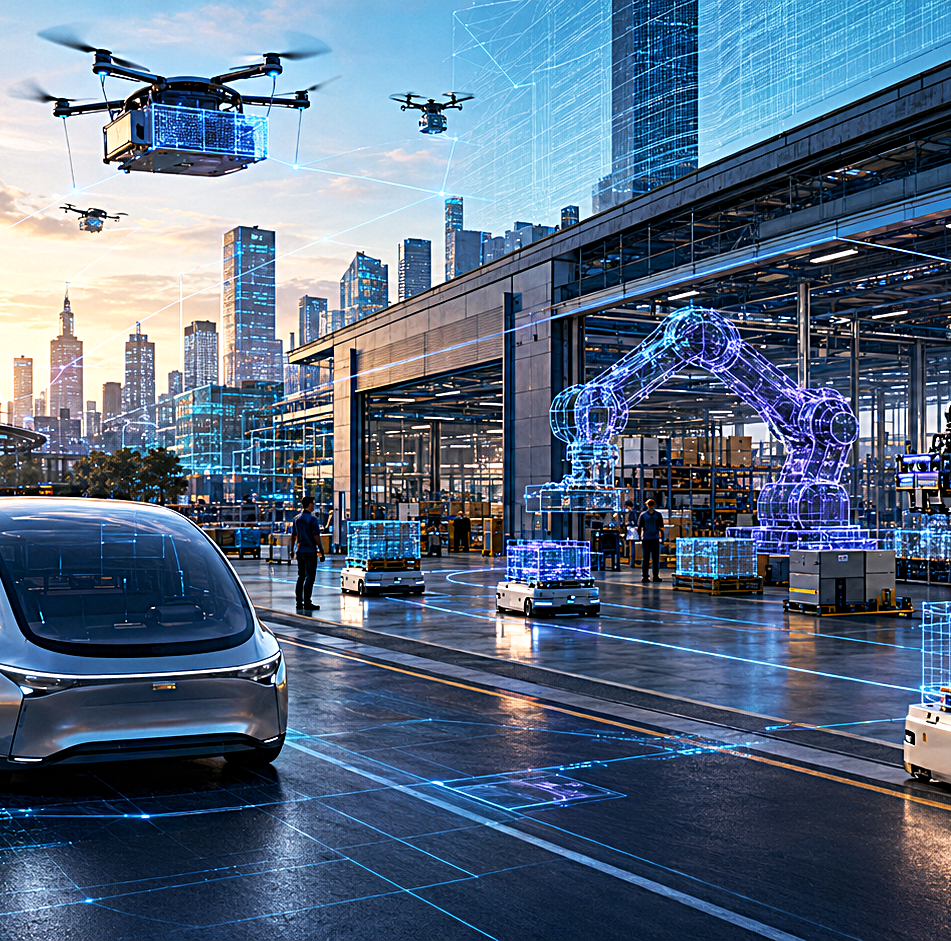
If we visualize a fully AI-dominated delivery system for a letter or package—based on these converging trends—it would look something like this: A package begins its journey not at a counter, but in a digitally pre-validated system where AI verifies address accuracy, predicts optimal routing, and assigns a delivery pathway before physical movement even begins. At a local intake hub, robotic arms and vision systems identify, sort, and containerize the item without human handling. Autonomous mobile robots move it through a densely packed, AI-optimized warehouse where storage and retrieval are dynamically adjusted in real time. As the package travels, embedded sensors or RFID tags continuously update its status, eliminating discrete “scan events” in favor of continuous tracking. A central agentic AI system monitors the entire network, rerouting the package instantly if disruptions occur—weather, congestion, or demand spikes.
For long-distance transport, AI-optimized routing minimizes fuel, time, and congestion, while predictive systems ensure that vehicles and infrastructure are maintained before failures occur. Upon arrival at the destination region, the package is transferred to a micro-fulfillment center close to the recipient, where final sorting is again fully automated. The last mile may involve a hybrid system: an AI-assisted human driver, an autonomous vehicle, or a drone/ground robot depending on density, weather, and cost optimization. Delivery endpoints themselves may evolve into smart receptacles—secure, networked “delivery nodes” that authenticate receipt and integrate directly into the logistics network.
The benefits of such a system are substantial and already partially measurable. Cost reductions of 15–40% across logistics operations are being observed today, with the potential for far greater savings as autonomy scales.4 Labor costs—historically the largest expense—decline sharply, while throughput increases due to 24/7 operation and elimination of human bottlenecks. Quality improves through lower error rates, fewer lost packages, and real-time visibility. Efficiency gains compound: AI-driven route optimization reduces fuel use, predictive maintenance cuts downtime by up to 50%, and automated systems compress delivery windows from days to potentially same-day or even sub-hour in dense areas.1,6
Yet it is important to resist the idea of an imminent full takeover. Even in 2026, industry leaders emphasize integration over replacement: the most successful systems are hybrid, combining human flexibility with machine precision.6 Physical variability—irregular packages, unpredictable environments, human recipients—remains a barrier to total automation, especially in the last mile. The trajectory, therefore, is not a sudden displacement but a steady absorption of tasks into AI systems until humans occupy only the exception-handling layer.
In that sense, the future of USPS-, UPS-, and similar services is less about disappearance and more about transformation into AI-coordinated infrastructures—networks where intelligence is embedded at every node, every package is a data object, and delivery itself becomes a largely autonomous flow. The takeover is real, but it is happening quietly, piece by piece, already visible in the systems we use every day.
References
- Warehouse Automation Trends 2026: AI-Driven Fulfillment Center — https://robotomated.com/learn/market/warehouse-automation-trends-2026
- Supply Chain Automation: Agentic AI in 2026 — https://insightpulsehub.com/supply-chain-automation-6-ai-trends-transforming-logistics-in-2026/
- UPS Seeks to Replace Manual Scans With Tracking Tech — https://www.wsj.com/logistics-report/ups-seeks-to-replace-manual-scans-with-tracking-tech-caf437db
- AI for Shipping: Transforming Logistics in 2026 — https://parcelpath.com/ai-for-shipping/
- Robots, drones could slash delivery costs to $1 — Reuters — https://www.reuters.com/business/robots-drones-could-slash-global-food-delivery-costs-1-per-order-barclays-says-2026-04-15/
- Will autonomous robotics leap forward in 2026? — https://www.itpro.com/technology/will-autonomous-robotics-leap-forward-in-2026
###
Filed under: Uncategorized |





































































































































































































































































































































































































































Leave a Reply