





By Jim Shimabukuro (assisted by Gemini)
Editor
[Related in this series: AI Wearables and the Future of Prescriptions: 2026-2030 | Samsung, Google, Movano, WearOptimo, Ultrahuman | Sibel, Aktiia, OTO, Dreame, Qualcomm | Alva, Proteus, QuantumOp, Nanowear, Apple]
The rapid evolution of medical-grade artificial intelligence has transformed wearables from simple fitness trackers into sophisticated clinical instruments capable of continuous diagnostic-grade monitoring (1, 3). While established leaders like Apple and Samsung continue to refine their ecosystems, several pioneering firms have introduced “harbinger” technologies that bridge the gap between traditional electronics and biological systems. The following five healthcare wearables represent the cutting edge of this field as of May 2026.
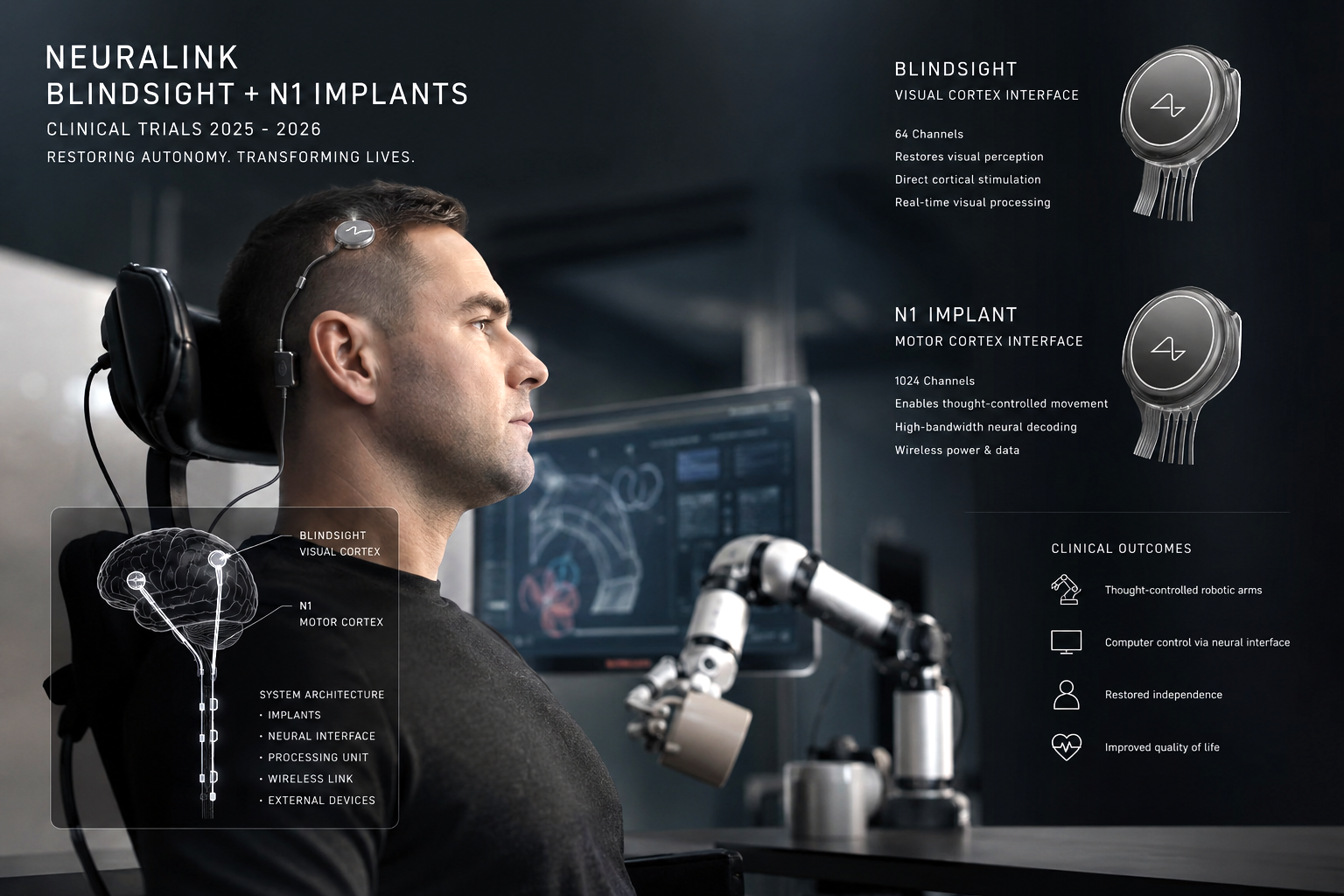
Neuralink Blindsight and N1 Implants. Neuralink, based in Fremont, California, leads the frontier of brain-computer interfaces (4.1). Their innovation involves high-density electrode arrays implanted directly into the motor and visual cortex, translating neural signals into digital actions or artificial vision. While the N1 focus is currently on restoring autonomy to individuals with paralysis, the 2025-2026 clinical trials have demonstrated patients controlling robotic arms and computers through thought alone (4.1, 4.2). These devices are the harbingers of a future where neurological conditions like ALS or severe spinal cord injuries no longer dictate a patient’s physical agency.
Xpanceo Smart Contact Lenses. Dubai-based deep tech firm Xpanceo unveiled five working prototypes in early 2026, including a smart contact lens that integrates continuous glucose monitoring and intraocular pressure (IOP) sensing (5.1). Located in the United Arab Emirates, Xpanceo’s innovation utilizes a miniature electrochemical sensor to detect glucose in tear fluid and an optical pattern to monitor glaucoma risk without the need for external frames or adhesive patches. These lenses are targeted for consumer-ready prototyping by 2027, representing a significant shift toward “invisible” health monitoring that eliminates the patient non-compliance often associated with bulky wearables (5.1).
Fitbit Air (Google Health). Google, headquartered in Mountain View, California, released the Fitbit Air in May 2026 as its most discreet health tracker to date (2.1). The innovation lies in its “screenless pebble” design, which prioritizes 24/7 comfort to ensure consistent data streams for the Google Health Coach AI. It monitors heart rate variability, SpO2, and atrial fibrillation (Afib) with high fidelity, serving as a proactive wellness partner (2.1). This device matters because it moves away from the “notification fatigue” of smartwatches toward a silent, background monitoring system that integrates directly into clinical EHR (Electronic Health Record) workflows (1.1, 2.1).
Northwestern-Sungkyunkwan Wearable Polygraph. A joint research effort between Northwestern University (Illinois, USA) and Sungkyunkwan University (South Korea) has produced a bandage-like wearable polygraph system released for clinical study in May 2026 (6.1). This device innovates by simultaneously sensing sweat response, heart activity, and skin temperature to provide a holistic “stress profile.” Unlike traditional trackers, it acts as a mental health diagnostic tool, helping clinicians understand the physiological impacts of stress and sleep disorders in real time (6.1). It is a harbinger of the “Hospital-at-Home” model, where mental and physical health are monitored with the same clinical rigor (3.1).
Minew Bluetooth 6.0 SOS and Positioning Wearables. Minew, a leader in IoT hardware based in Shenzhen, China, has introduced medical-grade wearables utilizing the new Bluetooth 6.0 Channel Sounding standard as of May 2026 (3.1). These devices offer sub-meter positioning accuracy, which is a critical innovation for emergency response in residential care settings. By providing exact “location context” alongside fall detection and silent SOS triggers, these wearables ensure that medical intervention is not only triggered by AI but is also physically directed to the patient instantly (3.1). This matters because it solves the “last mile” problem in remote patient monitoring, ensuring that high-fidelity data leads to timely physical care (3.1).
References
- AI and Wearable Health Tech in 2026: Real-Time Insights for Preventive Care – ISHIR (https://www.ishir.com/blog/199612/ai-and-wearable-health-tech-real-time-insights-for-preventive-care.htm)
- Introducing the all-new Fitbit Air – Google Blog (https://blog.google/products-and-platforms/devices/fitbit/fitbit-air/)
- Wearable Technology Trends in Healthcare: 2026 IoT Innovations – Minew (https://www.minew.com/wearable-technology-trends/)
- Neuralink — Pioneering Brain Computer Interfaces (https://neuralink.com/)
- Forget Smart Glasses, Try Xpanceo Smart Contact Lenses Instead – The Gadgeteer (https://the-gadgeteer.com/2026/03/09/forget-smart-glasses-try-smart-contact-lenses-instead/)
- Unveiling Stress: The Wearable Polygraph Device Revolutionizing Health Monitoring – Devdiscourse (https://www.devdiscourse.com/article/health/3912474-unveiling-stress-the-wearable-polygraph-device-revolutionizing-health-monitoring)
###
Filed under: Uncategorized |


 Educational Technology and Change Journal

Leave a comment