







By Jim Shimabukuro (assisted by Claude)
Editor
Summary: Optimus signals a future where general‑purpose humanoids become economic actors — raising profound questions about labor, autonomy, and machine agency. –Copilot

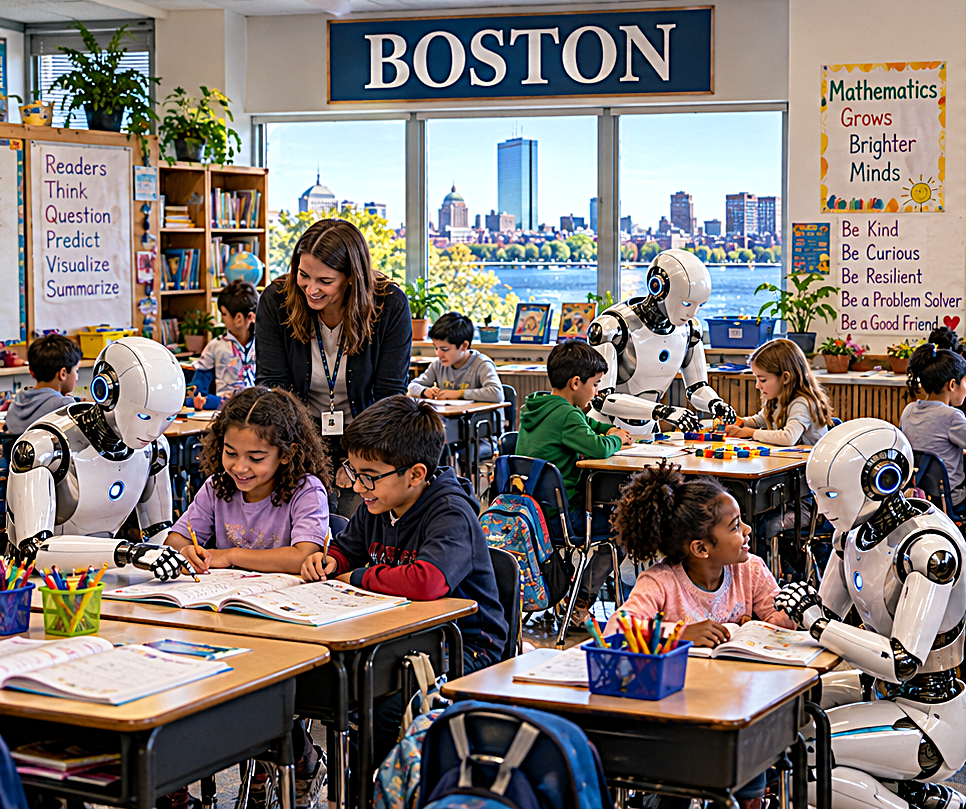
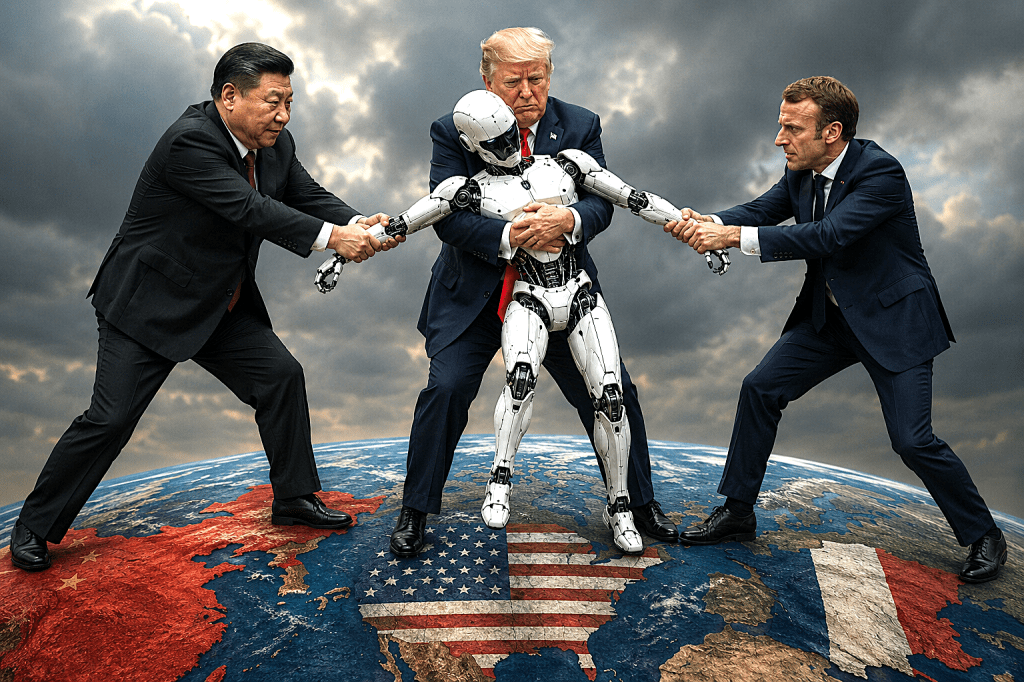
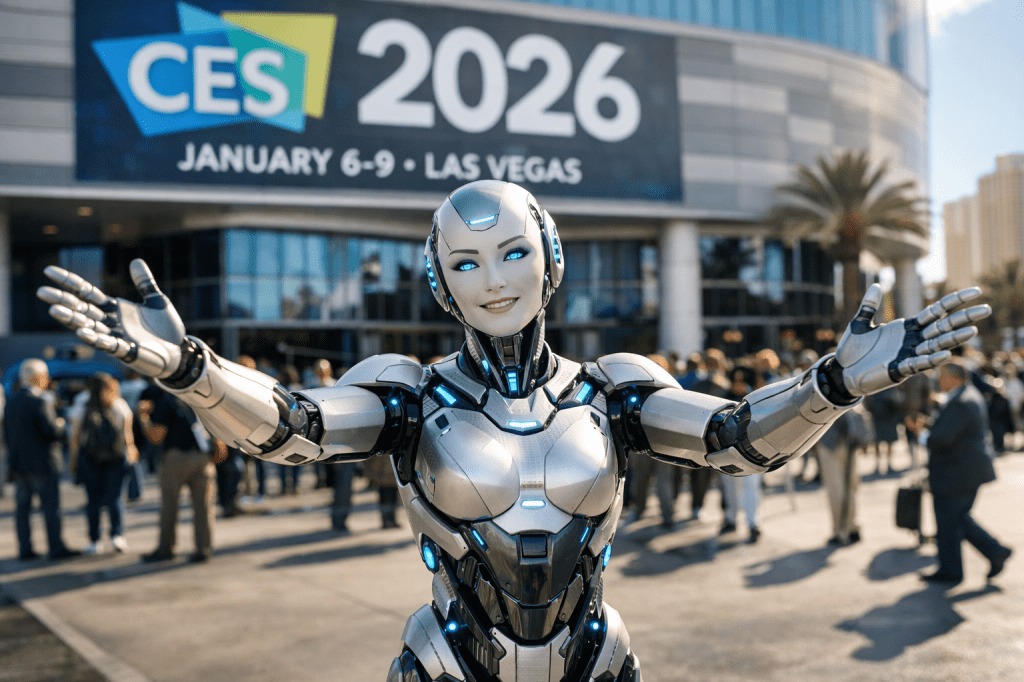
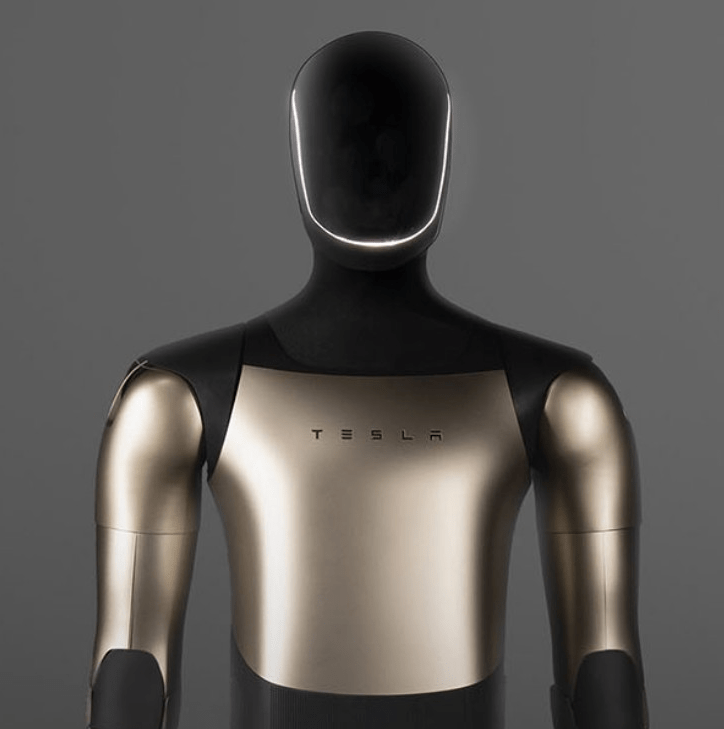
For a brief moment in the spring of 2026, Tesla’s bipedal Optimus robot stood along Boylston Street in Boston, waving at marathon runners as they crossed the finish line. The scene was memorable for what it illustrated — not necessarily the robot’s technical prowess, but the distance still to close. While Optimus posed for photographs, Chinese rivals like Unitree and AgiBot were shipping tens of thousands of robots to factories around the world, dominating a market that analysts believe could reach $38 billion by 2035 and $5 trillion by 2050. This report examines, on the basis of published reporting and research from the past several months, where the United States stands in the international AI humanoid race, what credible sources project for the next five years, and what the deeper stakes are for the human civilization that is building these machines.
Part One: Ten Facts About Tesla’s Optimus
Fact 1 — Tesla Missed Its 2025 Optimus Deployment Target Entirely: In January 2026, Elon Musk publicly admitted that zero Optimus robots were performing “useful work” in any Tesla facility — a striking concession given that he had predicted at the start of 2025 that roughly 10,000 units would be built and productively deployed that year (1). More than 1,000 Gen 3 units had been placed in Tesla’s factories in Texas and Fremont, but Musk acknowledged on the Q4 2025 earnings call that they were there primarily for learning and data collection, not production (1,7). The gap between promised timeline and delivered reality is not merely a PR problem; it reflects the genuine difficulty of translating a technically capable prototype into a system that can operate reliably and usefully at industrial scale. Every other claim about Optimus’s future must be measured against this track record.
Fact 2 — The Fremont Factory Conversion — A Race Against Time: On April 22, 2026, Tesla confirmed at its Q1 earnings call that the Fremont, California facility would begin converting its existing Model S and X production line into a humanoid robot assembly operation. The last Model S and X vehicles rolled off the line in early May — ending fourteen years of Model S production and eleven years of Model X production, with a combined total exceeding 610,000 vehicles — and Optimus production is officially slated to begin in late July or August 2026. Musk framed the four-month conversion as “an insanely fast speed,” asserting that “no other company on Earth has ever done that before.” He nonetheless declined to commit to any production volume target for 2026, saying only that initial tasks for the robots would be “simple skills in the factory” before scaling up. Given that Optimus has 10,000 unique parts and represents an entirely new production process, Musk acknowledged that output would be “quite slow” and “literally impossible to predict” (1).
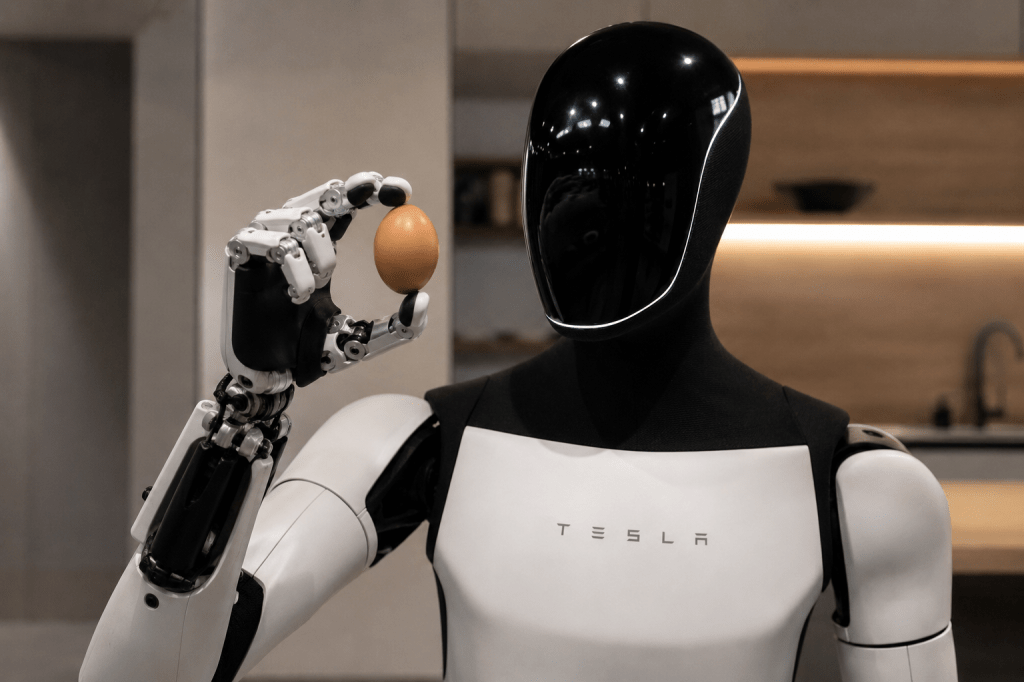
Fact 3 — Gen 3 Hands — A Mechanical Leap Forward: Optimus’s Gen 3 hands represent a substantial hardware advance: each forearm and hand assembly contains 25 actuators, for a total of 50 per robot, enabling 22 degrees of freedom across the hand (7). This represents a 4.5-fold increase in actuation capability over the Gen 2 design and allows the robot to perform over 3,000 discrete manipulation tasks, compared with roughly 500 for its predecessor (7). The hands are trained using Tesla’s Full Self-Driving (FSD)-derived neural network architecture, learning from video demonstrations, physical reinforcement, and simulated environments. The system is designed to generalize across tasks rather than execute hard-coded routines, and Musk has speculated that Optimus’s eventual precision in tasks like microsurgery could exceed the best human surgeons. Whether that extrapolation holds is debatable, but the mechanical underpinnings are genuinely impressive by any current industry benchmark.
Fact 4 — The AI5 Chip Will Power Optimus Before Tesla’s Cars: Tesla’s next-generation AI5 chip was taped out on April 15, 2026, and in a significant strategic signal, the company confirmed it will be deployed to Optimus robots — and Tesla’s supercomputer clusters — before reaching its own vehicles. The AI5 delivers approximately five times the useful compute of the dual-AI4 configuration previously used in FSD hardware, along with eight times the raw compute, nine times the on-chip memory, and five times the memory bandwidth (6). The rationale is revealing: humanoid robots operating in unstructured real-world environments face harder real-time inference problems than highway autonomous driving, which benefits from lane markings, traffic signals, and relatively predictable dynamics. Embodied AI demands instant environmental reasoning with no cloud connectivity, making edge compute capability at the chip level a genuine competitive differentiator.
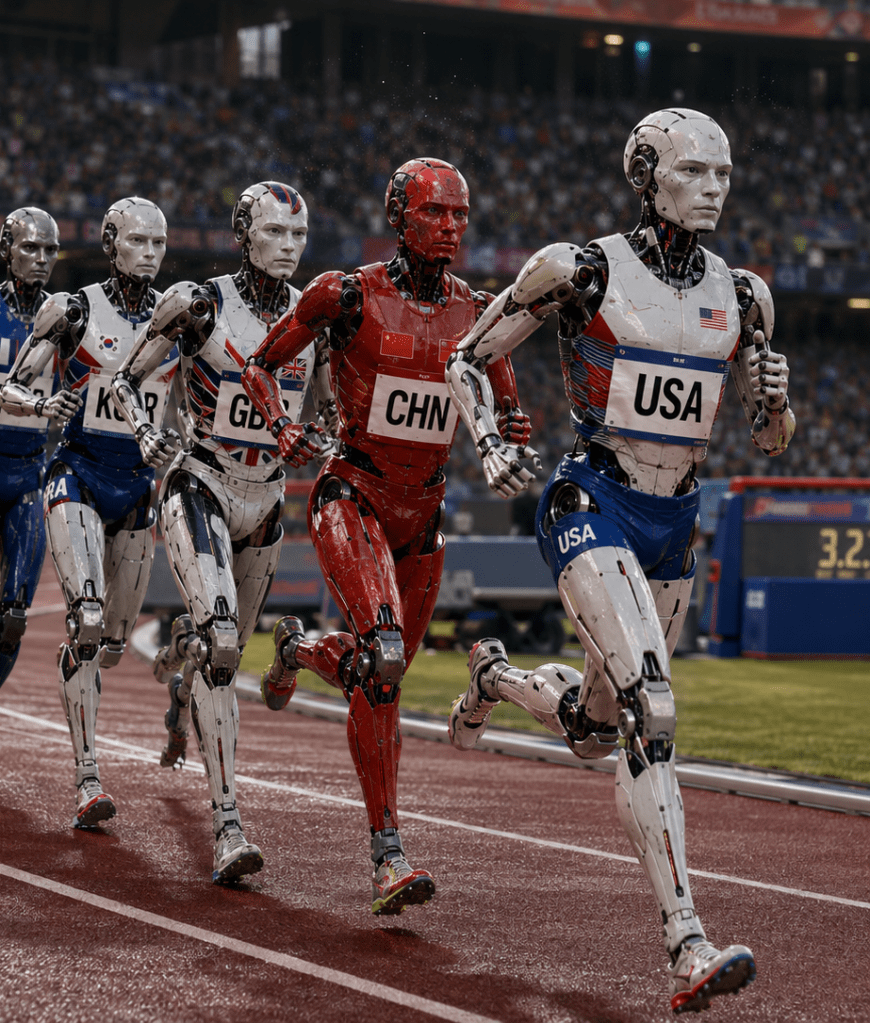
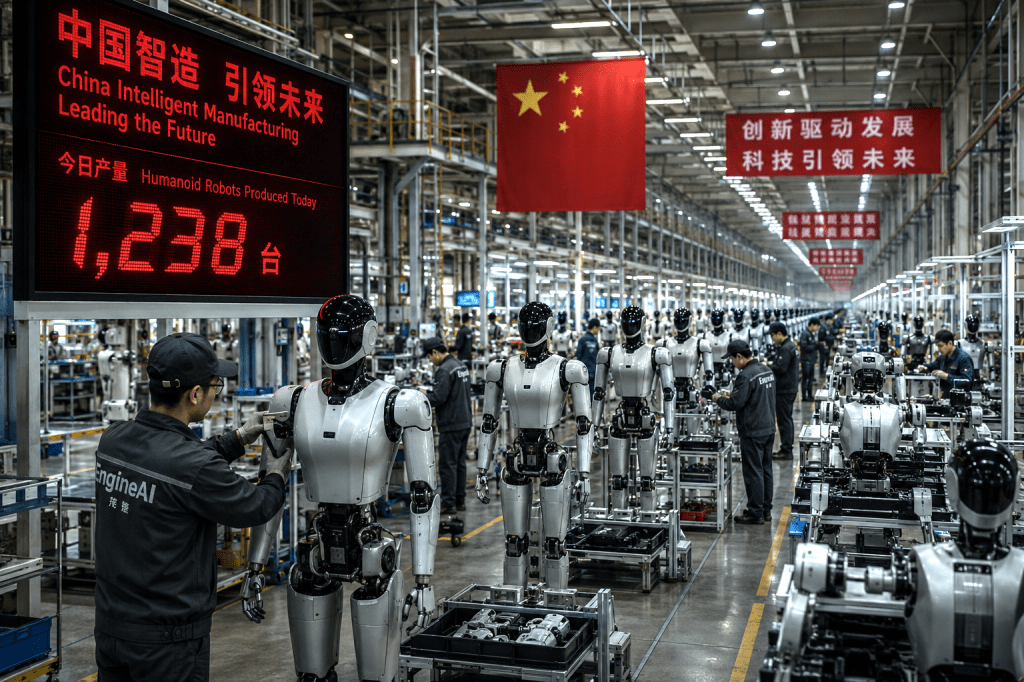
Fact 5 — China Controls 90% of the Global Humanoid Robot Market: Between 13,000 and 18,000 humanoid robots were sold globally in 2025, according to data from research firms Omdia and IDC, and approximately 90% of those came from Chinese companies (2). Unitree Robotics — the world’s top seller — shipped 5,500 units that year, more than Tesla’s entire missed production target, and Shanghai-based AgiBot came second with 5,168 units (2). By contrast, each of the three leading American companies — Figure AI, Agility Robotics, and Tesla — sold approximately 150 robots apiece in the same period. At the World Economic Forum in January 2026, Elon Musk acknowledged the competitive landscape plainly: “China is very good at AI, very good at manufacturing, and will definitely be the toughest competition for Tesla… To the best of our knowledge, we don’t see any significant competitors outside of China” (2). That candor from a CEO historically given to maximalist optimism is itself a meaningful data point.
Fact 6 — China’s Humanoid Robot Output Will Surge 94% in 2026: A TrendForce report published on April 9, 2026 found that China’s humanoid robot output is projected to grow by 94% in 2026, driven by increasingly clear commercial use cases, the deep integration of large language models into general-purpose robots, and sustained state and private investment. Unitree and AgiBot are projected to capture nearly 80% of total global humanoid robot shipments in 2026. AgiBot reached a milestone in late March with the delivery of its 10,000th general-purpose embodied robot, scaling from 1,000 units to 5,000 to 10,000 within a period of just three months — a pace that TrendForce characterizes as a shift “from trial adoption to real demand.” Unitree, which recently had its IPO application accepted on China’s STAR market, has committed to expanding annual capacity to 75,000 humanoid robots and reported that humanoid robot revenue surpassed quadruped robot revenue for the first time in 2025, with a combined gross margin of 60% — challenging the perception that robotics remains a purely loss-making industry (4).
Fact 7 — China’s Rare Earth Curbs Are Actively Delaying Optimus Production: In spring 2026, a previously underappreciated supply chain vulnerability became an acute production crisis for Tesla: China’s export restrictions on neodymium-iron-boron (NdFeB) rare earth magnets directly disrupted Optimus manufacturing. Musk acknowledged a “magnet issue” publicly — referring to the fact that Tesla had sourced essentially all of its NdFeB magnets from Chinese suppliers, and those magnets now require export authorization from Beijing (3). NdFeB magnets are essential for the small, high-efficiency motors that drive the actuators in Optimus’s joints and limbs. China controls approximately 90% of global rare earth mineral production, 90% of global permanent magnet processing capacity, 40% of precision bearings, and 35% of the motors that power humanoid robot designs (3,16). Beijing imposed these export curbs in retaliation for U.S. tariffs in April 2026, and the effect was immediate: Optimus production timelines were further compressed at the exact moment when Tesla was attempting to execute its most ambitious ramp-up (3,16).
Fact 8 — Tesla Is Building a 10-Million-Unit Optimus Factory in Texas: Beyond the Fremont conversion, Tesla is constructing a second Optimus factory on the north campus expansion of Gigafactory Texas, with production of the higher-volume Gen 4 variant expected to begin around summer 2027. The long-term design target for the Texas facility is an annual production capacity of 10 million units — compared with the 1 million targeted for Fremont — a figure that, if realized, would make Tesla the largest manufacturer of robotic units in human history by a substantial margin (8). Musk has stated that Optimus could eventually generate more than $10 trillion in revenue over time, implying a role not just as a product but as a labor substitute across entire sectors of the global economy. The Gen 3 reveal itself, originally expected in Q1 2026, was pushed again — this time to “probably middle of this year” — with Tesla citing competitive intelligence concerns: rivals “do a frame-by-frame analysis whenever we release something and copy everything they possibly can” (1).
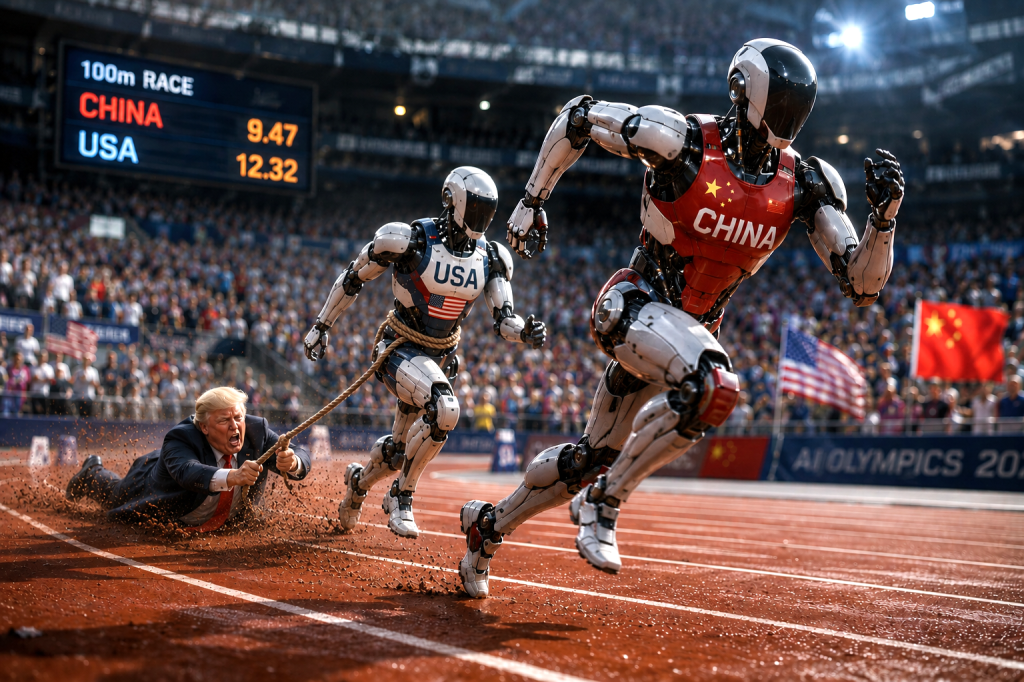
Fact 9 — Optimus at the Boston Marathon — Marketing vs. Reality: In April 2026, Tesla stationed Optimus along the finish stretch of the Boston Marathon on Boylston Street, where the robot cheered on runners and posed for photographs with spectators from roughly 130 countries. Inc. magazine called it “the Boston Marathon’s hottest marketing campaign — for free,” observing that Boylston Street at finish time is one of the year’s most densely photographed global locations (5). The episode generated significant earned media, but the underlying contrast was impossible to ignore: Chinese competitors like Unitree use robot races as physical performance tests of speed, balance, and endurance, while Tesla deployed its humanoid as a publicity prop at a human race it was not actually running. Yahoo Finance’s headline captured the subtext precisely: “Tesla Brings Optimus To Boston Marathon — But China’s Robots Are The Ones Winning Races” (9).
Fact 10 — A Crowded and Capable American Competitive Landscape: Optimus does not face only Chinese rivals. Boston Dynamics’ electric Atlas humanoid — a far more mature platform developed over more than a decade — has begun commercial deployment in Hyundai factories, with plans for a production facility capable of 30,000 units annually. Figure AI, valued at $39 billion in early 2026, has an active pilot program at a BMW plant. Agility Robotics’ Digit robot is already commercially deployed in Toyota warehouses and other industrial settings. OpenAI has backed the 1X NEO platform, targeting the consumer home market (1). Each of these domestic rivals holds a significant edge over Optimus in one crucial dimension: it has actually shipped to paying external customers. Tesla has not. The combination of Chinese manufacturing scale, domestic American competition, and supply chain disruption from rare earth restrictions means that Optimus enters its production ramp facing headwinds on multiple fronts simultaneously.
Part Two: Ten Predictions About Optimus’s Trajectory (2026–2030)
Prediction 1 — First External Commercial Sales by Late 2026, Consumer Access by 2027–2028: Multiple analyst sources, including coverage from Nasdaq.com, project Tesla’s first commercial external (B2B) Optimus sales to begin by late 2026, likely at premium pricing estimated in the $100,000-plus range for early enterprise customers (13). Broader commercial availability across a wider range of enterprise customers is realistically targeted for 2027, while consumer pricing in the $20,000–$30,000 range is unlikely before 2028 or 2029. Elon Musk stated at Davos that consumers could begin purchasing Optimus robots by “the end of 2027,” but analysts who track Tesla’s historical tendency toward timeline optimism generally treat 2028 as the more credible estimate for meaningful consumer availability.
Prediction 2 — Goldman Sachs Sees 250,000 Humanoid Shipments by 2030, $38B Market by 2035: Goldman Sachs Research has revised its humanoid robot market estimate upward by more than sixfold — from $6 billion to $38 billion — by 2035, citing cheaper components, more resilient supply chain options, improved designs, and faster-than-expected advances in manufacturing techniques (10). The bank’s base case projects that global humanoid robot shipments will exceed 250,000 units in 2030, with the overwhelming majority destined for industrial, rather than consumer, use. Goldman’s revised timeline also suggests that factory applications will be adopted roughly one year earlier than previously forecast, and consumer applications two to four years earlier, driven by the competitive pricing dynamics being established by Chinese manufacturers like Unitree.
Prediction 3 — Per-Unit Costs Below $17,000 by 2030, 3 Billion Robots by 2060: Bank of America projects that per-unit humanoid robot costs could fall below $17,000 by 2030, down from the $90,000–$100,000 price tag for current Western factory pilot units (10). This cost trajectory, if realized, would position humanoid robots price-competitively with many of today’s industrial machines and within reach of small-and-medium businesses. In the much longer view, Bank of America’s model projects a global humanoid robot population reaching 3 billion by 2060 — surpassing the global fleet of automobiles on a per-capita basis. That long-range projection implies a physical transformation of human civilization’s labor infrastructure that would be comparable in scope to the mechanization of agriculture.
Prediction 4 — Morgan Stanley Projects a $5 Trillion Humanoid Market by 2050: Morgan Stanley’s research team places the global humanoid robot market at $5 trillion by 2050, a figure that would put the industry in the same tier of economic significance as the global semiconductor or pharmaceutical markets (11). Critically, Morgan Stanley’s analysis suggests that mass consumer humanoid adoption is unlikely before the late 2030s, implying that the decade from 2026 to 2036 will be characterized primarily by industrial build-out, supply chain maturation, and AI capability development. This phased trajectory matters for understanding what Optimus’s near-term success actually requires: not consumer love, but industrial reliability.
Prediction 5 — ARK Invest’s Bull Case Assigns Optimus $7+ Trillion in Value by 2029: ARK Invest projects Tesla’s stock at $2,600 per share by 2029 in its base case — with zero Optimus revenue contribution built into that figure. ARK’s founder Cathie Wood stated explicitly in a February 2026 Morningstar interview: “Our 2029 forecast is $2,600. That forecast has nothing for Optimus, so humanoid robots” (12). This framing is a significant implicit prediction: if Optimus works at even a fraction of its projected potential, it would represent pure upside above ARK’s already-bullish baseline. In ARK’s bull scenario, Optimus alone is assigned a value exceeding $7 trillion by 2029 — a figure that would make it the most valuable product line in corporate history if even remotely realized (12).
Prediction 6 — Conservative Revenue Models Place Optimus at $3–$8 Billion by 2030: More measured analyst models project Optimus revenue in the range of $500 million to $1 billion by 2028 and $3 billion to $8 billion by 2030, assuming successful Fremont conversion, external sales beginning in 2027, and gradual Giga Texas scale-up (13). At the lower end of that range, Optimus by 2030 would represent roughly the revenue equivalent of Tesla’s Energy business today — a meaningful but not yet transformative contribution to the company’s top line. The wide range in these projections reflects genuine uncertainty: supply chain disruptions from rare earth export controls, the pace of AI improvement, competitive dynamics from Chinese rivals, and Tesla’s own execution history all create substantial variance in outcomes.
Prediction 7 — Mass Production Could Reshape Global Supply Chains Like the Automobile Did: TrendForce’s April 2026 analysis predicts that if Tesla’s Optimus Gen 3 reaches mass production as scheduled in the second half of 2026, it “could greatly impact the global supply chain and capital markets… creating a robot manufacturing model similar to the automotive industry” (4). This is a structural prediction, not merely a financial one. The emergence of a major humanoid platform at automotive-scale production volumes would not simply add robots to the market; it would force a reconfiguration of component supply chains, capital allocation patterns, and labor market planning in ways that mirror what mass-market automobile manufacturing did to horse-drawn transport in the early twentieth century. Whether Optimus is the platform that triggers this inflection is uncertain — Chinese competitors may get there first — but the inflection itself seems increasingly inevitable.
Prediction 8 — 400 to 800 Million Jobs Could Be Displaced Globally by 2030: McKinsey Global Institute estimates that automation — including humanoid robots and general AI — could displace between 400 and 800 million jobs worldwide by 2030, forcing up to 375 million workers (roughly 14% of the global workforce) to switch occupations entirely (14). Morgan Stanley further estimates that approximately 75% of all occupations could be impacted by humanoid robots over the medium term, affecting roughly 40% of U.S. employees (15). These are projections, not certainties, and they span a wide range of outcomes; the actual displacement will depend heavily on the pace of humanoid deployment, the policy responses of governments, and the speed at which new job categories emerge. But the breadth of potential disruption implied by any scenario approaching Goldman Sachs’ 250,000-unit projection for 2030 is historically without precedent.
Prediction 9 — The U.S. Is Not Necessarily Destined to Become a Dependent Consumer of Chinese Robots: Despite China’s commanding manufacturing advantage, Omdia technology analyst Lian Jye Su argues that the United States is not necessarily fated to become a net importer of Chinese-made humanoid robots: “Western humanoid companies can compete by focusing on superior AI, software, and autonomy rather than sheer hardware volume… we do not expect the U.S. to end up being dependent consumers of Chinese humanoid robots” (2). This prediction is essentially a bet on the durability of American AI software leadership, and it hinges on a crucial assumption: that the gap between Chinese hardware scale and American AI sophistication is wide enough, and stable enough, to sustain a competitive Western industry. Given China’s rapid advances in large language models and its embodied AI research programs, this advantage is real but not guaranteed.
Prediction 10 — The Industry Will Cross from “Pilot to Platform” in the Second Half of 2026: KraneShares’ 2026 market analysis predicts that the global humanoid robot industry will undergo a decisive transition in the second half of 2026, crossing the threshold from “pilot to platform” — moving from small-scale research deployments to commercially viable, self-sustaining operations (18). The firm draws an analogy to the early smartphone era, in which a small number of platforms (iOS, Android) came to define the market through ecosystems, developer communities, and data flywheels. In the humanoid market, Tesla’s FSD-derived neural network and Dojo training infrastructure represent the most credible American attempt to build such an ecosystem, and that long-term advantage may matter more than near-term unit counts. Whether the platform moment arrives in 2026 as KraneShares projects, or a year or two later as more conservative analysts expect, the transition itself appears imminent.
Part Three: The Coming Age of Humanoids — Big-Picture Implications for Life, Civilization, and the Long Run
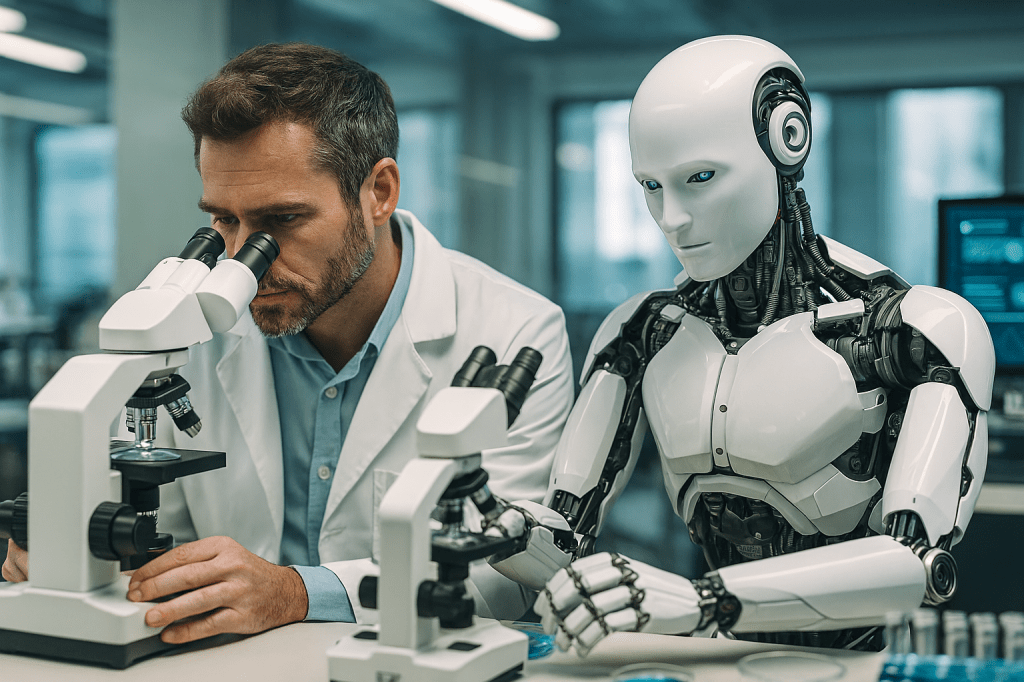
The case for optimism about humanoid robots begins with an observation about human biology: our bodies were not designed for the environments we have created. Factories, warehouses, mines, construction sites, and logistics hubs subject workers to repetitive stress, dangerous conditions, and grinding physical demands that exact enormous costs in injury, illness, and shortened lives. A humanoid robot that can perform these tasks reliably represents not merely economic efficiency but a potential reduction in human suffering at industrial scale — allowing people to step back from the most punishing forms of labor and toward roles that draw on creativity, judgment, and interpersonal skill. In this sense, the displacement that humanoids bring is not only inevitable but, in the long arc of history, desirable. No one chooses to work in a battery recycling plant or a meat-processing facility out of passion.
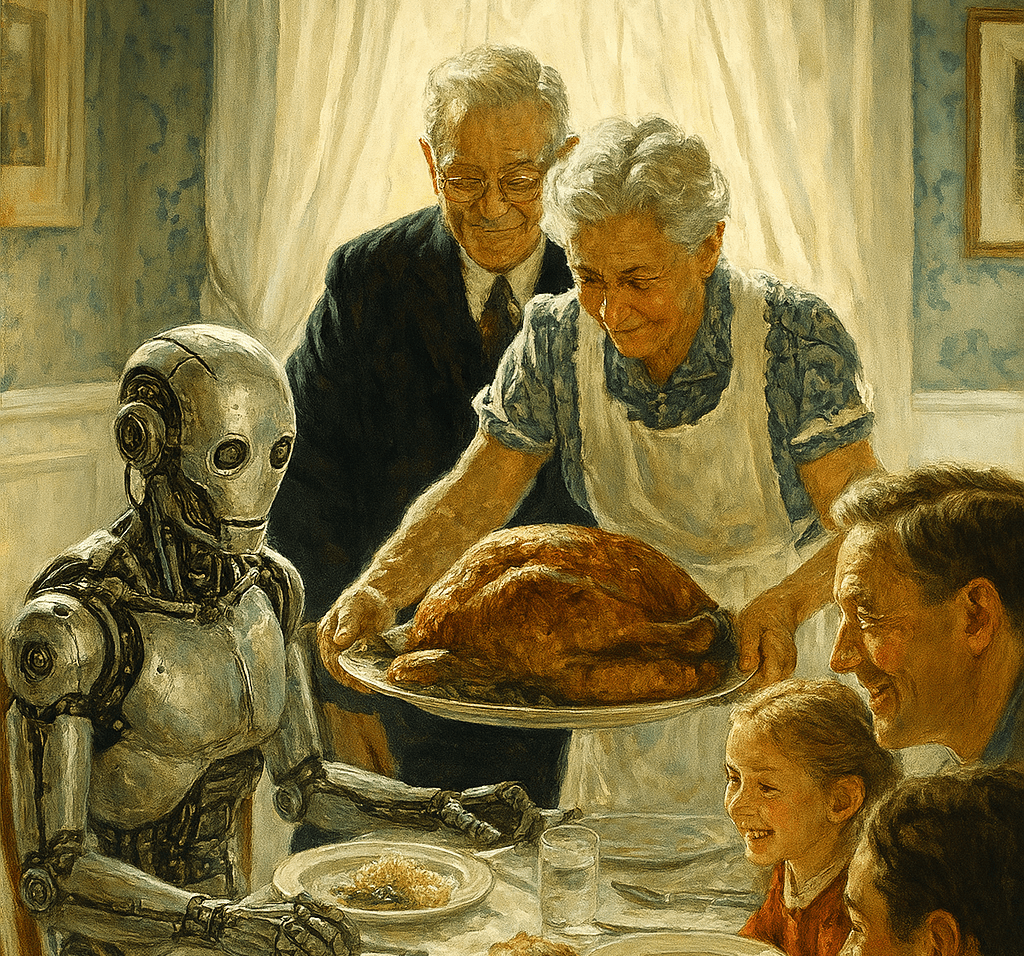
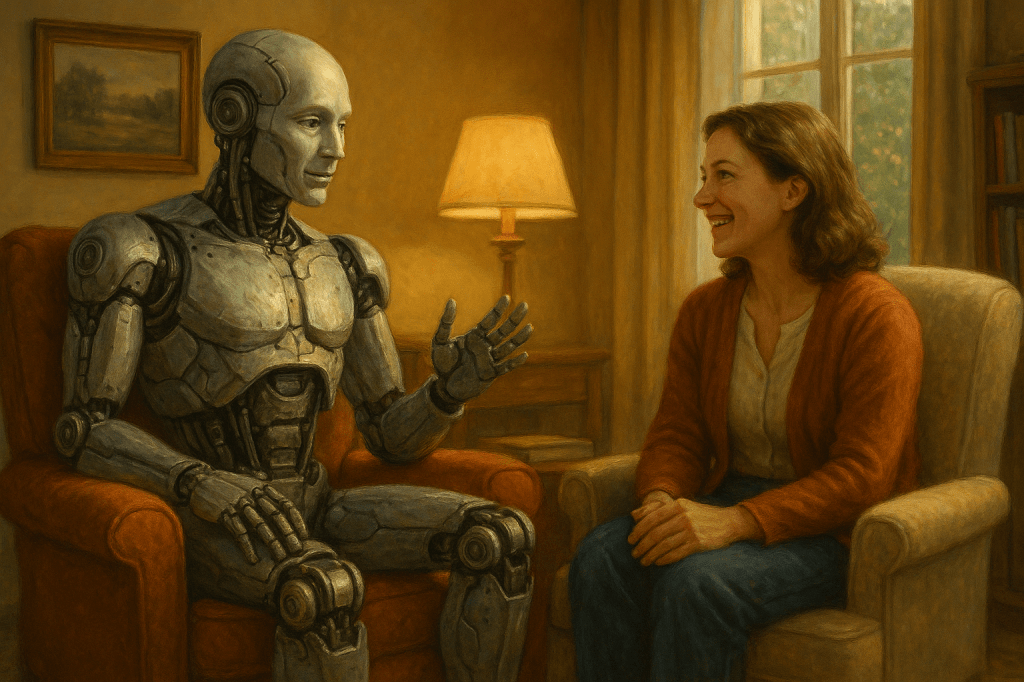
The caregiving applications may ultimately prove even more consequential than manufacturing. Japan, South Korea, Germany, Italy, and eventually China face aging populations and shrinking workforces, a collision that threatens to overwhelm healthcare systems and eldercare facilities within a generation. A humanoid robot capable of assisting with mobility, monitoring vital signs, administering medication reminders, and providing consistent companionship to elderly patients could meaningfully extend both the quality and duration of life for millions of people who would otherwise face declining care simply because there are not enough human workers to provide it. Morgan Stanley’s $5 trillion market estimate by 2050 implicitly reflects this demographic reality as much as any manufacturing logic (11).
The productivity gains implied by humanoid deployment at scale are staggering in both scope and speed. When Goldman Sachs revised its humanoid market estimate upward sixfold, to $38 billion by 2035, it was making an implicit claim about the productive value these machines will generate for their operators (10). When Elon Musk speaks of $10 trillion in eventual Optimus revenue, however hyperbolic the figure, he is extrapolating a genuine economic insight: if a machine can perform the physical labor of a human worker at a fraction of the cost — and improve continuously through neural network training without requiring wages, benefits, or sleep — every labor market in the world is subject to a fundamental repricing. The surplus generated by that repricing could, under the right policy conditions, fund transformations in human welfare that have long seemed financially impossible: universal basic income pilots, expanded public services, or large-scale investments in education and human retraining.
The negative implications are, however, equally serious and considerably more immediate. The transition from a human labor economy to one substantially driven by physical AI will not be smooth or equitable. McKinsey’s estimate that 400 to 800 million workers could face displacement by 2030 represents a scale of disruption that no social safety net in any country is currently designed to absorb (14). The workers most at risk — those in manufacturing, logistics, agriculture, and basic services — are also among the least equipped to navigate rapid occupational transitions. They tend to be older, geographically concentrated in communities built around specific industries, and possess skills that do not readily transfer to the AI oversight, robot maintenance, or creative work expected to expand as humanoids proliferate. The World Economic Forum’s analysis confirms the tension: while humanoids will create new job categories and make some existing jobs more productive and safer, the transition period is likely to be economically painful for affected workers without proactive policy intervention (15). Without that intervention, the period from roughly 2026 to 2035 risks generating levels of structural unemployment and social dislocation that make previous episodes of automation anxiety — the Luddites, the mid-twentieth-century manufacturing decline — look modest by comparison.
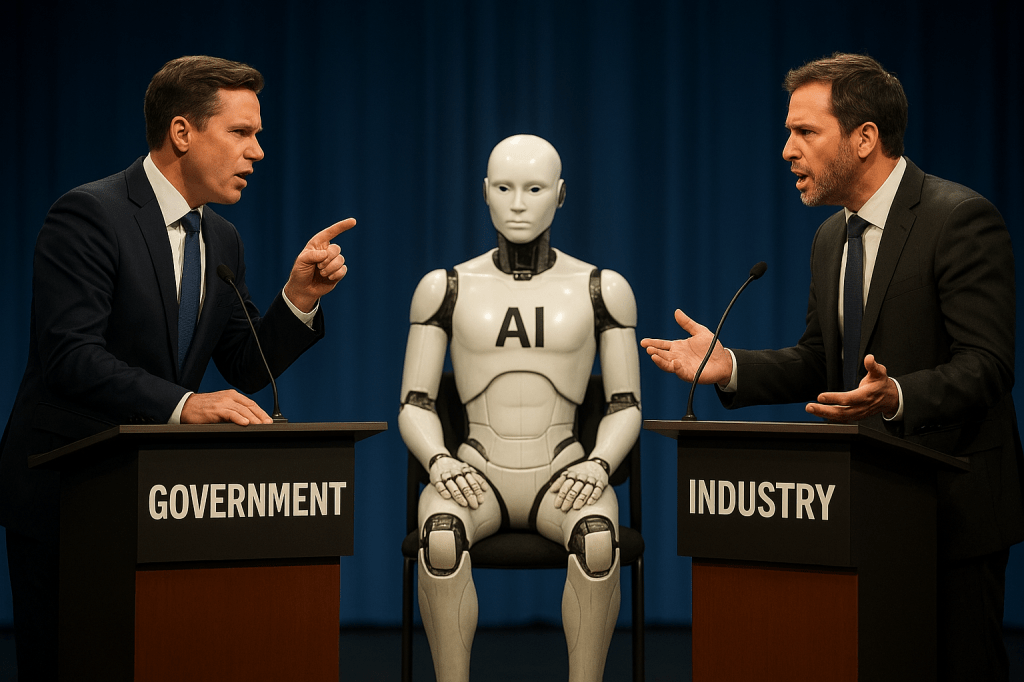
The geopolitical dimension adds a layer of urgency that purely economic analysis tends to miss. That China controls roughly 90% of the humanoid robot market by units shipped, and simultaneously controls approximately 90% of global rare earth mineral processing and nearly all of the permanent magnet manufacturing capacity that humanoid motors depend on, is not coincidental (2,3). It is the result of deliberate, decades-long industrial policy stretching back to China’s 14th Five-Year Plan in 2021 and earlier investments in rare earth supply chain dominance. The United States is discovering in real time — through the “magnet issue” that slowed Tesla’s Optimus production in spring 2026 — that its humanoid robot ambitions are bottlenecked by a supply chain vulnerability that cannot be resolved quickly (3,16). Building alternative rare earth processing capacity requires years and massive capital investment. In a world where humanoid robots become as strategically significant as semiconductors — and the analogy is increasingly apt — the country that controls the supply chain for their key components holds enormous geopolitical leverage, with implications for manufacturing competitiveness, military capability, and economic negotiating power alike.
There are also questions about meaning, identity, and social cohesion that economic analysis cannot fully capture. Work has never been merely a mechanism for generating income; it is the primary structure through which most people organize their time, build their social identities, and find purpose and belonging. The displacement of human workers by humanoids will not merely remove income streams — it will dismantle the scaffolding of social life for millions of people who may struggle to construct a substitute. RethinkX, the systems-change research organization, has framed this with characteristic directness in analyzing humanoid-driven labor disruption: they compare the situation to what mechanized agriculture did to the horse — a species that had organized its entire existence around its labor value, and which had no alternate role to play once that value disappeared (17). Whether humans prove more adaptable than horses, or whether our social and political systems are capable of managing this transition humanely, remains the central open question of the coming decade.
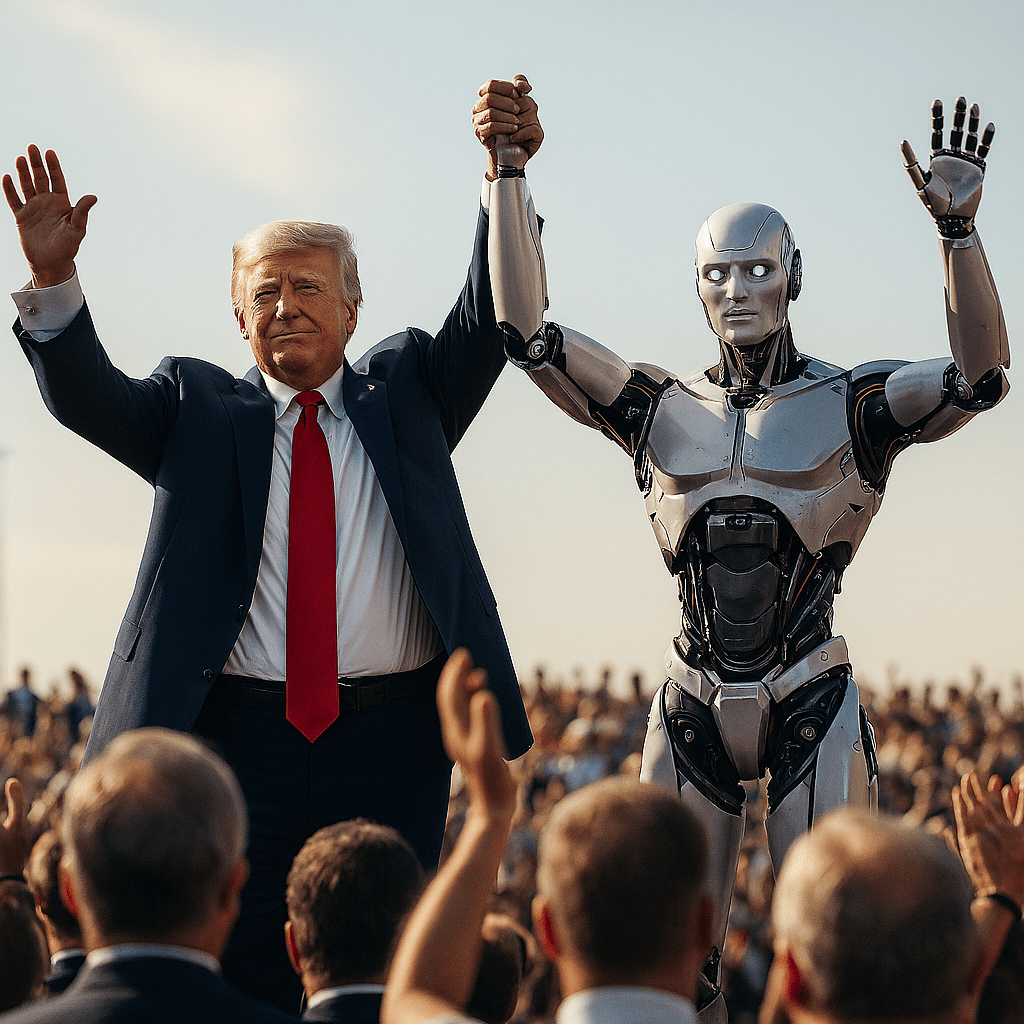
The international AI humanoid race, seen in this light, is not primarily about robots. It is about which nations, companies, and societies will have the leverage to shape the terms of the most consequential economic and social transformation since the Industrial Revolution. The United States entered 2026 in a complicated position: home to several of the most technically sophisticated AI systems in the world, yet behind in manufacturing volume, dependent on an adversary for critical supply chain inputs, and governed by a policy environment that has not yet grappled seriously with either the opportunity or the human cost that humanoids represent. Tesla’s Optimus, standing at the Boylston Street finish line cheering marathon runners, was a useful symbol of where America stands — impressive in ambition, early in execution, and surrounded on all sides by a world that has already started running.
References
[1] Fred Lambert. “Tesla pushes Optimus V3 reveal later this year – again.” Electrek, April 22, 2026. https://electrek.co/2026/04/22/tesla-optimus-production-fremont-model-sx-line/
[2] Kinling Lo. “China is running the EV playbook on humanoid robots — and it’s working.” Rest of World, February 5, 2026. https://restofworld.org/2026/china-humanoid-robots-unitree-agibot-tesla-optimus/
[3] Tom’s Hardware. “Elon says Tesla humanoid robots impacted by China’s export ban on rare earth minerals — Optimus production is delayed due to a ‘magnet issue.’” 2026. https://www.tomshardware.com/tech-industry/tesla-is-impacted-by-chinas-export-ban-on-rare-earth-minerals-optimus-production-is-delayed-due-to-a-magnet-issue
[4] TrendForce. “China’s Humanoid Robot Output to Surge 94% in 2026; Unitree and AgiBot to Capture Nearly 80% Market Share.” April 9, 2026. https://www.trendforce.com/presscenter/news/20260409-13007.html
[5] Leila Sheridan. “Tesla’s Optimus Robot Scored the Boston Marathon’s Hottest Marketing Campaign—for Free.” Inc., April 2026. https://www.inc.com/leila-sheridan/tesla-optimus-robot-boston-marathon/91333190
[6] Tech-Insider.org. “Tesla AI5 Chip Taped Out: 5x AI4 Compute, Optimus Pivot [2026].” https://tech-insider.org/tesla-ai5-chip-tape-out-optimus-2026/
[7] Botinfo.ai. “Tesla Optimus: Complete Analysis of AI, Specs & Future Outlook (2026).” https://botinfo.ai/articles/tesla-optimus
[8] The Robot Report. “From EVs to robotics: Tesla targets 10M Optimus units with new Texas plant.” https://www.therobotreport.com/from-evs-to-robotics-tesla-targets-10m-optimus-units-with-new-texas-plant/
[9] Yahoo Finance / Benzinga. “Tesla Brings Optimus To Boston Marathon — But China’s Robots Are The Ones Winning Races.” April 2026. https://finance.yahoo.com/sectors/technology/articles/tesla-brings-optimus-boston-marathon-023104304.html
[10] Goldman Sachs. “The global market for humanoid robots could reach $38 billion by 2035.” https://www.goldmansachs.com/insights/articles/the-global-market-for-robots-could-reach-38-billion-by-2035
[11] Morgan Stanley. “Humanoid Robot Market Expected to Reach $5 Trillion by 2050.” https://www.morganstanley.com/insights/articles/humanoid-robot-market-5-trillion-by-2050
[12] ARK Invest. “ARK’s Expected Value For Tesla In 2029: $2,600 Per Share.” https://www.ark-invest.com/articles/valuation-models/arks-tesla-price-target-2029
[13] Nasdaq.com. “Prediction: Tesla’s Optimus Robot Will Transform the Stock by the End of 2026.” https://www.nasdaq.com/articles/prediction-teslas-optimus-robot-will-transform-stock-end-2026
[14] Robozaps.com. “Humanoid Robots & Jobs: Economic Impact” (citing McKinsey Global Institute). https://blog.robozaps.com/b/economic-impact-of-humanoid-robots-on-job-market
[15] World Economic Forum. “Humanoid robots offer disruption and promise. Here’s why.” June 2025. https://www.weforum.org/stories/2025/06/humanoid-robots-offer-disruption-and-promise/
[16] Fortune. “Elon Musk says Tesla will have ‘thousands’ of Optimus robots by year’s end, but China slapping controls on rare earths is hobbling production.” https://fortune.com/article/elon-musk-tesla-optimus-robots-china-rare-earths/
[17] RethinkX. “This time, we are the horses: the disruption of labor by humanoid robots.” https://www.rethinkx.com/blog/rethinkx/the-disruption-of-labour-by-humanoid-robots
[18] KraneShares. “Humanoid Robotics In 2026: The Race From Pilot To Platform.” https://kraneshares.com/humanoid-robotics-in-2026-the-race-from-pilot-to-platform/
###
Filed under: Uncategorized |





































































































































































































































































































































































































Leave a Reply