





By Jim Shimabukuro (assisted by Claude)
Editor
Summary: AI is turning reading from a solitary act into an interactive cognitive partnership — reshaping comprehension, interpretation, and the future of literacy itself. –Copilot

AI is often discussed as a force that transforms writing, but its equally consequential effect on reading—on how we select, access, process, and experience written text—receives far less attention. Reading is not simply the passive reception of words; it is a cognitive, affective, and social act that involves attention, interpretation, memory, and pleasure. When AI alters any part of that chain, it alters reading itself. The five essays below draw on recent scholarship to examine five distinct transformations underway, identify the researchers who have made the most compelling cases for each, and assess why these changes matter beyond the immediate convenience they offer.
The Audible Turn — AI Text-to-Speech and the Shift from Eye to Ear
The most lucid account of this transformation appears in a short but incisive commentary published on July 30, 2025, in the Springer journal AI & Society (Vol. 41, 2026, pp. 1299–1300). Its authors are Ferit Kılıçkaya, a linguist at Burdur Mehmet Akif Ersoy University in Burdur, Turkey, and Joanna Kic-Drgas, a researcher at Adam Mickiewicz University in Poznań, Poland. Writing under the journal’s “Curmudgeon Corner” column—a section devoted to opinionated reflection on technology and society—they coined the phrase “the audible turn” to describe what they see as a civilizational recalibration in how human beings engage with written knowledge. The commentary is freely accessible via open access (1).
Kılıçkaya and Kic-Drgas argue that AI-powered text-to-speech (TTS) synthesis is rewriting a centuries-old contract between reader and text. For most of recorded history, reading meant eyes on a page; knowledge transfer was a silent, stationary, visual act. Today, tools such as Google’s NotebookLM, ElevenLabs, Nari Dia, and Murf.ai can render any digital document—lecture notes, policy reports, novels, research articles—into fluent, emotionally expressive, multilingual speech within seconds. These systems no longer produce the robotic monotone of earlier TTS; they simulate intonation, pacing, and tonal variation, and can even clone a speaker’s voice. As the authors observe, “No longer robotic or sterile, synthetic speech has learned to breathe” (1).
The technological shift is not merely about convenience. Kılıçkaya and Kic-Drgas situate the audible turn within a broad historical arc: “Much the same way the rise of print displaced oral traditions and shifted to literate traditions; we are now shifting back to the ear but are doing so with AI as our intermediary.” Audiobooks have been available for decades, but producing them required studio recording, voice talent, and significant post-production time. AI TTS eliminates that bottleneck entirely. Any instructor, author, or journalist can now transform written text into high-quality audio with a single prompt, in any of dozens of languages, for virtually no cost (1).
The most immediate impact on reading is that it is being unshackled from the physical act of sitting still and looking at a page. As the authors note, “Audio-led learning reconfigures time and space for engagement. One can listen to lecture summaries while jogging, absorb historical case studies while commuting, or revisit conceptual explanations during mundane chores” (1). The pervasiveness of the smartphone—now the most common reading device, according to Scribd’s 2026 State of Reading Report (7)—accelerates this shift: the phone in a pocket is also a reading machine, capable of delivering any document as spoken audio.
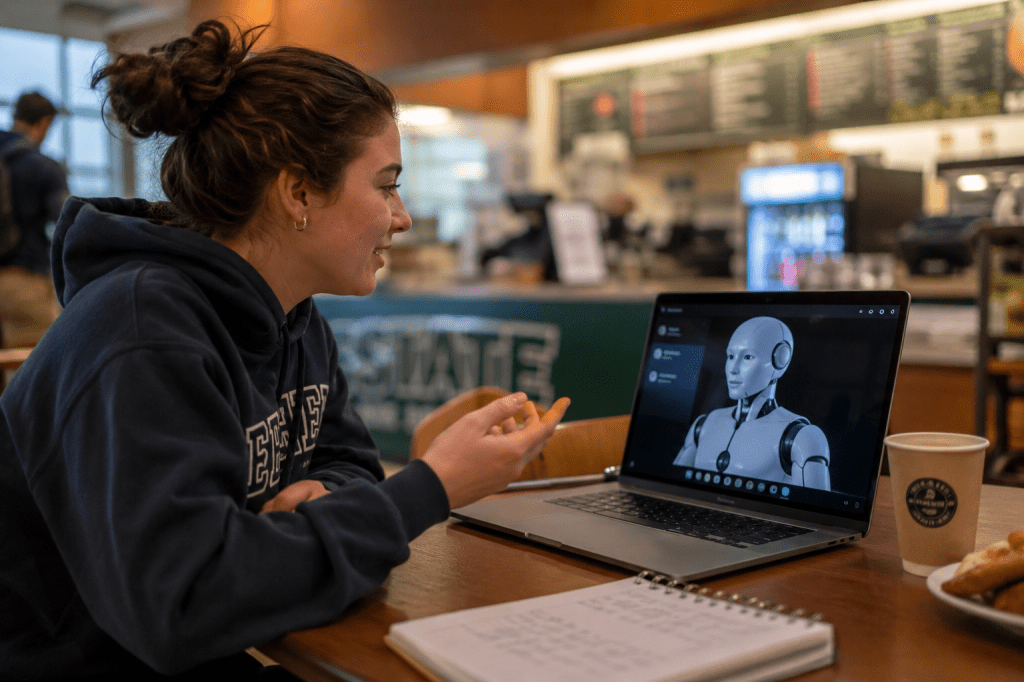
Listening, the authors point out, is not a passive activity but an interpretive and embodied one. When TTS is combined with interactive large language models, the experience becomes genuinely dialogic: a learner can ask a question, and the AI responds in natural speech. Language learners in particular benefit from being able to practice pronunciation and receive spoken feedback in a low-stakes environment. The authors foresee a near future in which AI narrators adapt tone, pacing, vocabulary complexity, and even emotional register in real time to match the listener’s proficiency and preferences—”the audiobook, in this vision, becomes a responsive learning companion rather than a fixed recording” (1).
Kılıçkaya and Kic-Drgas frame the audible turn as a democratizing force. TTS tools bring audio access to readers with visual impairments, those who cannot afford human-narrated audiobooks, and learners of less commonly taught languages who have never had quality spoken-word resources. At the same time, the authors raise urgent questions that the field has barely begun to address. If a voice can be cloned without consent, who owns it? Can listeners reliably distinguish a synthetic voice from a human one, and does it matter if they cannot? And most consequentially: “Does TTS language support render silent reading and comprehension skills, as we know it today, obsolete or, at the very least, degrade it over time?” (1)
This last question is not rhetorical. It points toward a structural change in what reading is. If the modal form of text consumption shifts from silent visual reading to listened audio, then the cognitive and experiential qualities that scholars have long associated with deep reading—the slow, reflective engagement with a printed page—may increasingly belong to a minority practice. That is a shift not just in technology but in what we mean when we say a person has “read” something.
Cognitive Debt — How AI Erodes Deep Reading and Critical Thinking
The sharpest empirical contribution to this topic comes from a team led by Nataliya Kosmyna at MIT’s Media Lab in Cambridge, Massachusetts. Their preprint, “Your Brain on ChatGPT: Accumulation of Cognitive Debt when Using an AI Assistant for Essay Writing Task,” was posted to arXiv on June 10, 2025 (2). The study draws on EEG neuroimaging to measure brain activity in real time, making it one of the most physiologically grounded investigations of AI’s cognitive consequences to date. The preprint attracted immediate attention from educators, cognitive scientists, and policymakers, though peer review was still pending at time of writing—a caveat the authors themselves acknowledged. Supporting research by Michael Gerlich of the ZHAW School of Management and Law in Winterthur, Switzerland, published in January 2025 in the open-access journal Societies, provides complementary survey-based evidence about AI, cognitive offloading, and critical thinking (3).
Kosmyna and colleagues enrolled 54 participants across three groups: those who wrote essays using ChatGPT, those who used a conventional search engine, and those who used no tools at all (a “Brain-only” group). EEG scans during writing showed dramatic differences in neural connectivity. Brain-only participants exhibited the strongest and most widely distributed neural networks; search-engine users showed moderate engagement; and LLM users displayed the weakest neural connectivity of all, particularly in networks associated with memory encoding and creative production. When participants were asked to recall what they had written shortly after finishing, LLM users struggled far more than the other groups. Kosmyna’s team introduced the concept of “cognitive debt” to describe the cumulative toll: each time a reader or writer delegates cognitive work to AI, they make a small withdrawal from the neural reserves needed for independent reasoning (2).
Gerlich’s large-scale survey study found a negative correlation between frequent AI usage and critical-thinking scores, and showed that users aged 17 to 25 demonstrated both the highest reliance on AI tools and the lowest performance on critical-thinking assessments—a demographic finding with especially sobering implications for young readers and students (3). A separate investigation by researchers at Microsoft Research, Carnegie Mellon University, and the University of Cambridge found that knowledge workers who trusted GenAI more tended to report lower mental effort during tasks that normally require critical thinking, suggesting that the problem extends well beyond the classroom (8).
Reading with AI assistance increasingly means reading at one remove. Rather than engaging directly with a source text, users interact with AI-generated summaries, paraphrases, or chatbot explanations of what a source says. Kate Hurley, a research intern at University of Michigan Information and Technology Services, described the pattern candidly in a December 2025 essay in EDUCAUSE Review: “I now use AI tools regularly to help draft emails, edit papers, and summarize articles… I have often seen it used as a substitute for thinking altogether, especially among younger people” (4).
The mechanism behind the cognitive drain is not simply laziness but a well-documented psychological process called cognitive offloading. When people use external tools to reduce mental effort, they free up short-term processing capacity, but they also forfeit the deeper encoding that makes information stick and become usable. Gerlich’s research suggests that unstructured, passive AI use—asking an AI to produce an answer rather than using AI to scaffold active inquiry—is where the greatest damage occurs (3).
The scholar Maryanne Wolf, who spent decades researching the neuroscience of the reading brain at UCLA and Tufts University, identified the threat even before large language models became ubiquitous. Her 2018 book Reader, Come Home: The Reading Brain in a Digital World argued that what she called “deep reading”—the slow, immersive engagement with text that cultivates empathy, critical analysis, and original thought—was already being displaced by the skim-and-tap habits of digital life (9). AI summarization and chatbot-based reading represent the logical acceleration of that trend: not just a faster way to skim, but a system that does the skimming (and the comprehending) on the reader’s behalf.
Hurley’s EDUCAUSE essay gives the stakes a personal register: “The MIT study also introduced me to the concept of cognitive debt, the idea that, over time, reliance on AI tools may permanently erode capacities in critical thinking, creativity, memory, and executive function… Without strong habits of evaluation and critical reflection, users can easily slip into this more passive mode of thought” (4).
The broader implication is civic. A democracy depends on citizens who can read complex documents carefully, evaluate conflicting claims, and form independent judgments. If AI tools are systematically reducing the neural effort required to process text—and doing so most aggressively in younger, less experienced readers—then the societal cost reaches far beyond academic integrity or classroom performance. Deep reading has historically been one of the primary mechanisms through which individuals develop the reflective capacity to resist manipulation and engage with democratic life. The attrition of that capacity deserves to be treated as a public issue, not merely a pedagogical one.
The Compression of Academic Reading — AI Summarization and the Bypass of Long-Form Text
A 2025 systematic review published in Frontiers in Education offers the most comprehensive academic survey of how generative AI has changed reading and writing in higher education. The lead author is Araceli García-Rodríguez of the Departamento de Biblioteconomía y Documentación (Department of Library and Information Science) at the Universidad de Salamanca in Spain. Applying the rigorous PRISMA methodology to a sample of 136 peer-reviewed, open-access studies published between January 2023 and March 2025, García-Rodríguez and her co-authors produced a synthesis covering empirical evidence from across the social sciences about AI tools—particularly ChatGPT—in students’ reading and writing processes. The review was published in open access in 2025 (5).
The change García-Rodríguez and her team document is the emergence of AI as an intermediary layer between the reader and the source text. Rather than reading a journal article, monograph, or assigned chapter directly, students and scholars now routinely use AI to generate summaries, paraphrases, or condensed interpretations of what the text contains. AI tools identify key arguments, propose feedback on draft responses, generate ideas for further inquiry, and produce text that students then edit and submit as their own. In this workflow, the original text becomes optional; the AI-generated digest becomes the de facto reading experience (5).
The findings of the review are not unambiguously negative. García-Rodríguez and colleagues report “a significant improvement in the quality of students’ texts, especially regarding coherence, discursive organisation, lexical richness, and argumentation.” AI serves as a kind of writing tutor that scaffolds structure and vocabulary, and students who use it interactively—treating AI feedback as a prompt for further revision rather than a finished product—show genuine gains. The review also highlights AI’s role in supporting students whose first language is not English, for whom vocabulary scaffolding is particularly valuable (5).
But the more troubling finding in García-Rodríguez’s synthesis is the pattern of overreliance and what the authors call “diminished metacognitive engagement.” Reading, at its best, is a self-monitoring activity: readers notice when they do not understand, slow down, re-read, and revise their mental models. When AI absorbs the reading task, this metacognitive loop is short-circuited. A student who has received an AI summary of a chapter has not rehearsed the cognitive moves that make sustained comprehension possible—the confusion, the inference, the integration of new ideas with prior knowledge—and is therefore less likely to retain or transfer what the AI told them (5).
The review also highlights an ethical dimension that further implicates reading: because AI-generated text closely mimics human writing, the boundary between a student’s own comprehension and a machine’s output becomes difficult to locate. Students who use AI to “read” a text and then produce written responses about it may be unable to say, even honestly, how much of their apparent understanding is genuinely theirs. This is not simply a question of plagiarism; it is a question of epistemic self-knowledge—of whether a person knows what they know (5).
The compression of academic reading matters because long-form engagement with texts is the primary mechanism through which scholars and students develop expertise. Reading a book is not the same as reading a summary of a book; the experience of following an argument across hundreds of pages, encountering counterarguments, noticing inconsistencies, and arriving at a judgment is itself a form of intellectual training that summaries cannot replicate. AI summarization tools do not merely shorten reading; they change its epistemological structure, substituting a curated digest for the reader’s own encounter with complexity. If this shift becomes normative in higher education, the question is not merely whether students are learning less—it is whether “reading” in the scholarly sense will continue to exist as a widespread practice at all.
The Performance-Pleasure Trade-Off — AI and the Experience of Close Reading
The most methodologically rigorous investigation of how AI changes the reading experience itself—not just its cognitive outcomes—was presented at the 2026 ACM CHI Conference on Human Factors in Computing Systems, held in Barcelona, Spain in April 2026. The paper, “What Does AI Do for Cultural Interpretation? A Randomized Experiment on Close Reading Poems with Exposure to AI Interpretation,” was authored by Jiayin Zhi and Hoyt Long (both at the University of Chicago), Richard Jean So (Duke University in Durham, North Carolina), and Mina Lee (University of Chicago). The research was supported by the Social Sciences and Humanities Research Council of Canada (6).
Zhi, Long, So, and Lee conducted a preregistered, randomized controlled experiment with 400 participants recruited via the crowdwork platform Prolific. Participants were assigned to one of three conditions: a control group that read poems without any AI assistance, a group that received a single AI-generated interpretation of each poem, and a group that received multiple AI interpretations. The poems used—Langston Hughes’s “Theme for English B,” Marilyn Nelson’s “Dusting,” and Linda Pastan’s “Love Poem”—were chosen for their accessibility to non-specialist readers and their diversity of theme and style. Participants completed close-reading interpretation tasks (identifying stylistic features and explaining their effects) and answered questions about their subjective experience: specifically, their appreciation, enjoyment, and self-efficacy (6).
The central definition at stake in the study is worth noting explicitly: “Close reading—the ability to understand, explain, interpret, evaluate, and critique culture works—in textual form like poems and novels, or in other media like songs and films” is described by the authors as “foundational to the development of literacy and critical thinking, as it seeks to reveal non-obvious qualities about the cultural text through careful perception” (6).
The results were nuanced in ways that illuminate both the promise and the peril of AI-assisted reading. A single AI interpretation improved both interpretive performance and the pleasure readers derived from the process—even, remarkably, for participants who reported not having directly used the AI. The authors suggest this may reflect “abstract modeling”: exposure to a single interpretation established a quality benchmark that readers internalized without consciously copying it, allowing them to make better sense of the poem while still feeling that the interpretation was their own (6).
Multiple AI interpretations, however, told a different story. They improved performance metrics but delivered no increase in pleasure, and for more experienced readers they actually reduced self-efficacy. Qualitative responses explained why. One participant wrote: “AI’s understanding of these poems was much deeper and, quite frankly, better than mine. I just couldn’t compete” (P26, AI-MULTIPLE). Another noted: “It made me feel less confident about how I was interpreting the poems” (P126, AI-MULTIPLE). Extensive AI coverage appeared to exhaust the interpretive space, leaving readers with nothing original to contribute (6).
The study also found a stark performance-pleasure trade-off among heavy copiers: “participants who reported using AI or whose responses showed high textual overlap with AI interpretations achieved performance scores closer to the AI benchmark but consistently reported lower Subjective Experience ratings across Enjoyment, Appreciation, and Self-Efficacy measures” (6). The inverse relationship held with striking consistency: the closer a reader’s interpretation tracked the AI’s, the worse the reading experience felt.
The CHI 2026 study matters because it quantifies something that critics and literary scholars have long argued but rarely been able to prove empirically: that the value of reading literary texts is not reducible to correct answers. “The reward of lay cultural consumption is fundamentally different from academic or professional contexts,” the authors write. “While AI can help produce more sophisticated interpretations, this performance gain becomes less meaningful if it diminishes the pleasure, discovery, and personal meaning-making that motivate recreational reading” (6).
The design principle the researchers extract from their findings—”less is more”—has immediate practical implications. Platforms that deploy AI literary interpretation, from poetry apps to educational tools, should resist the temptation to provide exhaustive AI coverage, because doing so degrades the experience that makes reading literature worthwhile in the first place. The deeper theoretical claim is that AI threatens not only the cognitive quality of reading but its experiential integrity. When AI absorbs the act of interpretation, reading is hollowed out. The text may be processed; it is no longer, in any meaningful sense, read.
Discovery Resists Algorithms — Human Recommendations Beat AI in Book Discovery
The most comprehensive survey of actual reader behavior in the AI era is the 2026 State of Reading Report, published on December 10, 2025, by Scribd, Inc.—the San Francisco-based company whose products include Everand (a digital reading service with millions of ebooks and audiobooks) and Fable (a social reading platform hosting more than 100,000 book clubs). The report draws on year-to-date user activity data from Everand covering January through October 2025, Fable data through November 2025, and a national consumer survey of more than 1,600 US adults aged 18 to 64 who had paid for an audiobook or ebook subscription within the previous two years. The findings were released by Scribd’s CEO, Tony Grimminck (7).
The headline finding of the report directly contradicts the assumption that AI-driven recommendation algorithms are supplanting human social networks as the primary gateway to books: “people I know personally” has become the top source of book discovery in 2025, surpassing platforms, social media, and AI-driven tools. Sharing a book with a friend or family member has overtaken “saving to a shelf” as the most common post-reading action. More than one-third of respondents participated in a book club that year, with book clubs growing in all formats—in-person clubs rose eight percent year over year, and on Fable alone, more than 820,000 people joined a new book club during 2025 (7).
The report also documents a format revolution within digital reading that has significant implications for how AI-TTS tools will be used. Audiobooks have edged ahead of ebooks as the most popular digital reading format, and 57 percent of respondents consume both. Smartphones are now the leading reading device, driven by convenience and portability—a finding that aligns with the shift Kılıçkaya and Kic-Drgas described in their commentary on the audible turn (1,7).
When the Scribd data asked readers what AI features they actually wanted, the answers were notably restrained: seamless switching between ebook and audiobook formats, mood-based recommendations, more personalized discovery, and—crucially—”AI that feels additive rather than intrusive” (7). This formulation is telling. It does not describe a desire for AI to choose books, curate reading lists, or generate interpretations. It describes a desire for AI that removes friction without displacing agency. Readers want AI as a technical convenience, not as a cultural authority.
The contrast with the cognitive-debt literature is instructive. While studies of AI writing and summarization tools show students adopting AI outputs wholesale and deferring to AI judgment, the Scribd data shows recreational readers actively preferring personal human connections even when AI alternatives are available. CEO Tony Grimminck put it plainly in the report: “Despite rapid technological progress and a year defined by AI experimentation, readers are choosing relationships over recommendations” (7).
This finding matters because it complicates the deterministic narratives that often surround AI and reading. The thesis that algorithms will inevitably displace human curation has not been borne out in the behavior of millions of actual readers. Reading remains, for most people, an act embedded in social life—something one does not simply to extract information but to connect with others, participate in communities, and share experiences. Book clubs, recommendations from friends, post-reading conversations: these are not inefficiencies that algorithms will eventually optimize away; they are, for many readers, the point.
The 2026 State of Reading Report also documents a broader reading uptick that is worth noting: more than half of respondents say they are reading more than the previous year, a rate that rises to 64 percent among adults aged 18 to 24. Average reading streaks on Fable reached 29 days, up 300 percent year over year. If AI is threatening the quality of reading engagement, as the cognitive-debt research suggests, the quantity of reading does not appear to be suffering—at least not yet. The more pressing question may be whether the books being read, listened to, and discussed through AI-facilitated platforms are being genuinely engaged with, or whether AI summarization and recommendation are producing a kind of “reading theater” in which the social rituals of book culture persist while the cognitive depth that reading traditionally provides continues to erode.
Discussion: What These Transformations Mean
Considered individually, each of the five transformations documented above is significant. Taken together, they suggest a more fundamental reconfiguration of reading’s role in human life—one that is proceeding unevenly, on multiple fronts simultaneously, and faster than scholars or educators have so far been able to track.
The first implication is that reading is becoming more abundant and less deep. AI-TTS tools are expanding the hours available for consuming text by converting “dead time” into listening time. AI summarization tools are making vast literatures rapidly digestible. AI recommendation engines and social platforms are exposing readers to more books than ever. By all volume metrics, reading is booming. And yet the EEG data from the MIT Media Lab, the survey data from Gerlich’s Swiss study, and the behavioral data from the CHI 2026 close-reading experiment all point in the same direction: as reading becomes faster, easier, and more mediated by AI, the cognitive and experiential engagement it produces appears to be declining. Abundance and depth are, at least in the short term, inversely related (1,2,3,6).
The second implication concerns the bifurcation of reading into two distinct practices that are drifting further apart. On one hand, there is functional reading for information—research, study, professional tasks—where AI assistance is most aggressively deployed, and where the cognitive-debt evidence is most alarming. On the other hand, there is recreational and social reading—novels, poetry, book clubs—where human resistance to algorithmic displacement appears stronger, and where the CHI 2026 data and the Scribd findings both suggest that readers are actively defending the experiential pleasures of reading against AI encroachment (6,7).
A third implication is that age is a critical variable. The Gerlich study found that participants aged 17 to 25 showed the highest AI reliance and the lowest critical-thinking scores (3). The Scribd data found that the 18-to-24 age group shows the steepest increase in reading volume. These two trends are not necessarily contradictory, but they raise the question of whether younger readers are consuming more text while understanding it less well—a pattern that would be difficult to detect from quantity metrics alone.
A fourth implication concerns what might be called the epistemics of AI-mediated reading. When a reader uses AI to summarize, interpret, or select texts, the knowledge they acquire is doubly mediated: first by the original author, then by an AI system whose selection criteria, biases, and omissions are largely opaque. The García-Rodríguez systematic review documents how this double mediation is already affecting academic reading in higher education, where the ability to evaluate sources critically—to read against the grain, notice what an argument excludes, and form independent judgment—is precisely what education is supposed to cultivate (5).
Finally, the five essays collectively suggest that the most important question about AI and reading is not whether it helps or hinders—it does both—but what is being traded away in each transaction. Kılıçkaya and Kic-Drgas end their commentary with a phrase that serves as an emblem for the whole: “The written word will not vanish—but it now has a powerful echo” (1). That echo is amplifying certain dimensions of reading—reach, accessibility, discoverability, audiobook flexibility—while muffling others: depth, metacognition, interpretive autonomy, and the intrinsic pleasure of wrestling with meaning on one’s own terms. Navigating that trade-off wisely will require not just technological literacy but a clear-eyed account of what reading is for, and what would be lost if the echo were to drown out the original voice.
References
1. Kılıçkaya, F., Kic-Drgas, J. “The audible turn: the rise of AI-led text-to-speech.” AI & Society 41, 1299–1300 (2026). Published July 30, 2025. https://link.springer.com/article/10.1007/s00146-025-02502-8
2. Kosmyna, N., Hauptmann, E., Yuan, Y.T., Situ, J., Liao, X., et al. “Your Brain on ChatGPT: Accumulation of Cognitive Debt when Using an AI Assistant for Essay Writing Task.” arXiv preprint arXiv:2506.08872. Published June 10, 2025. https://arxiv.org/abs/2506.08872
3. Gerlich, M. “AI Tools in Society: Impacts on Cognitive Offloading and the Future of Critical Thinking.” Societies 15(1): 6 (2025). MDPI. Published January 2025. https://www.mdpi.com/2075-4698/15/1/6
4. Hurley, K. “The Paradox of AI Assistance: Better Results, Worse Thinking.” EDUCAUSE Review. Published December 15, 2025. https://er.educause.edu/articles/2025/12/the-paradox-of-ai-assistance-better-results-worse-thinking
5. García-Rodríguez, A., et al. “The impact of generative AI on academic reading and writing: a synthesis of recent evidence (2023–2025).” Frontiers in Education (2025). DOI: 10.3389/feduc.2025.1711718. https://www.frontiersin.org/journals/education/articles/10.3389/feduc.2025.1711718/full
6. Zhi, J., Long, H., So, R.J., Lee, M. “What Does AI Do for Cultural Interpretation? A Randomized Experiment on Close Reading Poems with Exposure to AI Interpretation.” Proceedings of the 2026 CHI Conference on Human Factors in Computing Systems. Barcelona, Spain, April 2026. ACM. DOI: 10.1145/3772318.3791727. https://dl.acm.org/doi/10.1145/3772318.3791727
7. Scribd, Inc. “The 2026 State of Reading Report: Human Recommendations Surpass Algorithms in the AI Era.” Published December 10, 2025. Based on survey of 1,600+ US adults and activity data from Everand and Fable. https://www.scribdinc.com/newsroom/the-2026-state-of-reading-report-human-recommendations-surpass-algorithms-in-the-ai-era
8. Lee, H.-P. (Hank), et al. “The Impact of Generative AI on Critical Thinking: Self-Reported Reductions in Cognitive Effort.” Proceedings of the CHI Conference on Human Factors in Computing Systems 23 (2025). Microsoft Research, Carnegie Mellon University, and University of Cambridge. http://www.microsoft.com/en-us/research/uploads/prod/2025/01/lee_2025_ai_critical_thinking_survey.pdf
9. Wolf, M. Reader, Come Home: The Reading Brain in a Digital World. HarperCollins. 2018. https://www.maryannewolf.com/reader-come-home
###
Filed under: Uncategorized |

























































































































































































































































































































































































































































Leave a Reply