





By Jim Shimabukuro (assisted by Claude)
Editor
Summary: Tulsi Gabbard’s resignation was officially framed as a family decision, but the real story is how quickly a rift-ridden DNI tenure collides with Trump’s loyalty-first national security politics. It matters because her exit exposes both the human cost of power and the instability inside the administration’s intelligence chain. –Perplexity

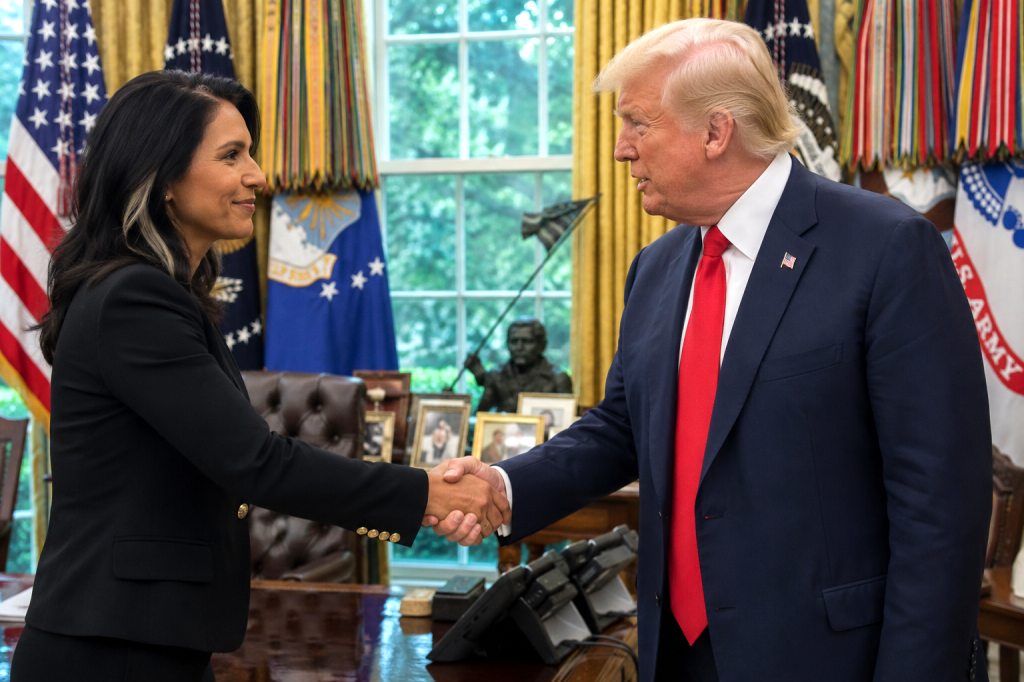
On May 22, 2026, Tulsi Gabbard announced her resignation as Director of National Intelligence (DNI), the highest-ranking intelligence official in the United States government. In her resignation letter — posted publicly on X and first reported by Fox News Digital — Gabbard stated that her husband, videographer Abraham Williams, had recently been diagnosed with “an extremely rare form of bone cancer” and that she could not “in good conscience ask him to face this fight alone” while serving in such a demanding post (1). Her resignation is effective June 30, 2026, making her the fourth Cabinet official to depart during Donald Trump’s second term (2).
President Trump responded warmly in a public post, writing “Tulsi’s done an incredible job, and we will miss her,” and announcing that her Principal Deputy Director of National Intelligence, Aaron Lukas — a 20-year CIA veteran and former clandestine operations officer — would serve as acting DNI (1,2).
Gabbard had been confirmed as DNI less than a month after Trump’s second term began, overseeing a sprawling coalition of 18 intelligence agencies (3). She was a surprising choice for the role: a former Democratic congresswoman from Hawaii with no prior intelligence community experience, who had run for president in 2020 on a platform opposing U.S. military interventionism. She subsequently left the Democratic Party in 2022, became an independent, and then formally aligned with the Republicans before endorsing Trump in the 2024 election cycle (2).
During her roughly 15 months in office, Gabbard oversaw sweeping changes to the intelligence community. According to a Gabbard aide cited by PBS NewsHour’s Nick Schifrin, her office reduced what she characterized as “agency bloat” by more than 40 percent, pursued the declassification of high-profile historical documents including files related to the JFK assassination, and claimed to have exposed what Trump allies called the “weaponization” of the intelligence community by its own insiders (1).
Key Facts Surrounding the Resignation
The Iran War and Gabbard’s Marginalization
The most consequential source of friction between Gabbard and the Trump White House was the U.S.–Israeli military strikes against Iran that began on February 28, 2026. Gabbard, who had endorsed Trump partly on anti-interventionist grounds and had campaigned vigorously against what she called “regime change wars,” found herself in an acute political bind when Trump authorized the operation.
The trouble began earlier, in the summer of 2025. As Trump was considering strikes against Iranian nuclear sites, Gabbard released a public video warning that “political elites and warmongers are carelessly fomenting fear and tensions between nuclear powers.” She did not explicitly name Trump, but former intelligence and White House officials told PBS NewsHour’s Nick Schifrin that the president did not know about the video beforehand and interpreted it as a public attempt to dissuade him from action. He went ahead with the strikes regardless, and, according to Schifrin’s sources, Gabbard “never recovered” from that moment (1).
After the war began in February 2026, Gabbard issued a carefully hedged statement saying that Trump had concluded the Iranian regime posed “an imminent threat” — but she conspicuously declined to offer her own judgment (3,4). A week later, during congressional intelligence hearings in March 2026, she further complicated matters by testifying that the previous year’s strikes had “obliterated” Iran’s nuclear program and that there had been no subsequent effort to rebuild — a statement that directly contradicted Trump’s repeated claim that Iran still posed an imminent threat. She also declined at multiple points to endorse the justification for the current war, saying: “It is not the intelligence community’s responsibility to determine what is and is not an imminent threat” (2).
These exchanges were widely noted. Reuters reported in April 2026 that Trump had expressed displeasure with Gabbard in recent months and had asked allies for their thoughts on potential replacements for his intelligence chief. A senior White House official confirmed Trump’s displeasure on record. Trump had himself said publicly in March 2026 that Gabbard was “softer” than him on curbing Iran’s nuclear ambitions (5).
Signs of Gabbard’s marginalization were visible in other ways. She was reportedly not present in the room when Trump huddled with top advisers in the immediate run-up to the Iran strikes (6). She was also absent from deliberations on the U.S. military operation that deposed Venezuelan President Nicolás Maduro and from strategy sessions on Cuba — during the latter of which she was on a beach in Hawaii (5,6). Former Trump and intelligence officials told PBS NewsHour that CIA Director John Ratcliffe had effectively been running the intelligence community in Gabbard’s stead (1).
Joe Kent’s Resignation and Its Aftermath
On March 17, 2026, Joe Kent — the director of the National Counterterrorism Center, who had previously served as Gabbard’s chief of staff — resigned in protest of the Iran war. Kent posted on X that “Iran posed no imminent threat to our nation, and it is clear that we started this war due to pressure from Israel and its powerful American lobby” (7). His departure left Gabbard in a politically untenable position as her subordinate’s public statement directly undermined the official justification for the war Gabbard was tasked with serving.
The day of Kent’s resignation, Gabbard issued a tepid statement saying that Trump was “responsible for determining what is and is not an imminent threat” while declining to endorse or criticize either Kent’s claims or the war itself. The response was widely criticized as evasive (8). NBC News reported that Gabbard was “in the hot seat” in the subsequent Senate Intelligence Committee hearing (9). PBS NewsHour noted that one of Gabbard’s other key deputies had also resigned over the Iran war (1).
The Director’s Initiatives Group (DIG) and Its Missteps
In April 2025, Gabbard established the Director’s Initiatives Group (DIG), a task force charged with declassifying documents, investigating what she called the “weaponization” of the intelligence community, and probing the origins of COVID-19 and alleged electoral fraud (10). Critics, including Senator Mark Warner, the top Democrat on the Senate Intelligence Committee, argued the DIG was a vehicle for partisan attacks on intelligence officers and characterized it as a “witch hunt” for those deemed disloyal to Trump (11).
In August 2025, Gabbard stripped the security clearances of 37 current and former officials, including former President Biden, former Secretary of State Hillary Clinton, and former DNI James Clapper. In publicly releasing the memo on X, however, Gabbard’s office inadvertently included the name of a CIA officer who was serving undercover overseas — a significant operational security breach. According to multiple current and former intelligence sources cited by NBC News, the episode alarmed the CIA’s workforce and deepened tensions between Gabbard and CIA Director John Ratcliffe. Gabbard’s office denied that any cover had been blown, arguing the memo had listed names without agency affiliations (12).
By February 2026, Reuters reported exclusively that Gabbard had wound down the DIG — a decision attributed by sources to alleged missteps, including the undercover officer disclosure (11). A source familiar with the matter told Reuters that the DIG’s activities — including its handling of the security clearance revocations — were among the reasons the White House had grown unhappy with Gabbard (5).
The Fulton County FBI Raid
In late January 2026, Gabbard took the unprecedented step of attending an FBI raid on Fulton County, Georgia’s election headquarters. The FBI removed physical ballots, tabulator tapes, ballot images, and voter rolls, citing probable cause of violations related to election record retention (1). Gabbard defended her presence in a letter to congressional Democrats, arguing that election security is a national security issue and that Trump had personally asked her to go (2). She facilitated a phone call between Trump and the FBI agents conducting the raid — an action PBS NewsHour described as “very unusual.” The Fulton County Board of Commissioners sued almost immediately, demanding the return of the materials (1). Trump later stated publicly that Gabbard had joined the raid at the insistence of then–Attorney General Pam Bondi, slightly distancing himself from direct ownership of the action (2).
Noteworthy Opinions on the Reasons for Gabbard’s Resignation
Because the official explanation — that Gabbard left voluntarily to care for her husband — is contradicted by reporting from multiple credible outlets, several significant analytical opinions have emerged. These range from the view that she was essentially fired, to the view that the role itself was structurally set up for failure, to the broader critique that Gabbard had compromised her core principles in a manner that left her with few allies on any side of the political spectrum.
Opinion 1: Gabbard Was Forced Out by the White House Over Iran
The most direct and fact-grounded interpretation holds that the cancer diagnosis, while genuine, was used as a face-saving pretext for a departure the White House had already decided upon. Under this view, Gabbard was not resigning voluntarily — she was being pushed out, primarily because her anti-war instincts and her carefully hedged public statements on the Iran conflict had become a liability to an administration that had staked its credibility on the justness and necessity of the war.
This interpretation is advanced most authoritatively by Reuters, which cited “a source familiar with the matter” stating directly that Gabbard had been “forced out” by the White House — and a separate source who said: “She was pushed out by the White House. The White House has been unhappy with her for quite some time.” The Honolulu Star-Advertiser, in its Reuters-syndicated reporting, added that another source told Reuters that the DIG’s missteps and the security clearance breach were also among reasons for the displeasure (5). This interpretation was further supported by MSNBC Now’s opinion coverage, which noted that months of reporting had established that Gabbard was being sidelined and that Trump was considering firing her well before the resignation announcement (4).
In April 2026, multiple Reuters sources confirmed that Trump had expressed displeasure with Gabbard and had actively solicited opinions on potential replacements. Trump had called Gabbard “softer” than him on Iran in public, in March 2026 — an unusual rebuke of a sitting Cabinet member (5). She was excluded from the room during pre-strike deliberations on Iran and absent from other major national security decisions (5,6). PBS NewsHour’s intelligence correspondent Nick Schifrin, citing former intelligence and Trump officials, reported that Gabbard was “largely cut out” and “frozen out of the policymaking process,” and that CIA Director Ratcliffe had already been effectively running the intelligence community in her place (1). The Times of Israel further noted that Gabbard was “not in the room” when Trump huddled with advisers just before the Iran strikes (6).
If accurate, this interpretation reframes the resignation not as a personal tragedy but as a political termination — one in which the stated reason (spousal illness) obscures a substantive breakdown in the relationship between a DNI and the president she serves. It also raises questions about how genuinely independent the DNI office can be when the officeholder fundamentally disagrees with the president’s most significant foreign policy decision. For the intelligence community broadly, it reinforces long-standing concerns about the politicization of the ODNI and its structural vulnerability when the DNI and CIA director are not working in concert.
Opinion 2: Gabbard Was Professionally Unfit, and the Breakdown Was Inevitable
A second, complementary interpretation holds that Gabbard’s tenure was always likely to end badly because she lacked the experience, institutional knowledge, and professional temperament required to manage 18 intelligence agencies — and that her pattern of missteps reflected not just political friction but genuine managerial incompetence.
The most direct expression of this view comes from Larry Pfeiffer, a former chief of staff to CIA Director Michael Hayden and a veteran of post-9/11 intelligence reform who now directs the Hayden Center at George Mason University. Speaking to PBS NewsHour’s William Brangham on the day of the resignation, Pfeiffer was unambiguous: “She was inexperienced to begin with. She should never have been nominated for the job. Once in the job, I don’t think she ever fully understood the responsibilities that she had in managing this vast enterprise of 18 intelligence agencies” (1). The Associated Press account, distributed by PBS NewsHour, described her as having “quickly come to be seen as ineffectual and irrelevant and appeared out of place in the Trump administration” (7).
Pfeiffer pointed specifically to Gabbard’s tendency, when she began losing the president’s confidence, to lean heavily into conspiracy theories around past elections — an approach he characterized as an attempt to recover favor rather than an appropriate exercise of her core mandate (1). The accidental disclosure of an undercover CIA officer’s identity in August 2025 is perhaps the most concrete piece of evidence supporting this interpretation: the incident showed that Gabbard’s office failed to coordinate basic operational security procedures with the CIA before publishing a sensitive document on social media (12). The DIG task force that she established was subsequently wound down amid allegations of missteps, and Reuters noted that its credibility was undermined by the fact that its most publicized conclusion — that Barack Obama had manipulated a 2017 intelligence assessment — was contradicted by a 2025 CIA review, a bipartisan 2018 Senate Intelligence Committee report, and Special Counsel Robert Mueller’s indictments (11). Pfeiffer also noted that the DNI role requires careful stewardship of a large acquisition enterprise and cross-agency coordination: “boring things,” as he put it, that are nonetheless critical and that Gabbard appeared to treat as secondary to ideological priorities (1).
This interpretation matters because it shifts the analysis from Trump’s grievances to structural and professional concerns. If Gabbard’s failures were primarily managerial and institutional rather than political, then the question of who succeeds her becomes urgent: the ODNI, created after 9/11 to break down intelligence silos, needs a leader who can navigate bureaucratic complexity. It also raises questions about the confirmation process: Gabbard’s lack of intelligence experience was a known and debated fact at the time of her nomination, and the Senate confirmed her anyway.
Opinion 3: Gabbard Sacrificed Her Core Principles for a Job She Ultimately Lost
A third interpretation, primarily advanced in the opinion press, is that Gabbard’s tenure represents a case study in political self-abnegation: she came into the role as a committed anti-interventionist, progressively abandoned those principles to maintain Trump’s favor, and was ultimately discarded anyway. Under this reading, the resignation is less about Iran or managerial competence than about a fundamental character failure — a willingness to compromise integrity for proximity to power.
This view is the animating thesis of the MSNBC Now opinion piece headlined “Tulsi Gabbard’s self-humiliation wasn’t enough for Trump,” published on May 22, 2026. The column traces Gabbard’s political trajectory from her dramatic 2016 resignation from the DNC vice chairmanship to endorse Bernie Sanders — a decision she explicitly justified in anti-war terms — through her endorsement of Trump on ostensibly similar anti-war grounds, to her eventual hedging and equivocating on the Iran war (4). The NBC News account reinforced the portrait of a figure fundamentally “out of place” in the administration (7).
The evidence for the ideological capitulation interpretation rests primarily on the gap between Gabbard’s stated principles and her public conduct in office. In the summer of 2025, she released the video criticizing “warmongers” as Trump prepared to strike Iran — a moment of apparent principle. But when Trump went ahead anyway, she did not resign. Instead, she issued carefully worded social media posts defending Trump’s “right” to make such decisions, even as she declined to endorse the factual premises behind them (2,4). At Senate hearings in March 2026, she repeatedly dodged questions about whether Iran had actually posed an imminent threat, saying only that it was “not the intelligence community’s responsibility” to make such a determination — a position that critics noted effectively insulated Trump’s decision from independent scrutiny (2). As MSNBC Now argued, had she resigned loudly at that point and publicly said the threat assessment did not support the war, her departure could have done political damage to the administration and carried moral weight. Instead, she stayed, equivocated, and lost the job regardless (4).
This interpretation carries weight beyond personal political biography because it speaks to the structural pressures on any senior intelligence official who disagrees with the commander-in-chief. If the DNI cannot honestly brief Congress or the public about intelligence conclusions — because doing so would directly contradict the president’s stated rationale for war — then the post loses its core institutional value. Gabbard’s case becomes a cautionary illustration of how political loyalty requirements can hollow out a position whose fundamental purpose is to speak truth to power.
Opinion 4: Gabbard Was a Convenient Scapegoat for the Administration’s Intelligence Failures
A fourth view, appearing in analysis from the Middle East Eye and implied in some intelligence community commentary, is that Gabbard served a useful function for the Trump administration while she remained useful — helping to dismantle structures the president distrusted, declassify documents that served political agendas, and provide the veneer of ideological diversity — and was discarded when that usefulness expired.
The Middle East Eye, covering her departure from an international security perspective, noted that Gabbard’s departure is “unlikely to change the Trump administration’s policy on Iran or Israel” and that she had been “largely sidelined from major decisions on the war” (6). Jewish Insider reported that Gabbard had staffed the ODNI with a series of isolationist figures — including William Ruger, an outspoken opponent of military operations against Iran — and suggested these hires were themselves sources of ongoing friction (13). The congressional pressure for her resignation, led by CBC Whip Sydney Kamlager-Dove in July 2025, captured the view from Democrats that Gabbard was being used to “spread propaganda” and “promote a partisan narrative rooted in conspiracy” (14).
Gabbard’s most prominent actions in office — the DIG’s declassification agenda, the security clearance revocations, the Fulton County election raid — were almost all oriented toward reinforcing Trump’s political narratives rather than managing the intelligence enterprise. The DIG’s central claim (that Obama manipulated the Russia assessment) was refuted by multiple independent bodies (11). The security clearance revocations targeted officials associated with Trump’s political adversaries. The Fulton County raid advanced Trump’s years-long effort to relitigate the 2020 election despite no credible evidence of manipulation (1,2). When these actions generated criticism and operational embarrassment (the CIA officer disclosure), the task force was quietly wound down. In short, when her usefulness as a political instrument ran out and she proved unable to credibly manage the broader intelligence enterprise, she became dispensable.
This interpretation matters because it suggests a pattern in how the Trump administration uses Cabinet officials: partisan instruments are valuable until they become liabilities. It also matters for the intelligence community itself, where career officials and analysts watched their institution used to pursue political grievances. The damage to morale, trust, and the credibility of finished intelligence products extends beyond any single officeholder’s tenure.
Conclusion: Weighing the Opinions
Taken together, the four interpretations are not mutually exclusive — in fact, they reinforce one another in important respects. But two of them appear, on the balance of evidence, to be the most probable explanations for Gabbard’s resignation.
The most probable primary explanation is Opinion 1 — that Gabbard was effectively forced out, with the cancer diagnosis serving as a face-saving pretext. This view rests on the strongest direct evidentiary foundation: on-record displeasure from a senior White House official, sourced Reuters reporting of an active candidate search months before the resignation, Trump’s own public comment that Gabbard was “softer” than him on Iran, and the documented pattern of her exclusion from every major national security decision in 2025 and 2026. The cancer diagnosis is real and undoubtedly painful; but the timing — arriving just as Gabbard was preparing to exit regardless, according to PBS NewsHour’s reporting that she “was on her way out anyway” — makes the official framing difficult to accept at face value (1,5).
The second most probable explanation, and arguably a necessary complement to the first, is Opinion 2 — that Gabbard’s professional unfitness compounded the political friction and made her departure inevitable once the Iran war exposed the depth of her disagreement with the president’s course. Larry Pfeiffer’s assessment is credible precisely because it comes from a veteran intelligence professional with no obvious partisan motive. The accidental identification of an undercover CIA officer, the early wind-down of the DIG amid its own missteps, and the damaging Senate hearing exchanges all point to a tenure in which political loyalty could not compensate for institutional inexperience.
Opinion 3 — the moral-failure reading offered by MSNBC Now — is analytically compelling and historically significant, but it functions more as a retrospective verdict on Gabbard’s political character than as an explanation for the mechanics of her departure. Opinion 4, meanwhile, is plausible but relies more on inference than on direct sourcing, and may overstate the administration’s strategic cynicism relative to what is more likely a pattern of organic organizational dysfunction.
In sum: Gabbard did not resign. She was removed — from real influence first, and from formal office last. The Iran war was the proximate cause. The deeper cause was a fundamental mismatch between a DNI who believed in fewer American wars abroad and a president who launched one — a mismatch that institutional deference and political loyalty could not indefinitely paper over.
References
1. PBS NewsHour. “Tulsi Gabbard’s record and impact on the U.S. intelligence community.” May 22, 2026. https://www.pbs.org/newshour/show/tulsi-gabbards-record-and-impact-on-the-u-s-intelligence-community
2. PBS NewsHour / Associated Press. “Tulsi Gabbard resigns as Trump’s national intelligence director.” May 22, 2026. https://www.pbs.org/newshour/politics/tulsi-gabbard-resigns-as-trumps-national-intelligence-director
3. CNBC. “Tulsi Gabbard resigning as Trump’s intelligence chief.” May 22, 2026. https://www.cnbc.com/2026/05/22/tulsi-gabbard-resigns-intelligence-trump-husband.html
4. MSNBC Now (MS Now). “Tulsi Gabbard’s self-humiliation wasn’t enough for Trump.” May 22, 2026. https://www.ms.now/opinion/tulsi-gabbard-resigns-trump-loyalty
5. Reuters / Honolulu Star-Advertiser. “Tulsi Gabbard resigns as Trump’s top U.S. intelligence official.” May 22, 2026. https://www.staradvertiser.com/2026/05/22/breaking-news/tulsi-gabbard-resigns-as-trumps-top-u-s-intelligence-official/
6. Middle East Eye. “Tulsi Gabbard’s resignation as director of national intelligence removes sidelined Iran war sceptic.” May 22, 2026. https://www.middleeasteye.net/news/tulsi-gabbard-resigns-director-national-intelligence-removing-sidelined-iran-war-sceptic
7. MSNBC Now / NBC News / Washington Post (MS Now). “Tulsi Gabbard resigns as Trump’s director of national intelligence.” May 22, 2026. https://www.ms.now/news/tulsi-gabbard-resigns-dni-trump
8. The Daily Caller / AOL. “Tulsi Gabbard Says She’s Concerned Joe Kent Blames Israel For Iran War.” March 19, 2026. https://www.aol.com/news/tulsi-gabbard-says-she-concerned-160031712.html
9. NBC News. “Tulsi Gabbard in spotlight after top official resigns in protest over Iran war.” March 18, 2026. https://www.aol.com/articles/tulsi-gabbard-spotlight-top-official-005443932.html
10. Office of the Director of National Intelligence. “DNI Gabbard Establishes Task Force to Restore Trust in the Intelligence Community.” April 8, 2025. https://www.dni.gov/index.php/newsroom/press-releases/press-releases-2025/4063-pr-05-25
11. Reuters / U.S. News & World Report. “Exclusive: Trump’s spy chief Gabbard winds down intelligence task force.” February 10, 2026. https://www.usnews.com/news/world/articles/2026-02-10/exclusive-trumps-spy-chief-gabbard-winds-down-intelligence-task-force
12. NBC News. “Tensions rise between Tulsi Gabbard and CIA chief after her disclosure of undercover officer’s name, insiders say.” August 30, 2025. https://www.nbcnews.com/politics/national-security/tulsi-gabbard-cia-director-john-ratcliffe-rcna223285
13. Jewish Insider. “DNI Tulsi Gabbard to resign, citing husband’s illness.” May 22, 2026. https://jewishinsider.com/2026/05/tulsi-gabbard-director-national-intelligence-resignation/
14. Rep. Sydney Kamlager-Dove (CA-37) / Congressional Black Caucus. “Kamlager-Dove Leads Members of the CBC in Calling for DNI Tulsi Gabbard’s Resignation.” July 24, 2025. https://kamlager-dove.house.gov/media/press-releases/kamlager-dove-leads-members-cbc-calling-dni-tulsi-gabbards-resignation
###
Filed under: Uncategorized |












































































































































































































































































































































































































































Leave a Reply