





By Jim Shimabukuro (assisted by Claude)
Editor
[Related: AI and the Future of Writing-Process Instruction]
Summary: AI is pushing writing from linear composition to iterative co‑creation — forcing educators and writers to redefine authorship in a world of machine partners. –Copilot

For more than half a century, writing-process pedagogy has rested on a foundational claim: that writing can be taught, and that teaching it means making the invisible arc of composing—planning, drafting, revising, editing—visible and learnable. That tradition, launched by Janet Emig and Donald Murray in the early 1970s, shaped countless college and high school writing courses and generated a rich body of scholarship on the cognitive, social, and rhetorical dimensions of composing. The question now pressing on that tradition is not modest: does the rise of generative and agentic artificial intelligence require a paradigm shift in how we teach writing, or can the existing model absorb the disruption through targeted adjustments?
“AI and the Future of Writing-Process Instruction” poses this question (1). It traces the writing-process movement from Emig’s landmark 1971 case studies of student composing through the LMS-enabled process data of the 1990s and 2000s, and into the present, where generative AI—for the first time—offers tools capable of recording, analyzing, and responding to a writer’s process in near real time. Whether this technological promise translates into genuine pedagogical gain, he argues, depends entirely on whether AI is designed and deployed with the writer’s development, not text production, at the center.
This report takes up the question by examining seven scholars who are, each in a distinct way, proposing or exploring new frameworks for writing instruction in the AI era. They range from a policy analyst at UCLA and Brookings to a team of five researchers in Spain; from a humanist at UC Merced who questions whether the College Writing course should exist at all, to HCI researchers at the University of Illinois who are redesigning AI tools on writing-center principles. Together they suggest not a single paradigm but a cluster of related shifts: from prohibition to transparency, from text production to thought development, from uniform assessment to process verification, and from a single-language model to one that centers equity and multilingualism. The essays that follow examine each writer’s contribution in turn, before drawing out the collective implications for writing instruction and student learning.
John Villasenor — The Tectonic Shift Argument
John Villasenor is a Professor of Electrical Engineering and Public Policy at the University of California, Los Angeles (UCLA), where he also teaches undergraduate writing courses. He holds a Nonresident Senior Fellowship at the Brookings Institution’s Center for Technology Innovation in Washington, D.C., a nonpartisan think tank whose TechTank blog reaches a broad audience of policymakers, educators, and practitioners. Villasenor writes from an unusual vantage point: he is simultaneously a working educator in undergraduate writing and a policy analyst who studies technology’s societal effects. Villasenor published “AI has rendered traditional writing skills obsolete. Education needs to adapt” on May 30, 2025, in the Brookings Institution’s TechTank blog—a freely accessible, widely read policy forum (2).
Villasenor’s argument is deliberately blunt. “Artificial intelligence (AI) has rendered traditional writing skills obsolete,” he states at the outset, and the education system has not yet acknowledged what most students under twenty-five already know: that nearly all writing in their professional lives will be produced with AI assistance (2). He draws an analogy to penmanship. Victorian handwriting theorists made sweeping claims for the cognitive benefits of fine penmanship—claims not entirely wrong—but those claims could not withstand the practical efficiency of the keyboard. In the same way, Villasenor argues, the case for non-AI-assisted writing will ultimately yield to AI’s efficiencies. “We are currently in a liminal space where it is still possible to imagine that the hard-earned rewards accessed through the labor of writing will be sufficient incentive to keep AI at bay. But that is an illusion,” he writes (2).
Villasenor does not advocate abandoning writing instruction but redirecting it. “Today’s writing curricula are overseen by people who came of age in the pre-AI era,” he writes, and there is “a natural bias in wanting to teach students to thrive in the world that most educators know best” (2). His prescription is to replace classroom policies prohibiting AI use with policies promoting its responsible use, and to refocus instruction on evaluative meta-skills. He argues that helping students become “proficient at using AI as a force multiplier to improve the depth, versatility, and speed of their writing” requires “teaching students how to evaluate writing for flow, organization, clarity, and logical and stylistic coherence.” Crucially, he contends that a person does not need to be a skilled writer to be a skilled evaluator of writing—“just as someone who can’t play piano can nonetheless distinguish between skilled and unskilled piano players” (2).
Villasenor’s contribution matters because it names, plainly and from a credible policy platform, a shift that many educators sense but few have stated so directly. His argument that AI democratizes good writing—making professional-quality prose accessible regardless of educational background—introduces an equity dimension often absent from deficit-framing debates about AI and authenticity. By treating AI-assisted writing not as cheating but as the emerging norm, he frames the pedagogical challenge as one of adaptation rather than resistance, and grounds that argument in observations from his own undergraduate classroom.
Brett Jacinto Shanley — The Post-Utility Vision
Brett Jacinto Shanley is a Lecturer in the Karen Merritt Writing Program at the University of California, Merced—the newest campus of the UC system, located in California’s Central Valley. He holds a Ph.D. from Columbia University (2022), an M.F.A. from The New School, and a B.A. from the University of Oregon. His research interests span classical rhetorical theory, critical pedagogy, rhetorical ethics, and semiotics, and he has presented work at the Modern Language Association convention, the Semiotic Society of America, and the International Linguistic Association Conference. Shanley’s article, “AI & the End of College Writing as We’ve Known It,” was published in 2025 in Changing English: Studies in Culture and Education, a peer-reviewed journal published by Taylor & Francis (3).
Where Villasenor argues for adaptation, Shanley argues for a more fundamental reckoning. “As of 2025,” he writes, “there is no reason that the presently ubiquitous and required ‘College Writing’ course should even exist—at least as long imagined” (3). His argument begins with the observation that generative AI has rendered the textual-generative skill development that the College Writing course was designed to foster effectively obsolete. To continue teaching that course in its traditional form is, Shanley suggests, to teach to a world that no longer exists.
Shanley reaches for the economist Deirdre McCloskey’s “Law of Academic Prestige,” which holds that the reputation of an academic discipline is inversely related to its usefulness. The usefulness at the heart of the College Writing course—the conscious development of transferable writing skills—is precisely what AI has rendered dispensable. Shanley proposes a “post-utility” vision of writing studies: rather than abandoning the field or uncritically embracing AI, he argues for recentering writing instruction around holistic personal and intellectual development, shedding what he calls the “hyper-expedient service discipline model” that has governed the field (3). The question for writing studies, in his view, is not whether AI can write, but what writing is for.
Shanley’s contribution is among the most radical offered by any of the scholars examined here. He is not proposing a new version of process pedagogy or a framework for AI integration. He is questioning the foundational rationale of the entire enterprise. His “post-utility” argument resonates with longstanding humanistic critiques of skills-based writing instruction but gives them new urgency by confronting a technological reality that makes those skills literally redundant. His framing opens space for a writing curriculum grounded not in what AI cannot do, but in what human development genuinely requires.
Eman Elturki — Process Pedagogy 2.0
Eman Elturki is a Senior Lecturer in the Department of English at the University of Illinois at Chicago (UIC), where she specializes in writing pedagogy, second-language writing, and the integration of educational technology in writing instruction. UIC is a large urban research university serving one of the most linguistically diverse student bodies in the United States, which positions Elturki to observe the intersection of AI and multilingual writing at firsthand. Elturki’s article, “AI-Aware Process Writing Pedagogy: Rethinking the Process-Based Approach,” was published in the TESOL Journal on April 14, 2026 (Vol. 17, Issue 2)—one of the flagship journals in the field of teaching English to speakers of other languages (4).
Elturki argues that what the field needs is not the abandonment of process-based pedagogy but its reinvention. Her proposal is described as “Process Pedagogy 2.0”: an AI-aware model that “recenters human decision-making, rhetorical reasoning, and ethical engagement within what she describes as hybrid human–AI writing ecologies” (1). The framework pivots on three key pedagogical moves. The first is transparency, in which students disclose how and where they used AI in their composing. The second is visible thinking, in which students articulate the reasoning behind their choices at every stage. The third is dialogic engagement, in which AI tools are used not to bypass deliberation but to deepen it (1).
The goal, in Elturki’s formulation, remains unchanged from the Murray-Emig tradition: “Process Pedagogy 2.0 insists that the goal remains the development of the writer, not the production of a text” (1). What changes is the environment in which that development occurs—a hybrid ecology in which AI is present not as a substitute for the writer’s judgment but as a partner that makes that judgment more visible and more demanding. Her framework preserves the core insight of process pedagogy while extending it into the age of generative AI.
Elturki’s contribution matters because it offers the most direct and theoretically grounded upgrade to the existing process model available in the current literature. She does not require writing educators to scrap their frameworks and start over; she asks them to evolve those frameworks in response to a changed environment. Her three-part structure—transparency, visible thinking, dialogic engagement—gives educators a practical vocabulary for redesigning assignments and assessments without abandoning the core insight of process pedagogy: that the act of composing, not the finished text, is where learning lives.
Aránzazu Sanz-Tejeda and Collaborators — The International Evidence Base
The article’s five authors are all affiliated with Spanish universities. Aránzazu Sanz-Tejeda (corresponding author) is at the Departamento de Filología Hispánica y Clásica, Universidad de Castilla-La Mancha, Ciudad Real, Spain. Juana Celia Domínguez-Oller is at the Universidad de Almería. Josep María Baldaqí-Escandell is at the Universitat d’Alacant. Raquel Gómez-Díaz and Araceli García-Rodríguez are both at the Universidad de Salamanca. Their collaboration across four Spanish institutions, drawing on Scopus and Web of Science databases, reflects the increasingly international character of research on AI and academic writing. “The impact of generative AI on academic reading and writing: a synthesis of recent evidence (2023–2025)” was published on January 6, 2026, in Frontiers in Education, an open-access journal, as part of a research-topic collection on “The Role of AI in Transforming Literacy” (5).
Sanz-Tejeda and her collaborators conducted a PRISMA-compliant systematic review of 136 open-access articles published between January 2023 and March 2025, drawn from 27 countries, examining the intersection of generative AI with academic reading and writing in higher education. Their central finding is paradoxical: AI demonstrably improves surface-level text quality—“a significant improvement is observed in the quality of students’ texts, especially regarding coherence, discursive organization, lexical richness, and argumentation”—while simultaneously threatening the metacognitive development, critical thinking, and authentic voice that writing instruction is designed to cultivate. Students face an unsettling dilemma: “choosing between producing a text that ‘sounds better’ thanks to [AI] or one that ‘sounds like themselves’” (5).
The authors are particularly pointed on the questions of detection and prohibition. Their review found that experienced evaluators correctly identified AI-generated text only about 20–25 percent of the time, leading to a conclusion that echoes across the field: “the debate has shifted from prohibition—considered neither advisable nor feasible—to transparency.” On the emerging competency of prompt writing, their synthesis is unambiguous: “the design of instructions for AI (prompting) is going to become one of the essential competencies” (5). Students must cultivate communication skills to generate appropriate prompts and develop critical thinking to evaluate the content generated. At the systemic level, the authors call for comprehensive institutional reform: “The transformation of universities through AI cannot be left to chance; it demands robust institutional policies, sustained investment in professional development, and ongoing, open dialogue on ethics.” Their most pointed conclusion is that AI integration “is not merely a technological issue, but fundamentally a pedagogical and ethical one” (5).
The significance of this work lies in its scale and international reach. By synthesizing 136 studies from 27 countries, Sanz-Tejeda and her collaborators provide the broadest empirical foundation available for claims about what AI is actually doing to student writing across diverse educational contexts. Their finding that prompting is becoming an “essential competency” gives direct empirical backing to the proposition that writing-as-prompting is not a speculative future but an already-documented present. Their call for systemic, institution-wide change raises the stakes beyond individual classroom practice to the level of policy and resource allocation.
Xinran Zhu, Cong Wang, and Duane Searsmith — The Hybrid Feedback Model
All three authors are researchers at the University of Illinois Urbana-Champaign (UIUC). Xinran Zhu, the corresponding author, works in educational technology and AI-mediated learning. Cong Wang and Duane Searsmith collaborate in educational technology and computing. Their study was conducted in a graduate-level educational technologies course during Spring 2025, with ten doctoral and graduate students as participants. The paper, “Writing With Machines and Peers: Designing for Critical Engagement with Generative AI,” was posted to arXiv in November 2025 (arXiv:2511.15750) and offers empirical data collected over eight weeks during Spring 2025 (6).
Zhu, Wang, and Searsmith identify what they see as a critical gap: “There is an urgent need for pedagogical approaches that help students use them critically and reflectively” (6). Their study followed participants as they developed literature review projects using a hybrid feedback system: a custom GPT-4o-backed AI tool called CyberScholar, which provided rubric-aligned, criterion-by-criterion feedback, followed by structured peer review from three human classmates per student and live synchronous peer discussion sessions.
The results were revealing in their specificity. Students found AI most useful for what might be called writerly housekeeping—rubric alignment, surface-level grammar and organization, verifying that required components were present. They found peer feedback most valuable for writerly substance: “conceptual development and disciplinary relevance.” One student’s reflection captured the complementary relationship concisely: “I believe it is more useful to start with AI feedback and then move on to human review… AI as a tool for correcting surface-level or easily fixable issues, while human reviewers are better equipped to identify deeper strengths or weaknesses in content.” Another offered a formulation that speaks directly to the question of paradigm change: “Revision was just editing; now I see it as critical reconstruction” (6). The researchers also found that students’ relationships with AI evolved across the eight weeks from initial skepticism toward more confident, strategic, and critically aware engagement—and that deep, dialogic engagement with AI was rare without deliberate scaffolding.
Zhu, Wang, and Searsmith’s contribution matters for two reasons. First, their hybrid model—AI for surface feedback, peers for conceptual depth—provides an empirically tested design for integrating AI into writing instruction without ceding the human dimensions of the writing relationship. Second, their finding that deep AI engagement requires deliberate scaffolding challenges any naive assumption that merely providing AI tools is sufficient. The pedagogical design, not the technology, carries the weight.
Yijun Liu, John Gallagher, Sarah Sterman, and Tal August — Grounding AI in Writing Center Pedagogy
All four authors are at the University of Illinois Urbana-Champaign. Yijun Liu (first author) and Tal August (last author) are particularly notable: both trained and served as writing center tutors before becoming AI and human-computer interaction (HCI) researchers—a biographical fact that is more than incidental, since their argument turns on the institutional history of writing centers as a model for AI design. John Gallagher is affiliated with Writing Studies; Sarah Sterman with HCI and computing. The paper, “From Crafting Text to Crafting Thought: Grounding AI Writing Support to Writing Center Pedagogy,” was submitted to arXiv in February 2026 (arXiv:2602.04047) and presented at CHI 2026, the premier international conference on human-computer interaction, held in Barcelona, Spain, in April 2026 (7).
The paper’s central argument is both historical and structural. Liu and her colleagues observe that AI writing tools, in their current form, function as what they call “fix-it shops”: they “prioritize immediate task completion over the writer’s development, thereby drawing on an ideology of workplace efficiency.” This brings them to a historical parallel: around the 1940s, university writing centers themselves functioned in exactly this way, “cleaning up students’ papers before submission” (7). Writing centers only made their transformation toward process, voice, and collaboration in the 1970s and 1980s, following the same process movement that Emig and Murray launched. “Forty years later,” Liu et al. write, “the purpose of writing centers began to shift… writing centers became more writer-centered rather than curriculum-centered, process-oriented rather than product-oriented, and collaborative rather than didactic” (7).
The historical parallel implies a design directive: AI writing tools should make the same transformation that writing centers made. To demonstrate this is possible, Liu and her colleagues designed and evaluated Writor, an AI tool that provides non-directive feedback organized around the writer’s own stated goals and—critically—refuses to generate text for the student. As they state: “In this paper, we rethink the form of AI writing support: moving away from usable text generation toward pedagogically grounded strategies that encourage writer agency” (7). In evaluations with thirty writing instructors, tutors, and AI researchers, Writor received its strongest endorsement from educators who were most skeptical of AI in writing—precisely because its non-directive approach preserved the pedagogical core they valued most.
The Liu et al. paper is among the most conceptually powerful in this group because it offers not just a vision but a historical precedent for how that vision has already been realized—by writing centers—and then translates that precedent into specific design principles for AI tools. Their title phrase, “from crafting text to crafting thought,” encapsulates the paradigm shift they are proposing and demonstrates that such a shift is not unprecedented. The writing-process movement accomplished it once before, in writing centers. AI tool design, Liu and her colleagues argue, can accomplish it again.
Chaoran Wang and Zhongfeng Tian — The Equity and Multilingual Imperative
Chaoran Wang is an Assistant Professor of Writing and Multilingual Writing Specialist at Colby College, a liberal arts institution in Waterville, Maine. Her research examines multilingual literacy and the role of technology through intersecting perspectives of applied linguistics, writing studies, and educational technologies. Zhongfeng Tian is an Assistant Professor of Bilingual Education at Rutgers University–Newark, New Jersey, whose research is grounded in translanguaging theory and focuses on fostering equitable, inclusive, and socially just learning environments for bilingual and multilingual students. Together, Wang and Tian represent a perspective often marginalized in mainstream composition scholarship: that of students writing across languages and within asymmetric structures of linguistic power. Rethinking Writing Education in the Age of Generative AI, edited by Wang and Tian, was published by Routledge in 2025 (8). A companion volume, Rethinking Language Education in the Age of Generative AI, edited by Tian and Wang, was published simultaneously.
The volume brings together scholars from writing studies, applied linguistics, and education to address pressing questions in writing pedagogy in an AI-mediated landscape. It covers L2 and multilingual writing, first-year writing, writing centers, and writing program administration and faculty development. The volume’s governing tensions are “innovation versus ethics, efficiency versus equity, and automation versus agency” (1).
Wang and Tian’s signal contribution is to insist that equity and multilingualism must be the starting point of any AI writing pedagogy, not an afterthought. Generative AI, trained predominantly on dominant-language text, may reinforce existing hierarchies of linguistic prestige rather than disrupt them. Their position can be summarized as “Generative AI does not affect all writers equally. Students writing in their second or third language face a different set of AI-assisted opportunities and risks than native speakers; students at under-resourced institutions may lack access to premium AI tools whose free-tier limitations produce inferior feedback” (1). The homogenization of academic style that AI promotes may disproportionately erase the rhetorical signatures of writers from non-dominant linguistic traditions. The Wang-Tian framework insists that these disparities must be named and addressed before any pedagogical model can claim to be comprehensive.
The Wang-Tian volume matters because it exposes a blind spot in most discussions of AI and writing instruction, which tend to assume a monolingual, well-resourced student as their default subject. By foregrounding multilingualism and equity from the outset, Wang and Tian reframe the central question of paradigm shift: not simply “how do we adjust the writing-process model for AI?” but “whose writing process, and in whose language, is being centered—and whose is being erased?” Their book represents the first sustained, book-length treatment of these questions, and it sets an agenda that subsequent scholarship will need to engage (8).
Implications for Writing Instruction and Student Learning
The seven writers examined above do not speak with a single voice. Villasenor wants wholesale adaptation to an AI-enabled future; Shanley wants to abandon the utility rationale entirely; Elturki wants to upgrade the process model in place; Sanz-Tejeda and her collaborators call for systemic institutional reform; Zhu, Wang, and Searsmith offer a tested hybrid design; Liu and her colleagues propose redesigning AI tools on writing-center principles; and Wang and Tian insist on equity as the first question, not the last. Yet across this diversity, a cluster of convergent implications emerges.
Prompting as a New Literacy
Perhaps the clearest consensus across these scholars is that prompt composition—designing instructions for AI that are precise, context-sensitive, rhetorically aware, and ethically grounded—is becoming a core literacy that writing programs must teach explicitly. Sanz-Tejeda and her collaborators state this most directly: “the design of instructions for AI (prompting) is going to become one of the essential competencies” (5). This is not a trivial restatement of writing instruction under a new name. Effective prompting requires many of the same intellectual moves that good writing requires—audience awareness, clarity of purpose, precision of language, sensitivity to register—and it requires some that are new, including knowledge of how large language models respond to different kinds of instruction, when they hallucinate, and how to refine a prompt through iterative dialogue. Writing programs that take this seriously will need to design assignments focused not on the final text but on the quality of the prompting process that produces it. This connects directly to what Elturki calls “visible thinking”—the requirement that students articulate the reasoning behind their choices at every stage of the composing process, including the prompting stage (1).
The Persistence of the Writer-Centered Principle
Beneath all the differences among these scholars, a shared principle recurs: AI integration must keep the development of the writer—not the production of a text—at the center of pedagogical design. Liu and her colleagues formulate it as a design principle: “moving away from usable text generation toward pedagogically grounded strategies that encourage writer agency” (7). Elturki formulates it as a pedagogical principle: “Process Pedagogy 2.0 insists that the goal remains the development of the writer, not the production of a text” (1). Sanz-Tejeda and her collaborators formulate it as an institutional obligation: AI integration “is not merely a technological issue, but fundamentally a pedagogical and ethical one” (5). The convergence is significant. It suggests that while the technological environment has changed radically, the core question of writing pedagogy—what is writing instruction for?—has not changed at all. The answer remains: for the development of the writer as thinker, communicator, and person.
Assessment Transformation
The current system of text-based assessment—in which a submitted essay serves as evidence of a student’s writing ability—is no longer tenable as a reliable indicator of that ability in an AI-rich environment. Sanz-Tejeda and her colleagues document that experienced evaluators correctly identify AI-generated text only about 20–25 percent of the time, rendering product-based assessment largely meaningless as a detection tool (5). The constructive response, implicit in Elturki’s transparency-and-visible-thinking framework, Zhu et al.’s emphasis on reflective writing, and Liu et al.’s focus on the writer’s own goal-setting, is to assess the process—the prompting, the revision decisions, the reflective annotations—rather than or in addition to the product (1,6,7). This shift has implications for how assignments are designed, how rubrics are constructed, and what evidence of learning counts in a writing course. It also has implications for the training required of instructors, who must be equipped to evaluate process artifacts rather than text artifacts alone.
Equity as a First Principle
Wang and Tian’s intervention is a caution to the field: any proposed solution to the AI-and-writing-instruction problem that does not explicitly address differential access and differential impact is incomplete. AI tools trained on dominant-language text may systematically disadvantage multilingual writers. Premium AI tools available to well-resourced students may amplify existing inequities. And institutional policies developed by monolingual faculty may inadvertently impose additional burdens on students already navigating language difference. The Wang-Tian position can be summarized as “Generative AI does not affect all writers equally” (1). A paradigm that does not account for this inequality is not a paradigm shift—it is a reproduction of existing structures under a new interface (8).
Paradigm Shift or Adjustment?
Is what is emerging a genuine paradigm shift or a set of adjustments to the existing model? The evidence points to both. In one sense, the foundational insight of process pedagogy—that composing is recursive, developmental, and teachable—survives the AI transition and may be strengthened by it, as new tools make the composing process more observable and more interventible than ever. In this sense, the adjustment reading has merit: process pedagogy is not being replaced but extended.
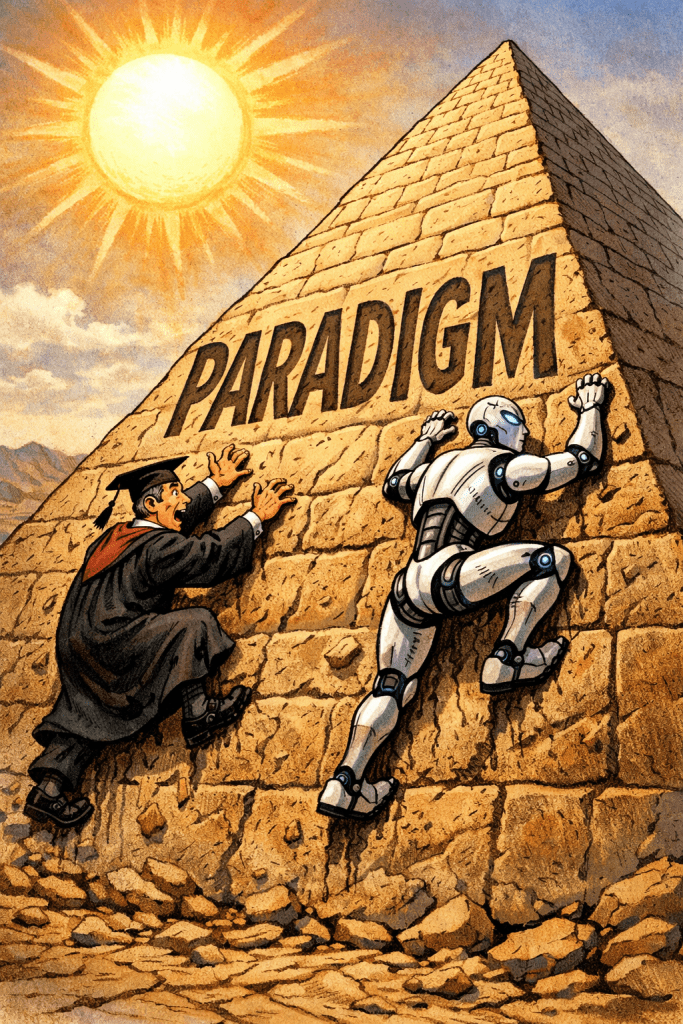
But in another sense, the shift is genuinely paradigmatic. The relationship between writer and text, between effort and product, between instruction and assessment—all of these are being restructured in ways that cannot be accommodated by simply adding an AI policy to an existing syllabus. When Sanz-Tejeda and her collaborators call for a wholesale rethinking of pedagogical assessment and institutional practices (5); when Shanley argues that the College Writing course has “no reason to exist—at least as long imagined” (3); when Liu and her colleagues insist that AI writing tools must be redesigned from the ground up on different pedagogical principles (7); and when Wang and Tian insist that equity must precede all other considerations (8)—together they are describing not adjustments but a different kind of enterprise. What writing instruction is for, who it is for, what it looks like in practice, and how its outcomes are recognized and evaluated: all of these are under reconstruction. If that is not a paradigm shift, it is something very close to one.
References
1. “AI and the Future of Writing-Process Instruction.” Educational Technology and Change Journal, June 1, 2026. https://etcjournal.com/2026/06/01/ai-and-the-future-of-writing-process-instruction/
2. Villasenor, John. “AI has rendered traditional writing skills obsolete. Education needs to adapt.” Brookings Institution, May 30, 2025. https://www.brookings.edu/articles/ai-has-rendered-traditional-writing-skills-obsolete-education-needs-to-adapt/
3. Shanley, Brett Jacinto. “AI & the End of College Writing as We’ve Known It.” Changing English: Studies in Culture and Education. Taylor & Francis, 2025. https://www.tandfonline.com/doi/full/10.1080/1358684X.2025.2598220
4. Elturki, Eman. “AI-Aware Process Writing Pedagogy: Rethinking the Process-Based Approach.” TESOL Journal 17, no. 2, April 14, 2026. https://onlinelibrary.wiley.com/doi/10.1002/tesj.70127
5. Sanz-Tejeda, Aránzazu, Juana Celia Domínguez-Oller, Josep María Baldaqí-Escandell, Raquel Gómez-Díaz, and Araceli García-Rodríguez. “The impact of generative AI on academic reading and writing: a synthesis of recent evidence (2023–2025).” Frontiers in Education 10, January 6, 2026. https://www.frontiersin.org/journals/education/articles/10.3389/feduc.2025.1711718/full
6. Zhu, Xinran, Cong Wang, and Duane Searsmith. “Writing With Machines and Peers: Designing for Critical Engagement with Generative AI.” arXiv:2511.15750, November 2025. https://arxiv.org/pdf/2511.15750
7. Liu, Yijun, John Gallagher, Sarah Sterman, and Tal August. “From Crafting Text to Crafting Thought: Grounding AI Writing Support to Writing Center Pedagogy.” Proceedings of the ACM CHI Conference on Human Factors in Computing Systems, Barcelona, April 2026. arXiv:2602.04047. https://arxiv.org/html/2602.04047
8. Wang, Chaoran, and Zhongfeng Tian, eds. Rethinking Writing Education in the Age of Generative AI. New York: Routledge, 2025. https://www.routledge.com/Rethinking-Writing-Education-in-the-Age-of-Generative-AI/Wang-Tian/p/book/9781032727653
###
Filed under: Uncategorized |



























































































































































































































































































































































































































































Leave a Reply