






By Jim Shimabukuro (assisted by Claude)
Editor
Summary: Genome sequencers, radiocarbon labs, and machine learning are teaching us to read the planet’s oldest trees. What they have written down is a record of Earth’s past, a hard look at its present, and a warning worth heeding.

On a wind-scoured ridge in the White Mountains of California grows a bristlecone pine that was already old when the first stone of the Great Pyramid was cut. It was a sapling before writing was invented and a mature tree when Rome fell, and it is standing yet. For most of human history, the only sensible response to a tree like this was to feel small in front of it. We can now do more than that. We can put questions to it and, for the first time, get answers at a speed the naturalists who first climbed these slopes would have found hard to believe.
The trees have not changed; our tools have. A ring of pale wood laid down over a single growing season is, in effect, a data point, and a five-thousand-year-old tree files thousands of them away in strict order. Reading that record once meant a lifetime bent over a microscope. Now genome sequencers, radiocarbon labs, and a new generation of machine-learning systems are drawing more out of ancient wood than a whole earlier generation of scientists could manage by hand. The oldest trees have been keeping careful notes all along. We are only now learning to read their handwriting.
A parts list five thousand years in the making
In early 2026, a team coordinated by the University of California, Davis published the first full genome of the Great Basin bristlecone pine, Pinus longaeva, the oldest individual, non-clonal organism known on Earth. [1] The scale of the thing is hard to hold in your head. The tree’s genome runs to roughly 24 billion base pairs, about eight times the size of ours, and yet it carries only slightly more protein-coding genes than a human does. Almost all the rest is repetitive DNA the tree has hauled through millions of years of evolution, apparently none the worse for it. “Assembling a 24 billion base pair genome that is eight times the size of the human genome is a significant technical challenge,” said Steven Salzberg of Johns Hopkins University, one of the study’s authors. [1]
Why sequence a tree that can outlive a hundred human generations? David Neale, the UC Davis plant scientist who led the project, will not let anyone oversell the answer. “It’s like having a parts list,” he said. “Sequencing one tree does not give us clear insights as to the genetic basis of longevity. But having a reference genome sequence… is a necessary reagent in modern biology. There is now a resource from which modern genetic discovery can begin.” [1] The sequence turned up genes for disease resistance and unusually long telomeres, the protective caps on chromosomes often associated with slow aging, though the team was careful to add that they found no firm evidence those telomeres are the reason the tree lasts so long. [1,2]
That caution is the point, because the bristlecone invites a fantasy. These trees do not seem to age the way animals do. They show few of the biological signs of senescence, and when one dies the cause is almost always something external: a storm, a fire, a bark beetle, an axe, rather than simple wearing out. Neale has fielded the hopeful questions for years. “People ask me… ‘David, tell me which is the longevity gene, and I will clone it, patent it and sell it,’” he said. “Of course, it’s massively complex. But there could be some fundamental discovery of the genetic basis of longevity in this one organism that could be applied to other organisms.” [1] A single longevity gene is almost certainly wishful. The real prize is humbler and larger at once: a reference against which the biology of endurance, in trees and perhaps in us, can at last be studied.
Teaching a machine to count the years
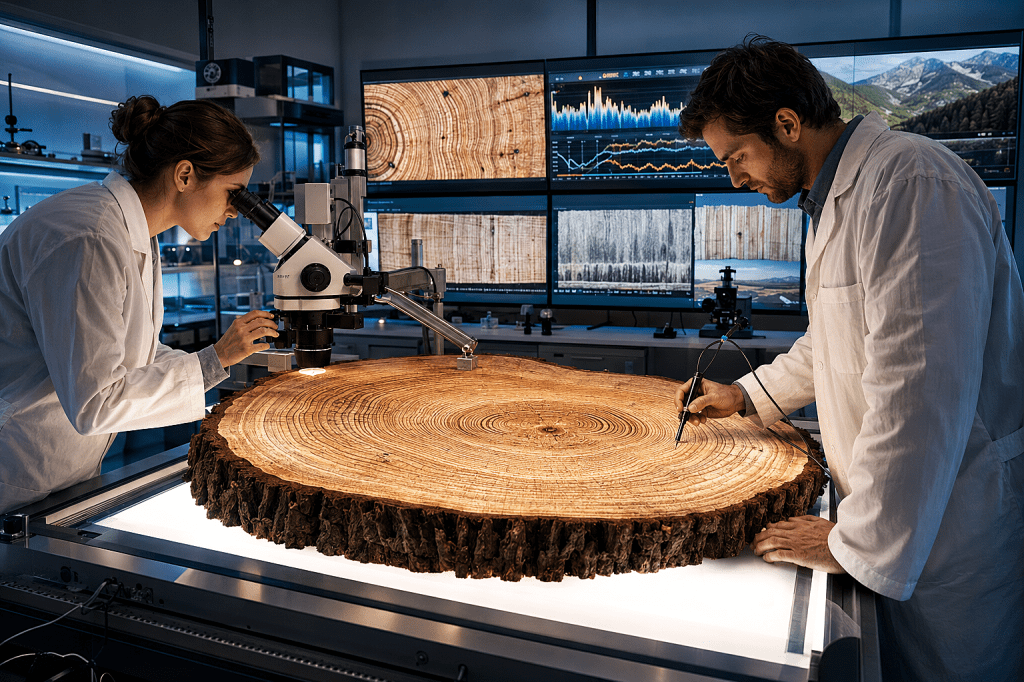
If the genome tells us what a tree is, its rings tell us what the tree has lived through, and here the daily work of science is being remade. Every ring is a season’s entry in a diary: a broad band for a kind year, a pinched one for a drought. Line the rings up across many trees and cross-date them the way a detective matches fingerprints, and they become a calendar accurate to the exact year, running back over millennia. The bottleneck was always labor. Measuring rings by hand is slow, precise work with a streak of subjectivity, and it caps how much wood any lab can ever get through.
That cap is beginning to give. In 2023, researchers led by Miroslav Poláček described a system that uses convolutional neural networks, the same image-recognition tools behind medical scans and face unlock on a phone, to find and measure tree rings on their own. [3] The authors were plain that the network is “not a substitute for a trained dendrochronologist,” and they designed it to hand its results into the software specialists already trust rather than to replace their judgment. [3] Still, the trajectory is unmistakable. Newer pipelines now count rings automatically with roughly ninety-six percent accuracy and measure their widths to within microns of a careful human hand. What this buys is not a robot that retires the expert. It lets a small field work through mountains of samples it could never have reached before, and do it the same way twice, so that another lab can check the result.
Not every claim to great age rests on rings you can count, and the same computational turn that speeds up ring measurement can also be used to estimate an age no core can reach. In Chile, a squat alerce known as the Gran Abuelo, the “great-grandfather,” has been put forward as a rival to the bristlecones, with a proposed age of about 5,484 years. That figure does not come from a complete core; the tree is too broad and too hollowed at the center for anyone to reach its first ring. Instead, the Chilean scientist Jonathan Barichivich built a statistical model, calibrated on fully dated alerce trunks and on how the species grows, and let it simulate the range of ages the tree might plausibly have reached, arriving at roughly 5,484 years with about an 80 percent chance it has passed 5,000. The estimate is disputed. Some dendrochronologists are unconvinced by an age drawn from a model rather than a ring-by-ring count, and the work has moved through conferences and interviews more than through the usual peer-reviewed channels. [11] It is a healthy reminder that the newest tools can widen what we are able to claim faster than they settle what we are able to prove.
A four-thousand-year weather station
Read enough rings and a forest turns into an archive of climate, and this is where the ancient trees pay their way for all of us, not only for biologists. At Columbia University’s Lamont-Doherty Earth Observatory, the dendrochronologist Ed Cook has spent decades converting rings into what he calls drought atlases: gridded, year-by-year maps of where the land ran wet and where it ran dry across whole continents, reaching back in some regions more than two thousand years. [4,5] Instrument records rarely stretch past a century, so these tree-built histories are how we know what the climate is capable of when no one is watching, including the megadroughts that held parts of North America in their grip for decades at a time, centuries before anyone kept a rain gauge. [4]
That long baseline is what makes the present so unsettling. In 2022, a team led by the UCLA climate scientist Park Williams used tree rings reaching to the year 800 to set the drought that has gripped southwestern North America since 2000 against the full sweep of the past. Their finding: this is the driest two-decade run the region has seen in at least twelve hundred years, and human-caused warming accounts for roughly forty percent of its severity. [6] Read without the ancient trees, the drought looks like a rough patch. Read with them, it becomes something the Southwest has not endured since the Middle Ages, and this time the dice are loaded by us.
A warning written in carbon
The rings hold more than rainfall. Because a tree builds its wood from carbon pulled out of the air, each ring is also a chemical snapshot of the atmosphere in the year it formed, and that has yielded one of the field’s most disquieting discoveries. In 2012, the Japanese physicist Fusa Miyake noticed a sudden, huge spike of radioactive carbon-14 in tree rings dated to the year 774. The likeliest culprit, researchers now think, was a solar storm of staggering force, at least ten times stronger than the 1859 Carrington Event that set telegraph wires sparking. [7] About nine of these “Miyake events” have since been found across the last fifteen thousand years, each one a mark the sky burned into the wood.
Here the deep past presses directly on the near future. A Miyake-scale storm arriving today would not merely singe telegraph lines. It could take out satellites, overwhelm power grids, and leave whole regions dark for months. [7] The oldest trees are the only long-run logbook we possess of how often the sun strikes that hard, and engineers now want that record as they try to harden the grids and communication networks modern life depends on. All this time, a five-thousand-year-old tree has been keeping watch on space weather.
Counting the rarest things alive
The newest science has made one more thing plain: how thin the ranks of these elders have grown. When researchers including Gianluca Piovesan and Charles Cannon pooled hundreds of thousands of tree-ring records from thousands of sites around the world, they found that trees older than two millennia are exceedingly rare, huddled in the coldest, driest, least disturbed pockets of the planet. [8,9] Such trees are not simply old. They are, Piovesan argues, irreplaceable, living stores of genetic and ecological memory that a forest cannot regrow on any human timescale once they are lost. [8] The instruments that let us read them keep getting sharper. The trees are not making more of their kind.
The very traits that make the elders precious to science, their great age and their harsh, marginal homes, also leave them exposed. Heat, drought, and bark beetles have already killed bristlecones that stood for thousands of years, and even the toughest survivors are being nudged toward the limit of what they can bear. [1] That gives the current wave of research its edge of urgency. We have reached the point where we can finally question these organisms in depth, and we have reached it just as the conditions that made them are shifting beneath their roots.
Reading the handwriting
It is worth sitting for a moment with how improbable this convergence is. Valerie Trouet, the dendrochronologist whose book Tree Story carried ring science to a wide readership, describes a tree ring as a line of text in a book the tree writes about its own life, wide lines for the good years and cramped ones for the hard years. [10] For nearly all of history we could hold that book without reading a word of it. Now the sequencer reads the tree’s inheritance, the neural network reads its diary faster than any human hand, and the radiocarbon lab reads the fingerprints the sky left in its grain. The people leading this work, Neale and Salzberg on the genome, Cook and Williams on climate, Miyake on the sun, Piovesan and Cannon on conservation, and Trouet as its clearest translator, are not chasing one breakthrough. They are building a way of listening.
What comes back, when we listen, is not prophecy; trees do not foretell anything. But they hold the longest continuous, precisely dated record of the living world found anywhere on land, and that record has a way of resetting our sense of scale. It tells us the sun has struck this planet harder than our grids are built to survive, that the current drought is not ordinary but historic, and that the organisms best placed to have witnessed all of it are among the rarest living things left to us. The oldest trees remember what we have forgotten and much we never knew. They have been speaking for a long time. The new thing is that we have finally built the instruments to hear them, and that we still hold a narrow window in which to act on what they say.
References
- Kerlin, Kat. “Unlocking Longevity Insights From Ancient Bristlecone Pine.” UC Davis News, March 23, 2026. https://www.ucdavis.edu/climate/news/unlocking-longevity-insights-ancient-bristlecone-pine
- Neale, D. B., et al. “A reference genome sequence for the exceptionally long-lived Great Basin bristlecone pine, Pinus longaeva.” G3: Genes|Genomes|Genetics, 2026. https://academic.oup.com/g3journal/advance-article/doi/10.1093/g3journal/jkag064/8526579
- Poláček, M., et al. “Automation of tree-ring detection and measurements using deep learning.” Methods in Ecology and Evolution, 2023. https://besjournals.onlinelibrary.wiley.com/doi/10.1111/2041-210X.14183
- Lamont-Doherty Earth Observatory. “Using Tree Ring Records to Decode Earth’s Climate History” (Ed Cook). Columbia University. https://lamont.columbia.edu/news/using-tree-ring-records-decode-earths-climate-history
- Cook, E. R., et al. “The Tree-Ring Drought Atlas Portal: Gridded Drought Reconstructions for the Past 500–2,000 Years.” Bulletin of the American Meteorological Society, 2021. https://journals.ametsoc.org/view/journals/bams/102/10/BAMS-D-20-0142.1.xml
- “Megadrought in southwestern North America is region’s driest in at least 1,200 years” (Williams et al., Nature Climate Change). UCLA Newsroom, February 14, 2022. https://newsroom.ucla.edu/releases/megadrought-southwestern-north-america
- “WVU researcher says ancient tree rings may help Earth prepare for dangerous space weather.” WVU Today, October 17, 2024. https://wvutoday.wvu.edu/stories/2024/10/17/wvu-researcher-says-ancient-tree-rings-may-help-earth-prepare-for-dangerous-space-weather
- “Ancient trees deemed vital to forest survival” (Cannon, Piovesan, et al.). The Morton Arboretum, 2022. https://mortonarb.org/news/ancient-trees-deemed-vital-to-forest-survival/
- Piovesan, G., and Cannon, C. H., et al. “Climate-driven patterns of global tree longevity.” Communications Earth & Environment, 2025. https://www.nature.com/articles/s43247-025-02609-2
- Trouet, Valerie. Tree Story: The History of the World Written in Rings. Johns Hopkins University Press, 2020. Author page: https://www.valerietrouet.com/tree-story.html
- “Is the world’s oldest tree growing in a ravine in Chile?” (Jonathan Barichivich, Gran Abuelo age estimate). Science / AAAS, 2022. https://www.science.org/content/article/world-s-oldest-tree-growing-ravine-chile
Note: Quotations are drawn verbatim from the cited public sources. Where a figure is described in the text (genome size, drought ranking, storm strength, ring-counting accuracy), it reflects the numbers reported in those sources.
###
Filed under: Uncategorized |



























































































































































































































































































































































































































Leave a Reply