






By Jim Shimabukuro (assisted by Claude)
Editor
Summary: A viral video gives the television five to ten years to live and says Japan has already built its replacement out of thin air and laser light. The claim is bigger than the evidence. The evidence is bigger than you might think.

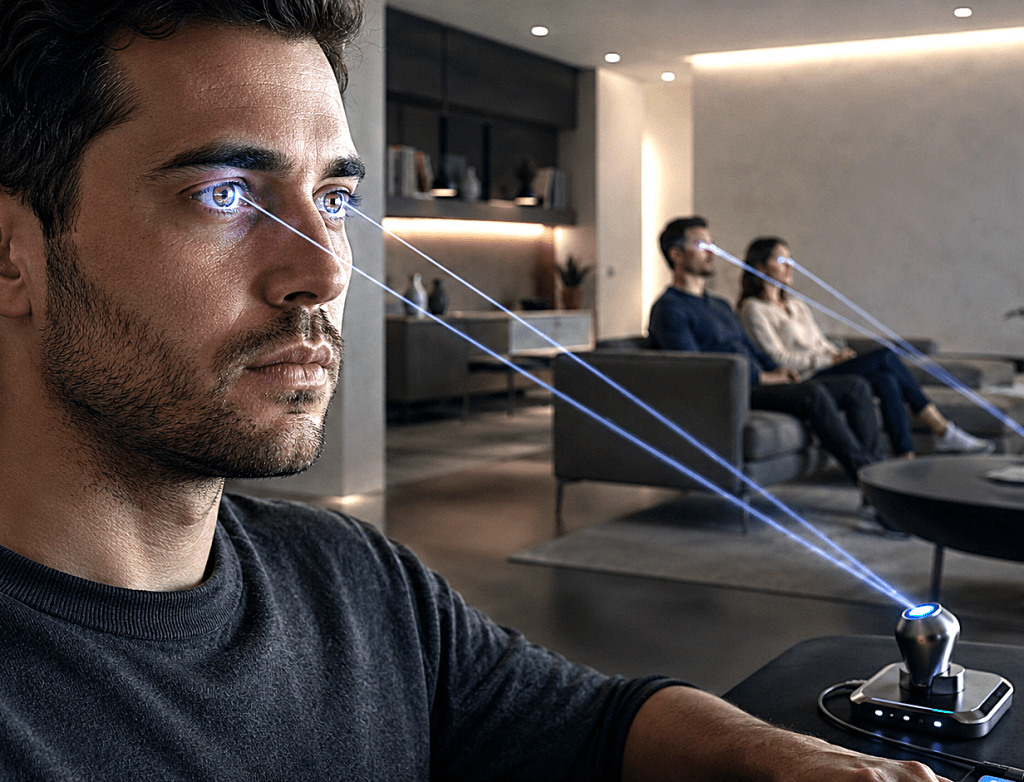
At the headquarters of Hiroshima Bank, in a lobby that looks like any other, customers stand at a cash machine and press buttons that do not exist. There is no glass panel and no touchscreen, only an image hanging in the air, formed by a plate of microscopic mirror structures that catches light from a hidden display and reassembles it, ray by ray, at a point in empty space. An infrared sensor watches for fingers. When one crosses the plane where a button appears to float, the machine registers a press. And because the floating image is visible only within a cone of roughly twenty degrees, the person standing next in line sees nothing at all: not the menu, not the balance, not the PIN [2].
That machine is the opening scene of “Japan’s New Invention Could Replace Television Forever,” a video posted to YouTube on August 23, 2026, by the channel rubenfoto1 [1]. Its thesis is blunt. The flat panel, meaning the television, the monitor, the phone, all the “flat rectangles of glass” through which modern visual life is delivered, is living on borrowed time, and within five to ten years it will begin to give way to displays with no surface at all. Some will float in the air. Some will wrap a scene around you in three dimensions with nothing strapped to your face. The most radical will skip every intermediate surface and draw the picture directly on your retina.
The internet manufactures claims like this by the hour. What makes this one worth more than a shrug is that nearly every company, machine, date, and dollar figure in the video turns out to be real. So this article does three things. It summarizes the video’s argument for readers who have not watched it. It tests the argument’s evidence against primary sources, because a story this good deserves to be checked rather than merely enjoyed. And then it goes looking for the parts of the picture the video leaves out: what the United States, China, South Korea, and Europe are actually doing, where artificial intelligence fits, which obstacles are still standing, and what a plausible, rather than cinematic, version of the next ten years looks like.
The video’s core argument fits in a single sentence, and it is a genuinely useful sentence: every previous revolution in television changed what the screen shows, while this one changes whether there is a screen. From black-and-white to color, from tubes to plasma to OLED, from standard definition to 8K, each upgrade improved the glowing surface without ever questioning it. Around that observation the video organizes three Japanese technologies, each attacking the surface from a different direction.
The first removes the glass. Asukanet, a company from Hiroshima that spent its early life producing photo books and handling funeral services, began patenting an optical component called the ASKA3D plate around 2011. The plate is a panel filled with an enormous array of microscopic mirrors. Place an ordinary display on one side at an angle, and light from it passes through the plate and reconverges on the other side at the same distance, forming a faithful copy of the image in midair. It is not fog, not vapor, not a stage illusion that needs darkness; the light is physically present at that point in space. Pair the plate with an infrared touch sensor and the floating image becomes a floating touchscreen [2]. This is the technology behind the Hiroshima Bank machines, and it has quietly spread through Japanese public life: in 2022, for instance, a town office in Sakai installed resident ticket machines with touchless aerial displays, a deployment pitched partly on hygiene grounds in the wake of the pandemic [3].
The video’s sharpest piece of evidence for how seriously rivals take this technology comes from South Korea. In July 2026, the country’s Electronics and Telecommunications Research Institute announced that it had finally produced, domestically, the core optical component of what it calls hovering hologram technology: the special mirror-reflector sheet that makes touchable midair images possible, until now “exclusively supplied by a Japanese company” [4]. The announcement listed the applications Korea has in mind, from sterile surgical displays to elevator buttons. The video reads the announcement as a declaration of war, which is colorful, but the underlying point survives contact with the source: a national research institute spent years reverse-engineering a component precisely because one Japanese firm had it locked up. Nations do not do that for party tricks.
The second technology removes the screen entirely, and it comes from a company most people associate with cassette tapes. TDK, founded in 1935 and later the world’s dominant maker of the microscopic magnetic recording heads inside hard drives, has developed what it calls a full-color laser module: a device weighing 0.38 grams, lighter than a paperclip, that merges red, green, and blue laser light inside a flat optical chip jointly developed with the telecom giant NTT, producing a beam capable of about 16.2 million colors [5]. A tiny moving mirror steers that beam through the optics of a pair of glasses and paints the image line by line directly onto the retina, the way an old cathode-ray tube painted a phosphor screen with electrons, except the canvas is the back of your eye. Because the beam enters through the center of the pupil, the picture does not depend on the eye’s lens focusing it. A journalist who tried the system at the CEATEC trade show reported that projected text “remained sharp as I looked at things close to me or far away” [6]. People who are nearsighted, farsighted, or astigmatic see it clearly without their prescription; TDK’s partner QD Laser has taken the same principle further and built retinal-projection eyewear for people with low vision, which clinical researchers have found can outperform conventional low-vision aids for some tasks [10].
What moves this from laboratory curiosity to industrial strategy is TDK’s recent buying spree, and here the video’s timeline checks out almost to the day. In October 2024, TDK announced the world’s first full-color laser control device for 4K smart glasses, built on a thin film of lithium niobate, a crystal borrowed from fiber-optic networks that can modulate visible light more than ten times faster than conventional approaches [7]. In 2025 it acquired SoftEye, an American designer of chips and algorithms for smart glasses, and in January 2026 it stood up a dedicated business organization, TDK AIsight. In June 2026 it signed a cooperation agreement with QD Laser covering next-generation light-source modules and optical engines, including the transfer of key retinal-projection patents [8]. And on August 18, 2026, days before the video appeared, TDK announced it had acquired the assets of OQmented, a German specialist in the mirror-based laser scanning at the heart of such systems, folding the technology into AIsight with the stated aim of building a vertically integrated display platform for smart glasses [9]. Companies do not assemble supply chains like that to publish research papers.
The third approach removes the headset. Sony’s Spatial Reality Display, currently sold as the 27-inch ELF-SR2, uses a high-speed camera to track the viewer’s eyes and serves each eye its own correct perspective, so that objects appear to float in front of the panel and recede behind it, with no glasses and no goggles [11]. In 2026 Sony wrapped that hardware into a larger ecosystem called XYN: a phone app and cloud service that photograph real places and objects and reconstruct them as photorealistic three-dimensional assets, with the capture tools reaching professional customers in the United States in the summer of 2026 [12]. When PetaPixel’s editor-in-chief tried Sony’s experimental large-format immersive version at the CP+ show in Yokohama in March, he described it as “like wearing the Apple Vision Pro, but without the headgear,” and judged its depth effect roughly twice as immersive as the Vision Pro’s photographic mode [13]. That sentence is Japan’s whole display philosophy in miniature: everyone agrees immersive three-dimensional imagery is coming; the American answer straps a computer to your face, and the Japanese answer keeps your face empty.
Behind Sony stands NHK, Japan’s public broadcaster, which thinks in decades. Its research laboratories began studying high-definition television in the 1960s, launched it as a real service decades later, then repeated the trick with 8K. Its declared next step after 8K is three-dimensional spatial imaging, and it has working hardware: a system called Aktina Vision that captures a scene from a grid of viewpoints and physically reconstructs the light rays, weaving 72 separate images through an 8K projection system into a single volume of light that can be viewed from different angles with the naked eye [14]. At its May 2026 open house in Tokyo, NHK showed its latest light-field display research, including a thin light-field headset that lets the eyes focus naturally at different depths to reduce the visual fatigue that plagues conventional VR [15]. None of this is a product. All of it is a broadcaster telling you its road map, the same way it told you about HDTV thirty years before you owned one.
Finally, the money. In March 2026, Nikkei Asia reported, and Reuters confirmed, that Washington and Tokyo were discussing a state-backed, next-generation display factory in the United States to be operated by Japan Display Inc., worth up to 13 billion dollars, inside a broader Japanese investment framework of roughly 550 billion dollars aimed at strategic American industries and explicitly framed as a counter to Chinese dominance of display manufacturing [16]. The day the news broke, JDI’s stock surged about 80 percent [17]. Displays, in other words, are now discussed in the same national-security breath as semiconductors. The video’s remaining exhibits round out the vision at both ends of the scale: a University of Tokyo team led by Takao Someya has demonstrated an ultrathin, elastic display that sticks to the skin like a bandage and can show messages, heart waveforms, and simple graphics on the back of a hand, with elderly care as the imagined first use [20], and the narrator closes the technical tour with a claim about liquid-crystal panels small enough for contact lenses, to which we will return, because it is one of the few claims that could not be verified.
And the video, to its credit, remembers the graveyard. In December 2011, Toshiba launched the Regza 55X3, a 55-inch glasses-free 3D television with four times full-HD resolution that tracked the viewer’s face to aim a separate image at each eye. It cost roughly 900,000 yen, around 11,500 dollars at the time [19]. It failed, the whole 3D television era failed with it, and the industry drew the lesson that people do not want a fancier rectangle. The video’s answer to that history is its best analytic move: 3D TV died because it was the same experience with an extra tax on it, whereas a floating ATM that makes shoulder-surfing physically impossible, a laser display that a legally blind person can see, and a 3D screen a design team can stand around together each do something the flat panel is physically incapable of doing. Gimmicks add; replacements remove.
Checked against primary sources, the video’s factual spine holds up unusually well for the genre. The Hiroshima Bank machines exist, complete with the twenty-degree privacy cone [2]. The ETRI announcement happened in July 2026, in substantially the terms described [4]. TDK’s 0.38-gram laser module, the NTT-developed optical chip, the 16.2 million colors, the lithium-niobate 4K device, the SoftEye purchase, the January 2026 creation of TDK AIsight, the QD Laser patent transfer, and the August 2026 OQmented acquisition are all documented in TDK’s own press releases [5,7-9]. Sony’s ELF-SR2 and the summer 2026 American launch of XYN’s capture tools are confirmed [11,12], and the flattering Vision Pro comparison is a real quote from a real editor, published March 10, 2026 [13]. The 13-billion-dollar factory reports, the 550-billion-dollar framework, and the 80 percent stock surge are all on the record [16,17]. Even the Toshiba obituary is accurate down to the price tag [19].
The wobbles are the ordinary kind. The narration, evidently working from automatic transcription, garbles names: Asukanet becomes “OUKet,” NTT becomes “NT,” the housebuilder Daiwa House becomes “Dia House.” It places the QD Laser agreement “in the same period” as January 2026 when the agreement was actually signed on June 1, 2026 [8], and it compresses NHK’s cautious, many-flavored research program into a tidier road map than the lab itself publishes. None of this changes the substance; all of it is worth knowing before you repeat the details at dinner.
Three claims could not be verified from freely accessible sources, and intellectual hygiene requires saying so. First, the striking claim that engineers from Citizen Finedevice presented liquid-crystal panels for contact-lens displays, under five millimeters across, at the Photonics West conference in January 2026. Citizen Finedevice is a real maker of liquid-crystal microdisplays, so the claim is plausible, but no accessible conference record confirms it, and an independent list of display papers from the relevant SPIE meeting compiled by veteran display analyst Karl Guttag does not include it [37]. Second, the specific assertion that NHK has stated a target of “around 2030” for introducing three-dimensional television; NHK’s published materials describe spatial imaging as the next step and show the hardware freely [14,15], but the crisp date does not appear in accessible English-language sources. Third, some of the listed aerial-display deployments, such as station guides and airport signage, rest on vendor and trade accounts rather than independent reporting. None of these appear to be fabrications. They are the parts a careful reader holds loosely.
The logic deserves the same scrutiny as the facts. The video’s strengths are real: the gimmick-versus-replacement filter is a better analytic tool than most professional trend pieces manage, and the video honestly concedes that the Star Wars fantasy, a bright, solid, walk-around hologram floating in open air, remains experimental everywhere on Earth. But three moves should trigger a reader’s skepticism. The first is category conflation. A kiosk plate that floats a bank menu, a laser that draws on retinas, and a light-field display for studios share a slogan, “screenless,” but not a market, a price point, or a physics problem; evidence for one is quietly presented as evidence for all. The second is the leap from deployment to destiny. ATMs and ticket machines prove the technology works; they do not prove it will conquer the living room, any more than holographic exhibits at trade shows proved that in the 1990s. The third is the deadline itself. The five-to-ten-year horizon appears in none of the video’s underlying sources. It is the video’s own invention, and it does the headline’s work without the evidence’s permission. Even the money is softer than it sounds: analysts at Omdia who examined the proposed Japan Display factory note that the company’s veteran engineers have largely departed, that key equipment has been sold to China, and that the 13-billion-dollar figure far exceeds what comparable plants cost to build, concluding bluntly that “it is prudent to remain skeptical of the latest news” [18].
The video presents the screenless turn as a disruption sneaking up on everyone. The record says otherwise. The largest force pushing displays off of surfaces is not Japanese, does not float, and has been unfolding in public for years: it sits on faces, and America leads it.
In September 2025, Meta launched Ray-Ban Display, its first mass-market glasses with a built-in screen, a small full-color panel floating in the right lens, controlled by a wristband that reads the electrical signals of the wearer’s hand muscles, at 799 dollars [21]. Demand embarrassed the supply chain. By January 2026 Meta had paused the planned international rollout entirely, citing “unprecedented demand and limited inventory,” with U.S. waitlists stretching months [22]. EssilorLuxottica, the Franco-Italian eyewear giant that manufactures the line, reported that sales of Meta glasses more than tripled in 2025 [23]. The market numbers behind those anecdotes are steep. IDC counted about 2.25 million display-less smart glasses shipped in the first quarter of 2026 alone, up 167 percent in a year, nearly matching all of 2024, and projects display-equipped glasses to grow from about 3 million units in 2026 to more than 12 million in 2030 [24]. Omdia, counting the broader “AI glasses” category, put 2025 shipments at 8.7 million units, up 322 percent, with Meta holding about 85 percent of the market [25].
The rest of Silicon Valley is converging on the same object. At Google I/O in May 2026, Google and Samsung showed intelligent eyewear running Gemini, built with the frame brands Warby Parker and Gentle Monster; audio-first models arrive in the fall of 2026, with display versions to follow [26]. Apple, according to extensive reporting, shelved a planned overhaul of its 3,500-dollar Vision Pro headset in late 2025 specifically to redirect engineers toward smart glasses [27], now expected around late 2027 [28]. Read that sequence against the video’s framing and an irony emerges: the American giants are abandoning the very headset strategy the video uses as its foil, and racing toward light, screen-bearing eyewear, which is to say, toward the same finish line as TDK, just starting from the assistant rather than from the optics.
China is the fastest-growing market and, increasingly, a maker as well as a buyer. Omdia found mainland China took nearly 11 percent of global AI-glasses shipments in 2025, second only to the United States, and that Chinese manufacturers controlled about 71 percent of the still-small display-equipped segment [25]. Firms like Rokid, Xiaomi, RayNeo, and XREAL are shipping glasses that project virtual screens for translation, navigation, and teleprompting at prices well below Meta’s [29]. Beneath the gadgets sits the deeper Chinese advantage the video does get right: BOE, TCL CSOT, and their peers dominate the manufacture of today’s flat panels, which is precisely why Washington and Tokyo are discussing a 13-billion-dollar hedge [16,17]. South Korea, for its part, is playing both sides: ETRI’s localization of the aerial-display component [4] complements Samsung’s eyewear partnership with Google [26]. And Europe’s position is instructive in a sadder way. Its research institutes fill the optics conferences, its one standout laser-scanning startup, OQmented of Germany, ended up sold to TDK [9], and its most powerful player in the entire story turns out to be an eyewear company, EssilorLuxottica, supplying the frames for an American platform [23].
The video barely mentions artificial intelligence, which is its largest omission, because AI answers the question every display revolution must answer: why now? The industry’s own vocabulary gives the game away. The category Omdia counts is not “smart glasses” but “AI glasses” [25]. Mark Zuckerberg, whose company sells most of them, put the logic plainly on an earnings call: “I continue to think that glasses are basically going to be the ideal form factor for AI. Because you can let an AI see what you see throughout the day, hear what you hear, and talk to you.” He went further, predicting that people without AI glasses would eventually be at “a pretty significant cognitive disadvantage” [30]. Whatever one thinks of that future, it explains the present: nobody wears a display on their face all day to watch reruns. They wear it because an assistant that can see what they see is useful in a way a television never was. AI is not a feature of the screenless display. It is the reason the screenless display finally has a job.
AI also attacks the problem that actually killed 3D television: content. Glasses-free spatial displays are worthless without spatial material to show, and producing it by hand is brutally expensive. That is what Sony’s XYN is for, using cloud reconstruction to turn ordinary photographs of real places into photorealistic three-dimensional assets [12], and what NHK’s real-time ray-tracing research is for at the broadcast end [15]. Beyond Japan, so-called world models are collapsing the cost further: World Labs, the startup founded by AI pioneer Fei-Fei Li, released Marble in late 2025, a commercial model that generates explorable, downloadable 3D environments from a text prompt or a single photograph [31]. When generating a navigable three-dimensional scene becomes as cheap as generating a paragraph, the content famine that starved 3D TV in 2011 does not recur. Machine vision likewise sits inside the hardware itself: eye tracking in Sony’s displays, gesture recognition above floating buttons, the scene understanding in every pair of camera glasses. Strip the AI out of any of these systems and they stop working. To the question “to what extent will AI play a role,” the honest answer is: it is the load-bearing wall.
Set aside the deadline and the video’s central insight survives every test applied to it: the technologies worth watching are the ones that remove a limitation no flat panel can remove. Privacy, for one, becomes a property of physics rather than policy; a screen visible only inside a narrow cone cannot be shoulder-surfed, which is why a bank was the first customer [2]. Hygiene, for another: a button made of light carries no fingerprints and no pathogens, the explicit selling point of the town-office machines installed during the pandemic’s long tail [3]. Accessibility may be the most profound. A retinal laser image stays in focus regardless of what the eye’s own optics are doing, so presbyopic, myopic, and astigmatic viewers see it sharply without correction [6], and for people with low vision, projection that partially bypasses the eye’s damaged front end can outperform conventional aids [10]. No television ever made can do that; for some users this is less a display than a prosthesis. And spatial displays without headsets restore something headsets destroyed: company. A surgeon, a design team, or a classroom can stand around a floating anatomy model and see it together, no isolation, no motion sickness, no headset hair [11,13]. Each advantage is a subtraction. That is the pattern that separates this wave from the 3D televisions in the graveyard.
Now for the obstacles, which are substantial. Start with physics and engineering. Laser-beam scanning, the technique at the heart of retinal projection, has a long history of humbling its believers: Intel’s Vaunt glasses were killed in 2018, the startup North sold its Focals and was absorbed by Google, and Microsoft’s HoloLens 2, the most prominent laser-scanned display ever shipped, drew withering technical criticism for image quality [34,35]. Display analysts who have tracked virtual retinal displays since the 1990s note that the idea is now on at least its second coming [36]. The TDK demonstration that so impressed journalists ran at 720p [6], far below what anyone would accept from a television, and every eyewear display fights the same three-way war among brightness, field of view, and the size of the sweet spot in which the image is visible at all. Aerial-imaging plates, meanwhile, remain expensive, dim in bright environments, and constrained to that narrow viewing cone, which is a feature at an ATM and a bug in a living room. And the free-floating, walk-around hologram stays where the video honestly leaves it: experimental, everywhere.
Then there is manufacturing, where the 13-billion-dollar factory deserves a colder look than its press coverage received. Omdia’s display-manufacturing practice notes that Japan Display has lost money for years, that its veteran technologists have retired or moved to rival panel makers, that equipment once considered for an American plant has been sold and shipped to China, and that comparable factories in China cost six to nine billion dollars, implying the American figure is either inflated or reflects painful cost disadvantages. Their analyst’s summary: prudent skepticism, with a real chance the story fades “into the dustbin of well-intentioned” projects [18]. A revolution that depends on a factory that may never be built is a revolution on a contingency.
The human obstacles may bind tightest of all. Cameras on faces invite social backlash, as Google Glass learned a decade ago, and always-on assistants that see everything you see raise privacy questions no privacy policy has yet answered convincingly; Meta’s own executives describe the ambition as an AI with context on “everything going on in a person’s life,” which is the pitch and the problem in one sentence [30]. Lasers aimed at retinas are engineered to be safe within international eye-safety limits, but regulatory classification is not the same as public comfort, and “it draws on your eyeball” is a sentence marketing departments will have to survive. Batteries, heat, and weight still fight every gram in an eyeglass frame. Content, the assassin of 3D TV [19], is only beginning to exist in spatial form. And the television itself is a formidable incumbent: cheap, communal, effortless, and very good at its job. Technologies rarely die because something better exists; they die when the better thing is also cheaper and easier, which no screenless display yet is.
So, is it really happening on the video’s timeline? The most defensible answer: the direction is real and the deadline is not. Nothing in the verifiable record supports flat panels becoming obsolete within five to ten years. What the record does support is a sequence. Aerial displays keep colonizing niches where their advantages are decisive: banks, hospitals, elevators, cars, clean rooms. Display-bearing glasses go from about three million units in 2026 toward the tens of millions by 2030 [24,25], absorbing more and more of the phone’s jobs, with Google’s and Apple’s entries [26-28] marking the moment the category stops being a Meta experiment and becomes an industry. Spatial displays stay professional through the decade, in design studios, operating theaters, and virtual production stages, while NHK works patiently toward broadcast-grade light fields on its own multi-decade clock [14,15]. Meanwhile the television dies the way it was already dying, not by laser but by neglect. Nielsen’s measurements tell that story without any help from Japan: streaming passed broadcast and cable combined for the first time in May 2025 [32], and by May 2026 held 48.6 percent of American TV time, with YouTube alone at 13.8 percent while cable news shed viewers by double digits [33]. The rectangle is not being murdered. It is being drained.
For individuals, the nearest changes are quietly humane. Retinal projection is a genuine accessibility technology; a class of devices that lets low-vision users read and aging eyes see sharply without correction will matter to millions of people long before it matters to Hollywood [10,6]. The less comfortable change is the one Zuckerberg names with unnerving cheer: if useful intelligence increasingly arrives through eyewear, then access to it becomes a new axis of inequality, his “cognitive disadvantage” [30], layered on top of every existing digital divide. Households will negotiate new etiquette, because a person wearing a display is a person whose attention you can no longer verify, and whose glasses may be recording.
For education, the field this journal serves, the interesting hardware is not the headset but the shared spatial display, precisely because it does not isolate. A glasses-free 3D panel showing a beating heart, a fault line, or a cathedral, visible to a whole cluster of students at once [11], fits the social reality of classrooms in a way individually-sealed headsets never have, and live translation and captioning in ordinary-looking glasses [26] arrives as an accessibility tool teachers did not have to request. The risks arrive in the same package: distraction that is invisible to the instructor, assessment in a world where the answer can be painted on a student’s retina, and procurement budgets asked to chase yet another device cycle before the evidence of learning gains exists.
For corporations and for governments, displays have stopped being a commodity and become terrain. The proposed JDI plant, whatever its fate, marks the first time in a generation that Washington has treated display manufacturing as strategic rather than disposable [16,17], and Korea’s determination to localize a single Japanese optical component shows how the pattern repeats down the supply chain [4]. If eyewear does absorb the phone’s functions, then the smartphone wars replay on faces: platform gatekeeping, app-store politics, antitrust, and a new advertising surface that overlays the physical world, with all the regulatory fights that implies. The political dimension is the least discussed and may prove the largest. A screen on a wall is a shared, inspectable object; what appears on it can be seen, disputed, and regulated in public. An image drawn on one person’s retina is none of those things. When the primary display becomes private, personalized, and mediated by whoever runs the assistant, the questions that already haunt social media, who filters reality, who verifies it, who profits from distorting it, migrate from the feed to the field of view. The fight over screens becomes a fight over sightlines, and provenance standards for what AI paints into a citizen’s eye will sound less like science fiction with every passing budget cycle.
The video ends with a genuinely lovely line: “We were never in love with televisions. We were in love with the images. The box was just the cage they came in” [1]. As prophecy, it is half right, and the half that is right is the half that matters. Something real is happening: a bank you can visit, patents you can read, acquisitions with dates, governments treating light itself as strategic infrastructure. But the box was never only a cage. It was also the thing that made images shared, bounded, and public, and what replaces it will redistribute those properties in ways no one, including the optimists in Hiroshima, has fully priced.
For readers who want to track whether the screenless future is arriving on schedule, three signals will tell the story better than any headline. Watch whether retinal-projection glasses reach consumers at consumer prices with resolution that no longer requires apologies. Watch whether spatial content pipelines, Sony’s, NHK’s, and the AI world models, make three-dimensional material as abundant as video. And watch whether the Japan Display factory gets built, because it is the cleanest test of whether the money behind this story is conviction or theater. The screen in your living room will almost certainly still be there in 2036. But it may be there the way radio is still here: everywhere, useful, and no longer where the future lives. The cage is opening. The bird, for now, is in no hurry.
References
1. rubenfoto1, “Japan’s New Invention Could Replace Television Forever,” YouTube, August 23, 2026. https://www.youtube.com/watch?v=qlHN1z-QAx4
2. “ATM x ASKA3D Holographic Display = Future is here!!,” Asukanet Co., Ltd. via AVIXA Xchange, April 2025. https://xchange.avixa.org/posts/atm-x-aska3d-holographic-display-future-is-here
3. “Touchless Aerial Display Technology Adopted by Sakai Town Office for Ticket Machines,” Mitsui Chemicals, Inc., press release, May 19, 2022. https://jp.mitsuichemicals.com/en/release/2022/2022_0519/index.htm
4. “ETRI Localizes Air-Touch Hologram Component, Ending Japan’s Monopoly,” Seoul Economic Daily (English), July 21, 2026. https://en.sedaily.com/society/2026/07/21/etri-localizes-air-touch-hologram-component-ending-japans
5. “TDK showcases smart glasses equipped with ultra-compact full color laser module at major exhibitions,” TDK Corporation, press release, October 13, 2022. https://www.tdk.com/en/news_center/press/20221013_01.html
6. Hubert Nguyen, “I Have Tested TDK’s Direct Retinal Projection System,” Ubergizmo, October 2023. https://www.ubergizmo.com/2023/10/i-have-tested-tdks-direct-retinal-projection-system/
7. “TDK develops world’s first full-color laser control device for 4K smart glasses,” TDK Corporation, press release, October 9, 2024. https://www.tdk.com/en/news_center/press/20241009_01.html
8. “TDK and QD Laser enter into business cooperation agreement for retinal projection optical engines for smart glasses,” TDK Corporation, press release, June 1, 2026. https://www.tdk.com/en/news_center/press/20260601_02.html
9. “TDK acquires assets from OQmented to advance AR display technologies,” TDK Corporation, press release, August 18, 2026. https://www.tdk.com/en/news_center/press/20260818_01.html
10. “Head-Mounted Laser Projector May Outperform Other Low Vision Aids,” Review of Optometry. https://www.reviewofoptometry.com/news/article/headmounted-laser-projector-may-outperform-other-low-vision-aids
11. “ELF-SR2 Spatial Reality Display,” Sony Professional. https://pro.sony/ue_US/products/spatial-reality-displays/elf-sr2
12. “Launch of XYN Spatial Capture Solution for Professionals,” Sony XYN news, 2026. https://xyn.sony.net/en/news/2026-spatial-press
13. “The Sony XYN Immersive Display Feels Like Apple Vision Pro Without Goggles,” PetaPixel, March 10, 2026. https://petapixel.com/2026/03/10/the-sony-xyn-immersive-display-feels-like-apple-vision-pro-without-googles/
14. “NHK develops glasses-free 3D,” Advanced Television, April 29, 2020. https://www.advanced-television.com/2020/04/29/nhk-develops-glasses-free-3d/
15. “NHK Develops New Head Mounted VR Display,” PRONEWS, May 21, 2026. https://en.pronews.com/news/20260521204115058.html
16. “US, Japan eye $13bn Japan Display plant as part of $550bn package,” Nikkei Asia, March 2026. https://asia.nikkei.com/business/electronics/us-japan-eye-13bn-japan-display-plant-as-part-of-550bn-package
17. “America and Japan may join forces to manufacture displays in the US — new $13 billion fab proposed by Japan Display Inc. to counter Chinese dominance,” Tom’s Hardware, March 2026. https://www.tomshardware.com/tech-industry/america-and-japan-may-join-forces-to-manufacture-displays-in-the-us-new-usd13-billion-fab-proposed-by-japan-display-inc-to-counter-chinese-dominance
18. Charles Annis, “Japanese government and JDI eye display factory in the US: Context, history, and possibilities,” Omdia, March 2026. https://omdia.tech.informa.com/blogs/2026/mar/japanese-government-and-jdi-eye-display-factory-in-the-us-context-history-and-possibilities
19. “Toshiba 55X3 4K 3DTV launches December 10th in Japan, no glasses necessary,” Engadget, December 7, 2011. https://www.engadget.com/2011-12-07-toshiba-55×3-4k-3dtv-launches-december-10th-in-japan-no-glasses.html
20. “Japanese researchers develop ultrathin, highly elastic skin display,” University of Tokyo via EurekAlert!, February 2018. https://www.eurekalert.org/news-releases/597107
21. “Meta Ray-Ban Display: Breakthrough AI Glasses Available Now,” Meta Newsroom, September 2025. https://www.meta.com/blog/meta-ray-ban-display-ai-glasses-connect-2025/
22. David Phelan, “Meta Ray-Ban Display Smart Glasses Are Delayed, Company Admits,” Forbes, January 8, 2026. https://www.forbes.com/sites/davidphelan/2026/01/08/meta-ray-ban-display-smart-glasses-are-delayed-company-admits/
23. “Ray-Ban maker EssilorLuxottica says it more than tripled Meta AI glasses sales in 2025,” CNBC, February 11, 2026. https://www.cnbc.com/2026/02/11/ray-ban-maker-essilorluxottica-triples-sales-of-meta-ai-glasses.html
24. “Smart Glasses Market 2026: XR Is Rewriting the Rules,” IDC, 2026. https://www.idc.com/resource-center/blog/smart-glasses-surge-the-xr-market-is-rewriting-its-own-rules/
25. “Global AI glasses shipments reach 8.7 million units with Mainland China emerging as the fastest-growing market,” Omdia, press release, March 2026. https://omdia.tech.informa.com/pr/2026/mar/global-ai-glasses-shipments-reach-8point7-million-units-with-mainland-china-emerging-as-the-fastest-growing-market
26. “Intelligent eyewear with Gemini is coming this fall,” Google (The Keyword), May 19, 2026. https://blog.google/products-and-platforms/platforms/android/android-xr-io-2026/
27. “Apple shelves Vision Pro overhaul to focus on AI glasses,” TechCrunch, October 2, 2025. https://techcrunch.com/2025/10/02/apple-shelves-vision-pro-overhaul-to-focus-on-ai-glasses
28. “Longtime leaker joins others in saying Apple Glasses won’t arrive until late 2027,” AppleInsider, May 31, 2026. https://appleinsider.com/articles/26/05/31/longtime-leaker-joins-others-in-saying-apple-glasses-wont-arrive-until-late-2027
29. “China’s AI glasses: Rokid virtual screen vs. Meta Ray-Ban Display,” CNBC, April 13, 2026. https://www.cnbc.com/2026/04/13/ai-smart-glasses-china-rokid-virtual-screen-meta-ray-ban-display.html
30. “Zuckerberg: Those without AI smart glasses will be at a disadvantage,” Wareable, July 31, 2025. https://www.wareable.com/wearable-tech/mark-zuckerberg-meta-q2-earnings-2025-ai-smart-glasses
31. “Fei-Fei Li’s World Labs speeds up the world model race with Marble, its first commercial product,” TechCrunch, November 12, 2025. https://techcrunch.com/2025/11/12/fei-fei-lis-world-labs-speeds-up-the-world-model-race-with-marble-its-first-commercial-product/
32. “Streaming Reaches Historic TV Milestone, Eclipses Combined Broadcast and Cable Viewing For First Time,” Nielsen, June 2025. https://www.nielsen.com/news-center/2025/streaming-reaches-historic-tv-milestone-eclipses-combined-broadcast-and-cable-viewing-for-first-time/
33. “Streaming Embarks on Annual Summer Ascent in Nielsen’s May 2026 Gauge Reports,” Nielsen, 2026. https://www.nielsen.com/news-center/2026/streaming-embarks-on-annual-summer-ascent-in-nielsens-may-2026-gauge-reports/
34. Karl Guttag, “Hololens 2 Display Evaluation (Part 1: LBS Visual Sausage Being Made),” KGOnTech, July 4, 2020. https://kguttag.com/2020/07/04/hololens-2-display-evaluation-part-1-lbs-visual-sausage-being-made/
35. Karl Guttag, “North’s Focals Laser Beam Scanning AR Glasses — ‘Color Intel Vaunt’,” KGOnTech, October 25, 2018. https://kguttag.com/2018/10/25/norths-focals-laser-beam-scanning-ar-glasses-color-intel-vaunt/
36. “Amalgamated Vision: The Second Coming of Virtual Retinal Displays?,” AR Insider, October 3, 2024. https://arinsider.co/2024/10/03/amalgamated-vision-the-second-coming-of-virtual-retinal-displays/
37. Karl Guttag, “SPIE AR/VR/MR 2026 Display Related Technical Papers,” KGOnTech (PDF), December 2025. https://kguttag.com/wp-content/uploads/2025/12/SPIE-ARVRMR-2026-Display-Papers.pdf
###
Filed under: Uncategorized |

















































































































































































































































































































































































































































































Leave a Reply