






By Jim Shimabukuro (assisted by Claude)
Editor
Nine months ago, on January 27, ETC Journal published “AI Is Reshaping Scientific Publishing and What Comes Next.” That article, built around a Berkeley Haas report on a December 2025 study in Science, argued that large language models (LLMs) were driving up paper counts, weakening the signals reviewers use to judge quality, and straining peer review. It ended by saying the next two years would show whether the research system could change “rapidly and thoughtfully enough to preserve scientific integrity while adapting to technological realities” (Shimabukuro, 2026).

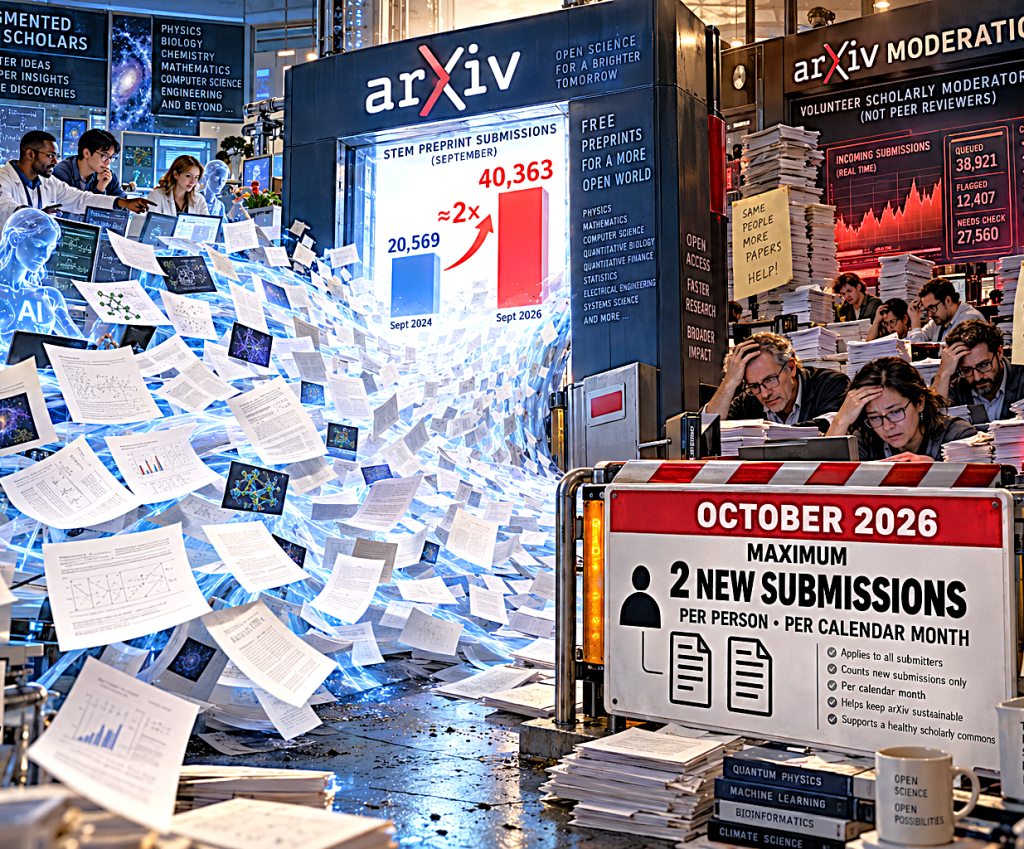
On October 1, arXiv, the free preprint server that has carried physics, mathematics, and computer science papers since 1991, began limiting each submitter to two new papers per calendar month. The reason was arithmetic. In September 2026 the service received 40,363 submissions, an all-time monthly record and roughly double the 20,569 it received in September 2024. The surge generated nearly 9,000 support tickets for staff and volunteer moderators, and submissions in the cs.AI category alone had grown more than sixfold in two years (Boboris, 2026; Kemper, 2026). arXiv called the cap a temporary measure while it builds better moderation tools. This update rechecks the January article’s claims against its own sources and newer evidence, reports what has happened since, with emphasis on September and October, and grades the article’s forecasts.
Checking the January Claims
The core numbers hold up. The Science study, by Keigo Kusumegi, Yian Yin, and colleagues at Cornell and UC Berkeley, examined more than two million preprints. Authors who appeared to adopt LLMs increased their output by 36.2 percent on arXiv, 52.9 percent on bioRxiv, and 59.8 percent on SSRN, compared with authors who did not (Kusumegi et al., 2025). The study also found that for papers without detected AI help, more complex writing went with a higher chance of journal publication, while for AI-assisted papers the relationship ran the other way. In the authors’ words, the positive correlation between linguistic complexity and scientific merit “not only disappears, it inverts.”
Three details need correcting. First, the study measured association, and its authors said so. AI use was inferred from word patterns, and the paper warns that “interpreting the estimated effects as causal requires assumptions that are difficult to satisfy” and that its detector “almost certainly fails to detect use by authors who heavily edit LLM-assisted text” (Kusumegi et al., 2025). The January article’s statement that LLM adoption “has led to dramatic increases in manuscript production” is stronger than the evidence. Second, the near-90 percent gains the article attributed to researchers “for whom English is not a first language” were measured for authors with Asian names at Asian institutions: 89.3 percent on bioRxiv and 88.9 percent on SSRN. Names and affiliations are stand-ins for language background; the study did not ask anyone what their first language was. Third, the article called this “the Berkeley study.” It was a Cornell-led project with two Berkeley Haas co-authors, Toby Stuart and Mathijs de Vaan (Morrison, 2026). The remark the article credited to “one Berkeley researcher,” that institutions experimenting now with “new evaluation criteria, new funding models” will be better placed than those that wait, came from de Vaan.
The January article also cited “a December 2025 survey of sixteen hundred academics” in which more than half used AI while reviewing manuscripts. The survey, run by the publisher Frontiers, drew 1,645 responses in May and June 2025 and was released in December. Fifty-three percent of reviewers reported using AI, and the figure rose to 87 percent among early-career researchers (Frontiers, 2025). The article then went past that evidence, describing “a recursive loop where AI-generated papers are evaluated by AI-assisted reviewers, with human judgment increasingly marginalized.” The survey showed reviewers mostly using AI to draft and condense their reports. Newer data, discussed below, show editors at one major journal setting AI-written reviews aside.
The account of Sakana AI’s “AI Scientist” needs context. The article reported that a paper produced entirely by the system passed peer review at an ICLR 2025 workshop “with acceptance scores clearly above the threshold.” The paper did score 6, 7, and 6. Sakana’s own announcement added facts the article left out: workshop acceptance rates run 60 to 70 percent, compared with 20 to 30 percent for the main conference; the company’s internal review found that none of its AI-written papers “passed our internal bar for an ICLR conference track publication”; the system “occasionally made embarrassing citation errors”; and the paper was withdrawn before publication, as planned from the start (Sakana AI, 2025). The test showed that a workshop’s reviewers could not distinguish the paper from a modest human one. It showed much less about the quality of research done without people.
Two smaller items. The article said bioRxiv and medRxiv “have implemented AI review tools.” What bioRxiv launched in November 2025 was an opt-in pilot that lets authors send a manuscript to the AI service q.e.d Science, which returns a report in about 30 minutes; integration with medRxiv was described as a plan (bioRxiv, 2025). And the article said NIH director Jay Bhattacharya had called for a crackdown on article processing charges. NIH did propose limits in July 2025, offering five options that ranged from disallowing publication costs entirely to a cap of $2,000 per paper, or $3,000 for journals that pay their reviewers, with a proposed start date of January 1, 2026 (National Institutes of Health, 2025). That date passed without a final rule. A March 2026 status review found that “an APC cap policy is still in the consideration phase, and limits have not yet been officially established” (Wood, 2026), and we could find no final NIH notice as of mid-October.
Two arguments in the article’s second half also deserve a second look. Its optimistic scenario rested on the idea that LLMs “continually learn, adjust, and improve,” a phrase set in quotation marks without a source. Deployed chatbots do not learn from each manuscript they help write. They change when their developers train and release new versions. Any feedback loop between journal guidelines and AI behavior therefore runs through companies’ training decisions, which journals do not control. The article also leaned on history: word processors, statistics software, and search engines each caused alarm and were then absorbed. None of those tools invented sources. The evidence gathered since January shows that fabricated references are a new kind of error, and one that can now be counted.
The Flood, Measured
Since January, editors and researchers have put numbers on trends the January article described mostly in general terms. Start with volume. Beyond arXiv’s record month, Google Research reported that submissions to the three largest machine learning conferences, ICLR, NeurIPS, and ICML, topped 74,000 in 2026, up from about 45,000 in 2025 and 23,000 in 2023 (Jayaram & Cohen-Addad, 2026). At Organization Science, a leading management journal, an editorial task force ran the AI detector Pangram over 6,957 submissions and 10,389 reviews received since January 2021. “Submission volume has risen 42% since the late 2022 release of ChatGPT, while writing quality has declined,” the editors wrote, and “the rise in AI-generated writing accounts for nearly all of these trends” (Gartenberg et al., 2026). To cope, the journal nearly doubled its deputy editors, from six to eleven, and its senior editors, from about 30 to 60, all unpaid (Drake, 2026).
At Transactions on Machine Learning Research (TMLR), the share of submissions turned away without review rose from 6 percent in 2023 to 53 percent, and single-author submissions rose thirteenfold in a year, according to editor-in-chief Nihar Shah of Carnegie Mellon University. Shah tried to interview ten authors whose papers had been flagged for desk rejection. Of the seven who agreed, three could not answer basic questions about their own work, three could discuss the main ideas but not the technical details, and one answered everything and found a major flaw in his own paper. Shah described the problem as “quite a widespread issue across all of sciences” (Jones, 2026).
Next, prevalence. In August, Lena Holzwarth, Rita González-Márquez, and Dmitry Kobak applied a word-frequency method to the full texts of open-access biomedical papers in PubMed Central and estimated that 89 percent showed an excess of LLM-associated vocabulary by the end of 2025. Even in methods sections, where researchers describe what they did, estimated LLM use exceeded 50 percent (Holzwarth et al., 2026). The study is a preprint, and it detects style, not how much of a paper a machine wrote. It does indicate that AI assistance in biomedical writing is now the norm.
The sharpest new evidence concerns citations to papers that do not exist. In May, a Columbia University team led by Maxim Topaz reported in a letter to The Lancet that it had checked 97.1 million references in nearly 2.5 million papers indexed in PubMed. In 2023, one paper in 2,828 cited at least one nonexistent work. In 2025, the rate was one in 458. In the first seven weeks of 2026 it was one in 277. More than 98 percent of the affected papers had drawn no publisher action at the time of the audit (Orrall, 2026). Topaz described a near miss in his own work: “I was deeply embarrassed: I checked for that, and it still almost happened to me” (Oza, 2026).
A second audit, by Zhenyue Zhao and colleagues including arXiv founder Paul Ginsparg and several authors of the Science study, examined 111 million references across arXiv, bioRxiv, SSRN, and PubMed Central. It produced “a conservative estimate of 146,932 hallucinated citations in 2025 alone.” The errors clustered in fields with fast AI uptake and among small, early-career teams, and the invented references disproportionately credited scholars who were already prominent and male. Preprint moderation and journal review caught only a fraction of them (Zhao et al., 2026). Elite venues are not exempt. In January, the detection company GPTZero reported more than 100 hallucinated citations in at least 53 papers accepted at NeurIPS 2025. The NeurIPS board replied that even if 1.1 percent of papers had incorrect references because of LLM use, “the content of the papers themselves are not necessarily invalidated” (Goldman, 2026).
Finally, reviews. Before ICLR 2026, Pangram scanned some 70,000 reviews and judged 21 percent, or 15,899, to be “fully AI-generated,” with more than half showing some AI involvement (Emi, 2025). Pangram sells detection software, so its figures deserve independent checking, and the Organization Science task force supplied some. It found that “over 30% of reviews in Organization Science still use some degree of AI today,” up from near zero before ChatGPT (Gartenberg et al., 2026). It also found that editors were not deferring to those reviews. Senior editor Claudine Gartenberg said of AI-heavy reviews, “They’re reading them and they’re not informing the editor’s ultimate recommendation” (Drake, 2026). The quality signal the January article described also shows up in the journal’s decisions: only 3.2 percent of manuscripts scoring 70 percent or higher for AI content received a revise-and-resubmit decision, against 11.9 percent of low-AI papers (Drake, 2026; Gartenberg et al., 2026).
Caps, Fees, Bans, and Traps
The responses since January fall into three groups: limits on volume, penalties for carelessness, and software that checks other software. arXiv has moved furthest. It already required first-time submitters to obtain an endorsement from an established author. In May, Thomas Dietterich, who chairs arXiv’s computer science section, announced that a submission containing “incontrovertible evidence that the authors did not check the results of LLM generation,” such as hallucinated references or leftover chatbot comments, would bring a one-year ban, after which the author’s papers must first be accepted by a peer-reviewed venue. “This means we can’t trust anything in the paper,” he wrote. The rule does not forbid LLM use; authors take “full responsibility” for their content however it was produced (Ha, 2026). On July 1, arXiv left Cornell to become an independent nonprofit, with backing from the Simons Foundation and Schmidt Sciences. Cornell Tech dean Greg Morrisett explained part of the reason plainly: “We’ve been running a deficit the last couple years” (Fleischman, 2026). Then came the October cap. Dietterich wrote that “a relatively small proportion of authors are submitting a large number of low-quality papers,” and that their volume delays careful authors for days or weeks (Kemper, 2026).
Reactions to the May rule were mixed. Research-integrity campaigner Anna Abalkina of the Free University of Berlin said, “I welcome this measure because it is aimed mainly at paper mills rather than legitimate authors.” Reese Richardson, a postdoctoral fellow at Northwestern University’s Center for Science of Science and Innovation, questioned whether volunteer moderators could keep up: “the same concerns about scalability apply” (Grove, 2026).
Conferences have tried price signals and traps. IJCAI-ECAI 2026 charged $100 per submission, waived for “primary papers” whose authors appear on no other submission, with the proceeds directed to reviewers (IJCAI-ECAI 2026, n.d.). ICML 2026 hid instructions inside every submitted PDF, visible only to an LLM, telling it to include two randomly chosen phrases in any review it wrote. Reviewers who had agreed to a no-LLM policy and whose reviews contained the phrases were flagged, and every flagged case was checked by a person. The conference desk-rejected 497 papers, about 2 percent of submissions, because their authors, serving as required reviewers, had broken the policy. Fifty-one reviewers who had used LLMs in more than half their reviews were removed from the pool. The organizers acknowledged that the method is easy to evade once known and probably catches only the most careless LLM use (ICML 2026 Program Chairs, 2026). TMLR, for its part, introduced annual submission quotas for authors (Jones, 2026).
Journal rules have tightened more quietly. In January, the International Committee of Medical Journal Editors added a new section to its recommendations covering AI use by authors, reviewers, and editors (International Committee of Medical Journal Editors, 2026). The same month, Science editor-in-chief H. Holden Thorp wrote that “all authors must certify and be responsible for all content, including that generated with the aid of AI,” and that AI-generated figures are not allowed (Thorp, 2026a).
The third group, machines checking machines, grew fastest. AAAI-26, a major AI conference, gave every one of 22,977 main-track papers a clearly labeled AI review alongside the human ones, all generated in under a day at less than $1 per paper. In a survey of 5,834 authors and committee members, 53.9 percent found the AI reviews useful and 20.2 percent did not, and respondents rated the AI reviews above human reviews on six of nine criteria, most strongly at spotting technical errors (Biswas et al., 2026). Springer Nature said nearly 60 AI tools supported more than 1.5 million papers in 2025 and flagged about 25,000 for problems such as doctored images, invented citations, and fabricated text, which were then passed to staff (Springer Nature, 2026). On October 14, Google opened Deep Review, a multi-agent system for checking technical documents, to the public. An earlier version had given private feedback to authors of more than 16,000 manuscripts at STOC 2026, ICML 2026, NeurIPS 2026, and ICLR 2027, feedback that was “completely decoupled from the official conference review process.” Google says the tool takes on the most laborious parts of review “while leaving higher-level judgements to humans” (Jayaram & Cohen-Addad, 2026).
Not everyone sees savings. In a July 16 editorial titled “AI in Scientific Publishing: Slower, Worse, and More Expensive,” Thorp argued that the technology had delivered the reverse of its sales pitch at Science (Thorp, 2026b). Checking tools also misfire. Renee Hoch, head of publication ethics at PLOS, said that in pilots of reference checkers, “we have seen a lot of false positives in which legitimate references are flagged” (Oza, 2026). Elena Vicario, director of research integrity at Frontiers, argued in June that blanket bans on reviewers’ AI use only push it “under the radar, unregulated,” and called on the publishing ethics bodies COPE and STM to write shared rules. “This is not, at heart, a technology problem. It is a governance and coordination problem,” she wrote (Vicario, 2026). Peer Review Week, held September 14 to 18, chose “Peer Review Capacity: Volume, Speed and Quality” as its 2026 theme, noting that “across journals, submission volumes continue to rise” (Sayab & Ghosh, 2026).
Mathematics as a Test Case
The January article proposed that papers carry machine-readable components so that claims could be checked directly. In October, one field received a large, unplanned trial of that idea. On October 6, OpenAI posted results from an unreleased internal model to GitHub: 722 manuscripts grouped into 372 “result families,” many accompanied by proofs written in Lean, which OpenAI describes as “a programming language that allows mathematical proofs to be checked by a computer” (Nucleus_AI, 2026; OpenAI, 2026). The average result used about three hours of ChatGPT Pro-equivalent computing. The results went to a public repository, not to journals. On October 15, OpenAI added a $5 million contribution to a Simons Foundation initiative to help mathematicians examine and build on AI-produced results (OpenAI, 2026).
A month earlier, 25 Fields Medal winners, among them Terence Tao, had released a letter warning that the goals of AI companies and of mathematicians are “severely misaligned.” “Solving problems is only a tool and proxy for achieving the primary goal of conceptual understanding and insight,” they wrote, describing processes that “invariably take time and are based on human interaction” (Agence France-Presse, 2026).
The episode separates two jobs that the January article treated as one. A Lean proof can establish that a statement is true without anyone reading it. It cannot tell a field whether the statement matters, how it connects to earlier work, or what it teaches. Journals and referees have done that second job. When hundreds of manuscripts arrive at once outside the journal system, mathematicians have to decide who will do it now, and at whose expense. Similar proposals are spreading to other fields. In June, physicists Sirui Lu and Xiao-Liang Qi proposed an “Agentic Publication Protocol” that bundles a paper with its code, data, computing environment, and instructions that let an AI agent reproduce the key results (Lu & Qi, 2026). Packages like that make results easier to verify. They do not reduce the number of results that need human attention.
The AI Scientist advanced as well. In March, Nature published the Sakana-led team’s description of a system that generates ideas, searches the literature, runs experiments, and writes manuscripts, along with an automated reviewer that the authors say matches human reviewers at predicting acceptance decisions (Lu et al., 2026; Sakana AI, 2026). Jeff Clune of the University of British Columbia, a member of the team, called the work “the dawn of a new chapter in human history” (Soo, 2026). Sakana’s announcement lists the limits: the system “occasionally produces naive or underdeveloped ideas,” “can struggle with deep methodological rigor and complex code implementation,” and “is susceptible to hallucinations or obvious mistakes” (Sakana AI, 2026).
How the January Forecasts Are Holding Up
The January article made five forecasts for 2026 and 2027. Here is where each stands after nine months. The first forecast, rising submissions with venues responding unevenly and “reviewer agents” screening papers before humans see them, has been borne out. Submissions are up at arXiv, at the big machine learning conferences, and at journals such as Organization Science. Responses vary from caps to fees to traps, and AI review is now routine at AAAI and inside Springer Nature’s workflow. One part needs revising. The article expected prestigious journals to screen hardest while lower-tier venues were overwhelmed. arXiv, which is free and does not select papers for quality, has been among the most aggressive.
The second forecast, expanded transparency requirements, has come true in part. The ICMJE expanded its guidance, and reference checking, which the January article illustrated with Grounded AI’s Veracity tool, has become a common defense. The strongest new rules, however, punish unchecked output rather than undisclosed use. arXiv bans authors for hallucinated references whether or not they disclosed AI help, and Science’s policies, Thorp wrote in January, “allow the use of large language models for certain processes without any disclosure” (Thorp, 2026a).
The third forecast, parallel publishing systems for machine-generated research, has arrived in a form the article did not anticipate. Experimental venues exist, including the aiXiv preprint server for AI-generated research and Agents4Science, a virtual conference held in October 2025 at which AI agents did most of the research work (Hulick, 2025; Zhang et al., 2025), but the most consequential parallel channel so far is a company’s own repository. OpenAI’s mathematics release bypassed journals entirely and set its own standards for disclosure.
The fourth forecast, that universities and funders would have to change how they judge research, has seen the least movement. The Organization Science editors wrote that “careers depend on publication counts in specific journal lists” and called on hiring and promotion committees to “do the hard work of actually reading papers and assessing intellectual contribution” (Gartenberg et al., 2026). We did not find a major university or funder that has announced such a change since January.
The fifth forecast, humans shifting toward overseeing AI checks while keeping judgments about significance, is visible in early form. AAAI kept its AI reviews labeled and separate from decisions. Google describes Deep Review as leaving higher-level judgment to people. Organization Science editors appear to be discounting AI-written reviews on their own. The cost of that oversight falls largely on volunteers, from arXiv moderators to the doubled editorial board at Organization Science.
The article’s economic warning has also held. The NIH cap on publication fees has stalled, while the cost of screening has risen: arXiv’s new independence was driven partly by deficits, and Thorp’s July editorial argued that AI has raised costs at Science.
The evidence since January also raises three issues the January article did not address. The first concerns fairness. A two-paper monthly cap treats a productive, careful lab the same as a paper mill, and because it counts only the submitting author, a group can rotate who presses the button. A $100 fee is trivial for some researchers and a real cost for others. Rationing slows the flood without sorting good papers from bad ones.
The second concerns the very researchers the January article saw as AI’s biggest winners. The largest productivity gains in the Science study went to authors with Asian names at Asian institutions. Fabricated citations are concentrated among small, early-career teams (Zhao et al., 2026), and reference checkers still flag legitimate citations (Oza, 2026). As screening tightens, authors who used AI to overcome a language barrier may face more suspicion and more false alarms than authors who never needed the help. Policies that judge papers by checkable errors, as arXiv’s now does, are fairer to them than policies that judge papers by how machine-like the prose sounds.
The third concerns the permanence of the damage. The Columbia audit found that nearly all papers with fake references remained uncorrected, and Topaz warned that the contamination “does not go away when the AI gets better” (Orrall, 2026). Because invented references disproportionately credit already prominent scholars, they also distort the citation counts that hiring committees use, feeding the same counting habits the January article blamed for the problem.
Several developments will test these conclusions over the coming months: results from Google’s NeurIPS 2026 pilot cohort, arXiv’s promised review of its cap, a decision from NIH on publication fees, and whether journals agree to referee any of OpenAI’s mathematics manuscripts. A replication of the Organization Science analysis at journals in other fields would show whether its findings are general.
The January article ended by saying the next two years would show which path the research system was on. Nine months in, the measurable answer is this: Monthly submissions to arXiv roughly doubled in two years. The share of biomedical papers citing a nonexistent source rose about tenfold between 2023 and early 2026. The main defenses so far are caps, fees, bans, and automated checks. None of them changes the incentive the January article identified, the counting of papers in hiring and promotion. Until institutions change that, the most likely picture for 2027 is more submissions, tighter limits, and more software checking software.
References
Agence France-Presse. (2026, September 12). Top math prize winners warn AI race is threat to field. The Standard. https://www.thestandard.com.hk/world/article/342574/Top-math-prize-winners-warn-AI-race-is-threat-to-field
bioRxiv. (2025, November 4). q.e.d Science – an AI review tool for authors. https://connect.biorxiv.org/news/2025/11/04/qed_review_tool
Biswas, J., Schoepp, S., Vasan, G., Opipari, A., Zhang, A., Hu, Z., Joseph, S., Lease, M., Li, J. J., Stone, P., Wagstaff, K. L., Taylor, M. E., & Jenkins, O. C. (2026). AI-assisted peer review at scale: The AAAI-26 AI review pilot (arXiv:2604.13940) [Preprint]. arXiv. https://arxiv.org/abs/2604.13940
Boboris, K. (2026, October 1). Fair moderation, equitable access, and AI: arXiv’s updated rate limit policy. arXiv Blog. https://blog.arxiv.org/2026/10/01/updated-rate-limit-policy/
Drake, J. (2026, April 30). AI slop is flooding academic journals. A top journal measured it. Forbes. https://www.forbes.com/sites/johndrake/2026/04/30/ai-slop-is-flooding-academic-journals-a-top-journal-measured-it/
Emi, B. (2025, November 18). Pangram predicts 21% of ICLR reviews are AI-generated. Pangram. https://www.pangram.com/blog/pangram-predicts-21-of-iclr-reviews-are-ai-generated
Fleischman, T. (2026, June 29). Digital research repository arXiv to start new chapter as nonprofit. Cornell Chronicle. https://news.cornell.edu/node/333261
Frontiers. (2025, December 15). Most peer reviewers now use AI, and publishing policy must keep pace. https://www.frontiersin.org/news/2025/12/15/most-peer-reviewers-now-use-ai-and-publishing-policy-must-keep-pace
Gartenberg, C., Hasan, S., Murray, A., & Pierce, L. (2026). More versus better: Artificial intelligence, incentives, and the emerging crisis in peer review. Organization Science, 37(3). https://doi.org/10.1287/orsc.2026.ed.v37.n3
Goldman, S. (2026, January 21). NeurIPS, one of the world’s top academic AI conferences, accepted research papers with 100+ AI-hallucinated citations, new report claims. Fortune. https://www.fortune.com/2026/01/21/neurips-ai-conferences-research-papers-hallucinations
Grove, J. (2026, May 22). Ban on authors who submit AI content “welcome but unenforceable.” Inside Higher Ed. https://www.insidehighered.com/news/faculty/books-publishing/2026/05/22/ban-authors-who-submit-ai-content-welcome-unenforceable
Ha, A. (2026, May 16). Research repository ArXiv will ban authors for a year if they let AI do all the work. TechCrunch. https://techcrunch.com/2026/05/16/research-repository-arxiv-will-ban-authors-for-a-year-if-they-let-ai-do-all-the-work/
Holzwarth, L., González-Márquez, R., & Kobak, D. (2026). Most biomedical publications show signs of LLM-assisted writing (arXiv:2608.10715) [Preprint]. arXiv. https://arxiv.org/abs/2608.10715
Hulick, K. (2025, October 24). A conference just tested AI agents’ ability to do science. Science News. https://www.sciencenews.org/article/science-conference-test-ai-agents
ICML 2026 Program Chairs. (2026, March 18). On violations of LLM review policies. ICML Blog. https://blog.icml.cc/2026/03/18/
IJCAI-ECAI 2026. (n.d.). Call for papers – main track. Retrieved October 18, 2026, from https://2026.ijcai.org/ijcai-ecai-2026-call-for-papers-main-track/
International Committee of Medical Journal Editors. (2026, January). Up-dated ICMJE recommendations. https://icmje.acponline.org/news-and-editorials/updated_recommendations_jan2026.html
Jayaram, R., & Cohen-Addad, V. (2026, October 14). Analyzing technical documents with Deep Review. Google Research Blog. https://research.google/blog/analyzing-technical-documents-with-deep-review/
Jones, F. (2026, September 17). Researchers submitting AI-assisted papers they “don’t understand.” Times Higher Education. https://www.timeshighereducation.com/news/researchers-submitting-ai-assisted-papers-they-dont-understand
Kemper, J. (2026, October 11). ArXiv caps submissions at two per month as AI paper flood overwhelms the preprint server. The Decoder. https://the-decoder.com/arxiv-caps-submissions-at-two-per-month-as-ai-paper-flood-overwhelms-the-preprint-server/
Kusumegi, K., Yang, X., Ginsparg, P., de Vaan, M., Stuart, T., & Yin, Y. (2025). Scientific production in the era of large language models. Science, 390, 1240. https://doi.org/10.1126/science.adw3000
Lu, C., et al. (2026). Towards end-to-end automation of AI research. Nature. https://doi.org/10.1038/s41586-026-10265-5
Lu, S., & Qi, X.-L. (2026). Agentic Publication Protocol: An attempt to modernize scientific publication (arXiv:2606.27386) [Preprint]. arXiv. https://arxiv.org/abs/2606.27386
Morrison, S. (2026, January 27). How AI is transforming research: More papers, less quality, and a strained review system. Berkeley Haas News. https://newsroom.haas.berkeley.edu/how-ai-is-transforming-research-more-papers-less-quality-and-a-strained-review-system/
National Institutes of Health. (2025, July 30). Request for information on maximizing research funds by limiting allowable publishing costs (NOT-OD-25-138). https://grants.nih.gov/grants/guide/notice-files/NOT-OD-25-138.html
Nucleus_AI. (2026, October 7). OpenAI puts AI-generated maths to the test with 722 manuscripts. YourStory. https://yourstory.com/ai-story/openai-ai-open-maths-problems-solved
OpenAI. (2026, October 6; updated October 15). Sharing AI progress in mathematics. https://openai.com/index/sharing-ai-progress-in-mathematics/
Orrall, A. (2026, May 7). One in 277 PubMed-indexed papers in 2026 shows fabricated references, says analysis. Retraction Watch. https://retractionwatch.com/2026/05/07/one-in-277-pubmed-indexed-papers-in-2026-shows-fabricated-references-says-analysis/
Oza, A. (2026, May 7). Fraudulent citations, blamed on AI hallucinations, are becoming more common in research papers. STAT. https://statnews.com/2026/05/07/lancet-study-finds-steep-rise-fraudulent-citations-academic-papers
Sakana AI. (2025, March 12). The AI Scientist generates its first peer-reviewed scientific publication. https://sakana.ai/ai-scientist-first-publication/
Sakana AI. (2026, March 26). The AI Scientist: Towards fully automated AI research, now published in Nature. https://sakana.ai/ai-scientist-nature/
Sayab, M., & Ghosh, R. (2026, April 20). Can peer review keep up? Announcing the theme for Peer Review Week 2026. The Scholarly Kitchen. https://scholarlykitchen.sspnet.org/2026/04/20/can-peer-review-keep-up-announcing-the-theme-for-peer-review-week-2026/
Shimabukuro, J. (2026, January 27). AI is reshaping scientific publishing and what comes next. ETC Journal. https://etcjournal.com/2026/01/27/ai-is-reshaping-scientific-publishing-and-what-comes-next/
Soo, S. (2026, March 25). Researchers create an “AI Scientist” that conducts its own scientific research. UBC Computer Science. https://www.cs.ubc.ca/news/2026/03/ai-scientist
Springer Nature. (2026, March 12). Springer Nature embraces AI tools across the publishing process, resulting in less friction and increased author satisfaction [Press release]. https://group.springernature.com/br/group/media/press-releases/ai-tools-support-less-friction-and-increased-author-satisfaction/27849346
Thorp, H. H. (2026a). Resisting AI slop [Editorial]. Science. https://doi.org/10.1126/science.aee8267
Thorp, H. H. (2026b, July 16). AI in scientific publishing: Slower, worse, and more expensive [Editorial]. Science. https://doi.org/10.1126/science.aek5570
Vicario, E. (2026, June 30). Now is the time for AI in peer review, and publishing policies need to recognize this [Guest post]. The Scholarly Kitchen. https://scholarlykitchen.sspnet.org/2026/06/30/guest-post-now-is-the-time-for-ai-in-peer-review-and-publishing-policies-need-to-recognize-this/
Wood, E. (2026, March 20). All the seats at the table: A summary and status review of the NIH APC caps proposal [Guest post]. The Scholarly Kitchen. https://scholarlykitchen.sspnet.org/2026/03/20/guest-post-all-the-seats-at-the-table-a-summary-and-status-review-of-the-nih-apc-caps-proposal/
Zhang, P., Hu, X., Huang, G., Qi, Y., Zhang, H., Li, X., Song, J., Luo, J., Li, Y., Yin, S., Dai, C., Jiang, E. H., Zhou, X., Yin, Z., Yuan, B., Dong, J., Su, G., Qiao, G., Tang, H., . . . Liu, X. (2025). aiXiv: A next-generation open access ecosystem for scientific discovery generated by AI scientists (arXiv:2508.15126) [Preprint]. arXiv. https://arxiv.org/abs/2508.15126
Zhao, Z., Wang, Y., Stuart, T., De Vaan, M., Ginsparg, P., & Yin, Y. (2026). LLM hallucinations in the wild: Large-scale evidence from non-existent citations (arXiv:2605.07723) [Preprint]. arXiv. https://arxiv.org/abs/2605.07723
###
Filed under: Uncategorized |






























































































































































































































































































































































































































































Leave a Reply