






By Jim Shimabukuro (assisted by Claude)
Editor
After four decades of growth, the earnings edge of a U.S. college degree is shrinking. A look at how far it has fallen, where it may go by 2031, who is moving in on the territory, and whether colleges’ countermoves are working.

In the spring of 2022, a typical American worker with a bachelor’s degree earned about 87 percent more per hour than a comparable worker with only a high school diploma. By the spring of 2026, that edge had slipped to about 78 percent. The numbers come from a working paper posted to the Social Science Research Network in September by economists José Azar, Mireia Giné, and Javier Sanz-Espín, who tracked the college wage premium using federal Current Population Survey data. In the authors’ words, “After expanding for four decades, the U.S. college wage premium is experiencing a sustained contraction,” which they describe as “the first sustained negative relative demand growth in a series spanning back to 1914” (Cowen, 2026). Over the same four years, real hourly wages for college graduates fell about 2 percent while wages for workers without degrees rose about 3.3 percent (Farrington, 2026).
Nine percentage points is a modest drop in a premium that remains large. A degree holder in 2026 still out-earns a high school graduate by more than three-quarters. But the direction has changed, and it has changed at the same moment that public belief in college has collapsed. On October 1, Gallup reported that only 31 percent of Americans now call a college education “very important,” down from 70 percent in 2013. “The 64-point gap between them in 2013 has shrunk to just two points today,” wrote Gallup’s Megan Brenan, comparing those who rate college very important with the 29 percent who now say it is “not too important” (Brenan, 2026).
In the United States, the odds are rising that a degree is losing economic value, and the evidence has hardened in the past six weeks. The results are nuanced. The decline is concentrated in particular majors, particular kinds of jobs, and the first few years after graduation. Abroad, the picture runs from relative strength in much of the OECD to graduate gluts in China and India. And the forces pushing the premium down are not all the same force.
What the numbers show
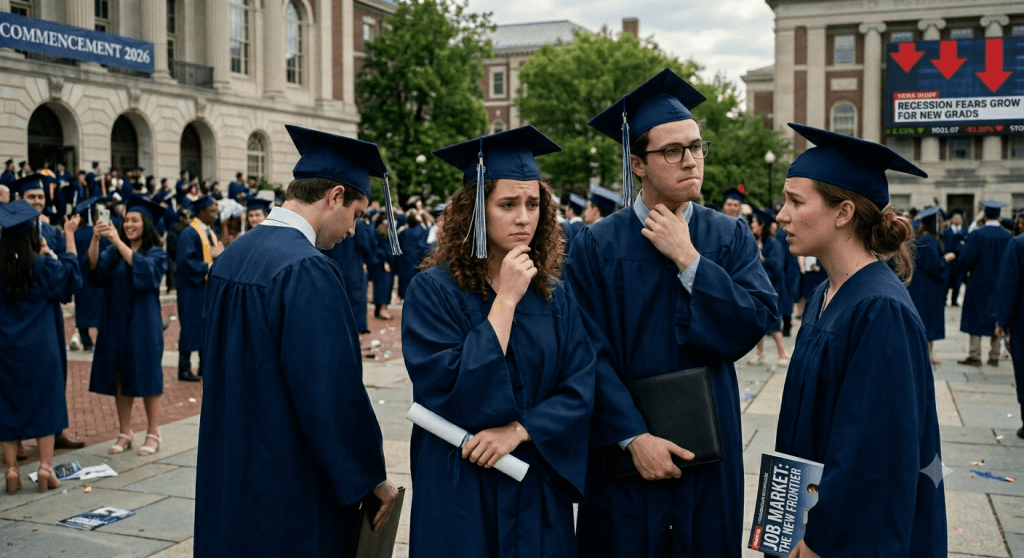
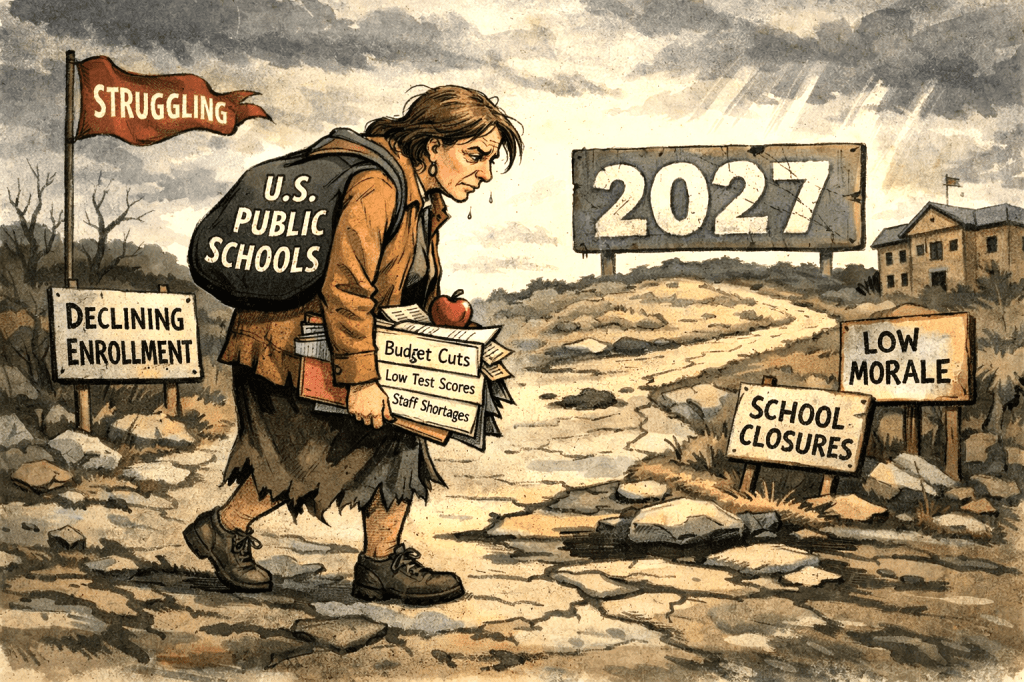
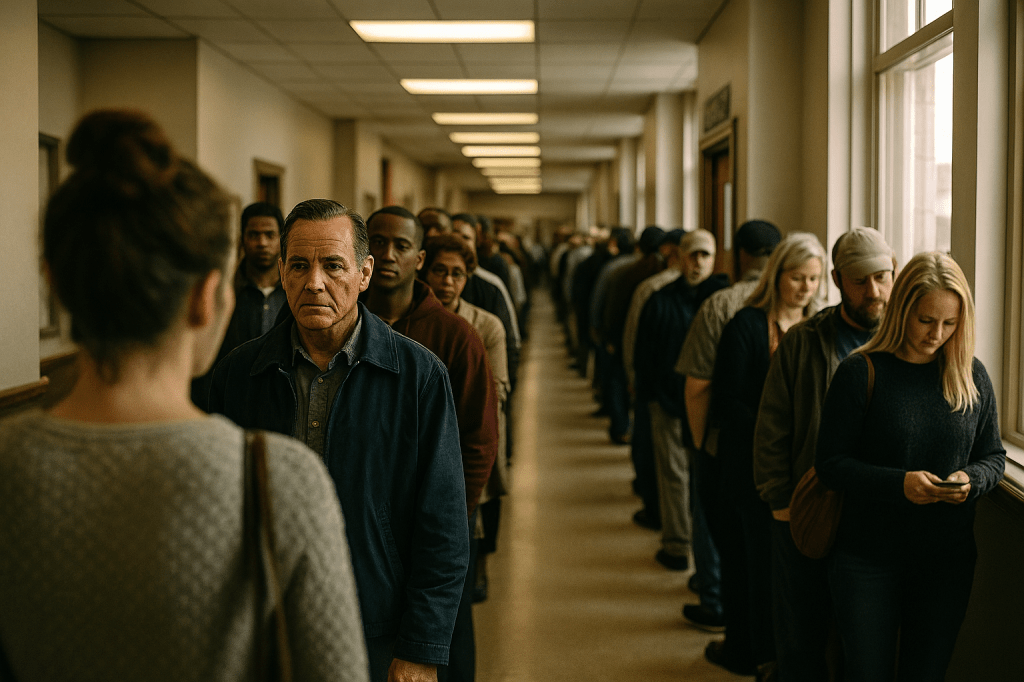
Start with the young, where the strain shows first. The Federal Reserve Bank of New York reported that in the second quarter of 2026, the unemployment rate for recent college graduates aged 22 to 27 stood at about 5.6 percent, and 42 percent of them were underemployed, meaning they held jobs that do not typically require a degree (Federal Reserve Bank of New York, 2026). Recent graduates now face higher unemployment than the workforce as a whole, a reversal of the long-standing pattern in which a fresh diploma bought a measure of protection.
Two new federal studies tie part of this to artificial intelligence. Census Bureau economists found that after ChatGPT’s release in late 2022, employment among 22- to 24-year-olds fell about 12 percent over ten quarters in the industries most exposed to AI, and graduates from AI-exposed majors saw starting earnings drop about 13 percent (Gioino, 2026). According to Staffing Industry Analysts’ summary of the work, the authors wrote that “this earnings decline is comparable in magnitude to the earnings losses associated with graduating into a large recession” (Staffing Industry Analysts, 2026). Most of these graduates did not end up jobless. Roughly half of the earnings loss came from lower pay within their field, and the other half from graduates moving into restaurants and retail (Gioino, 2026).
On September 22, the Federal Reserve Bank of Dallas published a parallel analysis. Samuel Dodini and Tucker Smith found that graduates from majors with 10 percentage points more exposure to AI automation saw a 1.7-point relative decline in employment after 2022, and those who found work earned about 5 percent less. Graduates in exposed fields were more likely to go on to graduate school, but master’s degree holders in those fields saw similar wage declines, which led the authors to conclude that “the returns to formal upskilling within AI-exposed fields may be limited” (Dodini & Smith, 2026). Computer science, computer engineering, and languages topped the exposure list. Nursing, education, and psychology sat near the bottom.
Students noticed. Goldman Sachs economists reported in June that computer science and programming enrollments each fell more than 10 percent in the 2025–26 academic year while healthcare and engineering rose, and a Gallup survey found 42 percent of bachelor’s students had reconsidered their major because of AI (Lichtenberg, 2026).
Other evidence cuts the other way, and it is just as recent. In September, UCLA economists Robert Fairlie and Jane Wu published a National Bureau of Economic Research paper that compared new graduates in summer 2026 with older graduates and with young workers who had no degree. They found no significant spike in unemployment for the new graduates relative to prior years, even using a broader measure that counts graduates who wanted a job but had stopped looking (Fairlie & Wu, 2026). Summer unemployment for graduates aged 22 to 25 was 7.3 percent, inside the 6.3 to 7.8 percent band seen since 2022 (Panganiban, 2026). The authors cautioned that “these findings do not rule out larger effects in the future” (Panganiban, 2026). The Census and Dallas Fed studies measure a hit to pay and job quality. The UCLA study measures joblessness. They are compatible: AI so far appears to be pushing graduates down the job ladder more than out of work.
Students and recent graduates themselves remain largely convinced. A Lumina Foundation–Gallup study released in February found that 75 percent of current students and 71 percent of college graduates agree their degree is worth the cost (Hrynowski & Marken, 2026). The skepticism is strongest among adults looking at college from the outside.
Why it is happening
Azar and his co-authors estimate that AI exposure accounts for roughly 28 percent of the 2022–2026 decline in the premium (Cowen, 2026). Tyler Cowen, who flagged the paper on his blog, said he does not see AI as the primary driver (Cowen, 2026). Writing in City Journal’s newsletter, Robert VerBruggen noted that the AI exposure measure is an estimate and that the study does not prove causation, while also observing that “jobs with higher exposure have fared progressively worse” since 2022 (VerBruggen, 2026). That leaves about 70 percent of the decline to explain.
Several forces fill the gap. The first is supply. The share of young adults with a degree has climbed for decades; across OECD countries, 48 percent of 25- to 34-year-olds now hold a tertiary qualification, up from 27 percent in 2000 (Hillman, 2025). When graduates become the majority of young workers, a degree stops sorting candidates the way it once did. The Burning Glass Institute put it bluntly in 2025: “For the first time in modern history, a bachelor’s degree is no longer a reliable path to professional employment,” citing lean post-pandemic staffing, more cautious hiring, and a surplus of degree holders alongside AI (Burning Glass Institute, 2025).
The second force is the other side of the wage ledger. Wages for workers without degrees rose faster than graduate wages after 2022, driven by tight labor markets in construction, logistics, health support, and the skilled trades (Farrington, 2026). The premium is a ratio, so it falls when the bottom rises, even if graduates are not doing worse in absolute terms. In this period, they were doing slightly worse.
The third force is cost and debt. Total U.S. student loan debt sits at about $1.86 trillion, with an average federal balance near $39,547 (Farrington, 2026). When the payoff shrinks while the price stays high, the calculation tips for students at the margin. In 2025, New York Fed economists Jaison Abel and Richard Deitz still put the return to a bachelor’s degree at 12.5 percent a year, “a rate well above the threshold for a sound investment,” but they warned that students who start and do not finish “incur at least some of the costs but enjoy far fewer benefits” (Abel & Deitz, 2025).
The fourth force is trust. Gallup’s July survey found confidence in higher education at 38 percent, down from 57 percent in 2015. Among those with little confidence, 31 percent cited perceived political agendas, 30 percent cost, and 25 percent poor preparation for the workforce (Jones, 2026). Only 23 percent of Republicans expressed confidence. Distrust shapes enrollment decisions, state budgets, and federal policy, all of which feed back into what a degree is worth.
The view from abroad
Outside the United States, the data do not show a single global trend. The OECD’s Education at a Glance 2026, released September 29, found that across member countries 87 percent of tertiary-educated adults were employed in 2025, against 78 percent of those whose highest credential was upper secondary school. The report noted that tertiary-educated young adults had “lower unemployment rates than their peers with lower educational attainment during economic booms and crises” (OECD, 2026). By that measure, a degree still pays across most of the developed world.
The pressure points are in large economies with fast graduate growth. In China, youth unemployment for 16- to 24-year-olds not in school rose to 17.9 percent in July, the highest July reading in three years, as a new wave of graduates entered the market (Cheng, 2026). In India, the Azim Premji University State of Working India 2026 report found that nearly 40 percent of graduates under 25 were unemployed and only about 7 percent of young graduates landed permanent salaried work within a year (The Wire, 2026). In Britain, the job site Indeed reported in August that graduate vacancies were 7 percent lower than a year earlier and at their weakest since 2020 (Cabrera, 2026). The International Labour Organization reported a global youth unemployment rate of 12.4 percent for 2025 and, in North America, a rise from 8.3 percent in 2023 to 9.8 percent (International Labour Organization, 2026). “Technological progress must work for young people, not against them,” said ILO director Sukti Dasgupta (International Labour Organization, 2026).
Demand for degrees abroad has not dried up. UCAS, which runs British university admissions, reported a record 695,740 applicants for 2026 entry, up 4.6 percent (UCAS, 2026). Young people are still applying. They are applying into a weaker graduate job market.
The next five years
No one can forecast the premium in 2031 with precision, and the range of public predictions is wide. In March, ServiceNow chief executive Bill McDermott said unemployment among new graduates “could easily go into the mid-30s in the next couple of years” as AI agents take over routine work (Burleigh, 2026). The Fairlie and Wu data suggest nothing close to that so far. A more grounded projection starts from what is already scheduled.
The first scheduled event is federal accountability. Under the 2025 budget law, the Education Department will release earnings data for every college program in 2027. Undergraduate programs whose graduates do not out-earn high school graduates four years after finishing, and graduate programs that do not beat bachelor’s holders, face loss of federal loan access, with penalties starting in 2028 for programs that fail two of three years (Blake, 2026). For the first time, a weak premium at the program level will carry a federal consequence.
The second is demographics. The number of U.S. high school graduates peaked in 2025 at roughly 3.8 to 3.9 million and is projected to fall about 10 percent by 2041 (Unglesbee, 2024). Fitch Ratings gave higher education a “deteriorating” outlook for 2026, citing “a vulnerable international student pipeline, a shrinking domestic student base and rising scrutiny on the value proposition of a higher education degree,” and expected mergers and closures to continue at elevated rates (Spitalniak, 2025).
The third is the spread of AI tools into entry-level white-collar work, which the Census and Dallas Fed studies show is already under way in the most exposed fields.
Taken together, the most likely five-year path is continued modest compression of the average premium, with a much wider spread underneath it. Degrees in nursing, engineering, and other licensed or hands-on fields are likely to hold their value. Degrees in fields where AI handles much of the junior work, and degrees from low-completion, high-cost institutions, are likely to keep losing ground, and some of those programs will lose federal loan eligibility after 2028. The average degree will very likely still pay more than a high school diploma in 2031. The question for a given student will increasingly be which degree, from which institution, at what price.
The challengers
Several alternatives are drawing students and employers. None has displaced the degree at scale, but each is winning in a specific niche.
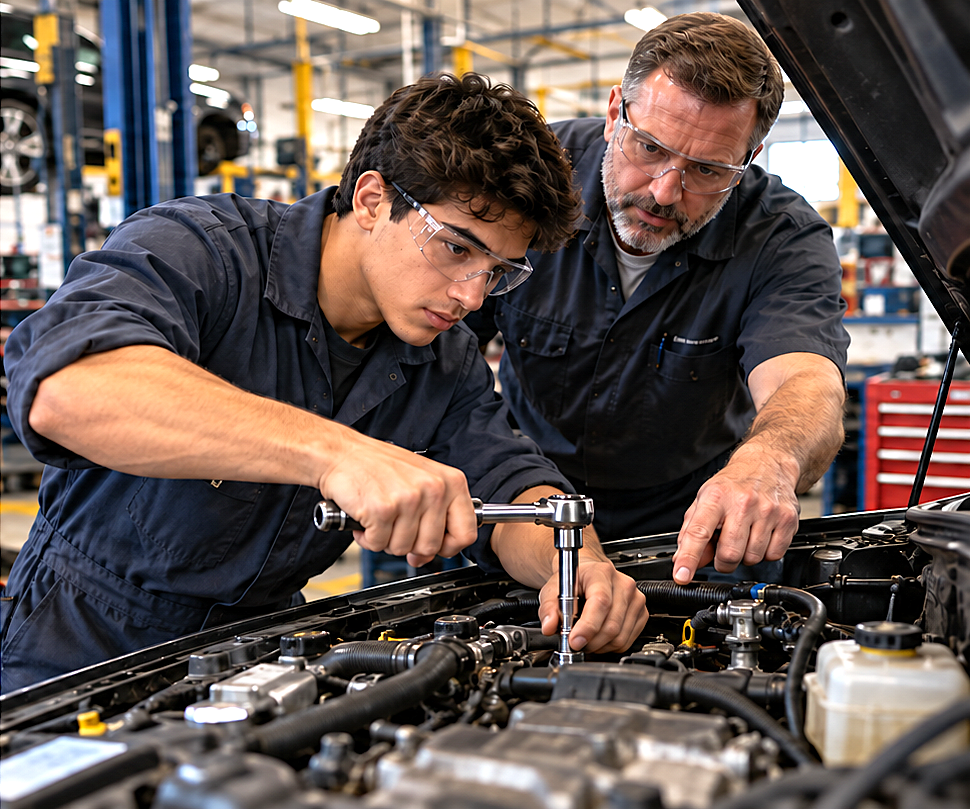
The skilled trades and apprenticeships are the most visible. The number of registered U.S. apprentices has risen about 80 percent over the past decade, according to figures compiled by Minding the Campus, which also reported an estimated three skilled-trade openings for every qualified worker (Harrington, 2026). “AI can’t build data centers, upgrade power grids, or maintain its own infrastructure,” said Greg Dyers of the staffing firm Randstad North America (Harrington, 2026). In Britain, the energy company E.ON said applications for its degree apprenticeships trebled in three years, to 165 applicants per role in 2026. In a survey it commissioned of 2,004 British teenagers, 67 percent cited student debt as a deciding factor and 36 percent said AI had pushed them toward automation-resistant careers (E.ON UK, 2026). Some of the headline enthusiasm needs discounting. Quartz reported in July that a widely shared figure of a 1,421 percent jump in Gen Z trade-school enrollment mostly reflects that generation aging into the eligible years (Lopopolo, 2026).
Short-term credentials now have federal money behind them. Workforce Pell, which opened July 1, 2026, lets students use Pell Grants for programs of 8 to 15 weeks in high-demand occupations. As of early October, 40 U.S. jurisdictions had an approval process running and a dozen programs in Iowa, Indiana, Nebraska, and Texas had won federal approval, covering fields such as EMT training, phlebotomy, HVAC, and machining (Capstone Workforce, 2026). Community colleges, the main providers, grew enrollment 3 percent in fall 2025, outpacing private four-year institutions, which declined (Alonso, 2026).
Employer-run pathways are the most talked about and the least proven. Palantir’s Meritocracy Fellowship recruited 22 high school graduates from more than 500 applicants in 2025, under the slogan “Skip the debt. Skip the indoctrination.” Chief executive Alex Karp told prospective fellows, “If you come to Palantir, your career is set” (Burleigh, 2025). Skills-based hiring is now official policy at about 70 percent of employers, but research from the Burning Glass Institute and Harvard Business School found that dropping degree requirements produced new opportunities for “fewer than 1 in 700 hires,” and about 45 percent of firms changed nothing in practice (EIN Presswire, 2026). Employers have rewritten their job ads faster than their hiring.
The alternatives are succeeding for concrete reasons. They are cheaper and shorter, they pay during training, and they lead to jobs that AI cannot easily do, such as wiring a data center or drawing blood. Their limits are equally concrete. Apprenticeship slots are scarce, Workforce Pell programs are only now being approved, and the most prestigious employer pathways admit a few dozen people a year.
How colleges are responding
Colleges have begun to move on price, time, and content. The early evidence is strongest on price.
On October 5, Bloomberg reported a new wave of tuition resets among private colleges. Emory & Henry University in Virginia cut tuition in half, to $19,990, and enrolled 100 more new students this fall. The University of Tulsa is cutting its price from $54,000 to $25,000, and Carroll College in Montana by 40 percent, to $26,800. “We just knew that we couldn’t be a school with a price tag of $40,000 and attract students,” said Emory & Henry president Lou Fincher. Robert Bielby of the consulting firm Huron was more cautious: “At some point, we’re probably going to see a full-scale reset in the industry. We’re just not there yet” (Albright, 2026). Most of these cuts replace discounting that already happened behind the sticker price, since private nonprofits discount tuition for first-time students by an average of 57 percent. The gain is transparency, which matters to families who never apply because of the listed price.
On time, the three-year bachelor’s degree is spreading. In September, Oklahoma approved 90- to 103-credit degrees at three public universities, including an artificial intelligence degree at Oklahoma State, and at least 70 institutions nationwide are offering or considering the format (Nietzel, 2026). A three-year degree cuts a year of tuition and a year of lost wages. Faculty groups, including the American Association of University Professors, argue the degrees “prioritize speed over essential intellectual development” (Nietzel, 2026). There are no labor market outcome data yet.
On content, Purdue University this fall became the first major university to make AI competency a graduation requirement in every undergraduate program, revising more than 300 degree plans. “We want Purdue graduates to develop the skills to be the leaders of AI systems rather than letting AI lead them,” said senior vice provost Haley Oliver-Jischke (Purdue University, 2026). Miami Dade College built a tiered applied AI program, from certificates to associate degrees, that grew from struggling to fill 30 seats to more than 2,000 students (Flaherty, 2026).
Other campuses are moving work experience into the degree itself. James DeVaney of the University of Michigan argued in September that “career readiness cannot wait until graduation, and it doesn’t have to,” and that universities add value by providing “the context, community, expert guidance, feedback and authentic experiences through which information becomes judgment” (DeVaney, 2026). Saint Leo University now requires every student to produce a business plan before graduating, and Wake Forest’s career chief argues that career offices belong in senior leadership. “If I’m not at that table, there’s no one really in the room sharing what’s happening,” said Wake Forest’s Andy Chan (Flaherty, 2026).
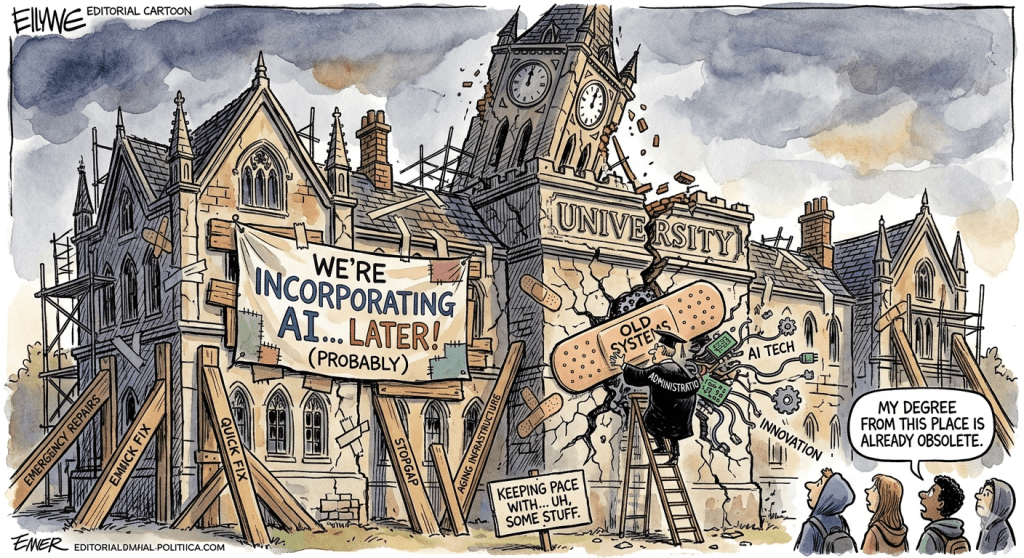
Whether these moves are promising depends on which problem they address. Price resets and three-year degrees attack the cost side of the premium, and price has early enrollment results to show. AI requirements and applied AI programs attack the skills side, but nothing yet shows that a required AI course raises graduate earnings, and the Dallas Fed’s finding of weak returns to graduate study in exposed fields is a caution. Work-integrated learning has the best long-run evidence behind it, but it is hard to scale. An Inside Higher Ed survey found 69 percent of provosts named staff capacity as the main barrier, career centers average 3,343 students per full-time staff member, and only 20 percent of provosts said their institution had a clear vision for teaching for an AI-era workplace (Flaherty, 2026). Stanford’s Susan Young summed up the planning risk: “If they underreact, they may miss shifts; if they overreact, they risk chasing temporary trends” (Flaherty, 2026).
Conclusion
The economic value of the average American bachelor’s degree is falling, measurably, after four decades of growth, and the public has turned more skeptical faster than the wage data alone would justify. The decline remains partial. A degree holder still earns far more than a high school graduate, still faces lower unemployment across the OECD, and in most surveys still believes the investment paid off. AI explains part of the shift, roughly a quarter to a third so far, with graduate oversupply, rising wages at the other end of the labor market, cost, and distrust explaining the rest.
Over the next five years, the federal earnings test, a shrinking pool of 18-year-olds, and the spread of AI into junior office work will push colleges to prove their value program by program. The alternatives are pulling in students where training is short, paid, and tied to physical work. Colleges that cut prices, shorten degrees, and build work experience into the curriculum have a reasonable case to make to students. Those that keep high prices and low completion rates in fields where AI does the entry-level work will have a harder one, and after 2028 the federal government will publish the numbers.
References
Abel, J. R., & Deitz, R. (2025, April 16). Is college still worth it? Liberty Street Economics, Federal Reserve Bank of New York. https://libertystreeteconomics.newyorkfed.org/2025/04/is-college-still-worth-it
Albright, A. (2026, October 5). Colleges slash tuition bills by $20,000 in reckoning over costs. Bloomberg, via WealthManagement.com. https://www.wealthmanagement.com/financial-planning/colleges-slash-tuition-bills-by-20-000-in-reckoning-over-costs
Alonso, J. (2026, January 15). Fall enrollment increased 1%, international students declined. Inside Higher Ed. https://www.insidehighered.com/news/students/2026/01/15/fall-enrollment-increased-1-international-students-declined
Blake, J. (2026, July 20). How soon could colleges lose loan access? Inside Higher Ed. https://www.insidehighered.com/news/government/student-aid-policy/2026/07/20/how-soon-could-colleges-lose-loan-access
Brenan, M. (2026, October 1). Record-low 31% say college education is “very important.” Gallup. https://news.gallup.com/poll/715133/record-low-say-college-education-important.aspx
Burleigh, E. (2025, November 5). Palantir says college is no longer a reliable training ground—so it hired 22 high school students instead: “Skip the debt. Skip the indoctrination.” Fortune. https://www.fortune.com/2025/11/05/palantir-colleges-no-longer-reliable-training-ground-gen-z-hire-22-high-school-students-fellowship
Burleigh, E. (2026, March 17). ServiceNow CEO says that new college graduate unemployment could reach 30% thanks to AI automation. Fortune. https://fortune.com/2026/03/17/servicenow-ceo-bill-mcdermott-gen-z-graduates-face-30-unemployment-next-couple-of-years-ai-takes-over
Burning Glass Institute. (2025, July 28). No country for young grads. https://www.burningglassinstitute.org/research/no-country-for-young-grads
Cabrera, S. (2026, August 4). UK graduate jobs hit lowest level since 2020 as AI hiring reaches record high. International Business Times UK. https://www.ibtimes.co.uk/uk-graduate-job-market-decline-ai-demand-1812241
Capstone Workforce. (2026, October 2). Workforce Pell status by state. https://capstoneworkforce.com/resources/workforce-pell-state-implementation
Cheng, S. (2026, August 20). China’s youth jobless rate climbs to 17.9% in July. Caixin Global. https://www.caixinglobal.com/2026-08-20/chinas-youth-jobless-rate-climbs-to-179-in-july-102475860.html
Cowen, T. (2026, September 2). The college wage premium in the generative AI era. Marginal Revolution. https://marginalrevolution.com/marginalrevolution/2026/09/the-college-wage-premium-in-the-generative-ai-era.html
DeVaney, J. (2026, September 22). Career readiness cannot wait until graduation, and it doesn’t have to. Inside Higher Ed. https://www.insidehighered.com/opinion/columns/learning-innovation/2026/09/22/career-readiness-cannot-wait-until-graduation
Dodini, S., & Smith, T. (2026, September 22). AI plays a role in weak labor market for college graduates. Federal Reserve Bank of Dallas. https://dallasfed.org/research/economics/2026/0922
E.ON UK. (2026, August 13). E.ON sees degree apprenticeship applications treble as school leavers rethink university-only routes. https://news.eonenergy.com/news/e-on-sees-degree-apprenticeship-applications-treble-as-school-leavers-rethink-university-only-routes
EIN Presswire. (2026, October 2). Employers dropped degree requirements. Hiring data shows limited follow-through. https://www.einpresswire.com/article/946939094/employers-dropped-degree-requirements-hiring-data-shows-limited-follow-through
Fairlie, R. W., & Wu, J. (2026). The early impacts of AI on employment among recent college graduates (NBER Working Paper No. 35796). National Bureau of Economic Research. https://www.nber.org/papers/w35796
Farrington, R. (2026, October 5). The college wage premium just fell to its mid-1990s level, and AI explains a third of it. The College Investor. https://thecollegeinvestor.com/89897/the-college-wage-premium-just-fell-to-its-mid-1990s-level/
Federal Reserve Bank of New York. (2026). The labor market for recent college graduates. Retrieved October 6, 2026, from https://www.newyorkfed.org/research/college-labor-market
Flaherty, C. (2026, September 29). Future-proofing graduates for an uncertain labor market. Inside Higher Ed. https://www.insidehighered.com/news/student-success/life-after-college/2026/09/29/future-proofing-graduates-uncertain-labor-market
Gioino, C. (2026, September 17). College grads shut out of AI-exposed majors since 2022 are ending up in retail and food service instead of the white-collar jobs they studied for. Fortune. https://fortune.com/2026/09/17/ai-chatgpt-college-majors-retail-jobs/
Harrington, C. (2026, September 9). Alternatives are having a moment. Minding the Campus. https://mindingthecampus.org/2026/09/09/alternatives-are-having-a-moment/
Hillman, N. (2025, September 9). Higher education and its benefits at all-time high across OECD countries: Education at a Glance 2025. Higher Education Policy Institute. https://www.hepi.ac.uk/2025/09/09/higher-education-and-its-benefits-at-all-time-high-across-oecd-countries-education-at-a-glance-2025/
Hrynowski, Z., & Marken, S. (2026, February 23). College students, grads see strong career value in degree. Gallup. https://news.gallup.com/poll/702284/college-students-grads-strong-career-value-degree.aspx
International Labour Organization. (2026, August 11). Youth unemployment rises as young people face a harder road to decent work. https://www.ilo.org/resource/news/youth-unemployment-rises-young-people-face-harder-road-decent-work
Jones, J. M. (2026, July 13). Confidence in U.S. higher education slips back slightly. Gallup. https://news.gallup.com/poll/712322/confidence-higher-education-slips-back-slightly.aspx
Lichtenberg, N. (2026, June 16). College students are voting with their feet on AI. Goldman has the receipts. Fortune. https://www.fortune.com/2026/06/16/goldman-sachs-college-students-ai-major-enrollment-shift/
Lopopolo, A. (2026, July 15). Trade school enrollment is booming. It’s mostly a demographic mirage. Quartz. https://qz.com/trade-school-enrollment-1421-percent-gen-z-explained-071026
Nietzel, M. T. (2026, September 6). Oklahoma becomes latest state to approve 3-year bachelor’s degrees. Forbes. https://www.forbes.com/sites/michaeltnietzel/2026/09/06/oklahoma-becomes-latest-state-to-approve-three-year-bachelors-degrees/
OECD. (2026). How does educational attainment affect participation in the labour market? In Education at a Glance 2026: OECD indicators. OECD Publishing. https://www.oecd.org/en/publications/2026/09/education-at-a-glance-2026_3bce4131/full-report/how-does-educational-attainment-affect-participation-in-the-labour-market_b0fe0937.html
Panganiban, M. (2026, September 29). AI has yet to cause a spike in unemployment among young graduates. University Herald. https://www.universityherald.com/articles/80457/20260929/ai-has-yet-cause-spike-unemployment-among-young-graduates.htm
Purdue University. (2026, August 19). Purdue’s AI competency graduation requirement begins in every undergraduate degree program. https://www.purdue.edu/newsroom/2026/Q3/purdues-ai-competency-graduation-requirement-begins-in-every-undergraduate-degree-program/
Spitalniak, L. (2025, December 5). Higher education faces “deteriorating” 2026 outlook, Fitch says. Higher Ed Dive. https://www.highereddive.com/news/higher-education-faces-deteriorating-2026-outlook-fitch-says/807222/
Staffing Industry Analysts. (2026, September 15). Graduating in AI era is like “large recession” for starting pay. https://www.staffingindustry.com/news/global-daily-news/graduating-in-ai-era-is-like-large-recession-for-starting-pay
UCAS. (2026, July 16). Record number of UK school leavers head into the results period with an offer of a university or college place this year. https://www.ucas.com/corporate/news-and-key-documents/news/record-number-of-uk-school-leavers-head-into-the-results-period-with-an-offer-of-a-university-or
Unglesbee, B. (2024, December 11). High school graduates to peak in 2025, with slightly deeper-than-expected declines ahead. K-12 Dive. https://www.k12dive.com/news/high-school-graduates-to-peak-in-2025-with-slightly-deeper-than-expected-d/735221/
VerBruggen, R. (2026, September 7). The college wage premium falls. City Journal (Substack). https://cityjournal.substack.com/p/the-college-wage-premium-falls
The Wire. (2026, March 18). Nearly 40% of Indian graduates under the age of 25 are unemployed: Azim Premji report. https://thewire.in/labour/nearly-40-of-indian-graduates-under-the-age-of-25-are-unemployed-azim-premji-report
###
Filed under: Uncategorized |































































































































































































































































































































































































































Leave a Reply