





By Jim Shimabukuro (assisted by ChatGPT)
Editor
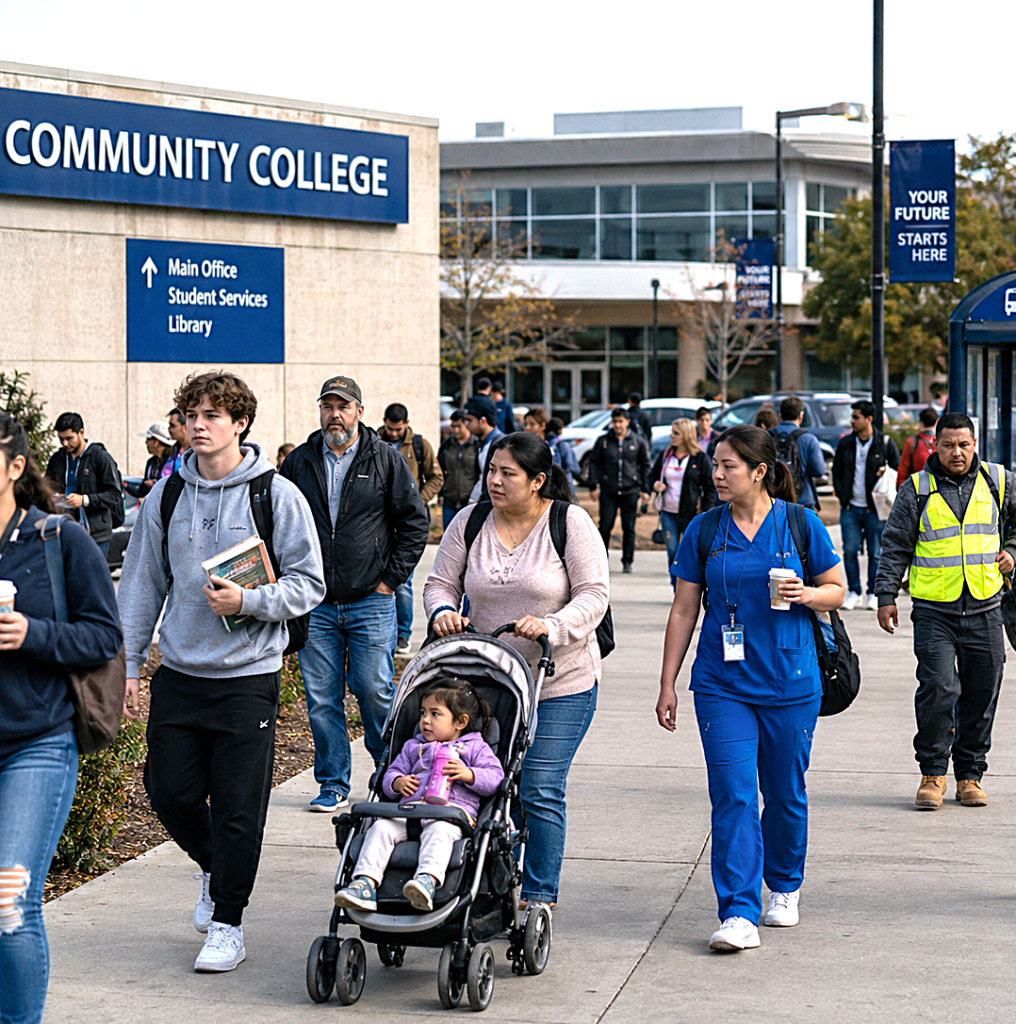
Introduction: Enrollment is rising again, but the sector’s 2026 recovery is being built on a different student mix, thinner finances, heavier student needs, and a demographic base that begins shrinking after 2025.

The easiest way to misread the condition of American community colleges in September 2026 is to look at the newest enrollment number and stop there. Spring 2026 community-college enrollment increased 3.1 percent from the previous spring, outpacing the 1.3 percent increase in undergraduate enrollment overall. Undergraduate certificate programs grew 10.2 percent. Health-professions enrollment rose again. Those are genuine gains, and after the losses of the early 2020s they matter (National Student Clearinghouse Research Center, 2026a).
But the more revealing question is not whether headcount is up. It is: What kind of community-college sector is growing back? The answer is increasingly different from the one that entered 2020. The traditional core of adult and regular-credit degree seekers has not simply returned. Growth is being pulled by high-school dual enrollment, short certificates, selected workforce fields, and new forms of noncredit education. At the same time, colleges are being asked to provide more advising, food and housing assistance, mental-health support, technology, fraud prevention, transfer guidance, and expensive career programs with less financial room than four-year public institutions possess.
That combination creates the most telling trajectory of the decade. The first half, 2020-2025, was dominated by an acute enrollment shock followed by emergency stabilization and partial recovery. The second half, 2026-2030, is more likely to be defined by a chronic structural squeeze: a smaller pool of traditional-age students in many states, difficulty recapturing working adults, widening dependence on dual enrollment and short-term credentials, stubborn transfer and completion losses, rising basic-needs burdens, workforce programs that cannot add seats fast enough, and operating budgets in which enrollment declines can trigger cuts that make enrollment recovery harder.
This is not a prediction that community colleges will disappear. The United States still depends on them for low-cost access, transfer, technical education, nursing and allied health, public-safety training, adult education, and local workforce development. The danger is subtler: a growing number of institutions may remain open while becoming thinner — fewer sections, fewer programs, fewer advisers and counselors, less geographic reach, and less capacity to respond when their communities need them most.
The mid-decade trajectory in one view
The contrast below is necessarily a national synthesis. Conditions differ sharply by state, region, and college, but the direction of the underlying pressures is increasingly consistent.
| Key factor | 2020-2025 | 2026-2030 trajectory |
| Enrollment | Pandemic collapse, then uneven recovery. | Aggregate growth can continue, but increasingly depends on dual enrollment, certificates, and selected fields rather than a full return of the old degree-seeking base. |
| Student mix | Adult and traditional credit enrollment fell hardest; high-school enrollment became a stabilizer. | High-school students become a larger share of many colleges; adult re-engagement remains difficult and expensive. |
| Demography | The large high-school cohorts still moving through the pipeline masked the coming shift. | The national high-school graduate count has passed its projected 2025 peak and begins a long decline, with severe regional differences. |
| Finances | Federal relief helped institutions absorb the emergency. | Relief is gone; enrollment-linked revenue, fixed costs, inflation, benefits, and limited tuition leverage expose structural deficits. |
| Student needs | Food, housing, childcare, transportation, and mental-health problems became impossible to treat as peripheral. | Support functions become core operating requirements even as some colleges cut the very staff who deliver them. |
| Workforce role | Demand for short, job-linked training accelerated. | Workforce Pell and employer demand expand opportunity, but faculty, clinical sites, labs, and equipment limit capacity in the highest-need fields. |
| Transfer and completion | Reforms produced gradual improvement, but leakage remained large. | The sector’s legitimacy increasingly depends on whether enrollment gains translate into credentials, transfer, and bachelor’s completion. |
| Institutional footprint | Closures and consolidations remained limited nationally. | More mergers, campus consolidation, program suspension, and service thinning are plausible where demographics and budgets deteriorate together. |
2020-2025: The pandemic did not create the enrollment problem; it accelerated it
Community colleges entered the pandemic with a problem that was already more than a decade old. Federal Reserve Bank of Kansas City economist Emily Pollard calculated that community-college enrollment fell 22 percent between 2010 and 2023, a loss of about 1.7 million students; 42 of the 50 states experienced declines greater than 10 percent (Pollard, 2026). The long decline matters because it changes the interpretation of 2020. COVID-19 was not a sudden reversal of a healthy growth trend. It struck a sector that had already been shrinking through a long economic expansion.
Community-college enrollment has historically been countercyclical. When unemployment rises, workers often return to school; when jobs are plentiful, the immediate income from working makes college harder to justify. Pollard cites research estimating that improved local labor-market conditions explain about 60 percent of the decline in first-time community-college enrollment from 2009 to 2019. The pandemic broke that familiar pattern. Unemployment exploded, but so did childcare disruption, illness, family responsibilities, and the abrupt shift to remote instruction. Instead of producing the expected enrollment surge, the emergency produced another decline (Pollard, 2026).
The damage was deep enough that recovery could not be measured simply by whether enrollment stopped falling. A Community College Research Center analysis found that only 27 percent of community colleges had recovered their fall 2019 enrollment by fall 2023. National community-college enrollment was about 6.59 million in fall 2019, fell to roughly 5.74 million in fall 2021, and recovered to about 6.0 million by fall 2023. The same analysis found that dual enrollment was the only major age segment with net growth through the pandemic period (Fink, 2025).
There was real institutional progress during this period. Community colleges continued redesigning developmental education and guided pathways, and six-year completion among credit students rose from 36 percent in 2012 to 43 percent in 2024 (Community College Research Center, 2026a). The point is not that the first half of the decade was uniformly disastrous. It is that improvement in student success was unfolding inside a sector whose enrollment base had already contracted and whose pandemic recovery would increasingly depend on different students and different programs.
The 2026 rebound is real – and it is changing the meaning of ‘recovery’
The latest national data are encouraging at first glance. In spring 2026, community-college enrollment rose 3.1 percent year over year. High-transfer public two-year institutions grew 5.5 percent, while high-vocational public two-year institutions grew 2.8 percent. Certificate enrollment across undergraduate education increased 10.2 percent. Health Professions grew between 6.0 and 7.1 percent across award levels and institution types. Yet Computer and Information Sciences enrollment at two-year institutions fell 11.2 percent in a single year (National Student Clearinghouse Research Center, 2026a).
That mix matters. A college can post a healthy headline enrollment increase while the underlying population shifts toward students with very different goals, schedules, support needs, and revenue implications. Dual enrollment is the clearest example. In 2023-24, about 2.8 million U.S. high-school students took college courses through dual enrollment, roughly 2 million of them at community colleges. By 2026, dual-enrolled students accounted for about one in five community-college enrollments nationally, and in 11 states and hundreds of colleges they represented more than one third (Jenkins & Fink, 2026).
California, with 116 community colleges, offers an unusually clear view of this statistical transformation. The Legislative Analyst’s Office estimated that total California Community Colleges enrollment in 2025-26 was only about 1 percent above 2018-19. But regular credit enrollment was still 3 percent below its pre-pandemic level. The difference was made up by growth elsewhere: noncredit enrollment was up 19 percent, and dual enrollment had jumped 76 percent, from 37,370 to 65,620 full-time-equivalent students (Legislative Analyst’s Office, 2026). Just over half of California districts had returned to or exceeded their pre-pandemic enrollment.
In other words, ‘back to pre-pandemic enrollment’ can describe a system that is not actually back to its pre-pandemic composition. That is one of the central facts of 2026. The recovery has been achieved partly by widening the community-college mission upward into high schools and outward into shorter workforce and noncredit programs. These are important public functions. They are also a warning against using raw headcount as a sufficient measure of institutional health.
The hardest students to win back are the adults community colleges were built to serve
The second half of the decade begins with a massive pool of potential adult students: approximately 43.1 million Americans have attended college without earning a credential, including 37.6 million working-age adults under 65 (Cornett, 2026). That number can look like an enormous recruitment opportunity. It is also evidence of how difficult adult persistence has been.
A 2026 Trellis Strategies survey summarized by Lumina Foundation found that adults with some college but no credential commonly left because of financial hardship, work conflicts, caregiving responsibilities, and other life pressures rather than academic failure (Cornett, 2026). Those forces are not easily solved by reopening a course section. They shape whether a student can get to campus after work, find childcare, survive a reduction in work hours, replace a broken car, or remain enrolled after an unexpected bill.
The National Student Clearinghouse Research Center’s June 2026 persistence report adds another warning. Among fall 2024 starters across higher education, students age 25 or older had a second-fall persistence rate of only 43.6 percent, down one percentage point from the previous cohort. Part-time starters improved to a decade-high 54.1 percent, but their persistence remained far below the overall 77.1 percent rate (National Student Clearinghouse Research Center, 2026b). Community colleges enroll unusually large shares of both older and part-time students, so these national age and intensity gaps fall disproportionately on the sector.
The labor market complicates recruitment further. Pollard’s 2026 analysis found that occupations classified as typically requiring an associate degree fell from 5.6 percent of employment in 2010 to 2.0 percent in 2023, reflecting in part higher credential requirements in occupations such as management and registered nursing. Inflation-adjusted median earnings of young associate-degree holders also declined 5.7 percent from 2010 to 2019, while bachelor’s-degree holders saw gains (Pollard, 2026).
That does not mean an associate degree has ceased to pay. A 2026 CCRC study of CUNY community-college entrants found that students completing a terminal associate degree earned about $9,700 more annually by year 10 than comparable noncompleters, a gain of roughly 30 percent; bachelor’s completers saw still larger gains (Minaya et al., 2026). The problem is therefore not a simple collapse in value. It is inconsistency. The payoff depends heavily on field, local labor market, whether the student completes, and whether the credential leads efficiently to the next educational or occupational step. For adults choosing between this month’s paycheck and a multi-semester program, that uncertainty matters.
The transfer promise still leaks students at every stage
Community colleges sell two propositions at once. One is a direct route into a job. The other is a low-cost first stage of a bachelor’s degree. The second proposition remains enormously attractive, but the national numbers expose how much attrition occurs between aspiration and completion.
The March 2026 Tracking Transfer report followed first-time students who started at community colleges in fall 2018. Only 31.6 percent transferred to a four-year institution within six years. Among those who transferred, 48.7 percent completed a bachelor’s degree within that period. A related Clearinghouse analysis calculated that just 18.0 percent of all students who began at two-year colleges in fall 2018 earned a bachelor’s degree within six years. Matthew Holsapple of the Clearinghouse described the result as a “persistent gap between student aspirations and ultimate degree attainment” (National Student Clearinghouse, 2026a; National Student Clearinghouse Research Center, 2026c).
The post-transfer numbers show that the four-year destination also matters. Seventy-three percent of community-college transfers in the 2018-19 transfer cohort went to public four-year institutions, where 71.2 percent completed a bachelor’s degree within six years. Students who had already earned an associate award before transfer also had higher one-year retention after transfer – 86.9 percent compared with 77.7 percent for students who transferred without an award (National Student Clearinghouse Research Center, 2026c).
Dual enrollment again complicates the picture. Students arriving at community college with previous dual-enrollment experience transferred at a 45.4 percent rate and had substantially higher bachelor’s completion than other first-time community-college students. In another 2026 Clearinghouse analysis, 27.5 percent of students who entered community college with prior dual enrollment completed a bachelor’s within six years, compared with 15.8 percent of first-time community-college students overall. Holsapple called dual enrollment “a strong on-ramp to student success in higher education” (National Student Clearinghouse, 2026b).
Those results make dual enrollment attractive for good reason. But they also create a measurement hazard. A rising share of younger students who have already demonstrated the capacity to succeed in college coursework can lift an institution’s enrollment and outcome profile without necessarily improving the experience of the older, working, first-generation, or stop-out students whose barriers are very different. CCRC’s July 2026 policy brief emphasizes that access to high-quality dual enrollment remains uneven even as participation expands (Jenkins & Fink, 2026). The sector can therefore become more successful on paper while becoming more segmented in practice.
Low tuition is no longer an adequate definition of affordability
Community colleges remain inexpensive by higher-education standards. In August 2026, the American Association of Community Colleges reported average annual tuition and fees of about $4,150, and only 12 percent of community-college students taking federal loans (American Association of Community Colleges, 2026a). But tuition is only one line in the budget of a student who is paying rent, buying food, arranging transportation, caring for children, and losing work hours to attend class.
A CCRC fact sheet released in August 2026 makes the scale of the problem difficult to dismiss. Drawing on a national 2023-24 survey, it reports that 73 percent of two-year college students experienced at least one form of basic-needs insecurity; 51 percent reported housing insecurity, 15 percent homelessness within the previous year, and 43 percent food insecurity within the previous month. Among two-year students who had dropped out, 83 percent said basic-needs insecurity was one reason. CCRC’s blunt summary is that “Addressing student basic needs is essential for college enrollment and persistence” (Anderson, 2026).
The operational implication is profound. A college built around inexpensive instruction now needs food pantries, benefits navigators, emergency grants, childcare referrals, housing assistance, transportation help, mental-health services, and staff who can connect students to public programs. These are not decorative student-affairs functions when a missed rent payment can end a semester. Yet they are labor-intensive and often financed through grants or temporary appropriations.
The basic-needs problem becomes most consequential when budgets tighten. In 2026, Contra Costa College in California faced a $1.8 million structural deficit and eliminated positions that included a dean of enrollment, a counseling/matriculation instructional assistant, a Welcome Center and Outreach program assistant, and a learning-disabilities specialist. The district said about 90 percent of its budget went to salaries and benefits, leaving personnel reductions as the main route to recurring savings (Kadah, 2026). The financial logic is understandable. The institutional logic is dangerous: cut the staff who help vulnerable students enroll and persist, then depend on enrollment and persistence to restore revenue.
The operating model is becoming less forgiving
The national finance picture is not one of universal austerity. State support for higher education increased in many places during and after the pandemic. But the two-year sector begins the second half of the decade with much less revenue per student than public four-year institutions and less ability to compensate through tuition.
The State Higher Education Executive Officers Association reported in 2026 that total education revenue at public two-year institutions averaged $13,722 per full-time-equivalent student in fiscal year 2025, down 2.6 percent from the prior year. Public four-year institutions averaged $21,508 per FTE – about 1.6 times as much. Two-year total education revenue per FTE declined in 35 states. Net tuition and fee revenue at two-year institutions averaged only $2,668 per FTE and fell 5.0 percent in a year (State Higher Education Executive Officers Association, 2026).
That gap matters because colleges do not shrink cleanly when enrollment falls. Buildings still need power, security, maintenance, insurance, and technology. Laboratories require equipment and compliance. Small programs still need qualified faculty. A college can reduce sections or leave vacancies unfilled, but it cannot reduce every cost in proportion to headcount. Pollard summarizes the dilemma in one sentence: “Community colleges face fixed costs and limits on how much they can shrink” (Pollard, 2026).
HACC, Central Pennsylvania’s Community College, shows what that means in practice. In June 2026, its board approved a revised $123.8 million operating budget after identifying $9 million in savings, reducing a projected deficit to $0.8 million. The college cited three years of flat state appropriations, a projected 1.8 percent enrollment decline, an 11 percent increase in employee healthcare costs, inflation, and collective-bargaining costs. It also approved plans to sell or lease seven buildings while keeping all five campuses open (HACC, 2026). This is not a college shutting down. It is a college actively shrinking its cost structure to stay viable.
At Clatsop Community College in Oregon, the arithmetic was smaller but more immediate. Facing a roughly $700,000 deficit and rising costs, the college laid off five full-time employees, moved other positions to part-time, and proposed suspending automotive technology, computer-aided design and drafting, and historic preservation and restoration (Frankowicz, 2026). The example is especially telling because two of the threatened areas are precisely the kinds of technical programs community colleges are expected to expand for regional workforce needs.
The risk for 2026-2030 is not simply that some institutions will run deficits. It is that recurring deficits force choices that alter the institution itself: fewer programs, fewer people, less physical space, and less redundancy. Once those reductions begin, the college has less capacity to rebuild enrollment quickly when local demand changes.
The workforce paradox: employers need more graduates than colleges can produce
No part of the community-college mission is receiving more public attention in 2026 than workforce preparation. The federal expansion of Pell eligibility to certain short-term programs, known as Workforce Pell, took effect July 1. Community colleges are central to the policy because they already run many of the short, job-linked programs the law is designed to support. Yet in July, AACC noted that many states and institutions were still establishing approval processes and identifying eligible programs. Federal officials had urged colleges to view July 1 as a “starting gun rather than any sort of deadline” (American Association of Community Colleges, 2026b, 2026c).
The harder constraint is not always student demand. In health care, demand can greatly exceed a college’s ability to add seats. A July 2026 MassINC study of six nursing and allied-health occupations in Massachusetts found about 4,500 qualified applicants for community-college programs but capacity for only about 2,200. Radiologic-technology programs had roughly five qualified applicants for every seat. Planned expansion across the six fields amounted to about 400 seats over the next two or three years – substantial growth, yet still far short of the pipeline needed if health-care demand accelerates through 2030 (MassINC, 2026).
Why not simply admit more students? Because high-cost technical programs are not lecture courses that can be doubled with another row of desks. Nursing and allied health require faculty who can often earn more in clinical practice, clinical-placement agreements with hospitals and health systems, specialized laboratories, equipment, licensing compliance, and small instructor-to-student ratios. Welding, advanced manufacturing, aviation maintenance, and other technical programs have analogous constraints. The sector is being asked to become the rapid-response training arm of the economy while many colleges are simultaneously trimming staff and facilities.
The spring 2026 enrollment data make the volatility of this role visible. Health-professions enrollment continued to rise, while Computer and Information Sciences at two-year institutions dropped 11.2 percent year over year (National Student Clearinghouse Research Center, 2026a). The data do not establish why computer enrollment fell so sharply, but they demonstrate how quickly student demand can move. Colleges must decide which programs to expand, staff, equip, or close while the labor market itself is changing faster than a typical curriculum-approval and hiring cycle.
A new operating tax: fraudulent ‘ghost students’
Open access has always been a defining community-college strength. In the online era it also creates a new vulnerability: large-scale fraudulent applications and enrollments designed to capture financial aid. The problem is national, but California shows its magnitude because the state tracks the applications closely.
CalMatters reported in May 2026 that California’s community-college system had seen suspected fraudulent applications rise from roughly 20 percent of applicants in 2021 to about 34 percent in spring 2025, with some districts reporting far higher rates. After new identity-verification and filtering measures, Sacramento-area colleges reported flagging about 12 percent of applications as suspect in spring 2026 – a major improvement, but still a significant administrative burden (Echelman, 2026). The California Community Colleges Chancellor’s Office describes the post-2020 increase in fraudulent applications as “unprecedented” and has added identity-proofing and other safeguards (California Community Colleges Chancellor’s Office, 2026).
The cost is more than stolen aid. Fraudulent applicants consume staff time, complicate financial-aid verification, occupy course seats until removed, distort enrollment data, and force colleges to erect identity checks around an admissions process designed to be easy to enter. This is a distinctly second-half-of-the-decade problem: institutions must preserve open access while treating every large online intake system as a cybersecurity and identity-management operation.
After 2025, demography starts pushing in the wrong direction
The enrollment rebound of 2024-2026 arrives just as the traditional college-age population begins a long demographic contraction. WICHE’s latest Knocking at the College Door projections put the national high-school graduating class at a record high in 2025, followed by steady decline through 2041. By the end of the projection, the number of graduates is expected to be about 13 percent below the peak. The decline is not evenly distributed: California is projected to fall 29 percent from 2023 to 2041, New York 27 percent, Illinois 32 percent, Pennsylvania 17 percent, and Michigan 20 percent (Lane et al., 2024; Western Interstate Commission for Higher Education, 2024).
Community colleges are unusually exposed because they are local. Students at regional public two-year colleges are more likely than students at four-year residential institutions to attend near home, and most colleges cannot replace a shrinking local high-school population by recruiting nationally or internationally. A rural campus, a small-city college, and an urban district with decades of population loss can therefore experience a demographic shock long before national enrollment totals look alarming.
Pollard’s 2026 Federal Reserve analysis cites an older higher-education demand model that estimated two-year enrollment could fall 16 percent from 2025 to 2029 as the demographic shift arrives. That estimate should not be mistaken for a current official national forecast – actual community-college enrollment grew in spring 2026, and dual enrollment and adult re-engagement can offset some demographic losses. It is better understood as a stress test showing why two-year institutions may be especially sensitive to fewer high-school graduates (Pollard, 2026).
The crucial point for 2026-2030 is direction, not a single national percentage. The demographic tailwind is over. Colleges in growing Sun Belt and selected western markets may continue to expand. Others will face fewer high-school graduates at the same time they are trying to rebuild adult enrollment. This will widen the gap between growing and shrinking institutions and make the national average less informative.
The map will change even if most colleges remain open
Institutional survival does not require a formal closure to become a public-access problem. A college can remain legally open while consolidating campuses, selling buildings, suspending programs, reducing evening sections, or centralizing services. For students whose margin for attendance is already small, those changes can be equivalent to losing access.
The Peralta Community College District in Oakland provides a preview. In June 2026, trustees moved forward with merging Laney College and Merritt College into a single institution, Oakland City College, by fall 2027 while retaining both physical campuses. District enrollment had fallen sharply: Laney’s headcount dropped from 17,698 in 2019-20 to 9,828 in 2024-25, and Merritt’s from 11,856 to 7,195. District leaders presented the merger as a way to reduce administrative duplication amid long-running budget and enrollment problems (Weissman, 2026; Peralta Community College District, 2026).
This kind of restructuring may preserve instruction that a full closure would destroy. It can also reshape identity, staffing, governance, and local access in ways that national enrollment datasets barely register. If the demographic and budget pressures described above intensify, the second half of the 2020s is likely to produce more combinations of merger, consolidation, program suspension, and reduced physical footprint rather than a dramatic wave of whole-college shutdowns.
2026-2030: The most likely national trajectory
Taken together, the evidence does not support a simple straight-line forecast. The sector can continue posting national enrollment gains in the near term, especially if certificate programs, dual enrollment, health care, noncredit workforce education, and selected state free-college initiatives keep expanding. Spring 2026 proves that growth is possible even after years of decline.
But the composition of that growth is the signal to watch. The likely national trajectory through 2030 is a continued shift away from the old model of a predominantly adult, regular-credit, associate-degree institution toward a more complicated portfolio: high-school students earning college credit; adults taking short workforce programs; students pursuing transfer degrees; incumbent workers upskilling in noncredit courses; and a smaller share of traditional terminal associate-degree students in fields where the labor-market return has weakened.
That diversification can stabilize enrollment, but it also raises operating complexity. Each population brings different calendars, advising systems, faculty requirements, funding rules, data reporting, employer relationships, transfer agreements, and student-support needs. The community college of 2030 may be doing more kinds of work for more kinds of learners even if its conventional degree enrollment is smaller.
At the same time, demographic contraction and local dependence will make geography increasingly decisive. Systems in expanding regions may add programs and facilities; colleges in shrinking regions will face pressure to consolidate them. The financial difference between a 2 percent enrollment decline and a 2 percent increase can be enormous when most costs are fixed and tuition revenue is limited. More institutions will therefore live close to the boundary where a modest enrollment miss, healthcare increase, expired grant, or state appropriation change triggers personnel or program cuts.
Student success will become the other pressure point. If a college recruits a student but loses that student before a credential, transfer, or meaningful labor-market payoff, enrollment growth alone will not repair the underlying model. The sector has made measurable progress in completion, but the 2026 transfer data still show that fewer than one in five students who start at a two-year college earn a bachelor’s degree within six years. The basic-needs data show why persistence remains difficult. The adult stop-out population shows how many people have already tried college without finishing.
By 2030, therefore, the national picture is likely to be more unequal rather than uniformly worse: some large systems and well-positioned colleges growing rapidly in dual enrollment and high-demand workforce fields; other institutions surviving through consolidation and narrower program portfolios; and many colleges caught between rising demand for intensive student services and limited recurring funds to provide them. The risk is not a single national collapse. It is cumulative erosion across hundreds of local decisions.
The warning hidden inside the recovery
Community colleges have repeatedly adapted to economic change, demographic change, and new public missions. Their 2026 enrollment rebound demonstrates that adaptability. It would be a mistake to treat the sector as a relic or to assume that declining birth rates make decline inevitable.
It would be an equal mistake to declare the crisis over because enrollment is rising. The numbers underneath the headline are sending a different message. A large portion of the recovery is coming from populations and programs that were smaller before the pandemic. Traditional adult students remain hard to recapture. The transfer pipeline still loses too many aspiring bachelor’s students. Basic-needs insecurity is widespread. High-demand technical programs can be full while lacking the capacity to expand. Two-year institutions operate with substantially less revenue per student than four-year publics. And colleges in multiple states are already balancing budgets by reducing people, programs, and physical space.
The most important question for the second half of the decade is therefore not how many community colleges survive as names on a map. It is how many retain enough instructional breadth, student support, workforce capacity, transfer effectiveness, and geographic reach to perform the role their communities assume they will perform.
That is why the 3.1 percent spring 2026 enrollment gain should be read as both encouraging and cautionary. Community colleges are growing again. But they are growing into a harsher operating environment and a different demographic era. The sector may enter 2030 with more students in high schools and short-term programs, more responsibility for the social conditions that determine whether students can remain enrolled, and fewer financial margins for error. If those pressures continue to accumulate, the defining problem will not be whether community colleges can attract anyone. It will be whether they can still afford to be community colleges in the full sense of the term.
References
American Association of Community Colleges. (2026a, August 12). A joint response to the U.S. Department of Education’s call to action. https://www.aacc.nche.edu/2026/08/12/a-joint-response-to-the-u-s-department-of-educations-call-to-action/
American Association of Community Colleges. (2026b, May 22). Advocacy Quick Hits: Latest Workforce Pell regulations. https://www.aacc.nche.edu/2026/05/22/advocacy-quick-hits-87/
American Association of Community Colleges. (2026c, July 13). AACC policy update: Latest developments in Workforce Pell. https://www.aacc.nche.edu/2026/07/13/aacc-policy-update-latest-developments-in-workforce-pell/
Anderson, M. (2026, August). Basic needs supports in community colleges. Community College Research Center, Teachers College, Columbia University. https://ccrc.tc.columbia.edu/publications/basic-needs-supports-community-colleges.html
California Community Colleges Chancellor’s Office. (2026). Fraud prevention. https://www.cccco.edu/About-Us/Chancellors-Office/Divisions/Information-Services-Technology-Innovation/fraud-prevention
Community College Research Center. (2026a). 2024-2026 biennial report. Teachers College, Columbia University. https://ccrc.tc.columbia.edu/about-ccrc/2024-2026-biennial-report.html
Cornett, A. (2026, April 20). Some College, No Credential (SCNC) survey report. Trellis Strategies/Lumina Foundation. https://www.luminafoundation.org/resource/some-college-no-credential-scnc-survey-report/
Echelman, A. (2026, May 19). California community colleges crack down on fake students stealing financial aid. CalMatters. https://calmatters.org/education/2026/05/financial-aid-fraud-california/
Fink, J. (2025, January 13). How many community colleges fully recovered their enrollments three years after the pandemic? Too few. Community College Research Center, Teachers College, Columbia University. https://ccrc.tc.columbia.edu/easyblog/how-many-community-colleges-fully-recovered-their-enrollments-three-years-after-the-pandemic-too-few.html
Frankowicz, K. (2026, April 6). College considers cuts amid rising costs. KMUN. https://kmun.org/college-considers-cuts-amid-rising-costs/
HACC, Central Pennsylvania’s Community College. (2026, June 2). Budget 2026. https://www.hacc.edu/Budget2026/
Jenkins, D., & Fink, J. (2026, July). Scaling dual enrollment pathways to college and career opportunity: Five state policy strategies. Community College Research Center, Teachers College, Columbia University. https://ccrc.tc.columbia.edu/publications/scaling-dual-enrollment-pathways-college-career.html
Kadah, J. (2026, April 13). Contra Costa College cuts staff who support student wellness, academic counseling, enrollment. Richmondside. https://richmondside.org/2026/04/13/contra-costa-community-college-district-approves-layoffs/
Lane, P., Falkenstern, C., & Bransberger, P. (2024). Knocking at the College Door: Projections of high school graduates (11th ed.). Western Interstate Commission for Higher Education. https://www.wiche.edu/knocking/
Legislative Analyst’s Office. (2026, February). The 2026-27 budget: California Community Colleges. State of California. https://lao.ca.gov/Publications/Report/5150
MassINC. (2026, July 22). Critical shortages ahead: Aligning the nursing and allied health education pipeline with growing employer demand. https://massinc.org/research/critical-shortages-ahead-aligning-the-nursing-and-allied-health-education-pipeline-with-growing-demand/
Minaya, V., Scott-Clayton, J., & Thomas, J. K. R. (2026, April). The returns to degree completion at CUNY’s community colleges. Community College Research Center, Teachers College, Columbia University. https://ccrc.tc.columbia.edu/publications/returns-degree-completion-cuny.html
National Student Clearinghouse. (2026a, March 19). Fewer than one in five students who began at community colleges earned a bachelor’s degree within six years. https://www.studentclearinghouse.org/nscblog/community-college-bachelors-degree-completion/
National Student Clearinghouse. (2026b, April 27). Data dive: Dual enrollment’s positive impact on higher education. https://www.studentclearinghouse.org/nscblog/data-dive-dual-enrollments-positive-impact-on-higher-education/
National Student Clearinghouse Research Center. (2026a, June 4). Clearinghouse Enrollment Insights: Final spring enrollment trends. https://nscresearchcenter.org/final-spring-enrollment-trends/
National Student Clearinghouse Research Center. (2026b, June 25). Persistence and retention: Fall 2024 beginning postsecondary student cohort. https://nscresearchcenter.org/persistence-retention/
National Student Clearinghouse Research Center. (2026c, March 18). Tracking transfer: Measures of effectiveness in helping community college students to complete bachelor’s degrees. https://nscresearchcenter.org/tracking-transfer/
Peralta Community College District. (2026, June). Unification plan FAQ. https://www.peralta.edu/transformation/unification-plan-faq
Pollard, E. (2026, February 5). Investigating the recent decline in community college enrollment. Economic Review, 111(1). Federal Reserve Bank of Kansas City. https://www.kansascityfed.org/research/economic-review/investigating-the-recent-decline-in-community-college-enrollment/
State Higher Education Executive Officers Association. (2026). State Higher Education Finance: FY 2025 report. https://shef.sheeo.org/report/
Weissman, S. (2026, June 16). 2 Oakland community colleges merge. Inside Higher Ed. https://www.insidehighered.com/news/institutions/community-colleges/2026/06/16/2-oakland-community-colleges-plan-merge
Western Interstate Commission for Higher Education. (2024, December). Report: High school graduates will peak next year, then most states will see steady declines through 2041. https://www.wiche.edu/knocking/press/
Research note. National 2026 enrollment figures cited here use the latest final spring data available as of September 3, 2026. Fall 2026 national enrollment estimates had not yet been released. Projections for 2026-2030 are analytical inferences from the cited demographic, enrollment, finance, and institutional evidence, not an official national forecast.
###
Filed under: Uncategorized |









































































































































































































































































































































































































































































Leave a Reply