






By Jim Shimabukuro (assisted by Claude)
Editor
The weight of the platform: the hidden costs of building AI into the university too soon and too firmly. Colleges are spending millions to make AI a campus utility. A growing set of critics, from Oxford law professors to Cal State faculty, warns that contracts, platforms, and governance layers built for this year’s tools can leave institutions less able to move when the tools change again.

In May 2026, the California State University system renewed its contract with OpenAI. The new agreement costs $13 million a year for three years and gives ChatGPT Edu to more than 470,000 students and 63,000 faculty and staff across 22 campuses (Rix, 2026). The first deal, signed in early 2025, had cost about $17 million for 18 months (Palmer, 2026a). Chancellor Mildred García has described the scale with pride: “No other university system in the U.S. or internationally is doing anything like this, not at this scale” (NPR, 2026).
The numbers underneath the renewal are less flattering. In a CSU survey reported by NPR, “Roughly 84% of students said they used ChatGPT. About a quarter of them said they used the version provided by CSU and the vast majority said they used the free version” (NPR, 2026). The rollout came with an online training program, and “as of April, only 0.7% of students and 16% of faculty have completed the voluntary training” (Corzo, 2026). Cal State paid for systemwide access, and most of its students who use ChatGPT still open the free consumer version.
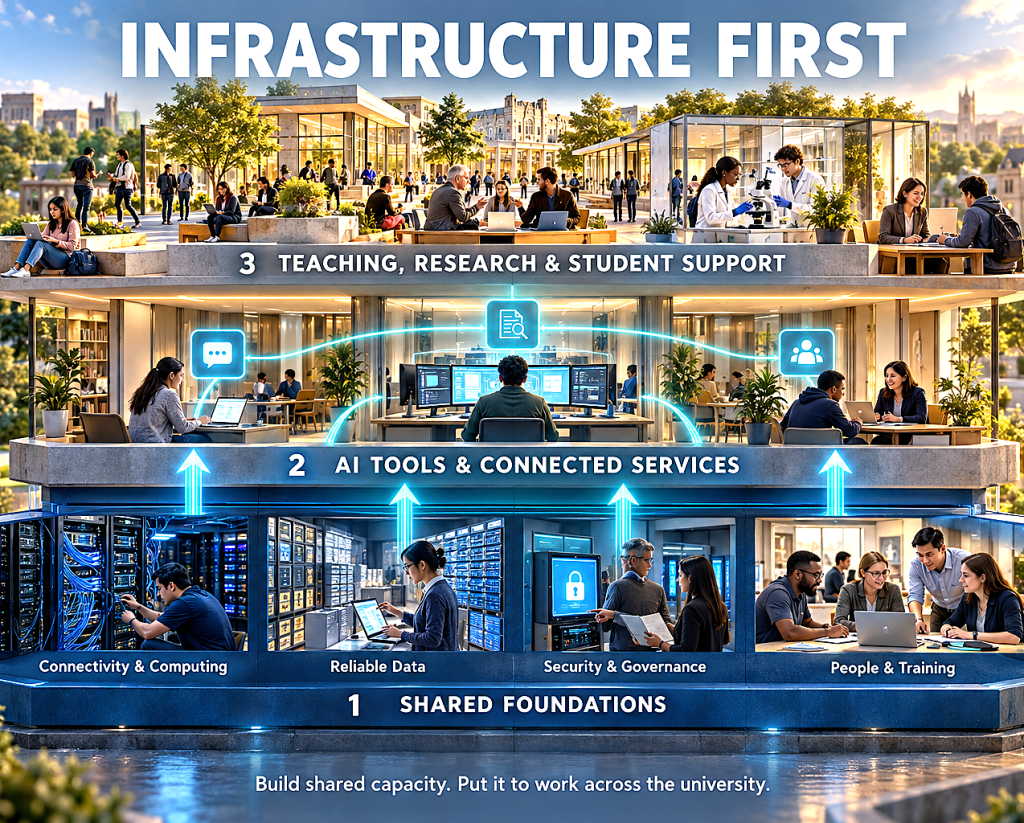
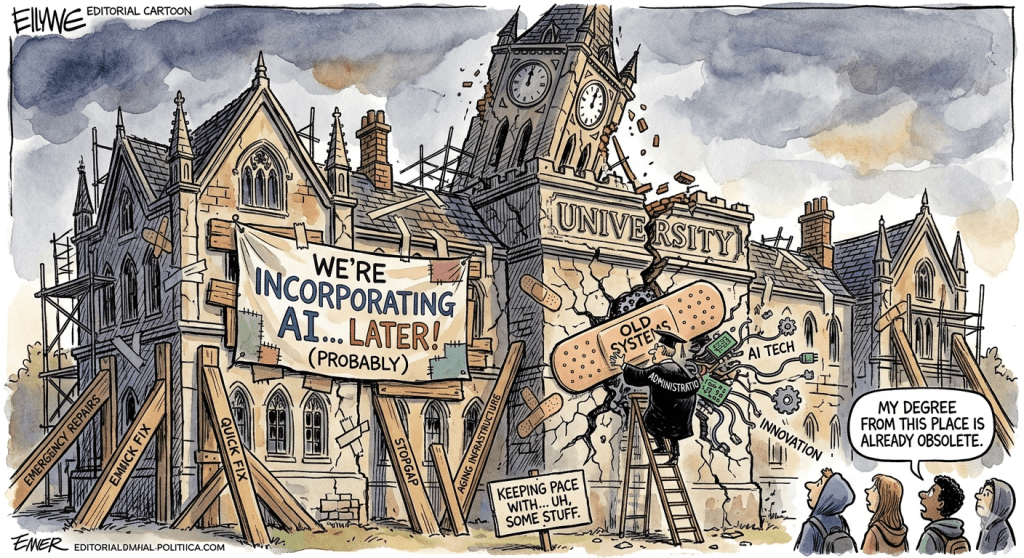
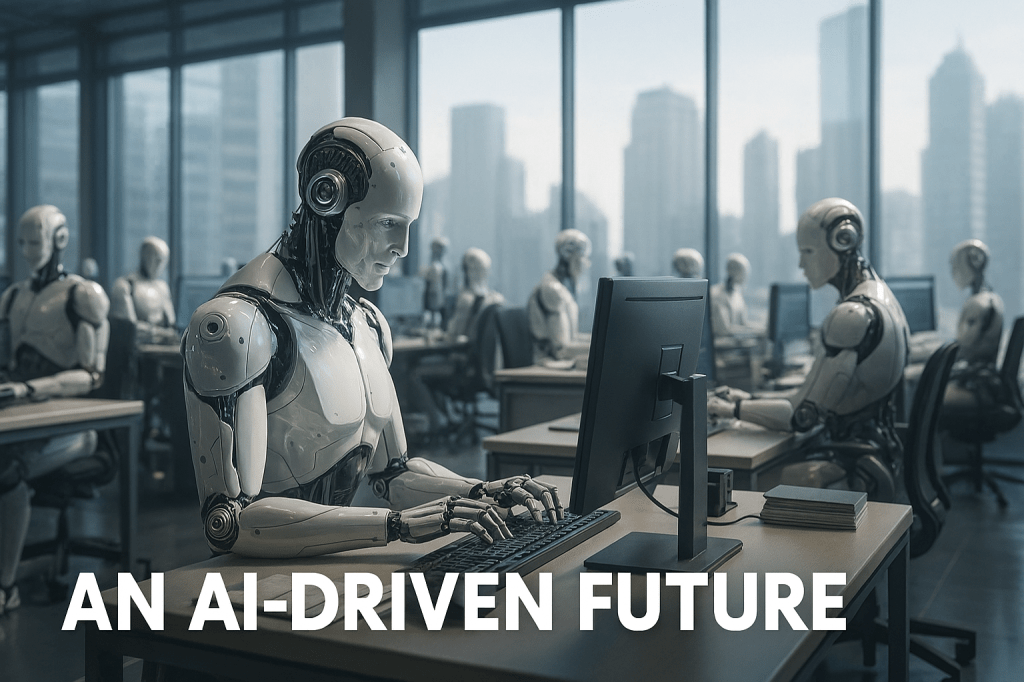
Cal State is the largest example of what this journal recently called the “infrastructure-first” approach to AI in higher education (Shimabukuro, 2026). The idea is simple. A university can hand out AI accounts and still leave students without reliable help, faculty unsure of the rules, and staff copying data between systems that do not talk to each other. Infrastructure-first institutions try to fix those conditions by treating AI as a campus utility, like Wi-Fi or the learning management system. They sign enterprise licenses with data protections, publish lists of approved tools, plug AI into course software, stand up governance committees, require training, and, at research universities, buy their own computing clusters.
Each of those moves has a defensible rationale. This article looks at the other side of the ledger: what happens when an institution builds heavy, durable structure around a technology that changes faster than the structure can. Stacey Alicea of the Research Partnership for Professional Learning put the pace bluntly in September: “AI models were changing every six months; now they’re changing every one to three months” (Palmer, 2026b). At that rate, a three-year contract signed this year will run through somewhere between 12 and 36 rounds of model changes. The voices gathered below have asked what that mismatch costs.
When a purchase becomes a foundation
The most detailed recent account of the problem comes from Tom Smith, academic director of the Royal Air Force College in the United Kingdom, writing in Tech Policy Press on September 30. Smith is no opponent of campus AI. His essay’s title is “Universities Need AI Infrastructure. They Don’t Need AI Lock-In,” and he states plainly, “Universities do need AI infrastructure. But they do not need AI lock-in” (Smith, 2026).
His concern is how a single purchase hardens over time without anyone deciding that it should. “A procurement decision can gradually become an institutional architecture,” he writes. Staff build workflows around the chosen platform, students learn through it, faculty create custom assistants inside it, institutional knowledge collects within it, and other university systems are wired to it. In his words, “The value of a platform increases as more activity takes place within it, while the cost of leaving rises at the same time.” Eventually, “changing providers is no longer comparable to replacing a software license. The institution must unwind an ecosystem” (Smith, 2026).
That process is easy to picture on a real campus. A writing program builds a set of custom tutoring bots in one vendor’s workspace. The library writes its research guides around that vendor’s interface. The help desk trains its staff on one product’s quirks. The center for teaching records a semester of workshops showing faculty where to click. None of this appears in the contract, yet all of it becomes part of the price of switching.
Brian Fleming, who writes about higher education strategy, made the same point in October 2025 using Amazon founder Jeff Bezos’s distinction between one-way and two-way doors. A two-way door is a decision you can walk back. A one-way door is not. Fleming warned that each new technology platform “arrives with training, integrations, data models, and processes that bend the institution around it. What begins as a tool quickly becomes infrastructure; what looks like progress becomes permanence” (Fleming, 2025). His advice was to start small, pilot, and be ready to step back.
The way contracts are financed can extend that drift into campus budgets. The University of Colorado’s three-year, $2 million ChatGPT Edu agreement is paid for by the system office in its first year, with individual campuses funding the second and third years (Montgomery, 2026). A decision made at the top becomes a recurring line in four separate campus budgets.
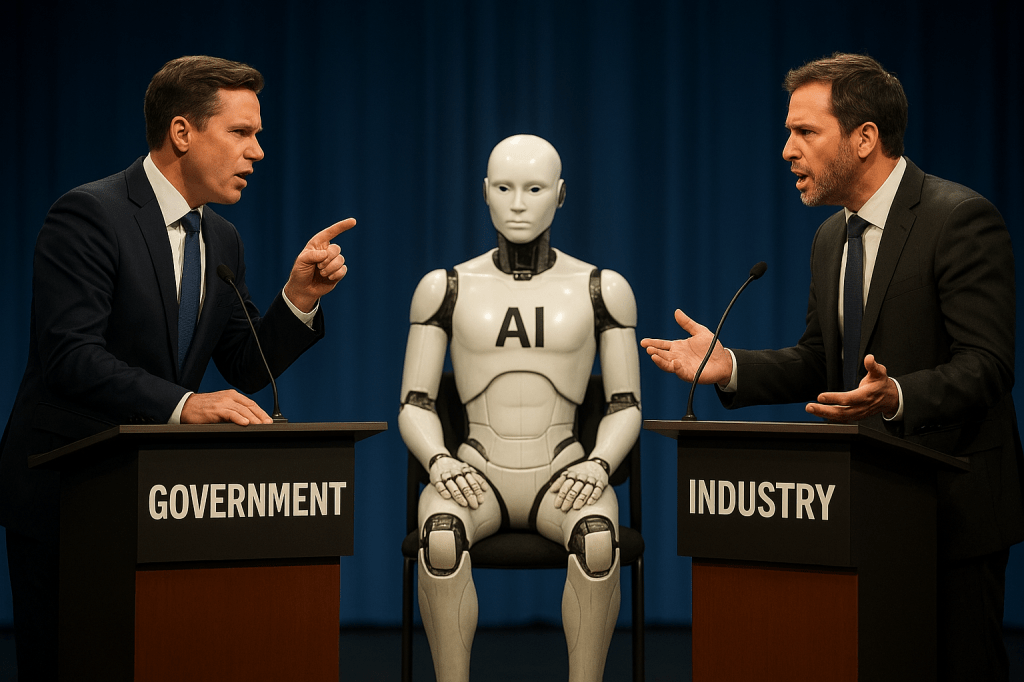
Lock-in also weakens a university’s position at the negotiating table. Horst Eidenmüller, a professor of commercial law at Oxford, argued in December 2025 that the current arrangement runs backward. AI firms gain credibility, training grounds, and future customers from campus deals, he wrote, so “Universities are paying Big Tech AI for the privilege of acting as its global showroom” (Eidenmüller, 2025). He listed the leverage universities hold: open-weight models such as Llama and Mistral, competing vendors, staged rollouts, and the reputational cost to a company if a prominent university walks away. Each of those levers depends on the university still being able to leave. A campus that has rebuilt its teaching and services around one product has given up much of that leverage before the first renewal.
Built for last year’s tools
California’s community colleges offer a cautionary case from the generation of campus AI that came just before ChatGPT. In March 2026, CalMatters reporter Martin Romero examined student-services chatbots that several districts had bought under multi-year contracts. At the Los Angeles Community College District, “contracts and amendments approved since 2021 total about $3.8 million through 2029.” The State Center Community College District had “a nearly $870,000, three-year contract” for a similar product (Romero, 2026).
The bots relied on libraries of questions and answers that staff had to keep current by hand, and they fell behind. Asked who led East Los Angeles College, the chatbot named a president who had left the job the previous year. Others gave wrong financial aid office hours. A Fresno City College student told CalMatters, “I think the chatbot is outdated and can’t navigate the services we provide on campus effectively” (Romero, 2026). The Los Angeles district plans to move its nine colleges to the vendor’s newer, generative platform under the existing contract at no added cost (Romero, 2026). That fix keeps the district inside the same vendor relationship through 2029, years after the technology it originally bought had been overtaken.
Hardware ages even faster. Marc Watkins of the University of Mississippi noted in early 2025 that “R1s and other research-intensive universities feel the pressure to go shopping for GPUs to provide their researchers with access to build, train, and fine-tune LLMs” (Watkins, 2025). The broader industry is now confronting what that kind of buying means. In a September 15 analysis for MIT Technology Review, David Rotman reported that the performance of the chips inside AI data centers “is roughly doubling every two years or so,” which forces owners to keep reinvesting. Princeton’s Mihir Kshirsagar warned that without that reinvestment, data centers risk becoming “hulks,” stranded assets “scattered all over the place” (Rotman, 2026). Rotman was writing about the largest technology companies. A university that buys a cluster with a one-time capital gift faces the same depreciation curve with far less money to replace it.
The same problem reaches the curriculum. Required training modules that teach students and faculty a particular interface date quickly when the interface changes. Jelena Belic of Leiden University and Kritika Maheshwari of TU Delft argued in Times Higher Education in August that universities should resist reshaping programs around a specific moment in AI: “When no one can say which AI skills the labour market will reward in five years, the strategy should be to invest in enhancing durable capacities rather than short-lived and tool-specific ones” (Belic & Maheshwari, 2026).
Structure built quickly also tends to lock in its own measures of success. Ethan Mollick of the Wharton School, one of the most widely read commentators on AI at work, told several hundred corporate leaders in New York in May, “We’re all making this up as we go along. So anyone who’s like, ‘We have the playbook’ — they’re lying to you.” He singled out a habit that comes naturally to large organizations: “KPIs are the biggest enemy at this point. They force you into very bad paths in the experimentation phase” (Lichtenberg, 2026). A university that measures its AI program by license activations, training completions, or the number of approved tools will tend to defend those numbers, even when better uses of AI are emerging somewhere else.
The evidence that any of this improves learning remains thin. “The evidence base is almost nonexistent,” Justin Reich, director of MIT’s Teaching Systems Lab, told Inside Higher Ed in September (Palmer, 2026b). Patrick O’Neill, an associate professor at Ivy Tech Community College in Indiana, offered a sharper verdict in the same article: “Universities are spinning hard to make it sound like they have control of AI, but I don’t think they do” (Palmer, 2026b). Pouring a permanent foundation under practices that have not been tested commits an institution to choices it has little basis for making yet.
Where students actually are
The Cal State survey points to a wider gap between what universities buy and what people use. On September 30, Inside Higher Ed reported on Instructure’s annual “EdTech Top 40” report, which tracked tools connected to its Canvas learning platform across 19.5 million U.S. higher education users. “The most popular AI tool didn’t even crack the top 100,” the report found. Google Gemini, the most widely adopted dedicated AI tool in the data, reached 87,788 users across 211 institutions (Palmer, 2026c). These figures count only tools plugged directly into Canvas, so they miss students who open ChatGPT or Gemini in a separate browser tab. Instructure’s Ryan Lufkin still read the data as a warning: “even though institutions are signing enterprisewide deals and making these tools available, they’re not leveraging the LTI tools to actually embed them into the class yet.” Separate Instructure research found that only 11 percent of higher education instructors had received comprehensive AI training (Palmer, 2026c).
Watkins, who works on AI and faculty development at the University of Mississippi, attended OpenAI’s 2026 Education Summit and came away skeptical of the pitch. “Students already live inside a free AI ecosystem that universities cannot control,” he wrote in March. “It’s not clear to me why universities should front the cost of AI when students are already the primary users (and products) of free AI tools.” He added a practical point that no procurement office can solve: “there’s no way anyone can keep an 18-year-old from switching to a different paid or free AI tool” (Watkins, 2026).
Provosts see the gap as well. Inside Higher Ed’s annual survey of 376 chief academic officers, published September 23, found that only about one in 10 institutions has a centralized AI strategy. Asked where institutional AI spending had paid off, 39 percent of provosts named individual productivity gains, 12 percent named department workflow improvements, and 8 percent named “institutionwide operational transformation” (Whitford, 2026). Paul LeBlanc, the former president of Southern New Hampshire University, explained the pattern: “When you bolt AI onto existing workflows, there is limited impact. When you use AI to rethink how the work happens, then you get more profound impacts … I don’t think there are a lot of universities that are deploying AI in that way, where they’re rethinking the whole system” (Whitford, 2026).
LeBlanc’s point bears directly on the infrastructure question. Licenses, approved-tool lists, and governance committees are the easiest parts of an AI program to buy and announce. Redesigning advising, assessment, or course structure is slow and contested. An institution can spend heavily on the first set and treat it as progress on the second.
Who gets to decide
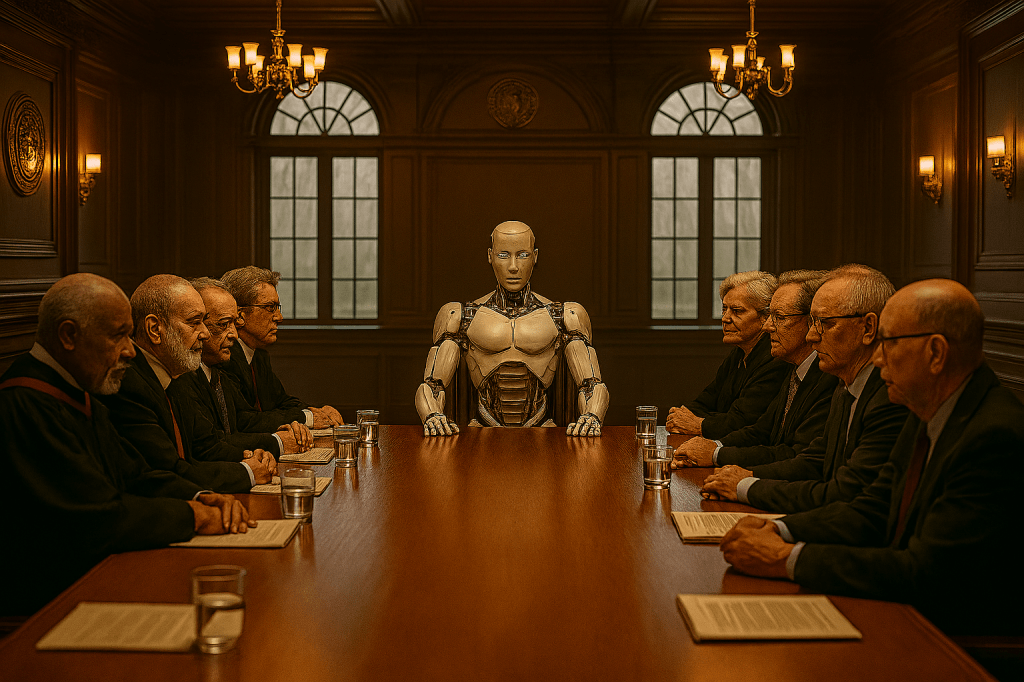
Smith’s essay raises a quieter cost. When a platform becomes the place where campus work happens, “Institutional policy is translated into permissions, defaults, interfaces, and automated workflows,” and “Authority can migrate without any formal decision to transfer it” (Smith, 2026). Questions that faculty senates once debated, such as what students may submit, what gets stored, and what a tutor is allowed to do, are increasingly settled by a vendor’s default settings.
Faculty at several institutions say the decisions were made over their heads. At the University of Colorado, computer science professor Jed Brown told the student newspaper, “This was all in violation of shared governance” (Montgomery, 2026). At Cal State, student association vice president Katie Karroum told CalMatters, “I think that we’re being treated as, like, test rats right now because there’s no policy and there’s no guidance” (Corzo, 2026). A January 2026 faculty petition described ChatGPT Edu as “not designed, trained, or optimized for education” (Rix, 2026).
Vendors are also reaching students directly, around the university’s own structure. On September 29, Times Higher Education reported on the OpenAI Student Collective, which places two paid undergraduate “campus leads” at universities in eight countries, including the United States, Britain, India, and Japan, to host workshops through June 2027. Leads receive subscriptions, coding credits, a stipend, and an invitation to OpenAI’s San Francisco headquarters. Lilian Edwards, emerita professor of law and technology at Newcastle University, said universities have “little choice but to be complicit” in the program. Ella Hafermalz of Vrije Universiteit Amsterdam warned, “OpenAI are not just a provider of tools: they are a potential competitor for universities” (Skillen, 2026). A university whose AI strategy depends on one company’s platform is poorly placed to push back when that company recruits on its campus.
Student advocates have reached a similar conclusion. A September report from Student Defense, a nonprofit legal group, warned that “the speed, power, and probabilistic nature of AI can amplify risks in ways that are difficult to understand,” and its co-founder Dan Zibel said college leaders “cannot afford to adopt AI first and ask questions later” (Sanchez, 2026).
Then there is the money that cannot be spent twice. Cal State renewed its contract while facing budget cuts. “This technology is not right for the CSU at this budget moment,” said Martha Kenney, a professor of women and gender studies at San Francisco State (Rix, 2026). At the University of Colorado, Colorado Springs, geography professor Dylan Harris, president of the campus chapter of the American Association of University Professors, said, “People are upset that there appears to be money to support AI but not faculty and staff” (Palmer, 2026a). A multi-year AI contract is a fixed cost. When enrollment or state funding falls, it competes with salaries, advising, and course sections, and it is the harder of the two to cut mid-term.
The case for structure, and a lighter version of it
Defenders of the infrastructure-first approach have real arguments. Two Chico State professors, Nik Janos and Zach Justus, argued that “Without a customized and secure product like ChatGPT Edu, students, faculty, staff and administrators will have less secure data and privacy” (Rix, 2026). University of Colorado President Todd Saliman acknowledged concerns about privacy, sustainability, and ethics, then concluded that “the importance of this tool today and in the future for our students, faculty and staff offers a return on investment we cannot ignore” (Palmer, 2026a).
The strongest case concerns fairness. Kenneth Sumner, a former provost who now advises colleges on AI governance, estimated in January that students without institutional access are paying “between $1,200 and $1,800 over four years in AI tool subscriptions.” He described two students in the same capstone course, one with a paid tool and one without, and wrote that the student with the paid tool turns in work that “earns higher grades not because of deeper learning, but because of subscription access” (Sumner, 2026). Institutional licenses close that gap. Without some shared structure, the wealthier student keeps the advantage.
None of the critics quoted here argue for doing nothing. Their objections center on weight and permanence. They describe a lighter kind of structure, one built to be changed. Fleming’s version is the pilot with a clear question and an exit. Eidenmüller’s is staged deployment across several vendors, with open-weight models kept in reserve to strengthen the university’s hand. Some campuses are already working this way. The University of Georgia ran an $800,000 pilot that gave students licenses for both ChatGPT Edu and Google’s Gemini Pro, and the University of Arkansas approved ChatGPT Edu, Gemini, NotebookLM, and Microsoft tools side by side (Zheng, 2026). Smith’s own prescription is an institution-run layer that sets the rules for identity, data access, and privacy while different models operate underneath it. “Procurement requirements can mandate portability,” he writes. “Institutional AI gateways can provide multiple models through common controls” (Smith, 2026).
Sydney Sharkey, an educator who writes about technology and higher education, expects budget pressure to force that shift whether institutions plan for it or not. “When budgets tighten, the institutional mood shifts from ‘we cannot afford to fall behind’ to ‘show us the measurable return,'” she wrote in March. “The post-hype phase will expose priorities” (Sharkey, 2026).
For a board or cabinet weighing its next AI contract, the critics’ questions are concrete. How long does the agreement run, and what does it cost to leave early? Can the university export the custom assistants, prompts, and course materials its people build? What share of students and faculty use the licensed tool instead of a free one, and how will anyone know? Is there evidence that the program improves learning, or only that it increases use? Who on campus approved it, and did faculty have a vote?
Smith closes his essay with a test that fits the pace Alicea described: “The real test of a university’s AI strategy is not which model it buys in 2026. It is whether it will still be free to choose in 2030” (Smith, 2026). Cal State’s renewal will be close to expiring by then. Whether the system can walk away, renegotiate, or switch at that point will depend on decisions it is making now about how deeply to build one company’s product into its teaching and administration.
References
Belic, J., & Maheshwari, K. (2026, August 19). Reshaping universities to suit the untested AI economy is wrong. Times Higher Education. https://www.timeshighereducation.com/opinion/reshaping-universities-suit-untested-ai-economy-wrong
Corzo, A. (2026, May 1). Cal State’s deal for ChatGPT polarizes students and faculty. CalMatters. https://calmatters.org/education/2026/05/california-state-university-open-ai-chatgpt-contract/
Eidenmüller, H. (2025, December 9). Wrong way round: Why Big AI should be paying universities, not billing them. Oxford Business Law Blog. https://blogs.law.ox.ac.uk/oblb/blog-post/2025/12/wrong-way-round-why-big-ai-should-be-paying-universities-not-billing-them
Fleming, B. (2025, October 8). Reversible by design. Learning Forward. https://bnfleming.substack.com/p/reversible-by-design
Lichtenberg, N. (2026, May 25). ‘Nobody knows anything’ and ‘this time is different’: The phrases that define — and haunt — the AI economy. Fortune. https://fortune.com/2026/05/25/nobody-knows-anything-this-time-is-different-ethan-mollick-no-playbook-ai/
Montgomery, C. (2026, March 7). University of Colorado signs $2 million deal with OpenAI for ChatGPT Edu access. CU Independent. https://cuindependent.org/2026/03/07/university-of-colorado-signs-2-million-deal-with-openai-for-chatgpt-edu-access/
NPR. (2026, May 25). This big university system is embracing AI. Students and faculty aren’t all on board. https://www.npr.org/2026/05/25/nx-s1-5772820/artificial-intelligence-education-technology-california-state-university
Palmer, K. (2026a, March 27). Faculty push back against OpenAI deals. Inside Higher Ed. https://www.insidehighered.com/news/tech-innovation/artificial-intelligence/2026/03/27/faculty-push-back-against-openai-deals
Palmer, K. (2026b, September 14). The “nonexistent” research on AI’s benefits for education. Inside Higher Ed. https://www.insidehighered.com/news/tech-innovation/artificial-intelligence/2026/09/14/nonexistent-research-ais-benefits-education
Palmer, K. (2026c, September 30). Higher ed’s AI integration overhyped, new data shows. Inside Higher Ed. https://www.insidehighered.com/news/tech-innovation/teaching-learning/2026/09/30/higher-eds-ai-integration-overhyped-new-data
Rix, K. (2026, May 21). California State University renews controversial systemwide contract with OpenAI. EdSource. https://edsource.org/2026/cal-state-renews-controversial-system-wide-contract-with-openai/758919
Romero, M. (2026, March 6). California colleges spend millions on faulty AI systems: ‘The chatbot is outdated.’ CalMatters. https://calmatters.org/education/higher-education/college-beat/2026/03/college-ai-chatbot/
Rotman, D. (2026, September 15). What’s at stake in AI’s trillion-dollar gamble. MIT Technology Review. https://www.technologyreview.com/2026/09/15/1144028/ai-infrastructure-boom-investment-bubble-risk/
Sanchez, O. (2026, September 18). Report: Higher ed’s adoption of AI outpaces student guards. Inside Higher Ed. https://www.insidehighered.com/news/quick-takes/2026/09/18/report-higher-eds-adoption-ai-outpaces-student-guards
Sharkey, S. (2026, March 5). When the AI bubble bursts, higher ed won’t “go back.” Screens & Sanity. https://screensandsanity.substack.com/p/when-the-ai-bubble-bursts-higher
Shimabukuro, J. (2026, October 1). AI infrastructure-first and the future of education. ETC Journal. https://etcjournal.com/2026/10/01/ai-infrastructure-first-and-the-future-of-education/
Skillen, R. (2026, September 29). OpenAI on campus: Universities have ‘little choice but to be complicit.’ Times Higher Education. https://www.timeshighereducation.com/news/openai-campus-little-choice-be-complicit
Smith, T. (2026, September 30). Universities need AI infrastructure. They don’t need AI lock-in. Tech Policy Press. https://www.techpolicy.press/universities-need-ai-infrastructure-they-dont-need-ai-lockin/
Sumner, K. (2026, January 14). The hidden tax students pay for your AI strategy [Opinion]. Inside Higher Ed. https://www.insidehighered.com/opinion/views/2026/01/14/hidden-tax-students-pay-your-ai-strategy-opinion
Watkins, M. (2025, February 21). The costs of AI in education. Rhetorica. https://marcwatkins.substack.com/p/the-costs-of-ai-in-education
Watkins, M. (2026, March 12). OpenAI’s education pitch has a free version problem. Rhetorica. https://marcwatkins.substack.com/p/openais-education-pitch-has-a-free
Whitford, E. (2026, September 23). From AI use to funding cuts: How provosts navigate 2026. Inside Higher Ed. https://www.insidehighered.com/news/governance/executive-leadership/2026/09/23/ai-use-funding-cuts-how-provosts-navigate-2026
Zheng, T. (2026, August 19). aiX weekly: AI in higher education. Columbia University, Department of Statistics. https://sites.stat.columbia.edu/tzheng/post/2026-08-19-aix-weekly-newsletter/
###
Filed under: Uncategorized |
















































































































































































































































































































































































































































Leave a Reply