



By Jim Shimabukuro (assisted by Claude)
Editor
Summary: Three self-development books the big recommenders keep talking about — and why their disagreements are the best part.
The celebrity book recommendation has become its own publishing force. A sentence from Oprah Winfrey can move more copies than a season of advertising, a slot on Adam Grant’s winter reading list can launch a first-time author, and an hour on Jay Shetty’s podcast reaches more readers than most book tours. The trouble, for anyone trying to choose a book rather than sell one, is that these endorsements usually arrive one at a time, each sealed inside its own echo chamber.
So for this shortlist we asked a narrower question: among the self-development books published in the past year or still riding the bestseller charts as of midsummer 2026, which ones drew serious attention from multiple high-profile readers — people with distinct vantage points who noticed different things in the same pages? Not every famous reader showed up for the genre this year. Bill Gates’s summer 2026 list, published in July, ran to a novel about a self-driving car, a history of the 1929 crash, and a biography of brain surgery — no self-help in sight [16]. Andrew Huberman’s long-awaited entry, Protocols, does not land until September 15 [17]. But three books cleared the bar, and the conversation around each is livelier than any single blurb suggests.
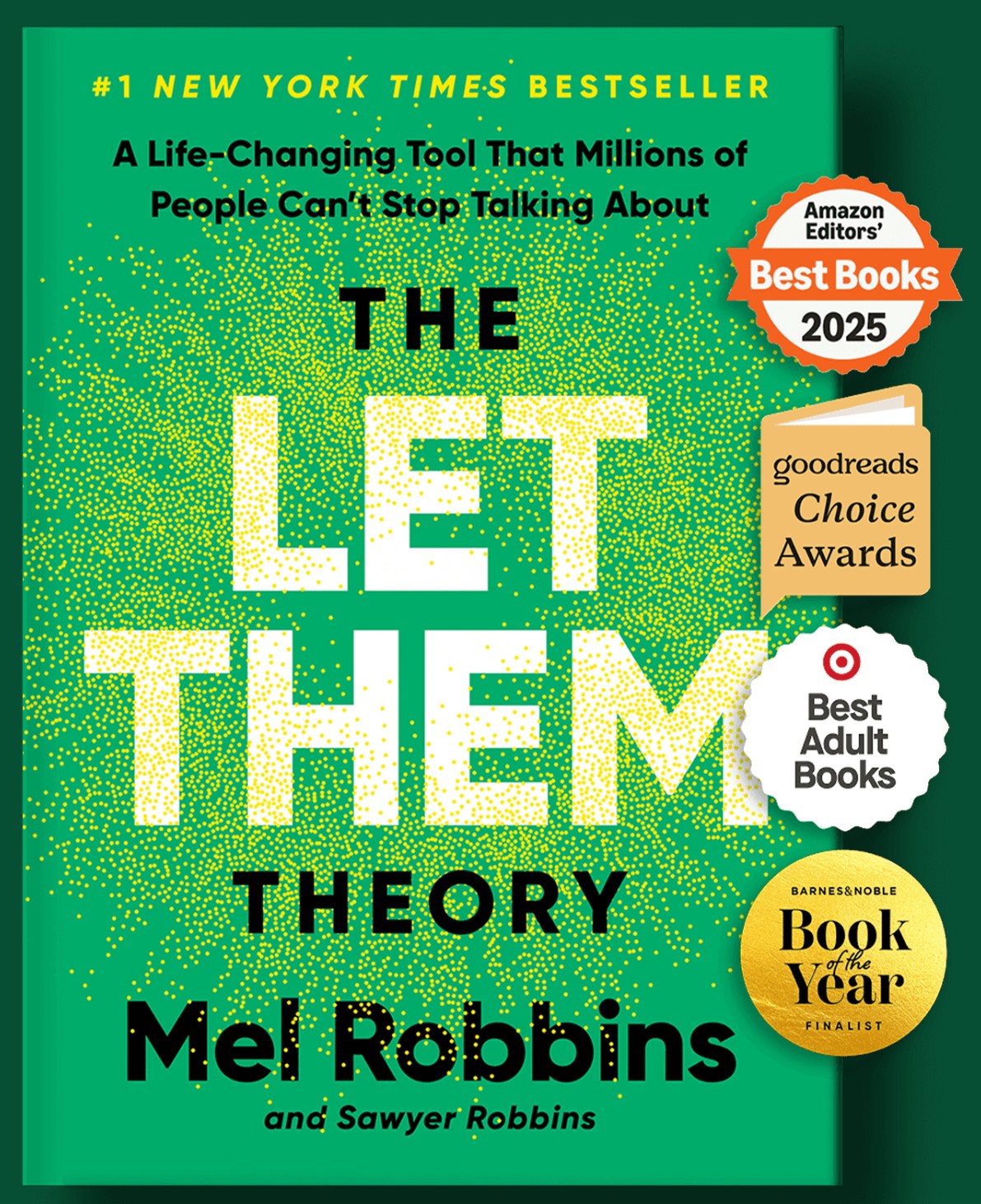
1. The Let Them Theory, by Mel Robbins with Sawyer Robbins
Hay House, December 24, 2024. Hardcover, 336 pages. ISBN 978-1-4019-7136-6.
Twenty months after publication, Mel Robbins’s two-word mantra is still the book everyone else in the genre is measured against. Its premise fits in a breath: when other people disappoint you, judge you, or refuse to change, let them — then redirect the energy you were spending on them back into your own choices. The publisher now counts more than eleven million copies sold, a full year at number one on the New York Times list in 2025, and editions in dozens of languages [3,4]. It was still riding the Publishers Weekly, Amazon, and independent bookstore charts this spring [7], remained on the American Booksellers Association’s indie hardcover nonfiction list as of July 1 [26], and Robbins spent 2026 filling arenas from Auckland to Atlanta on a fifteen-city world tour built around the book [8].
The book itself is more layered than the mantra suggests. Robbins, writing with her daughter Sawyer Robbins, opens from a blunt premise: “you will never be able to control or change another person. The only person you are in control of is you” [22]. From there the book works as a step-by-step guide to withdrawing your energy from other people’s opinions, drama, and judgment [4] — but the two famous words are only half the machinery. “Let Them is just the first half of the equation,” Robbins writes in a passage published as an excerpt by CBS News. “There is a second, even more crucial step to this theory: Let Me” [22]. That second step is where the book earns its keep: “Instead of wasting my energy on something I can’t control—what others say, think, and do—I poured my energy into what I can control: me” [22]. The promise, in her words, is that readers “stop exhausting yourself trying to control the uncontrollable” and recover “the space and freedom to experience your life the way you’ve always wanted” [22]. Chapter by chapter, Robbins applies the two moves to the places where other adults most reliably drive us mad — their moods, their choices, their silence — always circling back from what they are doing to what you will do next.
What earns it a place here, though, is the range of people who vouch for it and the different reasons they give. Oprah Winfrey, sitting down with Robbins for her podcast, told her the book was “everything I was trying to say for 25 years” and called it “one of the best self-help books I’ve ever read” [4,5] — the median-media voice of American self-improvement hearing her own quarter-century project compressed into two words. Jay Shetty, who trained as a monk before becoming a podcaster, read it as a modern rendering of detachment: “I know I’m going to be recommending this book to so many people in my life,” he told listeners after his conversation with Robbins [4,6]. And Dr. Gabor Maté, the physician best known for his work on trauma and addiction — not a man given to breezy endorsements — judged it “among the most straightforward and deepest of the many wisdom books published in recent years” [4].
The dissent is just as instructive. Practicing therapists have pushed back throughout the book’s run, warning that “a mantra is not a treatment plan” and that letting them can blur into avoidance, especially in relationships marked by real power imbalances; some also note that the technique repackages ideas long taught in acceptance-based therapies [9]. Read the praise and the pushback together and you get the honest picture: a workable tool for the everyday friction of other people’s opinions, and a poor substitute for help when the problem is bigger than friction. That is a more valuable orientation than any jacket blurb.

2. Strong Ground, by Brené Brown
Random House, September 23, 2025. Hardcover, 448 pages. ISBN 978-1-9848-5574-9.
Random House, September 23, 2025. Hardcover, 448 pages. ISBN 978-1-9848-5574-9.
Brené Brown built her reputation telling us to be vulnerable. Her latest — subtitled The Lessons of Daring Leadership, the Tenacity of Paradox, and the Wisdom of the Human Spirit — asks what it takes to stay steady, drawing on six years of work with her Dare to Lead coaching community, which has reached more than 150,000 leaders in 45 countries [18]. The result, a New York Times bestseller longlisted for the Porchlight Business Book Award [11], argues that in a period when bluster and cruelty are increasingly mistaken for strength, real leadership runs on connection, discipline, and accountability [11,18].
The book’s diagnosis is stated in its opening pages: we are living through a moment when, as the publisher’s copy puts it, “bluster, hubris, and even cruelty are increasingly framed as acceptable leadership,” and Brown’s answer is a set of mindsets and skill sets for “driving growth through connection, discipline, and accountability” [11]. Its most distinctive idea, though, is the one in the subtitle: paradox. Grounded leaders, Brown argues, are the ones who can hold two apparently contradictory truths at once — courage and fear, accountability and empathy, freedom and commitment — without collapsing into either. “Paradoxes are unflinching and stubborn,” she wrote in an essay introducing the book last September. “We can run from them… but, like me and my subtitle, they never surrender.” The payoff for staying put: “the gift of the paradox is that if we hang in there and tolerate the tension — grounding down and holding both ideas — a new and deeper level of understanding is born” [23]. She grounds the abstraction in her own life, describing how “making and keeping commitments and writing them down miraculously led to more freedom” [23] — discipline, it turns out, being the paradoxical road to liberty. The chapters mix research, personal reflection, poetry, and borrowed wisdom from spiritual and leadership teachers alike [18,23].
The crosstalk here is unusually rich because Brown’s most prominent reader is her own co-host. Adam Grant, the Wharton organizational psychologist who shares the podcast The Curiosity Shop with her, devoted a six-part series to working through the book on air, followed by a two-part ask-me-anything with listeners [12,20]. Grant is the evidence-first counterweight to Brown’s narrative instincts, which is what makes his verdict interesting: “It’s incredibly rich,” he said in the opening episode. “There’s no way we could do this in one episode” [12]. Across the series the two argue productively — about whether values should ever differ between home and work (Grant says no), and about a passage Grant singled out on the false choice between performance and culture [12].
Other readers pulled other threads. Maria Shriver’s Sunday Paper called the book “a bold and needed field guide” for leading through uncertainty [10]. NPR’s Rachel Martin, interviewing Brown for Wild Card in October, skipped the boardroom entirely and drew out the book’s spiritual spine — Brown’s stubborn, complicated faith and her conviction that grounded leadership is finally a question about the human spirit [13]. A leadership manual that can hold the attention of an organizational psychologist, a Sunday-morning spiritual digest, and a public-radio interviewer asking about God is doing something few business books manage.
3. The Balancing Act, by Nedra Glover Tawwab
TarcherPerigee (Penguin Random House), February 10, 2026. Hardcover, 256 pages. ISBN 978-0-593-85074-9.

If the last decade of pop psychology taught Americans one word, it was “boundaries” — and Nedra Glover Tawwab, a licensed therapist with two New York Times bestsellers on the subject, taught it as well as anyone [19]. Which is what makes her 2026 book, subtitled Creating Healthy Dependency and Connection Without Losing Yourself, the most quietly contrarian entry on this list. Having shown readers how to build fences, Tawwab now writes about how to lean: on attachment, family systems, codependency, and the unfashionable truth that a good life requires depending on people [14,19].
The book’s central tension is captured in two sentences of the publisher’s description: “If we give too much, we begin to lose ourselves. If we protect ourselves too much, we lose the closeness we all need” [24]. Tawwab’s project is to rehabilitate a word her field has spent decades pathologizing. “The healthy version of dependency,” she explains, “is being able to have a support system, exercise boundaries, and notice when something is becoming codependent and make some adjustments” [24]. The chapters work through the terrain systematically — anxious and avoidant attachment styles, the difference between a boundary and a wall, hyper-independence and what one early reviewer calls the myth of the self-made individual — and each ends with reflective questions that turn the reading into practice [25]. It is, in other words, a therapist’s book: less a slogan than a workbook for people who mastered saying no during the boundaries boom and now find themselves alone with their fences.
Adam Grant put it on his January list of the new books most likely to refresh your thinking for 2026, describing it as “walking the tightrope between setting boundaries and staying open” [1,2]. The clinicians agree from their own angles. Dr. Becky Kennedy, the parenting psychologist behind Good Inside, praised Tawwab for offering “the wisdom so many of us crave” — how to stay connected without disappearing into other people — and joined her on stage at New York’s Strand Book Store in February to talk it through [14,15]. Lori Gottlieb, the therapist and author of Maybe You Should Talk to Someone, boiled the book down to its central tension: “healthy relationships require us to lean on others” — just not so far that we vanish. The meditation writer Yung Pueblo promised readers the book “will light the way forward” [14].
Notice who is in that chorus: an organizational psychologist, a parenting clinician, a psychotherapist, and a poet of meditation. Each is reading the same correction — that the boundaries movement, taken neat, curdles into isolation — from a different professional worry. For readers who spent the early 2020s learning to say no, this is the book about what to say yes to, written by the person best credentialed to issue the amendment.
The Thread, and What’s Next
Put side by side, the three books form an unplanned trilogy about where you end and other people begin. Robbins tells you to release your grip on others; Brown tells you how to stand steady among them; Tawwab tells you how to lean on them without falling in. That the recommending voices — a talk-show founder, a former monk, a trauma physician, a data-driven psychologist, a parenting clinician — keep arriving at these same three from such different directions is the strongest signal a reader can ask for, stronger than any bestseller list.
Two near-misses deserve a sentence. Daniel Coyle’s Flourish, on why certain people and places make us feel alive, also made Grant’s 2026 list and carries his praise [1,2], and Ryan Holiday’s Wisdom Takes Work extended his Stoic-virtues series to strong reviews last fall [21] — though in Holiday’s case the recommender and the author are the same person, which rather defeats our test. And the genre’s next collision is already scheduled: Huberman’s Protocols arrives September 15 from Simon Element [17], at which point the podcast circuit that produced most of the quotes in this article will have something new to argue about. We will be listening.
References
1. Adam Grant, “The New Books to Refresh Your Thinking in 2026,” Granted (Substack), January 18, 2026. https://adamgrant.substack.com/p/the-new-books-to-refresh-your-thinking
2. Minda Zetlin, “Adam Grant Says Read These 5 Books for a Happier, More Productive Year in 2026,” Inc. https://www.inc.com/minda-zetlin/adam-grant-says-read-these-5-books-for-a-happier-more-productive-year-in-2026/91291093
3. Penguin Random House, The Let Them Theory by Mel Robbins and Sawyer Robbins (publication data and sales claims). https://www.penguinrandomhouse.com/books/743134/the-let-them-theory-by-mel-robbins/
4. MelRobbins.com, The Let Them Theory official book page (endorsements from Oprah Winfrey, Jay Shetty, Gabor Maté). https://www.melrobbins.com/book/the-let-them-theory/
5. Oprah.com, “Watch: Oprah Sits Down with Mel Robbins.” https://www.oprah.com/inspiration/watch-oprah-sits-down-with-mel-robbins
6. On Purpose with Jay Shetty, “Mel Robbins: How to Use the ‘Let Them Theory,’” episode page. https://www.jayshetty.me/podcast/mel-robbins-how-to-use-the-let-them-theory-a-life-changing-mindset-hack-that-15-million-people-cant-stop-talking-about
7. Book Riot, “The Bestselling Books of the Week, According to All the Lists,” April 2, 2026. https://bookriot.com/bestselling-books-of-the-week-april-2-2026/
8. Concert Addicts, “Mel Robbins Announces ‘Let Them Tour’ 2026,” September 18, 2025. https://www.concertaddicts.com/news-articles/tours/mel-robbins-announces-let-them-tour-2026
9. Modern Therapy Alliance, “Why Therapists Are Questioning Mel Robbins’ Let Them Theory,” February 2, 2025. https://moderntherapyalliance.com/why-are-therapists-upset-about-mel-robbins-the-let-them-theory/
10. Penguin Random House, Strong Ground by Brené Brown (publication data and press quotes, including Maria Shriver’s Sunday Paper). https://www.penguinrandomhouse.com/books/608374/strong-ground-by-brene-brown/
11. Barnes & Noble, Strong Ground by Brené Brown (bestseller designation; Porchlight Business Book Award longlist). https://www.barnesandnoble.com/w/strong-ground-brene-brown/1148026191
12. Brené Brown and Adam Grant, “Finding Our Strong Ground, Part 1 of 6,” The Curiosity Shop, September 17, 2025. https://brenebrown.com/podcast/finding-our-strong-ground-part-1-of-6/
13. NPR, Wild Card with Rachel Martin, “Brené Brown Is Stubborn About Her Faith,” October 2, 2025. https://www.npr.org/2025/10/02/nx-s1-5559825/brene-brown-strong-ground-dare-to-lead
14. Penguin Random House, The Balancing Act by Nedra Glover Tawwab (publication data and endorsements from Dr. Becky Kennedy, Lori Gottlieb, Yung Pueblo). https://www.penguinrandomhouse.com/books/760457/the-balancing-act-by-nedra-glover-tawwab/
15. Strand Book Store, “Nedra Glover Tawwab + Dr. Becky: The Balancing Act,” event page, February 2026. https://www.strandbooks.com/nedra-glover-tawwab-the-balancing-act.html
16. Kirkus Reviews, “Bill Gates Shares Summer 2026 ‘Best’ List,” July 20, 2026. https://www.kirkusreviews.com/news-and-features/articles/bill-gates-shares-summer-2026-best-list/
17. Simon & Schuster, Protocols: An Operating Manual for the Human Body by Andrew D. Huberman (Simon Element, September 15, 2026). https://www.simonandschuster.com/books/Protocols/Andrew-D-Huberman/9781668032145
18. Brené Brown, Strong Ground official book page. https://brenebrown.com/book/strong-ground/
19. Nedra Tawwab, The Balancing Act official book page. https://www.nedratawwab.com/books/the-balancing-act
20. Brené Brown and Adam Grant, “Strong Ground Ask Me Anything, Part 1 of 2,” The Curiosity Shop. https://brenebrown.com/podcast/strong-ground-ask-me-anything-part-1-of-2/
21. Penguin Random House, Wisdom Takes Work by Ryan Holiday (Portfolio, October 21, 2025). https://www.penguinrandomhouse.com/books/646522/wisdom-takes-work-by-ryan-holiday/
22. CBS News, “Book Excerpt: The Let Them Theory by Mel Robbins” (published excerpt of the book’s text). https://www.cbsnews.com/news/book-excerpt-the-let-them-theory-by-mel-robbins/
23. Brené Brown, “Strong Ground and the Tenacity of Paradox,” BreneBrown.com, September 10, 2025. https://brenebrown.com/articles/2025/09/10/strong-ground-and-the-tenacity-of-paradox/
24. Ros Johnson, “‘The Balancing Act’ (Healthy Dependency): Nedra Glover Tawwab,” Minding Therapy, February 17, 2026 (includes publisher’s description and author quotes). https://www.mindingtherapy.com/balancing-act-nedra-glover-tawwab/
25. Swapna Peri, review of The Balancing Act, Storizen, May 9, 2026. https://storizen.com/book-reviews/the-balancing-act-by-nedra-glover-tawwab/
26. American Booksellers Association, Indie Bestseller Lists, July 1, 2026 (extended hardcover nonfiction). https://www.bookweb.org/indie-bestseller-lists/july-1-2026
###
Filed under: Uncategorized |








































































































































































































































































































































































































































Leave a Reply