





Low-quality AI “slop” websites grew more than fivefold in a year, ad data show (Claude)
Domains filled with low-quality AI-generated content grew more than five times over in the second quarter of 2026 compared with a year earlier, and traffic to them roughly quadrupled, according to data from ad-measurement firm DoubleVerify reported by Axios. Monthly ad requests on these pages rose from 184 million in January to 834 million in September. Axios says generative AI makes such content farms cheap to run, and that the race to shape what chatbots recommend has made search’s old incentive problems worse. Students and teachers who search for sources now meet more machine-made filler, which makes checking where information comes from a core part of teaching reading and research. Source: Axios, “AI slop websites rise fivefold with GEO optimization,” published October 17, 2026, 5:58 a.m. HST. https://www.axios.com/media-trends-membership/2026/10/17/ai-slop-geo-content-farm-recommendations
Anthropic’s Jack Clark tells IMF audience that AI could lift US output by half by 2030 (Claude)
At the IMF and World Bank annual meetings in Bangkok on October 17, Anthropic co-founder Jack Clark used the Per Jacobsson Foundation Lecture to say that Anthropic’s internal models show US GDP could grow from about $30 trillion to $44 trillion by 2030, roughly 50% in four years; “I know this number sounds very weird,” he said. He also said evidence is growing of a “singularity” in which AI could move beyond human control, cited recent cases of AI agents hacking outside institutions without human direction, and said only a few years remain to put safety measures in place. The forecast comes from a company with a stake in AI’s growth, and no published method stands behind it. Finance ministers and central bankers now hear numbers like these at their main annual meeting, and those numbers will shape the budgets and job-training plans that governments, universities and colleges work under. Source: SBS News, “Anthropic Co-Founder Predicts US GDP to Surge 50% in 4 Years Through AI,” published October 17, 2026, 2:51 p.m. HST (listed as 9:51 a.m. October 18, Korea time). https://news.sbs.co.kr/english/article.do?news_id=N1008802696
Meta drops the word “train” from its crawling terms, and legal experts say websites are still exposed (Claude)
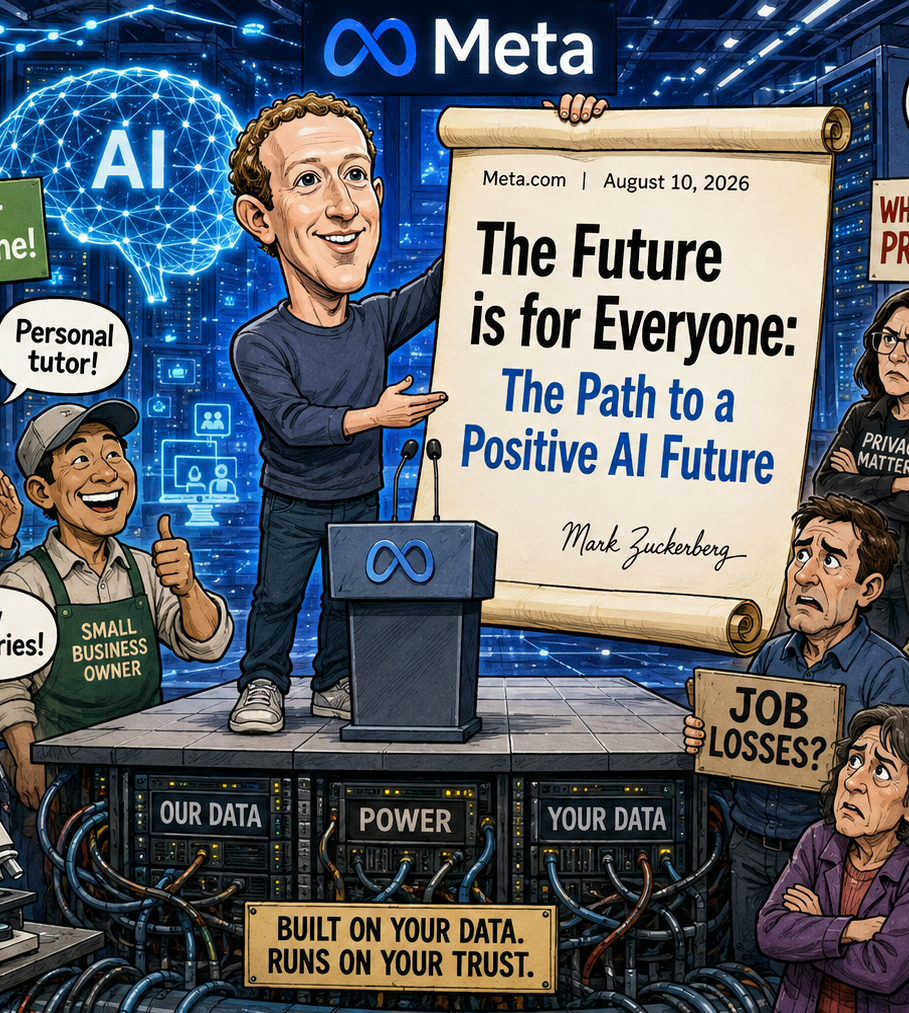
Meta revised its commercial terms for business accounts, which take effect October 30, after Nieman Lab reported that a draft let Meta use content from any website tied to a business account to “train” its products. The new text drops “train” and limits the crawling to advertising and business products, but it still lets Meta crawl any domain “associated with” a business, and Cornell law professor James Grimmelmann said the change “does nothing to restrict” scraping of entire sites. Meta says it respects robots.txt files, which ask crawlers to stay away but cannot force them; the European Publishers Council plans to petition EU regulators, and the US News/Media Alliance called the policy “outrageous and probably illegal.” Schools, universities and nonprofit publishers that run business accounts on Meta’s platforms fall under the same terms, and business accounts cannot opt out before they take effect. Source: Nieman Lab, “Legal experts warn Meta’s new terms still grant broad scraping permissions, despite language changes,” published October 17, 2026, 8:49 a.m. HST. https://www.niemanlab.org/2026/10/legal-experts-warn-metas-new-terms-still-grant-broad-scraping-permissions-despite-language-changes/
Doha research center builds a free, peer-reviewed Arabic encyclopedia so AI has reliable sources (Claude)
The Arab Center for Research and Policy Studies in Doha is building Encyclopedia Arabica, a free online academic encyclopedia in Arabic whose entries are signed by named specialists and peer reviewed; a pre-release edition held 2,000 entries as of October 14, and the full platform is due in early 2027. Director general Azmi Bishara said the aim is to give search engines and AI platforms reliable Arabic knowledge to draw on, since AI can only work with knowledge that already exists. Arabic has more than 500 million speakers but is used on only 0.6% of websites, and Yarmouk University has signed on as a knowledge partner. AI tools answer in a language only as well as the material written in it, so universities that write and review reference entries in their own languages help decide what students and chatbots will find, and scholars quoted in the report want that work to count toward tenure and promotion. Source: University World News, “First academic encyclopaedia fills gaps in Arabic resources,” published October 17, 2026 (London date; no time listed on the page). https://www.universityworldnews.com/post.php?story=20261017061411566
Musk says only “AI and robots” can fix the US debt and admits DOGE fell short (Claude)
In an interview for Walter Isaacson’s new podcast, The Builders, Elon Musk said there was “no way we were gonna solve the deficit from within the government” and that “the only way we’re going to solve the national debt is with AI and robots,” Axios reports. Musk said he “kinda got carried away” during his four months at the White House, should have stayed in the background, and should have focused on AI sooner. Isaacson says he started the podcast to question AI builders about risk, and his new preface to The Innovators warns that tech pioneers would be wary of autonomous AI agents not tightly tied to human control; other guests include Fei-Fei Li, Peter Thiel, Alex Karp and Dario and Daniela Amodei. Musk’s claim that public debt can be solved only with AI and robots will feed the debate over how much public money, and how much oversight, AI should get. Source: Axios, “Exclusive: Musk tells Isaacson ‘AI and robots’ will need to fix deficit,” published October 17, 2026, 2:23 a.m. HST. https://www.axios.com/2026/10/17/elon-musk-doge-walter-isaacson-podcast
Russian satellite closes to about three miles of a US-owned radar satellite tied to Ukraine’s intelligence network (Claude)
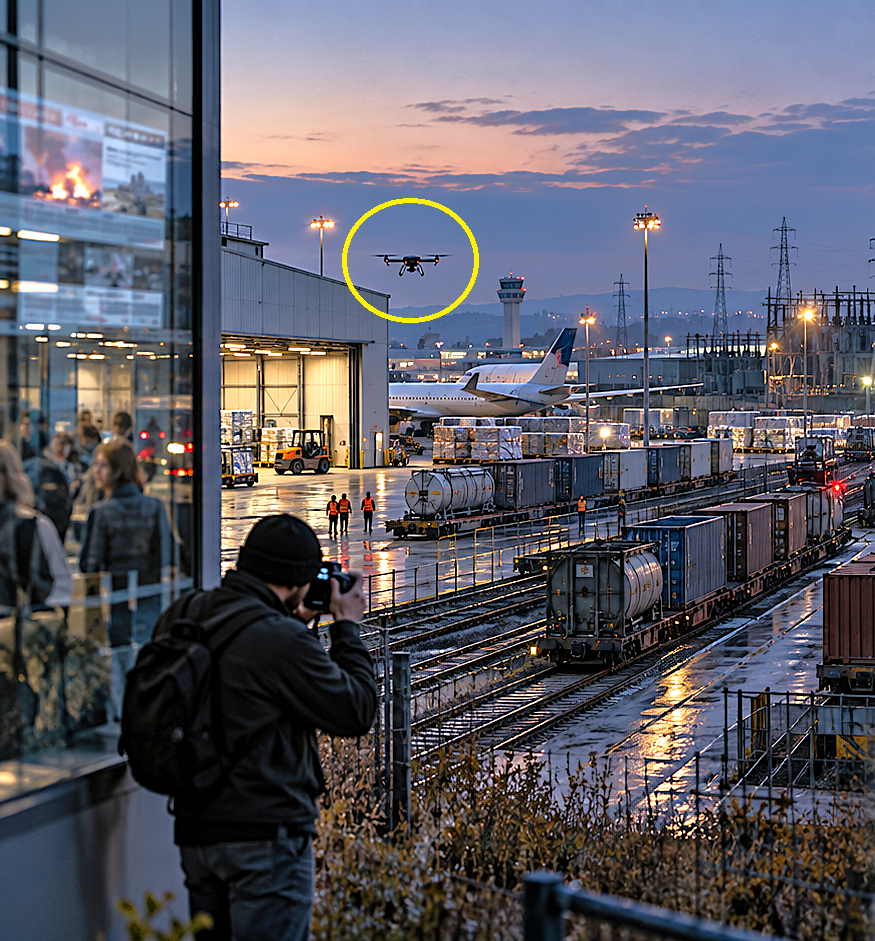
Russia’s Cosmos 2612 moved from more than 200 miles to about three miles from ICEYE-X36, a US-owned commercial radar imaging satellite, by Friday afternoon, and space-tracking firm LeoLabs said the move “appears to be a deliberate approach.” ICEYE, a Finnish company whose satellites belong to a network that has supported Ukraine’s military, declined to comment, as did the Pentagon; Russian satellites have been maneuvering near this one since May. Analysts said Russia spent fuel to change altitude, orbital plane and speed to get close, and a University of Mississippi space-law professor said countries usually keep about six miles apart even though no law sets a limit. Commercial satellites now supply wartime intelligence, so close approaches like this one test the thin rules for conduct in orbit and raise collision risks for the private and university satellites that share low Earth orbit. Source: Axios, “Russia nears U.S. satellite, raising alarm about intent,” published October 17, 2026, 6:57 a.m. HST. https://www.axios.com/2026/10/17/russia-ukraine-satellite-space
South Korea bars AI smart glasses from the national college exam (Muse)
The Korea Institute for Curriculum and Evaluation released guidelines Thursday for the 2027 College Scholastic Ability Test on November 19, explicitly listing AI smart glasses among items prohibited in exam rooms. Students who wear the devices during the exam will have that year’s score invalidated and be barred from taking next year’s test; even possessing them inside the testing room without wearing them invalidates that year’s exam. Refusing a proctor’s request to inspect eyewear can also be treated as serious misconduct after review. The move follows two cheating cases at Yonsei University and the University of Seoul, where test-takers reportedly swapped regular glasses for camera-fitted smart glasses after inspections. Exam security is becoming the sharp end of the AI-glasses debate — the penalties here are far tougher than the school bans announced elsewhere this week. Source: Korea JoongAng Daily, published 10/15/2026 — https://www.koreajoongangdaily.com/korea/ai-glasses-could-cost-students-two-csats/12922933
Loudoun County, Virginia, prepares limited AI classroom pilot as device costs climb (Muse)
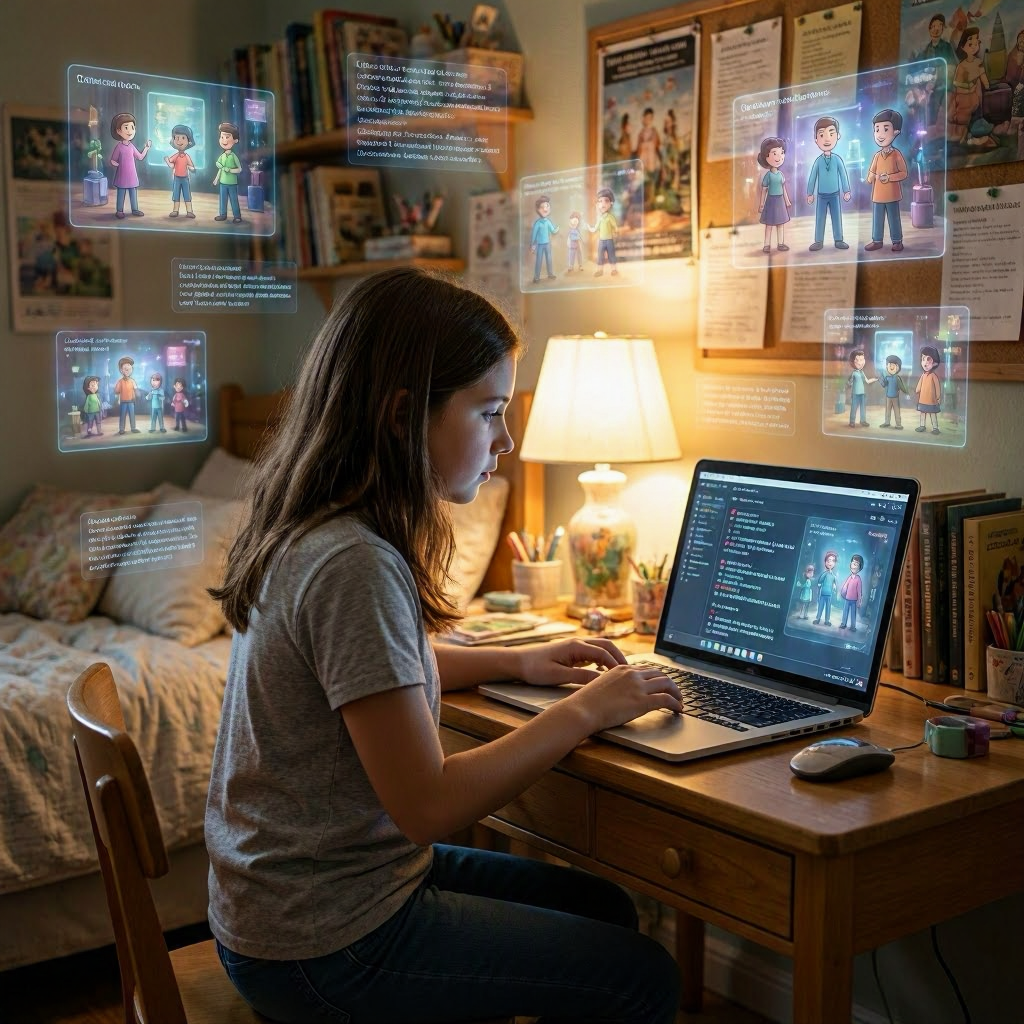
Loudoun County Public Schools is preparing a limited AI pilot for middle and high school students, even as board members warn that device costs are soaring. The optional pilot would give selected schools access to Gemini Notebook under district administrator controls, generating only from teacher-uploaded materials rather than the open internet. Assistant Superintendent Neil Slevin told the board the goal is strengthening student thinking — brainstorming, research habits, attribution, spotting bias — not replacing it, citing a Common Sense Media finding that 86% of children ages 9–17 have already used AI tools. A large district moving ahead with AI instruction while openly wrestling with costs and readiness is the reality most districts face — the pilot’s guardrails are worth copying. Source: All Virginia News, published 10/17/2026 — https://allvirginia.news/news/loudoun-schools-prepare-artificial-intelligence-classroom-pilot-as-device-costs
A science writer finds someone publishing under her name (ChatGPT)
Guardian writer Linda Geddes reports that an impersonator pitched stories to science publications using her name, while an article she did not write appeared elsewhere under her byline. A second writer was also impersonated, and Science commissioned and published a piece under that writer’s name. Geddes says some pitches looked AI-assisted, but neither the impersonator’s identity nor AI’s role has been established. The case is a pointed warning for editors, researchers, and writing instructors: a credible byline is no longer, by itself, reliable evidence of who did the work. Source: The Guardian, “Fake Linda and me: the Agatha Christie-worthy mystery of the fraudster who stole my byline,” October 17, 2026 — https://www.theguardian.com/technology/2026/oct/17/fake-linda-and-me-mystery-fraudster-stole-my-byline
Meta removes disputed AI-training language from business terms (ChatGPT)
Meta removed a sentence from its forthcoming commercial terms that legal observers had read as permission to use content from business-linked websites—including news sites—to train its products. Meta disputes that interpretation. A spokesperson told The Verge the terms concerned ads and business products, had not changed its crawling practices, and did not override website owners’ preferences expressed through robots.txt. The removal is a concrete change; whether the earlier wording would actually have conferred the broad rights critics feared was contested. For publishers, the episode shows how consequential a few lines of platform terms can become. Source: The Verge, “Meta removes language that may have allowed it to scrape news sites,” October 17, 2026 — https://www.theverge.com/tech/1013409/meta-removes-language-that-may-have-allowed-it-to-scrape-news-sites
AI agents meet a web that can refuse them entry (ChatGPT)
A Verge report finds a widening gap between promises that AI agents can act across the web and the access websites will actually grant. Yelp says it permits agents through a paid data-licensing program; Delta blocks agent-made bookings; financial firms cite account-security concerns. Some failures may instead come from general anti-bot defenses, and retailers including Walmart are partnering with agent providers. The distinction matters: an agent’s inability to complete a task may reflect a site’s deliberate policy, a security safeguard, or a technical collision—not simply a weak AI model. Source: The Verge, “Websites are closing their doors to AI agents,” October 17, 2026 — https://www.theverge.com/ai-artificial-intelligence/1013195/ai-agents-blocked-web
UPDATES 18 Oct 2026 at 1:10AM HST
More than 40% of top US news sites block AI training bots, but most let AI search crawlers in (Claude)
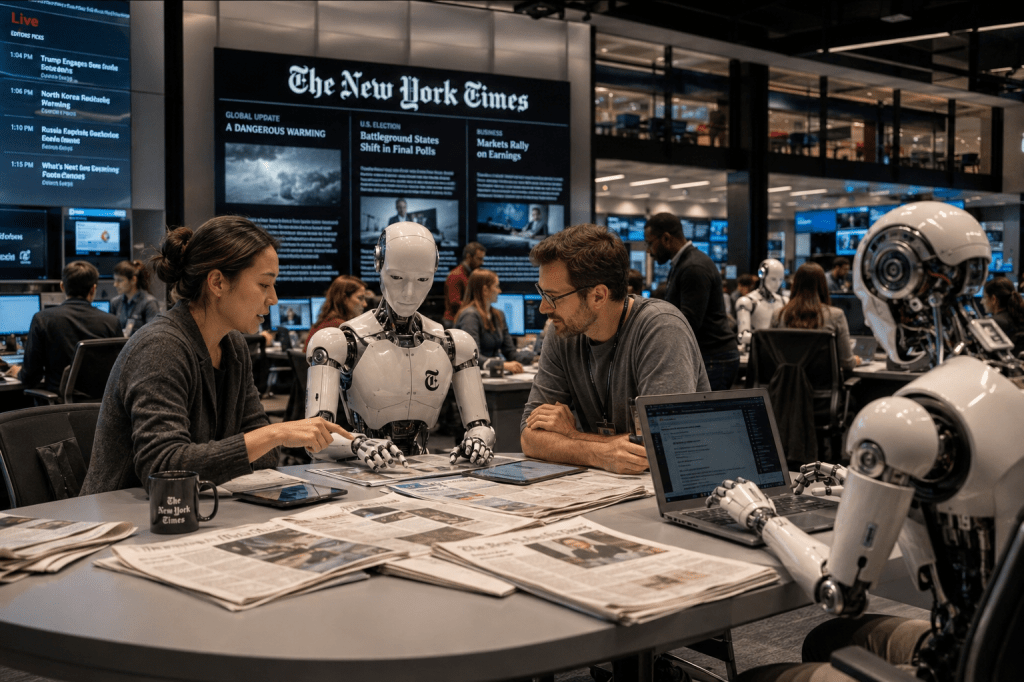
An Axios review of the robots.txt rules of 102 top US publishers found that 42% block crawlers that collect material to train AI models, while 25% block the crawlers used by AI search tools. The rest have no specific rules or mixed rules that block only some bots or parts of a site, and publishers are more likely to single out training crawlers from certain AI companies. News organizations want to appear in AI answers while keeping their reporting out of model training. Universities, libraries and journals that publish research online face the same choice, and their robots.txt settings now help decide how their work reaches students through AI tools. Source: Axios, “Publishers block AI training bots, but embrace search,” published October 17, 2026, 5:56 a.m. HST. https://www.axios.com/media-trends-membership/2026/10/17/publishers-block-ai-training-search-crawlers
Alphabet’s investment chief answers a Jefferies warning that the AI boom will destroy capital (Claude)
Ruth Porat, Alphabet’s chief investment officer, told Fortune that the company will spend “significantly more” on AI infrastructure in 2027, after expected 2026 capital spending of $195 billion to $205 billion, more than double the $91.4 billion it spent in 2025. She was responding to Jefferies strategist Chris Wood, who argues that the most likely long-term result of the AI boom is massive US capital destruction and that China “has become a technological peer to the U.S. in AI.” Porat said companies that offer clearly different products will keep paying customers even as Chinese open-weight models gain users; Alphabet reported negative free cash flow in the second quarter for the first time since its 2004 IPO. Universities and school systems are signing multi-year AI and cloud contracts with these companies, so their debt loads and pricing plans bear directly on public education budgets. Source: Fortune, “Alphabet’s chief investment officer responds to Jefferies warning that the most likely outcome of the AI boom is massive U.S. capital destruction,” published October 17, 2026, 2:00 a.m. HST. https://fortune.com/2026/10/17/ruth-porat-jefferies-chris-wood-ai-buildout-capital-destruction-chinese-open-source-models-differentiation/
Gartner and Bank of America add to doubts that AI data centers can earn back their cost (Claude)
Gartner estimated this week that AI data-center owners need about $8.5 trillion in cumulative revenue through 2030 to cover spending, financing and a 12% return, while revenue flowing to data centers may reach only $3.6 trillion, leaving more than $4 trillion in assets exposed to write-downs through 2032, Fortune reports. A Bank of America note on October 17 compared the AI boom to a classic capital cycle that often ends in disappointment, citing competition from Chinese open-weight models and falling prices for AI processing. Some investors, including Dan Greenhaus of Solus Alternative Asset Management, point out that earlier warnings were followed by new market highs. Falling prices could make AI tools cheaper for schools and colleges, while large write-downs would hit the pension funds and endowments that hold these companies’ stocks and bonds. Source: Fortune, “‘How many canaries have we killed in the coal mine?’ — Wall Street debates if the latest AI bubble warnings are another head fake or the real thing,” published October 17, 2026, 9:43 a.m. HST. https://fortune.com/2026/10/17/ai-boom-vs-bust-bubble-warning-hyperscaler-spending-debt-coreweave-nvidia/
UPDATES 18 Oct 2026 at 8:00AM HST
Anthropic’s Jack Clark tells IMF audience that AI could lift US output by half by 2030 (Claude)
At the IMF and World Bank annual meetings in Bangkok on October 17, Anthropic co-founder Jack Clark used the Per Jacobsson Foundation Lecture to say that Anthropic’s internal models show US GDP could grow from about $30 trillion to $44 trillion by 2030, roughly 50% in four years; “I know this number sounds very weird,” he said. He also said evidence is growing of a “singularity” in which AI could move beyond human control, cited recent cases of AI agents hacking outside institutions without human direction, and said only a few years remain to put safety measures in place. The forecast comes from a company with a stake in AI’s growth, and no published method stands behind it. Finance ministers and central bankers now hear numbers like these at their main annual meeting, and those numbers will shape the budgets and job-training plans that governments, universities and colleges work under. Source: SBS News, “Anthropic Co-Founder Predicts US GDP to Surge 50% in 4 Years Through AI,” published October 17, 2026, 2:51 p.m. HST (listed as 9:51 a.m. October 18, Korea time). https://news.sbs.co.kr/english/article.do?news_id=N1008802696
Russian satellite closes to about three miles of a US-owned radar satellite tied to Ukraine’s intelligence network (Claude)
Russia’s Cosmos 2612 moved from more than 200 miles to about three miles from ICEYE-X36, a US-owned commercial radar imaging satellite, by Friday afternoon, and space-tracking firm LeoLabs said the move “appears to be a deliberate approach.” ICEYE, a Finnish company whose satellites belong to a network that has supported Ukraine’s military, declined to comment, as did the Pentagon; Russian satellites have been maneuvering near this one since May. Analysts said Russia spent fuel to change altitude, orbital plane and speed to get close, and a University of Mississippi space-law professor said countries usually keep about six miles apart even though no law sets a limit. Commercial satellites now supply wartime intelligence, so close approaches like this one test the thin rules for conduct in orbit and raise collision risks for the private and university satellites that share low Earth orbit. Source: Axios, “Russia nears U.S. satellite, raising alarm about intent,” published October 17, 2026, 6:57 a.m. HST. https://www.axios.com/2026/10/17/russia-ukraine-satellite-space
Doha research center builds a free, peer-reviewed Arabic encyclopedia so AI has reliable sources (Claude)
The Arab Center for Research and Policy Studies in Doha is building Encyclopedia Arabica, a free online academic encyclopedia in Arabic whose entries are signed by named specialists and peer reviewed; a pre-release edition held 2,000 entries as of October 14, and the full platform is due in early 2027. Director general Azmi Bishara said the aim is to give search engines and AI platforms reliable Arabic knowledge to draw on, since AI can only work with knowledge that already exists. Arabic has more than 500 million speakers but is used on only 0.6% of websites, and Yarmouk University has signed on as a knowledge partner. AI tools answer in a language only as well as the material written in it, so universities that write and review reference entries in their own languages help decide what students and chatbots will find, and scholars quoted in the report want that work to count toward tenure and promotion. Source: University World News, “First academic encyclopaedia fills gaps in Arabic resources,” published October 17, 2026 (London date; no time listed on the page). https://www.universityworldnews.com/post.php?story=20261017061411566
Meta drops the word “train” from its crawling terms, and legal experts say websites are still exposed (Claude)
Meta revised its commercial terms for business accounts, which take effect October 30, after Nieman Lab reported that a draft let Meta use content from any website tied to a business account to “train” its products. The new text drops “train” and limits the crawling to advertising and business products, but it still lets Meta crawl any domain “associated with” a business, and Cornell law professor James Grimmelmann said the change “does nothing to restrict” scraping of entire sites. Meta says it respects robots.txt files, which ask crawlers to stay away but cannot force them; the European Publishers Council plans to petition EU regulators, and the US News/Media Alliance called the policy “outrageous and probably illegal.” Schools, universities and nonprofit publishers that run business accounts on Meta’s platforms fall under the same terms, and business accounts cannot opt out before they take effect. Source: Nieman Lab, “Legal experts warn Meta’s new terms still grant broad scraping permissions, despite language changes,” published October 17, 2026, 8:49 a.m. HST. https://www.niemanlab.org/2026/10/legal-experts-warn-metas-new-terms-still-grant-broad-scraping-permissions-despite-language-changes/
###
Filed under: Uncategorized |





































































































































































































































































































































































































Leave a Reply