







By Jim Shimabukuro (assisted by Claude)
Editor
Shrinking workforces and a political backlash against immigrants have made machines look like the answer. The evidence supports that bet in factories and fields, and much less in the jobs immigrants most often hold.
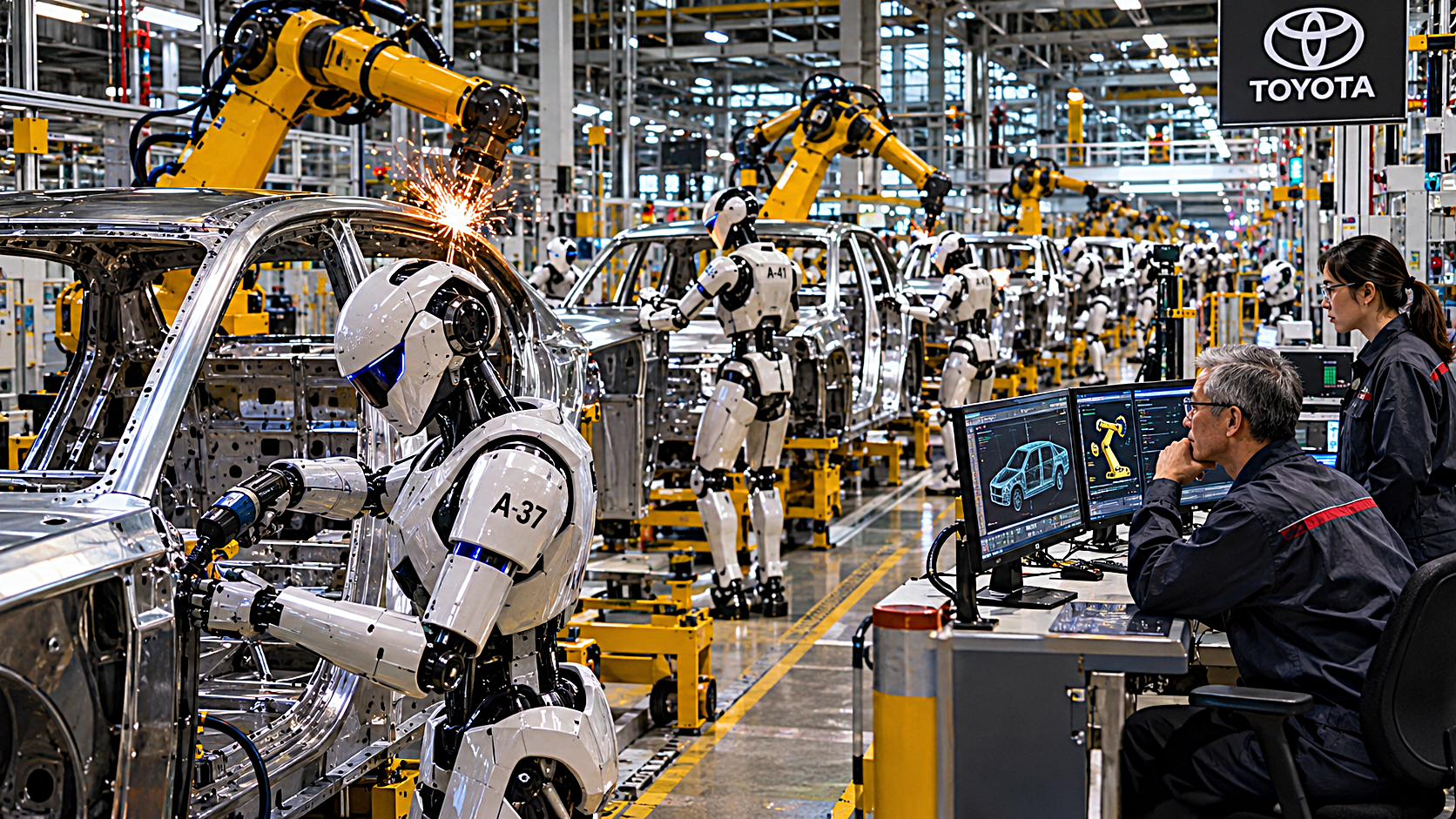
In mid-October 2026, Japan’s Immigration Services Agency reported that 4.28 million foreign nationals were living in the country at the end of June, a record and roughly 3.5% of the population (Agence France-Presse [AFP], 2026). The same month, Japan tightened its permanent-residency rules, requiring higher incomes and stronger Japanese, under a prime minister, Sanae Takaichi, who has pushed for stricter immigration controls (AFP, 2026). A few days later, Tesla announced that it had begun building what it called “the first production-quality bots that we have manufactured” at its factory in Fremont, California, and Elon Musk told investors the company would be able to build 20,000 Optimus humanoid robots a week by the end of 2027 (Korosec & O’Kane, 2026).
The two announcements describe two sides of one problem. In much of the developed world, the number of working-age people is falling. The usual remedy has been to bring in workers from abroad, and that remedy has become politically costly from Tokyo to Washington to London. Meanwhile, robots are getting cheaper and more capable, and a new class of general-purpose humanoid machines has moved from trade-show stages into a handful of factories. The reasoning that links these trends is simple: if machines can do the work, a country that does not want more immigrants will not need them. This article tests that reasoning against the evidence available in 2026. The trajectory is real in some industries and already visible in the data. It is much weaker in care, construction, and fresh-produce farming, where immigrants are concentrated, and the timing of the two trends does not line up.
The arithmetic
Japan is the clearest case. Its population fell for the 14th consecutive year in 2024, and its working-age population is projected to shrink by nearly 15 million over the next two decades (Gioino, 2026). Toshihiro Menju, a visiting professor at Kansai University of International Studies, puts the annual population loss at more than 900,000 and says that Japan has “no choice but to rely on foreign workers” (AFP, 2026). In nursing care alone, the health ministry’s long-term care plan calls for 250,000 more care workers by fiscal 2026, and 570,000 more by fiscal 2040, than the 2.15 million employed in fiscal 2022 (Yokota, 2026). In fiscal 2023, care job openings outnumbered applicants by about 3.9 to 1, compared with about 1.2 to 1 across all occupations (Yokota, 2026).
Germany faces a smaller version of the same gap. More than 617,000 jobs were unfilled at the start of 2026, elderly-care vacancies in 2025 stayed open for an average of 222 days, and the Labour Ministry’s monitoring program projects a shortfall of about 440,000 workers by 2029 (Loxton, 2026). The Bertelsmann Foundation estimates that Germany will need net immigration of 288,000 to 368,000 people a year through 2040 (Loxton, 2026).
The United States, long an exception among rich countries, is now on a similar path. The Congressional Budget Office projects that starting in 2030, annual deaths will exceed births and “net immigration accounts for all population growth”; without immigration, the population would begin to shrink that year (Congressional Budget Office [CBO], 2026). In January 2026, economists from the Brookings Institution and the American Enterprise Institute estimated that U.S. net migration in 2025 was between –295,000 and –10,000, probably the first negative year in at least half a century, and projected a range of –925,000 to +185,000 for 2026 (Edelberg et al., 2026). They calculated that the number of new jobs the economy needs each month to hold unemployment steady had fallen to 50,000 or less and “could well turn negative in 2026” (Edelberg et al., 2026).
The backlash
These shortages are arriving just as voters in many of the affected countries have turned against immigration. In Japan, the “Japanese-first” Sanseito party, which describes immigration as a “silent invasion,” made major gains in the 2025 upper-house election, while social media posts falsely claiming that foreigners collect a large share of welfare payments have spread (AFP, 2026). In the United States, the Trump administration’s enforcement campaign produced about 300,000 deportations in 2025 by the Brookings estimate, roughly half the figure the administration has claimed, along with 200,000 to 400,000 voluntary departures (Gurley & Zarracina, 2026). Britain closed its overseas visa route for care workers in 2025, a decision that researchers at the Centre for Care say removed “a critical staffing pipeline at a time when demand continues to grow,” with 111,000 adult social care roles unfilled (Hamid & Hussein, 2026). South Korea cut its 2026 quota for nonprofessional foreign workers on E-9 visas to 80,000, down from 130,000 in 2025 and 165,000 in 2024, after the labor ministry said demand had returned to pre-pandemic levels as vacancies in manufacturing and construction fell (Lim, 2025).
The backlash has limits, and some governments that talk tough on immigration keep widening legal labor channels. In June 2025, Italy’s government under Giorgia Meloni approved a decree authorizing 497,550 work entries for 2026 through 2028, including 267,000 seasonal workers for agriculture and tourism. The prime minister’s office described these workers as labor “indispensable to the national economic and productive system and otherwise unobtainable,” and the interior minister called legal entry channels “one of the pillars of our action” (Avvenire, 2025; quotations translated from Italian). Japan, despite its tighter residency rules, has committed public money to recruiting nursing-care staff from Southeast Asia, sharing recruitment costs with Japanese care operators (The Japan Times, 2024).
The distance between what voters say they want and what employers say they need is where the robot argument has found its audience. In July 2025, U.S. Agriculture Secretary Brooke Rollins said the administration would “move the workforce towards automation and 100% American participation,” adding that with “34 million people, able-bodied adults on Medicaid, we should be able to do that fairly quickly” (Castillo et al., 2025).
Where the machines are
Robot adoption is growing quickly. Factories worldwide installed 603,307 industrial robots in 2025, an 11% increase and a record, and the global operating stock rose to about 5 million units (International Federation of Robotics [IFR], 2026a, 2026b). China installed 354,226 of them, more than half the world total, and the United States installed 38,428 (IFR, 2026a). The IFR forecasts 655,000 installations in 2026 and 806,000 in 2029, with the global stock passing six million units in 2028 (IFR, 2026a).
Several of the fastest-aging countries are also the most automated. South Korea leads the world with 1,220 robots per 10,000 manufacturing employees, followed by Singapore at 818, Germany at 449, and Japan at 446; the United States ranks eighth at 307, and the global average is 132 (IFR, 2026c). That pattern is consistent with research by economists Daron Acemoglu and Pascual Restrepo, who found that “aging leads to greater (industrial) automation” and that countries undergoing faster demographic change adopted more robots and developed more automation technology (Acemoglu & Restrepo, 2018).
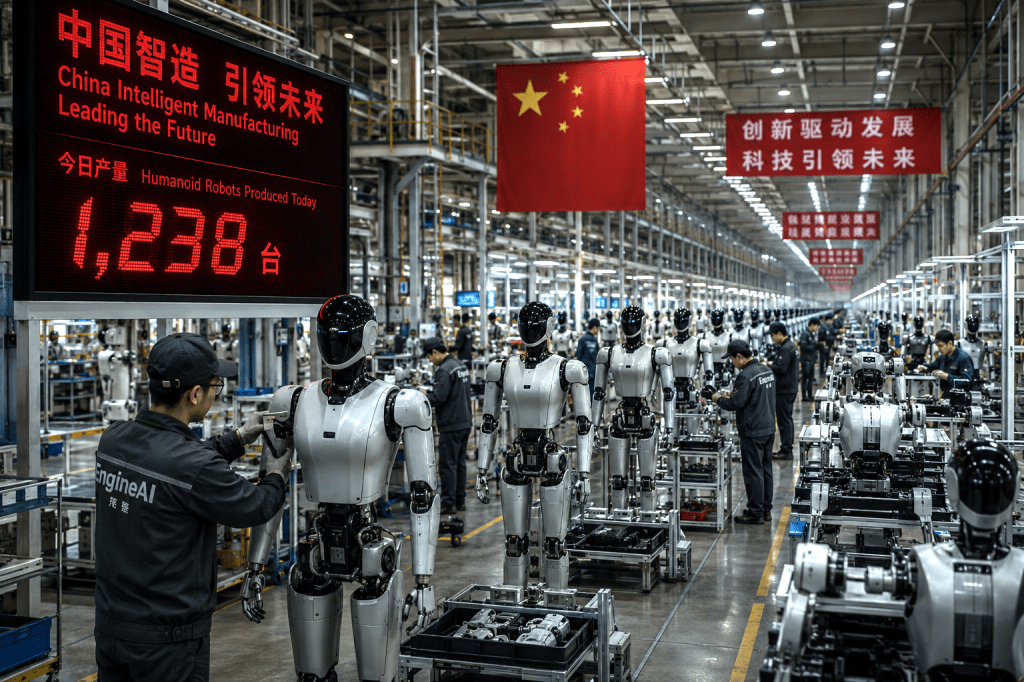
Humanoid robots are newer and far less proven. Figure AI reported that its Figure 02 robot worked ten-hour shifts during an 11-month pilot at BMW’s plant in Spartanburg, South Carolina, loading more than 90,000 sheet-metal parts used in more than 30,000 vehicles. Agility Robotics reports more than 65,000 operating hours for its Digit robot across nine customer sites, including the logistics company GXO and Toyota’s plant in Canada. The Chinese manufacturer Unitree shipped about 5,500 humanoids in 2025 and is targeting 10,000 to 20,000 in 2026, with its G1 model starting at around $16,000 (Humanoid Guide, 2026). By one estimate, China produced about 12,800 humanoids in 2025, roughly 90% of the global total (Chang et al., 2026). Most of these figures are reported by the companies themselves, and deployments are concentrated at a small number of sites (Humanoid Guide, 2026).
Prices are falling. Barclays estimates that the cost of a humanoid robot dropped from about $3 million to about $100,000 over the past decade (Pethokoukis, 2026). Goldman Sachs reported in 2024 that manufacturing costs had fallen about 40% in a single year, faster than its analysts expected, and projected more than 250,000 humanoid shipments in 2030, almost all for industrial use (Goldman Sachs, 2024). For China, Barclays projects in an optimistic scenario that 24 million humanoids could be working there by 2035, enough to offset up to 60% of the expected decline in the country’s labor force (Abdullahi, 2026).
Governments are making policy around these projections. In March 2026, Japan’s Ministry of Economy, Trade and Industry set a goal of holding 30% of the global “physical AI” market by 2040, naming logistics warehouses, factories, and home and elder care as target uses (Gioino, 2026). China has written embodied AI into its 15th Five-Year Plan for 2026–2030, and researchers at the Mercator Institute for China Studies (MERICS) list “a growing labor shortage” and “rising labor costs” among the forces behind the push (Chang et al., 2026).
The case for a machine solution
The strongest argument for the thesis is that something like it has happened before. In 1964, the United States ended the bracero program, which had admitted Mexican farmworkers on seasonal contracts. Michael Clemens, Ethan Lewis, and Hannah Postel studied the aftermath and found that domestic workers did not replace the braceros in large numbers and that domestic farm wages showed no measurable gain. Instead, “farm owners rapidly adopted new, labor-saving technologies,” speeding the mechanization of tomato, sugar beet, and cotton production, and output of tomatoes and cotton dipped only modestly and briefly (Clemens et al., 2017; National Bureau of Economic Research [NBER], 2017).
More recent research points in the same direction. Using Danish firm data from 1995 to 2019, Katja Mann and Dario Pozzoli found that a one-percentage-point increase in the local share of non-Western immigrants was associated with a 7% lower probability that a firm would adopt robots. They concluded that “robots and low-skill labor are substitutes” and that “labor shortages can induce firms to adopt automation technology” (Institute of Labor Economics [IZA], 2022). If that relationship holds, restricting immigration will itself speed up automation.
Employers describe the same calculation. Gary Wishnatzki of Wish Farms in Florida, which has been developing a strawberry-harvesting robot since 2013, says that “one machine will replace about 25 people,” and that “there are virtually no American citizens who are willing to do this work anymore.” By the company’s account, 2025 was the first season in which the machine picked as many berries as a human (Paluska, 2025). Ally Warson, a partner at the venture firm UP.Partners, says of the hazardous industrial jobs her firm’s investments target, “No one’s raising their hand and signing up for it” (Gioino, 2026).
Machines also offer practical advantages that matter to employers and governments. A robot does not need a visa renewal and cannot be deported. Barclays notes that a humanoid can work almost around the clock, pausing to recharge, and that at half a human’s efficiency it could deliver about 25% more output per day (Pethokoukis, 2026). For governments facing voters who oppose immigration, automation promises to keep production lines running without disputes over citizenship, housing, or integration. And in jobs that are dangerous, dirty, and dull, which Goldman Sachs analysts identify as the most attractive early market for humanoids (Goldman Sachs, 2024), replacing people with machines may benefit workers of any nationality.
Where the machine solution breaks down
The trouble is that the jobs robots do well are, for the most part, different from the jobs immigrants most often fill. Most factory robots are still fixed, single-purpose machines (Chang et al., 2026), repeating the same motion in a controlled space. The shortages behind the immigration debate are concentrated in nursing homes, home care, construction sites, and fresh-produce fields, where tasks vary from hour to hour, surroundings are unpredictable, and the work often involves handling people or fragile objects.
Care is the largest example. Immigrants make up nearly 30% of the U.S. direct care workforce, compared with about 20% of all employment, and an Economic Policy Institute analysis estimates that deporting 4 million people over four years would eliminate close to 400,000 direct care jobs, including about 120,000 held by U.S.-born workers (Zipperer, 2025). Japan has subsidized nursing-care robots since 2015, and the results so far run against the replacement thesis. A study by Karen Eggleston of Stanford, Toshiaki Iizuka of the University of Tokyo, Yong Suk Lee of the University of Notre Dame, and Ellie Xi of Stanford, using data from about 860 Japanese nursing homes, found that facilities adopting robots for lifting, mobility, and monitoring employed 28% more care workers and 39% more nurses, with total employment about 26% higher (Ronkin, 2026). Robot adoption also reduced reported difficulty retaining staff. The growth came entirely among part-time and contract staff, the authors acknowledge that full-time-equivalent staffing may have changed little, and the data date from 2017, early in the adoption curve (Prather, 2026). As Xi put it, “robots can complement rather than simply replace care workers” (Ronkin, 2026).
Construction shows a similar pattern. Immigrants make up about 35% of the U.S. construction workforce, and the Associated Builders and Contractors estimates that the industry needs to hire 349,000 more workers in 2026 (Rogelberg, 2026). In a survey conducted in July and August 2026, 87% of contractors reported openings for hourly craft positions, and 29% reported at least one direct or indirect effect from immigration enforcement in the previous six months (Associated General Contractors of America [AGC], 2026). Automated construction equipment remains expensive and is not yet reliable, according to Tony Payan of Rice University’s Baker Institute (Rogelberg, 2026).
In agriculture, the crops that are hardest to mechanize are the ones that rely most on immigrant hands. About 42% of U.S. crop farmworkers lacked work authorization in 2022, according to U.S. Department of Agriculture data. Mark Bolda, a berry farm advisor on California’s Central Coast, says growers are testing strawberry-picking machines but “nothing’s worked,” in part because the fruit hides under leaves, and Ryan Jacobsen of the Fresno County Farm Bureau says that “a fresh peach still requires a pair of hands to cut that off of a tree” (Castillo et al., 2025). The bracero study carries the same warning: crops for which no machinery was available suffered larger and longer-lasting production declines after the workers left (NBER, 2017). Where no machine existed, farms grew less.
Humanoids are supposed to close this gap, since a machine shaped like a person could in principle work in spaces built for people. The evidence suggests that point is still years off. The IFR’s 2026 report states that “most humanoids remain prototypes or pilot-stage technologies” and that conventional industrial robots remain economically superior for production work (IFR, 2026a). The MERICS researchers found that Chinese humanoids “still lack precision and dexterity,” that many impressive demonstrations are preprogrammed or remotely operated, and that the founder of UBTech reportedly said humanoids in Chinese factories are “only half as efficient as humans” (Chang et al., 2026). Rodney Brooks, a co-founder of iRobot (Loizos, 2025), argues that “human dexterity relies on a rich sense of touch” that today’s video-based training does not capture, and estimates that “we are more than ten years away from the first profitable deployment of humanoid robots even with minimal dexterity.” He also advises people “to not come closer than 3 meters to a full size walking robot” (Brooks, 2025), a serious constraint for a machine meant to help an elderly patient out of bed.
Musk himself was guarded when he spoke to investors in October 2026. He said the Optimus design still needed changes so that the robot “can’t, like, wear out after a month,” and that significant AI work remained before it would be “truly useful for open-ended tasks” (Korosec & O’Kane, 2026). Tesla had targeted 5,000 Optimus units for its own factories in 2025; mid-2025 reports put output at a few hundred (Humanoid Guide, 2026).
Hidden costs
A second set of problems lies outside the workplace. Immigrants are consumers and taxpayers as well as workers. The Brookings economists estimated that reduced immigration would lower U.S. GDP growth by 0.1 to 0.3 percentage points in each of 2025 and 2026 (Edelberg et al., 2026) and cut consumer spending by $60 billion to $110 billion over the two years (Gurley & Zarracina, 2026). A robot adds output, but it does not rent an apartment, buy groceries, or pay into a pension system. In aging countries, the labor shortage comes paired with a fiscal one: the CBO’s finding that immigration will account for all U.S. population growth after 2030 (CBO, 2026) is also a statement about who will pay the payroll taxes that support retirees. Automation can raise productivity and with it tax revenue, but Acemoglu and Restrepo also found that in the industries most amenable to automation, labor’s share of income tends to fall (Acemoglu & Restrepo, 2018), which matters for retirement systems funded by taxes on wages.
The effects cross borders. Remittances to low- and middle-income countries were expected to reach $685 billion in 2024, more than foreign direct investment and official development assistance combined; in Tajikistan they equaled about 45% of GDP, and in Nicaragua about 27% (Ratha et al., 2024). If wealthy countries replace migrant workers with machines on a large scale, those flows will shrink. China faces a domestic version of the problem. MERICS notes that its nearly 300 million internal migrant workers, many in precarious jobs with a thin social safety net, may be especially exposed to automation (Chang et al., 2026).
Native-born workers are not automatically protected either. A study using Norwegian employer-employee records found that workers exposed both to robot adoption and to the immigration that followed the European Union’s 2004 enlargement lost more earnings than those exposed to either shock alone, often after moving into lower-paid service jobs (Bennett & Johnsen, 2025). The research on robots and migrants is also mixed. A firm-level study of Austria found that companies using robots “tend to employ more workers overall,” including a higher share of low-educated migrants from outside the European Economic Area. Its authors, who note that their data show correlation and not cause, concluded that “instead of largely displacing labour, automation complements it” (Tverdostup et al., 2025).
The timing problem
The most serious weakness of the robots-for-immigrants trajectory is timing. The demographic and political shocks are happening now. U.S. net migration probably turned negative in 2025 (Edelberg et al., 2026). Japan’s care plan calls for 250,000 additional workers by fiscal 2026 (Yokota, 2026). Britain’s care vacancies number more than 100,000 (Hamid & Hussein, 2026). The machines that could fill those particular jobs are, by Brooks’s estimate, more than a decade from profitable deployment (Brooks, 2025), and even Tesla’s timeline puts high-volume humanoid production at the end of 2027 (Korosec & O’Kane, 2026).
Menju draws the conclusion for Japan: AI, robotics, and more work by women and older people cannot fully cover the shortfall (AFP, 2026). Even analysts who are enthusiastic about humanoids tend to describe them as a supplement. James Pethokoukis of the American Enterprise Institute, who argues that humanoids are arriving as labor grows scarce, writes that physical automation “isn’t a substitute for people; it’s a way of doing more with fewer of them,” and expects the countries that combine migration with automation to fare best (Pethokoukis, 2026).
Weighing the trajectory
Measured against the evidence, the thesis holds up in a narrower form than its strongest version. In manufacturing and warehousing, robots are already reducing the number of workers, immigrant or native, needed for a given level of output, and several of the countries with the steepest demographic declines are among the most automated. In some field crops, machines replaced immigrant labor six decades ago and may do so again as vision systems and harvesters improve. In those sectors, a country that restricts immigration can expect automation to absorb part of the shock, and the Danish and bracero studies suggest that restriction will itself speed adoption.
In care, construction, and fresh produce, the evidence so far points the other way. Robots in Japan’s nursing homes were followed by more hiring. Contractors and growers say the machines they need are not ready. The most capable humanoids in commercial pilots are moving sheet metal and totes in controlled factory settings. These are also the sectors where demand will rise most predictably as populations age.
The most likely outcome over the next decade is a shift in which immigrants are needed and where they work. Countries will need fewer foreign workers on assembly lines and in packing sheds, and they will keep needing foreign caregivers, builders, and pickers, as several are already acknowledging by recruiting them. Japan is funding a domestic physical AI industry and recruiting care workers from Southeast Asia at the same time (Gioino, 2026; The Japan Times, 2024). The governments most at risk are those that close the door to workers now on the assumption that robots will arrive in time to replace them. The research to date does not support that assumption. When the U.S. agriculture secretary suggested that automation and Medicaid recipients could quickly replace immigrant farm crews, a Ventura County grower said most farmers “either laughed out loud or were just deflated” (Castillo et al., 2025). On the timing question, the bracero record and the current state of humanoid robotics are on the growers’ side.
References
Abdullahi, A. (2026, May 20). China’s “decade of the robot” could bring 24M humanoids by 2035. eWeek. https://eweek.com/news/china-humanoid-robots-workforce-decline-apac
Acemoglu, D., & Restrepo, P. (2018). Demographics and automation (NBER Working Paper No. 24421). National Bureau of Economic Research. https://www.nber.org/system/files/working_papers/w24421/w24421.pdf
Agence France-Presse. (2026, October 18). Japan says it is hosting a record number of foreigners in 2026. The Star. https://www.thestar.com.my/aseanplus/aseanplus-news/2026/10/18/japan-says-it-is-hosting-a-record-number-of-foreigners-in-2026
Associated General Contractors of America. (2026, September 3). Construction workforce shortages remain acute despite “soft” market conditions as data centers strain labor supply, survey finds. https://www.agc.org/news/2026/09/03/construction-workforce-shortages-remain-acute-despite-soft-market-conditions-data-centers-strain
Avvenire. (2025, June 29). Ecco il nuovo decreto flussi: 500mila ingressi in tre anni [Here is the new flows decree: 500,000 entries in three years]. Avvenire. https://www.avvenire.it/attualita/ecco-il-nuovo-decreto-flussi-500mila-ingressi-in-tre-anni
Bennett, P., & Johnsen, J. V. (2025). Intersecting shocks: The combined labor market impacts of automation and immigration (IZA Discussion Paper No. 18218). IZA Institute of Labor Economics. https://docs.iza.org/dp18218.pdf
Brooks, R. (2025, September 26). Why today’s humanoids won’t learn dexterity. Rodney Brooks. https://rodneybrooks.com/why-todays-humanoids-wont-learn-dexterity/
Castillo, A., Hussain, S., & Garrison, J. (2025, July 9). Trump official suggests Medicaid recipients, automation can replace immigrant workers. California farmers disagree. Los Angeles Times (via Yahoo News). https://www.yahoo.com/news/california-farmers-medicaid-recipients-automation-100000063.html
Chang, W., Arcesati, R., & Junusova, A. (2026, April). Embodied AI: China’s ambitious path to transform its robotics industry. Mercator Institute for China Studies. https://merics.org/sites/default/files/2026-04/MER-RZ-Report-Embodied-AI-260422-Web.pdf
Clemens, M. A., Lewis, E. G., & Postel, H. M. (2017). Immigration restrictions as active labor market policy: Evidence from the Mexican bracero exclusion (IZA Discussion Paper No. 10512). IZA Institute of Labor Economics. https://docs.iza.org/dp10512.pdf
Congressional Budget Office. (2026, January 7). The demographic outlook: 2026 to 2056. https://www.cbo.gov/publication/61879
Edelberg, W., Veuger, S., & Watson, T. (2026, January 13). Macroeconomic implications of immigration flows in 2025 and 2026: January 2026 update. Brookings Institution. https://www.brookings.edu/articles/macroeconomic-implications-of-immigration-flows-in-2025-and-2026-january-2026-update
Gioino, C. (2026, April 6). “No one’s raising their hand”: Japan’s labor crisis is making the case for robots taking the jobs you don’t want. Fortune. https://fortune.com/2026/04/06/japan-labor-shortage-robots-ai-robotics-humanoid/
Goldman Sachs. (2024, February 27). The global market for humanoid robots could reach $38 billion by 2035. https://goldmansachs.com/insights/articles/the-global-market-for-robots-could-reach-38-billion-by-2035
Gurley, L. K., & Zarracina, J. (2026, January 13). US lost more immigrants than it gained in 2025, new estimate shows. Daily Herald (from The Washington Post). https://www.dailyherald.com/20260113/nation-and-world/us-lost-more-immigrants-than-it-gained-in-2025-new-estimate-shows/
Hamid, M., & Hussein, S. (2026, April 27). From crisis to chronic shortage: The future of adult social care workforce recruitment in the UK. Centre for Care. https://centreforcare.ac.uk/updates/2026/04/from-crisis-to-chronic-shortage-the-future-of-adult-social-care-workforce-recruitment-in-the-uk/
Humanoid Guide. (2026, July 19). Humanoid deployments in 2026 favor Figure and Agility. https://humanoid.guide/humanoid-deployments-in-2026-favor-figure-and-agility/
Institute of Labor Economics. (2022, December 19). Immigration or automation? IZA Newsroom. https://newsroom.iza.org/en/archive/research/immigration-or-automation/
International Federation of Robotics. (2026a). World robotics 2026: Industrial robots. Executive summary. https://ifr.org/img/worldrobotics/Executive_Summary_WR_2026_-_Industrial_Robots.pdf
International Federation of Robotics. (2026b, September 24). Five million robots now operate in factories globally [Press release]. https://ifr.org/ifr-press-releases/five-million-robots-now-operate-in-factories-globally
International Federation of Robotics. (2026c, April 8). Robot density surges in Europe, Asia, and Americas – IFR reports [Press release]. Business Wire. https://www.businesswire.com/news/home/20260408531951/en/Robot-Density-Surges-in-Europe-Asia-and-Americas-IFR-reports
Korosec, K., & O’Kane, S. (2026, October 21). Tesla starts Optimus robot production in California as profit falls 43%. TechCrunch. https://techcrunch.com/2026/10/21/tesla-stars-optimus-robot-production-in-california-as-profit-falls-43/
Lim, J. (2025, December 23). South Korea cuts 2026 low-skilled foreign worker quota to 80,000. The Nation (from The Korea Herald). https://www.nationthailand.com/news/world/40060235
Loizos, C. (2025, September 26). Famed roboticist says humanoid robot bubble is doomed to burst. TechCrunch. https://techcrunch.com/2025/09/26/famed-roboticist-says-humanoid-robot-bubble-is-doomed-to-burst
Loxton, R. (2026, April 21). How bad is Germany’s skilled worker shortage in 2026? The Local Germany. https://www.thelocal.de/20260421/how-bad-is-germanys-skilled-worker-shortage-in-2026
National Bureau of Economic Research. (2017, April). The effects of excluding low-skill foreign workers. The NBER Digest. https://www.nber.org/digest/apr17/effects-excluding-low-skill-foreign-workers
Paluska, M. (2025, May 9). Berry picking robots: Wish Farms is going all in on AI and automation. Tampa Bay 28. https://www.tampabay28.com/news/local-news/berry-picking-robots-wish-farms-is-going-all-in-on-ai-and-automation
Pethokoukis, J. (2026, January 15). Humanoid robots arrive just as humans stop showing up. American Enterprise Institute. https://www.aei.org/commentary/humanoid-robots-arrive-just-as-humans-stop-showing-up/
Prather, A. (2026, August 18). Robots were supposed to replace workers. In Japan’s nursing homes, the opposite happened. Association for Advancing Automation. https://www.automate.org/robotics/industry-insights/robots-were-supposed-to-replace-workers-in-japans-nursing-homes-the-opposite-happened
Ratha, D., Plaza, S., & Kim, E. J. (2024, December 18). In 2024, remittance flows to low- and middle-income countries are expected to reach $685 billion, larger than FDI and ODA combined. World Bank Blogs. https://blogs.worldbank.org/en/peoplemove/in-2024–remittance-flows-to-low–and-middle-income-countries-ar
Rogelberg, S. (2026, May 23). America is suffering a shortage of construction workers and sabotaging its ability to fill vacancies by wiping out the industry’s immigrant backbone. Fortune. https://www.fortune.com/2026/05/23/america-construction-shortage-trump-immigration-crackdown-ice-deportations-home-costs/
Ronkin, N. (2026, August 17). How robots are easing Japan’s elder care worker shortage. Stanford Report. https://news.stanford.edu/stories/2026/08/care-robots-japan-employment-labor-shortage-research
The Japan Times. (2024, December 17). Japan to actively recruit nursing care staff from overseas. Viet Nam News. https://vietnamnews.vn/world/1689173/japan-to-actively-recruit-nursing-care-staff-from-overseas.html
Tverdostup, M., Ghodsi, M., & Leitner, S. M. (2025). Migration vs. automation as an answer to labour shortages: Firm-level analysis for Austria (wiiw Working Paper No. 262). The Vienna Institute for International Economic Studies. https://wiiw.ac.at/migration-vs-automation-as-an-answer-to-labour-shortages-firm-level-analysis-for-austria-dlp-7282.pdf
Yokota, N. (2026, March 9). The structure of Japan’s care worker crisis: The “invisible roadmap” to 2040. Institute for Social Vision Design. https://isvd.or.jp/en/columns/2026-03-09-care-worker-shortage-structure
Zipperer, B. (2025, December 15). Trump’s deportation plans threaten 400,000 direct care jobs: Older adults and people with disabilities could lose vital in-home support. Economic Policy Institute. https://www.epi.org/blog/trumps-deportation-plans-threaten-400000-direct-care-jobs-older-adults-and-people-with-disabilities-could-lose-vital-in-home-support/
###
Filed under: Uncategorized |









































































































































































































































































































































































































































































































Leave a Reply