


By Jim Shimabukuro (assisted by Claude)
Editor
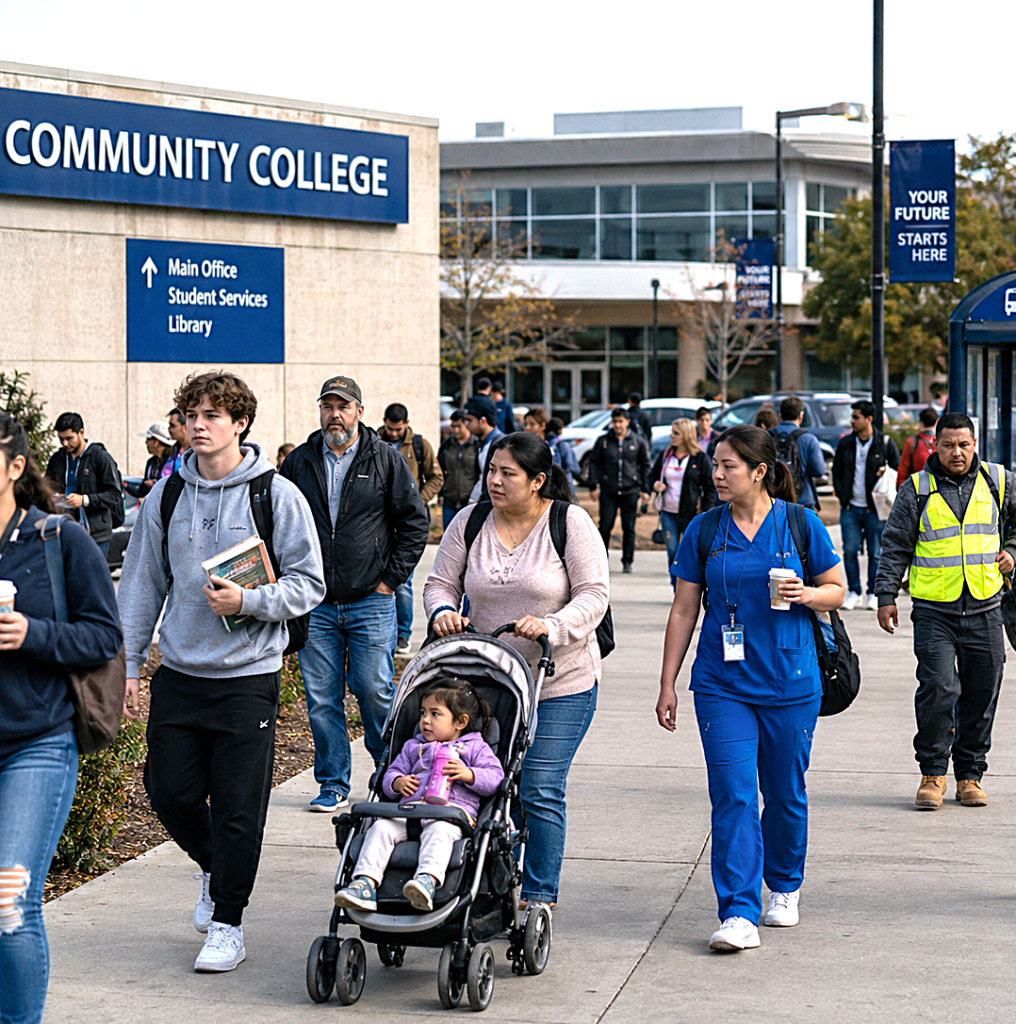
Introduction: Enrollment at America’s community colleges is up. Persistence is at a ten-year high. The finances are coming apart anyway — and the second half of this decade is where the bill arrives.

One morning in September 2025, federal immigration agents detained a student in a parking lot on the main campus of Elgin Community College, forty miles northwest of Chicago. The college said it had no role in the arrest, that it does not share students’ immigration status, and that the episode was isolated (CBS News Chicago, 2025).
What followed was not a lawsuit or a protest. It was an absence. “We had this drop of over 40% of the enrollment, over 700 students dropped from the ESL program all in that short duration of time,” ECC President Peggy Heinrich told the college’s student newspaper. The cause, she said, was not tuition or scheduling. “Students are experiencing a sense of fear, whether their status is undocumented, mixed status, whether they have US born children — there’s a sense of fear to leave your home or take public transportation when we have an immigration enforcement activity happening locally” (Elgin Observer, n.d.).
Seven hundred students is a rounding error in a sector that enrolls millions. But the episode is a fair portrait of the year community colleges are having. Nothing in the national enrollment data would have predicted it. Nothing in the national enrollment data can see it. And by every headline measure the sector is doing better in 2026 than it has done in a decade.
That contradiction is the story.
The good news, stated plainly
Community colleges enrolled about 5.8 million students in spring 2026, up 5.2 percent from spring 2021 (National Student Clearinghouse, 2026a). In fall 2025 they added roughly 173,000 students, a 3 percent gain and the largest increase of any sector in American higher education; private four-year colleges, by contrast, shrank 1.4 percent (Alonso, 2026). Certificate programs at all institutions grew 10.2 percent in spring 2026, adding 86,000 students (National Student Clearinghouse, 2026a).
The outcomes numbers moved too, which is the part that ought to matter most to anyone who has spent a career in the sector. Among students who started at community colleges in fall 2024, 63.3 percent persisted into a second year and 56.2 percent returned to the same college — both figures above their pre-pandemic marks, and both improving for a third consecutive year. Part-time students, historically the sector’s hardest retention problem, gained about a point on each measure (Community College Daily, 2026a).
“These trends reinforce the growing demand for flexible and career-focused educational pathways, especially short-term certificate programs that can help students quickly enter or advance in their chosen careers,” said Matthew Holsapple, senior director of research at the Clearinghouse Research Center (National Student Clearinghouse, 2026a).
A president reading only those paragraphs would conclude the sector had turned a corner. A chief financial officer reading the same paragraphs would want to know who, exactly, those additional students are.
Who is actually filling the seats
Of the 173,000 additional students community colleges enrolled in fall 2025, roughly 38 percent were under seventeen years old — high schoolers taking college courses through dual enrollment (Alonso, 2026). Over the same period, new undergraduates aged 25 and older fell 15.5 percent, a loss of about 35,000 students, and students aged 21 to 24 fell 5.2 percent.
Read those two sentences together and the recovery looks different. The sector is growing at the bottom of its age range and hollowing out in the middle, and the two populations are not financially or educationally interchangeable.
Dual enrollment is now enormous. More than 2.8 million students took dual enrollment courses in 2023–24, two million of them at community colleges, and high school students account for more than one in five community college enrollments nationally (Community College Research Center, 2026). In California, dual enrollment grew 76 percent between 2018–19 and 2025–26 (Legislative Analyst’s Office, 2026).
The problem is not that dual enrollment is bad. The evidence that it works is strong: 45.4 percent of community college entrants with dual enrollment experience transferred to a four-year institution within six years, against 31.6 percent of those without it (National Student Clearinghouse, 2026b). The problem is what it costs. Community colleges typically waive or deeply discount tuition for high school students, absorb the cost of instruction, and in many states receive partial or no state apportionment for the credit hours. A college that replaces a full-paying 28-year-old with a tuition-waived 16-year-old has grown its headcount and shrunk its revenue in the same transaction, and its enrollment dashboard will show only the first half.
There is a second cost that shows up on no ledger. Dual enrollment does not reach students evenly. White students enroll at nearly twice the rate of their Black and Hispanic classmates; English learners and students with disabilities are, in the Community College Research Center’s phrasing, “severely underrepresented” (Community College Research Center, 2026). The sector’s fastest-growing population is therefore also its least representative one. Meanwhile the adult learner — the returning veteran, the laid-off warehouse worker, the parent finishing a credential at night, the population around which the community college mission was built — is walking away in five figures a year.
Matthew Holsapple, describing the divergence between growing public two-years and shrinking private four-years, offered a line that applies just as well inside the community college numbers themselves: “We’ve seen them moving together, not in opposing directions like they have this year, and it’s a clear departure from the broad-based growth we’ve seen in recent years” (Alonso, 2026).
The money stopped arriving
State support for higher education reached $133.1 billion in fiscal 2026, an increase of 1.0 percent — the smallest gain since the depths of the pandemic in fiscal 2021, and a sharp deceleration from the 7.8 percent average annual growth of fiscal 2022 through 2025. Inflation over the same period ran between 2.7 and 3.0 percent, which means the sector took a real-terms cut while the headline number rose. Seventeen states and the District of Columbia cut higher education outright, seven of them by 5 percent or more. Arizona cut 13.6 percent. Public two-year institutions receive about 21 percent of all state support (State Higher Education Executive Officers Association, 2026; Alonso, 2026).
Rachel Burns, a senior policy analyst at SHEEO, framed the mood accurately and then named the risk. “Pre-pandemic, it might have been harder to absorb this kind of slower growth, but because we have so many good years, we feel less panicked,” she said. Then: “We’re starting to see higher ed serving once again as the balancing wheel that it has been in the past when there are economic downturns” (Blake, 2026).
The balancing wheel turns first in the places with the least political protection. In Arizona, the Maricopa County Community College District — the largest system in the state, with an estimated $8.8 billion annual economic impact and a hand in one of every thirty jobs in the county — received zero dollars in state operating aid in 2026, for the twelfth consecutive year. The state’s own funding formula would have generated $28.4 million. Maricopa asked for $7 million. The cumulative shortfall since 2015 is $655 million. “The state has an obligation to provide support for its community colleges,” said Chancellor Steven R. Gonzales. “As the largest community college system in the state, the lack of investment ultimately hurts Arizona’s long-term economic growth” (Maricopa Community Colleges, 2026).
The same Arizona budget eliminated $6 million a year for the Community College Adult Education Workforce Program — roughly 20 percent of the adult basic education budget at Pima Community College alone. Laurie Kierstead-Joseph, Pima’s assistant vice chancellor for adult basic education, described the way this kind of cut actually lands. It is not a single dramatic closure. “We won’t see that cut immediately, say in July or October, but we will over the course of the next year, need to look at how we will trim programming,” she said. The trimming starts with the things that never appear in a course catalog: transportation help, interview clothes, the wraparound support that determines whether an adult without a high school diploma finishes anything at all (Dowd, 2026).
In California, Santa Monica College spent the first half of 2026 doing arithmetic in public. The college carried a $5.8 million structural deficit and projected roughly $17.5 million for the following year. Its reserves stood at $17.8 million and were projected to fall below $300,000 by June 2027. Fall headcount had already dropped 14.7 percent between 2019 and 2024, to 23,453; winter enrollment fell another 5.1 percent year over year, and nonresident enrollment — the college’s highest-margin students — fell 14.8 percent. Trustees approved roughly sixty layoffs (Unglesbee, 2026b).
“Like other higher education institutions facing similar budgetary pressures, SMC has to take necessary steps to safeguard fiscal viability,” said Superintendent and President Kathryn Jeffery. Vice President of Business and Administration Chris Bonvenuto put the same point in the language of a spreadsheet with no remaining slack: “You’re going to have to cut that deficit if you want to be even.” Of the collapse in nonresident enrollment, Vice President of Student Success Tania Acosta said simply that it “is still very difficult and very troubling for the institution” (Unglesbee, 2026b).
California’s structural cushion is also deflating. Thirteen districts still receive hold-harmless funding — $86 million above what the state’s Student-Centered Funding Formula would actually generate for them — and beginning in 2025–26 that protection is frozen at a 2024–25 baseline with no cost-of-living adjustment. Statewide, Proposition 98 funding per full-time-equivalent student reaches an all-time nominal high of $12,930 in 2026–27, and, adjusted for inflation, still sits roughly $800 below the 2024–25 peak. Employee compensation consumes more than 80 percent of district spending, with pension contributions and health premiums rising faster than the apportionment (Legislative Analyst’s Office, 2026).
Texas: a cautionary tale about getting it right
The most instructive fiscal story of 2026 is not a failure. It is a success that could not be paid for.
In 2023 Texas enacted House Bill 8, widely admired as the country’s most serious attempt to fund community colleges for what students accomplish rather than for how many bodies sit in seats. Money follows completed credentials, transfers to universities, dual credit attainment, and carries bonuses for serving economically disadvantaged and adult students. It was, by design, an incentive.
The colleges responded. They beat the state’s outcome projections across the board. “Our colleges answered that challenge,” said Ray Martinez III, president of the Texas Association of Community Colleges, and “delivered results that exceeded projections” (Community College Daily, 2026b).
The appropriation, however, was fixed at roughly $1.2 billion. When performance outruns the pot, the state does not print more; it re-prices the outcomes. The Texas Higher Education Coordinating Board is now reducing the value of the very measures it asked colleges to chase. Paris Junior College projects a $1.4 million drop. Texarkana, Navarro, and McLennan project declines of at least 20 percent. Several colleges face reductions of 15 percent or more in fiscal 2027. “These changes are necessary to ensure the financial sustainability of the CCF program,” said Andy McLaurin, the board’s assistant commissioner for funding and financial aid (Community College Daily, 2026b).
Stephen Benson, president of Paris Junior College, said the obvious thing, which is worth quoting because it will be said in a dozen more states before 2030: “Successful colleges should not be penalized for exceeding expectations” (Community College Daily, 2026b).
The lesson generalizes. Outcomes-based funding inside a capped appropriation is not an incentive system. It is a tournament, in which colleges compete against each other for a fixed prize and the reward for collective improvement is a smaller payment per unit of improvement. As more states adopt performance formulas under tightening budgets, this arithmetic will be the sector’s most common and least anticipated fiscal shock.
Washington: the promise, and the fine print
For twenty years community college advocates asked for Pell Grants to cover short-term workforce training. In July 2025 they got it. The Workforce Pell Grant program was enacted in the budget reconciliation law, the final rule was published on May 19, 2026, and the program took effect July 1, 2026 (U.S. Department of Education, 2026). “Americans should not have to spend years in college and take on debt they may never be able to repay before entering the workforce,” Secretary Linda McMahon said. Under Secretary Nicholas Kent called it a “game changer” for career training (Community College Daily, 2026c).
Then the field read the regulations.
Eligible programs must run between 8 and 14 weeks, or 150 to 599 clock hours. They must achieve a 70 percent completion rate and a 70 percent job placement rate — both, simultaneously — and pass a value-added earnings test, while capping tuition against graduate earnings. Two facts about the American noncredit landscape collide with that design. First, typical noncredit workforce programs run between 15 and 100 clock hours, well beneath the 150-hour statutory floor. Second, when a completer enrolls in further education rather than taking a job, that student counts against the placement rate rather than toward it — a rule that penalizes precisely the stackable-credential pathways community colleges spent a decade building (Seepersad, 2026; Community College Daily, 2026c).
The result is that very few programs qualify. North Carolina’s preliminary assessment found that roughly 4 percent of the state’s short-term credential programs are expected to be eligible. State-level occupation approvals are wildly uneven: North Carolina approved 364 occupations, Pennsylvania nineteen (Seepersad, 2026; Community College Daily, 2026c).
Nor is there money to build the machinery. The $160 million in implementation funding contained in the original legislation disappeared from the final statute, and most states cannot yet track what happens to completers. As one review found, none of the states examined had complete data on whether graduates went on to pursue or complete further credentials. States have until 2029–30 to update the unemployment wage record systems the accountability tests depend on — which is to say, the tests began running three years before the data infrastructure is due to exist.
Sean Seepersad, division director of academic affairs at the Connecticut Office of Higher Education, delivered the verdict most administrators privately share: “This is not a rollout problem. It is a design problem” (Seepersad, 2026). Michael Pearson, director of workforce development policy at the Progressive Policy Institute, put it more mildly — “the rollout challenges will limit Workforce Pell’s potential” — and estimated the expansion would cost about $2 billion over a decade, a small figure next to what is happening to Pell overall (Community College Daily, 2026c).
That larger figure is the one to watch. The American Association of Community Colleges estimates that $16.9 billion in additional funding is needed simply to avoid cuts to the existing Pell Grant program or reductions in eligibility, against a projected shortfall approaching $132 billion over the coming decade. Without congressional action, award reductions affecting every Pell recipient become possible in 2028–29 (American Association of Community Colleges, 2026; Community College Daily, 2026c). Roughly 61 percent of community college students receive federal grant aid (American Association of Community Colleges, 2026b).
Around that central risk sits a ring of smaller ones, each aimed at a program community colleges rely on. Federal adult education, funded at $729.2 million in fiscal 2025, was proposed for elimination — zero dollars — in the fiscal 2027 budget request, after roughly $715 million was withheld nationally in July 2025. “It made it so clear that things were hanging by a thread before,” said Bria Dolnick of Literacy Works in Chicago (Mobasher, 2026). The administration has also proposed restricting Perkins career and technical education funding exclusively to middle and high school students, phasing out postsecondary CTE accountability measures, while moving CTE administration toward the Department of Labor (Advance CTE, 2025). AACC has additionally opposed proposed elimination of or deep cuts to TRIO, GEAR UP, Supplemental Educational Opportunity Grants, Title III-A institutional aid, Federal Work Study, and campus childcare (American Association of Community Colleges, 2026a).
No single one of these is fatal. Taken together they describe a federal posture in which the one new revenue stream for community colleges is narrow, unfunded, and hard to qualify for, while the established streams that serve the least advantaged students are on the table every budget cycle.
The open door as an attack surface
There is a problem in 2026 that nobody in the sector was trained for. California’s community colleges have lost more than $30 million to financial aid fraud since 2024 — $13 million between January and May of 2025 alone, and roughly $500,000 a month since. Losses in the first quarter of 2026 came to $1.9 million, including $700,000 in March (Burke & Willis, 2026).
The mechanism is banal and industrial. Fraud rings use automated systems to submit applications, enroll in courses, remain just long enough to trigger a disbursement, and vanish. At the peak in spring 2025, 34 percent of all applications to the California system were flagged as suspected fraudulent; in the Los Rios district, the figure hit 64 percent between January and March of that year (Echelman, 2026). “It became a lot easier for them to commit the fraud at a larger scale,” said Victor DeVore, dean of student services at San Diego Community College District, describing accounts whose logins jump continents mid-session: “One minute they’re logging in from Nairobi, the next minute — Virginia” (Echelman, 2026; Burke & Willis, 2026).
The system has fought back, and the counter-numbers are real. Los Rios flagged 12 percent of applications in spring 2026, down from 64 percent. Statewide losses fell to $1.5 million in federal aid and $330,000 in state aid for the term. “Is there still fraud? Yes. Is the problem lessening? Yes,” said Chris Ferguson, executive vice chancellor for finance (Echelman, 2026; Burke & Willis, 2026). Identity verification became mandatory on July 1, 2026.
But look at the compliance figures underneath the win. As of May 2026, only half of students had completed identity verification, and only about two-thirds of colleges were using the system’s fraud detection software (Echelman, 2026). Nicole Albo-Lopez, deputy chancellor of the Los Angeles Community College District, described the institutional learning curve in the plainest terms: “We learned we can’t leave the back door open. Because they’ll find a way in” (Burke & Willis, 2026).
Here is the part that deserves more attention than it has received. Every layer of friction that keeps a bot out also keeps out a category of real applicant: the student with no credit history, no stable address, no government photo ID, no smartphone capable of running a liveness check, no confidence that submitting documents to a government-adjacent system is safe. Those are not edge cases at an open-access institution; they are a meaningful share of the mission. California is measuring the fraud it stopped with some precision. No state is measuring the students the verification wall turned away. The open door is being fitted with a lock, and the sector has no instrument that reads the far side of it.
The students arriving are less prepared than the students who left
In September 2025 the National Assessment Governing Board released twelfth-grade results that ought to be read as a forecast of the community college classroom for the rest of the decade. Forty-five percent of twelfth graders scored below NAEP Basic in mathematics — the highest share ever recorded. Thirty-two percent scored below Basic in reading, also the largest on record. Just 33 percent were judged academically prepared for entry-level college coursework in mathematics, down from 37 percent in 2019 (National Assessment Governing Board, 2025).
Martin R. West, the board’s vice chair, identified where the damage is concentrated: “there are drops in achievement overall but these are largely driven by big declines among the lowest-performing students” (National Assessment Governing Board, 2025).
Selective universities can decline to admit that cohort. Community colleges cannot, and would not want to. But the sector is being asked to absorb a measurably weaker-prepared entering class at the same moment that state funding is flat in real terms, developmental education has been compressed by corequisite reform, adult basic education is being defunded in states like Arizona and proposed for elimination federally, and accountability formulas are being tuned to reward faster completion. The inputs got harder and the standards got tighter in the same five-year window. That combination has no obvious precedent in the sector’s history.
The workforce bet meets an uncertain labor market
The sector’s strategic answer to nearly every pressure described so far is the same: pivot harder toward short-term, job-aligned credentials. Certificates are growing fastest, Workforce Pell rewards them, governors like them, and skeptical taxpayers understand them. It is a reasonable bet. It is also being placed at an awkward moment.
Unemployment among recent computer science graduates ran 6.1 percent in early 2026, against 4.8 percent for recent graduates across all fields — an inversion of the field’s long-standing premium, and a warning to any college building its enrollment strategy around a single hot occupational cluster (Higher Ed Dive, 2026). The honest counterweight comes from the Economic Policy Institute, which examined occupational data for the class of 2026 and cautioned against the easiest explanation: “Since the weakening labor market is hitting both young college and noncollege workers alike, it’s hard to argue that AI is uniquely causing job losses for new labor market entrants” (Economic Policy Institute, 2026).
Whether the cause is artificial intelligence, a hiring correction, or ordinary cyclical weakness, the practical consequence for community colleges is identical. Workforce Pell conditions eligibility on placement rates and graduate earnings measured against local benchmarks. If entry-level hiring stays soft through 2028, programs will lose eligibility for reasons that have nothing to do with the quality of their instruction, and colleges will have built curriculum, hired faculty, and bought equipment against a revenue stream that evaporates on a metric they do not control.
Public patience, meanwhile, is thin. Gallup found American confidence in higher education at 38 percent in July 2026, down from 42 percent a year earlier and far below the 57 percent of 2015. Confidence among Democrats fell to 50 percent, a new low for the group; among Republicans it stood at 23 percent (Gallup, 2026). The immediate college-going rate among high school graduates has fallen from about 70 percent to 62 percent over the past decade (Sataua, 2026).
Consolidation arrives in the sector that was supposed to be immune
Community colleges have generally been spared the closure wave that has taken more than 300 degree-granting institutions since 2008. That exemption is ending, and Oakland shows how.
Laney College enrolled 17,698 students in 2019–20 and 9,828 in 2024–25 — a loss of 44 percent. Merritt College fell from 11,856 to 7,195 over the same period. In June 2026 the Peralta Community College District moved to merge them into a single institution, Oakland City College, by fall 2027 (Weissman, 2026). “The enrollment has decreased so much. It’s hard to fathom,” said Trustee Cindi Napoli-Abella Reiss (Alexander, 2026).
The faculty response is worth recording, because it is the response every merged college produces and every board underestimates. Merritt bioscience professor Gisele Giorgi, who authored a petition gathering more than 300 signatures, said: “There are so many questions still left unanswered. We really need to plan better.” Stefani Devito, a Merritt wellness clinician, was blunter about the timeline: “Operationally, from my ground-level perspective, we cannot do what needs to be done in time for fall 2027 enrollment” (Weissman, 2026).
The rating agencies see the same terrain. Fitch called higher education’s 2026 financial outlook “deteriorating.” Moody’s held a negative outlook, describing an “increasingly difficult and shifting operating environment.” S&P Global expects “mounting operating pressures and uncertainty” (Unglesbee, 2026a). The Federal Reserve Bank of Philadelphia has estimated roughly eighty college closures between 2025 and 2029. “Nearly every college in the country is facing some kind of financial pressure,” Robert Kelchen of the University of Tennessee told Fortune (Sataua, 2026).
2026–2030: four lines converging
The first half of this decade was a collapse followed by a recovery — a coherent story with a satisfying shape. The second half will be different in kind, because four independent pressures are scheduled to arrive within the same four-year window.
The pipeline reverses. American high school graduates peaked in 2025 at 3.9 million and will fall to about 3.4 million by 2041, a 13 percent decline. Thirty-eight states will lose graduates; eight will lose more than 20 percent. Five states account for three-quarters of the national decline: California (−29 percent), Illinois (−32 percent), Michigan (−20 percent), New York (−27 percent), and Pennsylvania (−17 percent) — which is to say, the states operating the largest community college systems (Western Interstate Commission for Higher Education, 2024). The significance for this sector is specific: because dual enrollment now supplies the growth, and dual enrollment draws from the eleventh and twelfth grades, the demographic decline hits community college headcount through the high schools before it hits anyone else, and it hits hardest exactly where the systems are biggest.
State budgets absorb a federal cost shift. The 2025 reconciliation law is projected to reduce federal Medicaid support to states by roughly $840 billion over ten years (Blake, 2026). States must find that money, and higher education has historically been where they look — the balancing wheel Rachel Burns described. Simultaneously, the pandemic-era protections are expiring: California’s hold-harmless baseline is frozen, Texas is re-pricing its outcomes, and one-time federal relief is gone from every operating budget in the country.
Federal aid narrows on schedule. Workforce Pell revenue arrives late, small, and only for the minority of programs that clear the 70/70 threshold. The broader Pell shortfall threatens award reductions for all recipients as early as 2028–29. Adult education, postsecondary CTE, TRIO, and work-study face recurring elimination proposals. Meanwhile states must rebuild their wage-record systems by 2029–30 to support the accountability regime that is already live.
Accountability tightens as outcomes get harder to produce. Earnings-based program tests take effect as entry-level hiring softens and as an entering class arrives with the weakest measured preparation on record. Colleges will be judged on graduate wages in a labor market they do not control, using data systems that do not yet exist, for students whose academic starting point has moved backward.
Any one of these is manageable. The trouble is that they are not sequential. They land between 2027 and 2030, on institutions whose reserves were spent surviving 2020 through 2025, and whose 2026 balance sheets — Santa Monica’s $300,000 projected reserve, Maricopa’s twelfth year at zero, Paris Junior College’s $1.4 million — already show what the cushion looks like when it is gone.
What the dashboards cannot see
Demarée Michelau, president of the Western Interstate Commission for Higher Education, offered the reasonable institutional counsel when the demographic projections were released: “States and institutions have time right now to build approaches that will work in their contexts to meet current and future workforce needs” (Western Interstate Commission for Higher Education, 2024). That was 2024. Most of the time she was describing belonged to the years that have since passed.
The most dangerous feature of the current moment is not any single item on the list above. It is that the sector’s primary instrument — the enrollment report — is now systematically misreading its own condition. Headcount is up while net tuition revenue per student falls. Persistence is at a decade high while the population that persists is shifting toward sixteen-year-olds taking one course. Fraud losses are declining while the verification wall built to stop them turns away an unmeasured number of legitimate students. Certificates are booming while the labor market those certificates point toward becomes harder to forecast. Each metric is accurate. Together they describe an institution in better shape than it is.
The Elgin ESL program lost seven hundred students in a matter of weeks. It did not lose them to a competitor, or to tuition, or to a demographic trend, or to anything a dashboard tracks. It lost them to fear — and it will not get most of them back. Multiply that kind of invisible loss across 923 institutions, six and a half million students, and the four converging pressures of the next four years, and the question facing American community colleges is no longer whether they can grow. They are growing. The question is whether growth still pays for anything.
References
Advance CTE. (2025, June 13). ED discloses effort to transfer CTE to DOL as it proposes to eliminate support for postsecondary CTE. https://careertech.org/blog/ed-discloses-effort-to-transfer-cte-to-dol-as-it-proposes-to-eliminate-support-for-postsecondary-cte/
Alexander, B. (2026, June 29). Campus closures, mergers, and cuts: A summer 2026 survey. https://bryanalexander.org/horizon-scanning/campus-closures-mergers-and-cuts-a-summer-2026-survey/
Alonso, J. (2026, January 15). Fall enrollment increased 1%, international students declined. Inside Higher Ed. https://www.insidehighered.com/news/students/2026/01/15/fall-enrollment-increased-1-international-students-declined
American Association of Community Colleges. (2026a). AACC federal funding priorities, April 2026. https://www.aacc.nche.edu/wp-content/uploads/securepdfs/2026/05/AACC_Funding_Priorities_April_2026.pdf
American Association of Community Colleges. (2026b). Fast facts 2026. https://www.aacc.nche.edu/wp-content/uploads/securepdfs/2026/03/AACC2026_Fast_Fact_Sheet.pdf
Blake, J. (2026, February 5). Report: Growth in state higher ed funding is slowing down. Inside Higher Ed. https://www.insidehighered.com/news/government/state-policy/2026/02/05/report-growth-state-higher-ed-funding-slowing-down
Burke, M., & Willis, D. J. (2026, May 28). Inside California community colleges’ persistent struggle to stamp out financial aid fraud. EdSource. https://edsource.org/2026/california-colleges-scammers-ai-fraud/759202
CBS News Chicago. (2025, September 18). Federal immigration agents detain student at Elgin Community College. https://www.cbsnews.com/chicago/news/elgin-community-college-federal-immigration-agents
Community College Daily. (2026a, June 25). Persistence, retention rise again at community colleges. https://www.ccdaily.com/2026/06/persistence-retention-rise-again-at-community-colleges/
Community College Daily. (2026b, July 23). Community colleges beat student outcome predictions. Now Texas can’t afford related incentives. https://www.ccdaily.com/2026/07/community-colleges-beat-student-outcome-predictions-now-texas-cant-afford-related-incentives/
Community College Daily. (2026c, July 22). Don’t get too excited about Workforce Pell, yet. https://www.ccdaily.com/2026/07/dont-get-too-excited-about-workforce-pell-yet/
Community College Research Center. (2026, February). Understanding dual enrollment. Teachers College, Columbia University. https://ccrc.tc.columbia.edu/publications/understanding-dual-enrollment-fact-sheet.html
Dowd, B. (2026, June 24). Arizona’s community colleges may have to reduce adult learner support as state cuts funding. KJZZ. https://www.kjzz.org/education/2026-06-24/arizonas-community-colleges-may-have-to-reduce-adult-learner-support-as-state-cuts-funding
Echelman, A. (2026, May 19). California community colleges crack down on fake students stealing financial aid. CalMatters. https://calmatters.org/education/2026/05/financial-aid-fraud-california/
Economic Policy Institute. (2026, May 21). Class of 2026: What occupation data show about AI and the young college graduate workforce. https://www.epi.org/blog/class-of-2026-what-occupation-data-show-about-ai-and-the-young-college-graduate-workforce/
Elgin Observer. (n.d.). ESL enrollment drops 40%. Elgin Community College. https://elginobserver.com/25022/news/esl-enrollment-drops-40/
Gallup. (2026, July 13). Confidence in U.S. higher education slips back slightly. https://news.gallup.com/poll/712322/confidence-higher-education-slips-back-slightly.aspx
Higher Ed Dive. (2026, February 9). AI, computer science and the shifting reality of tech employment. https://www.highereddive.com/spons/ai-computer-science-and-the-shifting-reality-of-tech-employment/810676/
Legislative Analyst’s Office. (2026, March 5). The 2026-27 budget: California Community Colleges. https://lao.ca.gov/Publications/Report/5150
Maricopa Community Colleges. (2026, June 23). Maricopa Community Colleges receive $0 operating aid for 12th consecutive year. https://www.maricopa.edu/news/2026/maricopa-community-colleges-receive-0-operating-aid-12th-consecutive-year
Mobasher, T. (2026, July 28). Immigrant adult learners face uncertainty as Trump’s proposed budget cuts threaten English language programs. Borderless Magazine. https://borderlessmag.org/2026/07/28/trump-administration-adult-education-immigration-ged-preparation-job-training-fiscal-year-2027/
National Assessment Governing Board. (2025, September 9). Nation’s report card shows declines in 8th-grade science and 12th-grade math and reading. https://www.nagb.gov/news-and-events/news-releases/2025/declines-in-8th-grade-science-and-12th-grade-math-and-reading.html
National Student Clearinghouse. (2026a, June). Spring 2026 enrollment trends: Undergraduate growth continues as graduate enrollment levels off. https://www.studentclearinghouse.org/nscblog/spring-2026-enrollment-trends-undergraduate-growth-continues-as-graduate-enrollment-levels-off/
National Student Clearinghouse. (2026b, March 19). Fewer than one in five students who began at community colleges earned a bachelor’s degree within six years. https://www.studentclearinghouse.org/nscblog/community-college-bachelors-degree-completion/
Sataua, T. (2026, August 31). College enrollment crisis deepens as U.S. high school graduates decline. Fortune. https://fortune.com/2026/08/31/college-enrollment-decline-closures-high-school-graduates/
Seepersad, S. (2026, May 8). Workforce Pell is not what was intended. Inside Higher Ed. https://www.insidehighered.com/opinion/views/2026/05/08/workforce-pell-not-what-was-intended-opinion
State Higher Education Executive Officers Association. (2026). New Grapevine data shows softening state support for higher education in FY 2026. https://sheeo.org/new-grapevine-data-shows-softening-state-support-for-higher-education-in-fy-2026/
U.S. Department of Education. (2026, May 18). U.S. Department of Education issues final rule to create new Workforce Pell Grant program. https://www.ed.gov/about/news/press-release/us-department-of-education-issues-final-rule-create-new-workforce-pell-grant-program
Unglesbee, B. (2026a, January 5). What 3 credit ratings agencies forecast for higher ed in 2026. Higher Ed Dive. https://www.highereddive.com/news/ratings-agencies-higher-ed-finance-2026-outlooks-moodys-sp-fitch-federal-policy/808596/
Unglesbee, B. (2026b, February 9). Santa Monica College approves dozens of layoffs to target shortfalls. Higher Ed Dive. https://www.highereddive.com/news/santa-monica-college-layoffs-deficit/811552/
Weissman, S. (2026, June 16). 2 Oakland community colleges plan to merge. Inside Higher Ed. https://www.insidehighered.com/news/institutions/community-colleges/2026/06/16/2-oakland-community-colleges-plan-merge
Western Interstate Commission for Higher Education. (2024, December). Report: U.S. high school graduates will peak next year, then most states will see steady declines through 2041. https://www.wiche.edu/resources/report-u-s-high-school-graduates-will-peak-next-year-then-most-states-will-see-steady-declines-through-2041/
###
Filed under: Uncategorized |















































































































































































































































































































































































































































Leave a Reply