



By Jim Shimabukuro (assisted by ChatGPT, Perplexity, & Copilot)
Editor
A USA vs Czechia FIBA Women’s World Cup game on 7 September 2026 can prompt a small geographical question with a surprisingly large answer: What happened to Czechoslovakia? The short answer is that it became two states, Czechia and Slovakia, on January 1, 1993. The longer answer is that the split was peaceful, the relationship remains unusually close, and the two countries now offer a revealing comparison in Central European politics.

The name Czechia sometimes causes avoidable confusion. It is the short-form English name of the Czech Republic, not a different country. Slovakia is its eastern neighbor and former federal partner. Both are members of the European Union and NATO; both use parliamentary systems; both retain dense family, cultural, commercial, and educational ties across a border that most travelers cross without a passport check. But they have not moved through the past several years in lockstep. Their governments have adopted markedly different tones toward Russia’s war against Ukraine, while recent elections have also narrowed some of the contrast that was visible earlier in the decade.
One country, then two
Czechoslovakia was created in 1918 from the collapse of the Austro-Hungarian Empire. It brought together the historically more industrialized Czech lands—Bohemia and Moravia—with Slovakia, whose political and economic development had been shaped within the Hungarian half of the empire. The new republic was among interwar Central Europe’s more durable parliamentary democracies, but it was never a simple nation-state. It included large German, Hungarian, Ruthenian, Jewish, and other communities, and it contained a persistent argument over the balance of Czech and Slovak power (Encyclopaedia Britannica, n.d.).
The twentieth century made that argument more difficult. The Munich Agreement of 1938 stripped Czechoslovakia of the Sudeten borderlands; Nazi Germany then occupied the Czech lands in 1939, while Slovakia became a formally separate but dependent state allied with Berlin. After the Second World War, Czechoslovakia fell into the Soviet sphere. Communist rule lasted from 1948 until the Velvet Revolution of 1989, when a mass civic movement brought the regime down. The reform movement of 1968 had already made the country a federation of Czech and Slovak republics, but it had not settled the larger question of how much authority should rest in Prague and how much in Bratislava (Encyclopaedia Britannica, n.d.).
After 1989, the dispute was sharpened by economic transition. Václav Klaus, the leading Czech advocate of rapid market reform, and Vladimír Mečiar, the dominant Slovak leader, could not agree on a new federal arrangement. Their parties won the June 1992 elections in their respective republics, then negotiated a division rather than a renewed federation. The Federal Assembly set the end of the common state for December 31, 1992. No referendum on separation was held. The Czech Republic and Slovakia began as independent states on January 1, 1993—a negotiated outcome that became known as the Velvet Divorce (Boilard, 2021).
Close neighbors after the split
The word “divorce” can exaggerate the distance that followed. Czechs and Slovaks continue to understand one another’s closely related languages, and generations have shared television, schools, workplaces, families, and migration routes. Both states are in the EU’s Schengen area, so the old internal federal boundary is normally an open crossing. Trade has remained substantial: Slovakia’s foreign ministry described Czechia in late 2025 as Slovakia’s second-largest trading partner and investor, and both governments said they wanted to deepen cooperation (Ministry of Foreign and European Affairs of the Slovak Republic, 2025).
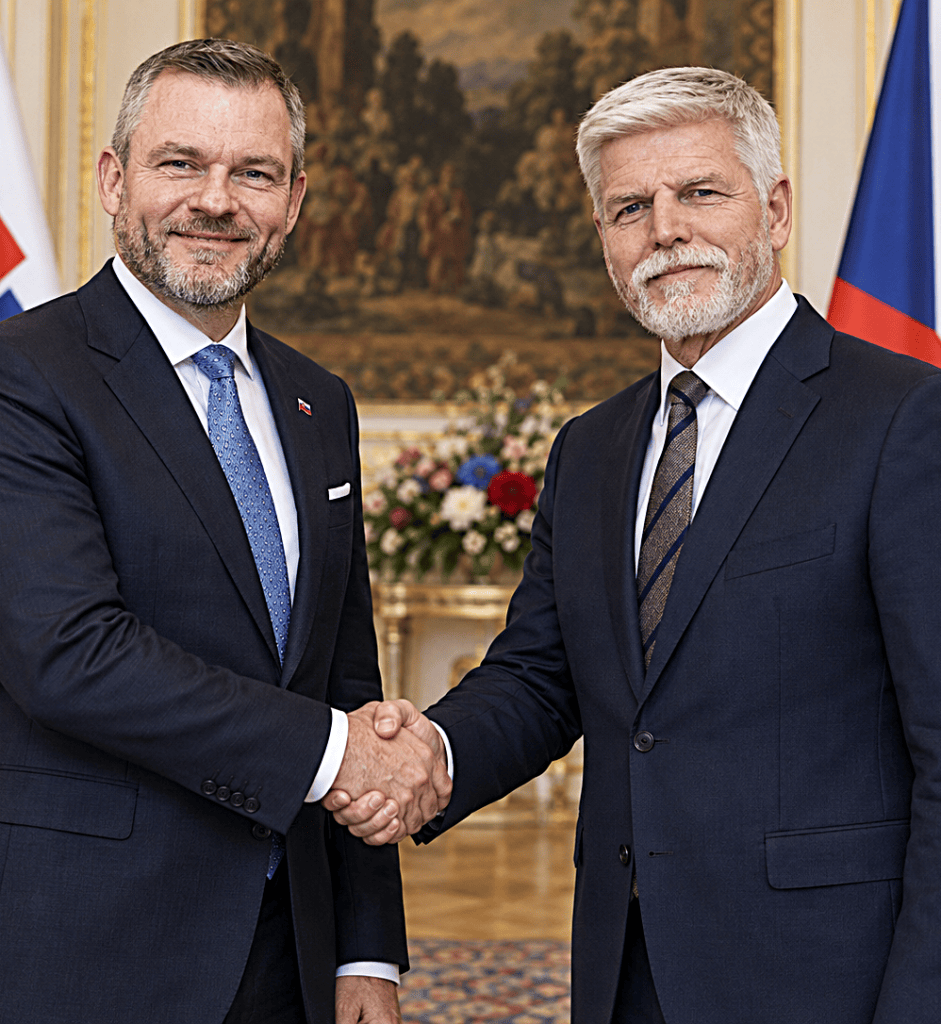
Relations have nevertheless reflected political disagreements. In 2024, the Czech government under Prime Minister Petr Fiala suspended the long-standing practice of joint cabinet meetings after sharp differences over Slovakia’s Ukraine policy. The 2025 Czech election opened the way for a reset. Prime Minister Andrej Babiš chose Slovakia for his first foreign trip in January 2026, and the two governments agreed to resume joint meetings. In March, Babiš and Slovak Prime Minister Robert Fico signed a memorandum on enhanced cooperation. The resumed meetings restored a practical channel between the neighbors even as differences over Ukraine remained (Government of the Czech Republic, 2026; TASR, 2026).
NATO, Russia, and Ukraine
Czechia joined NATO in March 1999, alongside Poland and Hungary. Slovakia followed in March 2004. Both are also members of the European Union, and both remain bound by NATO’s collective-defense commitments. Their divergence lies in policy toward Ukraine, not in alliance membership (NATO, 2024).
Under Fiala’s government, Czechia became one of Ukraine’s most active backers in Central Europe. Its multinational ammunition initiative pooled partner funds and sourced shells beyond the EU to help fill Ukraine’s artillery shortage. A Czech Foreign Ministry account published in February 2025 said the program had secured “urgent and predictable deliveries” in 2024 and would continue in 2025 (Ministry of Foreign Affairs of the Czech Republic, 2025).
That policy shifted after ANO, led by Babiš, won the October 2025 parliamentary election with 34.51 percent of the vote and 80 seats in the 200-seat Chamber of Deputies. Babiš formed a coalition with the Freedom and Direct Democracy party and the Motorists; his government took office in December and won a confidence vote in January 2026. By July, Babiš said Czechia would not participate in NATO’s €70 billion military-assistance package for Ukraine and had opted out of the Czech-led ammunition initiative, while making a small one-off contribution to a NATO mechanism for supplying U.S. weapons. Czechia remained in NATO and the EU; the change was one of policy and emphasis rather than alliance alignment (Czech Statistical Office, 2025; Reuters, 2025a, 2025b, 2026a, 2026b).
Slovakia’s change was sharper. Before Fico returned as prime minister in 2023, Slovakia had transferred major military equipment to Ukraine, including its S-300 air-defense system and MiG-29 aircraft. Fico’s government ended new state military-aid packages and has repeatedly opposed EU financing for Ukraine’s military needs. In October and December 2025, Fico said Slovakia would not participate in EU programs aimed at financing military assistance, arguing that he did not believe the war had a military solution (Reuters, 2025c, 2025d).
Fico has sought better relations with Moscow and criticized sanctions and weapons transfers. Slovakia still relies on NATO for its own security. In November 2025, he asked the alliance to strengthen Slovakia’s air defenses on its eastern flank. His government therefore combines resistance to arming Ukraine with continued reliance on NATO’s security umbrella (Reuters, 2025e).
Democracy, under different pressures
Both countries remain competitive parliamentary democracies. Freedom House’s 2026 reports rated Czechia “Free” at 95 out of 100 and Slovakia “Free” at 88. Czechia’s score was unchanged from 2025; Slovakia fell from 89 to 88, with Freedom House citing increased use of accelerated legislative procedures and continued pressure on media and civil society (Freedom House, 2026a, 2026b).
Czechia has its own vulnerabilities, including illiberal rhetoric and the influence of powerful business interests in politics. Freedom House’s 2026 overview still describes political rights and civil liberties as generally respected and notes recent progress against government corruption (Freedom House, 2026a).
Slovakia faces more acute rule-of-law questions. Parliament abolished the Special Prosecutor’s Office in 2024 as part of a package of criminal-law reforms. In its July 2026 Rule of Law report, the European Commission said the capacity to detect, investigate, and prosecute high-level corruption had “further deteriorated,” with a sharp decline in corruption cases detected and prosecuted and no new high-level corruption cases detected in 2025. The Commission also cited continuing concerns about public-service media, frequent fast-track lawmaking, and pressure on civil society (European Commission, 2026c).
Czechia and Slovakia are not on opposite sides of a democracy-authoritarian divide. Czechia remains more stable by the available measures. Slovakia is still politically competitive, but changes to prosecution, criminal law, public media, and lawmaking have drawn much stronger scrutiny from European institutions and domestic critics (European Commission, 2026c; Freedom House, 2026b).
Two economies, different headwinds
The two economies share skilled workforces, deep integration with European supply chains, and large manufacturing sectors, especially automobiles and related industries. Both face aging populations, labor shortages, and exposure to weakness in Germany and the wider European economy. Recent growth has diverged.
The European Commission reported that Czech GDP expanded by 2.6 percent in 2025 and forecast growth of 1.8 percent in 2026 and 2.4 percent in 2027. Slovakia’s outlook was weaker: growth slowed to 0.8 percent in 2025 and was forecast to remain at 0.8 percent in 2026 before improving to 1.5 percent in 2027. The gap leaves Slovakia entering the next few years with less momentum, alongside fiscal consolidation, energy costs, and competitiveness pressures on export manufacturing (European Commission, 2026a, 2026b).
Politics and economics meet most visibly in frustration over living costs, public services, and the uneven rewards of post-communist transformation. Populist parties in both countries have benefited from the perception that decisions made in Prague, Bratislava, Brussels, or Berlin do not adequately protect ordinary households. Czech and Slovak leaders now turn that frustration toward different foreign-policy themes, especially Ukraine and the European Union.
American campuses and exchange
U.S. higher-education ties are modest but durable. Fulbright commissions operate in both Czechia and Slovakia, supporting student, scholar, and teaching exchanges. The U.S. Fulbright Foreign Student Program enables graduate students, young professionals, and artists from abroad to study or conduct research at U.S. institutions (U.S. Department of State, n.d.).
Open Doors 2025 provides the latest nationwide student counts available as of September 7, 2026. In the 2024–25 academic year, U.S. colleges and universities hosted 840 students from the Czech Republic and 366 from Slovakia, up from 803 and 326 respectively the year before. The latest U.S. study-abroad figures cover 2023–24: 3,702 Americans studied in the Czech Republic and 37 in Slovakia. The Czech Republic ranked 15th among U.S. study-abroad destinations; Slovakia ranked 116th (Institute of International Education, 2025a, 2025b).
Czech higher education is far more internationalized than the U.S. exchange numbers alone suggest. The Czech Statistical Office reported 330,500 students in public and private higher education in 2025–26, including 58,962 foreign students—nearly one in five. The United States is one partner among many in that larger international mix (Czech Statistical Office, 2026).
What remains of Czechoslovakia
Czechoslovakia is gone as a state, but it remains present as a lived reference point. Czechia and Slovakia are connected by language, commerce, families, memories, and institutions that neither has had reason to dismantle. Their peaceful separation remains exceptional in a region where the end of multinational states has often been violent.
Today their paths are less symmetrical. Babiš’s Czech government has sharply reduced state military support for Ukraine while staying within NATO and the EU. Fico’s Slovakia has gone further, resisting European military support for Ukraine and drawing greater concern over anti-corruption institutions, public media, and the lawmaking process. Both remain pluralist parliamentary states in which elections can still change policy.
For a sports viewer wondering what became of Czechoslovakia, the answer is straightforward: Czechia and Slovakia are not estranged remnants of a failed state. They are close neighbors with a common history, separate political systems, and increasingly distinct arguments about what security, sovereignty, and democracy should mean in Europe after Russia’s invasion of Ukraine.
References
Boilard, S. D. (2021). Czechoslovakia splits into two republics. EBSCO Research Starters. https://www.ebsco.com/research-starters/history/czechoslovakia-splits-two-republics/
Czech Statistical Office. (2025, October 5). After four years, voters changed the composition of the Chamber of Deputies. https://csu.gov.cz/produkty/after-four-years-voters-changed-the-composition-of-the-chamber-of-deputies
Czech Statistical Office. (2026, April 23). Tertiary education. https://csu.gov.cz/tertiary-education
Encyclopaedia Britannica. (n.d.). Czechoslovakia. https://www.britannica.com/place/Czechoslovakia
European Commission. (2026a, June 3). Country report—Czechia. https://economy-finance.ec.europa.eu/economic-surveillance-eu-member-states/country-pages-including-country-reports/country-report-czechia_en
European Commission. (2026b, June 3). Country report—Slovakia. https://economy-finance.ec.europa.eu/economic-surveillance-eu-member-states/country-pages-including-country-reports/country-report-slovakia_en
European Commission. (2026c, July 17). 2026 rule of law report: Country chapter on the rule of law situation in Slovakia. https://commission.europa.eu/document/download/88318b79-b6d9-4e2e-a5ca-160217594e45_en?filename=Country+chapter+-+Slovakia+-+EN.pdf
Freedom House. (2026a). Czechia: Freedom in the World 2026 country report. https://freedomhouse.org/country/czechia/freedom-world/2026
Freedom House. (2026b). Slovakia: Freedom in the World 2026 country report. https://freedomhouse.org/country/slovakia/freedom-world/2026
Government of the Czech Republic. (2026, January 8). Prime Minister Babiš in Bratislava: We will resume the joint meetings of the Czech and Slovak governments. https://vlada.gov.cz/en/media-centrum/aktualne/prime-minister-babis-in-bratislava-we-will-resume-the-joint-meetings-of-the-czech-and-slovak-governments-224960/tmplid-81/
Institute of International Education. (2025a). Czech Republic: Country and area facts and figures 2025 [Open Doors fact sheet]. https://opendoorsdata.org/wp-content/uploads/2026/01/OD_Czech-Republic_Fact-Sheet-2025.pdf
Institute of International Education. (2025b). Slovakia: Country and area facts and figures 2025 [Open Doors fact sheet]. https://opendoorsdata.org/wp-content/uploads/2026/01/OD_Slovakia_Fact-Sheet-2025.pdf
Ministry of Foreign Affairs of the Czech Republic. (2025, February 23). Strengthening Ukraine’s defense: Czech ammunition initiative. https://mzv.gov.cz/ljubljana/en/bilateral_relations_business_and_economy/strengthening_ukraine_s_defense_czech.html
Ministry of Foreign and European Affairs of the Slovak Republic. (2025, December 16). Minister J. Blanár: Slovakia and the Czechia are ready to deepen mutual above-standard relations. https://www.mzv.sk/en/pressreleasedetail?articleId=56417861&groupId=10182&p_p_id=sk_mzv_portal_pressrelease_detail_portlet_PressReleaseDetailPortlet&p_p_lifecycle=0
NATO. (2024, March 11). NATO member countries. https://www.nato.int/en/about-us/organization/nato-member-countries
Reuters. (2025a, October 4). Populist Babis cruises to Czech election win, will seek support from fringe parties. https://www.reuters.com/world/europe/populist-billionaire-babis-seeks-comeback-czech-election-2025-10-04/
Reuters. (2025b, November 3). Czech election winner Babis signs coalition deal with partners. https://www.reuters.com/world/czech-election-winner-babis-signs-coalition-deal-with-partners-2025-11-03/
Reuters. (2025c, October 26). Slovakia will not be part of EU scheme for Ukraine’s military needs, PM Fico says. https://www.reuters.com/world/slovakia-will-not-be-part-eu-scheme-ukraines-military-needs-pm-fico-says-2025-10-26/
Reuters. (2025d, December 19). Slovakia rejects further financing of Ukraine’s military needs, PM says. https://www.reuters.com/world/slovakia-rejects-further-financing-ukraines-military-needs-pm-says-2025-12-19/
Reuters. (2025e, November 19). Slovak PM Fico asks NATO to strengthen Slovakia’s air defences. https://www.reuters.com/business/aerospace-defense/slovak-pm-fico-asks-nato-strengthen-slovakias-air-defences-2025-11-19/
Reuters. (2026a, January 15). Czech PM Babis’ government wins confidence vote as policies on budget, Ukraine shift. https://www.reuters.com/world/czech-pm-babis-government-wins-confidence-vote-policies-budget-ukraine-shift-2026-01-15/
Reuters. (2026b, July 8). Czech Republic will not participate in €70 billion package for Ukraine, PM Babis says. https://www.reuters.com/business/aerospace-defense/czech-republic-will-not-participate-70-billion-package-ukraine-pm-babis-says-2026-07-08/
TASR. (2026, March 31). Slovak and Czech premiers sign memorandum on enhanced cooperation. https://newsnow.tasr.sk/slovak-and-czech-premiers-sign-memorandum-on-enhanced-cooperation/
U.S. Department of State. (n.d.). Fulbright Foreign Student Program. https://exchanges.state.gov/non-us/program/fulbright-foreign-student-program
###
Filed under: Uncategorized |

















































































































































































































































































































































































































Leave a Reply