






By Jim Shimabukuro (assisted by Claude)
Editor
Russia’s jet-powered drones are outrunning Ukraine’s defenses, and the rest of the world is watching a preview.

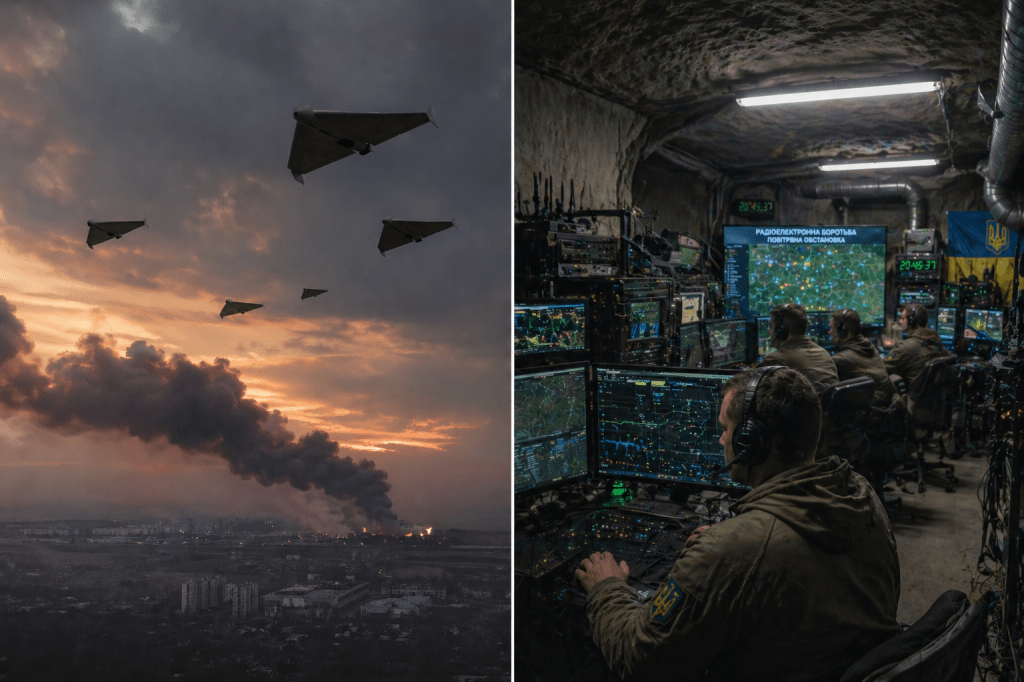
On the night of September 2, 2026, Russia sent 163 aerial weapons toward Ukrainian cities. Ukrainian air defenses brought down 135 of them, a rate of about 83 percent that would have counted as a good night two years earlier. What made the night different was the composition of the wave. Roughly half of the incoming machines were not the lawnmower-engined Shaheds that Ukrainians had learned to recognize by their buzzing, but jet-powered versions flying at 400 to 650 kilometers per hour, high and fast enough that most of the cheap interceptor drones Ukraine had built its air defense around could not catch them (Tech Times, 2026). Five people were killed and 67 injured across thirteen regions. President Volodymyr Zelensky’s response the following day was blunt: “The enemy did not go on vacation. We need a stronger response and countermeasures” (as cited in Tech Times, 2026).
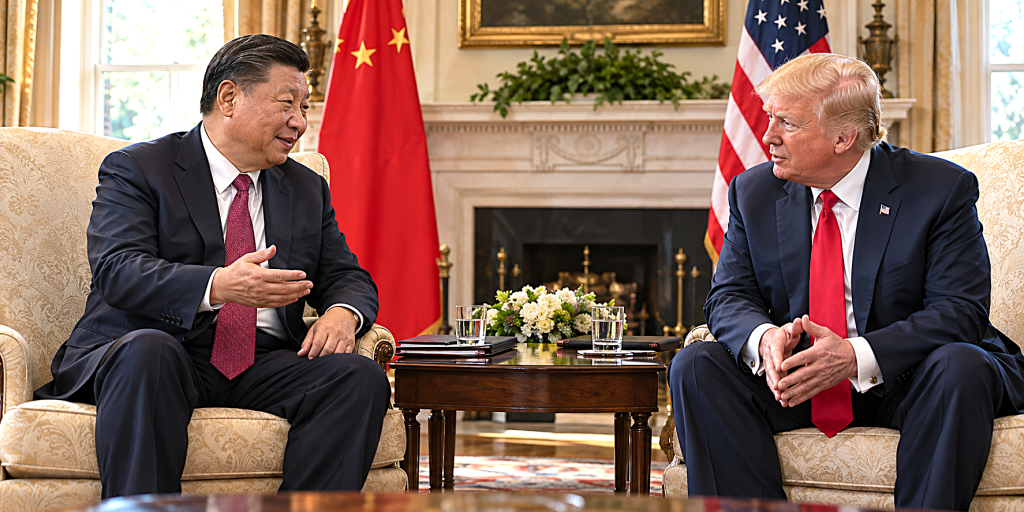
Twelve days later, NBC News published an interview with Eric Schmidt, the former Google chief executive who now serves as chief executive and executive chairman of the rocket maker Relativity Space, chaired the U.S. National Security Commission on Artificial Intelligence, and has advised the Pentagon. Schmidt had just returned from Ukraine. “The rate of innovation is faster than I’ve ever seen, and I work in tech,” he told reporter Alexander Smith (Smith, 2026). Then he said the thing that made the interview travel: “Historically, Ukraine was this small, really smart, really fast innovator, and the Russians were, if you will, big, slow, not very capable. That’s changed” (as cited in Smith, 2026).
That sentence is the subject of this article. It is a claim about who is winning a technological race, made by a man with a commercial stake in the answer, about a category of weapon that did not meaningfully exist three years ago. It deserves to be taken seriously and taken apart.
What a jet drone actually is
Start with the machine. The Geran-2, the Russian-built descendant of Iran’s Shahed-136, is about three and a half meters long with a delta wing, weighs a little over 200 kilograms, and is pushed along by a 50-horsepower piston engine that sounds like a scooter. Ukrainians named it accordingly: the flying moped (Reed, 2026). It carries a warhead of roughly 50 kilograms, though 90-kilogram and thermobaric versions exist, and it can fly hundreds of kilometers, with a theoretical maximum reach of around 2,500 kilometers when lightly loaded. Its cruising speed is about 180 kilometers per hour. A family sedan on a German autobahn moves faster.
Russia received its first shipment of Shahed-136 and Shahed-131 airframes from Iran in mid-August 2022 and used one for the first time on September 13, 2022, near Kupiansk. The wreckage already bore a Russian name stenciled on the fuselage: Geran-2 (Bondar & Errera, 2026). Within a year Russia was building its own at the Alabuga Special Economic Zone in Tatarstan and at the Izhevsk Electromechanical Plant Kupol, a subsidiary of the air-defense conglomerate Almaz-Antey. The original Iranian parts list has been progressively replaced by Russian and Chinese equivalents.
The jet variants began as an attempt to solve one problem: the moped was too slow to survive. Around January 2025 a domestic production line for the Geran-3 came online, fitting a Chinese Telefly turbojet where the piston engine had been. Top speed roughly doubled, to about 300 miles per hour. The Center for Strategic and International Studies notes that the original delta airframe was never designed for sustained flight at those speeds and could not take the structural loads; Russia halted Geran-3 production in August 2026 (Bondar & Errera, 2026). The Missile Defense Advocacy Alliance, working from a different set of recovered wreckage, describes Geran-3s with Iranian-lineage Tolou-class turbojets reaching 500 to 600 kilometers per hour at ceilings up to 9,000 meters, first documented on June 29, 2025, with only about 138 launched by early 2026 (Reed, 2026). The two accounts disagree on engines and speeds, which is normal for a weapon identified mostly from fragments.
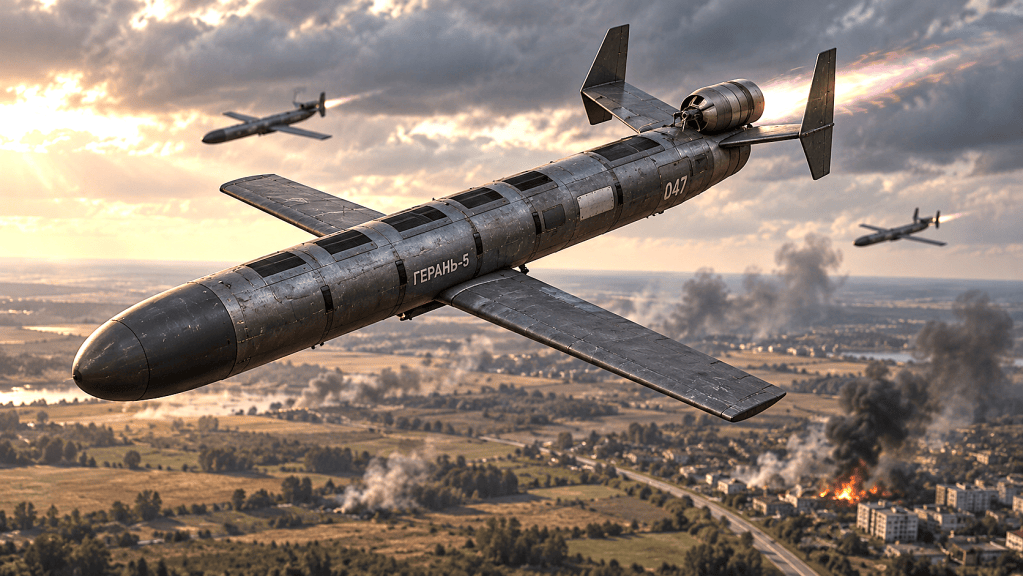
What replaced the Geran-3 is more consequential. Ukraine’s Defense Intelligence Directorate has published a component breakdown of the Geran-4: a reinforced, more aerodynamic delta airframe built around a Chinese Telefly TF-TJ2000A turbojet producing roughly 200 kilograms of thrust, cruising at 300 to 400 kilometers per hour and accelerating to 500, ceiling around 5,000 meters, range about 450 kilometers, carrying either a 50-kilogram warhead or a 90-kilogram thermobaric one (Tech Times, 2026). CSIS puts its maneuvering speed at 186 to 249 miles per hour with a maximum of 311 (Bondar & Errera, 2026). The Geran-5 abandons the delta wing entirely for a body that looks like a small cruise missile: roughly six meters long, a 5.5-meter wingspan, a 90-kilogram warhead, speeds to 600 kilometers per hour, ceilings around 6,000 meters, and a range approaching or exceeding 950 kilometers (Tech Times, 2026; Vakulina, 2026).
Ukrainian intelligence has been explicit about why the Geran-4 exists. It was developed, the agency said, “as a countermeasure against the effectiveness” of Ukraine’s interceptor drones (as cited in Tech Times, 2026). The weapon is a direct answer to the defense that was beating its predecessor.
The engine is Chinese and remains available. Analysts identified 45 foreign components in a recovered Geran-3, roughly half of them American-manufactured, and the Telefly turbojet powering the current variants has not been the target of sanctions that would constrain its supply (Tech Times, 2026). Kateryna Bondar of CSIS has described China’s role in Russian drone manufacturing as “critical, extremely important” (as cited in Tech Times, 2026).
How this differs from a cruise missile
The obvious objection is that a six-meter machine with a turbojet, a 90-kilogram warhead, and a thousand-kilometer range is a cruise missile wearing a different label. Fabian Hoffmann, who writes on missile classification, largely agrees. NATO’s glossary defines a missile as “a self-propelled munition whose trajectory or course is controlled while in flight,” and by that standard everything in the Geran family qualifies (Hoffmann, 2026). Hoffmann argues that cruise missiles and long-range one-way drones occupy a single spectrum rather than separate boxes. Cruise missiles prioritize “advanced midcourse and terminal guidance seekers, heavier, more sophisticated payloads, and engines optimized for high subsonic to supersonic velocities.” Long-range drones give up capability in exchange for cost and mass-producibility, using simpler propulsion and guidance (Hoffmann, 2026). He would call Ukraine’s Palianytsia and Peklo “mini cruise missiles” rather than inventing a hybrid category, and the same logic applies to the Geran-5.
The practical distinctions are about money, numbers, and what happens in the last thirty seconds of flight.
A Kalibr or a Storm Shadow costs somewhere between one and three million dollars and is built in dozens or low hundreds per year. A Geran-2 costs between $20,000 and $50,000 in baseline Russian production, rising to $35,000 to $80,000 for hardened versions (Reed, 2026). Russia now builds more than 6,000 one-way attack drones a month (Breaking Defense, 2026). That ratio is the whole point. A defender who spends a four-million-dollar Patriot interceptor to destroy a fifty-thousand-dollar drone wins the engagement and loses the war. Zelensky put the arithmetic plainly in March 2026: “Our expertise is that an interceptor drone costs $3,000–$5,000. That means about $10,000 per ‘Shahed’, while a Patriot missile costs $4 million. Ukraine spends $10,000 to shoot down a drone, while a Middle Eastern country spends $4 million” (as cited in TSN, 2026).
The second distinction concerns guidance, and this is where the “smart missile” comparison gets interesting. A cruise missile is launched at a set of coordinates and flies to them using inertial navigation, satellite fixes, terrain matching, and in advanced cases an imaging seeker that compares what it sees against a stored reference. Nobody talks to it after launch. The early Gerans worked the same way, and worse: preprogrammed flight paths, a satellite receiver that Ukrainian jamming could confuse, no link home.
That changed through a sequence of field modifications that CSIS has documented in unusual detail. In November 2023 a Geran was recovered with a 4G modem in a 3D-printed box taped to its winglet. By early 2025 the modification had become a standard telemetry module built around a Raspberry Pi and a Chinese ZTE modem, carrying both Russian and Ukrainian SIM cards. By mid-2025 nearly every Geran had one. In the summer of 2025 Russia began fitting Chinese Xingkai Tech mesh radio modems that let an operator watch a live video feed and steer the drone in flight, rerouting the signal through multiple nodes when one was jammed. By late 2025 the module was no longer taped on; it was a designed-in subsystem (Bondar & Errera, 2026).
The satellite antennas followed the same curve. The Iranian Nasir receiver had four elements. Russia’s Kometa-M4 also had four. A Chinese module introduced in early 2025 had eight, then sixteen arranged in concentric rings by March. Russia’s own Kometa-M12 had twelve, and the Kometa-M16 that appeared at the end of 2025 had sixteen in three rows (Bondar & Errera, 2026). Each jump was a response to Ukrainian electronic warfare. A Ukrainian Air Force official told CSIS that jamming was still killing “nearly half” of the Gerans in some night attacks, which explains why the antennas keep growing.
The result is a machine CSIS describes as having stopped being “purely a preprogrammed munition flying to a fixed coordinate” and become “a remotely-piloted strike aircraft that could loiter, observe, identify targets, and be redirected mid-mission by an operator watching a live video feed” (Bondar & Errera, 2026). Some carry basic security cameras. Others carry infrared, laser rangefinders, and computer vision. Some carry air-to-air missiles to shoot at Ukrainian helicopters and interceptors, or anti-tank mines to scatter on roads.
Which brings up artificial intelligence, a term that is doing a great deal of unearned work in coverage of this war. On July 12, 2026, Geran-4s struck grain ships at the port of Chornomorsk. David Axe reported that the drones were flying with machine-vision targeting running on a Raspberry Pi, the roughly fifty-dollar hobbyist computer that schoolchildren use for robotics projects. The Canadian drone analyst known as Roy described the sequence: “Seeker is controlled by an operator via a radio mesh modem, but it can be locked onto a target and handed over to its machine-learning algorithms to complete an attack in the presence of EW jamming” (as cited in Axe, 2026). The operator picks the ship. The onboard model holds the lock through the final seconds when jamming would otherwise sever the radio link.
Schmidt himself pushes back on calling this AI. Asked about it in September, he said: “Technically, that is not AI; it is computer vision. The system knows what it is looking for and recognizes it in the camera image” (as cited in Hvylya, 2026). That is a fair description of where the technology stands. These are not agents that reason about objectives, choose targets from a commander’s intent, or coordinate with one another. They are pattern-matchers running on cheap silicon, doing one job in one phase of flight. Russia has fielded systems that go further, including the V2U strike drone Ukraine recovered in 2025, which identifies and selects targets on its own (Zvirynskyi, 2026). But the Geran-4’s machine vision is closer to a smartphone’s face-unlock feature than to anything that deserves the word agentic.
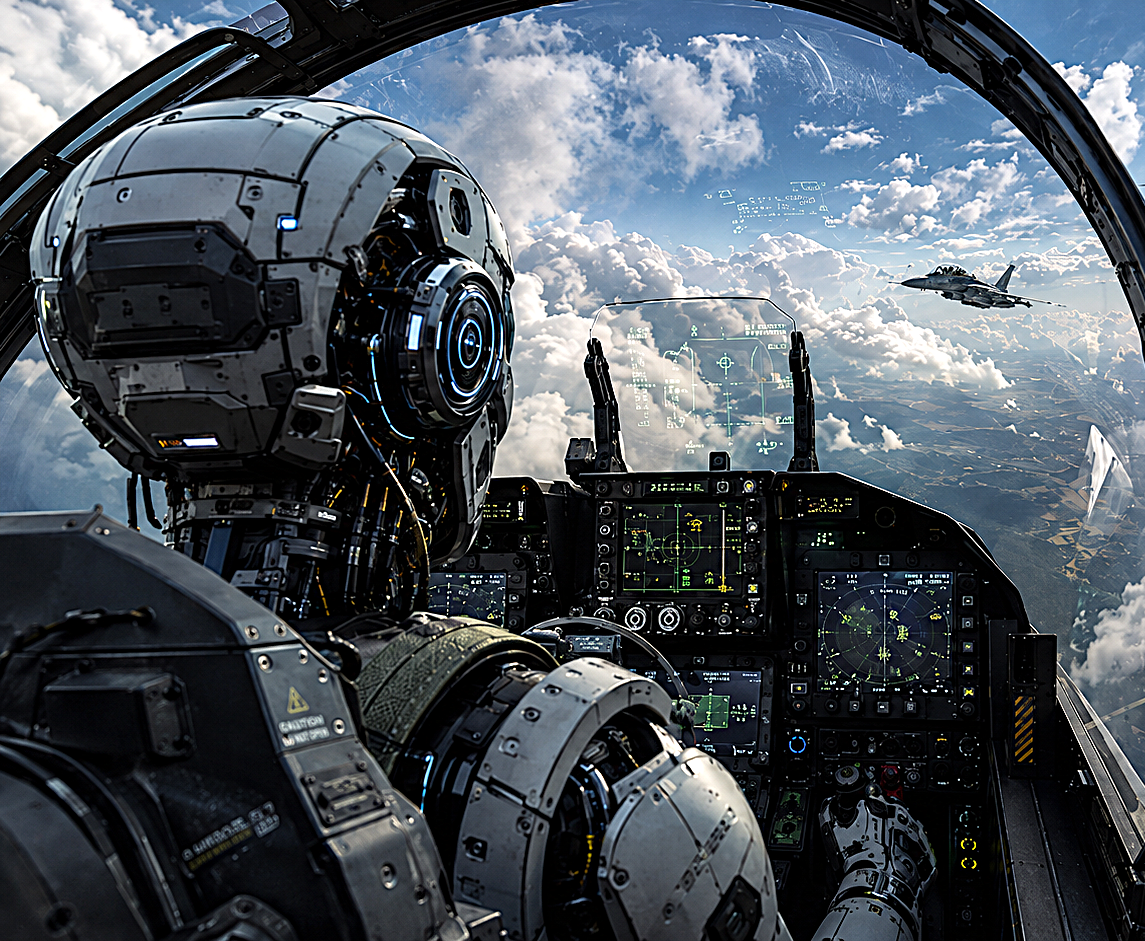
The distinction matters for what comes next, because Schmidt’s argument is that the next step is close. “Humans can’t run a swarm of 1,000 drones, but a computer can,” he told NBC. “So what I think will happen is computers will develop war plans within a swarm” (as cited in Smith, 2026).
Why speed broke the defense
Ukraine built the most effective counter-drone system in the world, and it did so on a very specific assumption: that the target would be slow.
The logic was elegant. A Shahed-136 flies at 180 kilometers per hour. A quadcopter or fixed-wing interceptor that costs a few thousand dollars can reach 300. That margin is enough to be vectored onto a target, climb, close, and detonate. Wild Hornets’ Sting interceptor costs about $2,500 and by spring 2026 was destroying Shaheds and Gerbera decoys by the thousand; one two-person crew downed 23 in a single March engagement (Bidochko, 2026). Ukraine’s three main interceptor lines, General Cherry, Sting, and Octopus, had each passed a thousand kills by early 2026 (Segal, 2026). Interception rates against conventional Shaheds ran above 90 percent, sometimes 95 (Rushton, 2026; Vakulina, 2026).
Then the target got faster than the interceptor. Colonel Yurii Ihnat, head of communications for Ukraine’s Air Force Command, stated the problem in July without softening it: “These drones are no longer within the reach of interceptor drones, whose speed is up to 300 km/h. That means mobile fire groups and anti-drone interceptors can no longer be relied upon. Missiles have to be used, and that is what the Air Force and other units of the defence forces are doing” (as cited in Vakulina, 2026).
Every part of the kill chain degrades at once. A drone at 600 kilometers per hour crosses a given stretch of sky in a third of the time, which shrinks the interval between radar detection and impact. Flying at 5,000 to 9,000 meters, it climbs above the effective envelope of mobile fire groups with machine guns, above most man-portable missiles, and above the ceiling many interceptor drones can reach while still holding enough energy to maneuver. A closing engagement that used to permit two or three attempts now permits one. And because the jet variants cost more than the piston models, Russia mixes them with cheap Gerbera decoys so that the expensive defenses are spent on the wrong targets.
The numbers show the effect. Leo Chiu’s analysis for the Kyiv Post found that Ukraine’s overall overnight interception rate averaged 86 percent in July 2026 and ran between 79 and 96 percent in the last week of August. Against jet-powered drones specifically, Ihnat said the rate had fallen “to about 60%, compared to the 90-95% against propeller-driven drones” (as cited in Chiu, 2026). One in four jet drones that Ukraine would have stopped a year ago now gets through.
The volume grew alongside the capability. Ihnat said that in July there were “five times as many” jet drones as in June, and that on some days “two-thirds of all drones launched during the day are jet-powered” (as cited in Rushton, 2026). Chiu counted more than 2,800 jet-powered launches in August alone. On August 4, jet variants exceeded half of a single night’s salvo for the first time (Tech Times, 2026). In the four days to August 30, Russia launched nearly 1,500 drones, roughly 800 of them jet-powered (Zavadska, 2026). Commander-in-Chief Oleksandr Syrskyi told Ukrainians in July what was coming: “The aggressor plans to raise the share of jet-powered strike drones to 50%” (as cited in Vakulina, 2026). Russia hit that target within a month.
Jimmy Rushton reported in August that Russia was producing roughly 3,000 jet-powered drones a month and that jet production had overtaken piston production (Rushton, 2026). Ukraine’s Defense Intelligence puts total Shahed-type capacity at about 2,700 a month; the facility at Alabuga expanded by 340 hectares between May 2025 and May 2026 and is projected to reach 3,500 to 4,000 units monthly by this autumn (Tech Times, 2026). Estimates differ, and all of them point the same direction.
Weighing Schmidt’s claim
Is Russia winning the race?
The case for yes is strongest when the question is narrowed to one-way attack drones. Russia has iterated on the Geran continuously for four years while increasing output, and it has done so with a feedback loop that Western procurement cannot match. CSIS found a Geran shot down on October 15, 2025, whose satellite receiver had been installed on October 8, meaning the airframe left the factory and reached a target inside a week, carrying a modification that answered something the Russians had learned days earlier (Bondar & Errera, 2026). That is the loop Schmidt means when he says, in a separate interview, that “in this war, innovation happens in days. A new capability appears, and within three or four months the other side finds a way to blunt it” (as cited in Hvylya, 2026).
Russia has also been working on the infrastructure layer. After losing access to Starlink, it began building Rassvet, a low-orbit constellation intended to guide drones and missiles. It has not gone well. Of sixteen satellites launched on July 19, none reached the planned 870-kilometer orbit; most stalled at 300 to 400 kilometers. Twelve of sixteen from the March 24 launch reached their intended altitude and remain operational, giving Russia two daily connectivity windows over Ukraine totaling perhaps 90 minutes. Serhii Beskrestnov, then an adviser to Ukraine’s defense minister, estimated Russia would need 200 to 250 satellites for continuous coverage, and Russia has managed only a handful of Soyuz-2.1b launches since 2022 (Hajdari, 2026). The Institute for the Study of War warns that even a partial constellation “may allow Russian forces to conduct more precise strikes against Ukraine using remotely controlled unmanned systems” (as cited in Hajdari, 2026). Russia is trying to build a strategic capability from scratch under sanctions, and failing slowly rather than quickly.
The case for no rests on everything outside the jet-drone category.
Ukraine produces six to nine times more drones per working-age person than Russia does. Its FPV output went from three to five thousand a year in 2022 to roughly three million in 2025, with capacity for more than eight million in 2026. Over 500 companies build drones in Ukraine, with 40 to 50 of them leading the market (Bidochko, 2026). The Council on Foreign Relations estimates Ukraine produced four million robotic and autonomous systems in 2025 and holds $25 billion to $40 billion in defense production capacity sitting idle for lack of funding, and calls Ukraine’s defense industrial base “arguably the most robust and innovative” in Europe (Horowitz et al., 2026).
Ukraine is also winning a campaign that Russia cannot answer. Ukraine’s Ministry of Defense reported that in August 2026 alone its deep-strike operations hit twelve major oil refineries with combined annual capacity near 100 million tonnes, two gas processing and petrochemical plants, three fuel terminals, and two defense industry enterprises, at distances between 400 and 1,900 kilometers from the border. The targets included the Kamensky Combine, which makes solid rocket propellant, and the Progress Rocket Space Centre in Samara (Ministry of Defence of Ukraine, 2026). By July, Ukrainian strikes had disabled 42.7 percent of Russia’s oil refining capacity and inflicted an estimated $13.5 billion in losses on the refining industry since August 2025, with Russian fuel production down about 25 percent year on year in June and roughly 20 percent below domestic demand (Dubovyk, 2026). Fuel shortages have spread across more than 50 Russian regions.
Ukraine has its own jet-powered long-range weapon, and its record shows what this kind of engineering actually costs. The FP-5 Flamingo is fourteen meters long, carries a 1,150-kilogram warhead more than 3,000 kilometers, and costs between $500,000 and a million dollars, built from carbon fiber around recycled jet engines and Soviet-era bomb warheads. Of 34 launches between May and late June 2026, open-source analysts credited only five with hits. Then on June 26 and 27 three of five Flamingos struck the Barrikady plant in Volgograd, destroying or damaging workshops that build Iskander-M launcher components. Fire Point’s director attributed the earlier failures to the difficulty of “building guidance systems precise enough to allow the missile to negotiate its path while flying at nap-of-the-Earth altitude” (as cited in Korshak, 2026). Ukraine says it will build more than 200 a month by the end of 2026.
So the honest answer is that Schmidt is describing a real change and overstating its scope. Russia has taken the lead in high-volume one-way strike aviation and in the specific contest of jet drones against interceptors, and it took that lead during 2026. Ukraine leads in front-line robotics, in interceptor design, in naval drones, and in long-range strike effectiveness measured by damage to the enemy’s economy. Both statements are true at the same time, and the first one is the more dangerous.
One more thing belongs in this assessment. Schmidt is the chief executive of Swift Beat, the drone company formerly known as White Stork, which signed a co-production memorandum with Ukraine’s Ministry of Defense on July 3, 2025. Swift Beat makes Merops, the interceptor system that the U.S. Army has bought by the thousand. When Schmidt published an op-ed in The Washington Post on September 9, 2026, arguing for exactly the production surge his company would supply, his byline listed Relativity Space and omitted Swift Beat. DroneXL’s Haye Kesteloo called this an editorial failure rather than a hidden conflict, noting that all of it is public and a one-line disclosure would have cost nothing (Kesteloo, 2026). Readers should weigh the argument on its evidence and know who is making it.
The counter-measures race
Ukraine’s answer to the jet drone is currently the most intensely contested engineering problem in the world, and about twenty Ukrainian companies are working on it (Butterworth-Hayes, 2026).
The core requirement is brutal. An interceptor must reach 600 kilometers per hour or better, climb past 5,000 meters quickly, carry a sensor that can find a small fast-moving object without satellite navigation, and cost a few thousand dollars, because a system that costs $200,000 loses the exchange even when it works.
Four Ukrainian prototypes went through field testing in August. On September 3, Zelensky approved a fast track for the most promising of them. “There are manufacturers in Ukraine capable of completing this task. It is important to complete it within the established deadlines,” he said, adding that “we will also act asymmetrically. The relevant operations have been approved” (as cited in Zavadska, 2026). The requirement is production in the thousands, not the hundreds.
The publicly identified contenders show the range of approaches. F-Drones’ LITAVR+ is an incremental answer: a propeller interceptor pushed from 350 to over 400 kilometers per hour, with a 500-gram warhead, a 9,000-meter ceiling, fifteen minutes of endurance, and an engagement range of 84 kilometers from its launch point. Its guidance abandons satellite navigation for terminal optical lock, using a dual camera with daytime and thermal imaging, and the company builds its own controllers, software framework, and engines. Chief executive Stanislav Khutor emphasizes remote operation, “when the pilot can control the drone from virtually anywhere in the world” (as cited in Popilnichenko, 2026). F-Drones has released footage of LITAVR+ engaging jet Shaheds.
The Alexa Spatium takes the other path and puts a turbojet on the interceptor. It is a small machine, about 1.5 by 1.7 meters, modular, launched from a mobile catapult that can be set up in minutes, and credited with roughly 600 kilometers per hour. It entered Ukrainian service on August 21, 2026, and can be recovered and reused or turned against ground targets (Elezhar, 2026; Butterworth-Hayes, 2026). The Griffen jet interceptor comes in at around $10,000 a round. The Skyfall P1-Sun, at roughly $3,000 and 350 kilometers per hour, has a JetKiller variant that went into trials in July; Defense Ministry adviser Hanna Hvozdiar says the P1-Sun fleet destroyed more than 3,000 Russian Shaheds during 2026 (Tech Times, 2026).
Foreign entrants are arriving. X-Bow’s Buckler uses a solid rocket motor to reach the target quickly, at under $100,000 a round. Frankenburg’s Mark I is a small guided air defense missile. MBDA has integrated its FULGUR missile into the SKY WARDEN system. A UK-Ukrainian consortium, Firebolt Engineering, is working the same problem (Butterworth-Hayes, 2026).
Underneath the new programs, Ukraine keeps scaling what already works. The Octopus interceptor went into serial production in April 2026 with an initial order of 8,000 units, built across a network of 29 Ukrainian companies with four holding state contracts, and with British government backing for licensed manufacture. Digital Transformation and Defense Minister Mykhailo Fedorov set the target: “The goal is ambitious: to achieve full detection of aerial targets and at least 95% destruction” (as cited in Mukhina, 2026). Ukraine took delivery of twice as many interceptor drones in the first months of 2026 as in all of 2025.
Interceptor drones are only one layer. Ukrainian F-16s and Mirage 2000-5s have destroyed more than 2,500 Geran and Gerbera drones since 2025, and pilots increasingly use 20mm cannon and AGR-20 rockets rather than air-to-air missiles, preserving expensive stocks and reducing the fragment hazard from an exploding Geran. Justin Bronk of the Royal United Services Institute credits the tactics as much as the hardware: Ukrainian units “have developed much more suitable tactics in contexts that minimize the very real danger of being hit by fragments from exploding Geran-2s and 3s” (as cited in Breaking Defense, 2026). Bronk also flags the cost of using fighters this way, which “can only be meaningfully reduced by not regularly tasking fighters against such targets — saving finite flying hours, airframe fatigue life and air-to-air missiles” (as cited in Breaking Defense, 2026). Captain Daine Van de Wall of the U.S. Army’s Security Assistance Group–Ukraine makes a related point about where Ukraine’s real advantage lies: “Ukraine’s most significant adaptation is not the technology itself, but how formations from the brigade level down to the squad have absorbed and operationalized it” (as cited in Breaking Defense, 2026).
Electronic warfare remains the cheapest layer and still accounts for a large share of kills, with a Ukrainian Air Force official telling CSIS that jamming neutralizes nearly half the Gerans on some nights (Bondar & Errera, 2026). Its effectiveness erodes with every antenna upgrade and every mesh modem Russia fits, and the machine-vision terminal handoff is specifically designed to survive it.
There is also a layer Ukraine does not discuss in detail. Zelensky’s promise on September 3 to “act asymmetrically” points at the factories, the engine supply, and the launch sites (as cited in Zavadska, 2026). The deep-strike campaign against Russian industry is part of the counter-drone campaign.
What the Americans and their allies have learned, and what they have not
Schmidt’s warning to the United States is the part of the NBC interview least likely to be acted on quickly, and it lands on a mixed record.
The United States has moved faster than its reputation suggests in one area. Merops, the Swift Beat interceptor built and proven in Ukraine, is the only American-origin counter-drone system operationalized there (Segal, 2026). It has downed more than 4,000 Russian drones. Army Secretary Daniel Driscoll described the speed of the American purchase during the Iran crisis: “When the conflict kicked off, within about eight days, we were able to purchase 13,000 Merops, which are incredible.” He was equally direct about the economics: “They’re about $15,000 a piece right now, we’re able to take Shaheds down that cost $30,000 to $50,000, which is amazing,” and he expects the price to fall below $10,000 at scale (as cited in Altman, 2026). Brigadier General Curtis King has said Merops accounted for roughly 40 percent of Shahed interceptions in the theater where it was deployed (as cited in Fornusek, 2026). In May 2026 the Pentagon’s Joint Interagency Task Force 401 awarded Perennial Autonomy a three-year contract with a $500 million ceiling covering Merops and two other systems, the largest single counter-drone award the department has made. “Drones are the defining threat of our time,” said Brigadier General Matt Ross, who directs the task force (as cited in Inside Unmanned Systems, 2026). Lithuania bought 48 Merops systems in April without competitive bidding.
The rest of the American record is less encouraging. Defense Secretary Pete Hegseth’s July 2025 memorandum, “Unleashing U.S. Military Drone Dominance,” conceded the starting position: “Our adversaries collectively produce millions of cheap drones each year. While global military drone production skyrocketed over the last three years, the previous administration deployed red tape” (Secretary of Defense, 2025). The memo delegated procurement authority to unit commanders and rescinded restrictive policies. Fourteen months later, homeland defense officials were still describing basic gaps. Lieutenant General Joseph Jarrard, deputy commander of U.S. Northern Command, said in August 2026 that some military locations have “neither the sensors to detect an incoming drone swarm nor the effectors to stop it” (as cited in Army Recognition, 2026). The air defense architecture over North America was designed to find aircraft and missiles coming from outside, not small machines launched from a parking lot nearby. The Pentagon has requested roughly $21 billion for counter-drone capabilities.
Europe has spent the year discovering the same problem at higher cost. NATO has pledged $40 billion for counter-drone capability over five years. Romania signed a €5.7 billion contract with Rheinmetall. The arithmetic that drives these decisions is the one Ukraine solved years ago: an air-to-air missile fired from an F-16 costs about $400,000 to destroy a Shahed worth roughly $35,000 (Fornusek, 2026). Federico Borsari of the Center for European Policy Analysis notes that the choice of weapon in any given incursion depends on “asset availability, operational conditions, and the type of target” (as cited in Fornusek, 2026). Bronk points out that fielding thousands of cheap short-range systems brings its own burden, in “huge personnel and logistics requirements” (as cited in Fornusek, 2026). Ulrike Franke of the European Council on Foreign Relations worries that the proliferation of national projects is producing a “hotch-potch” that duplicates effort (as cited in Fornusek, 2026).
Joshua Segal of the Foreign Policy Research Institute documented the lag in practice. Video from Gulf states shows Shaheds breaking through air defenses in ways that are rare in Ukraine, despite Ukraine absorbing attacks an order of magnitude larger. Ukraine’s approach is to field something good enough immediately and improve it monthly; the Western default is to buy exquisite systems on long timelines (Segal, 2026).
The deeper problem is that the American and European defense establishments are studying a war whose lessons are still changing. The interceptor drone that was the answer in January 2026 was a partial answer by August. A country that spends four years procuring a counter-drone system will field it against a threat two generations past the one it was designed for. That is the mechanism Schmidt is pointing at when he says “whoever plays the game of fastest innovation to scale will win this war” (as cited in Smith, 2026), and it is why he stresses that “the central point is not innovation alone but innovation at scale” (as cited in Hvylya, 2026).
The near future
Three things are likely to shape the coming winter.
Russia will push jet drones past half of its strike inventory and keep raising the nightly count. Zelensky warned in March that Russia was cutting missile production to fund drones, running 350 to 500 a day, aiming for 600 to 800 during 2026 and 1,000 a day as the goal, which would require Ukraine to hold 2,000 to 3,000 interceptors ready every day (as cited in TSN, 2026). Russia’s winter 2025–2026 campaign already used roughly 14,670 guided bombs, 738 missiles, and 19,000 attack drones (Segal, 2026). The 2026–2027 campaign will be larger and faster, and it will be aimed at the electrical grid.
Ukraine will field jet interceptors in quantity, and the gap will partly close. The engineering is not exotic. As one senior engineer on a Ukrainian interceptor program put it, “it’s an engineering problem, to which there’s an engineering solution” (as cited in Rushton, 2026). The constraint is money and time, not physics. Ukraine’s idle production capacity, measured in the tens of billions of dollars, is the single most consequential variable in the air war, and it is a Western budgetary decision rather than a Ukrainian technical one.
Autonomy will spread at the edges. Russia is already running machine vision on fifty-dollar computers for terminal guidance, and Ukraine’s interceptors increasingly guide themselves in the final seconds because jamming and speed leave no time for a human. Schmidt’s swarm scenario is a further step, and he has been consistent about the risk: “The danger of taking the human out of the loop is not that the machine malfunctions, but that the machine functions exactly as designed, with bad data, and faster than anyone can stop it” (as cited in Gardels, 2026).
His view of the ground war is bleaker than his view of the technology. “The battlefield today is a no man’s land where nothing moves because there are drones and anti-drones above you,” he told NBC. Drones now cause 75 to 85 percent of casualties in the front-line kill zone (Horowitz et al., 2026). Ukraine’s Defense Ministry estimated 42,020 Russian killed and wounded in August, about 1,350 a day, and Britain’s military chief has put Russia’s cumulative casualties at 1.5 million, including around 500,000 dead (Smith, 2026). Schmidt’s reaction to those figures was not analytical: “The death rate on the Russia side is horrible. It’s just horrible, and these are human beings, too” (as cited in Smith, 2026).
His prescription is narrow and specific. “They need Western help. In particular, they need some money, and they need technological help,” he said. “If that help comes, I think Ukraine can hold” (as cited in Smith, 2026). Elsewhere he added the condition that matters: “but it must arrive quickly” (as cited in Hvylya, 2026).
For everyone else, the lesson of the turbojet summer is available at a discount. Russia solved a problem that every defended country will eventually face: how to deliver a warhead a thousand kilometers for the price of a used car, fast enough to beat the cheap defenses and cheap enough to beat the expensive ones. The parts are a Chinese turbojet, a Raspberry Pi, a mesh modem, and a factory willing to change the design every three weeks. None of that is classified, and none of it is expensive. The countries now writing forty-billion-dollar counter-drone budgets are responding to a weapon that costs less than the paperwork required to buy its opposite.
References
Altman, H. (2026, April 16). Cheap interceptor drones proven in Ukraine protected U.S. troops against Iranian Shaheds. The War Zone. https://www.twz.com/land/cheap-interceptor-drones-proven-in-ukraine-protected-u-s-troops-against-iranian-shaheds
Army Recognition. (2026, August 20). US Northern Command warns drone defense gaps leave military bases exposed to domestic swarm attacks. https://www.armyrecognition.com/news/army-news/2026/us-northern-command-warns-drone-defense-gaps-leave-military-bases-exposed-to-domestic-swarm-attacks
Axe, D. (2026, July 14). A $50 computer just flew Russia’s newest jet drone into a Ukrainian grain ship—and jamming couldn’t stop it. Euromaidan Press. https://euromaidanpress.com/2026/07/14/geran-4-vs-grain-ships/
Bidochko, L. (2026, June 1). How Ukraine became a drone superpower. Just Security. https://www.justsecurity.org/138164/ukraine-drone-superpower/
Bondar, K., & Errera, N. (2026, September 4). From Shahed to Geran: How Russia continues to reinvent the one-way attack drone. Center for Strategic and International Studies. https://www.csis.org/analysis/shahed-geran-how-russia-continues-reinvent-one-way-attack-drone
Breaking Defense. (2026, August). How Ukraine tries to intercept Russian drones more effectively — and affordably. https://breakingdefense.com/2026/08/how-ukraine-tries-to-intercept-russian-drones-more-effectively-and-affordably/
Butterworth-Hayes, P. (2026, September 10). Ukraine and its allies accelerate work on high-speed interceptors as Russia evolves Geran threat. Unmanned Airspace. https://www.unmannedairspace.info/counter-uas-systems-and-policies/ukraine-and-its-allies-accelerate-work-on-high-speed-interceptors-as-russia-evolves-geran-threat/
Chiu, L. (2026, September 1). Analysis: What changed in Russia’s drone war in Ukraine? Kyiv Post. https://www.kyivpost.com/analysis/83498
Dubovyk, T. (2026, July 4). Ukrainian strikes disable 43% of Russian refining capacity. Kyiv Post. https://www.kyivpost.com/post/79574
Elezhar, A. E. (2026, August 24). Ukraine adds jet-powered interceptor to neutralize Shahed-type drones. The Defense Post. https://thedefensepost.com/2026/08/24/ukraine-jet-powered-interceptor/
Fornusek, M. (2026, August 24). As Russian drone incursions escalate, NATO weighs costs of shooting back. The Kyiv Independent. https://kyivindependent.com/natos-patience-with-drone-incursions-wears-thin/
Gardels, N. (2026, June 16). AI & drones: Eric Schmidt on the biggest revolution in the history of warfare. Noema Magazine. https://www.noemamag.com/ai-drones-eric-schmidt-on-the-biggest-revolution-in-the-history-of-warfare/
Hajdari, U. (2026, September 1). Russia’s Starlink copycat has failed so far but still threatens Ukraine. Euronews. https://www.euronews.com/next/2026/09/01/russias-starlink-copycat-has-failed-so-far-but-still-threatens-ukraine
Hoffmann, F. (2026, April 26). Missiles, drones, and missile-drones? A primer on missile classification. Missile Matters. https://missilematters.substack.com/p/missiles-drones-and-missile-drones
Horowitz, M. C., Dumbacher, E. D., & Kahn, L. (2026, June 12). How Ukraine’s drone innovation reversed Russia’s momentum. Council on Foreign Relations. https://www.cfr.org/articles/how-ukraines-drone-innovation-reversed-russias-momentum
Hvylya. (2026, September 8). Eric Schmidt on AI warfare, drone swarms and Russia’s rapid adaptation in Ukraine. https://en.hvylya.net/interview/2940-eric-schmidt-russia-has-learned-to-innovate-at-ukraine-s-speed
Inside Unmanned Systems. (2026, May 28). Pentagon awards $500M to Perennial Autonomy for counter-drone interceptors proven in Ukraine. https://insideunmannedsystems.com/pentagon-awards-500m-to-perennial-autonomy-for-counter-drone-interceptors-proven-in-ukraine/
Kesteloo, H. (2026, September 11). Eric Schmidt warns Ukraine’s drone edge is gone. He sells the fix. DroneXL. https://dronexl.co/2026/09/11/eric-schmidt-warns-ukraine-drone-edge-gone-sells-fix/
Korshak, S. (2026, June 29). Ukraine’s ‘Flamingo,’ a new carbon fiber budget missile, delivers hits and damage in deep strike. Kyiv Post. https://www.kyivpost.com/post/79225
Ministry of Defence of Ukraine. (2026, September 2). 12 refineries and 2 Russian defense industry enterprises hit: Results of deep strike operations in August. GlobalSecurity.org. https://www.globalsecurity.org/wmd/library/news/ukraine/2026/09/ukraine-260902-ukraine-mod01.htm
Mukhina, O. (2026, April 30). “Octopus” interceptor goes to serial production: 8,000 units ordered to counter Russia’s Shahed strikes. Euromaidan Press. https://euromaidanpress.com/2026/04/30/octopus-interceptor-goes-to-serial-production-8000-units-ordered-to-counter-russias-shahed-strikes/
Popilnichenko, K. (2026, August 10). How Ukraine’s LITAVR+ interceptor hunts jet-powered Shahed drones. United24 Media. https://united24media.com/defense-tech/how-ukraines-litavr-interceptor-hunts-jet-powered-shahed-drones-21540
Reed, A. (2026, June 15). Missile defense review issue brief: Russia’s Geran drones (2026-MDRS-07). Missile Defense Advocacy Alliance. https://www.missiledefenseadvocacy.org/wp-content/uploads/2026/06/Geran_Spotlight.pdf
Rushton, J. (2026, August 22). As Russia turns to jet-powered drones, Ukraine scrambles for new interceptor tech. The Kyiv Independent. https://kyivindependent.com/arms-race-in-the-skies-as-jet-powered-drones-swarm-ukraine/
Secretary of Defense. (2025, July 10). Unleashing U.S. military drone dominance [Memorandum]. U.S. Department of Defense. https://media.defense.gov/2025/Jul/10/2003752117/-1/-1/1/UNLEASHING-U.S.-MILITARY-DRONE-DOMINANCE.PDF
Segal, J. (2026, March 5). Better late than never, US and allies race toward Ukrainian counter-Shahed tech. Foreign Policy Research Institute. https://www.fpri.org/article/2026/03/better-late-than-never-us-and-allies-race-toward-ukrainian-counter-shahed-tech/
Smith, A. (2026, September 15). How Ukraine’s futuristic war could get ‘much worse,’ according to ex-Google CEO. NBC News. https://www.nbcnews.com/world/ukraine/ukraine-russia-drone-war-eric-schmidt-google-rcna597661
Tech Times. (2026, September 3). Jet-powered drones now half of Russia’s nightly strikes, stressing Ukraine’s cheap interceptors. https://www.techtimes.com/articles/326566/20260903/jet-powered-drones-now-half-russias-nightly-strikes-stressing-ukraines-cheap-interceptors.htm
TSN. (2026, March 17). 1,000 drones a day: Zelenskyy warns of Russia’s new strategy, names cost of intercepting targets. https://tsn.ua/en/ukrayina/1000-drones-a-day-zelenskyy-warns-of-russias-new-strategy-names-cost-of-intercepting-targets-3042890.html
Vakulina, S. (2026, July 2). Russia steps up use of jet-powered drones beyond the reach of Ukrainian interceptors. Euronews. https://www.euronews.com/my-europe/2026/07/02/russia-steps-up-use-of-jet-powered-drones-beyond-the-reach-of-ukrainian-interceptors
Zavadska, Y. (2026, September 3). Zelensky approves fast-track of interceptors to counter jet-powered Shahed. Kyiv Post. https://www.kyivpost.com/post/83689
Zvirynskyi, N. (2026, August 7). Russia’s AI drones: How tactics evolved over 4 years. Frontliner. https://frontliner.ua/en/how-russias-approach-to-using-ai-in-the-war-against-ukraine-has-changed/
###
Filed under: Uncategorized |


























































































































































































































































































































































































































































































Leave a Reply