





By Jim Shimabukuro (assisted by ChatGPT)
Editor
1. AI Majors Multiply, but What Should an AI Degree Guarantee? (story idea suggested by Claude
Lee, S. (2026, October 23). In higher education, the race is on to offer AI as an undergraduate major. WBUR. https://www.wbur.org/news/2026/10/23/ai-college-major-massachusetts
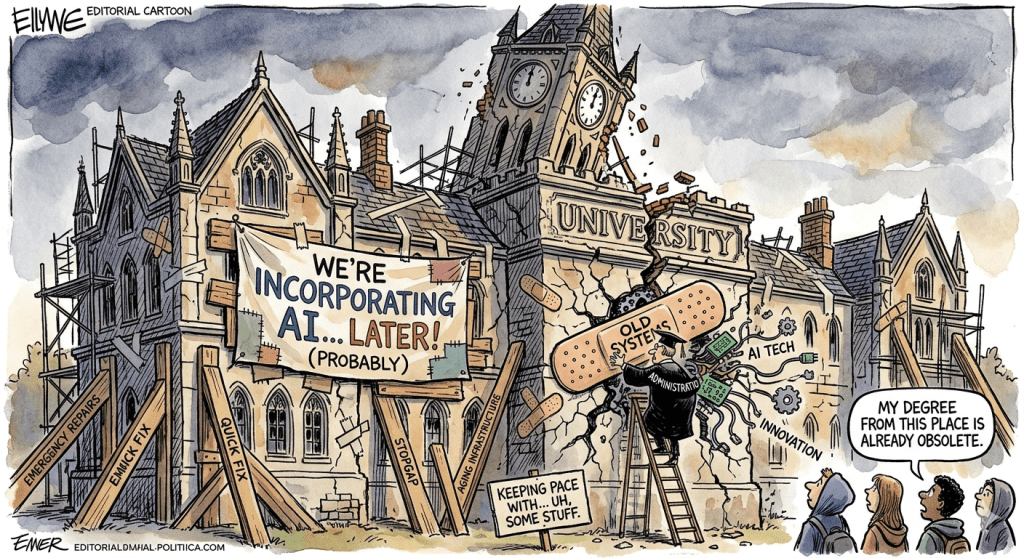
Suevon Lee’s report from Massachusetts captures a new competition among American colleges: more than 100 universities now offer an undergraduate artificial intelligence major, nearly twice the number recorded a year ago (Lee, 2026). Bentley University has gone from a handful of students when its major began in 2024 to nearly 100 today. MIT’s AI and Decision Making major enrolls 354 students and ranks second in popularity there. Worcester Polytechnic Institute has opened a bachelor’s program with 11 focus areas; Northeastern has renamed an existing data science degree to emphasize AI. For administrators trying to attract students worried about their careers, the label has become an advantage in recruitment.

But a degree title is not an educational standard. MIT professor Antonio Torralba describes an ambitious purpose: “Our goal is not to teach them to be users of [generative] AI” but to provide the foundations for building what comes next (Lee, 2026). That distinction matters. Learning to prompt a chatbot is not the same as studying statistics, computing, machine learning, model evaluation, data governance, and system failure. In a labor market where particular software may become obsolete between a student’s first and fourth years, strong foundations are likely to have greater value than familiarity with a current product.
The Northeastern team’s own curricular survey illustrates why families should read beyond program names. The researchers identified 361 undergraduate AI programs of various kinds in a spring 2026 snapshot, then examined requirements for 66 majors and 87 minors. Requirements varied considerably. More than a third of majors required a dedicated AI ethics course; only 24 percent of minors did (Muzny et al., 2026). These are counts of required courses, not direct measurements of what students actually learn about ethics. Nonetheless, the variation should concern accreditation bodies, employers, students, and faculty. An AI major that develops powerful systems without sustained work on reliability, privacy, bias, and public accountability is incomplete.
WPI offers a useful contrast. Its responsible-AI requirement places those questions inside the degree, while its specializations acknowledge that AI expertise is applied in diverse fields (Lee, 2026). Yet the debate should not stop at whether colleges ought to create AI majors. Georgetown researcher Zack Mabel makes the broader argument that “curricula of all different flavors need to embed AI” (Lee, 2026). He is right. Nursing, history, journalism, business, and elementary education students will use automated systems without becoming AI engineers. They need enough technical understanding to recognize errors, test outputs, protect sensitive information, and decide when human judgment must prevail.
The 2026 EDUCAUSE assessment report reinforces that wider obligation. Drawing on 438 faculty and staff respondents, it calls AI literacy—including knowing when not to use the technology—essential for students and educators (Robert, 2026). UNESCO’s September 2026 review of 36 teacher-competency frameworks likewise emphasizes curriculum alignment and evaluation rather than mere tool familiarity (UNESCO IITE, 2026). The challenge reaches well beyond computer science departments.
Universities therefore need two educational commitments, not a contest between them. Specialized AI degrees should meet demanding expectations in mathematics, engineering, responsible design, and evidence-based evaluation. Every other degree should teach the forms of AI judgment that its graduates will need in their professions. Both should be periodically assessed against demonstrated student abilities. A college should be able to show what graduates can build, what they can question, and what they know not to trust. The race to announce majors is understandable. The harder test will come when the first graduating classes must prove that the new degrees stand for something substantial.
2. Six-Year-Olds Can Talk to ChatGPT. Can They Critically Direct It? (story idea suggested by Claude)
Dolan, E. W. (2026, October 22). Brain scans suggest first graders don’t engage their control networks like adults when talking to ChatGPT. PsyPost. https://www.psypost.org/brain-scans-suggest-first-graders-dont-engage-their-control-networks-like-adults-when-talking-to-chatgpt/ | Horowitz-Kraus, T., Kenett, Y. N., Link-Sourani, D., Ashqar, E., & Farah, R. (2026). Lower engagement of cognitive control in children on ChatGPT. Cerebral Cortex, 36(10), bhag167. https://doi.org/10.1093/cercor/bhag167
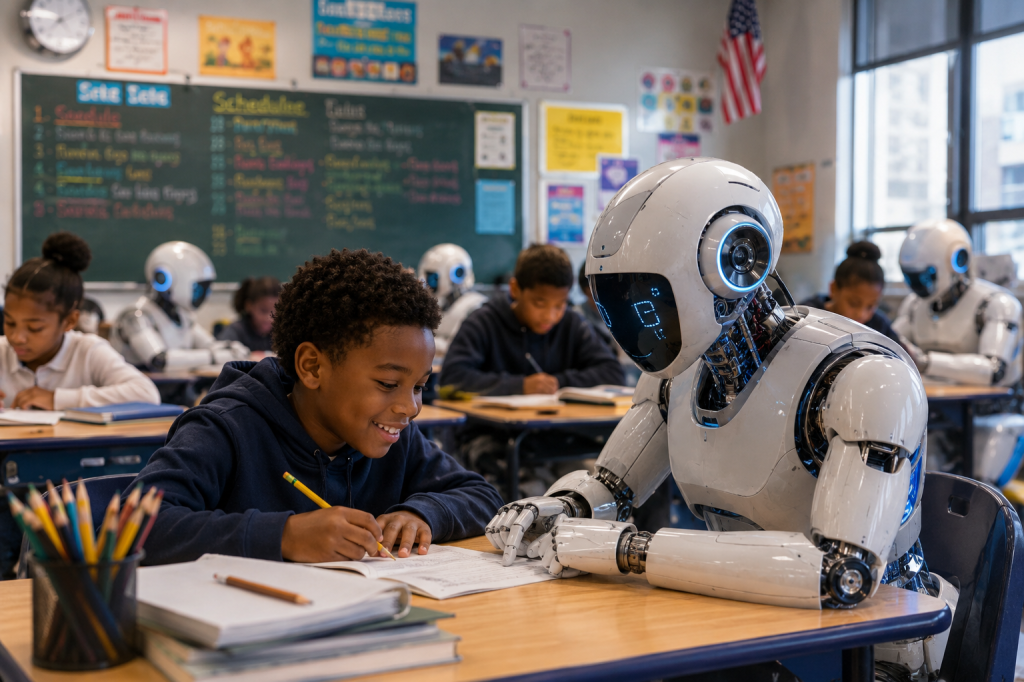
First graders can ask a chatbot to help invent a store. That does not mean they can evaluate its advice in the same way an adult does. A new study reported by Eric W. Dolan asked 15 first-grade children and 16 adults to spend five minutes discussing an imaginary store with ChatGPT inside a functional MRI scanner. Researchers examined how brain networks involved in attention, memory, planning, and monitoring coordinated during the conversation (Dolan, 2026; Horowitz-Kraus et al., 2026).
Adults showed stronger coordination in the frontoparietal control network, and stronger connections between that network and an attention network. On a separate creativity test, the two groups performed comparably relative to their own age groups. The finding was not that children lacked ideas. It was that the brain activity accompanying the AI exchange differed. The authors suggest that adults may be more prepared to filter the chatbot’s suggestions and keep the exchange directed toward a purpose. Their work raises a significant question for elementary education: what must a child already know how to do before an AI partner can genuinely help the child learn?
The distinction is especially important because the paper does not establish that ChatGPT weakens a child’s brain. The lead researcher states plainly: “This study does not show that ChatGPT reduces cognitive control in children or harms their brains” (Dolan, 2026). There was no comparison session in which the same children planned a store alone or with a teacher. The study therefore cannot distinguish an AI-specific effect from ordinary differences between six-year-old and adult cognition. A small sample, a single short task, and unequal instructions further constrain the inference. Children were introduced to ChatGPT as “the smartest computer in the world,” a description adults did not receive (Dolan, 2026). That wording itself could discourage a child from challenging the machine.
These limits should shape classroom policy rather than end the conversation. Teachers have always adapted instruction to developing capacities: children first learn to read with guidance, then to evaluate sources, develop arguments, and work independently. Conversational AI adds an unusually fluent source of assertions and suggestions to that sequence. Unlike an encyclopedia entry, it responds immediately to a child’s enthusiasm, changes direction on request, and can appear confident when incorrect. Its ease of use can disguise the difficulty of evaluating it.
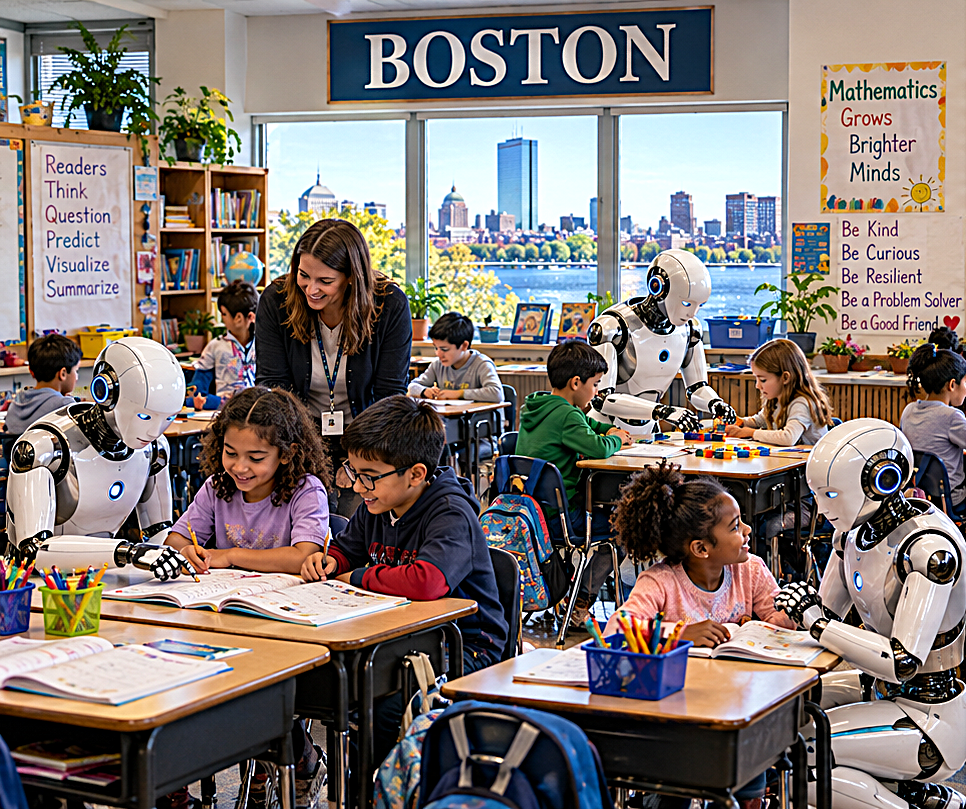
The sensible starting point for early grades is adult-guided use. A teacher might invite a chatbot to suggest three possible stores, then ask pupils which ideas seem realistic, which are unfair, and what information must be checked. Children could compare its recommendations with a classroom discussion, explain their own decisions, and identify an answer that sounded plausible but was wrong. In this design, AI supplies material for inquiry; it does not decide the answer for the child. The researcher’s practical advice is to treat AI as “a shared activity instead of an independent tutor” (Dolan, 2026).
There is wider support for teaching those habits explicitly. UNESCO’s student AI competency framework organizes learning around human judgment, ethical use, technical understanding, and design, with progression from understanding to application and creation (UNESCO, 2024a). Its teacher framework similarly makes human agency and sound pedagogy central (UNESCO, 2024b). Neither provides a neuroscience-based minimum age for chatbot use, and this study cannot provide one either. What educators can reasonably require now is a stronger explanation of how a tool fits children’s developmental needs.
The urgent question is not whether first graders should encounter AI at all. Many already will. It is whether schools will give them time and human support to develop the skills required to question it. A child who can produce an answer with ChatGPT has completed only the first part of the educational task. Learning why that answer deserves belief, revision, or rejection is the part that should govern classroom practice.
3. ASU Asks Whether the University Itself Should Change (story idea suggested by ChatGPT)
King, S. (2026, October 22). The future of AI is human: Key insights from the 2026 summit. Arizona State University, Enterprise Technology. https://tech.asu.edu/features/AASE-Future-Human
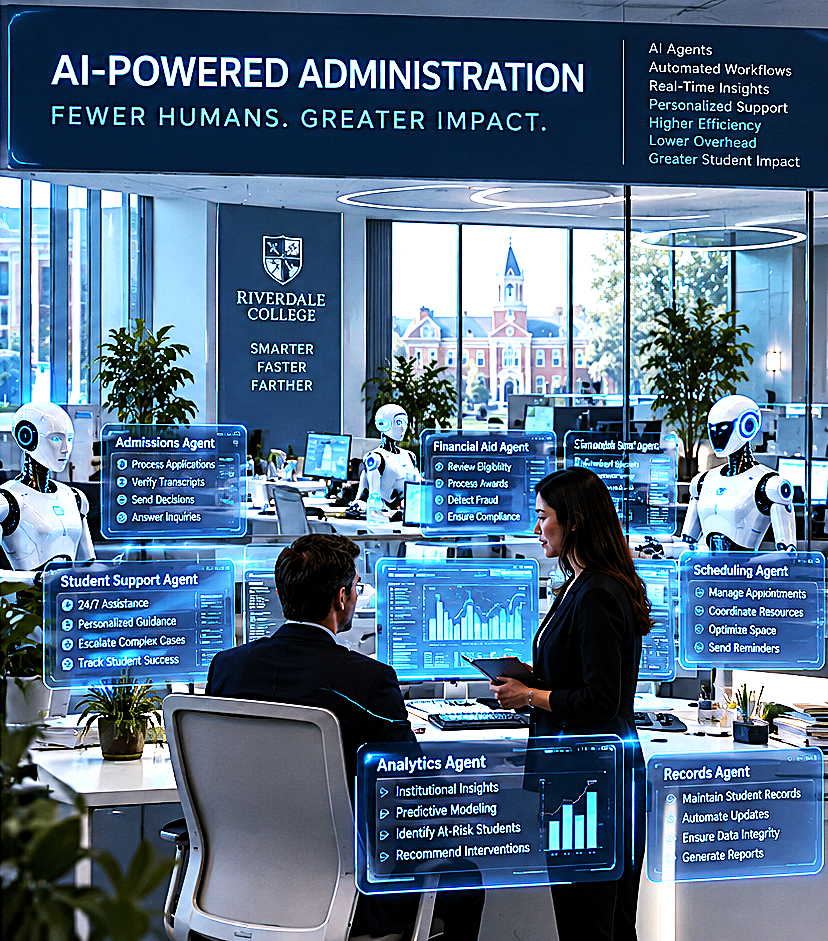
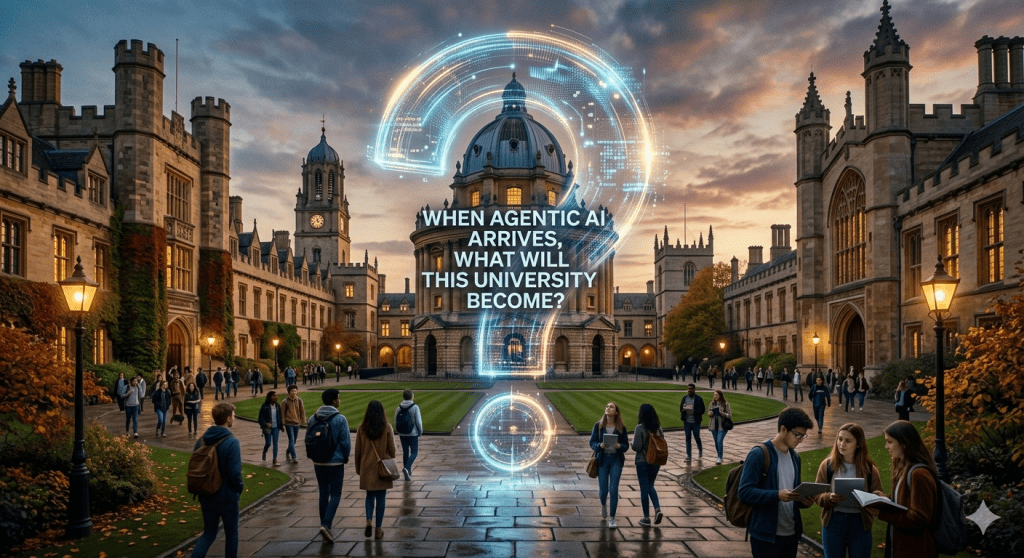
At Arizona State University’s Agentic AI and the Student Experience summit, October 20–22, educational leaders discussed a larger transformation than adding chatbots to courses. The meeting considered AI agents across the student journey, from admission and financial aid to graduation and continued learning. Stephanie King’s account emphasizes purposeful use, student agency, institutional inclusion, and willingness to reconsider established practices (King, 2026). Its most consequential implication is organizational: colleges may need to redesign how people receive education and support, rather than automate pieces of inherited administrative arrangements.
ASU president Michael Crow warned that “AI without a purpose is an amoral outcome” (King, 2026). The comment is a direct challenge to institutions whose AI strategy consists mainly of purchasing tools. A university exists to help students learn, produce knowledge, and serve society. A technology plan should begin with those objectives and measurable student problems. Valerie Singer of Amazon Web Services asked institutions to start with obstacles students actually encounter—financial aid, transcripts, and efficient pathways to a degree—before selecting AI applications (King, 2026).
A first generation of campus agents might answer routine questions, assemble forms, notify advisers about missing requirements, or help students navigate departments. Those are useful services, particularly at institutions where office hours, staff shortages, and fragmented systems produce repeated delays. But merely attaching an agent to every separate office can preserve the very complexity students struggle with. One automated adviser might still send a student to an automated registrar, who then refers the student to an automated financial-aid office. The transaction becomes faster while responsibility remains scattered.
A more serious redesign would organize support around the student’s task. Imagine a learner whose course selection affects aid eligibility and expected graduation date. With appropriate authorization, a coordinated service could check the relevant requirements together, explain the consequences, identify exceptions, and hand a difficult judgment to an accountable person. That would require common data definitions, privacy safeguards, clear decision rights, accessible appeal procedures, and agreement across departments. These requirements are institutional and political as much as technical. No summit declaration demonstrates that such integration has already been achieved at scale.
Nor should educational leaders confuse administrative efficiency with educational quality. Some interactions are transactions; others are teaching. An automated schedule adjustment may save time. A conversation about a struggling student’s ambitions, family responsibilities, or reason for leaving college calls for human care and judgment even if an agent prepares useful information. ASU’s Chris Howard emphasized “the power and the empowerment of giving someone agency” (King, 2026). A system that quietly makes consequential choices for learners would violate that principle, however convenient its interface.
Evidence on current AI adoption also counsels against grand claims. EDUCAUSE’s 2026 assessment survey documents both growing experimentation and uncertainty among faculty and staff. It emphasizes the need for guidance and informed decisions about when AI should or should not be used (Robert, 2026). Meanwhile, the 2026 CHLOE research collection addresses the competitive, operational, and pedagogical pressures shaping online higher education (EDUCAUSE, 2026). Neither establishes that autonomous agents reliably replace the complex judgment exercised by university personnel. The present evidence supports careful redesign and evaluation, not declarations of a fully agent-run campus.
Still, the direction of ASU’s discussion is important. University departments, calendars, approval chains, and course-delivery conventions were built for particular staffing arrangements and information limits. Some continue to serve students well; others force unnecessary waiting and repetition. Agentic systems offer a reason to inspect each process and ask what educational purpose it serves. Students, faculty, advisers, disability specialists, and staff should help make those decisions, not simply inherit them from vendors or senior administrators.
The strongest version of ASU’s argument is not that AI should run the university. It is that universities should finally redesign services around learning, access, and accountable decisions—and use AI agents wherever they demonstrably improve those outcomes. The measure of success will be whether students receive clearer support, stronger education, and greater control over their own paths.
References
Dolan, E. W. (2026, October 22). Brain scans suggest first graders don’t engage their control networks like adults when talking to ChatGPT. PsyPost. https://www.psypost.org/brain-scans-suggest-first-graders-dont-engage-their-control-networks-like-adults-when-talking-to-chatgpt/
EDUCAUSE. (2026, August 28). CHLOE reports. https://library.educause.edu/resources/2026/8/chloe-reports
Horowitz-Kraus, T., Kenett, Y. N., Link-Sourani, D., Ashqar, E., & Farah, R. (2026). Lower engagement of cognitive control in children on ChatGPT. Cerebral Cortex, 36(10), bhag167. https://doi.org/10.1093/cercor/bhag167
King, S. (2026, October 22). The future of AI is human: Key insights from the 2026 summit. Arizona State University, Enterprise Technology. https://tech.asu.edu/features/AASE-Future-Human
Lee, S. (2026, October 23). In higher education, the race is on to offer AI as an undergraduate major. WBUR. https://www.wbur.org/news/2026/10/23/ai-college-major-massachusetts
Muzny, F., Jones, C., Ithier, C., Sikora, H., Patel, H. H., & Brodley, C. E. (2026). A tool to map AI programs in the U.S.: A snapshot from April 2026 and an analysis of requirements for AI majors and minors [Preprint]. arXiv. https://arxiv.org/abs/2606.12428
Robert, J. (2026, June 1). The impact of AI on learning assessment. EDUCAUSE. https://library.educause.edu/resources/2026/6/2026-educause-the-impact-of-ai-on-learning-assessment-report
UNESCO. (2024a). AI competency framework for students. https://www.unesco.org/en/articles/ai-competency-framework-students
UNESCO. (2024b). AI competency framework for teachers. https://www.unesco.org/en/articles/ai-competency-framework-teachers
UNESCO Institute for Information Technologies in Education. (2026, September 28). UNESCO IITE has released the analytical report “Teacher AI Competency Frameworks.” https://iite.unesco.org/news/unesco-iite-has-released-the-analytical-report-teacher-ai-competency-frameworks/
Four Additional Stories for 10/23/26
“In the Age of AI, Universities Must Focus on Student Development” (story idea suggested by Muse)
Aju Press, October 23, 2026, https://www.ajupress.com/view/20261023165670725
Sungkyunkwan University and Seoul National University co-hosted the second “AI in Higher Education” conference in Seoul today, drawing hundreds of faculty, staff, and students. Bae Sang-hoon of Sungkyunkwan told the audience that knowledge is shifting from professors to AI and that the educator’s role has to change from transmitting knowledge to supporting student growth, while Lee Min-seok, who chairs the education division of the National AI Strategy Committee, argued that companies now want graduates who can define problems and question results rather than memorize content. Seoul National University presented guidelines and a chatbot designed to question students instead of answering them, and an AWS Korea speaker stated that AI now handles 75 percent of coding tasks at large technology firms. The article is a useful window into how South Korea’s leading universities and its national AI strategy apparatus are describing the same pressures U.S. campuses face, in plainer language than most American institutions use. One sourcing note: Aju Press discloses that the article was translated by AI.
“Comparing ChatGPT and Teacher Feedback for EFL Writing Development” (story idea suggested by ChatGPT)
Discover Education, Springer Nature, October 22, 2026, https://link.springer.com/article/10.1007/s44217-026-02329-5
In a four-week study involving 46 university students learning English as a foreign language, researcher Neda Naqdi Babaee compared writing development under ChatGPT-generated feedback and teacher-written feedback. The ChatGPT group demonstrated significantly better overall writing outcomes after adjustment for initial proficiency, with particularly strong evidence for improvement in task achievement, although differences in grammatical accuracy were not significant. Students valued the speed and detail of AI feedback while continuing to appreciate the contextual sensitivity and authority of their teachers’ responses. Because the study was relatively small, nonrandomized, and unable to isolate feedback source from differences in feedback quantity and immediacy, it does not establish that AI is a better writing instructor. Nevertheless, it raises an important instructional question: If AI can provide some kinds of effective feedback faster and more consistently, should composition teachers increasingly concentrate on helping students develop ideas, exercise judgment, and discover their own voices? This study provides an empirical basis for reconsidering the allocation of responsibilities between teachers and AI assistants in writing instruction, without assuming that improvements in essay scores necessarily mean improvements in independent thinking.
“Choosing a Computing Degree in the AI Era: SIM Explains the Skills and Career Pathways to Compare” (story idea suggested by Meta)
Media OutReach Newswire, October 23, 2026, https://www.b2b-asianews.com/2026/10/23/choosing-a-computing-degree-in-the-ai-era-sim-explains-the-skills-and-career-pathways-to-compare/
This article suggests judging a computing degree by what it teaches students to do, by its programming and mathematics requirements, and by whether students get to build and test systems, rather than by whether the program title contains the word artificial intelligence. The piece also cautions against searching for an “AI-proof” credential, a phrase that captures how much of the current market for education is being sold on fear of displacement. It asks whether the label is becoming a substitute for curriculum, and what a student, a parent, or an employer should look for when the label is everywhere.
“Turnitin Turns To AI” (story idea suggested by Meta)
The Mancunion, October 23, 2026, https://mancunion.com/news/turnitin-turns-to-ai
Many universities across the United Kingdom are ending or threatening not to renew their contracts with Turnitin after the company proposed changes to its End User Licence Agreement in July 2026. The paper notes that Turnitin is used by around 98 percent of UK universities for submission and assessment, and that the dispute centers on whether student and staff work could be used for AI purposes, a prospect the company says it does not use to train generative models or large language models. Newcastle, Southampton, and Westminster have each announced they will not renew beyond the 2026-27 academic year, even after Turnitin postponed the changes, because the company has said it intends to revisit them the following year. This story matters because it reframes academic integrity as a question of ownership and consent: the tool built to detect borrowed work is now suspected of borrowing the work itself, and universities are deciding whether the cost of that uncertainty is higher than the cost of losing a familiar system.
###
Filed under: Uncategorized |


























































































































































































































































































































































































































Leave a Reply