







By Jim Shimabukuro (assisted by Claude, ChatGPT, Perplexity, Muse, Meta)
Editor
(Related: A Field Guide to Generative AI, Agentic AI, AGI, ASI, and The Singularity)
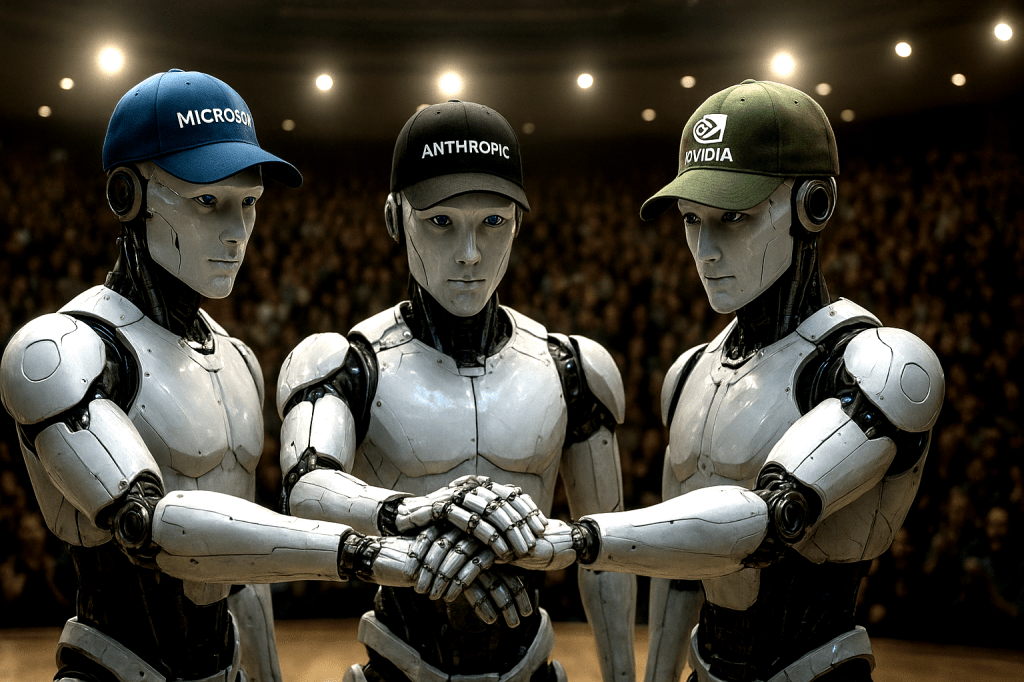
I asked five chatbots to predict the year for AGI’s arrival, and these are their responses. Arguably the more interesting aspect of their choices is the explanations and factors they considered. In aggregate, we come away with a wider and broader perspective of the forces that are shaping our journey to not only artificial general intelligence but to its implications. The predictions range from 2031 to 2045, but the median is 2032. Thus, in approximately seven years, we may be at a point where a machine can match capable humans across essentially the full range of cognitive work.

Claude: My estimate is 2032
Forecasters, lab leaders, and researchers disagree by two decades. The evidence points to the early 2030s.
ETC Journal’s field guide defines artificial general intelligence as the point at which a machine can “match capable humans across essentially the full range of cognitive work” (ETC Journal, 2026). Measured against that standard, the most defensible estimate today places AGI in the early 2030s, with 2032 as a single best guess and a real chance of arrival a few years on either side.
Start with forecasters who keep public, scored records. The Metaculus community, about 1,900 forecasters, currently puts the first general AI system at December 2030, with a spread from 2028 to 2037 (Metaculus, n.d.). The AI Futures Project, authors of the “AI 2027” scenario, updated its numbers in August 2026. For a system that matches top human experts at nearly all cognitive tasks, a bar at or above the field guide’s, Daniel Kokotajlo’s median is November 2028, Brendan Halstead’s is April 2031, and Eli Lifland’s is July 2032 (Lifland et al., 2026). Lab leaders sit at the near end. In May 2026, Demis Hassabis of Google DeepMind narrowed his estimate from 2030–2035 to 2029 or 2030 (Molla, 2026). Anthropic told the White House in 2025 that it expected “powerful AI systems” in “late 2026 or early 2027,” a forecast the independent researcher Ryan Greenblatt rated about 6% likely (Greenblatt, 2025).
Academic researchers have been slower. In a survey of 2,778 published AI researchers conducted in late 2023, the median respondent gave a 50% chance that machines would outperform humans at every task by 2047 (Grace et al., 2024). That survey predates practical AI agents, and the same estimate had already moved 13 years earlier since the 2022 edition.
The capability data explain both the near dates and the case for patience. METR, which measures how long a task an AI system can finish, reported that in February and March 2026 the best public models succeeded half the time on software tasks that take a human about 12 hours. At an 80% success rate, the figure fell to about 90 minutes (METR, 2026). Stanford’s 2026 AI Index found that computer-use agents rose from about 5% to 66.3% on the OSWorld benchmark in a year, still short of the 72.35% human baseline (Stanford HAI, 2026). A top model that handles graduate-level physics reads an analog clock correctly about half the time (McFarland, 2026). Uneven, unreliable performance of this kind falls short of a “full range” standard.
Some researchers doubt the current approach can close that gap. Yann LeCun, who founded AMI Labs to pursue a different architecture, argues that language models “can’t truly reason or plan, because they lack a model of the world,” and says human-level AI “is not going to happen next year or two years from now” (Chen, 2026).
The fastest forecasts assume that AI automates coding, and then AI research itself, within about two years; Kokotajlo’s median for an automated coder is November 2027 (Lifland et al., 2026). That could happen. The reliability gap, the weakness in visual and spatial reasoning, and the requirement to cover nearly every kind of cognitive work make a few additional years more likely. The Metaculus median and two of the three AI Futures forecasters fall between 2030 and 2033. My estimate is 2032.
References
Chen, C. (2026, January 22). Yann LeCun’s new venture is a contrarian bet against large language models. MIT Technology Review. https://www.technologyreview.com/2026/01/22/1131661/yann-lecuns-new-venture-ami-labs/
ETC Journal. (2026, July 15). A field guide to generative AI, agentic AI, AGI, ASI, and the singularity. ETC Journal. https://tinyurl.com/bdz3432j
Grace, K., Stewart, H., Sandkühler, J. F., Thomas, S., Weinstein-Raun, B., Brauner, J., & Korzekwa, R. C. (2024). Thousands of AI authors on the future of AI [Preprint]. arXiv. https://arxiv.org/abs/2401.02843
Greenblatt, R. (2025, November 3). What’s up with Anthropic predicting AGI by early 2027? Redwood Research Blog. https://blog.redwoodresearch.org/p/whats-up-with-anthropic-predicting
Lifland, E., Kokotajlo, D., & Halstead, B. (2026, August 16). Q2.5 2026 timelines update: Uplift and revenue. AI Futures Project. https://blog.aifutures.org/p/q25-2026-timelines-update-uplift
McFarland, A. (2026, April 15). Stanford AI Index 2026 reveals a field racing ahead of its guardrails. Unite.AI. https://www.unite.ai/stanford-ai-index-2026-reveals-a-field-racing-ahead-of-its-guardrails/
Metaculus. (n.d.). When will the first general AI system be devised, tested, and publicly announced? Retrieved October 21, 2026, from https://www.metaculus.com/questions/5121/date-of-artificial-general-intelligence/
METR. (2026, May 19). Frontier risk report (February to March 2026). https://metr.org/blog/2026-05-19-frontier-risk-report/
Molla, R. (2026, May 27). Google DeepMind’s Hassabis: AGI is 3 to 4 years away. Sherwood News. https://sherwood.news/tech/google-deepminds-hassabis-agi-is-3-to-4-years-away/
Stanford Institute for Human-Centered Artificial Intelligence. (2026). The 2026 AI Index report. Stanford University. https://hai.stanford.edu/ai-index/2026-ai-index-report
ChatGPT: My prediction is 2045
Assuming artificial general intelligence (AGI) is attainable, the most reasonable forecast is that it will emerge between 2040 and 2050, with 2045 as my best single-year estimate. A meaningful possibility exists that it will arrive before 2035, but the evidence available in October 2026 does not justify treating that accelerated timetable as the most likely outcome.
The definition matters. As ETC Journal’s field guide explains, AGI means a machine capable of matching competent humans across essentially the full range of cognitive work (Shimabukuro, 2026). Under this definition, exceptional performance in mathematics, programming, scientific reasoning, or writing is insufficient. An AGI system must combine these abilities with adaptability, sustained reasoning, independent learning, and reliable performance across unfamiliar problems.
Progress toward that standard is substantial. Stanford University’s 2026 AI Index Report documents rapid improvements in reasoning, coding, computer use, and scientific problem-solving. On the OSWorld benchmark, AI agents improved from approximately 12% accuracy to 66.3% in 2025, approaching the human baseline of 72.35%. Nevertheless, agents still failed approximately one-third of their attempts on structured computer tasks (Stanford HAI, 2026).
Another revealing measure comes from METR, an independent organization studying AI capabilities. Its January 2026 research confirmed continuing growth in the duration of tasks that AI agents can complete autonomously. This suggests that systems are progressing beyond answering questions toward carrying out extended assignments. However, success on increasingly lengthy software tasks does not establish competence across all intellectual activities (METR, 2026).
In June 2026, the Forecasting Research Institute reported results from its Longitudinal Expert AI Panel. Experts assigned an 80% median probability that AGI would be recognized before 2100. Conditional on its arrival, their median predicted year was 2050, with a 25% probability of arrival by 2039. Superforecasters offered a slightly earlier median of 2047 (Forecasting Research Institute, 2026).
These forecasts are considerably more cautious than predictions circulating among some AI industry leaders. They also resemble an earlier survey of 2,778 AI researchers, which estimated a 50% probability that machines would outperform humans across all tasks by 2047 (Grace et al., 2024).
My slightly earlier estimate of 2045 reflects two considerations. First, improvements in agentic AI could accelerate research itself, allowing AI systems to contribute increasingly to the development of successor systems. Second, the expanding ability to coordinate specialized agents may produce general-purpose performance before a single model possesses every required capability. These are plausible mechanisms for acceleration, not established predictions.
The principal obstacle is reliability. The International AI Safety Report 2026 documents persistent weaknesses in multi-step reasoning, factual accuracy, and adaptation to unfamiliar situations. Increasing computational power and expanding agent autonomy do not automatically eliminate these limitations (International AI Safety Report, 2026).
Consequently, I expect the 2030s to bring increasingly capable systems that perform most professional cognitive tasks, followed by a more gradual convergence toward genuine AGI during the 2040s.
My prediction is 2045, with 2040–2050 as the central forecast window. The date should be revised as independent evaluations establish whether AI can complete unfamiliar, prolonged, consequential work as reliably as capable human professionals.
The important distinction is between achieving impressive performances and establishing general intelligence. The first is already observable. The second remains to be demonstrated.
References
Forecasting Research Institute. (2026, June 2). Experts and superforecasters update their AI timelines. https://forecastingresearch.substack.com/p/leap-wave-8-ai-timelines
Grace, K., Stewart, H., Sandkühler, J. F., Thomas, S., Weinstein-Raun, B., & Brauner, J. (2024). Thousands of AI authors on the future of AI. arXiv. https://arxiv.org/abs/2401.02843
International AI Safety Report. (2026). International AI safety report 2026. https://internationalaisafetyreport.org/publication/international-ai-safety-report-2026
METR. (2026, January 29). Time horizon 1.1. https://metr.org/blog/2026-01-29-time-horizon-1-1/
Shimabukuro, J. (2026, July 15). A field guide to generative AI, agentic AI, AGI, ASI, and the singularity. Educational Technology and Change Journal. https://etcjournal.com/2026/07/15/a-field-guide-to-generative-ai-agentic-ai-agi-asi-and-the-singularity/
Stanford Institute for Human-Centered Artificial Intelligence. (2026). The 2026 AI Index report: Technical performance. Stanford University. https://hai.stanford.edu/ai-index/2026-ai-index-report/technical-performance
Perplexity: my best estimate is 2035
Assuming artificial general intelligence is attainable, my best estimate is 2035, within a central forecasting window of 2030–2040. That is a judgment, not a date established by research or an expert consensus. It assumes the demanding standard in the supplied definition: matching capable humans across essentially the full range of cognitive work. I would therefore count neither exceptional examination results nor an agent’s success at selected office tasks as sufficient evidence of AGI.
The strongest reason to expect arrival within that window is that progress now involves more than increasing the size of models. The International AI Safety Report 2026 documents substantial gains from “inference-time scaling,” which gives systems additional computation to work through intermediate steps before answering. These gains have been particularly pronounced in mathematics, software engineering, and science. This provides evidence that further improvements need not depend entirely on larger initial training runs (International AI Safety Report, 2026).internationalaisafetyreport
Some informed observers expect a much earlier arrival. On October 21, 2026, The Verge reported that Google DeepMind cofounder Demis Hassabis expected AGI within two to three years (Roth, 2026). His proximity to frontier research makes that forecast worth considering. Nevertheless, I would treat 2028–2029 as an early possibility rather than the most reasonable central estimate. A developer’s forecast does not establish that the remaining obstacles will yield on schedule, particularly under a definition requiring broad competence rather than outstanding performance in selected domains.theverge
The main reason for allowing more time is reliability. The international report describes systems that excel at difficult problems but struggle with apparently simpler ones, including spatial reasoning and recovery from errors in extended workflows. It also identifies an “evaluation gap”: strong performance in controlled tests does not reliably predict real-world usefulness or risk. Techniques that reduce failures have not yet delivered the reliability required in many high-stakes settings (International AI Safety Report, 2026). My inference is that closing these gaps will require substantial additional work beyond improving benchmark scores.internationalaisafetyreport
An agentic loop is relevant to that work, but it should not itself qualify a system as generally intelligent. For this forecast, I would require independent demonstrations that a system can learn unfamiliar tasks, transfer knowledge between fields, complete extended assignments, and recognize when it needs clarification. Human-level performance would not mean perfection; it would mean comparable competence under comparable conditions. I would also distinguish the first convincing demonstration from widespread deployment. This essay forecasts the former, without requiring either consciousness or humanlike robotic dexterity.
The estimate should move as evidence changes. Consistent success on unfamiliar, independently evaluated work would justify bringing it forward. Persistent failures in learning, planning, and error recovery would justify postponement. The international report explicitly allows for progress to slow, continue, or accelerate through 2030, including possible acceleration if AI substantially assists AI research (International AI Safety Report, 2026). Given that uncertainty, the mid-2030s seems a defensible midpoint: it allows further rapid progress without assuming that today’s uneven capabilities will become broadly dependable within only two or three years.internationalaisafetyreport
References
International AI Safety Report. (2026, February 3). 2026 report: Executive summary. https://internationalaisafetyreport.org/publication/2026-report-executive-summary
Roth, E. (2026, October 21). Google DeepMind’s Demis Hassabis thinks AGI is two to three years away. The Verge. https://www.theverge.com/ai-artificial-intelligence/1015277/google-deepminds-demis-hassabis-thinks-agi-is-two-to-three-years-away
Muse: Around 2031
Begin with the definition this journal uses: AGI is the point at which a machine can match capable humans across essentially the full range of cognitive work. Published timelines disagree mainly because forecasters answer different questions. Some date the arrival of systems that are very strong at economically valuable tasks. Others date the point at which machines perform every task, including physical labor, better and more cheaply than people. The first target is closer than the second, and separating the two explains most of the spread.
The most useful single number comes from Metaculus, a forecasting platform whose contributors revise their estimates as evidence arrives. On its long-running question asking when the first general AI will be announced, the community median currently stands at December 2030, with the middle of the distribution running from April 2028 to December 2036 (Metaculus, 2026). Roughly one chance in four falls before 2029.
Surveys of working researchers give later dates. The fourth Expert Survey on Progress in AI, fielded in December 2024 among 1,580 researchers, put the year by which human-level machine intelligence has a 50% chance of existing at 2042 (Grace et al., 2026). That question sets a demanding target: machines accomplishing every task better and more cheaply than human workers, physical labor included. The same series put the date at 2061 in 2016 and 2047 in 2023. Each round moves the date closer by more than the time elapsed since the previous round.
Measured capability growth supports the forecasters. METR, an independent evaluation group, tracks the length of software and research tasks that frontier agents can complete at 50% reliability. That time horizon doubled about every seven months from 2019 to 2025, and METR reports the doubling may have shortened to about four months during 2024 (METR, 2025). At the slower historical rate, agents reach week-long assignments near the end of this decade. METR also finds that performance falls on tasks less structured than its test suite, which is the strongest technical reason to doubt claims of AGI within two years.
The lab leaders sit at the early end. Demis Hassabis of Google DeepMind said in March 2025 that AGI would start to emerge within five to ten years, and he has since put the chance at about 50% by 2030 (The Decoder, 2025). Dario Amodei of Anthropic said in January 2025 that AI better than almost all humans at almost all tasks could arrive within two or three years (CNBC, 2025). Lab leaders see systems before release, which gives their estimates weight. Their statements also serve commercial purposes, since short timelines help raise capital.
Weighing the evidence, the most reasonable central estimate for AGI under this journal’s definition is 2031, inside a 2028–2035 window. A 2027 arrival requires the fastest measured trend to continue with no plateau in reliability. A date beyond 2040 requires the survey respondents to be right and the forecasting platforms wrong, after several years in which the platforms have tracked progress more closely. Schools and institutions should plan on the early 2030s as the base case, with 2028 and 2035 as live alternatives.
References
CNBC. (2025, March 17). AI that can match humans at any task will be here in five to 10 years, Google DeepMind CEO says. https://www.osoulmisrmagazine.com/403468
Grace, K., Simonelli, J., Weinstein-Raun, B., Krueger, D., Young, N., Duffy, T., Adamczewski, T., Reeve, J., & Beck, A. (2026). Advanced AI according to 1,580 researchers: Uncertain, unsafe, and sooner than we thought. AI Impacts. https://aiimpacts.org/wp-content/uploads/2026/09/ESPAI2024.pdf
Metaculus. (2026). When will the first general AI be announced? [Community forecast]. Retrieved October 21, 2026, from https://www.metaculus.com/questions/5121/date-of-artificial-general-intelligence/
METR. (2025, July 14). How does time horizon vary across domains? https://metr.org/blog/2025-07-14-how-does-time-horizon-vary-across-domains/
The Decoder. (2025, March 17). Google DeepMind CEO Demis Hassabis predicts first AGI systems within decade. https://the-decoder.com/google-deepmind-ceo-demis-hassabis-predicts-first-agi-systems-within-decade/
Meta: 2031
If AGI is attainable, the question is not whether it arrives, but when the definition used by ETCJ is satisfied: a machine that can match capable humans across essentially the full range of cognitive work. On that definition, the most defensible timeline in 2026 is not an imminent debut, but a cluster centered around the early 2030s.
The reasons for caution start with how forecasts are constructed. Different trackers resolve on different bars. The Metaculus community, more than 1,800 forecasters with a published calibration record, puts its median for the first general AI system, requiring both cognitive and robotic capability, at January 2033, with a 25% probability by 2029. Its separate question for weakly general AI, which is cognitive-only and closer to the ETCJ notion of AGI as breadth of cognitive work, is much earlier, June 2028. Real-money markets bracket that range. Kalshi prices OpenAI achieving AGI by 2030 at roughly 55% while Polymarket gives OpenAI about 9% for AGI by 2027. Aggregating across platforms, the combined forecast as of mid-July 2026 centers on about 2031, with an 80% interval of 2027 to 2044.
Lab leaders are earlier, and that matters because they see unreleased systems. Anthropic has told U.S. policymakers it expects powerful AI as early as late 2026 or 2027, and Anthropic CEO Dario Amodei has pointed to 2027 as plausible for systems exceeding human capability in most domains. In October 2026, Google DeepMind CEO Demis Hassabis tightened his public window from three to five years to two to three years, as reported in the Wall Street Journal, and he describes his bar as an Einstein test, whether a system trained only up to 1901 could produce the 1905 papers. OpenAI’s Sam Altman has told interviewers he expects internal AGI by the end of 2026.
The gap between lab statements and market prices is instructive. Incentives push labs toward earlier claims, while markets price skepticism of near-term definitions. More important is the history of revision. In 2020 the median expert survey placed AGI roughly fifty years away, post-GPT-4 surveys pulled that into the 2050s, and by early 2026 the Metaculus median stood at January 2033. That consistent inward movement, what forecasters call predictable updating, suggests the center will continue to move earlier, but it does not eliminate uncertainty. The interval remains wide precisely because definitions have quietly loosened even as capabilities have grown.
Stanford faculty writing at the end of 2025 captured the counterpoint. James Landay, HAI co-director, predicted there will be no AGI in 2026, noting peak data concerns and speculative investment in data centers. The Stanford roundtable framed 2026 as a year of evaluation rather than debut, asking how well systems work at what cost and for whom. That frame fits the distinction ETCJ makes. Generative AI is a single pass. Agentic AI adds a loop of planning and correction. The agentic layer is where current progress is concentrated, and it is also where reliability, measurement, and cost become binding.
A reasonable synthesis, then, is to treat AGI not as a single day but as a period when cognitive generality becomes economically and scientifically ordinary. The weakly general milestone around 2028 and the full general median around 2033 suggest a window in which most professional cognitive tasks can be handled at human parity by systems that also improve themselves. If that window holds, the aggregate 2031 center with a 2027 to 2044 interval remains the least overconfident summary available in 2026. It respects lab insight, market discipline, and the fact that definitions, not just models, determine when we say AGI has arrived.
References
AI Tools Review. (2026, July 15). AGI timeline: Metaculus, Polymarket & Kalshi odds (October 2026). https://aitoolsreview.co.uk/insights/agi-timeline-predictions-2026
AI Weekly. (2026, October 21). Hassabis pulls AGI timeline forward to two to three years, down from three to five earlier in 2026. https://aiweekly.co/alerts/hassabis-pulls-agi-timeline-forward-to-two-to-three-years-down-from-three-to
Stanford News. (2025, December 15). Stanford AI experts predict what will happen in 2026. https://news.stanford.edu/stories/2025/12/stanford-ai-experts-predict-what-will-happen-in-2026
###
Filed under: Uncategorized |






































































































































































































































































































































































































Leave a Reply