









By Jim Shimabukuro (assisted by Claude)
Editor
The voters who decided the 2026 midterms came from several groups that agreed on one thing: the costs of the past two years. That agreement will not last, and the 2028 election will go to the party that reassembles more of their coalition.

The midterm elections of November 3, a broad defeat for Republican candidates (Cappelletti & Sloan, 2026), were decided by Americans who belong to neither party. As of 9:58 a.m. Hawaii time on November 18, the Associated Press count showed Democrats with 257 House seats won and Republicans with 171; its Senate count, as of 9:57 a.m., showed totals of 56 for Democrats and 44 for Republicans. The labels “Majority reached” and “Control reached” beside the Democrats in those counts are worked out from AP’s numbers and are not calls by AP. Seven House seats were counted as won by neither party in the results available at that hour, which did not say why or which way those seats would go, and all of these figures may have changed since (Associated Press, 2026a). The voters behind the result were visible in the exit polls. Self-described independents made up a third of the electorate and backed Democratic candidates by about 20 points, which would be the widest margin either party has won among them in the history of exit polling (Winston, 2026).
Those voters are usually called the independent middle, and the label raises the question this article sets out to answer: who, exactly, does it describe? The population is large. Gallup found that a record 45% of American adults identified as independents in 2025, against 27% for each major party, and that the share reaches 56% among adults in Generation Z (Jones, 2026). Commentators often describe these Americans as the ones who reject both the MAGA movement and the cultural left that its critics call “woke.” If that description is right, the middle could be a political force in its own right, a bloc capable of setting the terms of the 2028 presidential election and the first year of the next administration.
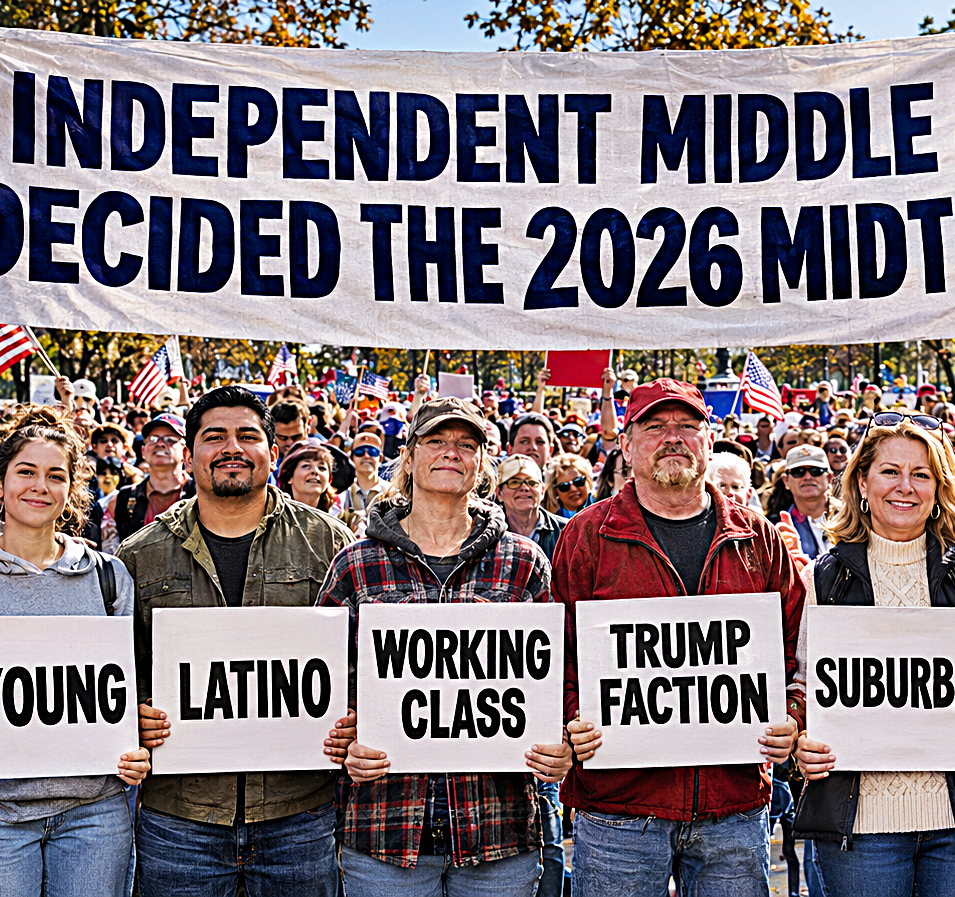
The evidence points to a different conclusion. The independent middle of 2026 was a temporary coalition of disparate groups, each with its own reason for turning against the governing party, held together by shared grievances over prices, the war with Iran, and tariffs. It shared no program and no identity. Between 2027 and 2029, as those grievances ease or are answered, the coalition will come apart, and the 2028 election will turn on which party reassembles more of its pieces. The sections below identify the groups and what moved each of them, explain why together they amount to a coalition of circumstance and not a bloc, follow the likely course of that coalition from January 2027 through 2029, and consider what the episode means in American history and for the rest of the world.
Five groups and an absence
The group closest to the popular image of an independent middle is also the smallest: voters with no attachment to either party. When Gallup asked independents which way they leaned in 2025, 20% of all adults said Democratic, 15% said Republican, and only 10% leaned toward neither (Jones, 2026). The American National Election Studies put pure independents at 6.7% of voters in 2024, the smallest share in more than 70 years of tracking (Smith, 2026). This month these unattached voters were 8% of the electorate and chose Democratic House candidates over Republicans by 59% to 31% (NBC News, 2026). Their politics resist a single label. A study in American Politics Research by Eveline Dowling, Nathan Micatka, and Caroline Tolbert classified most unaffiliated voters as moderates and found that independents value open-mindedness and freedom from party labels (Petrova, 2026), while Samara Klar of the University of Arizona cautions that independents are “not always centrist or moderate” (Cooper, 2026). What the unattached core supplies to the larger coalition is a habit of judging whoever is in charge, and in 2026 that judgment fell on the Republicans.
Young voters supplied the largest movement, and their case shows how much of the middle’s size depends on who shows up. About seven in ten voters under 30 backed Democratic House candidates, after splitting roughly evenly between Donald Trump and Kamala Harris in 2024 (Sanders et al., 2026). Most of that change came from a different set of young people voting. Sara Suzuki of Tufts University’s CIRCLE found that a third of young Democratic voters this year had not voted in 2024, and that 34% of young Trump voters stayed home this year, more than three times as many as switched parties; she described the swing as young people “moving in and out of the electorate” (Gotta, 2026). The economy was the top issue for 43% of them, and 60% said their House vote was meant to oppose Trump (Schneid, 2026). Young voters are also the generation least attached to parties, which makes their contribution to the 2026 coalition large and conditional on turnout that no party can take for granted.
Latino and working-class voters who tried Trump in 2024 came back on prices and on immigration enforcement. About one-third of Hispanic voters backed Republican House candidates this year, compared with roughly four in ten who voted for Trump two years earlier, and about seven in ten Hispanic voters in Texas supported the Democrat James Talarico for the Senate (Associated Press, 2026b). Pew Research Center data show Trump’s approval among Latino voters falling from 38% in February 2025 to 24% this fall (Schneid, 2026). Matt Tuerk, the Democratic mayor of Allentown, Pennsylvania, said Latino voters had given Trump a chance and turned away after what they saw as betrayal, and he warned that they are now “on probation” with Democrats; another Allentown voter complained that Trump “didn’t come through” and was instead “locking them up” (Associated Press, 2026b). These voters judged the 2024 result on prices and on how the promised immigration crackdown was carried out, and they will judge the 2026 winners on the same terms.
A fourth group came from inside the Trump coalition and objected above all to the war. More in Common, a research organization, divides Trump’s 2024 voters into four segments, the least partisan of which, the “Reluctant Right,” made up 20% of his coalition (Axios, 2026). In an April survey, 54% of the Reluctant Right opposed the Iran war and 26% supported it; 70% named the cost of living as a top priority, while only 11% thought it was a priority for the president; and 35% expressed some regret about their 2024 vote, more than double the share a year earlier (More in Common, 2026). Vice President JD Vance drew the same conclusion after the election. “The reason we lost is the war,” he wrote, arguing that many Trump voters had turned out and voted for Democrats, and he relayed four tasks for winning them back: end the war, focus on the cost of living, put America first, and change the relationship with Israel (Altman-Devilbiss, 2026; D’Abrosca, 2026). These voters joined the 2026 coalition through opposition to a war they regarded as a broken promise, and their political home remains on the right.
Suburban and moderate voters made up the fifth group, and they set the tone of the Democratic victory. Moderates were the largest ideological group in the exit polls, at 41% of the electorate (Winston, 2026). The AP survey found that about half of voters who backed Democratic House candidates called themselves moderates, up from roughly four in ten in 2018, 2022, and 2024 (Cappelletti & Sloan, 2026). Third Way, a center-left think tank, reports that the moderate Democrats it tracked in Senate races in Republican-leaning states campaigned on costs, corruption, and mainstream border policies, and that six of them drew between 67% and 75% of moderate voters in CNN exit polls (Third Way, 2026). About seven in ten voters said Congress was doing too little to check the presidency (Sanders et al., 2026). For these voters the issue was competence and restraint as much as any policy.
The coalition had a sixth component that cast no ballots. The polling firm J.L. Partners, comparing an Election Day survey with more than 30,000 campaign interviews, found that 35% of Trump’s 2024 voters did not vote on November 3 and that 8% switched to Democrats. By its estimate, the absence of Trump voters accounts for 10 points of the 15-point swing toward Democrats since 2024, and switchers for the other five (Political Wire, 2026). Vance disputes that reading and puts the emphasis on defection (Altman-Devilbiss, 2026), but the turnout pattern among young voters points the same way as the J.L. Partners figures (Gotta, 2026). Much of the middle’s verdict was delivered by people who chose not to vote for anyone.
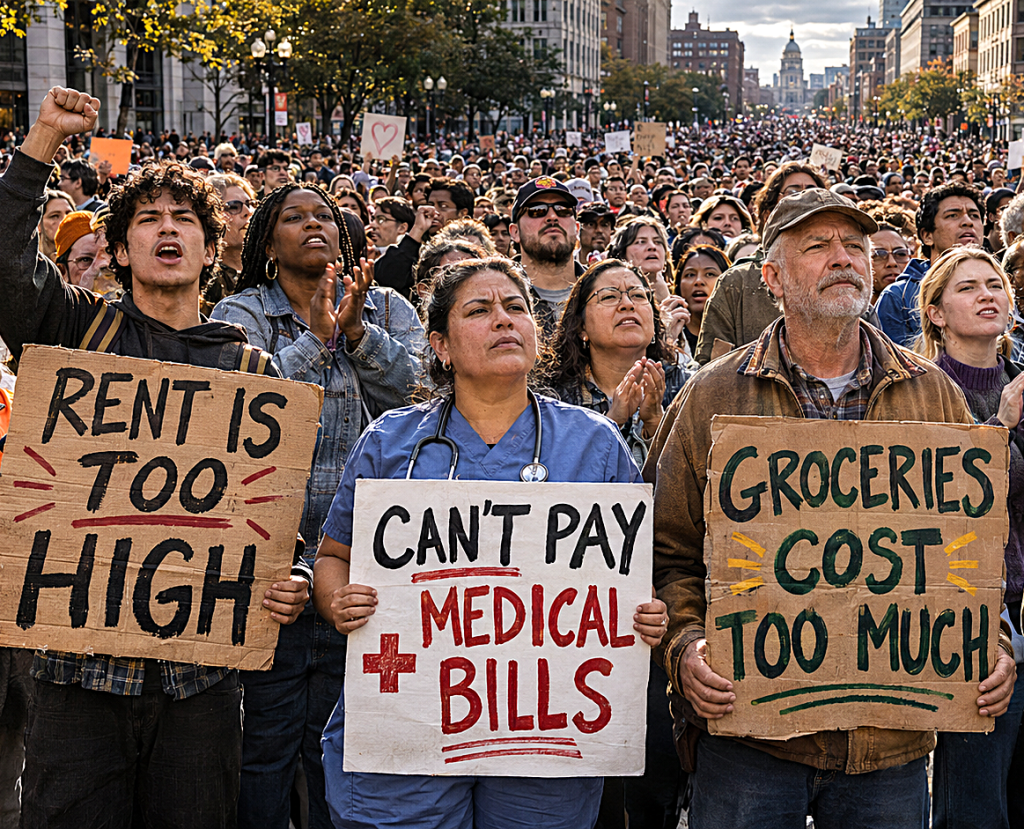
Set side by side, the six groups arrived at the same act by different routes. The unattached core judged the party in power, young voters responded to living costs and opposition to Trump, Latino and working-class voters reacted to prices and enforcement, the Reluctant Right objected to the war, moderates wanted a check on the White House, and a large share of 2024 Trump voters stayed home. Every one of these routes passed through the same set of costs. The question that follows is whether a group assembled this way can act together again.
A coalition of circumstance
Three tests separate a political bloc from a coalition of circumstance: whether its members share goals, whether they recognize themselves as a group, and whether they act together across more than one election. The 2026 middle fails all three, and the evidence for each failure comes from the same surveys that record its success.
The members do not share goals beyond the costs that brought them together. About one-third of those who voted for Democratic candidates this year called themselves democratic socialists, including just under half of those under 30 (Cappelletti & Sloan, 2026), while the moderates who ran in Republican-leaning states distanced themselves from their party’s left (Third Way, 2026). The Working Families Party claims its agenda of taxing billionaires and pausing data centers won the election (Cameron, 2026), an agenda that sits uneasily with Republican-leaning voters whose main complaints were the war and inflation. Immigration divides the groups further. Latino voters moved away from Republicans partly over how enforcement was carried out (Associated Press, 2026b), while the Trump voters Vance hopes to recover want America put first (D’Abrosca, 2026). On Israel, 64% of independents favor reducing or ending military aid (Smeltz et al., 2026), a position close to that of Vance’s defectors and at odds with the pro-Israel views of Democrats such as Governor Josh Shapiro of Pennsylvania (Politi, 2026). The coalition agreed about what had gone wrong and disagreed about what should come next.
Nor do its members recognize themselves as a group. Independents view both parties unfavorably: 58% of them held an unfavorable view of the Democratic Party they had just supported (Winston, 2026). Most Americans say they want a third party, yet in Gallup’s 2025 surveys only 15% of adults, and 29% of independents, said they would be very likely to vote for a third-party candidate, and 54% said they would switch to a major-party candidate if their preferred one had little chance of winning (Jones, 2025). The independent candidates who tested the idea this year did not get there either. The Independent Center, which advocates for independent voters, recorded second-place finishes and no victories among the nine strongest independent campaigns it tracked (Independent Center, 2026), and Kevin Smith, a political scientist quoted by Nebraska Public Media after Dan Osborn’s Senate campaign there, said the results now suggest a ceiling for independent candidates (Wade, 2026). A group that will not vote for its own candidates cannot organize as a bloc.
The third test, durability, is where the coalition is weakest. Gallup’s data show independents leaning Republican in 2024, under Joe Biden, and Democratic in 2025, under Trump, and the firm attributes such shifts to the unpopularity of the sitting president, with Democratic favorability still among the lowest it has recorded (Jones, 2026). Tuerk’s warning that Latino voters are “on probation” says the same thing in plainer words (Associated Press, 2026b). And if two-thirds of the swing came from Trump voters staying home (Political Wire, 2026), a large part of the coalition can disappear in 2028 simply by voting again.
The strongest case for calling the middle a bloc rests on its persistence. Republicans have now lost independents in five consecutive elections (Winston, 2026), the independent share of the population keeps growing with each new generation (Jones, 2026), and Morris Fiorina of Stanford and the Hoover Institution has documented a “historically unprecedented period of electoral instability” in which nonaligned voters repeatedly decide who governs (Fiorina, 2024). What persists in that record, however, is the pool of unattached voters and their habit of punishing the party in power. The coalitions drawn from the pool change with each election. The 2024 version elected Trump with the help of many of the same young and Latino voters who turned against his party this year (Associated Press, 2026b; Sanders et al., 2026). A permanent supply of swing voters is a condition of American politics; the coalition of 2026 is one temporary arrangement of it.
“Accidental” is therefore a fair description of how the coalition formed, in the sense that nobody organized it. No party, leader, or movement assembled these groups. The war, the prices, and the tariffs of the past two years did. That origin defines the practical problem for 2027 through 2029: anyone who wants the coalition’s votes must rebuild it from separate parts, and the parts will pull apart as the circumstances that joined them change.
2027 to 2029: how the coalition comes apart
The coalition’s future depends on three developments in sequence: whether its shared grievances persist through 2027, how the parties’ nominating contests sort its pieces in late 2027 and 2028, and what the 2028 winner owes it once in office. What follows is a projection, built from current evidence, of how each stage is likely to unfold.
The war is the grievance most likely to change first, and its end would hurt the coalition more than any other development. As of early November, mediators were still trying to prevent a return to large-scale fighting, the United States was striking Iranian targets and maintaining a naval blockade, and Washington appeared unwilling to accept Tehran’s seven demands for ending the war (Motamedi, 2026). The war is what linked the Reluctant Right to independents and young voters, and one Vance ally put the Republican calculation plainly: if the war is not ended, no Republican has a chance in 2028 (CNN, 2026). A settlement in 2027 would remove the issue that pulled anti-war conservatives away from their party, and the Republicans who most clearly opposed the war, Vance among them, would be the first to benefit. A war that drags into 2028 would keep that part of the coalition available to Democrats.
Prices are likely to ease more slowly, and the credit for any relief will be disputed. The Peterson Institute for International Economics projects headline inflation falling from 3.7% over 2026 to 2.3% in 2027 and Brent crude oil declining from about $100 a barrel to just over $80 by the end of 2027 (Dynan, 2026). If that happens, the most widely shared complaint of 2026 will be weaker by the time the 2028 campaign begins. Tariffs may move the other way. After the Supreme Court ruled in February that the International Emergency Economic Powers Act does not authorize tariffs (Hillman, 2026), and after the temporary replacement duties expired in July, the administration imposed new duties of 10% or 12.5% on 60 economies under a different statute, alongside a long list of product tariffs on steel, cars, pharmaceuticals, and other goods (Congressional Research Service, 2026). Democratic leaders have measures ready to reverse them (Mascaro, 2026), but Trump has said he holds “total veto power, so they have to come to us” (Altman-Devilbiss, 2026). Tariffs are therefore likely to remain in place through 2028, a cost the middle will continue to feel and Democrats will continue to attribute to the president.
The new Congress will be the first place where the coalition’s internal differences become visible. House Democrats have prepared a 100-day agenda that includes restoring Affordable Care Act tax credits, reversing Medicaid cuts, reversing tariffs, and forcing more votes on the war; their oversight and judiciary leaders are preparing investigations into Trump, his family, and his administration; and Hakeem Jeffries has said impeachment is “neither on nor off the table” (Mascaro, 2026). Some measures have Republican partners. Senator Josh Hawley supports a ban on stock trading by members of Congress, calling it “my bill that’s currently pending,” and Senate Democrats will need Republican votes to clear the 60-vote threshold on most legislation (Cowan, 2026). Fiorina’s account of recent history predicts the risk. Parties that win power tend to pursue policies more extreme than the electorate wants, and the backlash produces the next majority (Fiorina, 2024). The middle will measure 2027 by visible results on costs and corruption, and a stock-trading ban signed into law would count for more with it than any number of hearings.
The president’s response will also shape how long the coalition holds, because its members are united most firmly by what they oppose. Trump named his deputy chief of staff and homeland security adviser, Stephen Miller, as White House chief of staff days after the election (Al Jazeera, 2026a), and European officials worry that a president blocked at home will turn to foreign policy, where he has more room to act; one EU diplomat predicted he would be “more a ‘mad dog’ than a ‘lame duck’” (Genovese et al., 2026). A confrontational final two years, with harsher enforcement or new military action, would keep Latino voters, moderates, and anti-war conservatives together against the administration. A conciliatory one would give each of them less reason to stay together. On this point the coalition’s fate rests partly with the man it voted against.
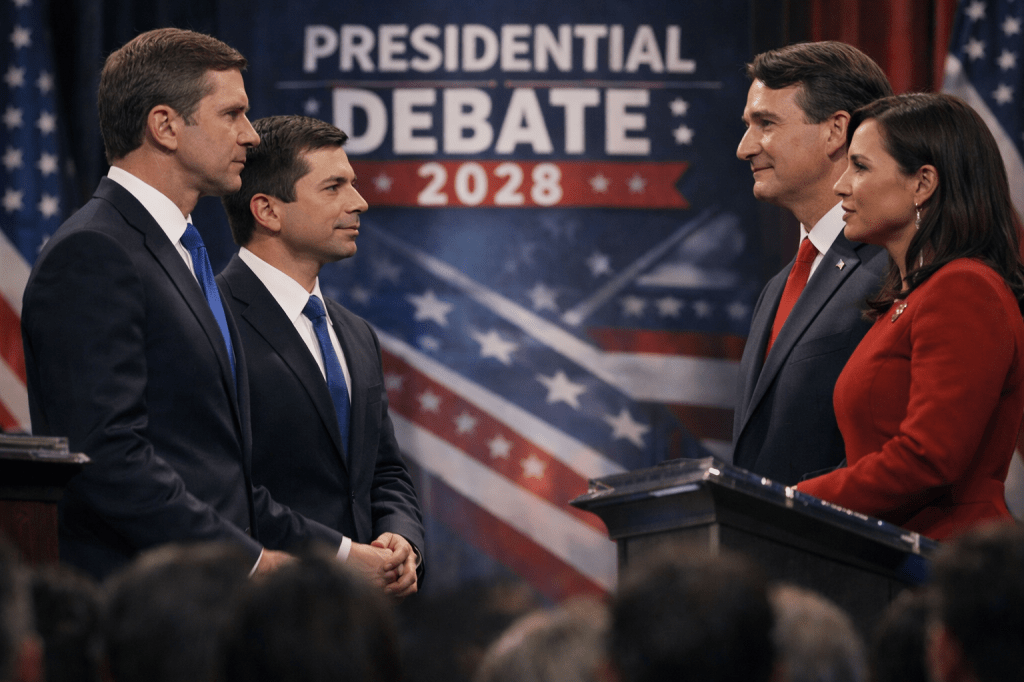
The nominating contests of late 2027 and early 2028 will begin sorting the pieces, and the rules favor some pieces over others. The Democratic calendar opens in South Carolina on January 22, 2028, followed by Nevada, New Hampshire, New Mexico, Michigan, and Virginia through February 29 (Al Jazeera, 2026b). States with large Black and Latino populations will speak early, which gives the Latino voters now “on probation” an unusual degree of influence. Unattached voters have much less. In 2024, 22 states held closed presidential primaries or caucuses, excluding about 27 million registered voters outside the major parties (Macomber, 2024). The contest itself will pit the moderates’ argument against the progressives’. Third Way cites polling in which 52% of Democrats and Democratic-leaning independents want the next nominee to move to the center (Third Way, 2026), while Representative Ro Khanna, a progressive considering a run, says the race should be “an ideological brawl” (Cappelletti & Sloan, 2026). The field described by the Financial Times runs from Governor Josh Shapiro of Pennsylvania, a centrist, to Governor Gavin Newsom of California and Representative Alexandria Ocasio-Cortez of New York (Politi, 2026). A nominee chosen mainly by the party’s committed voters could appeal strongly to one piece of the 2026 coalition, young progressives for example, while losing another, such as the Reluctant Right.
Republicans face a mirror image of that problem. Vance’s post-election program of ending the war, cutting costs, putting America first, and changing the relationship with Israel is an attempt to recover the anti-war and price-sensitive voters who left in 2026 (D’Abrosca, 2026). It irritated Trump, and Vance has seriously considered not running (CNN, 2026). Secretary of State Marco Rubio, seen as closer to traditional Republican positions, is the most likely alternative (Politi, 2026). Tucker Carlson’s talk of a third-party campaign threatens the opposite outcome: a split on the right that would separate the America First dissidents from the party altogether (CNN, 2026). One Republican advantage is easy to overlook. If two-thirds of the 2026 swing came from Trump voters who stayed home (Political Wire, 2026), the cheapest pieces of the coalition to recover are people who already voted Republican once and need only a reason to vote again. A nominee who can bring them back recovers much of the lost ground without persuading anyone new.
By November 7, 2028, three outcomes are plausible. In the first, Democrats hold the coalition together: prices have eased, Congress can point to measurable results, the nominee is acceptable to moderates and Latino voters, and young turnout stays high. In the second, Republicans rebuild their 2024 coalition: the war has ended, inflation is lower, the abstainers return, and a candidate running on Vance’s four tasks wins back much of the Reluctant Right. In the third, the right divides. A Carlson-style independent campaign would draw America First voters away from the Republican nominee, and the Perot precedent suggests it would shape the outcome without winning it, since Perot took about 19% of the vote in 1992 and no electoral votes (McGee, 2020). Which of these occurs will depend less on the size of the independent middle than on which party offers more of its groups a reason to vote, and on which party’s abstainers decide to stay home.
Whoever wins in 2028 will take office in January 2029 owing the presidency to a coalition assembled against the other side, and the record of recent years suggests that such debts are short-term. Gallup’s data show independents turning against the party of each unpopular president in turn (Jones, 2026). The new administration’s first-year decisions on tariffs, foreign commitments, and the federal budget will be judged by the same standard of measurable results that defeated its predecessor’s party, and the voters most ready to apply that standard are the 56% of Generation Z adults who call themselves independents (Jones, 2026).
Three questions follow from this projection, and each deserves wider discussion than one article can give it. The first is whether abstention has become the main way discontented partisans register a verdict, which would make turnout more decisive than persuasion in 2028. The second is whether the end of the Iran war, which every party says it wants, would cost Democrats the cross-partisan support the war created. The third is whether any party can govern for long with a coalition it did not build and does not command.
What history says, and why it matters
The 2026 coalition is the latest and largest case of a pattern that has been building for three decades. Independents have been the largest political group in most years since Gallup began its regular telephone polling in 1988 (Jones, 2026), yet pure independents are now at a 70-year low (Smith, 2026). The two findings fit together. More Americans refuse a party label, while fewer are truly unattached; most behave as conditional partisans who stay with a party only while it performs. Such voters produce swing coalitions, and they rarely produce new parties.
That distinction matters because, in the past, the voters who punished both parties built third parties to do it. Richard Hofstadter observed that when a third party’s demands become popular enough, one or both major parties take them over and the third party disappears (Hofstadter, 1955). Bernard Tamas of Valdosta State University traces that sequence through the Populists of the 1890s, who ran joint candidates with the Democrats in 1896 and had disappeared by 1900, and the Progressives of the 1910s, who cost Republicans seats until the party moderated and absorbed them by 1920 (Tamas, 2025). Ross Perot followed the same course. His 1992 campaign put the federal deficit at the center of national debate, Republicans made fiscal discipline part of their 1994 Contract with America, and the political scientists Rapoport and Stone concluded that “neither party could afford to offend” Perot’s voters (McGee, 2020). The 2026 coalition reached the same point without a party, a candidate, or a platform. It punished the governing party directly, and the first sign of absorption is already visible in Vance’s four tasks, which read as a list of the coalition’s complaints.
That is the historical significance of the episode: the work that third parties once did is now done by shifting coalitions inside the two-party vote. Fiorina has described the result as a period of instability with no precedent in American history, driven by sorted parties that overreach once in power and lose the voters who put them there (Fiorina, 2024). The Independent Center, an advocacy group, counts a change of party control in at least one chamber of Congress in 11 of the 14 national elections since 2000 (Independent Center, 2026). The 2026 midterms extend that record and suggest it will continue, because the pool of voters who produce such swings is growing with each generation.
For the United States over the next three years, the consequence is government on a short schedule. Each governing party now has about two years to show results before the coalition that elected it is reconsidered, and that schedule rewards measures voters can see quickly, such as lower prices, a ban on congressional stock trading, or the end of a war, over long projects whose benefits arrive later. It also encourages parties to treat turnout as the main lever, since the 2026 results show how much can be won or lost by which partisans bother to vote. Policy reversals are the price. Tariffs, health subsidies, immigration enforcement, and military commitments have all changed direction with changes of party control, and nothing in the 2026 result suggests that pattern will end before 2029.
For the rest of the world, the same instability shapes how other governments deal with Washington. European officials responded to the midterm result with concern that a weakened president would act more unpredictably abroad; David McAllister, who chairs the European Parliament’s foreign affairs committee, responded that Europe must continue to do more for its own defense (Genovese et al., 2026). The preferences of the American middle point toward a more cautious foreign policy. In the Chicago Council on Global Affairs survey taken in July, 67% of independents preferred that the United States share global leadership with other countries, and 76% said the Iran war had not been worth its costs (Smeltz et al., 2026). Those preferences will influence American policy only when they decide an election, and the coalition that carries them changes from one election to the next. Allies and adversaries alike are therefore likely to keep hedging, planning for an American government that may reverse itself every two to four years.
The independent middle that decided the 2026 midterms was a coalition of young voters, Latino and working-class voters, anti-war conservatives, suburban moderates, a small unattached core, and a large number of Trump voters who stayed home. Its members agreed about the costs of the past two years and about little else. That agreement was enough to defeat a governing party and is unlikely to survive the end of the conditions that produced it. Between 2027 and 2029 the coalition will be pulled apart by the end or continuation of the war, the pace of price relief, the choices of the new Congress and the president, and the nominating rules of both parties, and the 2028 election will go to whichever party puts more of its pieces back together. The larger pool of unattached voters from which it was drawn will remain, and it will continue to decide American elections, and with them the reliability of American commitments abroad, for years after 2029.
References
Al Jazeera. (2026a, November 6). Trump names Stephen Miller as new chief of staff, replacing Susie Wiles. https://www.aljazeera.com/news/2026/11/6/trump-says-making-adviser-stephen-miller-white-house-chief-of-staff
Al Jazeera. (2026b, August 15). US Democrats finalise major shakeup to 2028 presidential primary calendar. https://www.aljazeera.com/news/2026/8/15/us-democrats-finalise-major-shakeup-to-2028-presidential-primary-calendar
Altman-Devilbiss, A. (2026, November 4). Vance blames Iran war for GOP midterm losses, says Trump voters defected. The National News Desk. https://cbsaustin.com/news/nation-world/vice-president-jd-vance-blames-iran-war-for-gop-republican-midterm-election-losses-says-president-trump-voters-defected-cost-of-living-inflation-israel-congress-house-senate
Associated Press. (2026a, November 18). 2026 U.S. House and U.S. Senate election results [Live results as of 9:58 a.m. HST]. https://apnews.com/hub/elections
Associated Press. (2026b, November 6). Latino voters swing left in midterm elections, lifting Democrats to big wins in Texas and nationwide. ITV News. https://www.itv.com/news/2026-11-06/latino-voters-swing-left-in-midterms-lifting-democrats-to-big-wins
Axios. (2026, January 20). Report: Young Trump voters drive a sharp cultural turn. https://www.axios.com/2026/01/20/young-trump-voters-traditionalism-right-wing
Cameron, H. (2026, November). Democrats are divided over what midterm victory means. Newsweek. https://www.newsweek.com/democrats-are-divided-over-what-midterm-victory-means-12695753
Cappelletti, J., & Sloan, S. (2026, November 5). Democrats’ victory was clear. The party’s future is not. Associated Press via KSAT. https://www.ksat.com/news/politics/2026/11/05/democrats-victory-was-clear-the-partys-future-is-not/
CNN. (2026, November 13). Once Trump’s presumed heir, Vance is wrestling with his political future. https://www.cnn.com/2026/11/13/politics/jd-vance-2028-presidential-campaign
Congressional Research Service. (2026, October 8). Active presidential tariff actions in 2026: Fact sheet (CRS Report R49481). https://www.everycrsreport.com/reports/R49481.html
Cooper, M. L. (2026, October 20). Elections 2026: Most independents lean R or D. KSFR. https://www.ksfr.org/election-2026/2026-10-19/elections-2026-most-independents-lean-r-or-d
Cowan, R. (2026, November 16). US Congress Democrats plot ‘must-have’ victories in 2027. Reuters via Lee Enterprises. https://news.lee.net/news/nation-world/government-politics/us-congress-democrats-plot-must-have-victories-in-2027/article_e36ed7ca-5afb-5d73-ac62-37224d4a7d23.html
D’Abrosca, P. (2026, November 4). JD Vance blames Iran war for GOP midterm losses in post-election post. Fox News. https://www.foxnews.com/politics/vance-courting-disgruntled-trump-voters-form-new-right-alliance-republican-bloodbath
Dynan, K. (2026, October 6). Global growth remains solid in a challenging environment. Peterson Institute for International Economics. https://www.piie.com/blogs/realtime-economics/2026/global-growth-remains-solid-challenging-environment
Fiorina, M. P. (2024, September 24). Historical context: An era of tenuous majorities continues. Hoover Institution. https://www.hoover.org/node/362556
Genovese, V., Vakulina, S., Corlin, P., & Pacheco, M. (2026, November 4). Lame duck or mad dog? Why Trump’s defeat could spell trouble for Europe. Euronews. https://www.euronews.com/2026/11/04/lame-duck-or-mad-dog-why-trumps-defeat-could-spell-trouble-for-europe
Gotta, J. (2026, November 18). Turnout fueled historic midterm shift toward Democrats among young voters. KPBS. https://www.kpbs.org/news/politics/2026/11/18/turnout-fueled-historic-midterm-shift-toward-democrats-among-young-voters
Hillman, J. A. (2026, February 23). The Supreme Court clipped Trump’s tariff powers and opened new trade battle fronts. Council on Foreign Relations. https://www.cfr.org/articles/the-supreme-court-clipped-trumps-tariff-powers-and-opened-new-trade-battle-fronts
Hofstadter, R. (1955). The age of reform: From Bryan to F.D.R. Knopf. https://archive.org/stream/in.ernet.dli.2015.187961/2015.187961.The-Age-Of-Reform_djvu.txt
Independent Center. (2026, November 10). Post-election analysis: The real historic story of 2026. https://www.independentcenter.org/articles/post-election-analysis-real-historic-story-of-2026
Jones, J. M. (2025, October 20). Americans see need for third party, but offer soft support. Gallup. https://news.gallup.com/poll/696521/americans-need-third-party-offer-soft-support.aspx
Jones, J. M. (2026, January 12). New high of 45% in U.S. identify as political independents. Gallup. https://news.gallup.com/poll/700499/new-high-identify-political-independents.aspx
Macomber, C. (2024, February 13). New UA Institute report: Key learnings about excluded independents. Unite America. https://uniteamerica.org/articles/new-ua-institute-report-key-learnings-about-excluded-independents
Mascaro, L. (2026, October 14). Here’s what’s on House Democrats’ agenda if they sweep to power in midterm elections. Associated Press via PBS News. https://www.pbs.org/newshour/politics/heres-whats-on-house-democrats-agenda-if-they-sweep-to-power-in-midterm-elections
McGee, S. (2020, October 6; updated 2025, June 30). How billionaire Ross Perot brought populism back to presidential politics. History.com. https://www.history.com/articles/ross-perot-populist-1992-election-changed-politics
More in Common. (2026, April 16). Trump won with these voters. Now their support is shifting. https://moreincommon.substack.com/p/trump-won-with-these-voters-now-their
Motamedi, M. (2026, November 9). Iran stands by demands to end the war as US ramps up military pressure. Al Jazeera. https://www.aljazeera.com/news/2026/11/9/iran-stands-by-demands-to-end-the-war-as-us-ramps-up-military-pressure
NBC News. (2026, November). National exit polls: Election 2026 results. https://www.nbcnews.com/politics/2026-elections/exit-polls
Petrova, K. (2026, July 2). What millions of voter records reveal about political independents. PsyPost. https://www.psypost.org/independent-voters-are-mostly-ideological-moderates-seeking-political-flexibilit/
Political Wire. (2026, November 16). Trump voters who stayed home cost GOP midterms. https://politicalwire.com/2026/11/16/trump-voters-who-stayed-home-cost-gop-midterms/
Politi, J. (2026, November 5). The race for the 2028 US presidential election has begun. Who’s in the lead? The Irish Times. https://www.irishtimes.com/world/us/2026/11/05/the-next-us-presidential-race-has-begun/
Sanders, L., Lodhi, H., & Yoo, H. (2026, November 3). AP Voter Poll: How key demographic groups voted in the 2026 midterms. Associated Press via PBS News. https://www.pbs.org/newshour/politics/ap-voter-poll-how-key-demographic-groups-voted-in-the-2026-midterms
Schneid, R. (2026, November 4). What Democrats’ midterm gains reveal about Trump’s voter coalition. TIME. https://time.com/article/2026/11/04/what-democrats-midterm-gains-reveal-about-trump-s-voter-coalition/
Smeltz, D., Kafura, C., El Baz, L., & Bach, C. (2026, October 1). Americans, foreign policy, and the 2026 midterms. Chicago Council on Global Affairs. https://globalaffairs.org/research/public-opinion-survey/americans-foreign-policy-and-2026-midterms
Smith, C. (2026, January 12). More voters say they’re independent, but shifting support ‘a big-time problem’ for GOP. The National News Desk. https://newschannel9.com/news/nation-world/more-voters-say-theyre-independent-but-shifting-support-a-big-time-problem-for-gop
Tamas, B. (2025, November 5). American third parties in 2024: Why third parties fail even in the best circumstances [Conference paper]. State of the Parties: 2024 & Beyond, Ray C. Bliss Institute of Applied Politics, University of Akron. https://www.uakron.edu/bliss/docs/2025-State-of-the-Parties/tamas-sop25-paper.pdf
Third Way. (2026, November 4). Moderates made Democratic majorities. https://www.thirdway.org/memo/moderates-made-democratic-majorities
Wade, J. (2026, November 4). Nebraska Democratic Party leader says third party candidates contributed to Osborn loss. Nebraska Public Media. https://nebraskapublicmedia.org/en/news/news-articles/nebraska-democratic-party-leader-says-third-party-candidates-contributed-to-osborn-loss/
Winston, D. (2026, November 11). Independents decide the election, again! Roll Call. https://rollcall.com/2026/11/11/independents-decide-the-election-again/
###
Filed under: Uncategorized |































































































































































































































































































































































































































































































Leave a Reply