





By Jim Shimabukuro (assisted by Claude, ChatGPT, and Perplexity)
Editor
How the chatbot prompt broke the traditional model of the writing process, and what a transparent replacement will require
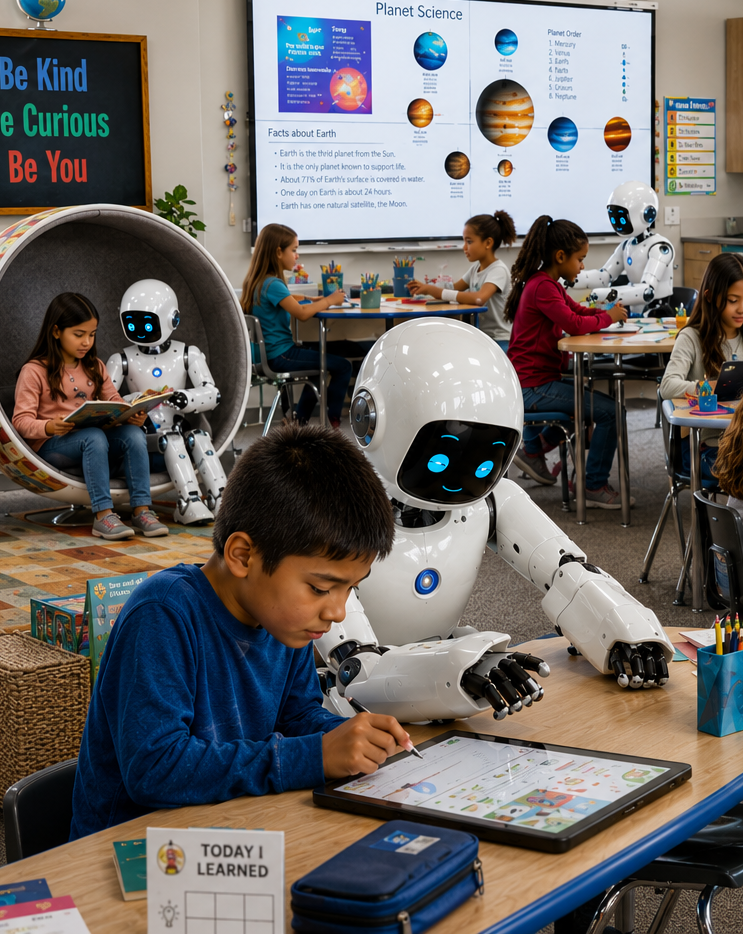
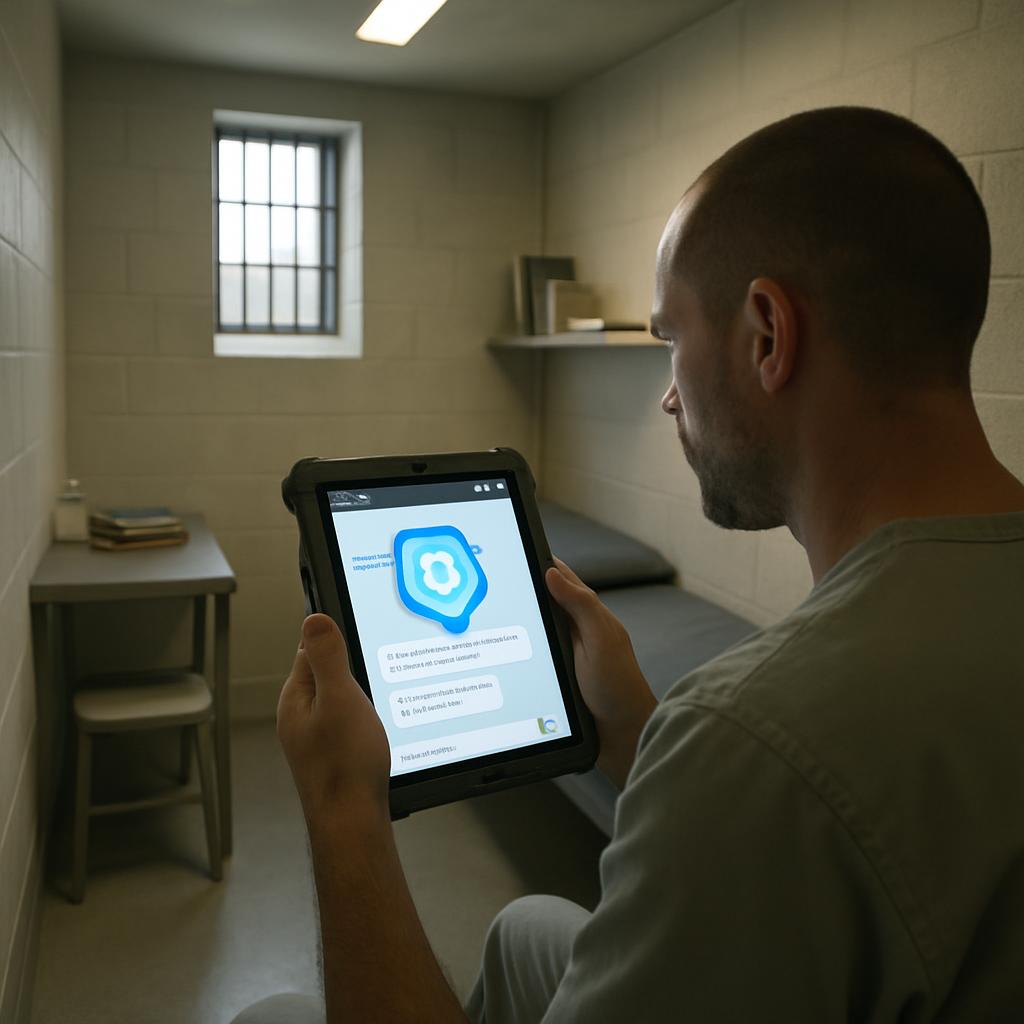
On October 19, 2026, Google began rolling out a feature for teachers who assign Gemini Notebooks through Google Classroom. Teachers now receive an AI-written summary of how a class engaged with an assigned notebook, a sample of common questions and areas where students may need support, and, for each student, the full chat transcript “for additional context and to confirm the accuracy of AI provided insights” (Google Workspace Updates, 2026). Students see a notice that their conversations are visible. Brit Mennuti, Google Classroom’s product lead, told EdTech Magazine what that notice says: “When students interact with these teacher-led AI experiences, there’s a prominent banner in the Gemini app or Gemini Notebook that lets them know: Your teacher can see what you’re doing here” (Stone, 2026).

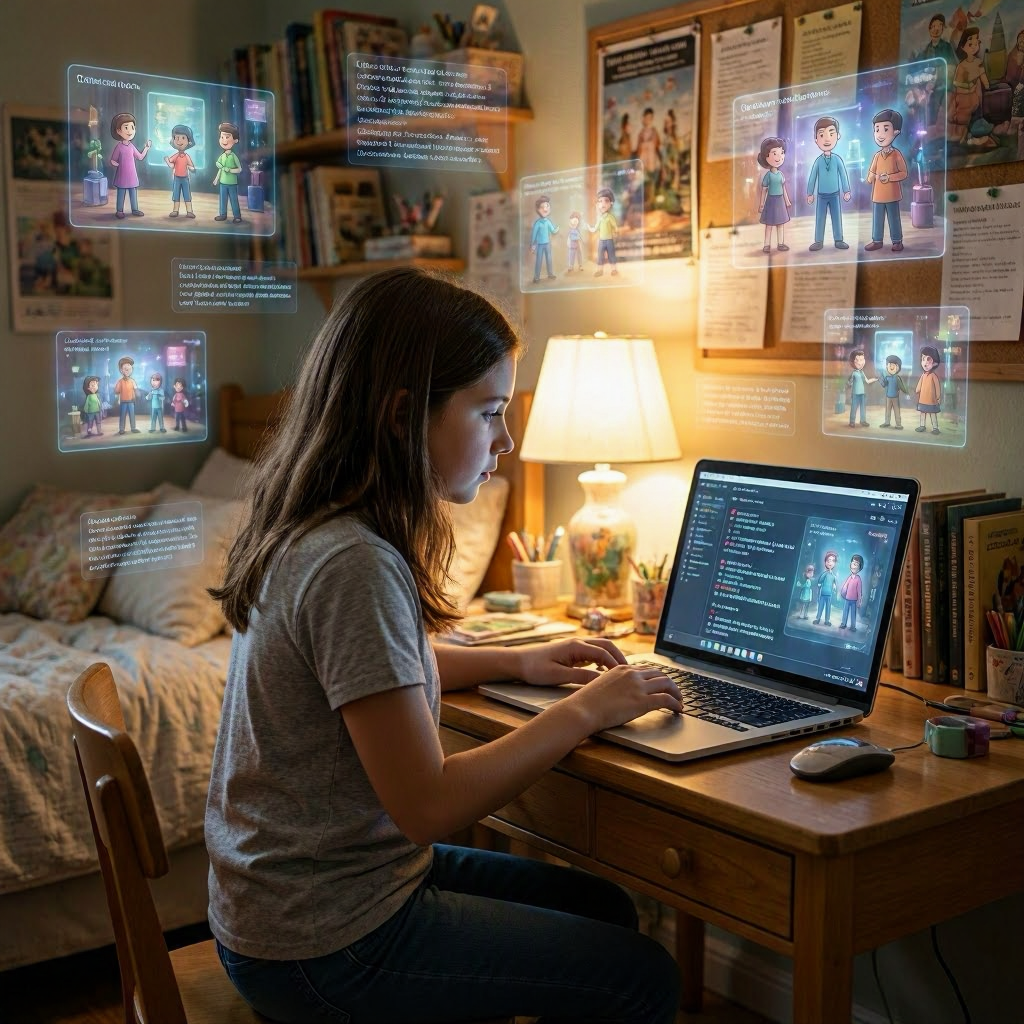
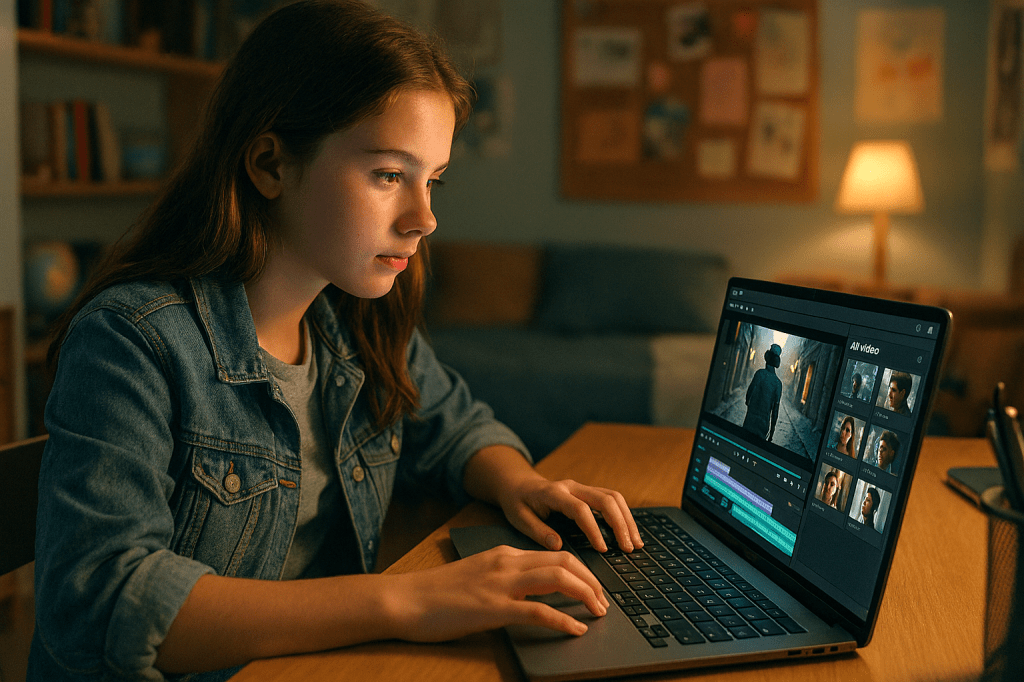
The feature is a small one, easy to miss among a season of product announcements. It also reflects a change in what writing teachers can know about how their students write. Under the model that has guided writing instruction since the late 1970s, the most important parts of composing happen inside the writer’s head, where no teacher can watch them. When a student writes by directing a chatbot, many of those decisions have to be typed out as instructions, and the instructions are saved. The planning, the second thoughts, the request to cut a paragraph or find a stronger source now leave a written trail.
This article looks at that trail: what research published in 2026 shows it contains, why it does not fit the older model, the tools and policies now being built around it, and the objections of teachers and scholars who regard it as surveillance. The argument here is that the prompt record is an anomaly the traditional model cannot absorb, and that the transparent model now taking shape will work only if students own their records and the conversation between teacher and student stays at its center.
A model that lived inside the head
In 1981, Linda Flower and John Hayes published “A Cognitive Process Theory of Writing” in College Composition and Communication. They described writing as a set of mental activities, chiefly planning, translating ideas into language, and reviewing, that writers move among repeatedly, guided by goals that change as the work develops (Flower & Hayes, 1981). The model explained what experienced teachers had seen for years. Writers discover what they think while writing, and a conclusion can expose a flaw in the thesis that sends the writer back to the beginning.
The process movement built a teaching practice on that insight. Teachers collected drafts and portfolios, held conferences, assigned peer review, and asked for reflective memos. Each practice offered a partial view of the writer’s thinking. A teacher holding a student’s first and third drafts can see what changed but usually not why. A paragraph may have been rewritten because the student spotted a weak argument, because a classmate objected, or because the student simply liked the new sentence better. The draft records the result of a decision. The decision itself stays private.
The tension between process and product in assessment is older than Flower and Hayes. Academic developers at the University of Sussex noted in January that the “process model” of curriculum “was first introduced by Stenhouse in 1975 as an alternative to the product model,” and they made the case for reviving it in the AI era: “Shifting the focus from product to process allows us to foreground thinking, development, and learning” (Watson & Bateman, 2026). For roughly half a century, then, process teaching has had a strong theory and thin evidence. The theory said the important work was cognitive. The evidence available to teachers was mostly text.
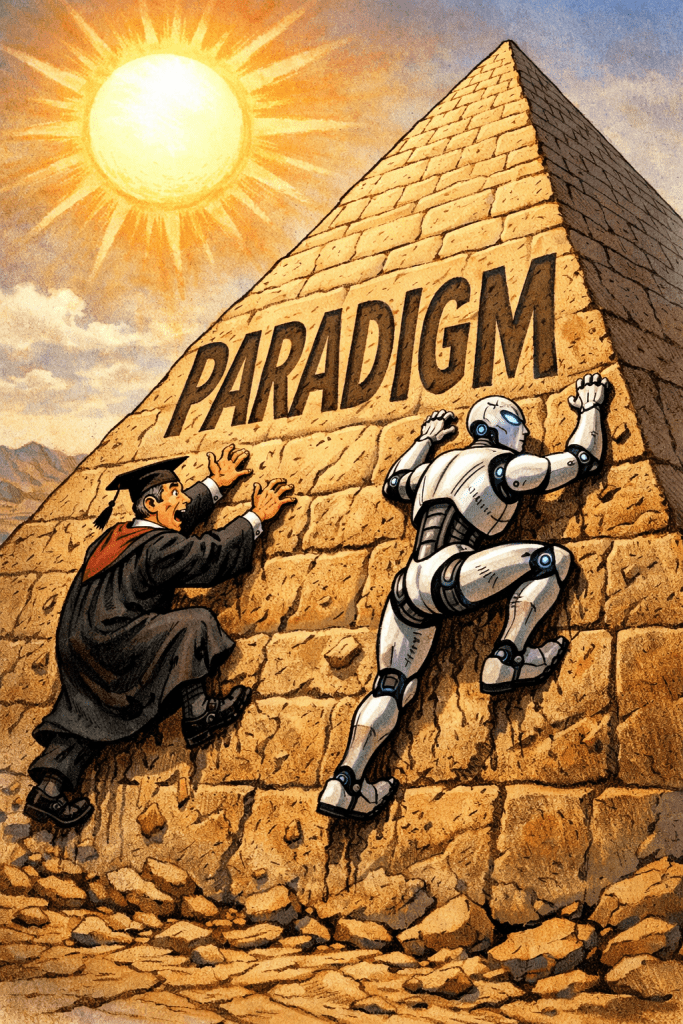
The historian of science Thomas Kuhn described the kind of problem that eventually unsettles a working model. In the summary of Kuhn’s work by the philosopher Alexander Bird, “a crisis in science arises when confidence is lost in the ability of the paradigm to solve particularly worrying puzzles called ‘anomalies’” (Bird, 2025). One odd result rarely matters: “It is only the accumulation of particularly troublesome anomalies that poses a serious problem for the existing disciplinary matrix.” Kuhn wrote about science, and the comparison to writing instruction has limits. Still, the field now faces two troublesome facts that the process model was not designed to handle. The finished text has stopped being reliable evidence of who did the thinking, and a new kind of evidence, the conversation with the machine, has appeared beside it. ETC Journal raised the question of a paradigm shift in two articles last June (Shimabukuro, 2026a, 2026b). The research published since then makes the case more concrete.
The finished essay stops being evidence
The first fact arrived through detection. Turnitin reported in February that from October 2025 through February 2026, about 15% of the essays it checked contained more than 80% AI-generated writing, up from about 3% when its detector launched in April 2023 (Turnitin, 2026). Detectors themselves have lost credibility with many instructors. In an April feature in the American Psychological Association’s Monitor on Psychology, Liz Delf of Oregon State University warned that “use of these checkers can lead to false accusations and can create an adversarial relationship with students” (Abrams, 2026).
By late October the problem had spread well beyond essays. Richard Borcherds, a Fields Medal–winning mathematician at the University of California, Berkeley, told Newsweek that AI “makes it increasingly difficult to tell whether a homework solution represents the student’s own understanding or was generated by AI,” and he now grades homework for completion rather than correctness (Greenwood & Silverman, 2026). Eric Klopfer of MIT told the same reporters, “At this point, at least for some students, homework is no longer a valid evaluation of their learning.” An education newsletter summed up the situation on October 28: “Detection-only tools now share the weakness that undercut version-history trails, because whatever the software reads as evidence, another tool can learn to fake” (A. Chen, 2026).
Many teachers have responded by moving writing back into the classroom. The San Francisco Standard reported on October 21 on Eliza Russo, a teacher who shifted her essays to in-class handwritten work after detecting AI use. “I did not become a teacher to become a cop,” she said (Wallach, 2026). The University of Chicago has prohibited AI in its core social science courses this fall, according to a division memo quoted by Ray Schroeder in Inside Higher Ed (Schroeder, 2026). These measures protect the finished product as evidence by removing the machine. They also sacrifice much of what process teachers spent decades building, because a timed essay written in one sitting leaves little room for planning or revision. Jon Lang, who works on writing assessment at UC Berkeley, made the point in the Standard: college writing “requires that they draft and redraft. If they’re only taught how to write to the exam, they never revise” (Wallach, 2026).
What the conversation logs show
The second fact is the record itself. Researchers who capture student conversations with chatbots are finding that the logs answer questions that drafts never could.
Several of these studies borrow Flower and Hayes’s categories directly. Sarah Levine and colleagues at Stanford analyzed screencasts of high school students writing arguments with ChatGPT. “While planning and drafting, students primarily asked ChatGPT for ideas and then built upon those ideas to develop their own arguments,” they report, and “while reviewing, they generally used ChatGPT as they might use Grammarly or other editing tools” (Levine et al., 2025).
A Virginia Tech team led by computer scientist Sang Won Lee went further. They built a writing environment with its own ChatGPT window, logged every query and copy-paste, and sorted the queries by Flower and Hayes’s stages of planning, translating, and reviewing, with a fourth category for requests to write everything (Jelson et al., 2026). The paper notes that such queries are “typically hidden from instructors.” The work was presented at the CHI conference on human-computer interaction in Barcelona in April, and Virginia Tech’s October 8 account of it reports that “in nearly half of all AI interactions, students asked the tool to write the essay for them” and that “among 77 students in the study, six wrote without using ChatGPT at all” (Moxley, 2026). Students who used AI for planning or revising reported ownership of their essays comparable to those who did not use it. “Even if they used ChatGPT to give them all of their ideas, they still felt ownership of the essay,” said Andrew Jelson, the doctoral student who led the research.
Other studies show what students ask for. Maya Usher and Meital Amzalag analyzed the chatbot conversations of 43 graduate students and sorted the requests into seven types. Content generation and expansion accounted for 34.66% of prompt segments, followed by source integration and verification at 28.22%, while translation help was the least common at 2.83% (Usher & Amzalag, 2025). Jon Olav Sørhaug of the University of Agder examined 895 prompts from 108 Norwegian K–12 students and found that “generative AI extensively produced content on student’s behalf, even when students primarily sought scaffolding” (Sørhaug, 2026). In the logs, the student’s request and the machine’s response are separate items, and they often diverge. A student who asked for help organizing an essay may receive a finished paragraph. Only the conversation shows that gap.
Stine Brynildsen of Østfold University of Applied Sciences in Norway recorded the screens and faces of ten upper secondary students as they wrote with chatbots. She concluded that “chatbot-mediated writing is neither uniform nor routinized as students display diverse practices” (Brynildsen, 2026). One consequence, she writes, “is that the boundary between what is human and what is tool is blurred.”
Data from outside the classroom point the same way. Anthropic’s AI Fluency Index, released in February and based on 9,830 multi-turn conversations on Claude.ai, found that 85.7% of conversations included iteration, meaning users built on earlier responses rather than accepting the first one. But when the model produced a finished artifact such as a document or code, “users are 5.2 percentage points less likely to identify missing context, 3.7 points less likely to check facts, and 3.1 points less likely to question the model’s reasoning” (Thompson, 2026). The more finished the output looks, the less people question it, and that pattern is visible only in the record of the exchange.
The prompt as the composing act
These findings support the central claim of the emerging model. When a student writes by directing a chatbot, the prompt becomes the main observable act of composing. The student’s reading of the assignment, judgments about the draft, and decisions about what to change all have to be put into words before the machine can act on them.
Consider two students given the same assignment: an evidence-based argument on whether colleges should require AI literacy. The first types, “Write a 1,500-word essay about requiring AI literacy in college.” The second names the audience, separates basic literacy from technical training, lists the questions the essay must answer, asks for credible sources, and requires a section on opposing views. When the first draft arrives and recommends one required course for every student, the second student notices that it ignores differences between, say, engineering and history majors, and asks the machine to address them. The revision introduces a new problem: it recommends mandatory coursework without discussing cost or faculty training. The student catches that too and asks again.
Neither student has written a sentence of the essay. A teacher reading their conversations can still learn a great deal about each one’s grasp of the assignment, eye for weak reasoning, and ability to state a problem precisely. A student who types “make it better” six times leaves a different record from one who names a specific flaw and asks for a fix that keeps the parts that already work.
Turnitin’s data from its Clarity writing environment, which includes an AI assistant that “helps, but refuses to write for, the student,” suggests that prompt quality can be measured at scale. The company reported that 29% of student prompts reviewed over two months asked for review or general feedback, that 94% of students wrote their own prompts instead of using suggested ones, and that “only a third of the prompts (36%) in the feedback category were considered effective” (Turnitin, 2026). These are vendor figures, and Turnitin has not published its criteria for “effective.” They do show that a major assessment company treats prompting as a gradable skill, and that by its measure most students have not yet learned it.
Controlled studies add weight. Mengmeng Fan and Pengcheng Chang of Zhengzhou University randomly assigned 744 undergraduates at one site to four “divisions of labour”: AI drafts and the student evaluates and revises; the student drafts and AI evaluates; the student drafts, AI revises, and the student rules on each change; and no AI. A smaller replication at a second site randomized 126 students (Fan & Chang, 2026). After all AI was withdrawn at a week-six post-test, “both arrangements in which the student judged AI-produced text outperformed the arrangement in which AI judged student-produced text and the no-AI control,” while “having AI evaluate was equivalent to no AI.” The logs revealed something the assignment rules could not. Students with a strong tendency to depend on the tool were “re-outsourcing their assigned evaluation” to the AI. The paper’s title states the lesson: “Telling Students to Evaluate Does Not Make It Happen.” The rules said what students were supposed to do, and the logs showed what some of them did.
Xinran Chen of Jinggangshan University found a related split in an eight-week study of 168 undergraduates in six English academic-writing classes. Students given open access to AI produced the strongest writing while the AI was available. At week eight, writing without AI, students who had worked under bounded assistance with required reflection “showed higher adjusted outcomes than open collaboration in writing quality … higher-order thinking … argument depth … and independent revision quality” (X. Chen, 2026). Chen cautions that because the conditions were assigned to only six intact classes, the results should be read as “classroom-level, mechanism-consistent associations rather than definitive causal effects.” The study separates two outcomes that a finished essay merges: how good the writing is with help, and how much the writer can do alone.
Zhe Dai’s study of 120 English majors tested ways of teaching students to handle AI feedback. Feedback-literacy training “primarily improved how students processed and enacted AI feedback,” calibration training “more directly strengthened students’ internal judgment,” and the combination produced “the strongest retention after AI support was removed” (Dai, 2026). A July review of 33 studies of AI feedback in second-language writing found that “higher-regulation learners typically engaged in selective uptake, recursive evaluation, and extended processing of AI feedback, whereas lower-regulation learners more frequently indicate rapid acceptance and reduced evaluative engagement” (Alghamdi & Alghizzi, 2026). Both findings rest on recorded traces of what students did with each suggestion.
The prompt record also exposes the assignment. If thirty students in a section misread the same requirement, their opening prompts will show it, and the instructor learns that the assignment needs rewriting. This places a new obligation on teachers. An instruction that students must translate into directions for a machine has to be clear enough to translate.
Building the transparent model
The tools that capture the record are already in schools. Turnitin Clarity, introduced in March 2025, shows instructors details “such as pasted text, typing patterns, construction time and draft history,” along with how students used the built-in AI assistant when the instructor enables it (Chechitelli, 2025). Grammarly Authorship labels text as typed, AI-generated, or pasted. In August, Grammarly announced that “instructors can require Authorship reports directly within Blackboard assignments,” and said that “students have generated more than 5 million Authorship reports to date” (Grammarly, 2026).
Researchers are working on ways to make the record easier to read. DraftMarks, developed at Georgia Tech and Stanford and presented at CHI 2026, overlays a document with marks modeled on paper drafts: eraser crumbs where the writer revised heavily, masking tape over AI-generated passages, glue residue where AI text was later removed, and faint ghost text for AI suggestions the writer rejected (Georgia Institute of Technology, 2026; Siddiqui et al., 2026). “By making the invisible parts of the process tangible, it forces writers to confront whether they are truly engaging with AI or just passively accepting it,” said lead author Momin Siddiqui, a master’s student at Georgia Tech.
Google’s October update addresses the practical obstacle that would otherwise stall the whole approach. A teacher with 100 students, each producing dozens of prompts per assignment, cannot read every conversation. An AI that reads them first and flags patterns, such as common misunderstandings or students who need help, makes the record usable at the scale of real courses. Google keeps the full transcripts available so that teachers can check the summary against the source, which answers the obvious worry about relying on one machine’s account of students’ work with another machine (Google Workspace Updates, 2026).
Policy is beginning to follow. Cornell University’s Center for Teaching Innovation offers instructors several forms of AI attribution, the most demanding of which asks for “the entire exchange (e.g., screenshots, copied texts, etc.), highlighting the relevant sections.” Its sample syllabus language admits the cost: “I recognize that requesting a transcript of your interactions with AI puts a higher burden on you; therefore, I encourage you to be intentional about how and when you use it” (Cornell University Center for Teaching Innovation, n.d.). In June, Steven Baule of Winona State University proposed a “transparency appendix” for high-stakes work that “typically identifies the tool(s) used, the phase of work in which they were used, representative prompts, a concise account of the output received, and an explanation of what the writer changed, verified, rejected, or expanded.” In that framework, he writes, “disclosure is not a punishment or a confession” (Baule, 2026). Schroeder’s October 28 column cites a systematic review by Helen Crompton and Diane Burke that lists “transparency of learning” among five ways educators are using generative AI in assessment, and he concludes that assessment redesign worldwide “is converging around process, authenticity and dialogue” (Schroeder, 2026).
The Virginia Tech team found evidence that visibility changes behavior. In a separate classroom deployment, students who knew their instructor could see their AI interactions asked the tool to write their essays far less often, even when submissions were anonymized. “This suggests that the students were internalizing the accountability norm,” Lee said (Moxley, 2026).
Evidence on whether transparency rules work in practice remains thin. A 2026 scoping review in the journal Computers by Itahisa Pérez Pérez and colleagues at the University of La Laguna in Spain found only 11 qualifying studies of transparency mechanisms in higher education assessment. The most common patterns were “the absence of explicit assessment (27.3%) and unverified self-disclosure (18.2%),” requirements were “often poorly specified (45.5%),” and evidence on workload and acceptability was rarely reported. The authors conclude that transparency is “more feasible when it is proportionate, grounded in clear expectations, and aligned with the assessment design, while avoiding punitive or overly surveillant dynamics” (Pérez Pérez et al., 2026).
The case against watching
That last phrase points to the strongest objection. Many writing teachers regard process tracking as surveillance, and their complaints are specific.
Morgan Banville of Massachusetts Maritime Academy, writing in June for the Digital Rhetoric Collaborative, described a loop built from learning-management analytics, proctoring software, plagiarism checkers, and process trackers. “In this surveillance loop, no one is trusted and everyone (and their writing) is under suspicion,” she wrote, and these mechanisms “promote compliance over genuine learning” (Banville, 2026). Michael G. Wagner argued in May that process trackers relocate the problem without solving it: “But watching someone type does not prove that they are thinking. The problem has simply migrated from the essay to the essayist” (Wagner, 2026). He reports that “students have reported deliberately introducing typographical errors and syntactic awkwardness to ensure their work appears adequately ‘human’ to the algorithm,” and that dictation software produces text that looks to process trackers like “instantaneous large-block paste events with zero construction time,” which puts students who rely on assistive technology under suspicion. Wagner locates the harm in how the tools are imposed: “The tools themselves, however, are not the problem. The coercive context is.”
The Conference on College Composition and Communication, the main professional body for college writing teachers, passed a resolution this year affirming the right of students and faculty to refuse generative AI in the writing classroom, citing data privacy, labor rights, and academic freedom. “This is an academic freedom issue, and students and teachers should be able to make a choice,” said Jennifer Sano-Franchini of West Virginia University, the organization’s immediate past chair (Palmer, 2026). Some institutions have deliberately built the opposite of Google’s design. The University of Southern California’s guidance for its ChatGPT Edu rollout states, “ChatGPT Edu is not a monitoring tool. Faculty cannot view students’ chat history, prompts, uploads, or usage patterns” (Guzman & Shapiro, 2026).
Students do not always want the AI option at all. David Head, who teaches large history surveys at the University of Central Florida, offered an AI-assisted essay track alongside the traditional one. “Out of about 1,000 possible essays that could have used the AI option, fewer than 50 actually did,” he wrote in March, and he shelved the option for spring 2026 (Head, 2026). Some instructors doubt what the conversation itself teaches. Kirkwood Adams, a writing instructor at Columbia, describes chatbots as “‘status quo’ machines — they reduce any idea or piece of writing down to its most generic, statistically average form” (Craig, 2026).
The record can also be gamed. Any trace that counts toward a grade becomes a target. A student who knows the prompts will be read can stage a thoughtful-looking conversation after getting the answer elsewhere, or paste in a sequence of prompts drafted with a second chatbot. The studies by Chen and by Fan and Chang add a quieter caution. A conversation that produces an excellent essay may still leave the student unable to write well alone. A strong log shows that the student directed the machine well. Whether the student learned anything has to be checked another way.
What a workable model requires
These objections do not make the record go away. Students are already writing with chatbots, the conversations already exist, and the companies that host them are deciding who can read them. The practical question for schools is whether the transparent model is built around students and teachers or around the software.
The research and the critics point toward several requirements. The first is student ownership of the record. Grammarly describes Authorship as a report the student generates and shares, “built on transparency and attribution, with student consent” (Grammarly, 2026). When students control the record and submit it with their work, it functions much like a lab notebook in a science course, a document the student keeps and the teacher reads. Google’s banner is a minimum standard. Consent at the level of the assignment, with a non-AI path for students who decline, would meet much of the CCCC’s concern.
The second is proportion. The La Laguna review found transparency most workable when it is “proportionate,” and Baule reserves his full appendix for summative and high-stakes work. A weekly reading response does not need a transcript.
The third is that the record informs a human judgment rather than replacing it. The New Current newsletter proposed a test for any integrity approach: “can they explain a choice they made in the essay, and can they write a stronger paragraph on a related prompt two weeks later without help?” (A. Chen, 2026). The log tells a teacher what to ask about in a conference. Process teaching always depended on that conference, and the log gives the teacher better questions to bring to it.
The fourth is a shared standard for good prompting. Teachers need rubrics that reward an accurate reading of the assignment, specific diagnosis of weaknesses, precise corrective instructions, and a willingness to challenge the machine. Turnitin’s finding that only about a third of feedback prompts were effective suggests the skill is widely untaught, and Dai’s results show it responds to instruction.
The fifth falls on AI developers. A chatbot built for teaching has to keep track of an assignment and a growing draft across long conversations, tell cosmetic revisions from substantive ones, and decline to write for a student who asked only for help with structure, the failure Sørhaug documented. Summary tools that read logs for teachers need to be checked against the transcripts, as Google’s design allows, and they need to allow for the possibility that a student who ignores an AI suggestion is exercising sound judgment.
Flower and Hayes described a writer moving among planning, translating, and reviewing inside a mind no one else could enter. In 2026, a student writing with a chatbot does much of that moving in a text box, and the text box keeps a copy. Writing teachers can now read a version of the process they have theorized about for 45 years. Whether that reading helps students learn depends on decisions being made this fall about who owns the record, who reads it, and what a teacher does with what she finds.
References
Abrams, Z. (2026, April 1). Teaching academic writing in the age of AI. Monitor on Psychology, 57(3). https://www.apa.org/monitor/2026/04-05/academic-writing-ai-higher-education
Alghamdi, L. H., & Alghizzi, T. M. (2026). Metacognitive filtering and cognitive offloading in AI-assisted L2 writing: A PRISMA guided process-tracing synthesis. Behavioral Sciences, 16(7), Article 1229. https://doi.org/10.3390/bs16071229
Banville, M. (2026, June 8). Surveillance-in-the-loop writing. Digital Rhetoric Collaborative. https://www.digitalrhetoriccollaborative.org/2026/06/08/surveillance-in-the-loop-writing/
Baule, S. M. (2026, June 29). Transparency appendices may be the next essential AI disclosure practice in higher education. eCampus News. https://www.ecampusnews.com/ai-in-education/2026/06/29/transparency-appendices-may-be-the-next-essential-ai-disclosure-practice-in-higher-education/
Bird, A. (2025). Thomas Kuhn. In E. N. Zalta & U. Nodelman (Eds.), The Stanford encyclopedia of philosophy. Stanford University. https://plato.stanford.edu/entries/thomas-kuhn/
Brynildsen, S. (2026). Who – or what – is writing now? Exploring upper secondary students’ chatbot-mediated writing practices. Frontiers in Education, 11, Article 1767132. https://doi.org/10.3389/feduc.2026.1767132
Chechitelli, A. (2025, March 4). Turnitin Clarity: Bringing transparency to the student writing process. Turnitin. https://www.turnitin.com/blog/turnitin-clarity-bringing-transparency-to-the-student-writing-process
Chen, A. (2026, October 28). The Syllabus – October 26, 2026. New Current: AI in Education. https://newcurrent.substack.com/p/the-syllabus-october-26-2026
Chen, X. (2026). Layer-sensitive cognitive offloading in generative AI-assisted writing: Supported performance and independent no-AI outcomes. Frontiers in Psychology, 17, Article 1906199. https://doi.org/10.3389/fpsyg.2026.1906199
Cornell University Center for Teaching Innovation. (n.d.). AI attribution guidelines. Retrieved October 31, 2026, from https://teaching.cornell.edu/generative-artificial-intelligence/ai-attribution-guidelines
Craig, D. J. (2026). Chatbots have entered the classroom. What happens next? Columbia Magazine. https://magazine.columbia.edu/article/ai-chatboats-classroom-education
Dai, Z. (2026). Rethinking AI-assisted writing instruction: Feedback literacy scripts, calibration training, and student writing development. Frontiers in Psychology, 17, Article 1829268. https://doi.org/10.3389/fpsyg.2026.1829268
Fan, M., & Chang, P. (2026). Telling students to evaluate does not make it happen: Task stage, offloading tendency, and error detection in AI-assisted student writing. Behavioral Sciences, 16(9), Article 1671. https://doi.org/10.3390/bs16091671
Flower, L., & Hayes, J. R. (1981). A cognitive process theory of writing. College Composition and Communication, 32(4), 365–387. https://doi.org/10.58680/ccc198115885
Georgia Institute of Technology. (2026, April 20). This new tool makes AI’s role in student writing visible [News release]. EurekAlert! https://www.eurekalert.org/news-releases/1124983
Google Workspace Updates. (2026, October 19). Teacher-led Gemini Notebook in Google Classroom now offers insight summaries for educators and updated sharing settings for admins, including trusted domains. https://workspaceupdates.googleblog.com/2026/10/teacher-led-gemini-notebook-in-google-Classroom-now-offers-insight-summaries-for-educators-and-updated-sharing-settings-for-admins-including-trusted-domains.html
Grammarly. (2026, August 13). Grammarly Authorship is now available in Blackboard. https://www.grammarly.com/blog/product/grammarly-authorship-is-now-available-in-blackboard/
Greenwood, A., & Silverman, H. (2026, October 26). Berkeley professor stops grading homework over AI—how teachers are adapting. Newsweek. https://www.newsweek.com/berkeley-professor-grading-homework-ai-12619345
Guzman, A. T., & Shapiro, S. D. (2026, January 12). Faculty guidance: Preparing for the ChatGPT Edu rollout in spring 2026. University of Southern California, Office of the Provost. https://www.provost.usc.edu/faculty-guidance-chatgpt-edu-spring-2026/
Head, D. (2026, March 25). Why my AI writing assignment failed. The James G. Martin Center for Academic Renewal. https://jamesgmartin.center/2026/03/why-my-ai-writing-assignment-failed/
Jelson, A., Manesh, D., Jang, A., Dunlap, D., Kim, Y.-H., & Lee, S. W. (2026). An empirical study to understand how students use ChatGPT for writing essays. In Proceedings of the 2026 CHI Conference on Human Factors in Computing Systems. Association for Computing Machinery. https://doi.org/10.1145/3772318.3791056 (Open-access preprint: https://arxiv.org/abs/2501.10551)
Levine, S., Beck, S. W., Mah, C., Phalen, L., & Pittman, J. (2025). How do students use ChatGPT as a writing support? Journal of Adolescent & Adult Literacy, 68(5), 445–457. https://doi.org/10.1002/jaal.1373
Moxley, T. (2026, October 8). Research reveals the ways students really use AI to write. Virginia Tech News. https://news.vt.edu/articles/2026/09/eng-cs-writing-on-the-wall-AI-education.html
Palmer, K. (2026, March 16). Writing faculty push for the right to refuse AI. Inside Higher Ed. https://www.insidehighered.com/news/tech-innovation/teaching-learning/2026/03/16/writing-faculty-push-right-refuse-ai
Pérez Pérez, I., González Afonso, M. C., Plasencia Carballo, Z., & Pérez Jorge, D. (2026). Transparency mechanisms for generative AI use in higher education assessment: A systematic scoping review (2022–2026). Computers, 15(2), Article 111. https://doi.org/10.3390/computers15020111
Schroeder, R. (2026, October 28). Assessments in teaching and learning in the age of AI. Inside Higher Ed. https://www.insidehighered.com/opinion/columns/online-trending-now/2026/10/28/assessments-teaching-and-learning-age-ai
Shimabukuro, J. (2026a, June 1). AI and the future of writing-process instruction. ETC Journal. https://etcjournal.com/2026/06/01/ai-and-the-future-of-writing-process-instruction/
Shimabukuro, J. (2026b, June 4). Does AI require a paradigm shift in the writing process? ETC Journal. https://etcjournal.com/2026/06/04/does-ai-require-a-paradigm-shift-in-the-writing-process/
Siddiqui, M. N., Nasseri, N., Coscia, A. J., Pea, R., & Subramonyam, H. (2026). DraftMarks: Enhancing transparency in human-AI co-writing through interactive skeuomorphic process traces. In Proceedings of the 2026 CHI Conference on Human Factors in Computing Systems (Article 862). Association for Computing Machinery. https://doi.org/10.1145/3772318.3791109
Sørhaug, J. O. (2026). Prompting for scaffolding: A thematic analysis of K-12 students’ use of educational chatbots for writing support. Journal of Writing Research, 17(3). https://doi.org/10.17239/jowr-2026.17.03.04
Stone, A. (2026, October 1). Google launches new AI tools purpose-built for education. EdTech Magazine. https://edtechmagazine.com/k12/article/2026/10/google-launches-new-ai-tools-purpose-built-education
Thompson, E. (2026, February 25). Anthropic study finds AI users iterate more but question outputs less. EdTech Innovation Hub. https://www.edtechinnovationhub.com/news/anthropic-study-finds-ai-users-iterate-more-but-question-outputs-less
Turnitin. (2026, February 24). Turnitin data shows transparency about AI use benefits students and educators [Press release]. https://www.turnitin.com/press/turnitin-data-shows-transparency-about-ai-use-benefits-students-and-educators
Usher, M., & Amzalag, M. (2025). From prompt to polished: Exploring student–chatbot interactions for academic writing assistance. Education Sciences, 15(3), Article 329. https://doi.org/10.3390/educsci15030329
Wagner, M. G. (2026, May 8). Students performing human. The Augmented Educator. https://www.theaugmentededucator.com/p/students-performing-human
Wallach, E. (2026, October 21). AI is changing how students learn to write—and think. The San Francisco Standard. https://sfstandard.com/2026/10/21/ai-changing-students-learn-write-think/
Watson, S., & Bateman, K. (2026, January 29). How can a process approach to assessment help address the impacts of AI? Learning Matters. University of Sussex. https://blogs.sussex.ac.uk/learning-matters/2026/01/29/how-can-a-process-approach-to-assessment-help-address-the-impacts-of-ai/
###
Filed under: Uncategorized |












































































































































































































































































































































































































Leave a Reply