






By Jim Shimabukuro (assisted by Claude)
Editor
Summary: A world without July 4th reveals how narrowly the Revolution avoided failure — reminding us that America’s identity rests not on inevitability, but on fragile, contingent choices that could have produced a very different nation. –Copilot

Every Fourth of July, Americans celebrate an outcome that looked, for most of the war that produced it, like a long shot. The colonists who declared independence in the summer of 1776 had no navy, no professional army, and no central government worth the name. Their opponent was the most powerful empire on earth, only a decade and a half removed from its triumph over France in the Seven Years’ War (1). So the holiday invites a question that rarely gets asked over the hamburgers and fireworks: what would this continent look like if the odds had held? Would a defeated America have grown up into something like Canada, perhaps even merged with Canada into one enormous North American nation? Or would the map have shattered, with Britain, France, Spain, Mexico, and Russia each holding a piece?
Historians spent much of the twentieth century refusing to play this game. E. H. Carr dismissed counterfactual speculation in 1961 as a “parlor game,” insisting that history is “a record of what people did, not of what they failed to do” (2). The genre has since earned a measure of respectability, helped along by chaos theory’s lesson that small changes can produce large results and by a fading faith in historical inevitability (2). And the American Revolution is unusually good material for it. Christopher Hamner, a historian at George Mason University, puts the premise plainly: “Certainly British victory in the conflict was entirely plausible” (1).
The war Britain nearly won
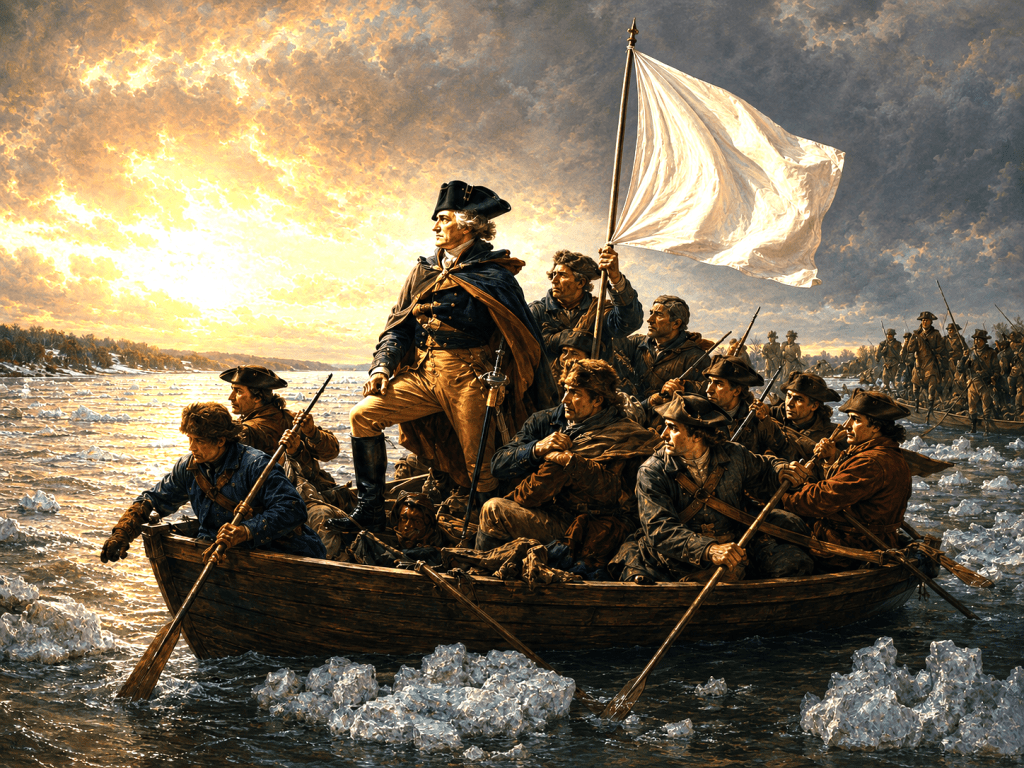
The military record supports him. In 1776, William Howe’s army beat Washington on Long Island and drove him across Manhattan; Howe, satisfied with having secured New York City, let the Continental Army slip away to the north (2). The historian Thomas Fleming wrote that the patriot cause experienced “almost too many moments … on the brink of disaster,” again and again “to be retrieved by the most unlikely accidents or coincidences or choices made by harried men in the heat of conflict” (2). Remove one of those retrievals, whether the escape from Brooklyn, the gamble at Trenton, or the victory at Saratoga that persuaded France to enter the war, and the story changes.
How a British victory would have played out depends on when and how it came. Throughout the conflict, the British “alternated between coercive policies and conciliatory policies,” punishing the rebels one season and offering pardons the next, and some historians argue that a consistent application of either approach might have ended the war in its first few years (1). The terms of an American surrender would have followed from the timing. Capitulation during a punitive phase would likely have meant treason trials, confiscated estates, and the hangman for at least some of the men whose signatures sit on the Declaration of Independence; surrender during a conciliatory phase might have meant amnesty for nearly everyone willing to swear loyalty to the crown (1).
The Canada scenario
Suppose the colonies gave up in 1777 on tolerable terms. What then? Hamner points to the obvious model: “it is not difficult to imagine that, like Canada, the colonies might ultimately have broken away, gradually and peacefully, to become an independent political entity several generations later” (1). Even Thomas Paine’s famous argument in Common Sense, that a small island could not govern a vast continent in perpetuity, works as well as a forecast of eventual dominion status as it does as a case for revolution (1).
Canada’s actual road supplies the template. After armed rebellions broke out in Upper and Lower Canada in 1837 and 1838, London sent Lord Durham to investigate. His 1839 report, famous for finding “two nations warring in the bosom of a single state,” pushed the colonies toward responsible government, meaning colonial cabinets answerable to elected assemblies rather than to the governor and the crown (3). Nova Scotia formed the first responsible government in the British Empire in 1848, Confederation followed in 1867, and Canada evolved toward full independence without ever fighting a war for it (3). Fold thirteen more colonies into that story and the numbers become striking. A British North America running from Hudson Bay to Georgia would have held the empire’s demographic center of gravity; its grievances would have been harder to ignore, and its eventual confederation, taking in American and Canadian provinces together, would have produced a single country larger than the present United States and Canada combined. Alternate-history novelists have enjoyed working out the details. In Richard Dreyfuss and Harry Turtledove’s novel The Two Georges, the union holds into the late twentieth century, and the governor general of the North American Union is Sir Martin Luther King (2).
Or a carved-up continent
The tidy one-nation outcome assumes Britain keeps control of the interior, and that was never a given. The boundaries Britain drew before the war hint at how differently the continent might have been organized. The Royal Proclamation of 1763 barred white settlement west of the Appalachian Mountains in an attempt at détente with Native nations, a restriction that infuriated land-hungry colonists (4). The Quebec Act of 1774 then attached the entire region north of the Ohio River, land that became Ohio, Michigan, Indiana, and parts of Wisconsin, Illinois, and Minnesota, to the Province of Quebec, on the theory, as the historian Alan Taylor has put it, that “Quebec’s authoritarian government” could better keep out settlers and speculators from the thirteen colonies (5). A Britain victorious in 1777 or 1780 had every reason to keep those lines. Picture the result: an English-speaking population penned along the Atlantic seaboard, a French-Catholic province holding the Great Lakes country, and the trans-Appalachian west developing as Indian country under imperial protection rather than as Kentucky and Ohio.
West of the Mississippi, the game opens up further. In our timeline the United States doubled its territory in 1803 because Napoleon’s Caribbean ambitions had collapsed and war with Britain loomed; he sold 828,000 square miles for fifteen million dollars to a republic anxious about its western outlet. “There is on the globe one single spot, the possessor of which is our natural and habitual enemy,” Jefferson wrote. “It is New Orleans” (6). Without an independent United States there is no Louisiana Purchase. The territory stays with Spain, or passes to France and is seized by the Royal Navy during the Napoleonic Wars, or descends to an independent Mexico that inherits Spain’s claims from Texas to the Rockies and keeps California, since there is no expansionist republic next door to fight the war of 1846 against it. Any of those paths produces a North America with three or four substantial countries instead of one.
Fiction has mapped this version too. Robert Sobel’s For Want of a Nail, a 450-page mock history published in 1973 complete with invented footnotes and bibliography, reverses the Battle of Saratoga and follows the consequences for two centuries. Britain organizes the defeated colonies into a Confederation of North America, while irreconcilable rebels led by Alexander Hamilton and James Madison trek into Spanish territory, found a nation named Jefferson, and later, under Andrew Jackson, conquer Mexico and build a United States of Mexico stretching through Arizona and California (2). Sobel was writing entertainment, not forecasting. But his continent, a British confederation in the east facing a hybrid Anglo-Hispanic republic in the southwest, is at least as plausible as the single-dominion version.
Then there is Russia. Russian traders worked the Alaskan coast from the eighteenth century, but the colony never amounted to much; permanent Russian settlers in Alaska never numbered more than four hundred, and defeat in the Crimean War drained St. Petersburg’s interest in the region (7). What matters for our counterfactual is the reason Russia sold to Washington in 1867: it believed an American Alaska would “off-set the designs of Russia’s greatest rival in the Pacific, Great Britain” (7). In a British North America there is no such buyer. Alaska either stays Russian for decades longer, an armed outpost breeding friction down the Pacific coast, or falls to Britain outright in some northern sequel to the Crimean War. Either way, the Pacific Northwest becomes a contested imperial frontier between London and St. Petersburg rather than a line settled by treaty with the Americans.
Slavery, emancipation, and the ideas of 1776
Geography is only half the question. The other half is what kind of society a British America would have been, and here the most uncomfortable answers concern slavery. In 1772, the Somerset decision declared slavery “odious” and unenforceable in England itself, a ruling that southern planters read as a long-term threat to their human property (4). In November 1775, Virginia’s royal governor, Lord Dunmore, promised freedom to any enslaved person who deserted a rebel master and joined British forces; tens of thousands ran to the British lines, in what the writer Keith Brooks calls “the first mass emancipation in American history” (4). Britain abolished slavery across its empire in 1833, when about two million people were enslaved in the United States; the republic needed another generation and a civil war to do the same, by which time the number had doubled to four million (4). Measured against a plausible British-American emancipation in the 1830s, the Revolution’s record on human freedom looks a good deal less triumphant than the holiday speeches suggest.
None of this makes Britain an abolitionist savior. Dunmore owned slaves himself, his proclamation was a war measure rather than a principle, and the empire that freed its Caribbean slaves had spent two centuries running the Atlantic slave trade (4). Something real disappears in a world without 1776, too. The Declaration’s claim that all men are created equal was drafted by a slaveholder and honored mostly in the breach, yet its words armed nearly every later movement that took freedom seriously, from the Black abolitionist David Walker to the Seneca Falls convention, Vietnam’s declaration of independence from France, and Martin Luther King at the Lincoln Memorial (4). A British North America might have gained an earlier emancipation and lost the most quotable revolutionary charter ever written. Which mattered more is exactly the kind of question counterfactual history exists to sharpen.
The hinge years
If the exercise has a skeleton, it is a short list of dates when the continent’s future was genuinely open. The first is 1763, when victory over France left Britain with a huge war debt and a huge new territory, producing both the Proclamation line and the taxes, from the Stamp Act to the Tea Act, that turned prosperous colonists into rebels (4). Then 1772, when Somerset gave southern slaveholders a reason to wonder how safe their institution was inside the empire (4). Then 1774, when the Quebec Act convinced New Englanders that the crown preferred French Catholics to its own Protestant subjects (5). Then the fighting itself: the New York campaign of 1776, when the Continental Army escaped destruction more than once, and Saratoga in 1777, the victory that brought French money, ships, and soldiers into the war (1,2). Each date is a fork, and at each fork the British path was at least as likely as the American one.
The forks keep coming after the war ends, whichever way it ends. In 1803 the Louisiana Purchase handed the young republic the middle of the continent, an event wholly contingent on there being a republic to buy it (6). Between 1837 and 1848 the rebellions in the Canadas, the Durham Report, and the arrival of responsible government showed that Britain had learned to loosen its grip before a colony tore itself away (3). And 1867 is the counterfactual’s punchline: in a single year the Canadian colonies confederated into a dominion and Russia sold Alaska to the United States, the two futures of North America, negotiated evolution and expansive republic, formalized side by side (3,7).
A bigger Canada, or a broken map?
So which is it? For the thirteen Atlantic colonies themselves, the Canadian model is the strong favorite among the historians who have taken the question seriously: gradual, negotiated, eventually complete independence, arriving perhaps two or three generations behind schedule (1). For the rest of the continent, honesty requires the messier answer. The Mississippi Valley, Texas, California, and the Northwest were claimed or coveted by Spain, France, Mexico, Russia, and Britain, and without an aggressive republic buying, annexing, and conquering its way west, there is no reason to assume they all end up under one flag (6,7). The single mega-dominion and the four-nation patchwork are both live possibilities, and the choice between them would have turned on decisions made in London, Madrid, Paris, and St. Petersburg over a nineteenth century that never happened.
The historian Gerald Horne states the moral of the exercise: “Simply because Euro-American colonists prevailed in their establishing of the U.S., it should not be assumed that this result was inevitable. History points to other possibilities” (4). That is the case for spending a little of the Fourth of July in a world where the fireworks never happen. Seen from there, the actual outcome looks less like destiny and more like what it was: a near thing, retrieved again and again by luck, weather, and the choices of harried men, one horseshoe nail at a time (2).
References
1. Christopher Hamner, “What If…?: Reexamining the American Revolution,” TeachingHistory.org (Roy Rosenzweig Center for History and New Media, George Mason University). https://teachinghistory.org/history-content/ask-a-historian/25269
2. Paul Aron, “If the British Won …,” Commonplace: The Journal of Early American Life. https://commonplace.online/article/if-the-british-won/
3. David Mills, “Durham Report,” The Canadian Encyclopedia. https://www.thecanadianencyclopedia.ca/en/article/durham-report
4. Keith Brooks, “What If The British Had Won?,” The Indypendent. https://indypendent.org/2016/06/what-if-the-british-had-won/
5. Maxime Dagenais, “Quebec Act, 1774,” The Canadian Encyclopedia. https://www.thecanadianencyclopedia.ca/en/article/quebec-act
6. “Louisiana Purchase, 1803,” Milestones in the History of U.S. Foreign Relations, Office of the Historian, U.S. Department of State. https://history.state.gov/milestones/1801-1829/louisiana-purchase
7. “Purchase of Alaska, 1867,” Milestones in the History of U.S. Foreign Relations, Office of the Historian, U.S. Department of State. https://history.state.gov/milestones/1866-1898/alaska-purchase
###
Filed under: Uncategorized |












































































































































































































































































































































































































































































Leave a Reply