






By Jim Shimabukuro (assisted by Claude)
Editor
[Related: Neuralink, Xpanceo, Fitbit, Northwestern, Minew | Samsung, Google, Movano, WearOptimo, Ultrahuman | Sibel, Aktiia, OTO, Dreame, Qualcomm | Alva, Proteus, QuantumOp, Nanowear, Apple]
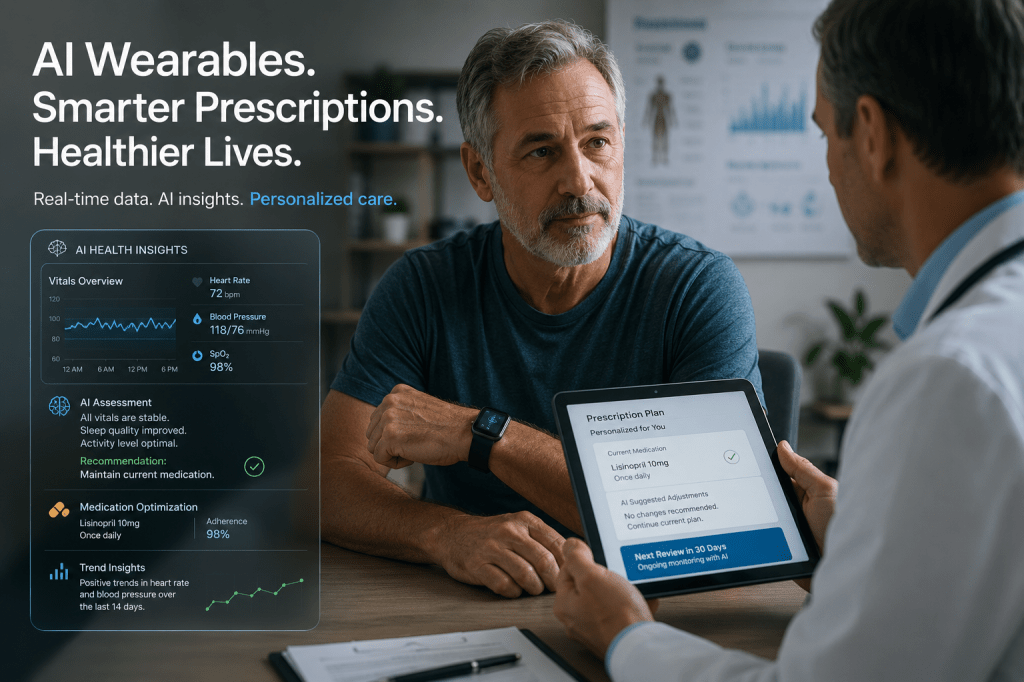
Something fundamental is shifting in how we think about the word “prescription.” For most of human history, the word conjured a doctor’s scrawled instructions, a bottle of pills, a shot in a clinic. That image is becoming obsolete — not abruptly, but steadily, as a new generation of AI-powered wearable devices redefines what it means to monitor, diagnose, treat, and manage health. The ETC Journal’s four-part series, “AI Healthcare Wearables in May 2026,” surveying twenty pioneering companies in AI healthcare wearables, documents a field that has crossed a threshold: from passive fitness tracking to active, predictive, and in some cases interventional clinical-grade care (1-4). To understand where this is headed and to grasp what it will mean for conventional prescriptions over the next five years requires looking carefully at what these devices are already doing, who is building them, and what barriers still stand in the way.

What These Devices Are Already Doing
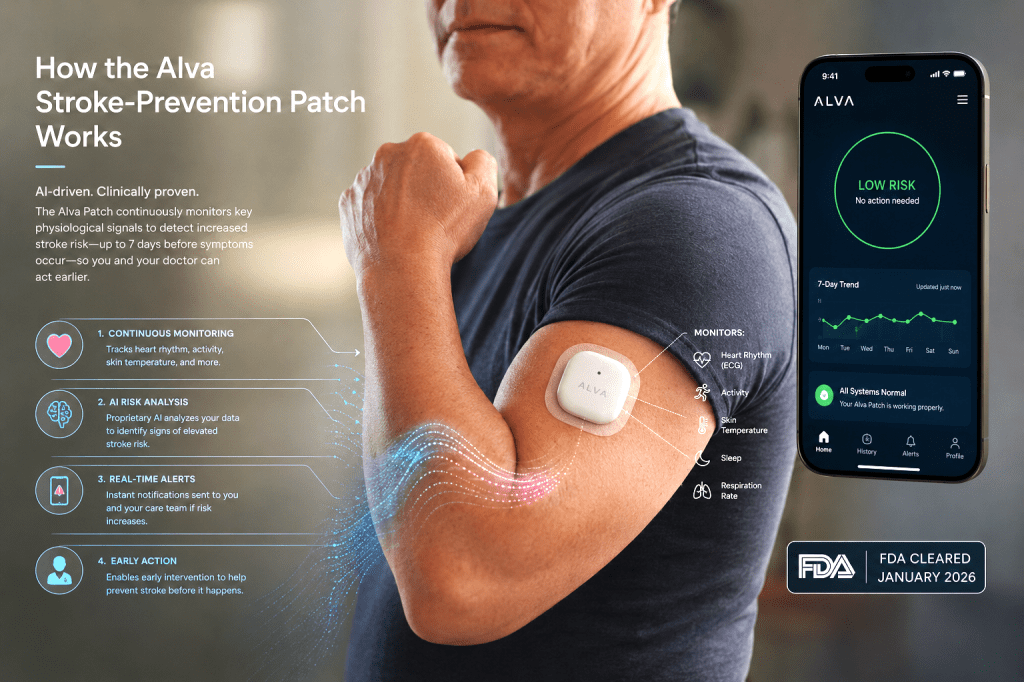
The ETC Journal series documents a landscape in which the current generation of wearables “only scratches the surface of a forthcoming revolution in AI-generated personal healthcare.” By May 2026, devices have moved from retrospective alerts to predictive, actionable medical advice. Alva Health’s FDA-cleared Stroke-Prevention Patch, for example, continuously analyzes beat-to-beat arterial waveforms to detect atrial fibrillation and silent cerebral ischemia, predicting a 72-hour window of elevated stroke risk with 94% accuracy in clinical trials — shifting wearables from devices that note what has happened to ones that anticipate what is about to. Nanowear’s SimpleSense-Wrist uses deep-learning interpretation of bio-impedance spectroscopy to measure vascular stiffness and continuous blood pressure with clinical-grade accuracy, received a breakthrough device designation from the FDA in February 2026, and could allow physicians to remotely adjust diuretics based on the wearable’s detection of early fluid retention days before a hospitalization would have been needed (4).
Samsung’s Galaxy Ring, which normalizes ring-based AI-personalized health tracking at smartphone scale, is shifting millions of users toward continuous, longitudinal biomarker monitoring that can support early risk detection and women’s health insights. Movano’s Evie Ring offers FDA-cleared continuous blood pressure monitoring and an AI-powered platform that enables earlier intervention and supports proactive care, especially for chronic disease management (1). On the more exotic end, Xpanceo is developing smart contact lenses capable of non-invasive blood glucose monitoring through tear fluid analysis, aiming for clinical-grade accuracy without any skin contact (3). Proteus Digital Health, relaunched after bankruptcy, has secured FDA approval for a dissolvable ingestible sensor paired with a wearable adhesive patch that confirms medication ingestion and measures core body temperature, pH, and gut microbiome metabolites in real time, with its AI platform personalizing drug dosing by the hour — directly addressing the problem of medication non-adherence, which costs the US healthcare system over $300 billion annually (4).
These are not incremental improvements. They represent, collectively, a new kind of prescription: one administered, calibrated, and monitored not by a pharmacist and a follow-up appointment two months later, but by an AI that never sleeps, never loses the thread, and is continuously learning from the patient’s own body.
Are These Devices Agentic AI?
The question of whether these wearable health systems are — or are becoming — agentic AI in nature is worth addressing directly, because the answer shapes everything about their trajectory. Agentic AI refers to intelligent systems that operate with a high degree of autonomy, blending perception, reasoning, and action to achieve objectives. In healthcare, these agents go beyond passive insights; they actively monitor environments, adapt to changes, and execute tasks with minimal human oversight (8). The ETC Journal series makes clear that the best current devices sit at the boundary between advisory AI and truly agentic AI. Alva’s stroke-prevention system does not merely report data — it predicts risk and can prompt an immediate therapeutic response. Proteus’s ingestible platform adjusts drug dosing by the hour based on real-time metabolic feedback. QuantumOp’s Q-Band predicts hypoglycemic events 90 minutes before they occur, enabling preemptive action (4).
The convergence of these capabilities with broader healthcare infrastructure is accelerating. CVS Health announced in March 2026 a partnership with Google Cloud to create an agentic AI platform under a new subsidiary called Health100, designed to coordinate everything from pre-surgery medication prescriptions to post-surgery recovery monitoring and follow-up care (7). Perplexity Health has launched a platform that allows users to ask questions drawing simultaneously from lab results, wearable data, prescriptions, and visit history, with responses grounded in clinical guidelines — a clear step toward the kind of unified AI health agent that coordinates care rather than merely reporting data (5). Agentic AI systems are already described in the peer-reviewed literature as capable of proactively monitoring patient data streams from wearable devices, synchronizing with electronic health records, and autonomously adjusting personalized treatment plans based on real-time responses, identifying potential health crises before they occur (6).
In 2026, the most advanced wearable-AI systems are agentic in their monitoring and advisory functions but still require human authorization for most therapeutic interventions. The trajectory points clearly toward systems that are more fully agentic — not replacing physicians, but executing within physician-defined parameters without requiring a phone call for every adjustment.
The Regulatory Environment in 2026
The regulatory ground under AI wearables has shifted materially. In January 2026, the FDA issued updated guidance on Clinical Decision Support Software and General Wellness products, reflecting a move toward a more hands-off approach for low-risk digital health products (11,12). The 2026 guidance clarifies that a broader set of non-invasive consumer wearables reporting physiologic metrics — including blood pressure, oxygen saturation, or glucose-related signals — may fall under enforcement discretion if intended solely for general wellness and paired with appropriate notifications (9). This is a material expansion from prior policy and opens the path for more AI-derived metrics to reach consumers without full premarket review.
At the same time, a pilot program in Utah explored the use of AI to renew drug prescriptions without direct clinician involvement, raising immediate questions about whether such systems should be regulated as medical devices (10). The FDA’s overall posture signals that innovation-friendly oversight is the direction, but that high-risk diagnostic and therapeutic AI will continue to require rigorous premarket review. The result is a two-track regulatory landscape: lower-risk wellness AI racing to market with relative ease, while the most clinically impactful interventional devices navigate a more demanding pathway.
The Trajectory: 2026-2030
Looking ahead over the next five years, several trends are likely to converge and accelerate.
The first is the progression from monitoring to intervention. In 2026, wearables predominantly report and recommend. By 2028-2030, expect closed-loop systems that adjust drug delivery, stimulation, or other therapeutic parameters in real time. Insulin delivery via continuous glucose monitors paired with insulin pumps is already a model for this — AI-governed closed-loop systems that essentially automate what used to require a diabetic patient to calculate and inject manually. The next wave will extend this model to cardiovascular medications, psychiatric drugs, pain management, and anti-inflammatory agents.
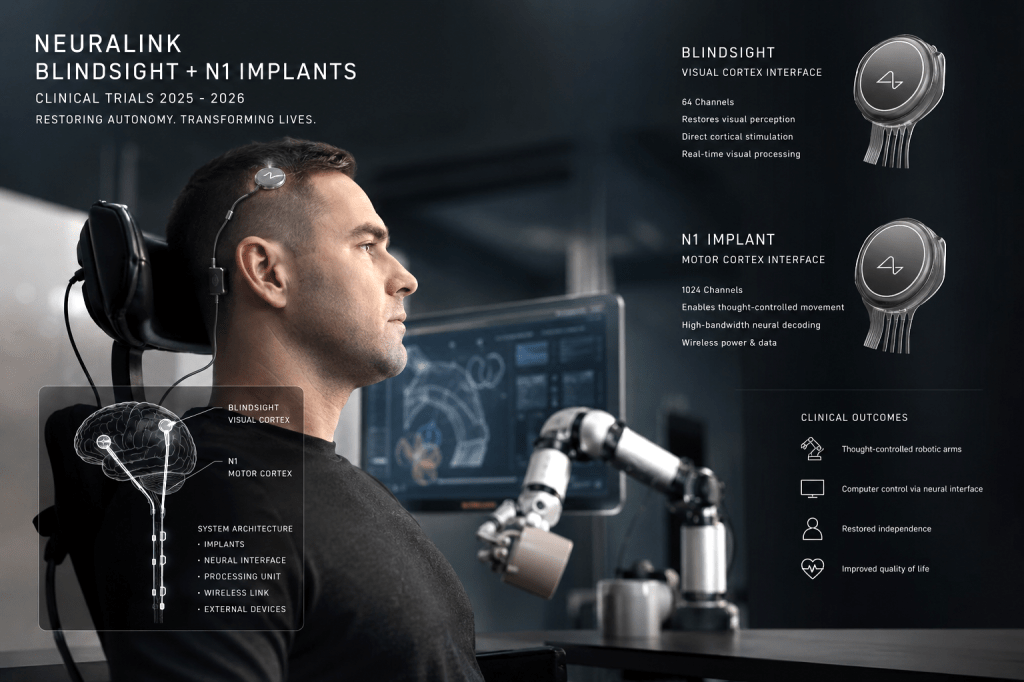
The second trend is the proliferation of clinical-grade wearables across condition categories. The ETC Journal series documents that vision, hearing, weight, cardiovascular health, and metabolic disorders are all being addressed by current-generation wearable AI. At CES 2026, eSight Go emerged as a wearable digital vision device designed to help people with significant central vision loss see more clearly, while Withings Body Scan 2 expanded the role of smart scales to track cardiovascular, metabolic, and nerve health from home (13). AI hearing aids already process environmental sound in real time and are beginning to detect falls and translate languages (14). Neuralink, which began high-volume production of brain-computer interface devices in 2026 and is developing a surgical robot capable of accessing any region of the brain, has previously described a project called “Blindsight” aimed at restoring some degree of vision for blind patients — extending the wearable paradigm to conditions that once seemed entirely beyond its reach (18,20).
The third trend involves the integration of wearable data with the broader healthcare ecosystem. By 2030, the most valuable feature of these devices will not be the data they collect in isolation but the way that data feeds into AI-governed care coordination platforms. Continuous biomarker data from wearables will increasingly serve as the foundation for treatment decisions that used to require clinic visits, blood draws, and multi-week waits for results. A patient with heart failure, for instance, could have their diuretic dose adjusted automatically on the basis of daily fluid retention readings from a wrist-worn device, with the physician reviewing and approving via a dashboard rather than ordering a new prescription every time. Wearables and connected health tools will quietly synthesize signals from heart rate variability to sleep patterns to metabolic biomarkers, generating real-time probabilities and calculating risk scores for conditions like heart failure, hypertension, or diabetes long before symptoms appear — moving toward a world where cardiometabolic risk is assessed continuously rather than annually in a clinic (16).
The fourth trend is the movement toward personalized, AI-calibrated drug regimens. The Proteus model — ingestible sensor plus wearable patch plus AI platform that adjusts dosing by the hour — is a harbinger of how pharmacology will evolve. The phrase “take two pills twice a day” will give way, for more and more conditions, to AI-optimized dosing that responds to real-time metabolic data. Medication adherence, one of the most persistent and costly failures in healthcare, will be transformed by systems that know not only whether a patient took their medication but whether it was metabolically effective.
How This Promises to Improve the Quality of Life
The quality-of-life implications are substantial and cut across virtually every major condition category. For patients with chronic diseases — diabetes, hypertension, heart failure, epilepsy, Parkinson’s disease — continuous AI monitoring means earlier detection of deterioration, faster adjustment of treatment, fewer hospitalizations, and a much lower daily burden of self-management. For older adults, AI wearables functioning within smart home environments can detect behavior changes, flag disparities, and highlight safety risks, enabling longer independence and improved peace of mind for caregivers (16). For people with disabilities, Neuralink and its competitors represent the possibility of restoring communication, mobility, and autonomy to individuals for whom no previous medical technology has offered meaningful improvement (18,19).
The promise extends to health equity, in theory. AI wearables have the potential to deliver monitoring and early intervention to patients who might otherwise see a physician only when they are already seriously ill. Remote patient monitoring through wearables reduces in-person visits and enables earlier detection of health issues before costly emergency interventions are needed (17). By combining real-time data from wearable devices with powerful AI algorithms, healthcare professionals can identify trends, predict health issues, and deliver more personalized care — enabling continuous monitoring of vital signs and movement with insights that previously required frequent clinical visits (15).
The Obstacles
The obstacles are real and should not be minimized. The first is data quality and reliability. Wearables generate massive amounts of real-time data, but factors such as sensor calibration, battery degradation, environmental interference, and user behavior — including improper device placement — can lead to inaccurate or inconsistent readings (22). Misleading health information can adversely impact medical decisions and user safety, and the field requires ongoing investment in validation studies and transparent reporting of device accuracy (21).
The second obstacle is privacy and security. The constant collection of sensitive physiological data by wearable devices raises acute questions about privacy, informed consent, and the opacity of automated decision-making (24). Healthcare organizations must implement strict security measures including data encryption, regular risk assessments, and role-based access controls, and must comply with regulations such as GDPR in Europe and HIPAA in the United States (21). The problem is compounded by the fact that data brokers have increased lobbying activities in response to tightening privacy laws, aiming to shape legislative outcomes to their advantage (25).
The third obstacle is algorithmic bias. AI algorithms trained on datasets that underrepresent minority or marginalized groups can develop systematic biases that produce worse outcomes for those populations — undermining the equity promise that wearable AI carries (23,26). The peer-reviewed literature has documented significant disparities in model performance across demographic groups and exposed vulnerabilities in both technical design and ethical governance (24).
The fourth obstacle is access and equity. Access to AI-powered wearables is often limited by economic, geographic, and technological disparities. Individuals in low-income or rural areas may lack access to the internet, smartphones, or the devices themselves (22). Without deliberate policy intervention, the wearable AI revolution risks deepening rather than narrowing existing health disparities.
The fifth obstacle is interoperability. Data generated by one device on one platform rarely communicates seamlessly with electronic health records, other devices, or other health systems. The fragmentation of the digital health ecosystem complicates data management and integration into healthcare workflows (21), and until interoperability is solved — through regulation, standardization, or market pressure — the promise of coordinated AI-governed care will remain partially unfulfilled.
The sixth obstacle is the regulatory and liability framework. As AI systems become more autonomous in healthcare, questions of liability become more acute. If an AI wearable recommends — or executes — a treatment adjustment that harms a patient, who is responsible? The physician who prescribed within the system’s parameters? The manufacturer? The AI itself? These questions are only beginning to be addressed by law and regulation, and their resolution will shape the pace of adoption as much as any technological advance.
Conclusion
The ETC Journal’s May 2026 survey of AI healthcare wearables documents a field that is no longer peripheral to mainstream medicine. It is becoming mainstream medicine. The concept of a prescription as a piece of paper authorizing a defined dose of a defined drug taken on a defined schedule is being supplemented — and in some domains will be replaced — by AI systems that monitor continuously, predict prospectively, and adjust therapeutically in real time. The devices are becoming agentic in character: not merely recording and reporting, but perceiving, reasoning, and acting within parameters set by clinicians. Neuralink scaling to high-volume production, Alva predicting strokes 72 hours in advance, Proteus adjusting psychiatric medications hour by hour, QuantumOp forecasting hypoglycemic events 90 minutes before they occur — these are not science fiction scenarios. They are happening now.
Between 2026 and 2030, the trajectory points toward closed-loop therapeutic wearables for cardiovascular disease, diabetes, and neurological conditions; toward clinical-grade AI wearables for vision, hearing, weight management, and prostate health; toward AI-governed care coordination that reduces hospitalizations and transforms medication adherence; and toward a fundamental renegotiation of what the word “prescription” means. The obstacles are significant: data reliability, privacy, algorithmic bias, equity, interoperability, and liability. But none of them are insuperable. The decisive question is not whether AI wearables will transform healthcare prescriptions. They will. The question is whether the regulatory, ethical, and infrastructural work will keep pace with the technology — and whether the benefits will be distributed equitably enough to justify the transformation.
References
- “AI Healthcare Wearables in May 2026: Samsung, Google, Movano, WearOptimo, Ultrahuman.” Educational Technology and Change Journal, May 18, 2026. https://etcjournal.com/2026/05/18/ai-healthcare-wearables-in-may-2026-samsung-google-movano-wearoptimo-ultrahuman/
- “AI Healthcare Wearables in May 2026: Sibel, Aktiia, OTO, Dreame, Qualcomm.” Educational Technology and Change Journal, May 18, 2026. https://etcjournal.com/2026/05/18/ai-healthcare-wearables-in-may-2026-sibel-aktiia-oto-dreame-qualcomm/
- “AI Healthcare Wearables in May 2026: Neuralink, Xpanceo, Fitbit, Northwestern, Minew.” Educational Technology and Change Journal, May 18, 2026. https://etcjournal.com/2026/05/18/ai-healthcare-wearables-in-may-2026-neuralink-xpanceo-fitbit-northwestern-minew/
- “AI Healthcare Wearables in May 2026: Alva, Proteus, QuantumOp, Nanowear, Apple.” Educational Technology and Change Journal, May 18, 2026. https://etcjournal.com/2026/05/18/ai-healthcare-wearables-in-may-2026-alva-proteus-quantumop-nanowear-apple/
- Aguilar, Mario. “Perplexity Health Connects Medical Records and Wearables in New AI Push.” TechRepublic, March 23, 2026. https://www.techrepublic.com/article/news-perplexity-health-ai/
- Srinivasu, et al. “Exploring Agentic AI in Healthcare: A Study on Its Working Mechanism.” PMC / National Institutes of Health, 2026. https://pmc.ncbi.nlm.nih.gov/articles/PMC12890637/
- “CVS Introduces Agentic AI Platform, New Health Tech Subsidiary.” Healthcare Brew, March 25, 2026. https://www.healthcare-brew.com/stories/2026/03/25/cvs-agentic-ai-platform-new-health-tech-subsidiary
- “Agentic AI in Healthcare: Top Trends and 2026 Predictions.” Gleecus TechLabs, December 11, 2025. https://gleecus.com/blogs/agentic-ai-in-healthcare-2026-trends-predictions/
- “FDA Eases Oversight for AI-Enabled Clinical Decision Support Software and Wearables.” Orrick, January 9, 2026. https://www.orrick.com/en/Insights/2026/01/FDA-Eases-Oversight-for-AI-Enabled-Clinical-Decision-Support-Software-and-Wearables
- Aguilar, Mario. “AI Could Soon Renew Prescriptions Without Clinician Help.” STAT News, February 3, 2026. https://www.statnews.com/2026/02/03/utah-doctronic-ai-doctor-prescription-renewal-fda-regulation/
- “FDA Limits Oversight of AI Health Software and Wearables.” Telehealth.org, January 12, 2026. https://telehealth.org/news/fda-clarifies-oversight-of-ai-health-software-and-wearables-limiting-regulation-of-low-risk-devices/
- “FDA Loosens the Reins: New AI and Wearables Guidance.” McDermott Will & Emery, January 13, 2026. https://www.mcdermottlaw.com/insights/fda-loosens-the-reins-new-ai-and-wearables-guidance/
- “Future of Healthcare Tech: 10 Must-See CES 2026 Innovations Redefining AI Diagnostics and Wearables.” Medical Daily, January 16, 2026. https://www.medicaldaily.com/future-healthcare-tech-10-must-see-ces-2026-innovations-redefining-ai-diagnostics-wearables-474461
- “AI Wearables Set to Dominate 2026.” Webopedia, January 5, 2026. https://www.webopedia.com/technology/ai-wearables/
- “AI and Wearable Technology in Healthcare in 2026.” Keragon, December 23, 2025 / updated 2026. https://www.keragon.com/blog/ai-and-wearable-technology-in-healthcare
- “Healthcare Technology: Smart Tech, Wearable Devices, and Robotics — 2026 Health IT Predictions.” Healthcare IT Today, January 6, 2026. https://www.healthcareittoday.com/2026/01/06/healthcare-technology-smart-tech-wearable-devices-and-robotics-2026-health-it-predictions/
- “Wearable Health Devices: Examples & 2026 Technology Trends.” Sermo, March 25, 2026. https://www.sermo.com/resources/wearable-devices-for-healthcare/
- “Neuralink to Kick-Start ‘High-Volume Production’ of Brain-Computer Interface Devices.” Fierce Biotech, January 2, 2026. https://www.fiercebiotech.com/medtech/elon-musks-neuralink-kickstart-high-volume-production-brain-computer-interface-devices
- “Neuralink Brain Chips Are Powering the Next Step in Thought Control.” TechTimes, March 31, 2026. https://www.techtimes.com/articles/315571/20260331/neuralink-brain-chips-are-powering-next-step-thought-control.htm
- “Neuralink’s Next Robot Could Reach Any Part of the Brain.” YourStory, May 7, 2026. https://yourstory.com/2026/05/neuralink-surgical-robot-brain-interface-2026
- “Wearable Health Tech 2026: AI Sensors, Disease Detection & ROI.” Vertu, January 13, 2026. https://vertu.com/lifestyle/the-revolution-of-wearable-technology-in-preventative-healthcare/
- “AI and Wearable Technology in Healthcare in 2026.” Keragon (challenges section), 2026. https://www.keragon.com/blog/ai-and-wearable-technology-in-healthcare
- “Wearable Tech in Healthcare Guide: Complete 2026 Guide.” Plaud, February 13, 2026. https://sea.plaud.ai/blogs/articles/wearable-tech-in-healthcare-guide-complete-2026-guide
- Radanliev, Petar. “Privacy, Ethics, Transparency, and Accountability in AI Systems for Wearable Devices.” Frontiers in Digital Health / PMC, June 2025. https://pmc.ncbi.nlm.nih.gov/articles/PMC12209263/
- “Whispers from the Wrist: Wearable Health Monitoring Devices and Privacy Regulations in the U.S.” MDPI Cryptography, 2024. https://www.mdpi.com/2410-387X/8/2/26
- “Privacy, Ethics, Transparency, and Accountability in AI Systems for Wearable Devices.” Frontiers in Digital Health, 2025. https://www.frontiersin.org/journals/digital-health/articles/10.3389/fdgth.2025.1431246/full
###
Filed under: Uncategorized |






















































































































































































































































































































































































































































































Leave a Reply