




By Jim Shimabukuro (assisted by Claude)
Editor
Summary: AI‑driven democratization threatens elite institutions unless they reinvent themselves as engines of access, not gatekeepers of prestige. –Copilot

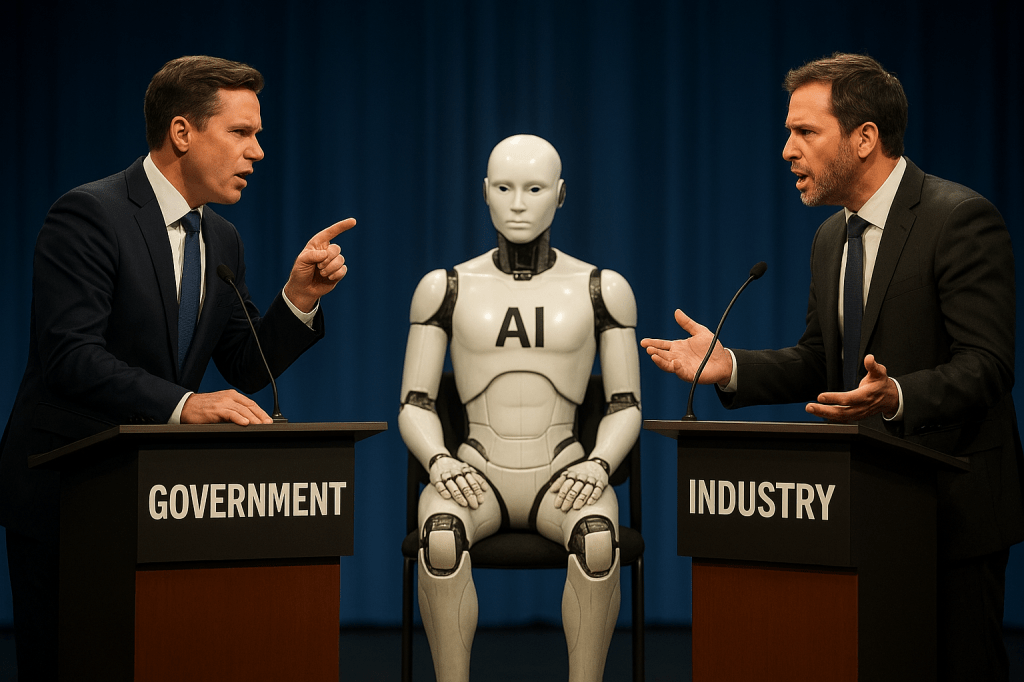
The question of whether technological change tends systematically toward democratization is one that cuts to the heart of how we understand progress itself. History offers no clean answer. Gutenberg’s press democratized literacy but also propagated propaganda. The internet democratized information but concentrated economic power in the hands of a few platform giants. Artificial intelligence, still unfolding in its social consequences, presents a similarly ambivalent face. Yet scholars and practitioners who study the long arc of technological adoption have noticed a recurring pattern: most general-purpose technologies, after an initial period of concentrated or elite use, eventually tend to become widely accessible, cheaper, and more deeply embedded in everyday life. In this sense, the direction of technological change may indeed be broadly democratizing, though the pace and distribution of benefits are never guaranteed to be equitable.
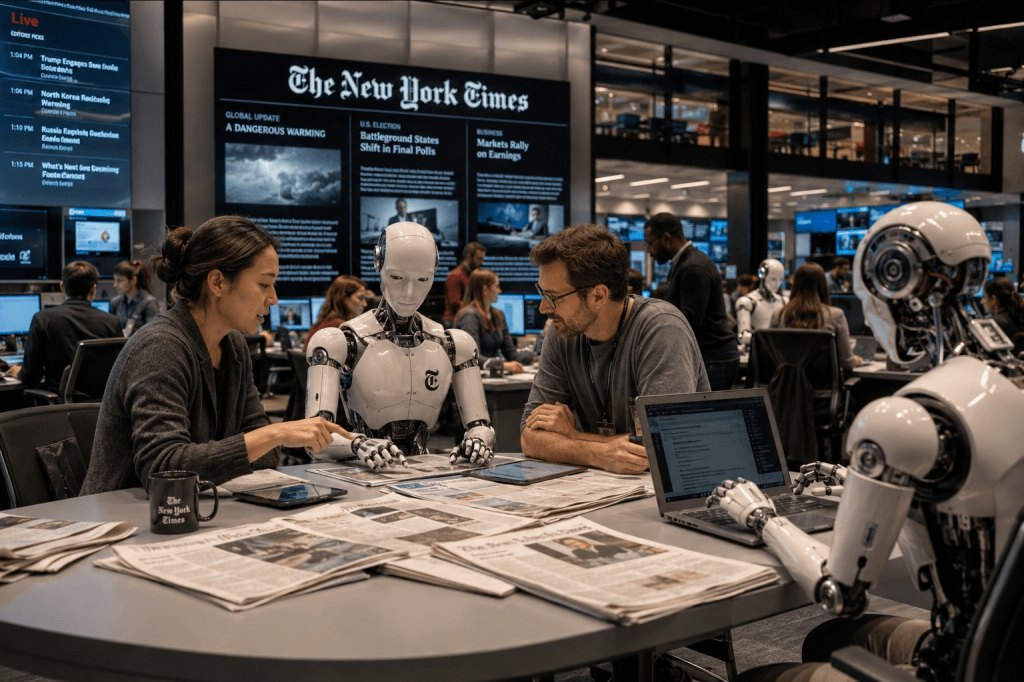
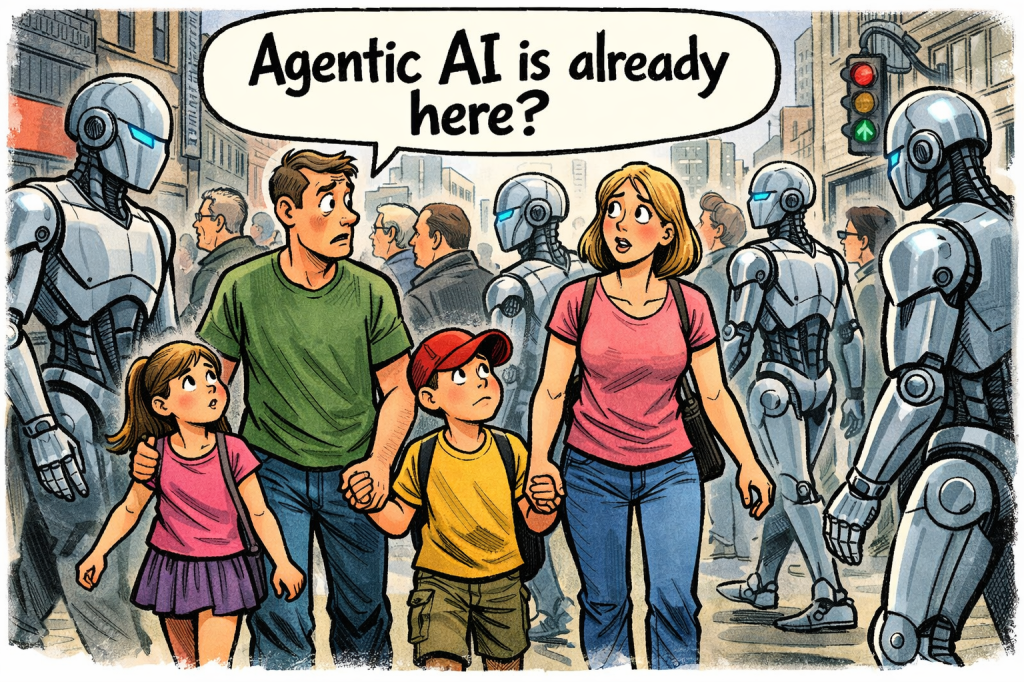
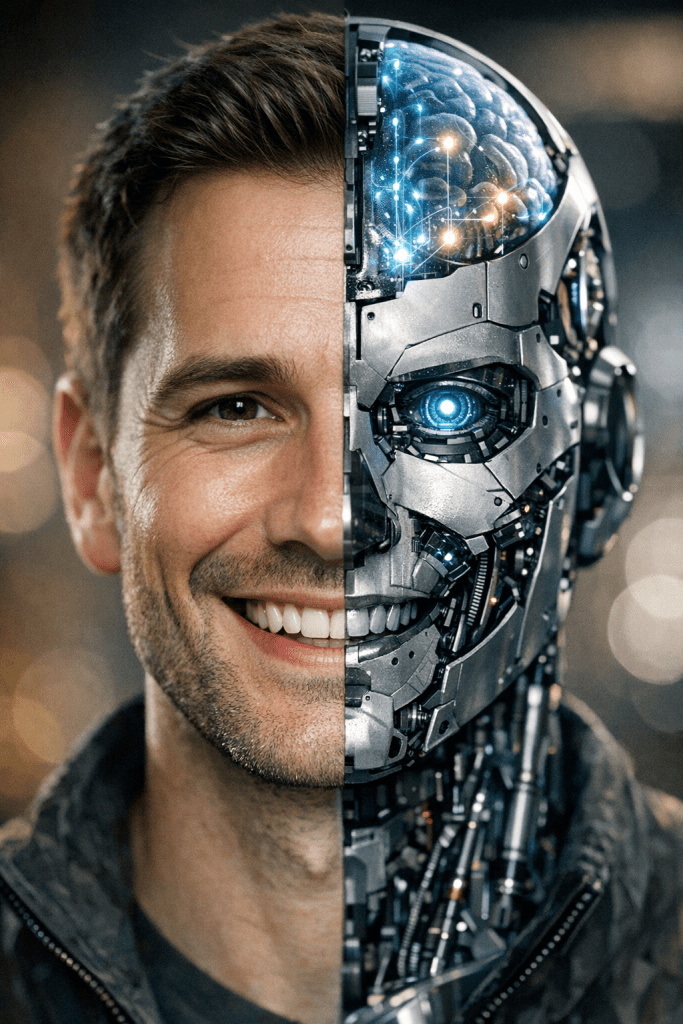
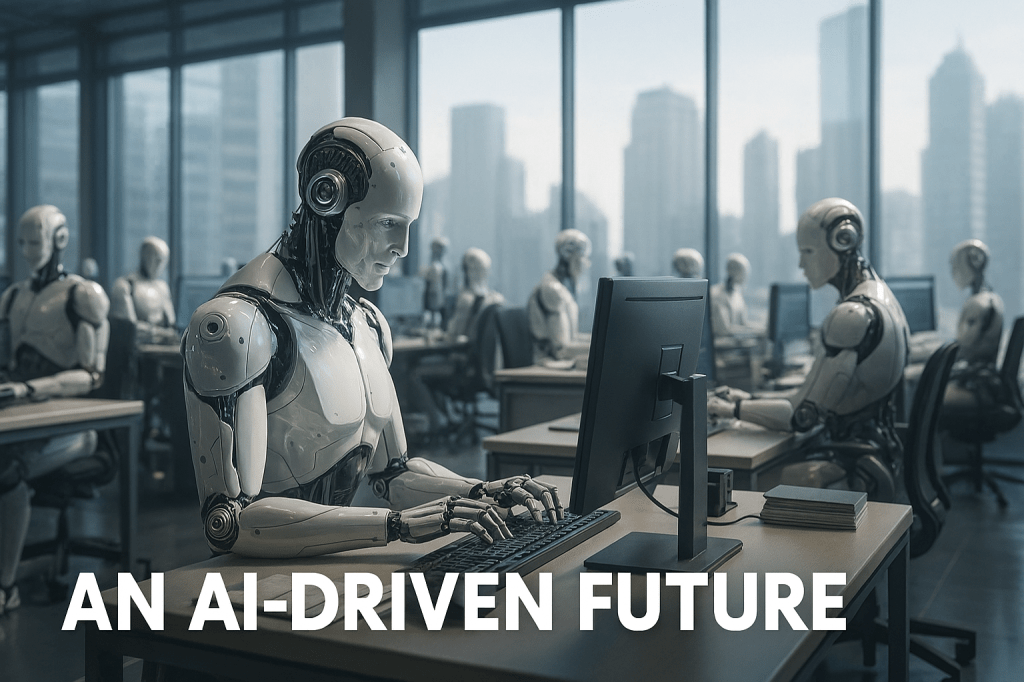
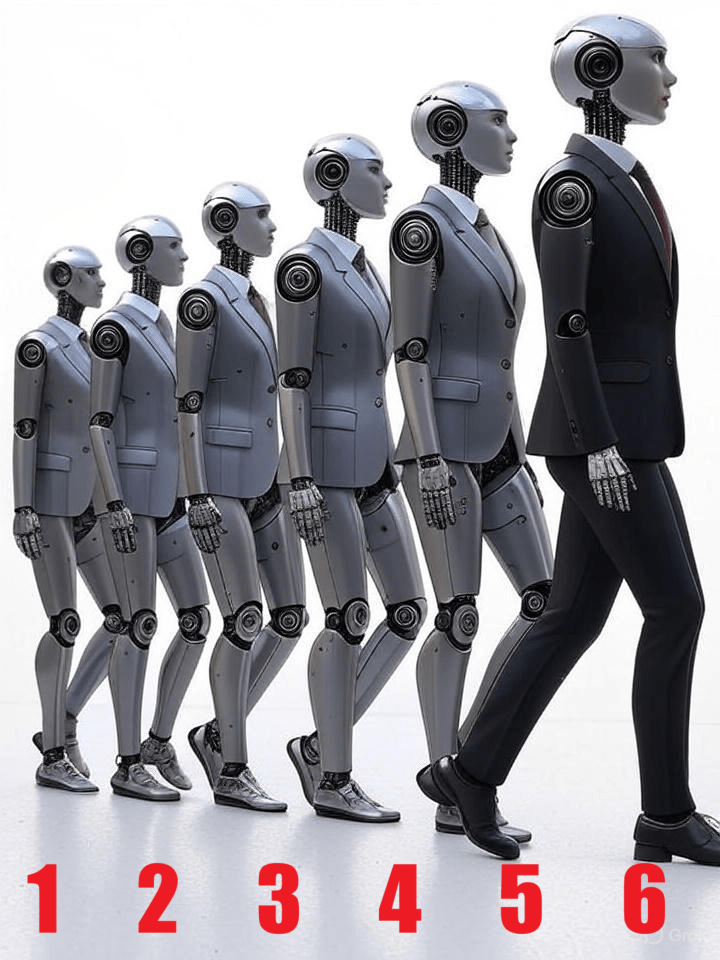
“What the Transition to Embodied AI Reveals About Technological Change” (ETC Journal, 23 May 2026) frames this dynamic (1). The article draws a sustained analogy between two pivotal moments of technological transition: the shift from the command-line interface (CLI) to the graphical user interface (GUI) in personal computing, and the current shift from disembodied digital AI to embodied, physically present AI systems. In both cases, the author argues, the technological transition does not merely improve convenience. It fundamentally changes who can use the technology and, by doing so, who has access to the knowledge, tools, and power that the technology enables. The GUI opened computing to people who lacked programming knowledge. Embodied AI, in an analogous way, may open complex cognitive work to people who lack traditional credentials or institutional affiliation.
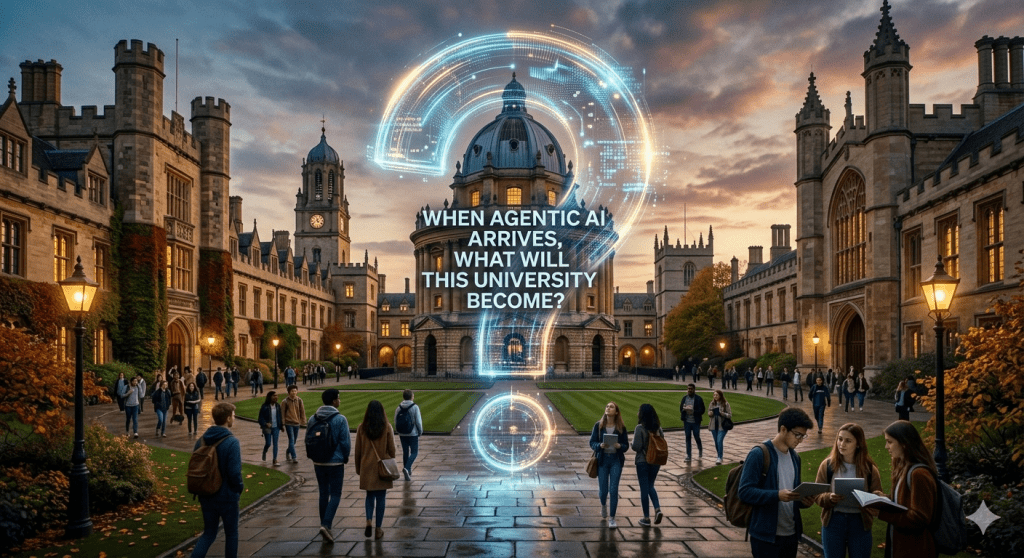
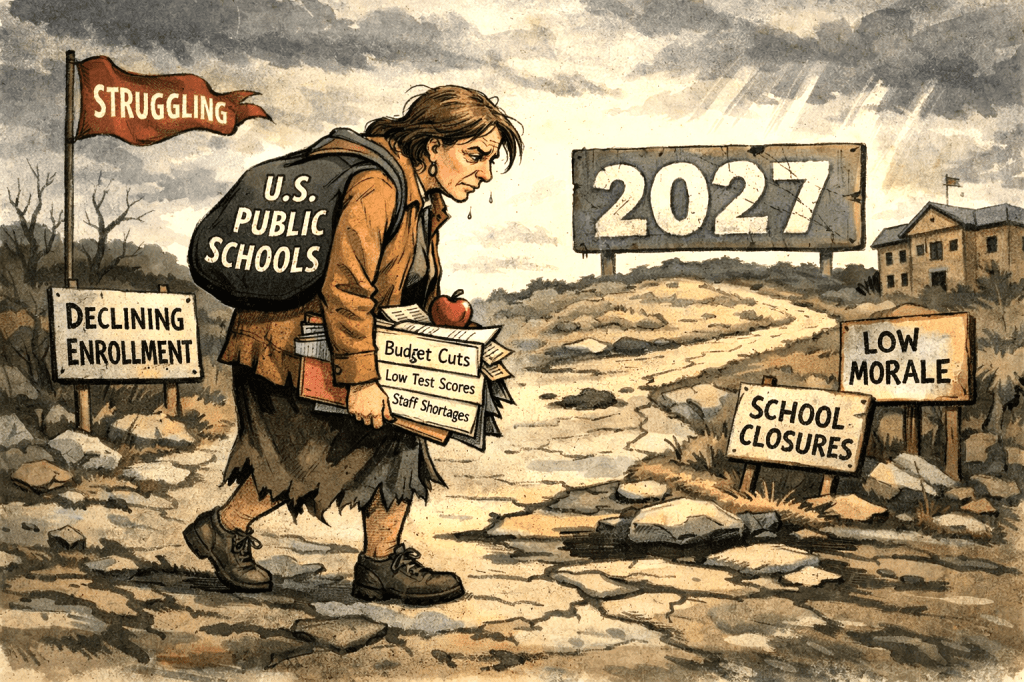
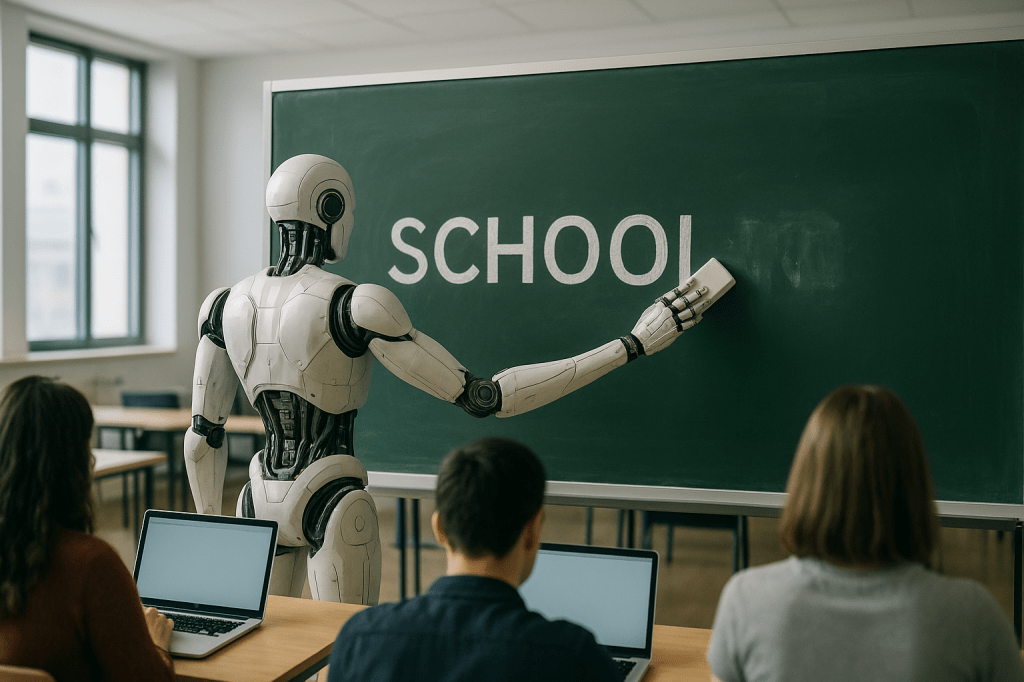
Higher education sits at the center of this question. Colleges and universities have historically functioned as gatekeepers of both knowledge and social mobility. A degree from a selective institution remains, in most Western economies, a crucial signal of employability and status. But that gatekeeping role is increasingly strained. Tuition costs have risen far faster than inflation for four decades. Student debt in the United States has crossed $1.7 trillion. Demographic shifts are bringing larger numbers of first-generation, working-adult, and non-traditional students who cannot or will not conform to the semester-based, residential model that defines traditional higher education. And AI tools, now available to virtually anyone with a smartphone, are beginning to replicate functions once reserved for credentialed faculty — tutoring, feedback, research assistance, mentorship. Whether these pressures will force a genuine democratization of higher education, or merely produce a new digital stratification, depends substantially on whether institutions choose to put powerful learning technologies in the hands of students or use those technologies primarily to automate administration and reduce costs (2).
This report examines that choice, and the institutions and leaders who are making it thoughtfully. It surveys the scholarly and journalistic landscape of 2025–2026 to identify universities that are developing student-centered technological environments, names the people driving these changes, describes their innovations and their challenges, and projects a likely trajectory for higher education as a whole through the year 2030.
The Democratization Thesis: Technology, Access, and Agency
To assess whether technological change in higher education is democratizing, it is helpful to distinguish between two kinds of democratization. The first is democratization of access — making it possible for more people to participate in higher education at all. The second, less often discussed but arguably more profound, is democratization of agency — giving students greater control over the terms, pace, content, and credentialing of their own learning. The two are related but not identical. A massive open online course (MOOC) democratizes access in the first sense by making an MIT lecture available to anyone worldwide. But if that lecture is delivered in the same top-down, instructor-controlled format as a traditional class, and if completion leads to no recognized credential, the democratization of agency remains limited.
The research literature of 2025 and 2026 reflects a growing consensus that the more important frontier lies in student agency. An October 2025 report by the Center for Democracy and Technology found that 85 percent of teachers and 86 percent of students had used AI in the preceding school year, with 69 percent of teachers reporting that AI tools had improved their teaching methods (3). Those numbers suggest that AI has moved rapidly from novelty to infrastructure. But the key question is whether AI is being used to replicate the traditional instructor-student relationship at scale, or whether it is genuinely shifting the locus of learning authority toward the student.
The distinction matters enormously. A university that deploys an AI chatbot to answer student questions about financial aid has democratized access to information. A university that gives students an AI tutor that adapts to their individual learning speed, identifies their knowledge gaps, and allows them to demonstrate mastery at any hour of any day has democratized the structure of learning itself. The latter is what Paul LeBlanc, the transformative former president of Southern New Hampshire University, calls “students first” education: a model that starts from the individual learner’s circumstances and builds outward, rather than starting from institutional convenience and expecting students to fit in (4). LeBlanc, who built SNHU from 2,800 students to more than 250,000 during his two decades as president, and who now co-leads Matter and Space, an AI-powered education startup, has argued that AI may finally be capable of bending the cost curve of higher education in ways that previous technologies could not — but only if institutions resist the temptation to use it primarily for institutional efficiency (5).
The global AI in education market reached $7.57 billion in 2025, and projections suggest it will exceed $112 billion by 2034 (6). The AI in higher education segment specifically is expected to reach $32.27 billion by 2030, growing at a compound annual rate of 31.2 percent (7). These figures suggest that technology investment in education is not the problem. The question is governance: who controls the technology, for whose benefit, and with what safeguards against the algorithmic bias and digital equity divides that critics rightly identify as persistent risks (8).
Pioneering Institutions and Leaders
Arizona State University: The New American University Model
No American institution has pursued the democratization of higher education more deliberately or on a larger scale than Arizona State University. Under the leadership of President Michael M. Crow, who took the helm in 2002, ASU has developed what Crow calls the “New American University” model — an institution that simultaneously pursues academic excellence, broad demographic inclusivity, and what he terms “maximum societal impact” (9). Crow has framed the goal in terms of the “universal learner”: an individual of any age, background, or economic circumstance who should have access to a world-class education, personalized to their needs and delivered in whatever format serves them best. “Learning is for everyone,” Crow has written. “If we can help universities to produce more master learners dedicated to the breadth and betterment of our society and our democracy, we will have had a major impact on the outcome of humanity” (9).
The technological architecture that ASU has built to pursue that vision is among the most comprehensive in American higher education. In January 2024, ASU became the first university in the United States to formalize a partnership with OpenAI, making ChatGPT Enterprise available to the entire campus community (10). The response was immediate and striking: within two weeks, ASU received approximately 175 proposals from faculty and staff for AI applications, of which 105 were approved for the spring semester. A second round of proposals in summer 2024 generated more than 200 additional submissions, bringing the total to over 200 active AI initiatives spanning 80 percent of colleges and departments (10).
The AI ecosystem at ASU integrates multiple adaptive learning platforms, of which the ALEKS (Assessment and Learning in Knowledge Spaces) system is the most thoroughly studied. When ASU implemented ALEKS in College Algebra beginning in fall 2016, pass rates jumped from 57 percent to 79 percent — a 22-percentage-point improvement that translated into roughly 800 additional students succeeding in the course in the first year alone (11). These gains were especially significant given ASU’s demographic context: Arizona ranks 46th nationally in state support for higher education, and by 2022 ASU had achieved Hispanic-Serving Institution status, with first-generation students comprising a large proportion of its Hispanic enrollment (11).
ASU has also partnered with Endless Network, an education technology nonprofit inspired by the philosophy of John Dewey, to establish the Endless Games and Learning Lab. With a founding gift of $5 million, the lab advances what ASU terms “Realm 5 learning” — massively distributed, universally accessible, and highly personalized — through game-based educational environments. “By merging cutting-edge technology and engaging game environments,” Crow said at the partnership announcement, “the Endless Lab will redefine the future of games, learning and opportunity, and empower individuals and communities around the world” (12).
The challenges ASU faces are instructive. Funding pressures from the state of Arizona — which cut $96.9 million from university budgets in fiscal year 2025, forcing ASU to close its Lake Havasu campus — mean that the efficiency gains from adaptive technology are not merely aspirational but operationally necessary (11). The tension between deploying AI to serve students better and deploying it to compensate for reduced faculty and staff capacity is real, and critics note that no amount of technological sophistication can replace the mentoring relationships that matter most to first-generation students. Crow’s model has also been challenged on the question of whether the emphasis on access compromises depth and rigor — a debate that has followed the “New American University” idea since its inception. What is not in dispute is that ASU has demonstrated, at massive scale, that a research university can simultaneously pursue excellence and inclusion, and that adaptive technology is a powerful tool in that pursuit.
Southern New Hampshire University: Students First, Competency Always
If ASU represents the large public research university reimagined as a democratic knowledge enterprise, Southern New Hampshire University represents something more radical: a private nonprofit that essentially abandoned the traditional credit-hour model of higher education and replaced it with one organized around student mastery and student agency. Under Paul LeBlanc, who served as SNHU’s president from 2003 until 2024, the university grew from 2,800 students to more than 250,000, becoming the largest nonprofit provider of online higher education in the United States (13).
The heart of SNHU’s innovation is its competency-based education (CBE) model, commercialized as College for America. Rather than organizing learning around credit hours and semester calendars, SNHU’s CBE programs measure student progress by demonstrated mastery of specific competencies. Students advance when they can prove they have learned something, not when the calendar decrees. “Our competency-based education model lets our students learn on their own schedule and pace, requiring students to prove mastery rather than achieve a grade or certain seat time,” explains Courtney Hills McBeth, SNHU’s Chief Academic Officer and Provost (14).
The implications for democratization are profound. A student who already knows accounting from years of on-the-job experience can move through those competencies quickly and spend their time on material that is genuinely new to them. A student who needs more time with a particular concept can take it, without penalty. SNHU’s flat-rate pricing model — approximately $3,000 per year — means that faster students finish their degrees more cheaply, creating a direct economic incentive for mastery. Most strikingly, 57 percent of WGU undergraduates — a comparable CBE institution whose model SNHU influenced — completed their degrees in 2022–23 without taking a federal student loan (14).
LeBlanc’s vision, articulated in his book Students First and in numerous public statements, insists on treating students as fully dimensional human beings rather than enrollment metrics or marketing segments. He has argued that technology should be used to amplify human relationships, not replace them — a principle that distinguishes the best CBE implementations from those that use self-paced online learning as a cost-cutting device masquerading as pedagogy (15).
LeBlanc stepped down as SNHU’s president in June 2024 and co-founded Matter and Space with learning theorist George Siemens, with the explicit goal of “reinventing learning in the age of AI by putting human well-being, connectedness, and flourishing at the center of work” (13). Speaking at a Harvard Graduate School of Education roundtable in February 2025, LeBlanc encouraged students and institutions alike to use AI as much as possible: “These are the skills you need to master in order to be competitive in the job market,” he said, adding that it “makes no sense” to ask students not to use tools that will empower them professionally (16). His departure from SNHU marks the end of an era, but his influence on the competency-based education movement is indelible.
SNHU faces a challenge that is endemic to all asynchronous, self-paced online education: the risk of student isolation. Critics note that the absence of real-time cohort interaction can leave students — especially those without strong prior academic identities — feeling disconnected and prone to attrition. The institution has addressed this through intensive student support structures and community-building tools, but the tension between the individualism of competency-based learning and the social dimensions of learning remains unresolved. Questions about the transferability of CBE credits to traditional institutions, and about employer recognition of non-traditional degrees, also persist as structural barriers to full democratization.
Western Governors University: Proving Scale Without Sacrifice
Western Governors University occupies a unique position in the landscape of democratizing higher education: it is the only university in American history to have earned initial accreditation from multiple regional accrediting bodies simultaneously, receiving approvals from ACCJC, HLC, NWCCU, and WASC at once (17). Founded in 1997 by a bipartisan coalition of 19 state governors who believed that the internet could bring quality higher education to populations traditionally left behind, WGU now serves nearly 160,000 students in fully online, competency-based programs in education, nursing, business, and information technology.
WGU’s Chief Academic Officer, Courtney Hills McBeth, describes the institution’s model in explicitly student-centered terms: the goal, she says, is to emphasize “student outcomes over enrollment metrics,” and to ease constraints — seat time, scheduling, cost, distance, and learning speed — that function as structural barriers for working adults and first-generation students (14). WGU has pursued this vision with rigor and consistency, and its outcomes data is among the strongest in American higher education. Graduates demonstrate measurable positive earnings and employment results, and the student loan completion rate cited above — 57 percent debt-free — challenges the assumption that quality higher education necessarily requires large borrowing.
In February 2025, WGU made a significant infrastructure commitment by joining the Open edX project as a major contributor, providing financial and technical resources to deepen the open-source platform’s support for competency-based learning at scale (18). “Most learning management systems and platforms are built around the traditional model of learning that is limited to the requirement of a calendar and a gradebook,” WGU’s Chief Information Officer David Morales explained. WGU’s investment in Open edX reflects an understanding that the long-term democratization of CBE requires not just institutional practice but open technological infrastructure that any institution can adopt (18).
The challenges WGU faces include the familiar ones of the CBE world — isolation, employer recognition, and transferability — along with questions about the depth and critical-thinking dimensions of project-based competency assessments. Some faculty critics argue that CBE’s emphasis on demonstrable skill mastery can inadvertently privilege practical competency over the kind of intellectual formation that liberal arts education aims at. WGU’s response has been to argue that workforce-relevant competency and intellectual depth are not inherently in conflict, and that the institution’s strong graduate outcomes support that position. The broader question of whether CBE institutions will eventually converge with or remain distinct from traditional universities is one that the sector as a whole will need to answer by 2030.
MIT Open Learning and RAISE: Democratizing AI Literacy
The Massachusetts Institute of Technology approaches democratization from a different direction. Rather than redesigning institutional structures, MIT Open Learning has focused on democratizing access to the knowledge and tools that MIT itself produces — and, more recently, on ensuring that the next generation of learners has the AI literacy needed to navigate and shape the AI-saturated world they will inherit.
The MIT OpenCourseWare initiative, which has made materials from more than 2,500 MIT courses freely available online since 2001, is the foundational expression of this philosophy. The newer MIT Learn platform extends this work by using AI — specifically an AI assistant called AskTIM — to help learners navigate the full breadth of MIT’s offerings, summarize lectures, reinforce key concepts, and guide learners through homework and quizzes (19). These tools represent what MIT describes as “personalized learning for a global community of learners, powered by AI and led by MIT” (19).
The most compelling figure in MIT’s democratization story is Cynthia Breazeal, professor of media arts and sciences, Dean for Digital Learning at MIT Open Learning, and founding director of the MIT RAISE (Responsible AI for Social Empowerment and Education) initiative. In 2025, TIME magazine named Breazeal to its list of the 100 Most Influential People in AI, recognizing her for work that has placed AI literacy tools in the hands of more than one million students in 170 countries (20).
RAISE’s Day of AI program, launched in 2021 and exponentially expanding since, has developed hundreds of hours of open-source AI literacy curriculum for K–12 learners, reaching an estimated 30,000 teachers and doubling its reach annually (21). The 2025 MIT AI and Education Summit, organized by RAISE in partnership with the App Inventor Foundation, brought together educators, students, researchers, and policymakers to examine how AI can be shaped by — and not merely imposed upon — the communities of learners it serves. “Whether you’re a learner, a parent, a policymaker, AI and education now go hand in hand,” Breazeal said at the summit’s close, calling for AI design that centers “equity, creativity, and care” (22).
Breazeal’s vision — which she summarized in a 2024 interview by saying “[h]umans are deeply social, emotional, cognitive, multidimensional creatures” and that “the more that we can design technologies that support all of us, the more deeply we can engage” — represents a counterweight to purely efficiency-driven conceptions of educational AI (20). The challenge for MIT RAISE and programs like it is the gap between inspiring curriculum design at the world’s most prestigious technical university and the daily realities of under-resourced classrooms and under-trained teachers in the districts that most need AI literacy education.
Georgia Institute of Technology: Community-Based Learning and Lifelong Access
Georgia Tech has approached the democratization question through two complementary lenses: community-embedded learning that takes the classroom into the world, and a comprehensive institutional commitment to lifelong learning that dissolves the boundary between graduation and ongoing education.
Under the umbrella of its College of Lifetime Learning — established on the conviction that education should not stop at graduation — Georgia Tech has developed what it calls the “Georgia Tech Commitment to a Lifetime Education,” a promise to provide “an educational experience that is highly individualized and sustainable for a lifetime as personal and professional needs change” (23). The commitment organizes around five core initiatives: whole person education, new products and services, advising for a new era, AI and personalization, and a distributed worldwide presence. The advising component is particularly notable for its democratic ambition: Georgia Tech envisions a future in which each learner possesses “an interactive database of their own educational timeline,” augmented by a “human-aware AI that coaches learners through meeting their goals throughout their education and careers” (23).
At the course level, a striking 2025–2026 Innovation Incubator grant enabled associate professor Francesco Fedele to build a community-based learning initiative that connected Georgia Tech engineering students directly with Atlanta’s working artists, integrating AI with artistic practice to dissolve boundaries between disciplines (24). This is not a trivial example: it illustrates a model in which technology serves as a bridge between the university and the community it inhabits, rather than as a mechanism for delivering content to passive students in isolation.
Georgia Tech has also partnered with edX to develop courses that train AI to teach AI — a recursive ambition that reflects the institution’s technical confidence. Anant Agarwal, CEO of 2U, which owns edX, summarized the democratizing logic of the partnership: “AI tools have the potential to democratize teaching. Today, only well-resourced institutions can give every instructor a team of teaching assistants. AI can change that — giving every educator their own ‘super-TA'” (25).
The primary challenge for Georgia Tech’s lifetime learning model is institutional: the incentive structures of a research university — where tenure, promotion, and prestige derive from research productivity rather than teaching innovation — do not naturally reward the kind of sustained pedagogical investment that genuine democratization requires. Georgia Tech’s leadership has been explicit in acknowledging this structural tension, and the creation of the College of Lifetime Learning represents an institutional commitment to address it. Whether that commitment will hold over time, as research priorities compete for faculty attention and resources, remains to be seen.
University of Central Florida: Affordable, Scalable, Student-Centered
The University of Central Florida, one of the largest universities in the United States by enrollment, has pursued democratization through a combination of AI-powered student support, radical affordability commitments, and an annual national conference that has made UCF a convening point for practitioners across the country.
UCF’s Knightbot, launched in partnership with Mainstay and expanded from 6 to more than 50 university units since 2023, is an AI-powered student support system that provides real-time, personalized responses to student questions across academics, financial aid, advising, and campus services around the clock. The system resolves 85 percent of student queries without human intervention, freeing staff for the higher-order relational work that matters most to student success (26). Critically, UCF’s director of higher education innovation has framed Knightbot not as a cost-saving measure but as a student-centered tool: “Students respond far more to text messages that are personalized and tailored than to mass emails or phone calls because the information comes directly to them, when they need it, and it is useful” (26).
UCF’s Affordable Instructional Materials (AIM) initiative represents a different dimension of democratization: the commitment to ensuring that financial barriers do not compromise academic equity. In 2025 alone, 76.5 percent of all UCF course sections utilized low- or no-cost course materials — a figure that reflects years of sustained collaboration among the Division of Digital Learning, UCF Libraries, the Office of the Provost, and faculty across the university (27). AIM is a model of what genuinely student-centered institutional culture looks like: a “strategic, student-centered movement that proves affordability, innovation and academic excellence aren’t competing priorities, but complementary ones” (27).
UCF also hosts the annual Teaching and Learning with AI Conference, now in its fourth iteration with the June 2026 edition, which has become a national forum for practitioners sharing best practices across K–12 and higher education (28). The conference exemplifies a commitment not just to innovation at UCF but to the diffusion of that innovation across the broader field.
Cross-Cutting Challenges
The institutions profiled above represent the leading edge of a genuine movement in higher education, but they also illuminate the challenges that movement faces. Three deserve particular attention.
The first is the risk of a new digital stratification. A 2025 analysis by EDUCAUSE found that fully half of chief technology officers reported their institution was not granting students institutional access to generative AI tools — creating a divide between institutions with resources to invest in AI and those without (29). Jenay Robert, senior researcher at EDUCAUSE, has emphasized that “access is only part of the equation. If we want to avoid widening the digital equity divide, we also have to help students learn how” to use these tools responsibly (29). A February 2026 article in the Wiley journal New Directions for Community Colleges, drawing on Van Dijk’s digital divide framework, found that AI adoption in community colleges was particularly threatened by algorithmic bias, uneven faculty preparation, and inadequate institutional support for students from underrepresented backgrounds (30). The Frontiers in Computer Science journal similarly documented, in January 2026, that the problem of the digital divide in AI-powered education is not simply one of device access or internet connectivity, but extends to the skills, cultural relevance, and empowerment needed to participate fully in an AI-mediated learning environment (31).
The second challenge is what one education technology leader has called “silent skill erosion” — the risk that AI tools enable students to produce credentialed outputs without developing the underlying competencies those credentials are supposed to certify (32). As AI writing assistants, tutors, and code generators become more powerful, the distinction between authentic learning and tool-assisted performance becomes harder to assess and, in some cases, harder to care about instrumentally. This is not merely an academic integrity problem; it is a structural challenge to the entire project of competency-based education, which stakes its democratizing claim on the premise that demonstrated mastery is a meaningful and transferable form of human capital.
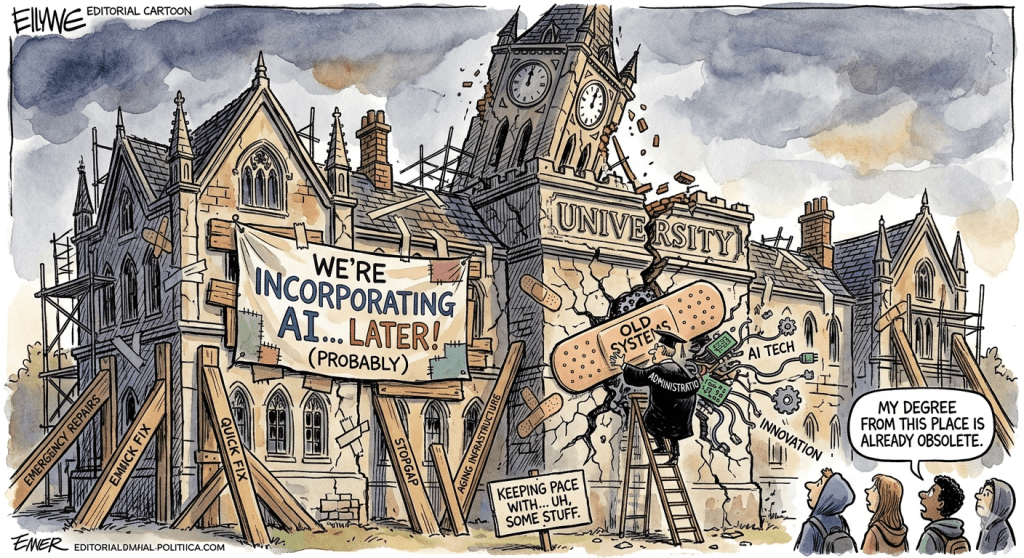
The third challenge is institutional inertia. The financial pressures bearing down on American higher education — declining state funding, demographic headwinds in traditional student-age populations, competition from non-degree credentials and employer-provided training — create powerful incentives for institutions to use AI primarily to reduce costs rather than to enhance learning. Oliver Short, a leading voice in higher education technology strategy, has argued that the shift from “compliance-based” AI adoption (responding to external pressure) to “mission-based” adoption (using AI to advance the core educational mission of access, equity, and lifelong learning) will define which institutions flourish in the second half of this decade (33). His prediction is that institutions that frame AI as a lever for their educational mission, rather than a tool for efficiency, will pull ahead. The evidence reviewed here suggests he is right.
Trajectory for Higher Education, 2026–2030
The models examined in this report — ASU’s adaptive learning ecosystem, SNHU’s competency-based student-first architecture, WGU’s proof of CBE at scale, MIT RAISE’s global AI literacy movement, Georgia Tech’s lifetime learning commitment, and UCF’s affordable, AI-enabled student support — collectively suggest a trajectory for higher education in the next four years that can be described in five broad movements.
First, competency-based education will continue its expansion from the margins to the mainstream. The accreditation barriers that long limited CBE adoption are eroding, and the demonstrated outcomes of WGU and SNHU are increasingly difficult for skeptics to dismiss. By 2030, it is plausible that a significant minority of American undergraduates will be enrolled in programs that measure progress by demonstrated mastery rather than seat time — a shift that would represent the most fundamental structural change in American higher education since the credit hour was standardized in the early twentieth century.
Second, AI tutoring and personalized learning will move from pilot programs to baseline infrastructure. The global AI in higher education market, projected at $32 billion by 2030 (7), will produce tools that adapt to individual student learning styles, pace, and knowledge gaps with increasing sophistication. The critical question is not whether these tools will be widely available, but whether institutions will deploy them in ways that genuinely expand student agency or primarily use them to substitute for human instruction at lower cost. The World Economic Forum’s 2025 Future of Jobs Report projected that 39 percent of core worker skills required by 2030 will differ from those needed today (34), placing a premium on the kind of adaptive, self-directed learning that the best AI-powered educational environments support.
Third, AI literacy will become a universal curricular expectation. The argument advanced by Paul LeBlanc — that it “makes no sense” to train students without the tools they will use professionally — is gaining institutional ground rapidly. California State University’s 2025 partnership with Microsoft, OpenAI, and Google to build an AI-ready workforce represents one model; MIT RAISE’s open-source Day of AI curriculum, now reaching a million students annually, represents another (3,21). By 2030, some form of AI literacy requirement — covering not just the mechanics of AI tools but the ethical, epistemological, and civic dimensions of living with AI — is likely to be standard in accredited degree programs.
Fourth, the distinction between enrolled students and lifelong learners will continue to blur. Georgia Tech’s Commitment to a Lifetime Education points toward a future in which universities function less as four-year finishing schools and more as ongoing learning partners for individuals across their working lives. The expansion of micro-credentials, stackable certificates, and employer-sponsored education — already underway at SNHU through its community partnerships program — will accelerate. By 2030, the most adaptive institutions will have developed the data infrastructure and advising systems needed to maintain meaningful learning relationships with alumni and returning students, not just current enrollees.
Fifth, and most critically for the democratization thesis, the equity question will intensify before it is resolved. The new digital divide documented by EDUCAUSE, Frontiers, and others — not merely a divide between those with and without internet access, but between those with and without the institutional support, AI literacy, and cultural scaffolding to benefit from AI-powered learning — will demand active policy responses. Institutions and policymakers that treat AI competence as a universal learning outcome, ensuring that every undergraduate in every discipline graduates able to use, question, and manage AI tools (35), will narrow this divide. Those that allow AI-enhanced learning to become the province of well-resourced institutions and self-directed students will widen it.
The arc of the next five years in higher education is not predetermined. The institutions and leaders profiled in this report are demonstrating that genuine student-centered democratization is possible, scalable, and institutionally sustainable. Whether their models spread broadly enough to reshape the field, or remain admirable exceptions, will depend on choices that administrators, faculty, policymakers, students, and technology companies are making right now. The embodied AI transition that the Educational Technology and Change Journal has described as analogous to the CLI-to-GUI shift (1) may indeed be the moment when the tools of learning truly pass into the hands of the learners. The institutions that have chosen to lead that passage will have earned their place in the history of educational transformation.
References
1. Shimabukuro, J. (2026, May 23). What the transition to embodied AI reveals about technological change. Educational Technology and Change Journal. https://etcjournal.com/2026/05/23/what-the-transition-to-embodied-ai-reveals-about-technological-change/
2. Mapsted. (2026). Top technology trends in higher education to watch in 2025. https://mapsted.com/blog/higher-education-technology-trends
3. Goldstone, G. (2026, January 21). Designing the 2026 classroom: Emerging learning trends in an AI-powered education system. Faculty Focus. https://www.facultyfocus.com/articles/teaching-with-technology-articles/designing-the-2026-classroom-emerging-learning-trends-in-an-ai-powered-education-system/
4. EAB. (2023). Q&A with SNHU president Paul LeBlanc. https://eab.com/resources/podcasts/qa-with-snhu-president-paul-leblanc/
5. LeBlanc, P. J. (2025, June 26). AI in education — from systemic traps to intelligent human solutions [Podcast]. An Educated Guest. https://podcasts.apple.com/us/podcast/s3e3-paul-leblanc-ai-in-education-from-systemic-traps/id1569897957?i=1000714580574
6. Faculty Focus. (2026, January 21). Designing the 2026 classroom. (AI education market data cited from AIPRM, 2025.) https://www.facultyfocus.com/articles/teaching-with-technology-articles/designing-the-2026-classroom-emerging-learning-trends-in-an-ai-powered-education-system/
7. Klover.ai. (2026). The algorithmic institution: AI in higher education administration and strategic growth. https://www.klover.ai/the_algorithmic_institution_ai_higher_education_administration_strategic_growth_indepth_analysis_2026/
8. British Educational Research Association. (2025). Digital equity in the age of generative AI: Bridging the divide in educational technology. https://www.bera.ac.uk/blog/digital-equity-in-the-age-of-generative-ai-bridging-the-divide-in-educational-technology
9. Arizona State University Office of the President. (n.d.). Michael M. Crow biography. https://president.asu.edu/the-president
10. Zhao, [lead author]. (2025, September). Artificial intelligence and the future of personalized learning: The case of Arizona State University. ResearchGate. https://www.researchgate.net/publication/395241709_Artificial_Intelligence_and_the_Future_of_Personalized_Learning_The_Case_of_Arizona_State_University
11. Landis Technologies. (2025, September 24). Adaptive learning technology: ASU’s algorithm of success. https://landis-technologies.com/listen.education-blog/the-algorithm-of-success
12. ASU News. (2024, April 15). Game on: ASU, Endless announce partnership to scale personalized learning solutions. https://news.asu.edu/20240415-arts-humanities-and-education-asu-endless-announce-partnership-scale-personalized-learning
13. Ellucian. (2025, January 15). Ellucian announces Dr. Paul LeBlanc as Ellucian Live 2025 mainstage speaker. https://www.ellucian.com/newsroom/ellucian-announces-dr-paul-leblanc-ellucian-live-2025-mainstage-speaker
14. Open edX. (2025, July 28). How WGU transformed competency-based education at scale with the Open edX LMS. https://openedx.org/blog/how-wgu-transformed-competency-based-education-at-scale-with-the-open-edx-lms/
15. LeBlanc, P. J. (2023). Students first: Equity, access, and opportunity in higher education. (As cited in SNHU featured works page.) https://www.snhu.edu/about-us/leadership-and-history/president-corner/featured-works
16. The Harvard Crimson. (2025, February 14). Former SNHU president encourages artificial intelligence in higher education at HGSE event. https://www.thecrimson.com/article/2025/2/14/artificial-intelligence-hgse-talk/
17. Western Governors University. (2024). Program guidebook: Master of Science, Curriculum and Instruction. https://www.wgu.edu/content/dam/wgu-65-assets/western-governors/documents/program-guides/teaching/MSCIN.pdf
18. Open edX. (2025, February 21). The Open edX project and Western Governors University. https://openedx.org/blog/the-open-edx-project-and-western-governors-university/
19. MIT Open Learning. (2025). About us. https://openlearning.mit.edu/about-us
20. Time. (2025, August 26). Cynthia Breazeal: The 100 most influential people in AI 2025. https://time.com/collections/time100-ai-2025/7305873/cynthia-breazeal/
21. Day of AI. (2025, September 25). Day of AI and MIT RAISE launch national movement to empower students and educators in the AI age. https://dayofai.org/day-of-ai-and-mit-raise-launch-national-movement-to-empower-students-and-educators-in-the-ai-age/
22. MIT RAISE. (2026, January 17). AI in the hands of learners: Highlights from the 2025 MIT AI and Education Summit. https://raise.mit.edu/news/2025-mit-ai-and-education-summit/
23. Georgia Tech. (n.d.). Imagine a future in which learning is for life. https://news.gatech.edu/archive/features/imagine-future-which-learning-life.shtml
24. Fedele, F. (2026, January 9). Art meets AI: Transforming undergraduate education through community-based teaching and learning. Georgia Tech Center for Teaching and Learning Blog. https://blog.ctl.gatech.edu/2026/01/09/art-meets-ai-transforming-undergraduate-education-through-community-based-teaching-and-learning/
25. 2U/edX. (2025, October 15). Can AI teach AI? Georgia Tech and edX are testing the theory. https://2u.com/newsroom/can-ai-teach-ai-georgia-tech-and-edx-are-testing-theory/
26. UCF News. (2025, October 3). Enhancing student support: How UCF’s Knightbot transforms the college experience. https://www.ucf.edu/news/enhancing-student-support-how-ucfs-knightbot-transforms-the-college-experience/
27. UCF News. (2026, February 25). UCF’s commitment to affordable learning. https://www.ucf.edu/news/ucfs-commitment-to-affordable-learning/
28. UCF Faculty Center for Teaching and Learning. (2026). Teaching and learning with AI — AI for all conference. https://aiforall.ucf.edu/teachwithai/
29. Inside Higher Ed. (2025, April 21). Half of colleges don’t grant students access to generative AI tools. https://www.insidehighered.com/news/tech-innovation/artificial-intelligence/2025/04/21/half-colleges-dont-grant-students-access
30. Siddiqi, [first author]. (2026, February 23). New digital divide in the age of AI: Equity and access in higher education. New Directions for Community Colleges. Wiley Online Library. https://onlinelibrary.wiley.com/doi/abs/10.1002/cc.70051
31. Frontiers in Computer Science. (2026, January 12). AI and the digital divide in education. https://www.frontiersin.org/journals/computer-science/articles/10.3389/fcomp.2026.1759027/full
32. eCampus News. (2026, January 1). 13 predictions about edtech, innovation, and — yes — AI in 2026. https://www.ecampusnews.com/digital-innovation/2026/01/01/draft-2026-predictions/
33. Packback. (2025, December 15). 2026 predictions for AI in higher education. https://packback.co/resources/2026-predictions-for-ai-in-higher-education/
34. Aralia Education. (2026, February 4). How AI will impact higher education in 2026: 6 key predictions. (Citing World Economic Forum Future of Jobs Report 2025.) https://www.aralia.com/helpful-information/how-ai-will-impact-higher-education-in-2026-6-key-predictions/
35. Wong, W., Aristidou, A., & Scheuermann, K. (2025). The new digital divide in higher education: AI as public capability or private advantage? PA TIMES Online. https://patimes.org/the-new-digital-divide-in-higher-education-ai-as-public-capability-or-private-advantage/
###
Filed under: Uncategorized |






























































































































































































































































































































































































































Leave a Reply