





By Jim Shimabukuro (assisted by DeepSeek)
Editor
[Related: The Two-Minute Cliffhanger | AI-Generated Micro Dramas and the Democratization of Student Storytelling]
1. Definition and Essential Character
AI micro dramas are serialized, vertically filmed short-form series purpose-built for mobile consumption, with episodes typically running one to three minutes and spanning sixty to eighty instalments per series. They lean heavily into romance, fantasy, and high-concept hooks—werewolves, mafia bosses, and star-crossed lovers are stock elements—and are designed for the TikTok-era attention span (1,2). What distinguishes the AI variant from live-action micro dramas is that large language models and multimodal generative systems replace or drastically reduce the human roles of scriptwriter, actor, cinematographer, and editor. Entire series can be produced “end-to-end” by algorithms: an AI script is parsed into storyboards, characters are generated and kept consistent across shots, synthetic voices deliver dialogue, and the final video is assembled with AI-driven post-production, often with nothing spent on human actors (3,4).

2. Scale of Success
By any commercial yardstick, AI micro dramas have been a breakout success. In 2025, AI-generated comic-style micro dramas alone accounted for an estimated 16.8 billion yuan (about $2.44 billion) in market share, and by early 2026 more than 10,000 AI-produced titles were being released every month (5,6). On Douyin, China’s version of TikTok, nearly 50,000 new AI micro dramas were uploaded in March 2026; in January of the same year a new AI-generated title went live every ninety seconds (7,8). The global micro-drama market as a whole reached an estimated $11 billion in 2025 and is projected to hit $14 billion in 2026, with AI-driven content capturing a fast-growing slice (9). Outside China, revenue from overseas short dramas hit $1.5 billion in the first eight months of 2025, up 194.9 percent year-on-year, much of it fueled by AI tools that slash translation and production costs (10).
3. Emergence as a Recognized Genre
Micro dramas first appeared in China around 2018 alongside the rise of Douyin and exploded during the COVID-19 pandemic when audiences were confined to their phones (11). AI-generated micro dramas, however, constitute a more recent layer. The technology moved through three phases: a technical foundation period, a technical breakthrough window, and the commercialization exploration that took off in 2024‑2025 (12). By the second half of 2025 the volume of AI-animated short drama content was growing 106 percent quarter-over-quarter, and by January 2026 AI-generated titles made up 38 percent of the top-100 micro-drama chart, up from just 7 percent a year earlier—signaling that AI micro dramas had crossed from experiment to mainstream (13,14).
4. Production Methods
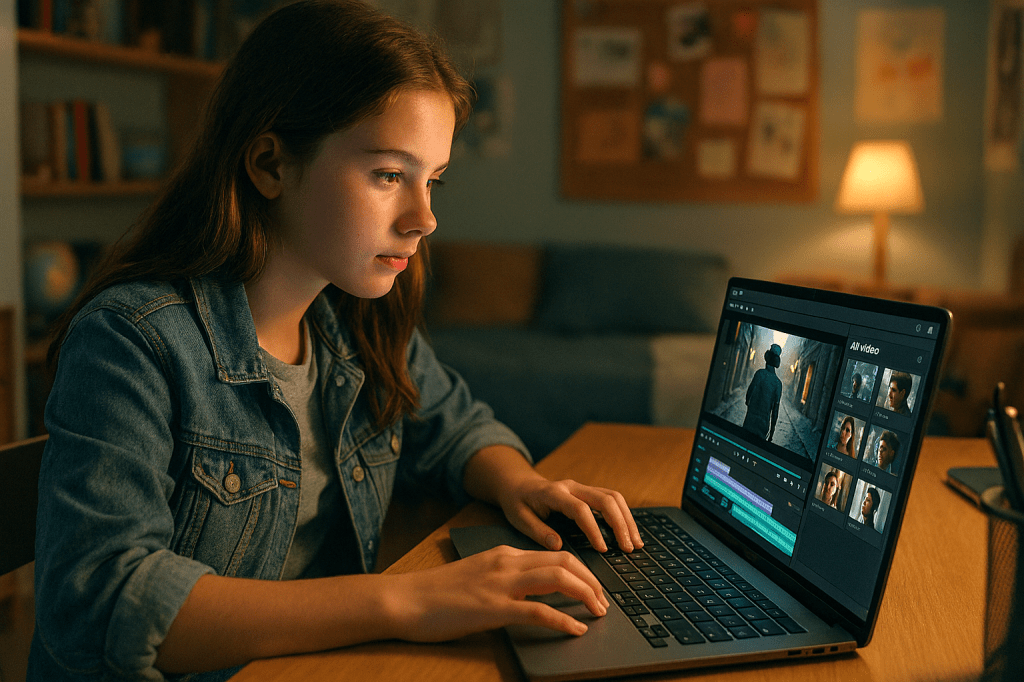
Production has been radically industrialized. Where a live-action micro drama previously required about two months for casting, location scouting, shooting, and post, an AI-generated series can now be finished in less than two weeks (15). The standard pipeline follows a “script establishment → AI parsing → persona generation → card-draw video generation → post-production refinement” model (16). Tools such as Kunlun Tech’s SkyReels platform and open-source projects like Jellyfish provide end-to-end workspaces that ingest a script, break it into storyboards, maintain character consistency, and export finished episodes (17,18). Some studios report that three-person teams can produce five series per month, with per‑minute costs collapsing from thousands of yuan to just a few dozen yuan (19).
5. Leading Countries, Companies, and Individuals
China is the unrivaled center of gravity. Domestic giants such as Kunlun Tech (with its SkyReels platform) and ByteDance (which operates Douyin and its micro-drama feed) are setting the pace, while Chinese platforms ReelShort, DramaBox, and ShortMax dominate overseas distribution (20,21). India has seen the rise of Dashverse, which launched the country’s first fully AI-generated micro drama “Raftaar” and raised $13 million in Series A funding (22,23). Ukraine-based Holywater, with its My Drama and My Muse apps, closed a $22 million round in early 2026—the largest micro-drama investment outside Asia—and struck a production deal with Fox Entertainment (24,25). In the United States, Cineverse and Lloyd Braun’s Banyan Ventures formed MicroCo in mid‑2025, the first U.S.‑based studio and AI-native platform built specifically for micro-series, while Korean firms such as Arcane and Vigloo are leveraging K-drama production expertise to enter the AI micro-drama market (26,27).
6. Drivers of Popularity
Industry analysts attribute the surge to a confluence of forces. AI micro dramas are dramatically cheaper and faster to produce than their live-action counterparts, allowing platforms to flood the market with content that is algorithmically tailored to micro‑audiences (28). The format is naturally suited to genres that demand heavy special effects—sci-fi, fantasy, supernatural romance—that would be prohibitively expensive to film with live actors (29). Moreover, AI tools have lowered the creative barrier to entry; small teams and even solo creators can now build sustainable businesses on advertising revenue shares that reach tens of thousands of yuan per month (30). Cultural researcher Zhang Peng notes that the core driver is the rapid improvement of generative AI’s visual fidelity, which now meets the minimum bar for micro-drama storytelling (31).
7. Projected Trajectory 2026‑2027
The near-term trajectory points to saturation, consolidation, and premiumization. In the first quarter of 2026, AI micro dramas accounted for more than 95 percent of the roughly 128,000 new micro-drama releases in China, effectively making AI the industry’s main production engine (32). Analysts forecast that China’s AI micro-drama market alone will exceed 240 billion yuan in 2026 and could break through 400 billion yuan by 2027, while the overseas AI‑drama market is projected to leap from about $1 billion in 2025 to $6.5 billion in 2026 (33,34). The next stage, according to a Tsinghua University research team, will be defined by the shift from project-based production to software‑driven, pipeline-based, and platform-centric creation, with competition hinging on who can turn AI into core industrial infrastructure (35). At the same time, tighter content review rules and audience fatigue with low-quality output will push the industry toward higher production values, original IP development, and interactive or personalized narrative formats (36).
8. Implications and Impact on Established Genres
The AI micro-drama phenomenon matters because it is re‑engineering the economics and creative logic of screen entertainment. By compressing development cycles and eliminating the traditional labor pipeline, AI micro dramas challenge the cost structures of both broadcast television and conventional streaming series, forcing legacy studios to experiment with short-form vertical content (37). Hollywood is already taking note: TikTok has cast live actors for its own micro dramas, while venture capital is pouring into AI film apps that promise to let users generate bespoke series on demand (38). More profoundly, AI micro dramas represent the first mass application of AI-generated video at industrial scale, proving that generative models can serve as a viable substitute for human crews in certain storytelling formats. This success is likely to accelerate the migration of audience data upstream into the development process, reshaping how stories are imagined, financed, and greenlit across the entire creative economy (39). The risk, however, is that a flood of algorithmically optimized, formulaic content could crowd out riskier, human-led storytelling and concentrate creative power in the hands of a few platform and tooling companies (40).
References
- “A.I. Shakes Up China’s Entertainment Landscape,” The New York Times, May 3, 2026. https://www.nytimes.com/2026/05/03/business/china-ai-microdramas.html
- “There’ll Definitely be a Backlash – Microdramas Come to Europe as Studios Bet on Short-Form Video,” VideoWeek, Feb. 4, 2026. https://videoweek.com/2026/02/04/theres-definitely-be-a-backlash-microdramas-come-to-europe/
- “From dragon monsters to handsome protagonists: The AI-generated microdramas taking China by storm,” Malay Mail, Nov. 7, 2025. https://www.malaymail.com/news/life/2025/11/07/from-dragon-monsters-to-handsome-protagonists-the-ai-generated-microdramas-taking-china-by-storm/
- “沒有攝像、沒有演員,一部AI生成短劇是如何誕生的?” China.com.cn, Apr. 29, 2026. https://big5.china.com.cn/cn/2026-04/29/content_118994055.html
- “AI redefines China’s booming micro drama industry,” Xinhua, Mar. 25, 2026. https://english.news.cn/20260325/2a6b0f2e0b7f4b2e8b5c6d7e8f9a0b1c/
- “How A.I. Is Transforming China’s Entertainment Industry,” The New York Times, May 3, 2026. https://www.nytimes.com/2026/05/03/business/china-ai-microdramas.html
- Ibid.
- “China’s $16.5B micro-drama industry becomes the world’s first mass application of AI-generated video,” The Next Web, May 1, 2026. https://thenextweb.com/news/chinas-16-5b-micro-drama-industry-ai-generated-video
- Ibid.
- “From clicks to creation: How AI is fueling China’s micro-drama boom abroad,” State Council Information Office, Apr. 30, 2026. https://english.scio.gov.cn/2026-04/30/content_118998627.html
- “Chinese Short Dramas Taking the Globe by Storm: Do You Grasp Their Underlying Logic?” 36Kr, Mar. 17, 2026. https://eu.36kr.com/p/3185174116704256
- “AI微短剧技术演进与发展趋势研究,” zsyb.cn, Jan. 8, 2026. https://www.zsyb.cn/detail-1758.html
- “China’s AI animated micro-drama sector eyes global expansion,” China.org.cn, Mar. 24, 2026. https://www.china.org.cn/business/2026-03/24/content_118895674.html
- “AI短剧爆发式增长问题与风险引关注,” paper.zgswcn.com, Mar. 19, 2026. https://paper.zgswcn.com/content/2026-03/19/content_118782354.html
- “How AI is rewriting the future of micro-dramas,” Beijing Review, Apr. 7, 2026. https://french.beijingreview.com.cn/2026-04/07/content_118933216.html
- “沒有攝像、沒有演員,一部AI生成短劇是如何誕生的?” China.com.cn, Apr. 29, 2026. https://big5.china.com.cn/cn/2026-04/29/content_118994055.html
- “GitHub – Forget-C/Jellyfish: An end-to-end production workspace for AI-generated short dramas,” GitHub, Apr. 20, 2026. https://github.com/Forget-C/Jellyfish
- “Kunlun Wanwei Launches China’s First AI Short-Drama Video Generation Model, SkyReels-V1,” TMTPost, Feb. 18, 2025. https://en.tmtpost.com/news/2025/0218/100000.html
- “技术平权下 AI漫剧加速演变,” Baijiahao, Jan. 27, 2026. https://baijiahao.baidu.com/s?id=1823996800453605461
- “Chinese social media giant steps up investment in micro-drama industry,” China.org.cn, May 13, 2026. https://www.china.org.cn/business/2026-05/13/content_119107704.html
- “Spirit Studios & Night Train Ride The Micro-Drama Wave With UK-Originated Series,” IMDb, Dec. 16, 2025. https://www.imdb.com/news/ni65162996/
- “Dashverse creates India’s first completely AI generated microdrama,” Afaqs, Sept. 9, 2025. https://www.afaqs.com/news/digital/dashverse-creates-indias-first-completely-ai-generated-microdrama
- “Dashverse raises $13 million led by Peak XV Partners,” Times of India, Aug. 13, 2025. https://timesofindia.indiatimes.com/business/india-business/dashverse-raises-13-million-led-by-peak-xv-partners/articleshow/112489464.cms
- “HOLYWATER secures $22M to expand mobile microdrama content,” Tech.eu, Jan. 16, 2026. https://tech.eu/2026/01/16/holywater-secures-22m-to-expand-mobile-microdrama-content/
- “Fox Entertainment to Produce 200-Plus Vertical Video Series Including Microdramas Under Deal Acquiring Stake in Ukrainian App Start-Up Holywater,” Variety, Oct. 9, 2025. https://au.variety.com/2025/tv/news/fox-entertainment-holywater-microdramas-18556/
- “Cineverse and Lloyd Braun’s Banyan Ventures Form JV to Launch MicroCo, a New Studio and Platform for Microseries,” Cineverse Investor Relations, Aug. 13, 2025. https://investor.cineverse.com/news-releases/news-release-details/cineverse-and-lloyd-brauns-banyan-ventures-form-jv-launch
- “Arcane Partners With Spoon Labs for AI-Enhanced Short-Form Drama Studio,” Chosun, Dec. 11, 2025. https://www.chosun.com/english/industry-en/2025/12/11/S7OY2QPQTVHHRFV3K4L7Z7N2TQ/
- “Micro dramas surge forward on back of advanced AI tools,” Global Times, Mar. 2, 2026. https://www.globaltimes.cn/page/202603/1308923.html
- “AI Redefines China’s Booming Micro Drama Industry,” CRI.cn, Apr. 10, 2026. https://big5.cri.cn/2026-04-10/ab69f630-5f7b-1f4e-2dd1-5bb74b8e9937.html
- “Z世代沉迷狗血短劇 AI虛擬寵物短劇背後藏百億商機,” East Week, Mar. 21, 2026. https://eastweek.stheadline.com/article/46162/
- “Micro dramas surge forward on back of advanced AI tools,” Global Times, Mar. 2, 2026. https://www.globaltimes.cn/page/202603/1308923.html
- “中国网络视听协会发布首期《微短剧创作指引》,” Jingji Ribao, May 2, 2026. https://www.jingjiribao.cn/detail/20260502/419265.html
- “AI短剧热潮:240亿市场爆发,人才缺口60万,内容产业迎变革,” Zhihu, Apr. 20, 2026. https://zhuanlan.zhihu.com/p/782938115
- “2026Q1海外AI剧/漫剧增长率700%:NetShort领跑,占比50%,” Jiemian, May 6, 2026. https://www.jiemian.com/article/10078451.html
- “AI短剧发展研究报告,” Hulianhutong Shequ, n.d. https://www.hulianhutongshequ.cn/ai-short-drama-report
- “China: A TMT: Media & Entertainment (PRC Firms) Overview,” Chambers and Partners, n.d. https://chambers.com/legal-guides/china-a-tmt-media-entertainment-prc-firms-overview
- “AI Is Changing How Stories Are Developed – And Who Decides What Gets Made,” Forbes, Mar. 9, 2026. https://www.forbes.com/sites/maryannhalford/2026/03/09/ai-is-changing-how-stories-are-developed-and-who-decides-what-gets-made/
- “Khosla Ventures, Jeffrey Katzenberg, and others are investing $12 million in a new AI movie app,” Business Insider, May 13, 2026. https://www.businessinsider.com/ai-movie-app-raises-12-million-khosla-ventures-jeffrey-katzenberg-2026-5
- “AI Is Changing How Stories Are Developed – And Who Decides What Gets Made,” Forbes, Mar. 9, 2026. https://www.forbes.com/sites/maryannhalford/2026/03/09/ai-is-changing-how-stories-are-developed-and-who-decides-what-gets-made/
- “文化观察 | 从剧本生成到视觉制作 从互动叙事到全球化传播 人工智能助力微短剧创作,” enorth.com.cn, n.d. https://news.enorth.com.cn/system/2026/04/10/061258016.html
###
Filed under: Uncategorized |






























































































































































































































































































































































































































































Leave a Reply