





By Jim Shimabukuro (assisted by Claude)
Editor
[Related: Trump’s AI Executive Order: International Response]
Summary: The critique reveals a deeper truth: regulating AI with yesterday’s tools leaves governments perpetually behind a technology that evolves faster than law. –Copilot

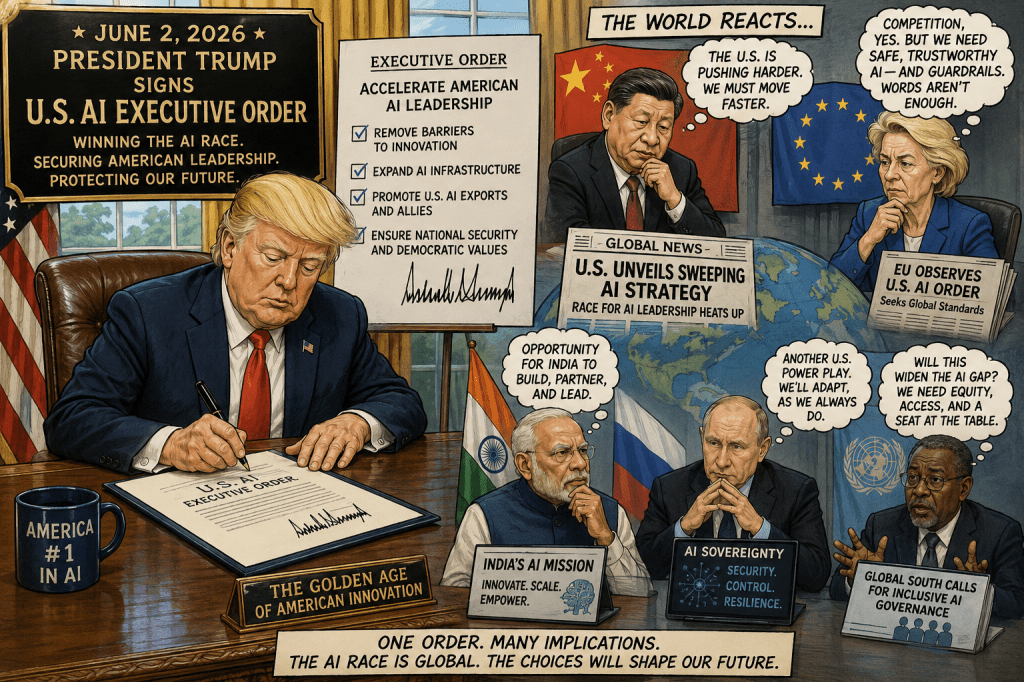
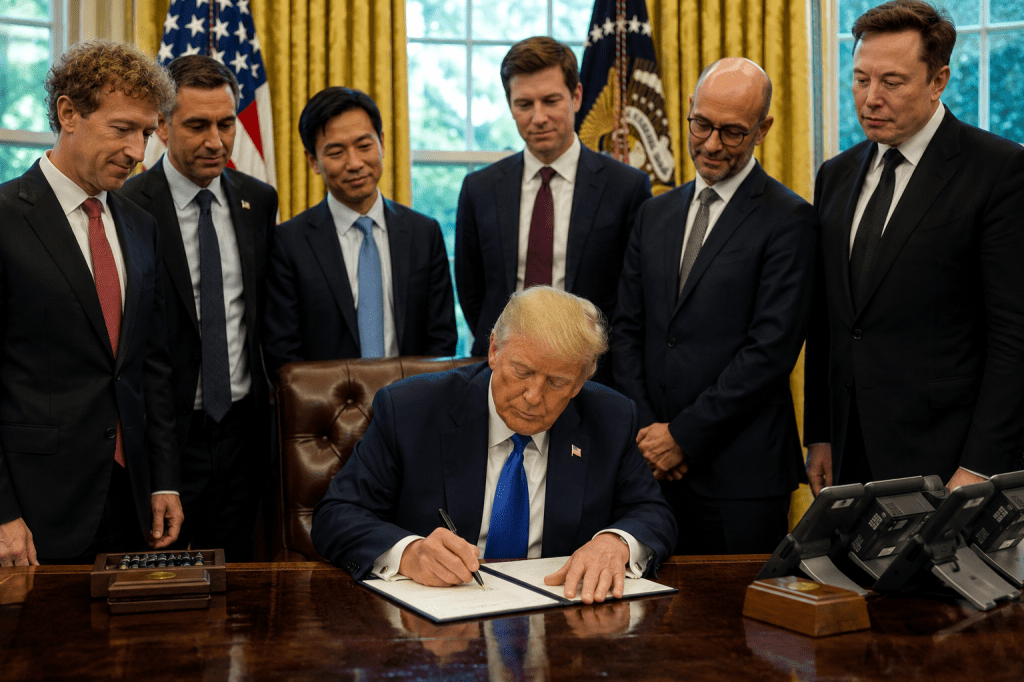
On June 2, 2026, President Donald Trump signed an executive order titled “Promoting Advanced Artificial Intelligence Innovation and Security,” establishing a voluntary framework under which major AI companies would share their most powerful frontier models with the federal government for review up to 30 days before public release (1,3). The order marks a significant departure from the administration’s previous hands-off posture toward AI regulation—one framed as essential to preserving American companies’ lead over China—and signals that national security concerns have begun to override, at least partially, the administration’s strong deregulatory instincts (5).
Background: The Catalyst
The executive order was directly triggered by a series of developments in early 2026 that made clear that advanced AI systems posed credible, near-term threats to critical infrastructure. The most dramatic was Anthropic’s April 2026 announcement that its Claude Mythos Preview model had identified extraordinary numbers of software vulnerabilities. Where an earlier Anthropic model had found roughly 20 exploitable weaknesses in the Firefox browser, Mythos discovered nearly 300, with total counts across all major operating systems running into the tens of thousands (8). Anthropic concluded the model was too dangerous for general release, restricting access to a small group of companies under a cybersecurity initiative called Project Glasswing (4). Anthropic’s CEO publicly described the situation as a cyber “moment of danger,” warning that without coordinated defensive action, the world risked a wave of devastating cyberattacks capable of taking down banking systems, power grids, hospitals, and water infrastructure (9). That concern was not hypothetical: a Chinese state-sponsored cyberattack had already demonstrated AI agents autonomously executing 80 to 90 percent of intrusion workflows at speeds no human operator could match (11).
The administration had been on the verge of signing a more restrictive version of the order in late May, but delayed after pushback from prominent technology executives including former White House AI advisor David Sacks (6). That earlier draft had proposed a 90-day pre-release review period; the final order cut the window to 30 days (7). The scaling back reflected a tension that runs through the entire framework: the administration’s desire to act on legitimate security concerns without appearing to embrace the kind of regulatory oversight it has otherwise opposed.
What the Order Does
The executive order establishes three principal mechanisms. First, it creates a voluntary program under which AI developers are invited to provide the government with early access to “covered frontier models”—those meeting a classified benchmarking threshold for advanced cyber capabilities—during a review window of up to 30 days before public release (1,2). This access is intended to allow government agencies and trusted partners to assess and prepare for the security implications of newly released models before they reach adversaries. Second, the order directs the Treasury Department, the Office of the National Cyber Director, the Department of Defense, the National Security Agency, the Department of Homeland Security, and the Cybersecurity and Infrastructure Security Agency to collaborate on an “AI cybersecurity clearinghouse” that will work with industry and critical infrastructure operators—including power companies and hospital administrators—to identify and remediate AI-related software vulnerabilities (5). Third, the Department of Justice is directed to treat AI-assisted hacking and unauthorized system access as high-priority criminal enforcement areas (6).
What the order explicitly does not do is equally significant. The text states: “Nothing in this section shall be construed to authorize the creation of a mandatory governmental licensing, preclearance, or permitting requirement for the development, publication, release, or distribution of new AI models, including frontier models” (1,6). The prohibition on mandatory requirements was not incidental; it was the price of getting the order signed at all.
Purpose of the Order
The order is animated by two sometimes-competing objectives. On the national security side, the administration seeks early warning about AI systems capable of enabling mass-casualty cyberattacks, with the clearinghouse serving as a standing intelligence-sharing mechanism between government agencies and the private sector (2,5). The order also pursues a competitive advantage function: early government access to frontier models allows federal agencies, the military, and vetted industry partners to begin adapting their own defenses before adversaries can exploit newly discovered vulnerabilities (4,9). On the innovation side, the administration frames the voluntary access framework as a partnership rather than a preclearance regime, insisting it “refuse[s] to stifle this innovation with overly burdensome regulation” (1). The balance between these objectives explains the order’s final shape—ambitious in its institutional architecture, cautious in its enforcement posture.
A third, less visible purpose is to establish a domestic policy predicate for engaging international AI governance discussions from a position of demonstrated seriousness. As the Council on Foreign Relations has noted, decisions made in 2026 will help determine “where responsibility, power, and opportunity ultimately concentrate in the AI era,” and a government that cannot show it has assessed its own frontier models is poorly positioned to press other nations to do the same (11).
Implications for the U.S. Government
For federal agencies, the order creates both new responsibilities and new capabilities, with the outcome depending heavily on implementation. The AI cybersecurity clearinghouse is potentially the most consequential institutional creation: if properly resourced and staffed, it could function as a standing mechanism for public-private intelligence sharing on AI-enabled threats, analogous to the Information Sharing and Analysis Centers that serve critical infrastructure sectors. The DOJ’s elevated enforcement mandate on AI-assisted cybercrime is a lower-friction complement, leveraging existing legal authority without requiring new legislation.
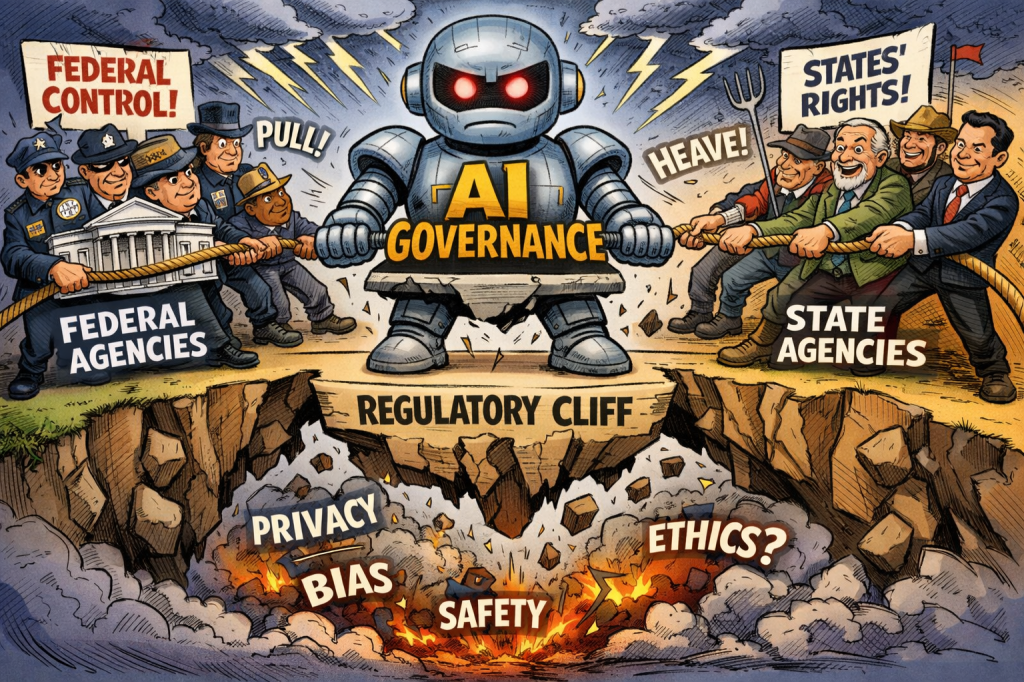
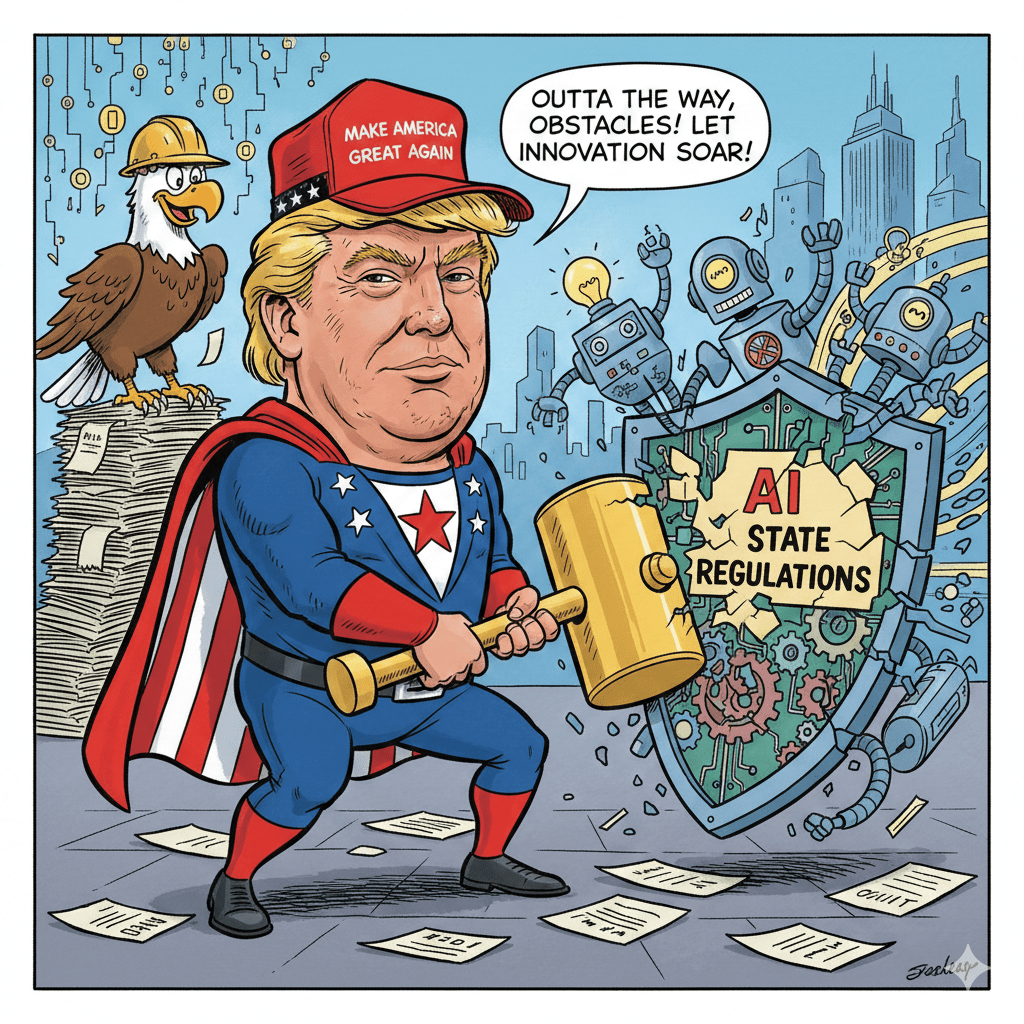
The order also has a federalism dimension that may generate significant legal and political turbulence. A DOJ AI Litigation Task Force is directed to challenge state AI laws in federal court on grounds that they unconstitutionally burden interstate commerce or are preempted by federal regulations, and the administration is conditioning $42 billion in broadband infrastructure funding on states’ willingness to repeal AI regulations deemed inconsistent with the national framework (12,13). Legal analysts have noted that executive orders do not themselves preempt state law—that power flows from congressional action—meaning these provisions are likely to face court challenges (13). The net effect may be more deterrent than directive: by raising the legal and financial costs of state-level regulation, the order could discourage new state AI laws even if it cannot nullify existing ones.
The government’s internal challenge is capacity. Even with sound institutional design, reviewing frontier AI models within 30 days requires deep technical expertise and secure evaluation infrastructure that federal agencies do not currently have at scale. The Center for AI Standards and Innovation (CAISI) has been tasked with pre-deployment evaluations, but the gap between ambition and capability is substantial (15).
Implications for Frontier AI Companies
For the largest frontier AI companies, the order presents a combination of opportunity and manageable friction. OpenAI’s chief global affairs officer welcomed it as “an important step forward” ensuring that “safety and innovation must advance hand-in-hand” (4), while Microsoft President Brad Smith called it “an important step toward advancing innovation while protecting the security of the American public” (4). These endorsements reflect the strategic interests of dominant incumbents: voluntary engagement with government creates an official channel for influence over benchmarking standards and enhances the credibility of safety claims with the public and with regulators in other jurisdictions.
For smaller companies and startups, the calculus is less favorable. Participating in pre-release government review—even voluntarily—requires sharing proprietary model weights and architectures with federal agencies, raising legitimate concerns about intellectual property protection and competitive exposure. There is also an implicit two-tier dynamic: companies that participate may be viewed as more trustworthy by the government for procurement purposes, while non-participants may face indirect market disadvantages. The line between voluntary and mandatory blurs quickly when the alternative is regulatory disfavor.
Open-source AI developers and international model providers operating outside U.S. jurisdiction are effectively exempt. This is the order’s most important structural gap from a national security standpoint: the threats that justify the framework—AI-enabled vulnerability discovery and cyberattack—are not limited to proprietary, domestic models.
Weighing the Pros and Cons
The case for the order rests on solid ground. It responds to a real and demonstrated threat—Anthropic’s own restraint in withholding Mythos Preview from public release underscores the gravity of the risk—and it creates institutional infrastructure for government-industry collaboration on AI security that did not previously exist in any organized form (8,10). The 30-day window, while short, establishes a norm that major frontier releases should be subject to some form of government review. The DOJ enforcement priority on AI-assisted cybercrime signals that such conduct will be treated with the seriousness it warrants.
The case against is equally substantial. A voluntary framework without meaningful incentives or sanctions is structurally fragile. The actors whose models pose the most acute risks—foreign developers, open-source projects, and startups willing to accept regulatory risk—have no legal obligation to participate. The administration’s simultaneous effort to preempt state AI regulations, without substituting federal mandatory requirements, risks leaving a regulatory vacuum precisely when AI capabilities are advancing most rapidly. Legal challenges to the state preemption provisions are likely to succeed, at least in part (13), further complicating the enforcement picture. And the 30-day review window, while politically necessary, may be technically insufficient for meaningful evaluation of models with the complexity and capability of Mythos Preview (7).
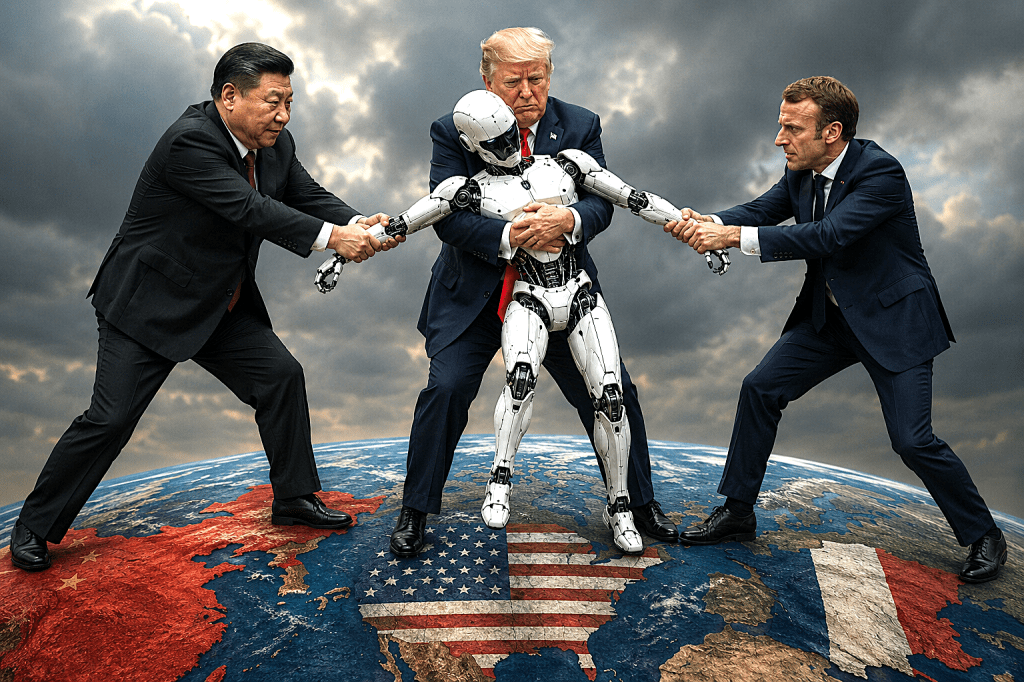
A deeper structural problem is the competitive dimension. U.S.-China competition for international AI market share is intensifying in 2026, and unilateral U.S. voluntary oversight frameworks create regulatory arbitrage that benefits developers in less-regulated jurisdictions (11). China’s government has demonstrated the ability to deploy AI for state purposes with considerably less internal friction than democratic governance allows. Meanwhile, the April 2026 White House warning about China conducting “industrial-scale” campaigns to distill U.S. frontier AI systems through proxy accounts suggests that the security gap may lie as much in post-release access controls as in pre-release review (15).
Conclusion: Workable, but Insufficient on Its Own
The executive order as signed is a meaningful but insufficient step. It is workable in the narrow sense that it can be implemented without legislative action and with broad industry acquiescence—the endorsements from OpenAI and Microsoft signal that the dominant players will likely comply. It is insufficient in the broader strategic sense because it addresses only the most cooperative slice of the AI risk landscape, leaving largely untouched the scenarios where state-level threats, foreign developers, and open-source proliferation combine to outpace government review capacity.
For the order to give the United States a durable strategic edge in AI power, several revisions or complementary actions are necessary. Congress should legislate mandatory pre-release review thresholds tied to specific, classified capability benchmarks—capability-based, not company-based—while pairing mandatory review with liability safe-harbor protections for participating companies to make compliance genuinely attractive. The government must also invest urgently in the technical infrastructure and staffing needed to evaluate frontier models in compressed timeframes; the 30-day window is effectively hollow without credible evaluation capacity. The DOJ enforcement priority on AI-assisted cybercrime should be matched by a dedicated AI security coordination office with genuine cross-agency authority, rather than merely elevated prosecutorial case priority.
Most importantly, the United States should use its bilateral and multilateral relationships—with the United Kingdom, the European Union, Japan, South Korea, and Australia—to negotiate a shared framework for frontier model evaluation. The Atlantic Council’s Commission on AI has recommended this as part of a broader roadmap for sustained U.S. leadership across six critical domains: innovation, talent, governance, supply chain, energy, and allied partnerships (14). A voluntary domestic program becomes strategically meaningful only when it is the foundation of a broader, allied oversight architecture that adversaries cannot circumvent by choosing a different jurisdiction.
The Mythos Preview episode illustrates the central challenge: the most dangerous AI capabilities may emerge faster than any regulatory framework can anticipate, and the companies most likely to develop them may or may not choose to self-regulate. The executive order deserves credit for recognizing that this is a governance problem, not merely a technological one. Its weakness lies in relying on the goodwill of the very actors whose commercial incentives may, on any given day, diverge from the national interest.
References
1. “Promoting Advanced Artificial Intelligence Innovation and Security” — The White House, June 2, 2026
7. “Trump’s new AI safety order seeks voluntary review of new models” — NPR, June 2, 2026
8. “Anthropic holds Mythos model due to hacking risks” — Axios, April 7, 2026
12. “AI Executive Order Targets State Laws and Seeks Uniform Federal Standards” — Latham & Watkins, 2026
13. “President Trump Signs Executive Order Challenging State AI Laws” — Paul Hastings LLP, 2026
15. “U.S. ramps up frontier AI testing as White House pivots toward safety” — Axios, May 5, 2026
###
Filed under: Uncategorized |
















































































































































































































































































































































































































































Leave a Reply