


By Jim Shimabukuro (assisted by ChatGPT)
Editor
[Related: This is Part 1 of an eight-part series. Links to the remaining installments will be added here as they are published.]
Introduction to the series: Karate has one of the most familiar silhouettes in the world: the white uniform, the dark belt, the poised fist, the explosive cry. Its early history looks nothing like that picture. Before karate had uniforms, ranks, public dojos, tournaments, or even an agreed-upon name, it circulated through the Ryukyu Islands in private instruction, family recollection, diplomatic contact, travel across the East China Sea, and bodily patterns preserved in kata.
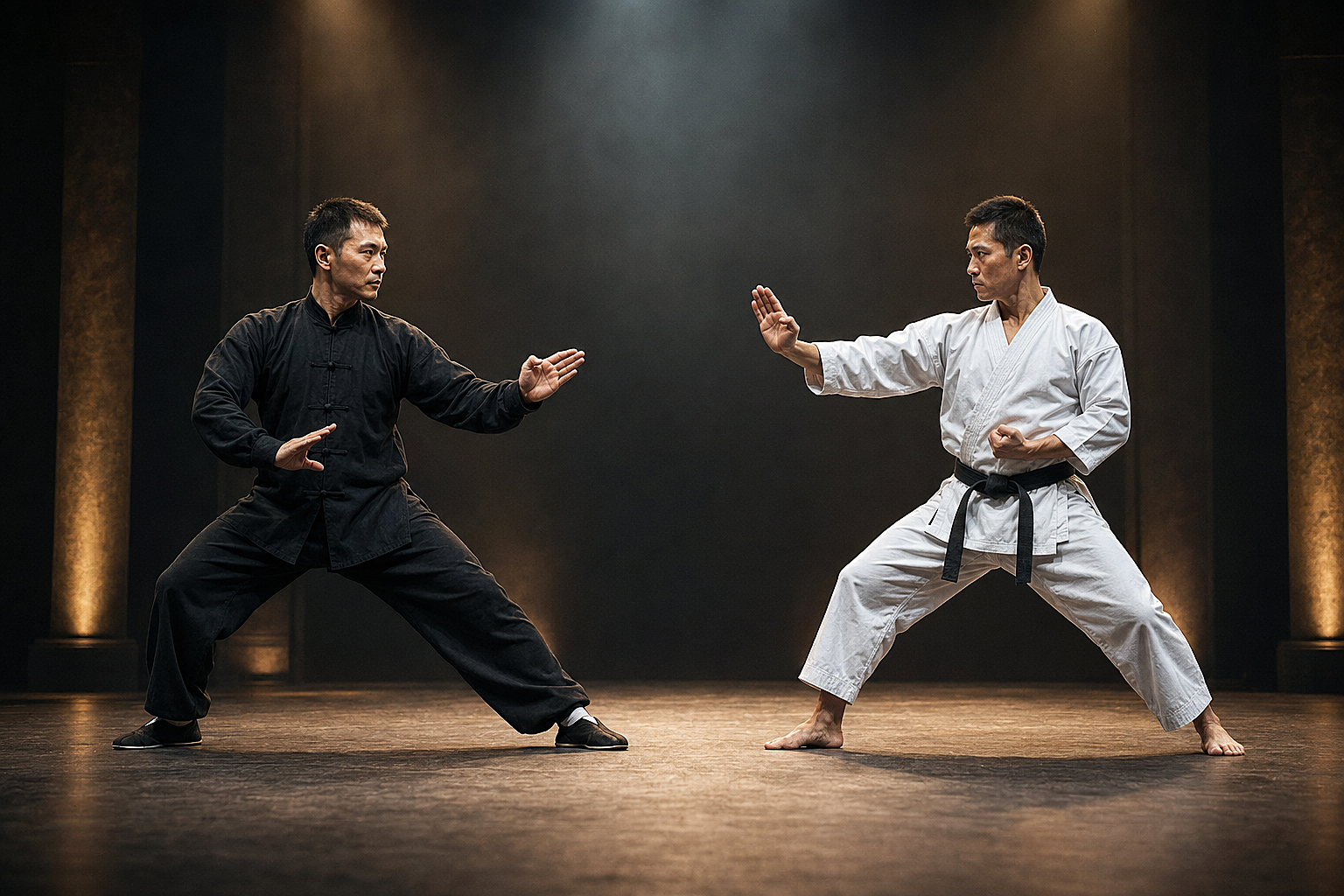
The usual origin story is satisfyingly simple. Okinawa possessed an indigenous fighting art called ti or te. Chinese boxing arrived from Fujian. The two traditions merged and became karate. That outline may contain a substantial truth, but nearly every part of it raises another question. What was ti before people began describing it retrospectively? Which Chinese arts reached Ryukyu, by what routes, and in what periods? Who actually studied in Fuzhou? Can a modern kata preserve the outline of a Chinese routine practiced two centuries ago? And how much of the story was reconstructed only after karate entered Okinawan schools and then moved to mainland Japan?
This eight-part series will pursue those questions without forcing the evidence into a cleaner story than it can support. Contemporary documents will carry more weight than later recollections. Near-contemporary testimony will be distinguished from family lineage traditions. Technical similarities between a karate kata and a Chinese form will be treated as evidence worth investigating, but not as proof of direct descent. When a conclusion is documented, strongly supported, plausible, traditional, disputed, or contradicted, the prose will say so plainly.
The investigation will begin with the damaged and fragmentary historical record. It will then examine the disputed idea of an indigenous Okinawan ti, follow the maritime corridor connecting Ryukyu with Fujian, and study the Chinese visitors, immigrants, diplomats, merchants, and castaways who reached Okinawa. Later installments will follow Okinawan practitioners to China, test the stories attached to individual masters, and ask what kata can reveal when written evidence fails. The final installment will consider how Okinawans transformed these varied inheritances into a martial culture of their own.
The purpose is not to take karate away from either Okinawa or China. It is to understand creation as something more interesting than a single moment of invention. Karate appears to have emerged through repeated encounters, selective borrowing, local experimentation, and reinterpretation across generations. Its history is not a straight ancestral line. It is a maritime history—a history of movement between islands, ports, languages, teachers, and bodies.
The search begins with a notebook written after a ship was blown off course.
Part 1 of 8: The History That Almost Disappeared
Why karate’s beginnings are harder to reconstruct than its legends suggest?
In 1762, a Ryukyuan government vessel bound for Satsuma was driven by bad weather to the coast of Tosa, on the Japanese island of Shikoku. The people aboard were not karate historians. They were officials and sailors trying to survive an accident, explain themselves to local authorities, and eventually return home. Yet their misfortune produced one of the earliest surviving passages now associated with karate’s Chinese background.
A Tosa scholar, Tobe Ryōki, questioned members of the party and compiled what he learned in a work known as the Ōshima Hikki. Modern textual research dates the shipwreck and the resulting record to 1762; the year 1776, still repeated in some karate publications, appears to be an error. The document ranged far beyond fighting arts. It recorded Ryukyuan language, government, customs, poetry, travel, and knowledge of China. Hidden inside this much larger account was a brief report about a visitor called Kūsankū, whose name is rendered in several later forms, including Kōshōkun and Kushanku. He was said to have come from China with disciples and to have been skilled in an engagement art called kumiai-jutsu. Although thin and apparently weak, he could use one hand and his legs to overcome a stronger man who seized him (1,2).
That small passage has carried an extraordinary historical burden. Kūsankū became associated with one of karate’s most important families of kata. He has often been identified as a military member of the Chinese investiture mission that reached Ryukyu in 1756. Some accounts turn his demonstration into a period of instruction and then construct a line of transmission from the Chinese visitor to Okinawan practitioners.
The document itself does much less. It does not use the word karate. It does not name an Okinawan student. It does not state that Kūsankū taught a kata or that the later kata bearing his name reproduces his art. Tobe did not witness the demonstration; he recorded what Ryukyuan informants told him about an earlier visitor. Even his parenthetical identification of kumiai-jutsu with the boxing described in the Chinese military encyclopedia Wubei Zhi was Tobe’s own interpretation. The identity of Kūsankū as a member of the 1756 mission is plausible, perhaps strongly so, but it is not established by the passage.
This is early karate history in miniature: a genuine document, a fascinating report, a probable Chinese connection, and a widening circle of later conclusions that the original source cannot quite sustain.
A martial art before its settled name
The first obstacle is deceptively basic. What should count as karate before people consistently called it karate?
Modern histories commonly begin with an Okinawan practice called ti or te, the Okinawan word for “hand.” In this familiar account, ti was a native Ryukyuan method of self-defense cultivated among the kingdom’s aristocratic families. Chinese boxing was later added, producing tōde, conventionally translated as “Tang hand” or, more broadly, “Chinese hand.” The art eventually became karate.
Official Okinawan presentations continue to describe this indigenous-Chinese fusion, while also acknowledging that almost no documents explain what the earlier ti actually was (4). The formulation is clear and useful. It honors Okinawan agency and avoids reducing karate to a Chinese art transplanted intact. But clarity is not the same as proof.
Historian and karate practitioner Kadekaru Tōru has drawn attention to a fundamental problem: the surviving premodern sources do not use ti as an established umbrella term for an indigenous unarmed martial system. His research finds sparse references to Ryukyuan unarmed practice and the use of tōde by roughly the mid-nineteenth century, but the neat historical sequence from an ancient system called ti to a hybrid called tōde becomes visible mainly in modern explanations (3,5).
This does not prove that Okinawans lacked indigenous fighting practices. Every society has ways of striking, wrestling, restraining, carrying weapons, guarding important people, and settling violence. The Ryukyuan elite also learned multiple accomplishments, including arts received from both China and Japan. The narrower question is whether those practices had already been organized into a distinct, commonly recognized system called ti. On present evidence, that remains disputed.
The distinction will matter throughout this series. “Okinawans possessed fighting practices” is a modest and highly credible proposition. “Okinawa possessed a unified martial art called ti with a traceable curriculum before Chinese influence” is a much larger claim. The second cannot simply borrow the certainty of the first.
Why the silence is so deep
Several forces created the silence surrounding early karate.
The first is the nature of the practice. Instruction appears to have been personal, local, and often restricted. A teacher might transmit one or several kata, conditioning practices, partner exercises, weapons, or methods of seizing and striking without issuing a diploma or writing a manual. Knowledge could pass within a family, among officials, or through a small circle attached to a teacher. Such transmission preserves movement, but it is poor at preserving dates, exact names, and the circumstances under which a technique entered the lineage.
The second is the purpose of the Ryukyuan archive. Kingdom records were created to administer offices, tribute, diplomacy, taxation, ranks, ritual, and foreign relations. They were not written to answer twenty-first-century questions about the ancestry of kata. A Chinese visitor’s duties might be documented while his informal evening instruction was not. An Okinawan official’s voyage to Fuzhou might appear in a genealogy or mission list without mentioning what he practiced during the journey.
The third is catastrophic loss. In 1879, Japan abolished the Ryukyu domain, removed King Shō Tai, and established Okinawa Prefecture. Important royal records were dispersed or transferred. Some documents moved to Tokyo were later lost in the 1923 Great Kantō Earthquake. Far greater destruction came in 1945. The Battle of Okinawa devastated Naha, Shuri, family collections, temples, libraries, and government offices. The Okinawa Prefectural Archives reports that nearly all records extending from the kingdom period through the early Shōwa years were lost locally (6,7).
That devastation must be taken seriously, but it cannot become an all-purpose explanation. It is tempting to claim that documentary proof once existed for every cherished lineage story and happened to be destroyed. Sometimes that may be true. Historically, however, a lost source cannot be used as if its contents were known. Destruction explains why the record is incomplete; it does not authorize us to fill the gaps at will.
The body as an archive—and an unreliable witness
Where documents disappear, martial artists understandably turn to kata. A kata can preserve a sequence much as a song preserves melody or a dance preserves choreography. Its turns, stances, hand formations, rhythm, breathing, and preferred distances may retain knowledge that no writer recorded. Shared names such as Sanchin, Seisan, Sanseru, Suparinpei, Passai, Kūsankū, and Chintō invite comparison with Chinese languages and fighting traditions.
Kata are indispensable historical evidence, but they are not fossils sealed at the moment of creation. Teachers alter emphasis. Students misunderstand transitions. A movement is shortened, enlarged, or given a different application. A school standardizes several versions into one; another preserves variations as separate kata. When karate entered mass education, some practices were simplified or reorganized for groups of children. Later, mainland institutions added new terminology, ranking, uniforms, training methods, and expectations borrowed from Japanese budō.
Present-day resemblance therefore establishes resemblance, not a complete genealogy. If a Fuzhou routine resembles Seisan, the similarity may indicate direct transmission, descent from an older shared source, regional exchange among Chinese schools, independent solutions to similar combat problems, or even comparatively recent contact. A persuasive claim requires more: the age and transmission record of the Chinese routine, the history of the Okinawan version, linguistic evidence, comparison of the complete sequences, and enough dissimilar evidence to test rather than merely decorate the hypothesis.
Part 7 will make that comparison directly. For now, kata should be regarded as moving archives: historically precious, technically rich, and altered each time they pass through another body.
When the practitioners began writing the history
The documentary landscape changes around the beginning of the twentieth century because karate itself was changing. It was moving from restricted instruction into public education, print, organized demonstrations, and eventually mainland Japanese institutions.
A 2026 historical study by Abe Akiyuki offers a revealing measure of that transition. Abe found an 1898 Ryūkyū Shimpō article that described tōde as “Chinese-style jujutsu?”—complete with a question mark, suggesting that the term was not self-explanatory to the newspaper’s readers. In the surviving issues he examined, articles containing the term numbered no more than three per year before 1905. After 1905, the number rose to around twenty per year. That was the period in which instruction associated with Itosu Ankō entered Okinawa’s prefectural middle school and teacher-training environment (8).
The change was larger than publicity. School instruction required karate to become visible, repeatable, explainable, and suitable for groups. Itosu’s 1908 “Ten Precepts of Tōde” advocated its educational and physical value. Asato Ankō’s 1914 recollections, recorded by his student Funakoshi Gichin for the Ryūkyū Shimpō, supplied names and stories about earlier practitioners. Funakoshi’s Ryūkyū Kenpō Tōde, published in Tokyo in 1922, gave the art its first major printed presentation for a mainland readership (4,5,9).
These writers are indispensable witnesses. Itosu and Asato were born during the Ryukyu Kingdom; Funakoshi trained under both. Their testimony reaches much closer to the nineteenth-century art than accounts recorded after World War II. But they were not neutral recording instruments. They were teachers and advocates explaining karate during a period of Japanese nation-building, Okinawan assimilation, modern schooling, military interest in physical culture, and growing pressure to make the art intelligible beside judo and kendo.
Funakoshi’s presentation changed over time. Scholarly comparison of his books shows him classifying techniques, reorganizing material, altering terminology, and seeking to position Okinawa’s art alongside recognized Japanese martial disciplines (10). This does not make his history false. It means his books are evidence of two things at once: the older practice he remembered and the modern art he was helping to create.
The same caution applies to later founders and lineage heads. Their recollections may preserve information found nowhere else. A tradition repeated by several independent students deserves more confidence than an isolated tale recorded generations later. But reverence for a master cannot substitute for source criticism. Martial authority and historical authority overlap only imperfectly.
The politics concealed inside a name
Even the word karate carries several histories.
The characters meaning “Tang hand” or “Chinese hand” could be pronounced tōdī or tōde in Okinawan usage, pointing openly toward China. Read in standard Japanese, the same characters became karate. During the early twentieth century, writers increasingly substituted the character for “empty” for the one meaning “Tang” or “China,” preserving the Japanese pronunciation while changing the meaning to “empty hand.” In 1936, an Okinawan meeting of prominent practitioners and officials endorsed “empty hand” as the standard written form (4).
That change was philosophical, practical, and political. “Empty hand” suited an unarmed art and could be associated with Buddhist ideas of emptiness. It also made the name less conspicuously Chinese at a time of Japanese imperial nationalism and deteriorating relations with China. The name did not merely label a stable object. It helped reposition the art.
The older regional categories are also less timeless than they appear. Shuri-te, Naha-te, and Tomari-te are useful descriptions of networks associated with three places, but they can give the impression that three ancient, bounded schools had always existed. In reality, practitioners crossed geographical and instructional lines, studied with several teachers, and possessed different combinations of kata. Formal style names proliferated later. When we project those mature categories backward, the past begins to resemble a map drawn after the roads had changed.
Names are therefore evidence, but they must be dated. Each may tell us as much about the period in which people classified karate as about the period they claimed to describe.
The appeal of the perfect origin story
Sparse evidence creates ideal conditions for legend. The most famous example says that karate developed because Okinawans were forbidden to possess weapons—first under King Shō Shin and then under Satsuma after the invasion of 1609. Deprived of swords, the population supposedly perfected its hands and feet as secret weapons. Farm and fishing tools became kobudō weapons, while karate became the art of resistance practiced behind closed doors.
Parts of the setting are documented. Shō Shin centralized the kingdom’s ruling families and weaponry. Satsuma imposed controls after 1609, including restrictions on carrying weapons. But the familiar causal chain—comprehensive disarmament, followed by secret popular resistance, followed by the creation of karate—is disputed. Research by Heiko Bittmann and Okinawan historical materials finds a far more complicated pattern of possession, control, status, and continued weapons practice than the total-ban story implies (11,12).
The legend endured because it explains several things at once: why karate is unarmed, why its history is secret, why written records are scarce, and why Okinawa could claim an art of resistance against outside rule. It is narratively efficient. That is precisely why it must be examined carefully.
A good story is not necessarily false. It is simply not self-validating.
How this investigation will weigh the evidence
A dated contemporary record will be treated as documented evidence for what it actually says, not for everything later associated with it. Agreement among independent near-contemporary sources may make a conclusion strongly supported. A reconstruction that fits the known travel routes, chronology, terminology, and techniques may be plausible even when direct documentation is absent. A lineage story preserved by practitioners will be identified as a traditional account. Claims challenged by substantial counterevidence will be called disputed; those incompatible with dates or surviving records will be described as contradicted.
The hierarchy is important. Documentary evidence can establish that a Ryukyuan traveled to Fuzhou. It may not establish that he studied a particular boxing style there. A descendant’s testimony may preserve the teacher’s name, but it may have been recorded decades later. A kata may strengthen the case for Chinese instruction without identifying the precise teacher. Several weak clues do not automatically become one strong proof merely because they point in the same desired direction.
This approach may leave some questions unresolved. That is not a failure. An honest boundary between knowledge and possibility is itself a historical finding.
The record is incomplete, not empty
After all these cautions, something substantial remains.
It is documented that Ryukyu maintained sustained diplomatic, educational, and commercial relations with China, with Fuzhou serving as the principal gateway for Ryukyuan missions. It is strongly supported that Chinese martial knowledge reached Okinawa through more than one route and more than one generation (3). Sparse eighteenth- and nineteenth-century records describe Chinese and Ryukyuan unarmed practices before karate became a modern public institution (2,3). By the early twentieth century, Okinawan teachers possessed kata-centered fighting traditions substantial enough to be adapted for schools, published in books, and carried to mainland Japan (4,8,9).
What remains uncertain is not whether exchange occurred. The uncertainty lies in its details: which practice arrived when, which teacher learned from whom, how much Okinawans already possessed, what was changed in transmission, and when later labels were projected backward.
The absence of a single founder or founding date may be the most revealing fact of all. Karate did not appear fully formed. It accumulated. Knowledge crossed the East China Sea with envoys, students, merchants, sailors, officials, and perhaps castaways. It entered Okinawan families and elite networks, met local practices and Japanese martial influences, and changed under the pressure of new generations. By the time the art acquired a stable public name, much of its formative history had already receded into memory.
The next installment will examine the most important uncertainty at the Okinawan end of that story: was there an indigenous martial tradition called ti, and if so, what can we responsibly say about it?
References
1. Shimamura, Kōichi. “Ōshima Hikki o chūshin to suru Ryūkyūsen Tosa hyōchaku shiryō no kisoteki kenkyū” [Basic Research on Records of Ryukyuan Ships Cast Away in Tosa, Centered on the Ōshima Hikki]. KAKENHI Project 21520208, 2009-2011. https://kaken.nii.ac.jp/ja/grant/KAKENHI-PROJECT-21520208/
2. Lu, Jiangwei. “Okinawa Karate to Fujian Hequan ni tsuite” [Okinawan Karate and Fujian Crane Boxing]. Okinawa Geijutsu no Kagaku, no. 28, Okinawa Prefectural University of Arts, 2016. https://www.ken.okigei.ac.jp/_userdata/2016_bulletin/05_ro.pdf
3. Kadekaru, Tōru. “Kinsei Ryūkyū no toshu bugei to ‘Tōde’ – Chūgoku kenpō no denpa to Nihon no bugei no juyō” [Unarmed Martial Arts and Tōde in Early-Modern Ryukyu: The Transmission of Chinese Boxing and Reception of Japanese Martial Arts]. Japan Society of Sport Anthropology, 2012. https://jssa.asia/salon_20121217.pdf
4. Cabinet Office, Government of Japan. “Heiwa o aishi, reisetsu o omonjiru ‘karate’ no miryoku” [The Appeal of Karate: Loving Peace and Valuing Courtesy]. 2023. https://www8.cao.go.jp/okinawa/8/2023/okinawahukki50/content/sports02.html
5. Kadekaru, Tōru. Okinawa Karate no Sōzō to Tenkai: Koshō no Hensen o Tegakari ni Shite [The Creation and Development of Okinawan Karate: Through Changes in Its Designations]. Doctoral dissertation, Waseda University, 2017. https://waseda.repo.nii.ac.jp/record/40324/files/Honbun-7673.pdf
6. Nakamoto, Kazuhiko. “Okinawa-ken Kōbunshokan ni okeru sensō kanren kiroku no hozon to keishō” [Preservation and Transmission of War-Related Records at the Okinawa Prefectural Archives]. Kiroku to Shiryō, no. 26, 2016. https://www.jsai.jp/kanko/kaisi/26/%2B26%2803%29kirokuNakamoto.pdf
7. National Archives of Japan. “Kaikan jisshūnen o mukaeta Okinawa-ken Kōbunshokan” [The Okinawa Prefectural Archives at Its Tenth Anniversary]. Archives, no. 22, 2005. https://www.archives.go.jp/publication/archives/wp-content/uploads/2015/03/acv_22_p63.pdf
8. Abe, Akiyuki. Kindai Okinawa no karate kyōiku ni kansuru rekishiteki kenkyū [A Historical Study of Karate Education in Modern Okinawa]. Doctoral dissertation summary, Hokkaido University, March 25, 2026. https://eprints.lib.hokudai.ac.jp/repo/huscap/all/99646/ABE_Akiyuki_summary.pdf
9. Funakoshi, Gichin. Tōde: Ryūkyū Kenpō [Tōde: Ryukyu Boxing]. Būkyōsha, 1922. National Diet Library Digital Collections. https://ndlsearch.ndl.go.jp/books/R100000039-I971654
10. Aoki, Kiyotaka, Yasuji Nakatani, Tomoji Miyamoto, Shōhō Kobayashi, and Kōji Kazuma. “Funakoshi Gichin no karatedō shisō ni kansuru kenkyū” [A Study of Gichin Funakoshi’s Thought on Karatedō]. Bulletin of the Institute of Health and Sports Science, Chuo University, no. 30, 2012. https://www.chuo-u.ac.jp/uploads/2018/11/9369_2112169.pdf
11. Bittmann, Heiko. “Karatedō-shi to kinbu seisaku ni tsuite no ichikōsatsu” [A Consideration of Karate History and the Policy of Weapons Control]. Kanazawa University International Student Center Bulletin, no. 17, 2014. https://kanazawa-u.repo.nii.ac.jp/record/31385/files/AA11546136_17-1-22.pdf
12. Okinawa Prefecture. “Karatedō no rekishi – karate rekishi nenpyō” [History of Karatedō: Karate Historical Chronology]. Okinawa Karate Promotion Vision, chapter 1, section 1, 2017. https://www.pref.okinawa.jp/_res/projects/default_project/_page_/001/008/870/2.pdf
Filed under: Uncategorized |


 Educational Technology and Change Journal

Leave a comment