




By Jim Shimabukuro (assisted by Claude)
Editor
Summary: The fusion of base editing and AI signals a medical revolution where precision biology becomes programmable—reshaping treatment, ethics, and human longevity. –Copilot

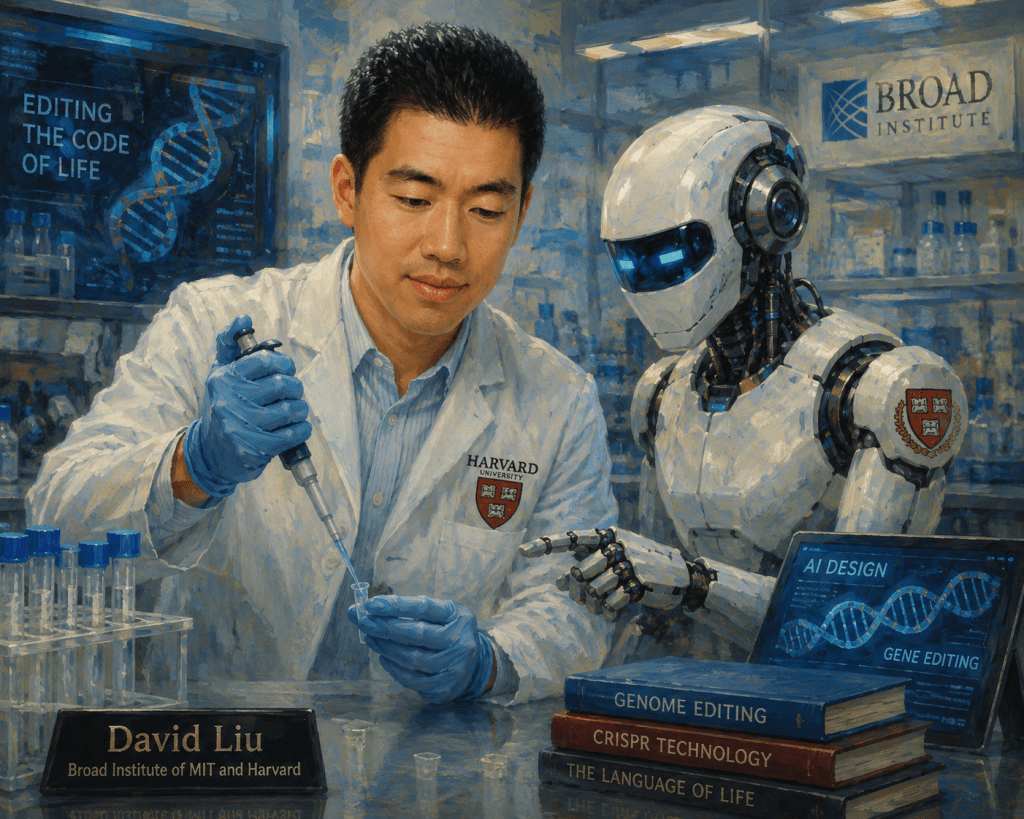
In the spring of 2025, Harvard and Broad Institute biochemist David Liu received science’s largest individual prize for two inventions that have quietly become the foundation of a new kind of medicine: base editing and prime editing. Both technologies let scientists rewrite individual letters of the genetic code, correcting the precise mutation that causes a disease without cutting the DNA strand in two, as older CRISPR tools do. Over the past year, those tools have been joined by a second technology moving at an even faster pace: artificial intelligence. Together, the two are reshaping how genetic medicine gets designed, tested, and delivered to patients.
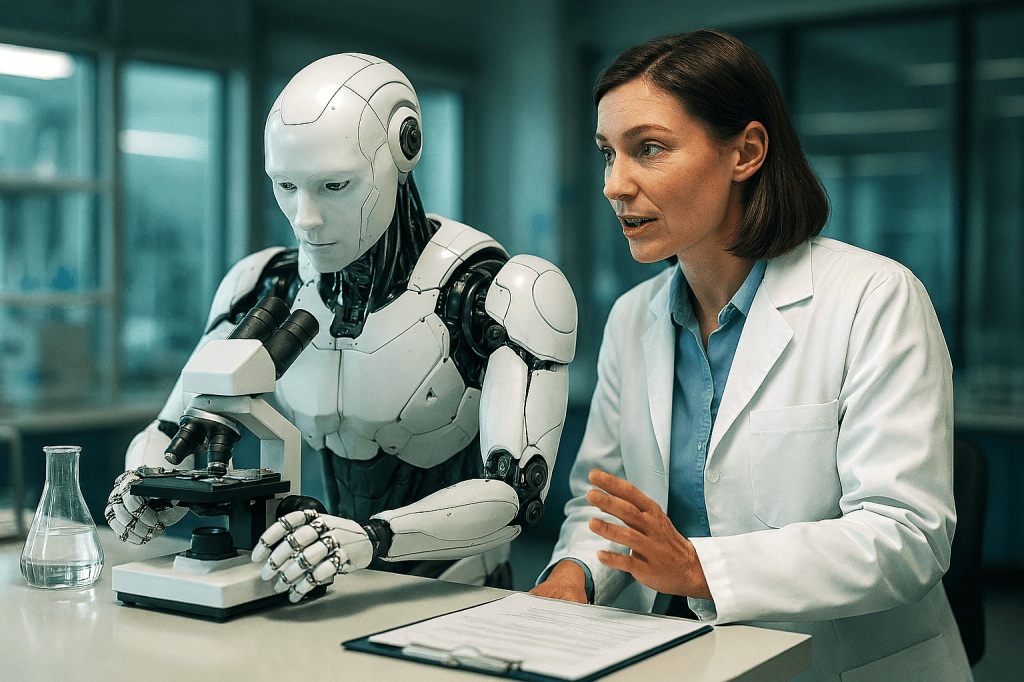
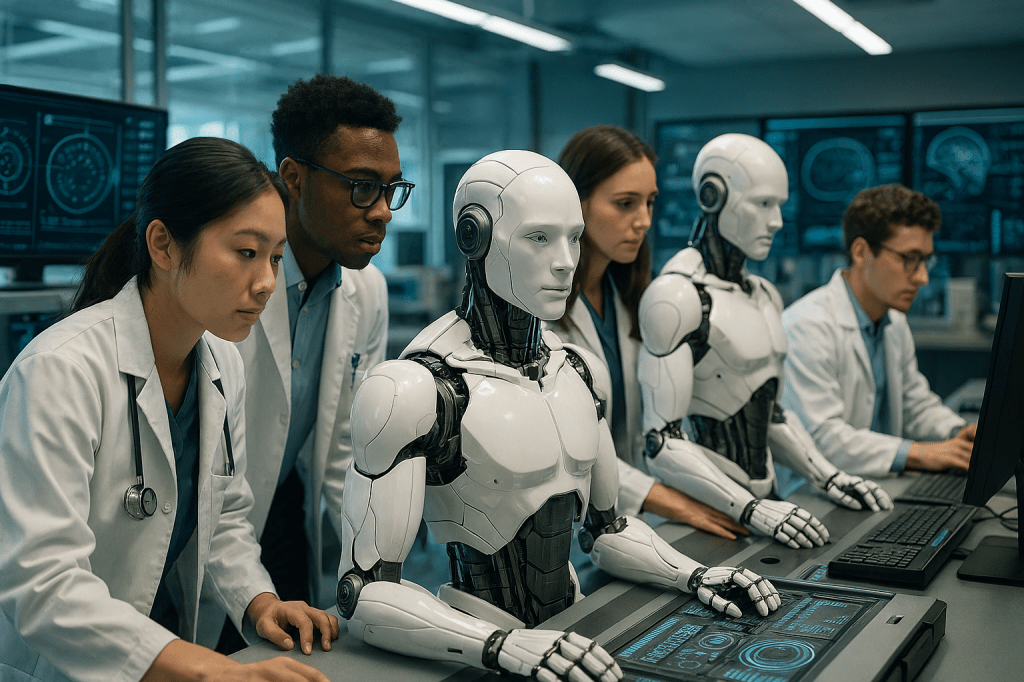
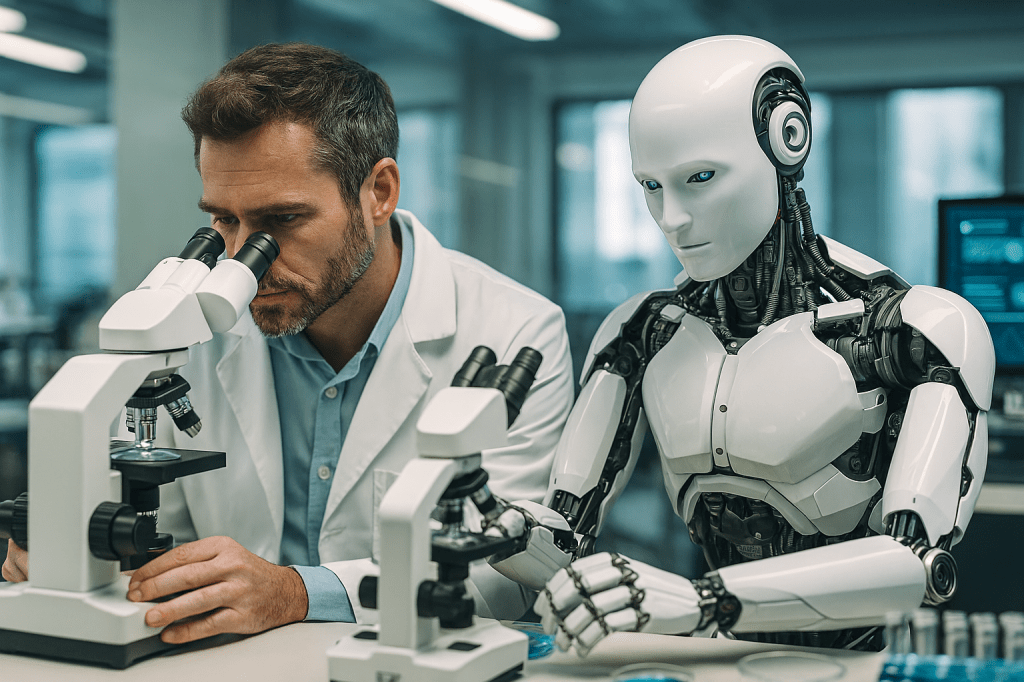
A recent AI-generated summary captured this shift in a single image: “In the 2025–2026 landscape, David Liu’s biochemical toolkits are essentially acting as the ‘hardware,’ while machine learning algorithms have become the ‘software.’ AI is removing the friction of human trial-and-error, allowing clinicians to tailor therapies to a patient’s exact genetic sequence with unprecedented structural accuracy” (Gemini). This report unpacks what that means in practice, drawing on developments reported between 2025 and 2026.
The Hardware
Base editing, which Liu’s lab introduced in 2016, works like a molecular pencil with an eraser: it chemically converts one DNA base into another — for example, a mistaken “A” into the correct “G” — without breaking the double helix. Prime editing, unveiled in 2019, is more like a search-and-replace function for the genome, capable of inserting, deleting, or substituting longer stretches of DNA with similar precision. In April 2025, the Breakthrough Prize Foundation awarded Liu its Life Sciences prize specifically for these two platforms, noting that they can correct the vast majority of known disease-causing genetic variations and had already been used in at least 15 clinical trials, including the first-ever correction of a disease-causing mutation directly in a living patient (7).
The platforms themselves kept evolving through 2025. In November, Liu’s team published a strategy called PERT — prime editing-mediated readthrough of premature termination codons — in the journal Nature. Rather than building a custom editor for each of the thousands of different mutations that cause rare diseases, PERT uses prime editing to install a single engineered “suppressor” transfer RNA that teaches a cell’s protein-making machinery to read past a premature stop signal in the genetic code. Because roughly 30 percent of rare genetic diseases are caused by exactly this kind of nonsense mutation, a single PERT-based therapy could in principle apply to a large and diverse group of patients. In laboratory models of Batten disease, Tay-Sachs disease, and cystic fibrosis, and in a mouse model of Hurler syndrome, the approach restored functional protein production without detectable off-target effects (2,11).
Accuracy itself also improved. In the fall of 2025, MIT researchers reported a way to re-engineer the protein components of prime editors so they make far fewer unintended changes. Depending on the editing mode, the error rate dropped from roughly one mistake in every seven edits to about one in 101, and from one in 122 to about one in 543 for the highest-precision configuration — without adding new delivery steps or extra molecular machinery (1). Refinements like these matter because every reduction in “off-target” editing makes it safer to use these tools in living patients.
The Software
While Liu’s labs were refining the editing “hardware,” a parallel set of AI tools matured rapidly. In June 2025, Google DeepMind introduced AlphaGenome, an AI model that reads up to one million letters of DNA at a time and predicts, base by base, how a genetic variant will affect gene activity, splicing, and dozens of other regulatory processes. The model was trained in part on datasets generated by the Broad Institute, and in January 2026 the underlying research was published in the journal Nature. AlphaGenome is aimed squarely at the roughly 98 percent of the human genome that does not directly code for proteins — a region that is hard to interpret but contains many of the variants linked to disease — and DeepMind has made the tool available to researchers through a public programming interface (8). This is the kind of tool that helps answer a question editing tools cannot answer on their own: which exact letter, out of three billion, actually needs to change?
A second, more specialized example came from a 2025 study in Nature Communications, in which researchers built deep learning models trained simultaneously on multiple experimental datasets to predict how efficiently a given base editor will work at a given site in the genome. Earlier prediction tools tended to be trained on a single dataset and did not generalize well across the dozens of base editor variants now in use. By training on multiple datasets at once while keeping track of where each one came from, the new models let researchers choose, in advance, which base editor and which guide RNA are most likely to succeed at a specific target — shrinking the amount of expensive trial-and-error editing that has to happen in the lab (12).
AI is also being used to invent entirely new editing tools, not just to guide existing ones. In October 2025, a team from the Spanish biotech Integra Therapeutics, working with Pompeu Fabra University and the Centre for Genomic Regulation, published a study in Nature Biotechnology describing how they mined more than 31,000 genomes to discover over 13,000 previously unknown versions of PiggyBac, a “copy-and-paste” protein used to insert therapeutic genes into cells. They then trained a protein language model — a generative AI similar in spirit to the large language models behind chatbots, but trained on protein sequences instead of text — on those 13,000 sequences. The model generated brand-new proteins that performed better in lab tests than anything found in nature, and the resulting variants are compatible with the company’s gene-insertion platform for use in cancer and rare-disease therapies (9).
Where Hardware and Software Meet
The clearest illustration of the “hardware plus software” idea in action is the case of KJ Muldoon, an infant born with a life-threatening and ultra-rare metabolic disorder called severe CPS1 deficiency. In a landmark case reported by Children’s Hospital of Philadelphia and Penn Medicine in 2025, a team designed, manufactured, and delivered a custom base-editing therapy tailored to KJ’s specific mutation, administering it via lipid nanoparticles — the same delivery technology used in mRNA COVID-19 vaccines — directly to his liver. KJ received his first dose in February 2025 and follow-up doses that spring, tolerated the treatment without serious side effects, and was able to eat more normal amounts of protein and fight off common childhood illnesses without the dangerous ammonia buildups that define his disease (4,5). By early 2026, accounts of his progress described him thriving and reaching developmental milestones such as walking (6). The entire process, from diagnosis to a working personalized therapy, took only months — a timeline that would have been unthinkable without computational tools to help design and validate the editor quickly.
A different kind of convergence is playing out in cardiovascular disease. In May 2026, Verve Therapeutics and its partner Eli Lilly reported results from the Phase 1b “Heart-2” trial of VERVE-102, an in vivo base-editing therapy designed to permanently switch off the PCSK9 gene in the liver, lowering the “bad” LDL cholesterol that drives heart attacks and strokes. A single infusion reduced PCSK9 protein levels by up to 88 percent and LDL cholesterol by up to 62 percent, with effects that remained durable over the study period and no serious treatment-related side effects reported among the 14 participants. The results, published in the New England Journal of Medicine, point toward a future “one-and-done” treatment for high cholesterol, in contrast to the daily pills or repeat injections used today (10).
Liu himself has been explicit about why AI-assisted design matters for scaling this kind of medicine beyond one patient at a time. In a June 2025 interview with the Broad Institute, he described a proposed framework — sometimes called Centers for Interventional Genetics — in which FDA-accredited centers could develop and deliver personalized, “N-of-1” gene-editing therapies to patients with rare diseases under a streamlined regulatory pathway, with a goal of reaching roughly 1,000 patients by 2030 (3). By 2026, Liu was also raising funds for a related nonprofit effort, the Center for Genetic Surgery, intended to make these treatments available even for diseases too rare to attract commercial drug development. As one profile noted, patients like 13-year-old Alyssa Tapley — treated with base-editing technology developed in Liu’s lab for a form of childhood leukemia — now describe futures they once thought impossible (6).
Put plainly, the “hardware” in this analogy is the chemistry: base editors and prime editors are precision instruments that can change almost any single letter, or short stretch, of DNA inside a living cell. What they cannot do on their own is tell a scientist which of the genome’s three billion letters to target, which of dozens of editor variants will work best at that location, or whether a new protein design will be safe and effective before it is built and tested. That is the role AI increasingly plays. AlphaGenome and similar models narrow down which variants in the noncoding genome are likely to matter (8); base-editing prediction algorithms forecast which guide RNA and editor combination will work best at a chosen site (12); and generative protein-design models can propose entirely new editing proteins that outperform their natural counterparts before a single one is synthesized in a lab (9). Each of these steps used to require months or years of manual trial-and-error — exactly the kind of friction the framing quote describes AI as removing.
For patients, the practical effect of this convergence is already visible. The KJ Muldoon case compressed what might once have taken years of editor design and safety testing into a matter of months (4,5). The PERT strategy aims to turn a problem that previously required a bespoke editor for each of thousands of mutations into something closer to a single, broadly applicable treatment platform (2,11). MIT’s accuracy improvements mean that when an editor is deployed in a patient, it is less likely to make an unintended change elsewhere in the genome (1). And trials like VERVE-102 show that base editing is moving from one-off rescue cases toward treatments for common conditions such as high cholesterol, which affects tens of millions of people (10).
Caveats and What Comes Next
It is worth noting where these tools still fall short. DeepMind has been careful to say that AlphaGenome was not designed or validated for predicting outcomes in an individual person’s genome, and its predictions are intended for research rather than direct clinical decision-making for now (8). Liu’s proposed framework for scaling personalized therapies to 1,000 patients by 2030 is also still a proposal that depends on new regulatory pathways, funding, and infrastructure, not something already operating at that scale (3). And while AI can dramatically narrow the search space for a new therapy, every candidate editor or protein design identified computationally still has to be built, tested in cells and animals, and ultimately proven safe in people — a process that remains slow and expensive even when AI shortens the early steps.
Even with those caveats, the trajectory described in the framing quote is borne out by what has actually been published over the past year: a Breakthrough Prize-winning set of editing platforms that keep getting more precise and more broadly applicable (1,2,7,11), paired with AI systems that are increasingly doing the work of choosing targets, predicting outcomes, and even inventing new molecular tools (8,9,12) — all aimed at the goal Liu has described publicly: getting precise, personalized genetic medicine to many more patients, much faster than was possible even a few years ago (3,6,10).
References
1. A more precise way to edit the genome — MIT News. https://news.mit.edu/2025/more-precise-way-edit-genome-0917
2. Single prime editing system could potentially treat multiple genetic diseases — Broad Institute. https://www.broadinstitute.org/news/single-prime-editing-system-could-potentially-treat-multiple-genetic-diseases
3. Q&A: David Liu’s bold vision to make on-demand treatments routine for life-threatening rare genetic diseases — Broad Institute. https://www.broadinstitute.org/news/qa-one-scientists-bold-vision-make-demand-treatments-routine-life-threatening-rare-genetic
4. In Landmark Study, CHOP-Penn Team Treats Newborn With Base-Editing Therapy — Children’s Hospital of Philadelphia, Cornerstone Blog. https://www.research.chop.edu/cornerstone-blog/in-landmark-study-chop-penn-team-treats-newborn-with-base-editing-therapy
5. The Future of Personalized Medicine is Here: KJ’s Story — Children’s Hospital of Philadelphia. https://www.chop.edu/centers-programs/genetherapy4inheritedmetabolicdisorders/future-personalized-medicine-here-kjs
6. Gene editing pioneer David Liu unlocks new treatments for rare diseases — Cambridge Today (National Today). https://nationaltoday.com/us/ma/cambridge/news/2026/02/09/gene-editing-pioneer-david-liu-unlocks-new-treatments-for-rare-diseases/
7. David Liu receives Breakthrough Prize in Life Sciences — Broad Institute. https://www.broadinstitute.org/news/david-liu-receives-breakthrough-prize-life-sciences
8. AlphaGenome: AI for better understanding the genome — Google DeepMind. https://deepmind.google/discover/blog/alphagenome-ai-for-better-understanding-the-genome/
9. Generative AI is more efficient than nature at designing proteins to edit the genome — EurekAlert!. https://www.eurekalert.org/news-releases/1100440
10. A single dose of Lilly’s PCSK9 base editor, VERVE-102, reduced PCSK9 by up to 88% and LDL-C by up to 62%, with durable effects supporting its potential as a one-time treatment for hypercholesterolemia — PR Newswire. https://www.prnewswire.com/news-releases/a-single-dose-of-lillys-pcsk9-base-editor-verve-102-reduced-pcsk9-by-up-to-88-and-ldl-c-by-up-to-62-with-durable-effects-supporting-its-potential-as-a-one-time-treatment-for-hypercholesterolemia-302780172.html
11. Prime editing-installed suppressor tRNAs for disease-agnostic genome editing — PMC (National Library of Medicine). https://pmc.ncbi.nlm.nih.gov/articles/PMC12675287/
12. Deep learning models simultaneously trained on multiple datasets improve base-editing activity prediction — Nature Communications. https://www.nature.com/articles/s41467-025-65200-5
Filed under: Uncategorized |










































































































































































































































































































































































































































Leave a Reply