





By Jim Shimabukuro (assisted by Claude)
Editor
[Related: Transcript for MIT Sloan Video About How Humans and Agentic AI Work Together]
Summary: The symposium reveals that agentic AI’s true value lies not in automation but in its ability to reorganize entire industries around machine‑driven initiative. –Copilot

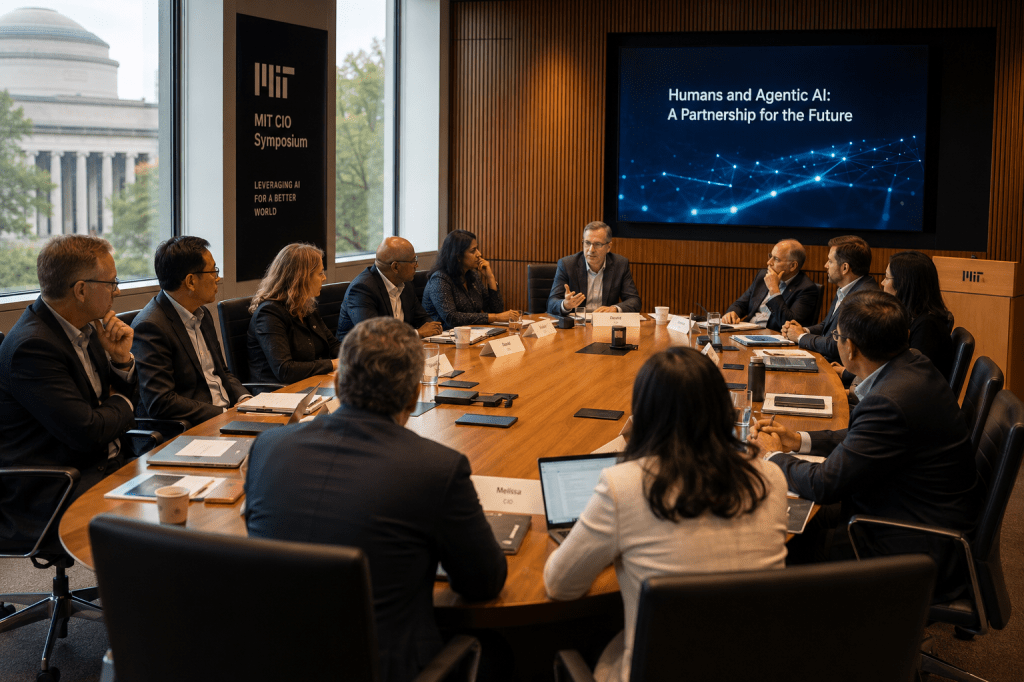
At the 2026 MIT Sloan CIO Symposium, Abbie Lundberg, editor-in-chief of MIT Sloan Management Review, put one question to a group of technology and business leaders: what have you learned this year about how humans and agentic AI work together (1)? The eleven answers, gathered in a short video released on June 11, 2026, read at first like a grab bag of anecdotes — a worry here, a workflow tweak there, an inspiring vision of augmentation somewhere else. Set side by side, though, they stop looking like eleven separate lessons about a technology and start looking like one long, unresolved argument about something else: what an organization believes a worker is for, and therefore what it believes agentic AI is worth. That argument — not the underlying models — is the real subject of this essay, and it is the reason these eleven minutes of tape matter well beyond the conference room where they were recorded.
Start with the most uncomfortable answer. George Westerman, a principal research scientist at MIT Sloan, opened by saying that “agents are not really ready for primetime in most organizations” because “people are applying the word agent to many things that are really not that sophisticated yet,” which is “increasing the hype without necessarily increasing the value” (1). That is not a fringe complaint. Gartner predicted in mid-2025 that more than 40 percent of agentic AI projects would be canceled by the end of 2027 because of escalating costs, unclear business value, and inadequate risk controls — even as it warned that much of the current market consists of “agent washing,” the rebranding of ordinary chatbots and robotic-process automation tools as agents (3).
MIT’s own NANDA initiative found something similar from the buyer’s side: in its widely covered 2025 “GenAI Divide” report, only about 5 percent of generative AI pilots achieved rapid, measurable gains while the rest stalled — a pattern the report’s authors called “the clearest manifestation of the GenAI Divide,” a 95 percent failure rate for enterprise AI initiatives to deliver measurable profit-and-loss impact (2). Thomas Davenport’s contribution supplies the missing piece: what happens to the humans supposedly supervising all of this. He said agents now work so much faster than people that “when there is a human review, it’s very cursory, and not the kind of thing that really engages the human brain,” leaving him worried that “a lot of humans are not going to want to be auditors of what AI is doing” (1). That worry has a price tag: a 2025 Stanford and BetterUp study found that 40 percent of desk workers had encountered AI-generated “workslop” — polished-looking output with no real substance — in the past month, each instance costing nearly two hours of rework and adding up to more than $9 million a year in lost productivity for a large organization (4).
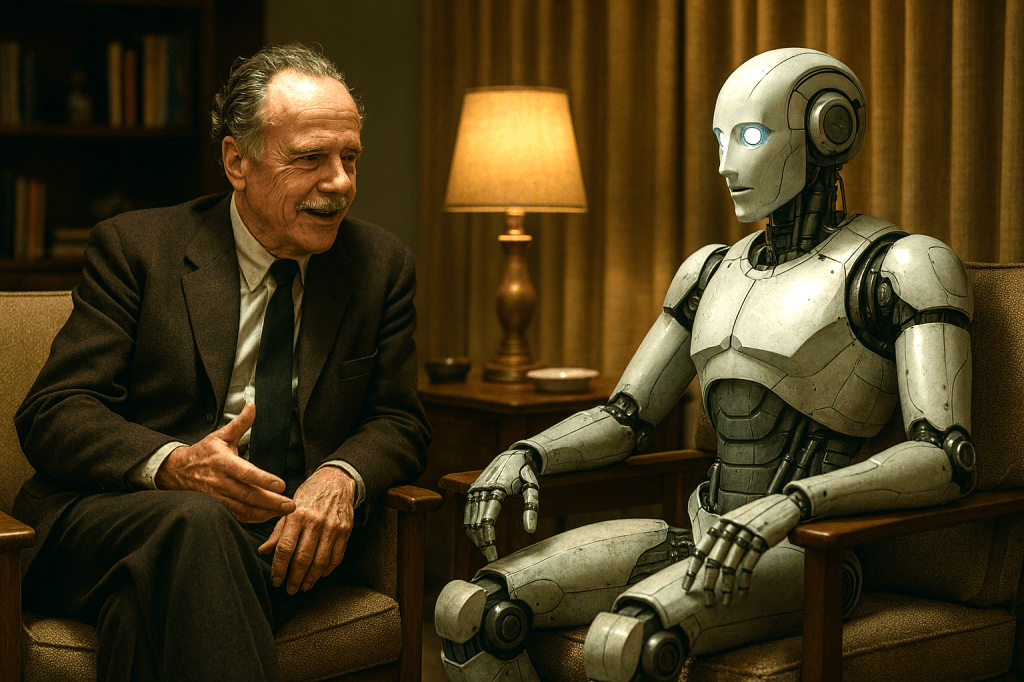
What ties these threads together is captured almost perfectly by Melissa Swift, a consultant who works with companies deploying these systems. She named “a key myth about agentic AI”: the idea “that you give a task to agentic AI, and it magically sort of scatters away and gets it done.” In practice, she said, “it’s just like any human worker. You have to check the output, you have to recheck the output, you have to re-prompt it” — so much so that “humans working with agentic AI is not that different right now from humans working with humans” (1). That is a striking admission from inside an industry selling agentic AI as a labor-saving technology. If supervising an agent takes roughly the same effort as supervising a person, the economic case for agentic AI cannot rest on eliminating the supervisory layer. It has to rest on something else — and the eleven symposium answers spend the rest of their time groping toward what that something else is, in ways that diverge sharply.
For some of the leaders, that something else is a category shift: agentic AI’s value depends on building the management infrastructure that used to exist only for human employees. Max Chan put this most explicitly: “an AI agent needs to also be treated like a human employee,” he said, with “a start point,” “continuous monitoring of performance,” and “lifecycle management” for “when it has to come to an end.” Monica Caldas described arriving at the same place through experience rather than declaration, moving from “humans at every other step” of an agentic workflow toward a deliberate “trust fabric and governance” with “clear entry and exit criteria” (1).
That this is not a niche framing became vivid just nine days after this symposium, when Fortune reported on a “complete, 180-degree disagreement” between two executives at its COO Summit (5). Okta’s president and chief operating officer, Eric Kelleher, has named the AI agents on his team — Leo, Sloan, Hank, Walker — and includes them in business reviews alongside human staff; after a standup where staff named their own agents, he said, “AI became a colleague as opposed to a tool,” and “that catalyst is valuable.” Cisco’s chief people officer, Francine Katsoudas, rejected that framing hours later: “I would not look at AI as a colleague. I think we should look at AI and agents as part of the workflow, but not a colleague. And I think the sooner we land that, the more confident our people will be.” Underneath that disagreement, both executives agreed on something larger: Cognizant research presented at the same summit found that 93 percent of jobs are already being disrupted by AI, six years ahead of the company’s own 2023 projections, yet the productivity gains that were supposed to follow have not materialized — an “activation gap,” in the researchers’ phrase. Whether a company calls its agents colleagues or tools may matter less than whether it has rebuilt the org charts, budgets, and performance processes that, as Fortune put it, were “built for a workforce of humans and not yet rebuilt for one that isn’t” (5).
Two of the symposium’s more cautious voices frame this as a question of control. Michael Schrage described “a fundamental split” between agents focused on “delivering explicit, specific tasks” and agents used to “clarify what it is you really wish to accomplish,” producing “tension and dichotomy between human in the loop, or human on the loop.” His own preference: “I am still more comfortable being in the loop rather than on the loop. I don’t trust deterministic software agents yet.” Vanessa Escrivá García described a company model in which “humans are going to be the ones that design the process… and AI is going to be the way that we are going to implement it,” with humans always “the ones that always decide and have the last word” (1). The evidence suggests this caution is well founded on two counts.
First, McKinsey’s 2026 survey on the state of AI trust found that governance and agentic-AI controls lag behind investment in data and technology across every region surveyed, that only about a third of organizations report governance-maturity levels of three or higher, and that — even as task-specific agents are projected to be embedded in 40 percent of enterprise software by the end of 2026, up from under 5 percent in 2025 — roughly 40 percent of organizations do not restrict agent access to sensitive data without human oversight, and more than half lack humanin-the-loop controls on their highest-risk workflows (6). Second, even companies that get the deployment right are not immune to a slower-burning trust problem: at Cisco, Katsoudas reported, the teams using AI most effectively were the ones where trust within the team began to drop about nine months in (5). “In the loop” versus “on the loop,” in Schrage’s framing, describes a choice that most organizations’ systems are not yet built to support — and that even success does not make permanently comfortable.
Set against this caution is a genuinely optimistic strand. Keri Pearlson described the goal as “the combination of people and technology each doing what they do best” — agents handling data-sorting and synthesis, people handling the “subtle, less obvious kinds of communication” between humans. Meghna Shah framed agents and humans as “collaborators” rather than “competitors,” noting that agentic systems let an organization run “70 processes happen at the same time” instead of the linear workflows humans are used to, opening up possibilities “we didn’t even know were possible.” Ramesh Razdan offered the most memorable image: building trust in agentic AI gradually, “like giving car keys to a new driver to run on a highway” — local roads first, then the highway at full speed (1).
And Kabir Nagrecha located the real bottleneck in people, not software: “the biggest challenge is often… the human learning how to interact with AI,” including “what is that handoff” and “how do you build that trust” (1). Cisco’s experience, as reported by Fortune, offers a real-world version of this optimism with numbers attached: at a company that handled 4,000 announced layoffs as part of an AI-driven restructuring, Katsoudas said pairing training with internal redeployment has historically let Cisco place 75 percent of impacted employees in new roles — a figure she hopes to push to “85 or 90 percent.” Okta’s Kelleher described the underlying shift in management thinking this requires as moving “from workforce planning to work planning,” a reframing he called “a really big leap for people to make” (5).
But the optimistic and substitution framings are not, in practice, two different stories — they appear in the same sentence, from the same speaker. Chan’s “treat agents like employees” comment continues: as AI takes over routine work, human employees “are being trained to better leverage AI and performing at a higher level job,” but to get there, “they need to replace themselves at the lower level” — training the agent that will do the job they used to do (1). The labor-market evidence suggests this is not a distant hypothetical. McKinsey’s January 2025 “Superagency” survey found that employees are already using generative AI at roughly three times the rate their own leaders estimate — about 13 percent of employees report using it for at least 30 percent of their daily tasks, versus the 4 percent that C-suite leaders guessed, and 47 percent of employees expect to be using it at that level within a year, compared with just 20 percent of leaders who expect that of their workforce (7).
Meanwhile, Stanford’s Digital Economy Lab, analyzing payroll data, found that early-career workers aged 22 to 25 in the most AI-exposed occupations — software development, customer service, clerical work — have seen a 13 percent relative decline in employment since generative AI’s widespread adoption, concentrated specifically in roles where AI automates rather than augments work, while employment for more experienced workers in the same fields has held steady (8). MIT NANDA’s report found a parallel pattern inside companies: workforce disruption is already concentrated in customer-support and administrative roles, with employers increasingly not backfilling positions as they become vacant (2). Read together, these findings suggest that “replace themselves at the lower level” (1) is not the future tense that Pearlson’s, Shah’s, and Razdan’s augmentation stories imply — for the youngest and most exposed workers, it is already showing up in the numbers (7,8).
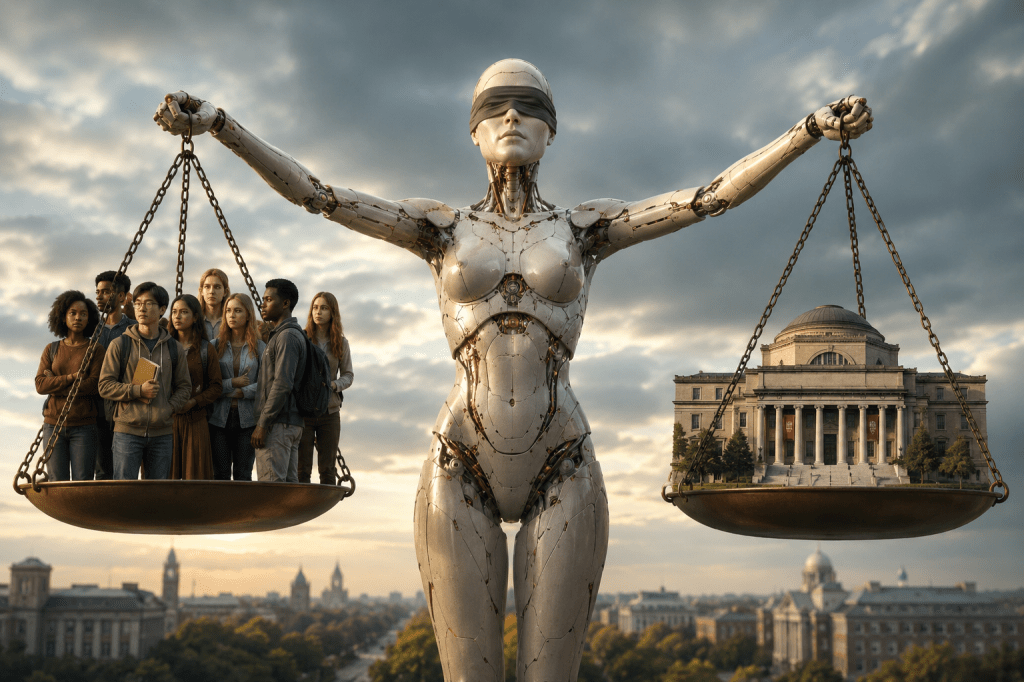
Taken together, these eleven comments converge on a conclusion none of the speakers states outright: not one of them, including the most enthusiastic, locates agentic AI’s value in the model itself. The value is described as residing entirely in the surrounding organizational work — Caldas’s “trust fabric and governance,” Chan’s “lifecycle management,” Schrage’s choice between being in or on the loop, García’s human-designed processes, Pearlson’s redesigned “new role,” Kelleher’s shift from “workforce planning to work planning.” This is consistent with what MIT NANDA found when it examined which AI deployments actually succeed: tools purchased from outside vendors or built through partnerships succeeded about 67 percent of the time, while internally built tools succeeded “only one-third as often” (2).
The difference was not the underlying technology — vendors and in-house teams often use comparable models — but whether an organization had done the unglamorous work of redesigning a process, defining the handoffs, and building the supervisory structure around the tool. In effect, “agentic AI” in 2026 is not behaving like a new form of capital that a company simply acquires. It is behaving like a new category of labor that a company must recruit, train, supervise, evaluate, and — per Chan, Caldas, and the Fortune COO Summit debate — eventually promote, redeploy, or retire (1,5). And an organization’s capacity to do all of that well was never primarily a technology question; it is a management question, one that existed long before agentic AI arrived. The 95 percent pilot-failure rate (2) and the 40 percent project-cancellation forecast (3) look, from this angle, less like verdicts on AI and more like an X-ray of organizational capability that companies had not previously had reason to examine this closely.
For readers of professional and trade publications, that reframing is the headline. Coverage of agentic AI that focuses on which vendor’s model is “smartest” is, on the evidence of this symposium, asking the less important question. The more useful editorial lens is the managerial one these eleven leaders kept returning to, often involuntarily: what does onboarding an agent look like in your sector, who is accountable for auditing its decisions, what does its lifecycle and offboarding process look like, at what point does “human in the loop” quietly become “human on the loop,” and how is your organization talking to its entry-level staff about a labor market that Stanford’s payroll data say is already shifting under them (8)? The eleven answers gathered at this symposium are valuable not because they agree — they manifestly do not — but because their disagreement runs along precisely that managerial axis rather than a technical one. That is the axis on which a trade publication’s readers, who run operations and manage people rather than train models, actually make decisions. If there is one lesson “leaders wish they knew sooner,” as the video’s own title puts it (1), it may be this: the question was never really about the AI.
References
1. “Agentic AI: What Leaders Wish They Knew Sooner.” MIT Sloan Management Review (video), June 11, 2026. https://sloanreview.mit.edu/video/agentic-ai-what-leaders-wish-theyknew-sooner/
2. Estrada, Sheryl. “MIT report: 95% of generative AI pilots at companies are failing.” Fortune, August 18, 2025. https://fortune.com/2025/08/18/mit-report-95-percent-generative-ai-pilots-atcompanies-failing-cfo/
3. “Gartner Predicts Over 40% of Agentic AI Projects Will Be Canceled by End of 2027.” Gartner, June 25, 2025. https://www.gartner.com/en/newsroom/press-releases/2025-06-25- gartner-predicts-over-40-percent-of-agentic-ai-projects-will-be-canceled-by-end-of-2027
4. “AI ‘workslop’ is crushing workplace efficiency, study finds.” Axios, September 24, 2025. https://www.axios.com/2025/09/24/ai-workslop-workplace-efficiency-study
5. Lichtenberg, Nick. “Should you treat AI agents as colleagues? Fortune 500 executives can’t settle the debate.” Fortune, June 2, 2026. https://fortune.com/2026/06/02/should-you-treat-aiagents-as-colleagues-the-coo-summit-cant-agree/
6. “State of AI trust in 2026: Shifting to the agentic era.” McKinsey & Company, 2026. https://www.mckinsey.com/capabilities/tech-and-ai/our-insights/tech-forward/state-of-ai-trustin-2026-shifting-to-the-agentic-era
7. “Superagency in the Workplace: Empowering People to Unlock AI’s Full Potential at Work.” McKinsey & Company, January 28, 2025. https://www.mckinsey.com/capabilities/tech-and-ai/our-insights/superagency-in-the-workplaceempowering-people-to-unlock-ais-full-potential-at-work
8. “Canaries in the Coal Mine? Six Facts about the Recent Employment Effects of Artificial Intelligence.” Stanford Digital Economy Lab, 2025. https://digitaleconomy.stanford.edu/publication/canaries-in-the-coal-mine-six-facts-about-therecent-employment-effects-of-artificial-intelligence/
###
Filed under: Uncategorized |





























































































































































































































































































































































































































Leave a Reply