


By Jim Shimabukuro (assisted by ChatGPT)
Editor
[Related: Introduction+Part 1]
Did Okinawa have an indigenous fighting art? The official chronicle Kyūyō contains a violent story from the reign of King Shō Shin. A court figure known in Japanese as Kyō Ahagon Jikki (京阿波根実基) appears under the Sinitic-style name 虞建極 in the chronicle. He is attacked by a youth carrying a dagger. The text says that Jikki had “no inch of iron in his hand” and, using only kūshu (空手), broke both of the attacker’s thighs before staggering from the castle and dying of his wounds (1).
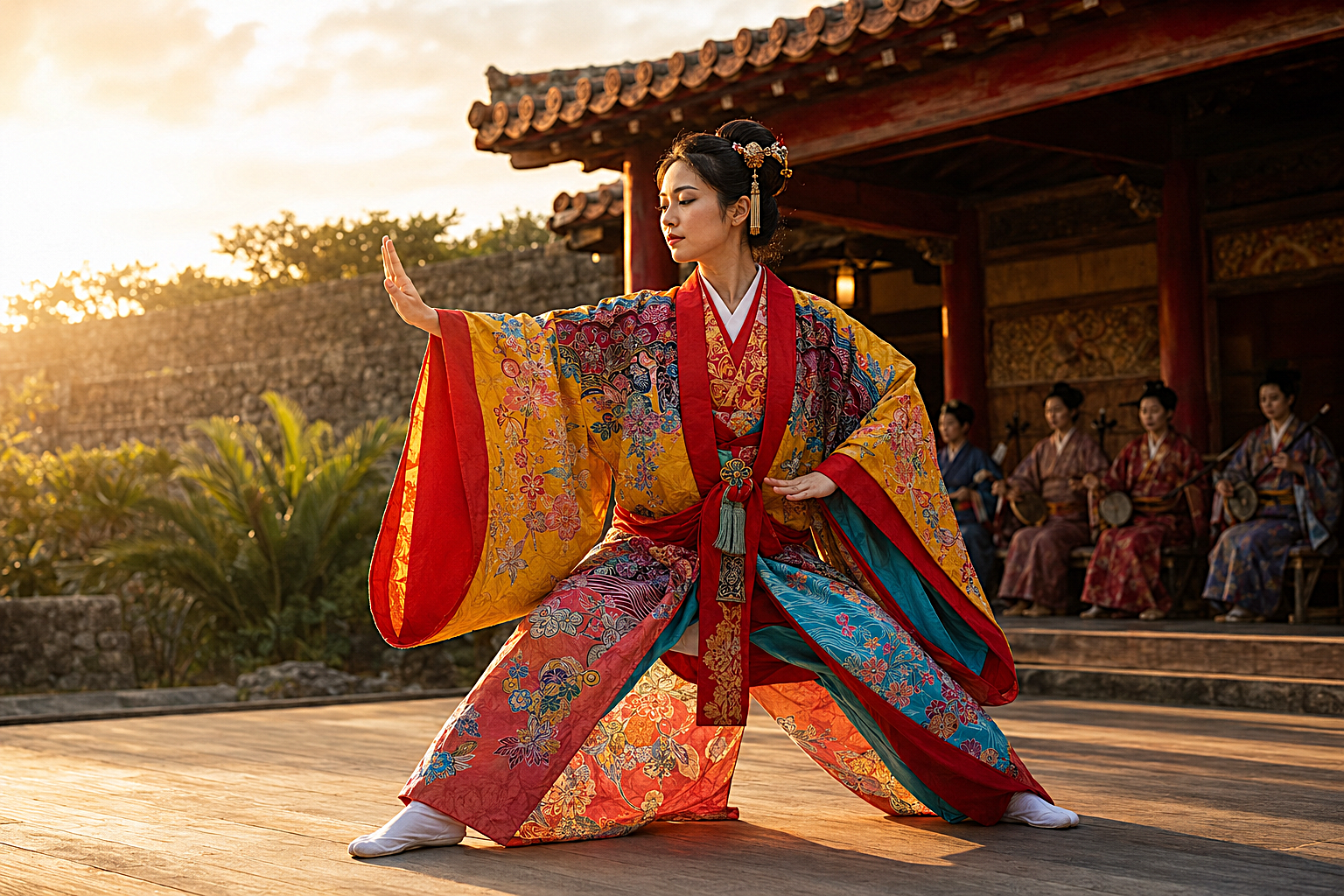
Read through modern karate, the characters 空手seem electrifying: karate, in an eighteenth-century compilation recounting a sixteenth-century fighter. But the sentence is not naming an art. In classical usage, 空手 means empty-handed or unarmed. The passage documents a story about formidable personal combat; it does not document a system called karate, still less an indigenous school called ti. Kadekaru Tōru’s source survey makes the distinction explicit (2).
That gap between an act and an art, between a hand and a named tradition, is the problem at the center of this installment. The evidence strongly supports the proposition that Okinawans struck, wrestled, restrained, guarded, trained with weapons, and cultivated personal combat skills. It does not follow that those practices formed a single, commonly recognized pre-Chinese martial system called ti.
The history becomes clearer when those two propositions are kept apart.
One character, too many meanings
The word normally romanized ti is written 手, “hand.” In the Shuri variety of Okinawan, the National Institute for Japanese Language and Linguistics records the headword as tii, with a long vowel. Standard Japanese reads the same graph te. The dictionary gives four broad senses: the bodily hand; a handle; skill, technique, method, or means; and, finally, tōde or the art of boxing. It separately records 唐手 as toodii—usually written tōdī in English-language karate literature—and says it may be shortened to tii (3).
This is useful linguistic evidence, but it has a date. The dictionary was first published in 1963 and revised in 2001. It documents how the word was known to twentieth-century speakers and scholars. It cannot, by itself, prove that seventeenth- or eighteenth-century Okinawans used tii as the formal name of an organized martial art.
The semantic range is the trap. “Hand” can also mean dexterity, a technique, a way of doing something, a dance movement, or an individual’s skill. English does something similar when it speaks of a hired hand, a hand at cards, or a musician’s touch. A statement that someone “knew ti” could have meant that he had skill, knew boxing, or could perform a particular set. Without a dated context, translating every martial occurrence as the proper name Ti converts an ordinary and flexible word into an institution.
Nor are ti, te, and di necessarily three arts. Tii is the Okinawan reading; te is the standard Japanese reading; dii appears as the voiced second element in tōdī. Mandarin Chinese would read 手 as shǒu and 唐手 analytically as Tángshǒu, but the Ryukyuan records do not show Okinawans using that Mandarin expression. Assigning a precise historical Fuzhou reading to these Okinawan labels would add certainty the sources do not contain.
The safest conclusion is modest. It is documented that tii became a colloquial Okinawan word for karate and boxing. It is plausible that this shorthand was in oral use before the surviving dictionaries and modern books. It remains disputed that Ti was the ancient proper name of one bounded, indigenous system.
Combat before ti
The premodern record is not empty. It is simply untidy—and its vocabulary refuses to line up behind the modern narrative.
The Kyūyō story gives us an unarmed fighter but not an art name. In 1762, the Ōshima Hikki described the Chinese visitor Kūsankū’s skill as kumiai-jutsu (組合術), an “engagement” or grappling-and-countering art, and linked it to Chinese kenpō (拳法). As Part 1 showed, that is evidence for a reported Chinese performance, not for indigenous ti.
A Ryukyuan aristocrat’s testament supplies another revealing cluster of terms. Aka Chokushiki (阿嘉直識, 1721–1784) advised his son on the accomplishments expected of an elite family. He recommended training in the Satsuma sword tradition Jigen-ryū and referred to inherited scrolls for sword, spear, and naginata. He also wrote that karamutō and yawara need not be practiced. Yawara is a familiar term for Japanese grappling or jujutsu. Karamutō is unresolved. It has been interpreted as 唐武道, “Chinese martial way,” 唐無刀, “Chinese unarmed [art],” or in other ways. Motobu Naoki argues that it denotes karate or an ancestral art, but the reading is disputed and the document does not equate it with ti (4).
What the testament does establish is more important than any speculative spelling. An eighteenth-century elite household knew several martial practices with different sources and purposes. Japanese swordsmanship, long weapons, grappling, and an obscure unarmed or Chinese-associated practice could coexist in one family’s educational world. That is a martial culture, but not evidence of one standardized curriculum.
The sharpest description of Okinawan striking appears in the anonymous Satsuyū kikō (薩遊紀行), a travel diary from 1801. The writer, a visitor from Higo, recorded what a Satsuma official with Ryukyu experience told him. Ryukyuan swordsmanship and yawara were said to be unimpressive, but the islanders had attained unusual skill in punching. The account calls the practice 手ツクミ, te-tsukumi, and says an adept summoned to the Satsuma office in Naha shattered six of seven stacked roof tiles; experts could also thrust with extended fingers (5).
This is documented evidence for an 1801 report, not an eyewitness description by the diarist. It nevertheless supports specialized striking and conditioning. It also exposes a common error. Te-tsukumi in this passage is not described as wrestling. The surrounding sentences are about punching, penetrating, tile breaking, and finger thrusts. The term occurs nowhere else yet identified in the premodern karate record, and Kadekaru notes a possible relation to an Okinawan expression meaning “to strike with the hand” (2). Turning it into tegumi, the later name attached to grappling, changes the evidence to fit the story.
Other fragments broaden the picture. Basil Hall, whose British expedition stayed at Okinawa in 1816, watched Ryukyuan officials amuse themselves with “a sort of wrestling game.” One participant then copied the defensive pose of British boxers he had seen aboard ship, only to be stopped by another official, who insisted that “Loo-choo man no fight” (6). The scene documents playful grappling among officials and a politically useful performance of peacefulness. It does not tell us the rules of the game, its name, or its ancestry.
In 1874, Ernest Satow published a report that Ryukyuans were expert mounted archers and matchlock shots and that a trained boxer could break a large earthen jar or kill with one punch (7). Satow’s account was not a direct observation of every practice; it drew heavily on Japanese geographical writing. Even so, it fits the 1801 report closely enough to strengthen the case that powerful striking had become a recognized Ryukyuan specialty by the nineteenth century.
The illustrated Nantō zatsuwa (南島雑話, 1855) shows men conditioning their fists against a post or solid object under labels including 拳法術, kenpō-jutsu. Yet the work concerns Amami Ōshima, not Okinawa Island, and its captions are difficult to read. It is plausible evidence for related conditioning practices within the wider island world, not proof of a kingdom-wide Okinawan system (8).
Finally, a program associated with an 1867 court celebration contains the expression 棒并唐手, “staff and tōde,” along with kōshu (交手), forms whose names resemble Seisan and Sūpārinpē, and weapons demonstrations. The program survives through a later reproduction in Shimabukuro Zenpatsu’s 1956 collection, so its transmission must be acknowledged. If accurately copied, it is the clearest late-kingdom evidence that 唐手 had become a recognizable performance category alongside other martial and theatrical arts (2).
Its setting also matters. This was a court celebration, not a midnight lesson hidden from the authorities. The program contradicts the strongest version of the secrecy legend, in which an illegal art could never be named or displayed publicly. It does not prove that instruction was open to everyone; a select performance before the king is compatible with restricted teaching. It does show that by the kingdom’s final years, at least one circle could present tōde as an intelligible accomplishment. What it does not reveal is whether the performers understood that accomplishment as Chinese, Okinawan, or already inseparably both.
Across these sources we meet kūshu, kumiai-jutsu, kenpō, yawara, karamutō, te-tsukumi, wrestling, tōde, named forms, staffs, blades, archery, and firearms. We do not meet a premodern text that plainly says: “The Ryukyuan unarmed martial system is called tii.”
That absence does not prove the term was never spoken. It does prevent historians from treating the term as documented.
Wrestling, tegumi, and mūtō
Okinawa undeniably has a wrestling culture. Okinawan sumo remains a distinct jacketed grappling sport, and Hall’s 1816 scene shows that wrestling-like play existed among officials more than two centuries ago. The harder question is whether later words and origin stories can be carried backward into the kingdom period.
Tegumi is usually written 手組, literally “hand-grappling” or “joining hands.” Mūtō or mūtū is another regional term attached in later accounts to rough grappling, wrestling, or combative play. Modern karate writing sometimes presents tegumi as Okinawa’s primordial fighting method: children wrestled, the activity acquired strikes, Chinese boxing supplied more sophisticated hand and foot techniques, and the blend became ti and then tōde.
As a reconstruction, this is plausible in the broadest human sense. Children wrestle; adults adapt play to combat; striking and grappling mingle. But the specific historical chain is a traditional account, not a documented sequence. The practitioner source most often cited for it is Nagamine Shōshin’s 1986 Tales of Okinawa’s Karate and Sumo Masters Based on Historical Fact and Oral Tradition. Its title accurately signals its mixed evidentiary method; it is not a premodern witness (9).
More recent ethnographic work supplies firmer dates but not ancient origins. Itani Yasuhiko’s study of mō-ashibi, rural youth gatherings centered on courtship, music, and dance, records memories of prewar and early postwar village life. One account describes mūtō as a kind of fighting game made by loosening or modifying karate kata. Other communities held Okinawan sumo or staff contests. These recollections document a twentieth-century social world in which grappling, karate, weapons, dance, and courtship occupied the same nighttime spaces (10). They do not establish that mūtō existed under that name in the eighteenth century, or that it was karate’s original substrate.
The responsible finding is therefore two-layered. Local wrestling and grappling are strongly supported and almost certainly older than their surviving descriptions. The antiquity, fixed meaning, and developmental role of the labels tegumi and mūtō remain uncertain. Most important, the 1801 te-tsukumi passage cannot be recruited as the missing early citation for tegumi: it describes striking.
The armed world around the empty hand
The image of a weaponless kingdom has made ti seem like a necessary substitute: if Okinawans lacked arms, their native genius must have migrated into the fist. The record examined here points in another direction.
Aka Chokushiki’s family possessed Japanese martial scrolls and practiced Jigen-ryū. Satow’s source described mounted archery and matchlocks. The 1867 celebration placed tōde beside staff and other weapons. The Satsuyū kikō compared punching with swordsmanship and yawara, which implies that all three were intelligible categories. Research on Ryukyuan weapons controls likewise shows regulation shaped by rank, office, occasion, and political authority—not the absolute disappearance of arms assumed by the popular “ban created karate” story (11).
This matters for the social setting of ti. Royal and aristocratic households, Kume Village scholar-official families, interpreters, envoys, guards, local administrators, and men who traveled to Satsuma or China did not all have the same duties. Some needed ceremonial accomplishment; some handled policing or personal protection; some trained for status, health, display, or reputation. A court guard’s restraining technique, an envoy’s self-defense, a village wrestling match, a family’s sword scroll, and a specialist’s kata could all be locally Okinawan without belonging to one system.
The sources are especially poor at connecting an office title to a precise curriculum. A man remembered as a guard may also have been an administrator, diplomat, or household retainer. Later genealogies can document his rank and journeys while saying nothing about how he fought. Conversely, a family story may preserve his martial reputation without identifying his official duties correctly. It is plausible that protection work encouraged close-range striking, seizing, escorting, and weapons retention. It is not documented that “the palace guards” shared one art called ti. That phrase often turns a social group inferred from biographies into a school for which no register, syllabus, or appointment record has been found.
Nor does “elite art” mean “standard elite art.” The surviving sources show plural skills transmitted through households and personal networks. They do not reveal a royal academy of ti, a common syllabus, ranks, examinations, or a kingdom-wide teaching office. Calling the whole field ti may be convenient for modern discussion, but convenience is not evidence that historical practitioners classified themselves the same way.
Did karate hide in the dance?
The dance hypothesis has an unusually early and respectable advocate. In a 1914 Ryūkyū Shimpō series, Asato Ankō—speaking to his student Funakoshi Gichin—suggested that tōde was an indigenous Okinawan martial art and that the vigorous rural dance called maikata or mēkata (舞方) preserved it in an undeveloped form (2).
That is important testimony. Asato was born in the Ryukyu Kingdom and belonged to the generation trained before karate entered public schools. But the statement was recorded decades after the world it purported to explain, and its grammar is conjectural: Asato was offering what he thought the origin might be. It documents a 1914 theory, not a premodern transmission record.
Technical resemblance deserves investigation. Okinawan dances can contain low stances, turns, hand formations, stepping patterns, feints, and forceful accents familiar to karate practitioners. The ethnographic material is even more suggestive. Itani cites a description of maikata as a “free form” incorporating karate kata, performed with heavy footfalls and ending in pushing and throwing rather than dangerous punching (10). This is strong evidence of exchange between martial and performative movement in the recent past.
It does not identify the direction of borrowing. Dance may preserve older combative gesture. Karate may have entered dance. Both may have drawn on a shared vocabulary of masculine display, rhythm, balance, and competitive play. A movement can also look martial because the human body has a limited number of efficient ways to step, turn, brace, push, or strike.
The dance claim is therefore plausible as a case of cultural overlap and disputed as a claim of direct descent. Similarity is a clue. It is not a family tree.
A native art after centuries of contact
The word “indigenous” creates a second historical trap. It can mean locally made, locally owned, or deeply embedded in Okinawan society. It can also imply untouched by outsiders. The first meaning fits karate far better than the second.
By the time the records become even moderately descriptive, Ryukyu had lived for centuries in contact with China and Japan. Chinese investiture missions stayed for months. Ryukyuan students and envoys traveled through Fuzhou. Kume Village maintained Chinese-derived scholarly and diplomatic traditions. After 1609, Satsuma imposed political control and Japanese martial practices entered elite life. Southeast Asian trade and movement among the Ryukyu and Amami islands added further channels. Separating an original Okinawan layer from every acquired element may be impossible even in principle.
Local innovation does not require cultural isolation. Okinawans could adopt a Chinese form, alter its rhythm and applications, connect it with local wrestling, teach it inside an official family, and make it Okinawan within a generation. They could also carry older island practices into a Chinese-influenced curriculum without preserving their former names. “Indigenous” is best treated as a question about local transformation and social ownership, not as a claim of martial purity.
This is where the strongest revisionist scholarship refines rather than erases Okinawan agency. Kadekaru does not argue that Okinawans had no combat skills. He argues that the familiar umbrella concept—an ancient unarmed art called 手 (tii)—is not found in the premodern records surveyed and may have been assembled in the Taishō period as teachers explained karate’s origins (2,12). The documentary record supports a locally distinctive martial culture. It does not support a sealed native system waiting intact for Chinese boxing to arrive.
When the familiar story appeared
The modern origin narrative can be dated more closely than the ancient art it describes.
In 1908, Itosu Ankō submitted his “Ten Precepts of Tōde” to Okinawan educational authorities. Its opening says that two streams, Shōrin-ryū and Shōrei-ryū, had come from China. Itosu describes fists and feet, conditioning, kata applications, entering and receiving, releases, and seizing methods. He does not explain tōde as the fusion of Chinese boxing with a named indigenous ti (2).
In 1914, Asato’s recollection supplied a native hypothesis through maikata. Then, in Ryūkyū Kenpō Tōde (1922), Funakoshi gave the fusion model its clearest early printed form. He proposed that an Okinawan art called te had existed first; Okinawans who studied Chinese martial arts compared the two, selected strengths, and attached the character 唐, “Tang” or “Chinese,” to the resulting tōde. Crucially, Funakoshi introduced this as something that “may be surmised,” not as a fact established by a cited kingdom document (12,13).
By 1941, Okinawan scholar Shimabukuro Gen’ichirō could summarize what had become the recognizable consensus: a local art called simply te, later joined by Chinese boxing and further developed under weapons restrictions. Yet he opened by admitting that karate’s origins still had no settled theory and that the scarcity of documents had forced him to revise his own earlier account (14). The modern formula was becoming conventional at the same time careful writers were acknowledging how little directly supported it.
That formula remains visible in present-day official explanations: Okinawa’s ancient tii, Chinese martial influence, fusion, and eventual karate (15). As cultural genealogy, it is elegant and may capture an important truth. As a literal chronology of two clearly bounded systems, it is more confident than the surviving premodern evidence.
What can be claimed
Okinawa possessed local combat traditions before karate became a modern public art. That conclusion is strongly supported. The record includes unarmed personal violence, powerful punching, finger thrusts, wrestling-like play, yawara, weapons training, mounted archery, firearms, family martial scrolls, kata-like performances, and a late-kingdom category called tōde. These practices existed in village, court, official, and family settings, and Okinawans made choices about what to learn, preserve, combine, and display.
It is also plausible that tii served informally as a broad word for boxing skill or “the hand” before it entered modern print. Oral vocabulary rarely waits for historians to record it.
What cannot presently be claimed as documented is an ancient, unified, commonly recognized indigenous martial system called Ti that existed before substantial Chinese influence and later fused, as a complete tradition, with a separate complete tradition of Chinese boxing. No surviving premodern source located in the strongest modern survey uses 手 (tii) that way. The sources instead name particular skills and practices in changing language.
The mystery of ti is therefore not solved by choosing between “Okinawan” and “Chinese.” The more defensible picture is a field of local fighting, wrestling, weapons, performance, and official skills repeatedly altered through contact. Okinawa did not merely receive karate from elsewhere. Nor can its early art be isolated from the maritime world that helped form it.
Part 3 will enter that world directly: the shipping lanes, tribute missions, study residences, merchants, interpreters, and port institutions that connected Ryukyu to Fujian—and made Fuzhou the most important external city in karate’s early history.
References
1. Zheng, Bingzhe, et al., compilers. Kyūyō (球陽), vol. 1, completed 1745. National Archives of Japan Digital Archive. https://www.digital.archives.go.jp/file/1239759
2. Kadekaru, Tōru. “Kindai ni okeru karate no rekishi: Karate no meishō no hensen ni tsuite, senzenki no tankōbon, shinbun, zasshi nado no kiroku kara yomitoru” [History of Karate in the Modern Period: Reading Changes in Its Name from Prewar Books, Newspapers, and Magazines]. Research Journal of Budo 44, no. 3 (2012): 175–183. https://www.jstage.jst.go.jp/article/budo/44/3/44_175/_pdf
3. National Institute for Japanese Language and Linguistics. Okinawa-go Jiten [Dictionary of the Okinawan Language], Shuri dialect data, entries “tii” and “toodii.” First published 1963; revised data edition 2001. https://mmsrv.ninjal.ac.jp/okinawago/
4. Motobu, Naoki. “‘Aka Chokushiki Yuigonsho’ ni miru 18-seiki no Ryūkyū no sho-bujutsu: Jigen-ryū, jūjutsu, karamutō” [Ryukyuan Martial Arts in the Eighteenth-Century Aka Chokushiki Testament: Jigen-ryū, Jujutsu, and Karamutō]. Research Journal of Budo 42, supplement (2009): 10. https://www.jstage.jst.go.jp/article/budo/42/Supplement/42_10/_pdf/-char/ja
5. Ono, Masako, Keiko Kanna, Megumi Taguchi, and Chika Tomita. “Kishi Akimasa Bunko ‘Satsuyū kikō’” [The Kishi Akimasa Collection’s Satsuyū Travel Diary]. Shiryō Henshūshitsu Kiyō 31 (2006): 215–258. https://sitereports.nabunken.go.jp/121018
6. Hall, Basil. Account of a Voyage of Discovery to the West Coast of Corea, and the Great Loo-Choo Island. London: John Murray, 1818. Project Gutenberg. https://www.gutenberg.org/cache/epub/29051/pg29051-images.html
7. Satow, Ernest Mason. “Notes on Loochoo.” Transactions of the Asiatic Society of Japan 1 (1874): 1–30. Wikisource transcription. https://en.wikisource.org/wiki/Transactions_of_the_Asiatic_Society_of_Japan/Series_1/Volume_1/Notes_on_Loochoo
8. Koyama, Masatatsu. “Karate.” Nipponica: Encyclopedia of Japan. Shogakukan, updated December 13, 2019. https://japanknowledge.com/contents/nipponica/sample_koumoku.html?entryid=1318
9. Nagamine, Shōshin. Shijitsu to Kuden ni yoru Okinawa no Karate, Sumō Meijinden [Tales of Okinawa’s Karate and Sumo Masters Based on Historical Fact and Oral Tradition]. Tokyo: Shin Jinbutsu Ōraisha, 1986. CiNii Books bibliographic record and contents. https://ci.nii.ac.jp/ncid/BN0255789X?l=en
10. Itani, Yasuhiko. “Okinawa no mō-ashibi ni miru ‘shūzoku to shite no kyōiku’” [Education as Custom Seen in Okinawa’s Mō-ashibi]. Japanese Journal of Adult and Community Education 50, no. 1 (2020): 1–10. https://www.jstage.jst.go.jp/article/jssace/50/1/50_1/_pdf/-char/ja
11. Bittmann, Heiko. “Karatedō-shi to kinbu seisaku ni tsuite no ichikōsatsu” [A Consideration of Karate History and Weapons-Control Policy]. Kanazawa University International Student Center Bulletin 17 (2014): 1–22. https://kanazawa-u.repo.nii.ac.jp/records/31385
12. Kadekaru, Tōru. Okinawa Karate no Sōzō to Tenkai: Koshō no Hensen o Tegakari ni Shite [The Creation and Development of Okinawan Karate: Through Changes in Its Designations]. Doctoral dissertation, Waseda University, 2017. https://waseda.repo.nii.ac.jp/records/40324
13. Funakoshi, Gichin. Tōde: Ryūkyū Kenpō [Tōde: Ryukyu Boxing]. Tokyo: Būkyōsha, 1922. National Diet Library Digital Collections. https://ndlsearch.ndl.go.jp/books/R100000039-I971654
14. Shimabukuro, Gen’ichirō. “Karatedō no kigen to sono enkaku” [The Origin and Development of Karatedō]. In Ryūkyū Hyakuwa. Ryūkyū Shiryō Kenkyūkai, 1941. Aozora Bunko transcription. https://www.aozora.gr.jp/cards/001526/files/51946_60912.html
15. Cabinet Office, Government of Japan. “Okinawa Karate no Shōkai” [Introduction to Okinawan Karate]. https://www8.cao.go.jp/okinawa/okinawakarate/shokai/karate-shokai.html
###
Filed under: Uncategorized |


 Educational Technology and Change Journal

Leave a comment